Reference & User Services Quarterly, vol. 56, no. 4, pp. 257–267
© 2017 American Library Association. All rights reserved.
Permission granted to reproduce for nonprofit, educational use.
National statistics indicate that academic libraries are experiencing declines in refer-ence transactions, but the referrefer-ences ser-vices in some libraries continue to thrive. While many studies explore reasons that students do not seek assistance from librar-ians, there is limited research explaining why students do ask for help. The authors conducted a study to answer two ques-tions: (1) How do undergraduate students look for information? (2) What prompted the students to seek out help from a librar-ian? To answer these questions, the au-thors conducted in-depth, semi-structured interviews with undergraduate students who had received reference assistance. An important theme that emerged from the interviews was students’ preferences to search independently without assis-tance. Despite this “do-it-yourself” men-tality, students aware of library research consultation services still continue to seek out assistance for librarians when stress-ful and time-consuming research questions arise. The findings from this study will help librarians better market their research services and understand how students perceive the help-seeking process.
I
think our generation is really good at finding information. If we can’t find it then I’ll [sic] just rephrase it and type in Google and see if other hits come up,” commented onePepperdine University undergraduate about how today’s students approach research. With national reference transactions at doctoral institutions declining 60 percent between 2005 and 2014, many librarians fear that students who share this attitude will be less likely to view librarians as a valu-able resource for research help.1 While the 13 percent rise in reference interac-tions at Pepperdine University between 2012 and 2014 is notably different than comparative national statistics, these numbers only show usage with-out explaining context. Why are our students increasingly seeking the help of librarians? In addition to identifying reasons for students’ decisions to ap-proach librarians, the authors wanted to explore how students independently look for information and to examine help-seeking behavior from the stu-dents’ perspective. We determined that a qualitative approach using one-on-one interviews would be more effective than surveys because it would allow us to follow up with additional questions and gain insight into our students’ re-search habits.
There are three important bene-fits to understanding students’ infor-mation-seeking approaches and their motivations for seeking help. First, our study can aid in determining how
Marc Vinyard, Colleen
Mullally, and Jaimie Beth
Colvin
Marc Vinyard (marc.vinyard@ pepperdine.edu) is Research and Instruction Librarian, Colleen Mullally
([email protected]) served as Assessment Librarian (2014–2016), and Jaimie Beth Colvin (jaimiebeth [email protected]) is Research and Instruction Librarian at Pepperdine University Libraries, Pepperdine University, Malibu, California.
This article is based on a presentation/ short paper for the 2016 Library Assessment Conference (http:// library assessment.org) on October 31–November 2, 2016.
Why do Students Seek Help in an Age
of DIY?
included anxiety, embarrassment for appearing foolish, or fear of bothering a busy librarian.5 Research findings from Ruppel and Fagan (2002) on virtual chat reference indicate that some students preferred chat assistance to visiting the reference desk. Reasons for the preference for chat ranged from perceptions that librarians were friendlier while chat-ting than in person, to concerns that the librarians staffing the reference desk appeared busy.6 The main takeaway from research on library anxiety and other psychological barri-ers is that librarians must be approachable in order to make students feel comfortable in seeking help.
Miller and Murillo (2011) used ethnographic interviews to study help-seeking behavior in students who chose to seek out professors, peers, or family for assistance in lieu of con-sulting librarians. In these interviews, they discovered that most students had limited relationships with librarians and were often unaware of librarians’ research skills.7 Students were more likely to consult with professors because of closer relationships and familiarity with their assignments.8 Peers and family were also identified as more likely sources of as-sistance than librarians. Miller and Murillo (2011) concluded that building closer connections with faculty and teaching more classes is essential in order for librarians to be integral to students’ academic success.9
Miller and Murillo’s (2011) findings are consistent with the research done by Vondracek (2007), which revealed that students were most likely to contact professors for research help, followed by friends and family, and least likely to ask librarians and other students.10 Moreover, the students in Murphy’s (2014) study on undergraduate research behavior were confident in their skills, preferred to conduct research on their own, and, if in need of help, were much more likely to consult professors, friends, or family than librarians.11
Interestingly, Tang and Tseng’s (2014) study on help-seeking behavior showed different preferences between dis-tance students and their peers who lived closer to campus. Of the students who lived close to campus, the primary preference for help was friends, with librarians and teach-ing faculty tied for second. However, distance students were most likely to contact librarians for help, followed by faculty. They speculated that students who live close to campus have more opportunities to form connections with peers and teaching faculty.12
From the limited literature exploring the reasons that students seek librarians for research help, the central mes-sage is the importance of forging partnerships with faculty in order to gain access to students via both library instruction and direct professor referrals. In Sobel’s (2009) study explor-ing why students asked librarians for help, she concluded that faculty recommending students contact librarians for help was the leading reason for students asking reference questions, even more so than librarians asking students to contact them during library instruction sessions.13 A similar study by Pellegrino (2012) supports Sobel’s findings. Pel-legrino’s study determined the likelihood of students asking reference questions when they received library instruction; students decide to approach librarians. We wanted to know
if students seek research help in response to referrals from faculty and fellow students or whether it could be attributed to a direct interaction with a library staff member via class instruction or public service desk. This information can help librarians increase reference transactions. Second, learning more about what students’ perceived as helpful during their time with librarians provides much-needed feedback about the skills students gain as a direct result of working with librarians. The students’ perspective of their experiences with librarians will also reveal if there are real or perceived barriers preventing students from making connections with librarians. Third, by learning about how students search for information independently, librarians will better understand their mindset and how they approach research. This knowl-edge will provide guidance for information literacy efforts.
BACKGROUND
Pepperdine University is a racially diverse Christian liberal arts institution nestled in the hills of Malibu, California. It has 3,300 FTE undergraduate students, the majority of whom receive library instruction during First-Year Seminar and English 101 courses. Additionally, most students will receive library instruction in capstone classes and other courses that have been designated “research intensive.” Pep-perdine has a strong library subject liaison program, and public services staff in the undergraduate library will com-monly refer students to the subject specialists for assistance with difficult research questions.
LITERATURE REVIEW
(82 percent) were a close second.22 Head’s findings are cor-roborated by Mizrachi’s (2010) study, which revealed that while most students begin their research with Google or another public search engine, most will also use library resources such as the catalog or databases.23 Similarly, Lee (2008) concluded that undergraduate students prefer to con-sult public search engines to begin their research.24 Perruso (2016) notes that while first-year students overwhelmingly relied on Google to begin their research, students were more likely to use library resources as they progressed through their studies.25 The preference for public search engines does not provide students with the skills to navigate library databases, and Head discovered that nearly three-fourths of students encounter difficulties when choosing keywords and constructing effective searches.26 Asher and Duke’s (2011) research found that students conduct simple searches in li-brary databases similar to Google queries, that they seldom look past the first page of search results, and that students also struggle to select the correct databases.27 The research on students’ information-seeking behavior suggests that students need assistance with their research.
Taken together, the literature on information-seeking behavior and help-seeking behavior touch on similar themes that often overlap. When students are conducting research independently they often employ strategies different than those recommended by librarians. They prefer the most convenient tools, such as public search engines. If students need help with research, they’re more likely to consult course instructors or friends. Their reluctance to consult librar-ians might be out of embarrassment, anxiety, or a misun-derstanding of librarians’ role. Lastly, faculty referrals have been identified as the leading catalyst influencing students to consult librarians.
RESEARCH QUESTIONS
This study aims to answer the following two research ques-tions:
1. How do undergraduate students look for information? 2. What prompted the students to seek out help from a
librarian?
METHODOLOGY
To best learn from undergraduates their motivations for seeking help and to identify how they search for information when doing so is challenging, we conducted semi-structured interviews with students who had used our reference ser-vices. Semi-structured interviews involve researchers asking subjects a set of open-ended, predetermined questions and following up with probing questions to discover additional information.28 During fall 2015, students who met in person with a librarian for longer than twenty minutes were notified she found that there was not a statistically significant
con-nection between students asking reference questions as a result of library instruction sessions. However, there was a statistically significant connection between faculty referrals and students’ reference questions.14 Lastly, in her four-year cohort study, Perruso (2016) discovered that by their fourth semester, students who had received library instruction were three times more likely to seek assistance from librarians than students who did not receive instruction.15
Magi and Mardeusz (2013) have conducted the only qualitative research exploring why students consulted a librarian. Their study explored the nature of the students’ research needs and the help student’s received from librar-ians by performing textual analysis of the responses to a set of open-ended questions that were distributed after research consultations. Magi and Mardeusz’s findings are consistent with both Pellegrino’s and Sobel’s findings; the most fre-quent reason for students to seek a librarian’s help was a faculty referral, followed by students learning about refer-ence services from library instruction.16 Magi and Mardeusz restricted their research focus to students’ motivations for seeking help, along with their experience of being assisted, and their preference for in-person assistance over online help.17 Our study builds on their work using a different qualitative approach. We also provide further exploration into the approaches students took to finding information before asking for help and students’ motivations for seeking assistance, in order to better inform librarians what research assistance students want them to provide.
Following in the path of other researchers interested in knowing how students look for information, our study ex-plores students’ information-seeking behavior and includes the approaches students used to look for information, the tools they preferred, and difficulties they encountered. Fister (1992) interviewed fourteen undergraduate students about how they conducted research. She discovered that while the students appreciated the complexities of research, the approach they took differed from the strategies librar-ians taught during library instruction.18 In a similar study in 1993, Valentine interviewed undergraduates about their research behavior and also concluded that students did not follow the logical steps recommended by librarians. Stu-dents preferred to employ strategies that would allow them to complete research with the least expenditure of time and effort.19 Most significantly, Valentine discovered if students were frustrated, they first turned to course instructors or friends for help. This is backed by later research from Miller and Murillo, and Vondracek.20 Students were reluctant to ask librarians for help with research either out of embarrassment or because they were unaware of the librarian’s role, which is consistent with findings from Miller and Murillo, Black, Swope and Katzer, and Robinson and Reid.21
to provide an overview about the point they were at in their research process and how they knew who to contact in the library, to describe what the librarian did with the student and strategies that the students would use again going forward, and to describe their feelings about being helped and whether they would seek help for themselves again or recommend librarians to others. We concluded the inter-view with questions about approachability of librarians, asking students to discuss any difficulties related to asking for help. We also provided students with the opportunity to talk about anything else they would like to add to the interview.
All of the interviews were conducted within about six weeks of students receiving assis-tance from librarians to make sure that they still had a strong recollection of their interactions.
The Data Analysis Process
The investigators analyzed the data using the technique of applied thematic analysis. Guest, MacQueen, and Namey (2012) describe applied thematic analysis as a procedure that is ideal for organizing and understanding transcripts from interviews by “making sense of . . . a set of field notes or transcripts from focus groups or in-depth interviews.”30
Following the transcription of the interviews, we read the outputs to become familiar with them and correct errors. Our team then collaborated to create a codebook consisting of approximately thirty terms that we defined, revised, and applied to the text of the interviews using NVivo, a qualita-tive data analysis computer software program. One librarian served as the primary coder during the first round of cod-ing. Next, the other two librarians independently reviewed all of these coded transcripts. They were able to indicate disagreements in coding and suggest codes that had been overlooked by the primary coder. Meetings were held to establish inter-rater reliability. All of the differences were reconciled and the researchers were able to reach complete agreement on the codes.
Identifying important codes was aided by, but not limited to, a ranking of the frequency of references. Upon comple-tion of the coding of the transcripts, the researchers met as a group to discuss and identify emerging themes that ad-dressed the study’s research questions.
RESULTS
The authors identified six themes that addressed how stu-dents look for information and what prompted them to ask a librarian for assistance: (1) how students research, (2) perceptions of their research skills, (3) assumptions held, both about the library and the process of searching for about our study and solicited for participation. Librarians
an-swered a total of thirty-seven in-person reference questions from undergraduate students that lasted twenty minutes or longer during the time that we were recruiting students to be interviewed. We interviewed ten students. Our study was limited to ten participants because research from Guest, Bunce, and Johnson (2006) suggests that most of the impor-tant themes are addressed with the first six interviews, and that data saturation occurs within twelve participants of an applied thematic study.29
We limited our study to undergraduate students for lo-gistical reasons. All of the authors worked in a library that primarily serves undergraduate students. Moreover, the cur-rent study was limited to in-person research questions, and because Pepperdine’s graduate students are geographically dispersed, they receive most of their reference assistance via email and phone.
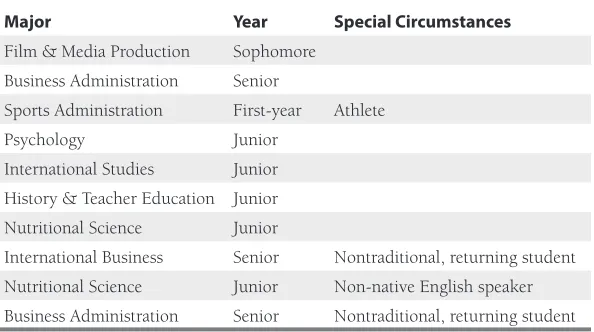
We were able to achieve a balance of majors within the undergraduate divisions and ethnic diversity in the students we interviewed. Eight females and two males were inter-viewed. Table 1 provides information about the students we interviewed.
The Interview Process
The student interviews were scheduled for one-hour blocks. Each one-on-one interview was conducted by the assessment librarian, audio-recorded, and later transcribed. Students responded to a series of semi-structured questions which opened with asking them to describe a “time in the past se-mester where you needed help locating information after try-ing to find the answer on your own” (see appendix). Probes were designed to (1) encourage the students to elaborate on the search process, the type of information sought, amount of time spent, and their physical location; (2) identify their reasoning in seeking out the person who helped locate the information; and (3) elicit their emotions during this process. They were then asked to focus on a time when they sought the help of a librarian. Follow-up questions asked students Table 1. Characteristics of Student Interviewees
Major Year Special Circumstances
Film & Media Production Sophomore Business Administration Senior
Sports Administration First-year Athlete Psychology Junior
International Studies Junior History & Teacher Education Junior Nutritional Science Junior
When students began seeking assistance, we were sur-prised that none of them relied on friends for research help. Instead, professors were identified as an important source for research assistance by over half of the students. Students have established relationships with course instructors, and understood that their professors were familiar with the as-signments and would be grading their papers. For example: “The best [source of help] would probably be a professor grading the paper that I’m writing about.”
The students had a strong preference for researching in-dependently. If students did seek out help, professors were a valued resource, but none of the interviewees asked their friends for assistance. Most of the research skills described were rudimentary keyword searches; however, some stu-dents demonstrated higher-level research skills. Lastly, while students would initially begin their research with public search engines, they identified library databases as impor-tant resources for obtaining credible information.
Personal Perceptions of Research Skills
Students’ perceptions of their research skills can influence their decision to seek help. Some students we interviewed were confident in their abilities while other students were anxious about their perceived lack of research skills. One student who felt confident as a researcher explained why s/he was unlikely to seek help: “I feel confident to just do the re-search on my own. If I were to ever need assistance it would be more fine-tuning, or even making sure that my thought process is not completely off track, checking that aspect, and not so much the research itself.” Another student was less confident as a researcher, citing issues with generating good search terms: “It’s just things that I can’t find on my own that I have a hard time [with] like keywords. It’s really just research in general I struggle with.”
In assessing their own research skills, four students com-pared themselves to their peers. This less confident student observed that other peers may have better research skills: “I attended high school in China and basically, I think that the difference [is] that we never did research. We never searched for information. We get information from our teachers [and] I think our ability to do research is not as good as American students.”
Students understand the importance of credibility, but one student admitted to struggling when it comes to evalu-ating sources: “I think that’s one of the biggest challenges with Google . . . deciding if they’re actually credible. I know at times, it’s hard to tell.”
All ten students discussed their perceived development as researchers. One student reflected on his/her personal growth as a researcher while at college: “I think it has de-veloped from my freshman year of college, especially when every class that I take that needs to do a research [paper], and I think for me particularly, I’ve taken other research classes.”
Half of the students provided insights about the varying degrees to which their high schools prepared them for the information, (4) motivation for asking for help, (5) path to
the librarian, and (6) experience working with a librarian.
How Students Research
To better understand why students might ask librarians for assistance, the interviewer questioned students about how they conduct research. All ten of the students expressed a “do-it-yourself” mentality toward research and would only consider asking for help if they were unable to locate infor-mation on their own. Some students explained that being able to conduct research was an important skill they wished to develop. One student commented, “The librarian definite-ly helped, but I think every time I search for information, I do it on my own first and if I cannot find the right article, then I get help. I think that’s a very important life skill.”
Students preferred the ease and convenience of using Google, but were also aware of the limitations of public search engines and the importance of library databases. For example, “It depends on what kind of assignment I get. If I just want to find basic information, I Google it, or use Wiki-pedia, or just go on the website and search for that informa-tion. If it’s a research paper, I will just go online and go to the Pepperdine [library website] and search the databases and e-journals.”
All ten students discussed the importance of locating in-formation from credible sources. Some students mentioned assignments that required scholarly sources, thus helping to emphasize the importance of credible sources. One stu-dent stated, “[My] English 380 class was the very first class where I had to do research and look for scholarly reviewed material for a research paper.” Students expressed a belief that library resources were likely to contain credible sources. For example, “If I am doing a research paper where I have to have specific type of journals and they have to be peer reviewed . . . I will always go to library website first.” This student recognized that the library has credible sources, in-cluding peer-reviewed articles. The student skipped Google and began research using library databases.
they know the librarian can help, but I think sometimes they just don’t want to reach out.”
Another student thought that many fellow students would be reluctant to make a special trip to the library in order to get help, highlighting an assumption that in order to receive research assistance students must show up in the library. This student stated: “It’s just going to be a drag and especially [for] those who live off-campus. If they’re at home working on a project, they’re not going to drive all the way to Pepperdine.”
Several students told us that their peers don’t think they have time to meet with a librarian. For example, “I think that the reason why a lot of people don’t come in too is be-cause of the time and our schedules were always just really busy.” Similarly, another student referred to a conversation with a friend seeking the help of a librarian: “She was like, ‘Oh, no [I don’t go to the library for help].’ I was like, ‘Why not? They help you a lot.’ [The friend of the interviewee said] ‘I don’t have the time to go in and sit down for an hour or whatever’... I think people just have that perception in their mind already.”
Even though the present study is limited to students who have received help from librarians, understanding what underlying assumptions students have about library services provides insight about barriers librarians need to overcome in order to better serve the general student popu-lation. The interviews revealed that students do not seek help for a variety of reasons ranging from being unaware of library research services, limits on the number of questions students felt they could ask, preferences for researching in-dependently, and the time commitment of visiting the library to meet with librarians.
Motivation for Asking for Help
All ten of the students described a research question that prompted them to ask for a librarian’s assistance. Given stu-dents’ preferences to research independently, it’s not surpris-ing that they only asked for help if they thought the question was particularly challenging.
Even students who view themselves as being indepen-dent would ask for help when they were unable to locate in-formation by themselves. For example, “I contacted someone this time ... because I was having a particularly hard time finding articles [for my] research. Normally it’s not a prob-lem because I feel like using the library website has been extremely helpful for all my papers. . . . I guess I hadn’t really needed it until this paper that I was assigned.”
Six out of the ten students were struggling to locate pri-mary sources for assignments. The types of pripri-mary sources varied by discipline and included statistical data, original research studies, and historical resources.
All ten students expressed negative emotions concern-ing difficult research questions. For example, “Frustrated because I knew I needed that and I knew it was out there. I know it’s there but I can’t find it and that was frustrating.” rigors of college research. Prior to college, some students
conducted research with public search engines and were not required to use library databases. One student explained: “I went to a pretty highly academic high school . . . I don’t think I ever really searched for anything through the library to be honest . . . the teachers were okay with us using stuff on websites.”
Over the course of the interviews, students shared per-ceptions of their research skills and discussed how their ability to locate information evolved from high school through college. From the upperclassmen, we learned more details about how they evolved as researchers during their time in college. In many instances, students described their ability to conduct research by comparing themselves to their peers.
Assumptions
An important advantage of conducting in-depth interviews was for the researchers to view library services from the perspectives of the students. Some misperceptions about library services deterred several students from seeking sistance. One of the more disconcerting, and incorrect, as-sumptions was the perception that students had a “quota” on the amount of research assistance they could obtain from librarians. A student explained: “I don’t want to just keep on coming back and I didn’t want to use her for this particular project...because I have several papers coming up for finals. I might need help with another project soon. You know, I don’t want to be a burden . . . I’m only going to use her when I really, really need her.” Another student expressed the sentiment of needing to conduct initial preliminary re-search before meeting with the librarian in order to make that meeting as efficient as possible and to avoid having to schedule additional appointments. This student stated: “I think if he helped me earlier on then it would just be him doing it, and then I wouldn’t want to go back and ask again for something specific.”
Nine out of the ten students described their peers’ aware-ness of library research services and their likelihood of them contacting librarians. Students expressed the belief that there was a general lack of awareness of the skilled research help librarians could offer. One student explained that other students would only seek librarian assistance after being ad-vised to do so. This student explained: “I think a lot of the students don’t realize that librarians are so willing to help. I do, and I rarely see librarians helping students, and if they do it’s because I think the students had been notified to do so for a class project.” A different student stated: “I think what’s best is just let people know the services that are available. I didn’t know about them and I don’t think many other people do. I think just make them aware.”
the librarians. For example, “I feel like you guys are very friendly and approachable and willing to help, and so I think it’s just up to the student to ask for the help.”
Library instruction is a particularly effective method for encouraging students to seek assistance from librarians. It puts a face on research help, providing a forum where the librarian can advertise different means of being available for assistance. This open invitation sends a message to students that librarians care and are well qualified to help. Faculty referrals are another effective means for generating research consultations with students. A research referral from faculty provides essential marketing of this less-known aspect of library services and endorses the subject expertise of librari-ans. Additionally, well-trained student workers are helpful in connecting students to librarians when students are unsure of who in the library could best assist them with research.
Experience Working with a Librarian
Students were asked about their experiences being assisted by librarians. Students expressed a strong preference for researching independently and the authors wanted to know if students thought that meeting with librarians was a valu-able experience.
Interviewees were asked about the skills and knowledge imparted during their research consultations. All ten of the students mentioned receiving assistance with navigating the library databases and identifying effective keywords as be-ing valuable. For example, “I have trouble . . . knowbe-ing what keywords to put in and what exactly to look for and what scientists or writers or publishers are going to use because one thing that the librarian helped me [with] was one of the words, ‘infertility.’” This student described having trouble building searches, identifying researchers who have written on the topic, and utilizing controlled vocabularies.
Librarians also used their expertise to help students re-fine and narrow their topics. For example, “We narrowed it down to drug resistance, streptococcus pneumoniae [in children] under six years of age. That helps me narrow it from one thousand references to five hundred.”
All ten students stated they were satisfied with the help they received, with some expressing positive emotions when describing their experiences. A student noted: “He was ex-tremely helpful and did his best to help me which was so nice and helped me print off papers just to read them and would help just to scroll through new [articles]. That was part of what was comforting about that too, just having someone really care.”
When asked if they would seek a librarian’s help in the future, all ten students indicated they would. A student said: “I feel like I haven’t really needed help before this specific time when I had to find an article from specific types of journals, but I’m very open to getting help from a librarian in the future after knowing how helpful they were this time.”
Ideally, a student with a strong preference for research-ing independently will incorporate the skills learned from All students discussed time spent doing research prior
to seeking a librarian’s assistance. For example, “I should have gone [to the librarian] a little sooner because she helped me . . . within, I don’t know, twenty or thirty minutes. . . . I searched for a long time on my own and I just shouldn’t have wasted that time.” Interviews revealed that students seek help when they go beyond what they consider a reason-able amount of time to spend searching. One student spoke about reaching that limit: “I don’t know exactly how long [I spent searching], but I’d say about a couple of hours, prob-ably two, just looking and because I did want to [research] on my own. I was kind of determined, but I just gave up at one point.” One student explained being frustrated with the amount of time spent on the research for the assignment prior to meeting with a librarian and questioned putting even more time into it: “I was extremely frustrated and was ready to just give up and let my paper be what it was. . . . I did not want to deal with it anymore because the class that I wrote it for is only a three-hour class.”
Despite their preference for researching independently, students will ask for help when they feel stressed by research that takes longer than they deem reasonable.
Path to Librarians
The authors were interested in learning how students con-tacted librarians and why they selected a particular librar-ian. Six out of ten students met with the same librarian who provided library instruction to their class. One student ex-plained that because of library instruction, “We now know [a] specific name and face. . . . We can go to in the library because we’re not going to just go there and wander around aimlessly until we find somebody able to help us out.” Stu-dents remembered librarians speaking to their classes about their availability for additional help. One student recalled: “He introduced himself as the research librarian for history and said that if we ever had any question, go to him.”
Half of the students identified the referral of their faculty member as the reason for their decision to ask a librarian for help. For example, “I’m glad [my professor] urged us to meet with him or else I don’t know if I would have.”
Only one student in the study met with a librarian be-cause of encouragement from peers, stating: “People say, ‘Oh go to the library, they’re really encouraging about it,’ so that helps. . . . A friend that said, ‘Oh I go into library all the time . . . whenever I need help.’”
Four out of the ten students explained that the library student workers helped them locate the librarian who could best assist them. One international student stated: “I went to the front desk and say I need help from . . . a science librar-ian and they helped me to search for which librarlibrar-ian [could best assist me].”
library instruction sessions.33 Our study revealed that library instruction was slightly more effective than faculty referrals in encouraging students to ask librarians for help. Sample size and type of research instrument used may account for the differences between our findings and those from the surveys used in the studies from Pellegrino (2012) and So-bel (2009).34
Studies from Miller and Murillo (2011), Vondracek (2007), and Murphy (2014) revealed that students were more likely to ask faculty, friends, and peers for research advice than librarians.35 While some students in our study relied on professors for research help, none of the students we interviewed identified friends or other students as effective resources for research assistance.
Our study was consistent with the research from Mur-phy, as well as Miller and Murillo (2011), showing that students have a strong desire to conduct research without assistance.36 In fact, students’ preference for researching independently was relevant to all six of our themes. Even though students in our study expressed appreciation for the librarian’s expertise in saving them time and stress, their “do-it-yourself” mentality is a significant barrier to asking librarians for help.
Previous researchers explored the role of library anxiety and embarrassment on students’ reluctance to seek out as-sistance.37 All of the students in our study, however, felt that the librarians were approachable. Some expressed opinions that it was the responsibility of the students to contact librar-ians for help. In light of the fact that some students will not seek assistance from librarians regardless of approachability, libraries must proactively market research services.
Stress is an easily recognized and common emotional response experienced by many students struggling with research. Magi and Mardeusz’s (2013) study, like ours, explored students’ emotions before and after receiving as-sistance.38 Similar to our findings, the students surveyed by Magi and Mardeusz unanimously responded that they were satisfied with the help they received and were likely to seek out assistance from research librarians in the future.39
By conducting in-depth interviews, the current study was able to explore students’ information-seeking behav-ior and motivations for seeking help in granular detail. In this process, we gained insight into their habits, emotions, assumptions, and outcomes. Simply by asking questions about topics such as the length of time they would spend researching before seeking help, listening to them describe their abilities in comparison to their peers, and asking them about their emotional response to research stages, we were able to piece together the evolution of their research skills.
STUDY LIMITATIONS AND FURTHER
RESEARCH
This study is limited to those students who sought research help from librarians; consequently, the students interviewed librarians into future research projects. For example, “It’s
good because now at least if I wanted to do research totally on my own, which I will, I’ll know at least which databases to go to for certain issues and which ones are good for more business stuff, which ones are good for more history stuff.”
ACADEMIC DISCIPLINE TRENDS
Our goal in recruiting students from a variety of academic majors was to create a study that represented the help-seek-ing behavior and research habits of a broad cross section of students. If a particular academic discipline was overrepre-sented, it would difficult for us to determine if the results of the study were applicable to students from other majors. Our coding of the documents and analysis of the six themes did not reveal any clear differences based on students’ majors. However, because of the study’s small size of ten partici-pants, it is difficult to identify differences in the help-seeking behavior of different disciplines.
DISCUSSION
One of the goals of this study was to obtain more detailed information about how students begin looking for informa-tion, including the time spent, physical setting, and other details relating to their search process. Research by Lee (2008), Head (2013), and Mizrachi (2010) all revealed that students prefer to begin their research with public search engines because of the ease of use, a finding that is unsur-prising to most librarians.31 This proved the case with our study as well. We did learn, however, that students spent at least thirty minutes conducting research and typically worked alone in their initial searches, with some conduct-ing their research in library study spaces, dorm rooms, and classrooms.
We wanted to know whether access to librarians influ-enced students’ search strategies when finding information was challenging. Students in our study were appreciative when librarians helped them search databases using ad-vanced features and selecting effective keywords. They explained that prior to working with the librarians, they were unaware of strategies such as limiting search results to specific dates. This finding is consistent with both Asher and Duke’s (2011) research, which found students’ database searches mimic their simplistic Google queries, and Head’s (2013) findings, which indicate that most students struggle to effectively search databases and formulate relevant key-words.32
work with their universities’ in-house marketing services to create advertising campaigns both online and in print that feature current students recommending librarians for their expertise and time saving help.
Especially considering the DIY attitude of today’s stu-dents, librarians must be mindful of students’ assumptions about the library and its services. Some students in the study were under the impression that there was a limit to how many questions they could ask librarians. Librarians should consider how to bust this misperception and other myths because incorrect assumptions such as these could deter students from seeking help.
Unsurprisingly, students often struggle to effectively search library databases despite the ease of typing key-words into Google. Effective database searching requires the creative construction of keyword searches and is an exploratory process greatly aided by someone else who is able to make helpful suggestions and explain the nuances related to searching. Students highlighted the importance of locating credible sources, but they experienced trouble in locating them. Locating primary sources can be especially challenging for students. We found that librarians, even in this DIY culture, are relevant, and appreciated for their expertise and abilities in helping students overcome their research challenges.
References
1. ACRL, Mean Reference Transactions for Doctoral Universities 2005–2014 (ACRL Metrics, 2015), http://www.acrlmetrics.com/. 2. Steve Black, “Psychosocial Reasons Why Patrons Avoid Seeking
Help from Librarians: A Literature Review,” Reference Librarian
57, no. 1 (January 2016): 35–56.
3. Jeffrey Katzer and Mary Jane Swope, “Why Don’t They Ask Questions?” RQ 12, no. 2 (1972): 163–64.
4. Sharon Lee Bostick, “The Development and Validation of the Library Anxiety Scale” (PhD diss., Wayne State University, 1992), 82–84; Constance A. Mellon, “Library Anxiety: A Grounded Theory and Its Development,” College & Research Libraries 47, no. 2 (March 1986): 160–65.
5. Catherine M. Robinson and Peter Reid, “Do Academic Enquiry Services Scare Students?” Reference Services Review 35, no. 3 (2007): 414–16.
6. Margie Ruppel and Jody Condit Fagan, “Instant Messaging Reference: Users’ Evaluation of Library Chat,” Reference Services Review 30, no. 3 (2002): 192.
7. Susan Miller and Nancy Murillo, “Why Don’t Students Ask Librarians for Help?: Undergraduate Help-Seeking Behavior in Three Academic Libraries,” in College Libraries and Student Cul-ture: What We Now Know, edited by Lynda M. Duke and Andrew D. Asher, 53–55 (Chicago: American Library Association, 2011). 8. Ibid., 55–60.
9. Ibid., 66–67.
10. Ruth Vondracek, “Comfort and Convenience? Why Students Choose Alternatives to the Library,” portal: Libraries & the Acad-emy 7, no. 3 (2007): 290–91.
11. Jo Ann Murphy, “Library Learning: Undergraduate Students’ Informal, Self-Directed, and Information Sharing Strategies,”
Partnership: The Canadian Journal of Library & Information Practice & Research 9, no. 1 (2014): 7–12.
12. Yingqi Tang and Hung Wei Tseng, “Distance Students’ Attitude Toward Library Help Seeking,” Journal of Academic Librarianship
were unlikely to be ones anxious or reluctant to ask for help. Based on the responses from students, our study may also have been less likely to include students who asked teach-ing faculty and peers for assistance instead of librarians. By contrast, studies such as Miller and Murillo (2011) sampled a broader range of students, including those who did not seek help from librarians. Specific student populations such as non-native English speakers, transfer students, and those students who have not received individual reference assistance from librarians could be explored in future stud-ies to assess their needs. Additionally, future studstud-ies could aim to understand how students would like to improve their research skills. Insight into the minds of our users can positively impact the information literacy services offered by librarians.
IMPLICATIONS
The students we interviewed expressed a strong “do-it-your-self” mentality. If students prefer to search independently, li-brarians must employ the most effective methods to promote their research expertise. Above all else, the findings from our study reinforce the importance of classroom instruction and faculty referrals to inspire students to ask librarians for re-search help. It is crucial that librarians partner with faculty. Gaining face time in the classroom via library instruction is also important in motivating students to seek help because it introduces the librarian as someone who is a trusted resource and knowledgeable about their assignments.
Though they still wanted to continue to take the reins with their research, students were appreciative of the amount of time they saved by receiving help from librarians. They also noted feeling relieved and under less stress as a result of consulting with librarians. Librarians can use these insights to market research services to students.
Additionally, because students heed recommendations of people they trust, librarians should also explore new avenues for referrals. Beyond looking to faculty to bridge connections between students and librarians, we can build relationships with student success centers, university counseling services, and academic advising personnel. It is vital for librarians to emphasize their utility when speaking to tutoring, counsel-ing, and academic advising personnel about the services the library can provide to students who are anxious or struggling academically.
40, no. 3–4 (2014): 308–10.
13. Karen Sobel, “Promoting Library Reference Services to First-Year Undergraduate Students: What Works?,” Reference & User Services Quarterly 48, no. 4 (2009): 367–68.
14. Catherine Pellegrino, “Does Telling Them to Ask for Help Work?: Investigating Library Help-Seeking Behaviors in College Undergraduates,” Reference & User Services Quarterly 51, no. 3 (2012): 275–76.
15. Carol Perruso, “Undergraduates’ Use of Google vs. Library Resources: A Four-Year Cohort Study,” College & Research Librar-ies 77, no. 5 (September 2016): 621–22.
16. Trina J. Magi and Patricia E. Mardeusz, “Why Some Students Continue to Value Individual, Face-to-Face Research Consulta-tions in a Technology-Rich World,” College & Research Libraries
74, no. 6 (November 2013),:609–10; Sobel, “Promoting Library Reference Services,” 67–68; Pellegrino, “Does Telling Them to Ask?,” 275–76.
17. Magi and Mardeusz, “Why Some Students Continue to Value,” 609–13.
18. Barbara Fister, “The Research Processes of Undergraduate Stu-dents,” Journal of Academic Librarianship 18, no. 3 (July 1992): 164–68.
19. Barbara Valentine, “Undergraduate Research Behavior: Using Focus Groups to Generate Theory,” Journal of Academic Librari-anship 19, no. 5 (Novembe 1993): 302.
20. Ibid., 303–4; Miller and Murillo, “Why Don’t Students Ask Librarians for Help?,” 55–60; Vondracek, “Comfort and Conve-nience,” 290–91.
21. Valentine,” Undergraduate Research Behavior,” 303–4; Miller and Murillo, “Why Don’t Students Ask Librarians?,” 53–55; Black, “Psychosocial Reasons,” 35–56; Katzer and Swope, “Why Don’t They Ask Questions?,” 163–64; Robinson and Reid, “Do Academic Enquiry Services?,” 414–16.
22. Alison J. Head, Learning the Ropes: How Freshmen Conduct Course Research Once They Enter College (Project Information Literacy, Dec. 5, 2013), 25, http://www.projectinfo lit.org/uploads/2/7/5/4/27541717/pil_2013_freshmenstudy _fullreportv2.pdf.
23. Diane Mizrachi, “Undergraduates’ Academic Information and Library Behaviors: Preliminary Results,” Reference Services Review 38, no. 4 (2010), 573–76.
24. Hur-Li Lee, “Information Structures and Undergraduate Stu-dents,” Journal of Academic Librarianship 34, no. 3 (May 2008): 214–15.
25. Perruso, “Undergraduates’ Use of Google,” 621–22. 26. Head, Learning the Ropes, 15–16.
27. Lynda M. Duke and Andrew D. Asher, “Searching for Answers: Student Research Behavior at Illinois Wesleyan University,” in
College Libraries and Student Culture: What We Now Know, edited by Lynda M. Duke and Andrew D. Asher, 74–82 (Chicago: American Library Association, 2011).
28. Lioness Ayres, “Semi-Structured Interview,” in The SAGE Ency-clopedia of Qualitative Research Methods, edited by Lisa M. Given, 810 (Thousand Oaks, CA: Sage, 2008).
29. Greg Guest, Arwen Bunce, and Laura Johnson, “How Many Interviews Are Enough? An Experiment with Data Saturation and Variability,” Field Methods 18, no. 1 (2006): 78.
30. Greg Guest, Kathleen MacQueen, and Emily E. Namey, Applied Thematic Analysis (Thousand Oaks, CA: Sage, 2012), 4.
31. Lee, “Information Structures and Undergraduate Students,” 214–15; Head, Learning the Ropes, 25; Mizrachi, “Undergradu-ates’ Academic Information and Library Behaviors,” 573–74. 32. Duke and Asher, “Searching for Answers,” 76–78; Head,
Learn-ing the Ropes, 15–16
33. Sobel, “Promoting Library Reference Services,” 367–68; Magi and Mardeusz, “Why Some Students Continue to Value,” 609– 10; Pellegrino, “Does Telling Them to Ask?,” 275–76.
34. Sobel, “Promoting Library Reference Services,” 367–68; Pel-legrino, “Does Telling Them to Ask?,” 275–76.
35. Miller and Murillo, “Why Don’t Students Ask Librarians?,” 55–60; Vondracek, “Comfort and Convenience,” 290–91; Mur-phy, “Library Learning,” 7–12.
36. Miller and Murillo, “Why Don’t Students Ask Librarians?,” 63–65; Murphy, “Library Learning,” 7–12.
37. Black, “Psychosocial Reasons,” 35–56; Katzer and Swope, “Why Don’t They Ask Questions?,” 163–64; Robinson and Reid, “Do Academic Enquiry?,” 414–16; Bostick, “Development and Vali-dation,” 82–84; Mellon, “Library Anxiety,” 160–65.
38. Magi and Mardeusz, “Why Some Students Continue to Value,” 613–17.
39. Ibid., 611–12.
APPENDIX. INTERVIEW QUESTIONS
1. I’d like you to think back to a time in the past semester when you needed help locating information after try-ing to find the answer on your own. Please talk about this experience.
a. Was it for an assignment or something you were try-ing to learn more about on your own? What was it you were trying to find? How did you go about look-ing for the information? What did you try? Where did you look? Where were you (e.g., in your dorm, the cafe, the library)? How long did you keep trying to find information before thinking that you might need to ask someone else?
b. Thank you for giving such a good context about the information you were trying to locate. I’d like you to talk now a bit about that moment when you realized you would need help.
i. Can compare how you felt to another time that you felt the same way?
c. Thanks for talking about that. Now I’d like to learn more about your thought process when seeking out help from someone else. What made you seek out the person who helped you find your answer or think through your problem?
2. It’s been helpful for me to hear about the context in which you found yourself needing help locating infor-mation. We’re going to switch gears and focus now on a time when you utilized the help of a librarian. Please tell us about this experience.
a. How did you know who to contact in the library? How did you know where to go to ask for help? b. Thanks. Can you describe for me what the librarian
did when you asked for help?
c. I’d like you to think about how you felt while being assisted. And now I would like you to tell me how you felt when you were finished.
a. What point in your search did you contact the li-brarian?
4. I appreciate all the thinking back to your experience with the librarian and the context for reaching out to a librarian. I have one final question about this inter-action with the librarian. Can you talk about any dif-ficulties you may encountered when asking a librarian for assistance?
a. Tell us how librarians can be more approachable. 5. You’ve been so helpful in talking with me today. I’d like
to ask if there’s anything you would like to add. yourself asking for help from a librarian in the
fu-ture?
e. With hindsight, if you had it to go do over again, tell us how you would look for information for this assignment/question?
f. And now, let’s think back again to what you observed in working with a librarian. Are there strategies or tools that the librarian used that you would want to try or use in the future? If yes, please explain. 3. Thanks for talking about what you your experience