Available online throug
ISSN 2229 – 5046
THERMAL CONDUCTIVITY
FOR HEAT AND MASS TRANSFER FLOW PAST AN INFINITE VERTICAL
P. SREEDIVYA*, Dr. K. SUNITHA
Malla Reddy Engineering College for Women,
Maisammaguda, Dhulapally, Post via Hakimpet Secunderabad-500014, Telangana, India.
(Received On: 17-08-16; Revised & Accepted On: 13-09-16)
ABSTRACT
T
his paper investigates the flow and heat mass transfer past an infinite vertical plate with variable thermal conductivity, heat source and chemical reaction. The consequential equations are discredited by means of Laplace transform with boundary condition and solved numerically. The velocity, temperature and concentration profiles are presented graphically This investigation is undertaken to study the heat and accumulation transport flow precedent an endless vertical plate with variable thermal conductivity. The governing equations for the model are formulated with appropriate boundary conditions. The flow phenomenon are characterized by the flow parameters such as Prandtl number (Pr), Schmidt number (Sc), Eckert number (Ec), magnetic field (M), porosity (K), thermal Grashof number (Gr), mass Grashof number (Gc), radiation (N), suction (α), thermal conductivity (τ), chemical reaction (Kr) and reaction order (n) which are studied for speed field, high temperature field and attentiveness allocation accessible graphically. Keywords Heat Transfer, Mass Transfer, Thermal Conductivity, V Keywords - Heat Transfer, Mass transport, changeable Thermal Conductivity, Heat Source, perpendicular PlateINTRODUCTION
In nuclear manufacturing, cooling of intermediate is additional significant beginning the security position of view and throughout this cooling procedure the cover high temperature starts oscillate about a non-zero constant mean temperature. The oscillatory flow has application in industrial and aerospace engineering. In the processes involving high temperatures, the radiation heat transfer in combination with conduction, convection and also mass transfer plays very significant role in the intend of applicable equipments in the areas such as nuclear power plants, gas turbines and the various propulsion devices for aircrafts, missiles, satellites and space vehicles. Moreover, radiation effect is significant in the dynamics of fluid in chemical, environmental, mechanical and solar power engineering. Thus,
Although different authors studied heat and mass transfer with or without radiation and viscous dissipation effects on the flow past an infinite vertical plate by considering different surface conditions but the learn on the effects of radiation on free convection high temperature and mass move with unstable thermal conductivity, viscous dissipation and reaction order on flow standard an endless vertical plate has not been found in the literature and consequently the motivation to undertake. Heat and mass transfer flow past an infinite vertical plate with variable thermal conductivity.
2. REVIEW OF LITERATURE
Muthucumaraswamy and Senthil Kumar [1] the heat and mass transfer effects on moving vertical plate in the presence of thermal radiation.
Gupta et al. [2] Heat and mass transfer on a stretching sheet with suction or blowing.
Sattar [3] the free of charge convection and accumulation transfer flow from side to side a absorbent medium precedent an endless perpendicular absorbent plate by time independent temperature and concentration.
Israel-Cookey et al. [4] the pressure of viscous dissipation and radiation on trembling MHD free convection flow past an infinite heated vertical plate in a porous medium with time dependent suction.
Soundalgekar et al. [7] the effects of viscous dissipative heat on the transient free convection flow past an infinite vertical plate with a step change in plate temperature. The problem governed by nonlinear coupled partial differential equations was solved by finite difference method. Buoyancy is also of importance in an environment where differences between land and air temperatures can give rise to complicated flow patterns.
Chamkha [13] studied the effects of solar radiation on free convection in an isotropic, consistent porous average support by a perpendicular level cover by a computational method.
Thermal Conductivity for Heat and Mass Transfer Flow Past an infinite Vertical / IJMA- 7(9), Sept.-2016.
Sangapatnam et al. [14]: considered the emission and mass transfer effects on MHD free convection flow past impulsively-started isothermal vertical plate with dissipation.
Yasar and Moses [15] developed a one-dimensional adaptive-grid finite-differencing computer code for thermal radiation magneto hydro dynamic (RMHD) simulations of fusion plasmas.
Aboeldahab and Azzam [16] described the effects of magnetic field on hydro magnetic mixed free-forced heat and mass convection of a gray, optically-thick, electrically conducting viscous liquid the length of a semi-infinite disposed cover for high temperature and attentiveness..
2. PROBLEM FORMULATION
1. 1.An unsteady endless perpendicular isothermal absorbent cover of laminar natural convection flow of dissipative and searing liquid in the attendance of oblique magnetic field surrounded on one side by infinite mass of fluid like air or water and both at same temperature T′∞ and the mass concentration C′∞ initially. 2. At time t′> 0, the plate temperature and the mass concentration is raised to T′w and C′w,
3. Causing the presence of high temperature and concentration difference T′w - T′∞ and C′w - C′∞ respectively. 4. As the plate is infinite in extent, the physical variables are functions of y′ and t′ where y′ is taken normal to the
plate and the x′ -axis is taken along the plate in the vertically upward direction. Under the Boussinesq approximation,
5. The governing equations for the flow are continuity, momentum, mass concentration and energy respectively are
(
)
(
)
B
u
y
u
v
C
C
g
T
T
g
t
u
′
−
′
∂
′
∂
+
−
+
−
′
=
′
∂
′
∂
∞ ∞ρ
σ
β
β
022 2 ' ' * ' (1) 2 2
y
T
k
t
T
C
P′
∂
′
∂
=
′
∂
′
∂
ρ
(2)C
K
y
C
D
t
C
′
−
′
∂
′
∂
=
′
∂
′
∂
1 2 2 (3)u′ = 0, T′ = T′∞, C′ = C′∞, for all y′ and t′ ≤ 0 u′ = U0, T′ = T′∞ + (T′w - T′∞)At′, C′ = T′w at y′ = 0
u′ → 0, T′ → T′∞, C′ → C′∞, as y′ → ∞, t > 0 (4)
The initial and boundary conditions relevant to the fluid flow are:
0
U
u
u
=
′
,v
U
t
t
2 0′
=
,v
U
y
y
=
′
0 ,' ' ' ∞ ∞
−
−
′
=
T
T
T
T
wθ
, ' ' ' ' ∞ ∞−
−
=
C
C
C
C
wφ
,(
)
3 0 ' '
U
T
T
v
g
Gr
=
β
w−
∞ ,(
)
3 0 ' ' *U
C
C
v
g
Gm
=
β
w−
∞ ,k
C
pµ
=
Pr
, 2 0 1U
vK
R
=
,D
v
Sc
=
,2 0 2 0
U
v
B
M
ρ
σ
=
(5)where
v = kinematic viscosity of the grey fluid,
σ = Stefan-Boltzmann constant, B0= constant magnetic field intensity,
ρ = density, K* = permeability, g = gravitational constant,
β = thermal expansion coefficient,
β* = concentration expansion coefficient, T′= t = temperature,
c′ = mass concentration,
D = chemical molecular diffusivity, R* = chemical reaction,
Thermal Conductivity for Heat and Mass Transfer Flow Past an infinite Vertical / IJMA- 7(9), Sept.-2016.
C′ = heat capacity at constant pressure, qr= radioactive heat flux,
u′ and v′ are velocity components in x and y directions respectively, K(T) = thermal conductivity,
T′w = wall temperature, T′∞ =free stream temperature,
C′w = species concentration at the plate surface, C′∞ = free stream concentration.
Quantities (5), the equation (1), (2), and (3) then reduce to the following forms
Mu
Gm
Gr
y
u
t
u
+
+
−
∂
∂
=
∂
∂
θ
φ
2 2 (6) 2 2
Pr
1
y
t
∂
∂
=
∂
∂
θ
θ
(7)
φ
φ
φ
R
y
Sc
t
∂
−
∂
=
∂
∂
2 21
(8)3. ANALYTICAL SOLUTION
To solve the governing equations in dimensionless form, we introduce the following non-dimensional quantities:
0
,
,
0
,
0
,
0
0
,
1
,
,
1
0
,
0
,
0
,
0
>
∞
→
→
→
→
=
=
=
=
≤
=
=
=
t
y
as
u
y
at
t
u
t
and
y
all
for
u
φ
θ
φ
θ
φ
θ
(9)The governing equations on using (9) into (1), (2), (3), (5) and using (6) to (9) into (4) reduce to the following
( )
ty
e
t
y
t
y
erfc
y
t
t
y
4 Pr 2 2Pr
2
Pr
2
Pr
,
−
−
+
=
π
θ
(10)( )
1
,
2
2
2
y ScR
y Sc
y ScRy Sc
y t
e
erfc
Rt
e
erfc
Rt
t
t
ϕ
=
−
−
+
+
(11)( )
+
+
−
=
−mt
t
y
erfc
e
Mt
t
y
erfc
e
G
t
y
u
y M y M2
2
2
,
4
+
−
+
+
−Mt
t
y
erfc
e
Mt
t
y
erfc
e
M
b
yG
y M y M2
2
4
1
+
+
−
−
+
+
−
+
− −bt
t
y
erfc
e
bt
t
y
erfc
e
ct
t
y
erfc
e
ct
t
y
erfc
e
e
b
G
b y b y c y c y bt2
Pr
2
Pr
2
2
2
2 Pr PrThermal Conductivity for Heat and Mass Transfer Flow Past an infinite Vertical / IJMA- 7(9), Sept.-2016.
+
−
+
+
−t
y
efct
G
e
t
y
t
y
erfc
y
t
b
G
y t2
Pr
2
Pr
2
Pr
2
Pr
4 3Pr 2
1
2
π
(12)subject to the boundary conditions
1
Pr
−
=
M
b
,Sc
M
RSc
d
b
M
c
−
−
=
+
=
1
,
, h = R + d,k = m + d,
1
Pr
1−
=
Gr
G
,1
2−
=
Sc
Gm
G
,2 1 2
3
1
b
G
d
G
G
=
−
−
,b
tG
G
G
13
4
=
−
(13)where Pr is the Prandtl number, Sc is Schmidt number, Ec is Eckert number, Gr is thermal Grashof number, Gc is mass Grashof number, and M is magnetic field, K is porosity, N is the radiation, α is suction, τ is the thermal conductivity, Kr is the chemical reaction and n is reaction order parameters.
4. RESULTS AND DISCUSSIONS
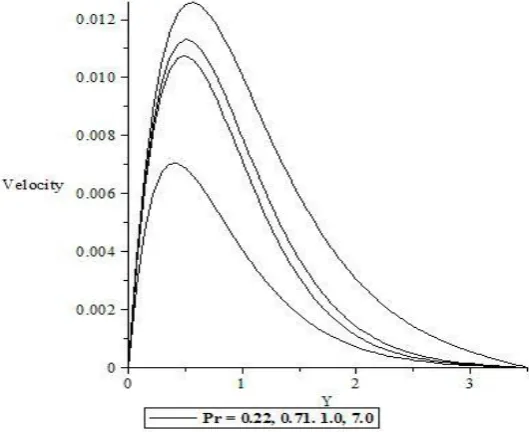
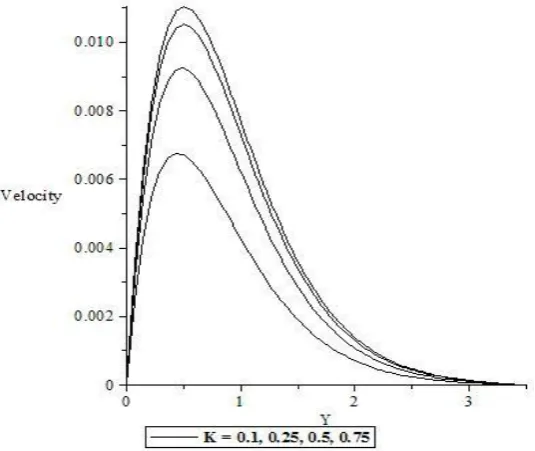
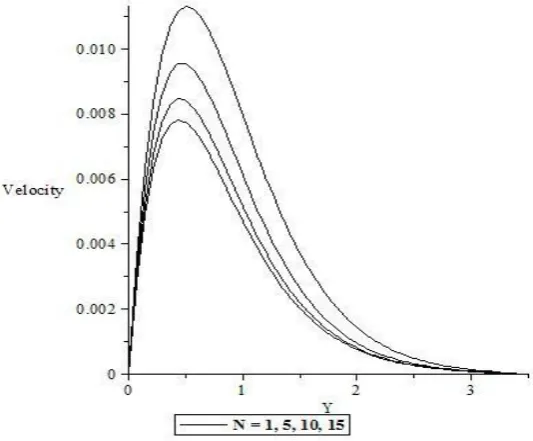
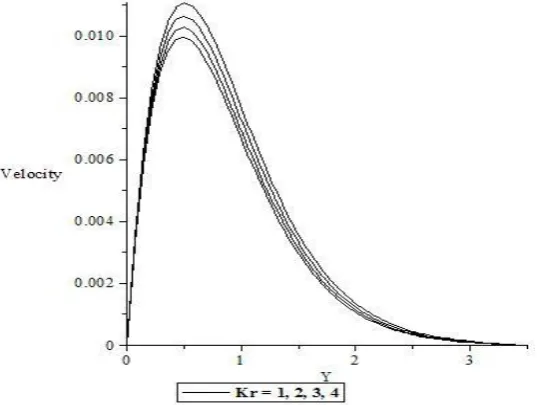
1. The numerical solutions are simulated for different values of the Prandtl number Pr, Schmidt number Sc, Eckert number Ec, thermal Grashof number Gr, mass Grashof number Gc, radiation parameter N, magnetic field parameter M, porosity parameter K, thermal conductivity parameter τ, suction parameter α, reaction order parameter n and chemical reaction parameter Kr.
2. The following parameters values are fixed throughout the calculations except where otherwise stated, Pr = 0.71, Sc = 0.62, Ec = 0.01, M = 5.0, K = 1.0, Gr = 0.1, Gc = 0.1, N = 1.0, α = 0.2, τ = 1.0, Kr = 0.5, n = 1.0, t = 0.5, y = 0.3.5.
Thermal Conductivity for Heat and Mass Transfer Flow Past an infinite Vertical / IJMA- 7(9), Sept.-2016.
Figure 2: Variation of Velocity against y for different values of Sc.
Figure 3: Variation of Velocity against y for different values of M.
Thermal Conductivity for Heat and Mass Transfer Flow Past an infinite Vertical / IJMA- 7(9), Sept.-2016.
Figure 5: Variation of Velocity against y for different values of Gr.
Figure 6: Variation of Velocity against y for different values of Gc.
Thermal Conductivity for Heat and Mass Transfer Flow Past an infinite Vertical / IJMA- 7(9), Sept.-2016.
Figure 8:Variation of Velocity against y for different values of α.
Figure 9: Variation of Velocity against y for different values of τ.
Thermal Conductivity for Heat and Mass Transfer Flow Past an infinite Vertical / IJMA- 7(9), Sept.-2016.
Figure 11: Variation of Velocity against y for different values of t.
Figure 12: Variation of Temperature against y for different values of Pr.
Thermal Conductivity for Heat and Mass Transfer Flow Past an infinite Vertical / IJMA- 7(9), Sept.-2016.
Figure 14:Variation of Temperature against y for different values of α.
Figure 15:Variation of Temperature against y for different values of τ.
Thermal Conductivity for Heat and Mass Transfer Flow Past an infinite Vertical / IJMA- 7(9), Sept.-2016.
Figure 17: Variation of Concentration against y for different values of Sc.
Figure 18: Variation of Concentration against y for different values of α.
Thermal Conductivity for Heat and Mass Transfer Flow Past an infinite Vertical / IJMA- 7(9), Sept.-2016.
Figure 20: Variation of Concentration against y for different values of n.
Figure 21: Variation of Concentration against y for different values of t.
5. CONCLUSIONS
• The speed enlarges with augment in the thermal Grashof number, mass Grashof number, thermal conductivity parameter, porosity parameter and time. Whereas the velocity decrease with increasing Prandtl number, Schmidt number, magnetic field parameter, radiation parameter, suction parameter and chemical reaction parameter.
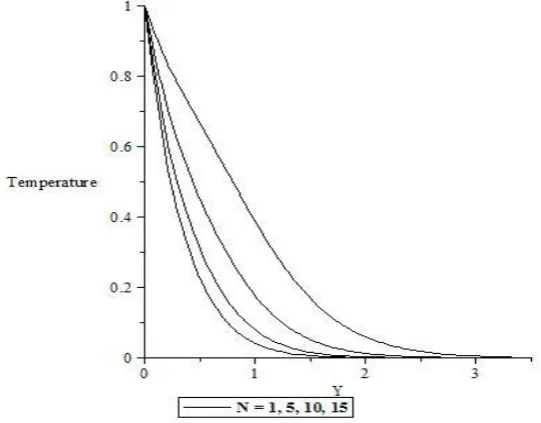
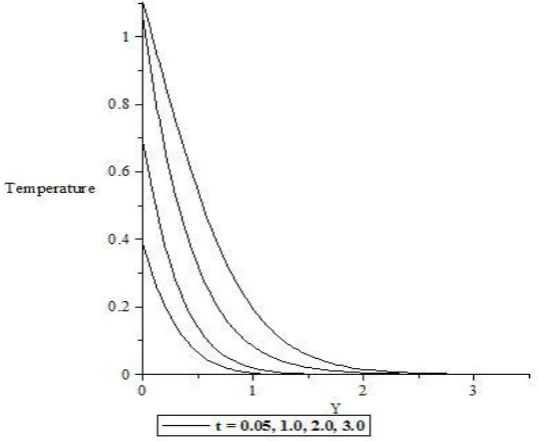
• The high temperature augments with augment in thermal conductivity parameter and time. But, the temperature decrease with increasing Prandtl number and suction parameter.
• The concentration increase with increasing reaction order parameter and time while the concentration decrease with increase in Schmidt number, suction parameter and chemical reaction parameter.
6. REFERENCES
1. Muthucumarswamy, R. and Senthil K. 2004. Heat and mass transfer effects on moving vertical plate in the presence of thermal radiation. Theoretical Applied Mechanics, 31, 35-46.
Thermal Conductivity for Heat and Mass Transfer Flow Past an infinite Vertical / IJMA- 7(9), Sept.-2016.
3. Sattar, M. A. 1994. Free convection and mass transfer flow through a porous medium past an infinite vertical plate with time dependant temperature and concentration. International Journal of Pure and Applied Mathematics, 23, 759-766.
4. Israel-Cookey, C. Ogulu, A. and Omubo-Pepple, V. B. 2003. Influence of viscous dissipation and radiation on unsteady MHD free-convection flow past an infinite heated vertical plate in a porous medium with time dependent suction. International Journal of Heat and Mass Transfer. 46, 2305-2311.
5. Illingworth, C. R. 1950. Unsteady laminar flow of gas near an infinite plate. Proceeding of Cambridge Philosopical Society, 44, 603–613.
6. Gebhart, B. 1962. Effects of viscous dissipation in natural convection. Journal of Fluid Mechanics, 14, 225–232.
7. Soundalgekar,V. M., Pohanerkar, S. G. and Lahurikar, R. M. 1997. Transient free convection flow of an incompressible viscous dissipative fluid. Warme und Stoff, 32, 301–305.
8. Das, U. N., Deka, R. K. and Soundalgekar, V. M. 1996. Radiation effects on flow past an impulsively started infinite isothermal plate. Journal of Theoretical Mechanics, 1, 111-115.
9. Riley, K. F., Hobson, M. P. and Bence, S. J. 2006. Mathematical Methods for Physics and Engineers. Third Edition, Cambridge University Press, New York.
10. Nield, D. A. and Bejan, A. 2006. Convection in Porous Media, 3rd Edition. Springer, New York.
11. Kishan, N. and Srinivasmaripala, A. 2012. MHD mixed convection, heat and mass transfer on an isothermal vertical plate. Advances in Applied Science Research, 3(1), 60-74.
12. Ramachandra, P. V. and Bhaskar, R. N. 2008. MHD free convection flow past a semi-infinite vertical permeable plate Indian Journal of Pure and Applied Physics, 46, 81-92.
13. Chamkha, A. J. (1997). Solar radiation assisted natural convection in a uniform porous medium supported by a vertical flat plate. ASME, Journal of Heat Transfer, 119, 89-96.
14. Sangapatnam, S., Nandanoor, R., and Vallampati, R. P. 2009. Radiation and mass transfer effects on MHD free convection flow past impulsively-started isothermal vertical plate with dissipation. Thermal Science, 13(2), 171-181.
15. Yasar, O. and Moses, G. A. 1992. R-MHD: An Adaptivegrid radiation magnetohydrodynamic Computer code. Computer Physics Communications, 69(2-3), 439-458.
16. Aboeldahab, E. M. and El-Din, A. G. 2005. Thermal radiation effects on MHD flow past a semi-infinite inclined plate in the presence of mass diffusion. Heat and Mass Transfer. 41(12), 1056-1065.
17. Alagoa, K. D. Tay, G. and Abbey, T. M. 1998. Radiative and free convective effects of MHD flow through a porous medium between infinite parallel plates with time-dependent suction. Astrophysics and Space Science. 260(4), 455-468. [18] Nield, D. A. and Bejan, A. 1999. Convection in Porous Media, 2nd Edition. Springer, New York.
18. Bejan, A. and Kraus, A. D. 2003. Heat Transfer Handbook, Wiley, New York.
19. Ingham, D. B., Bejan, A., Mamut, E. and Pop, I. 2004. Emerging Technologies and Techniques in Porous Media. Kluwer, Dordrecht.
20. Suneetha, S., Bhaskar, R. N. and Ramachandra, P. V. 2009. Radiation and mass transfer effects on MHD free convection flow past an impulsively started isothermal vertical plate with dissipation. Thermal Science, 13(2), 71–181.
21. Muthucumaraswamy, R. and Meenakshisundaram, S. 2006. Theoretical study of chemical reaction effects on vertical oscillating plate with variable temperature. Theoretical Applied Mechanics, 33(3), 245-257.
Source of support: Nil, Conflict of interest: None Declared