Abstract— Blocking artifact is one of the most annoying artifacts in the image compression coding. In order to improve the quality of the reconstructed image several deblocking algorithms have been proposed. A high-quality modified image deblocking algorithm based on the shape-adaptive DCT (SA-DCT) is shown. The SA-DCT is a low-complexity transform which can be computed on a support of arbitrary shape. This transform has been adopted by the MPEG-4 standard and it is found implemented in modern video hardware. This approach has been used for the deblocking of block-DCT compressed images. In this paper we see modified pointwise SA-DCT method based on adaptive DCT threshold coefficient instead of constant DCT threshold coefficient used by the original pointwise SA-DCT method. Extensive simulation experiments attest the advanced performance of the proposed filtering method. The visual quality of the estimates is high, with sharp detail preservation, clean edges. Blocking artifacts are suppressed while salient image features are preserved.
Index Terms— Anisotropic, DCT threshold coefficient. Deblocking, SA-DCT.
I. INTRODUCTION
The new JPEG-2000 image compression standard solved many of the drawbacks of its predecessor. The use of a wavelet transform computed globally on the whole image, as opposed to the localized block-DCT (B-DCT) (employed e.g. by the classic JPEG), does not introduce any blocking artifacts and allows it to achieve a very good image quality even at high compression rates. Unfortunately, this new standard has received so far only very limited endorsement
Chandan Singh D. Rawat, Phd Scholar, Electronics and Communication Engineering Department, National Institute of Technology,. Rourkela, Orrisa, India, 9029067260.
Rohan K. Shambharkar, M.E. Student, Electronics and Telecommunication Engineering Department V.E.S.I.T Mumbai, India, 9920835523.
Sukadev Meher, Professor and Head, Electronics and Communication Engineering Department, National Institute of Technology, Rourkela, Orissa, India,Tel: +919437245472
from digital camera manufacturers and software developers. As a matter of fact, the classic JPEG still dominates the consumer market and the near-totality of pictures circulated on the internet is compressed using this old standard. Moreover, the B-DCT is the work-horse on which even the latest MPEG video coding standards rely upon. There are no convincing indicators suggesting that the current trend is about to change any time soon. All these facts, together with the ever growing consumer demand for high quality imaging, makes the development of advanced and efficient post-processing (deblocking) techniques a very actual and relevant application area.
In this paper a modified pointwise SA-DCT method for the restoration of B-DCT compressed grayscale images is proposed. It is based on the pointwise shape-adaptive DCT (SA-DCT) [14] approach and its characterized by a high quality of the filtered estimate.
The SA-DCT [1, 2] is a generalization of the usual separable block-DCT (B-DCT) which can be computed on a support of arbitrary shape. It is obtained by cascaded application of one-dimensional varying-length DCT transforms first on the columns and then on the rows that constitute the considered support. Thus, it retains the same computational complexity of the B-DCT. The SA-DCT has been originally developed for coding non-rectangular image patches near the border of image objects, in such a way to minimize the stored information and to avoid the ringing artifacts (Gibbs phenomenon) that would appear in correspondence with strong edges. Because of its low complexity, the near-optimal de-correlation and energy compaction properties (e.g. [1], [5]), and its backward compatibility with the B-DCT, the SA-DCT has been included in the MPEG-4 standard [3], where it is used for the coding of image segments that lie on the video-object’s boundary. The recent availability of low-power hardware SA-DCT platforms (e.g. [2], [6]) makes this transform an appealing choice for many image-and video-processing tasks.
The first attempt to use of SA-DCT for image denoising was reported by the authors in [7]. The original version of the method has been adapted for image
MODIFIED POINTWISE
SHAPE-ADAPTIVE DCT FOR
HIGH-QUALITY DEBLOCKING OF
COMPRESSED IMAGES
International Journal of Advanced Research in Computer Science and Electronics Engineering Volume 1, Issue 2, April 2012
deblocking. These algorithms demonstrate a remarkable performance, typically outperforming the best methods known to the authors. The SA-DCT estimates have also been shown to achieve one of the highest subjective visual quality [8].
The paper is organized as follows. In the sections 2 to 5 a brief overview on the basic anisotropic LPA-ICI in conjunction with SA-DCT method [14] is shown. In section 6 we see the proposed modified pointwise SA-DCT method based on adaptive DCT threshold coefficient. In Section 7 the adaptation of the denoising algorithm to deblocking [14] is seen and to relate the quantization table with the value of the variance to be used for the filtering. The final Section is devoted to extensive experimental results by considering different types of quantization tables, several level of compression, for grayscale images.
II. ANISOTROPIC LPA-ICI
Noisy observations z of the form is given by,
z(x) = y(x) + η(x) (1)
where y is the original image, is
independent
Gaussian white noise, x is a spatial variable belonging to the image domain . we restrict ourself to grayscale images (and, thus, scalar functions).
Here only a brief overview on the original method developed for image denoising is shown and refer the reader to [14] (and references therein) for a more formal, complete, and rigorous description.
The use of a transform with a shape-adaptive support involves actually two separate problems: not only the transform should adapt to the shape (i.e. a shape-adaptive transform), but the shape itself must adapt to the image features (i.e. an adaptive shape). The first problem has found a very satisfactory solution in the SA-DCT transform [1, 2]. The second problem is essentially application-dependant. It must be noted that conventional segmentation (or local-segmentation) techniques which are employed for video processing (e.g. [10]) are not suitable for degraded (noisy, blurred, highly compressed, etc.) data. In this approach, the SA-DCT in conjunction with the anisotropic LPA-ICI technique [11, 12, 13] is used. The approach is based on a method originally developed for pointwise adaptive estimation of 1-D signals [12, 13]. The technique has been generalized for 2-D image processing, where adaptive-size quadrant windows have been used [16]. Significant improvement of this approach has been achieved on the basis of anisotropic directional estimation [7, 11]. Multidirectional sectorial- neighborhood estimates are calculated for every point. Thus, the estimator is anisotropic and the shape of its support adapts to the structures present in the image. In Fig. 1, some examples of these anisotropic neighborhoods for the Lena and Cameraman images are
shown. The developed anisotropic estimates are highly sensitive with respect to change points, and allow to reveal fine elements of images from noisy observations.
Fig. 1. Anisotropic LPA-ICI. From left to right: Sectorial structure of the anisotropic neighborhood achieved by combining a number of adaptive-scale directional windows; some of these windows selected by the ICI for the noisy Lena and Cameraman images [14].
III. SHAPE-ADAPTIVE DCT
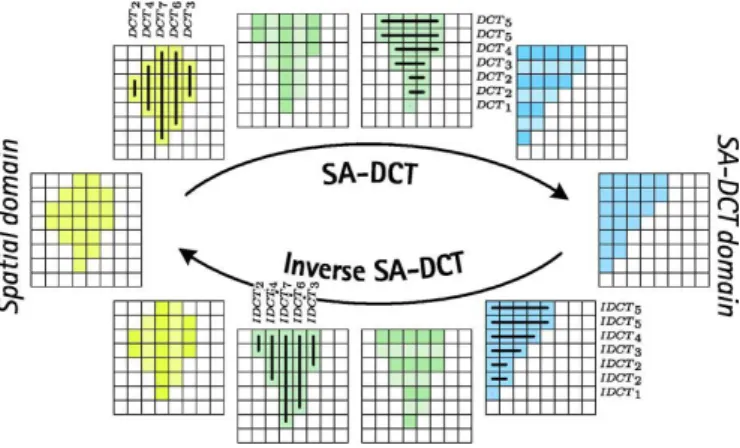
SA-DCT [1, 2] is computed by cascaded application of 1-D varying-length DCT transforms first on columns and then on rows that constitute the considered region as shown in Fig 2. This approach concerns normalization of transform and subtraction of the mean and which have a fundamental impact on the use of the SA-DCT for image filtering.
Fig. 2. Illustration of the shape-adaptive DCT transform and its inverse. Transformation is computed by cascaded application of 1-D varying-length DCT transforms, along the columns and along the rows [14].
A. Orthonormal Shape-Adaptive DCT
The normalization of the SA-DCT is obtained by normalization of the individual 1-D transforms that are used for transforming the columns and rows. In terms of their basis elements, they are defined as
(2)
[2], where and cm=2/L for m>0).
Here is the orthonormal SA-DCT transform
obtained for a region , where
and are
function spaces and indicates the domain of the
transform coefficients. is the inverse
transform of . The thresholding (or quantization) operator is indicated as γ. Thus, the SA-DCT-domain processing of the observations on a region U is written as
. From the orthonormality of T and the model (1) follows that
, where is again
Gaussian white noise with variance σ2
and zero mean.
B. Mean Subtraction
There is an adverse consequence of the normalization (2). Even if the signal restricted to the shape is constant, the reconstructed is usually non constant. In [5] this behavior is termed as ―mean weighting defect,‖ and it is proposed there to attenuate its impact by applying the orthonormal SA-DCT on the zero-mean data which is obtained by subtracting from the initial data its mean. After the inversion, the mean is added back to the reconstructed signal
(3)
where is the mean of z on U.
IV. POINTWISE ANISOTROPIC LPA-ICI + SA-DCT
The anisotropic adaptive neighborhoods defined by the LPA-ICI as supports for the SA DCT, as shown in Fig. 3 is used. By demanding the local fit of a polynomial model, the presence of singularities or discontinuities within the transform support cab be avoided. In this way, it can be ensured that data are represented sparsely in the transform domain, significantly improving the effectiveness of thresholding.
Fig. 3. From left to right: Detail of the noisy Cameraman showing an adaptive-shape neighborhood determined by the Anisotropic LPA-ICI procedure and the image intensity corresponding to this region before and after hard thresholding in SA-DCT domain [14].
A. Fast implementation of the LPA-ICI anisotropic neighborhoods
Narrow 1-D ―linewise‖ directional LPA kernels are used for k = 8 directions, and after the ICI-based selection of the adaptive-scales
constructed as the polygonal hull of
. Such neighborhoods are shown in Fig. 4.
Fig. 4. The anisotropic neighborhood is constructed as the polygonal hull of the adaptive-scale kernels' supports. One-dimensional ―linewise‖ kernels are used [14].
V. THRESHOLDING IN SA-DCT DOMAIN
An illustration of the SA-DCT-domain
hard-thresholding,
performed according to (2) is given in Fig. 5.
Fig. 5. Hard thresholding in SA-DCT domain. The image data on an arbitrarily shaped region is subtracted of its mean. The zero-mean data is then transformed and thresholded. After inverse transformation, the mean is added back [14].
A. Thresholding in SA-DCT domain: Local Estimate
For every point x Є X, a local estimate of the signal y is constructed by thresholding in SA-DCT domain as in (3)
(4)
where γx is a hard thresholding-operator based on the
universal threshold,
(5)
B. Thresholding in SA-DCT domain: Global Estimate All the local estimates (4) are averaged together using adaptive weights (7) that depend on their local variances and on the size of the corresponding adaptive-shape regions.
International Journal of Advanced Research in Computer Science and Electronics Engineering Volume 1, Issue 2, April 2012
(6)
(7)
C. Wiener filtering in SA-DCT domain: Local Estimate Once a global estimate of the signal is available, it is used as a reference signal in order to perform Wiener filtering in SA-DCT domain which is given by,
(8)
D. Wiener filtering in SA-DCT domain: Global Estimate All the local Wiener estimates (8) are averaged together using adaptive weights (10) that depend on the size of the corresponding adaptive-shape regions.
(9)
(10)
VI. PROPOSED MODIFIED POINTWISE SADCT ALGORITHM
From (4), the threshold coefficient for DCT for local estimate is calculated as
γx = DCT threshold coefficient ×
(11)
where σ is the standard deviation and is an adaptive-shape neighbourhood as shown in Figure 3.
The author has used DCT threshold coefficient DCTthrCOEF = 0.925 (constant). We propose a more adaptive method. The reconstructed image yU which is
restricted to the shape z|U (Figure 3)from hard thresholding is
given by
(12)
where TU is the orthonormal SA-DCT transform for a
region U and γ is the thresholding coefficient and is its mean.
From the above relation we conclude that is dependent on γ (or γx) and .
We propose to use value of γx dependent on MSE (Mean
Squared Error) of image and MAX (Maximum Absolute Difference).
First we calculate the value of MAX and MSE. Several experiments were carried out using Lena, Peppers and Barbara image of size 512 × 512 on MATLAB platform on a 1.6 GHz Intel(R) CPU. For B-DCT quantization, if the value of MAX and MSE is less than 90 then thresholding coefficient is 0.9. If the value of MAX is greater than 90 and the value of MSE is between 100 to 120 or greater than 250 then thresholding coefficient is 0.9. If the value of MAX is greater than 90 and the value of MSE is greater than 120 or less than 80 then the thresholding coefficient is 1.01. For JPEG compression if the value of MSE is less than 90 then the thresholding coefficient is 0.9 or else it is 1.01. Thus in our modified case the DCT threshold coefficient DCTthrCOEF = 1.01 or 0.9 depending on MSE and MAX.
VII. POINTWISE SA-DCT FOR B-DCT ARTIFACTS
REMOVAL
More sophisticated models of B-DCT-domain quantization noise have been proposed by many authors, here we model this degradation as some additive Gaussian white noise. In this section we restrict our attention to the grayscale/single-channel case and thus assume the observation model
z = y + n (13)
where y is the original (non-compressed) image, z its observation after quantization in B-DCT domain, and n is independent Gaussian with variance σ2
, n (·) ∼N (0,σ2). We estimate a suitable value for the variance σ2 directly from the quantization table Q = [qi,j]i,j = 1,…,8 using the
following empirical formula:
(14)
This formula uses only the mean value of the nine table entries which correspond to the lowest-frequency DCT harmonics (including the DC-term) and has been experimentally verified to be quite robust for a wide range of different quantization tables and images. A higher compression obviously corresponds to a larger value for the variance.
with the table Q.
Figure 6: Details of the JPEG-compressed grayscale Lena (Q=6,
PSNR=28.24dB) and Pointwise SA-DCT estimate (PSNR=29.8671dB) and of the corresponding modified Pointwise SA-DCT estimate (PSNR=29.8679dB). The estimated standard deviation for this highly compressed image is σ=17.6.
Figures 6, and 7 shows the JPEG compressed grayscale Lena image obtained for two different compression levels (JPEG quality Q=6 and Q=15) as used in original SADCT method [14] and the corresponding SA-DCT filtered estimates and our modified estimates. For these two cases the estimated standard deviations are σ=17.6 and σ=9.7.
VIII. EXPERIMENTAL RESULTS
Extensive simulation experiments were carried out. Consequently, we present comparative numerical results collected in two separate tables. The two tables contain results for grayscale images obtained using particular quantization tables found in the literature (Table 1) and JPEG (Table 2).
Figure 7: Details of the JPEG-compressed Lena (Q=15, PSNR=31.95dB) and Pointwise SA-DCT estimate (PSNR=33.2144dB) and of the corresponding modified Pointwise SA-DCT estimate (PSNR=33.2148dB). The estimated standard deviation for this compressed image is σ=9.7.
Three quantization tables - usually called Q1, Q2, and Q3 - have been used by many authors (e.g. [15] and references
compression. For identifying the considered quantization tables, the first row of each table is shown below:
Q1(1···8,1) = [50 60 70 70 90 120 255 255],
Q2(1···8,1) = [86 59 54 86 129 216 255 255],
Q3(1···8,1) = [110 130 150 192 255 255 255 255].
The values of the standard deviation σ corresponding to these three tables - calculated using formula (4) - are 12.62, 13.21, and 22.73, respectively.
In terms of image degradation, they correspond to a medium to high compression level, similar to what can be obtained by using JPEG with Q = 11 (Q1), Q = 9 (Q2), or Q = 5 (Q3).
In Table 1 we present results for deblocking from B DCT quantization performed using these specific quantization tables. We compare the results obtained by the SA-DCT algorithm against the best results obtained by any of the methods [17, 18, 19, 20, 21, 22], as reported in [17]. We use Lena, Peppers and Barbara image of size 512 × 512 for comparison our modified SA-DCT algorithm against the original SA-DCT algorithm. The results are in favor of our proposed technique.
Further positive results are shown in Table 2 for the case of deblocking from JPEG-compression. In this second table comparison is shown between SA-DCT against the best result obtained by any of the methods [23, 24, 25, 26, 27, 19], as reported in [23] and we compare the modified pointwise SA-DCT method against the original pointwise SA-DCT method. Also in this comparison, our modified Pointwise SA-DCT method is found to be superior to all other methods.
IX. CONCLUSION
International Journal of Advanced Research in Computer Science and Electronics Engineering Volume 1, Issue 2, April 2012 Table 1: PSNR (dB) comparison table for restoration from B-DCT quantization for three different quantization matrices. The values of best results correspond to any of the methods[17, 18, 19, 20, 21, 22] as reported in [17] and the value of original Pointwise SA-DCT method is compared with our modified Pointwise SA-DCT method.
Table
Lena Peppers Barbara
Compressed image Best result from [14] Deblocked SA-DCT image Deblocked Modified SA-DCT image Compressed image Best result from [14] Deblocked SA-DCT image Deblocked Modified SA-DCT image Compressed image Best result from [14] Deblocked SA-DCT image Deblocked Modified SA-DCT image
Q1 30.70 31.63 32.1256 32.1293 30.42 31.33 32.0149 32.023 25.94 26.64 26.7903 26.8026
Q2 30.09 31.19 31.5572 31.5593 29.82 30.97 31.4408 31.4532 25.59 26.32 26.453 26.4641
Q3 27.38 28.65 29.03307 29.037 27.22 28.55 29.13359 29.1436 24.03 24.73 25.12925 25.1301
Table 2: PSNR (dB) comparison table for restoration from JPEG compression of grayscale images. The values of best results correspond to any of the methods[23, 24, 25, 26, 27, 19] as reported in [23] and the value of original Pointwise SA-DCT method is compared with our modified Pointwise SA-DCT method.
Qua l
Lena Peppers Barbara
JPEG Best
result from [1]
SA-DCT Modifie
d SA-DCT
JPEG Best result from
[1]
SA-DCT Modifie
d SA-DCT
JPEG Best
result from
[1]
SA-DCT Modified
SA-DCT
4 26.46 27.63 28.07731 28.0818 25.61 26.72 27.40472 27.4359 23.48 24.13 24.65214 24.6549
6 28.24 29.22 29.8671 29.8679 27.32 28.22 28.96882 28.9925 24.50 25.08 25.50203 25.5176
8 29.47 30.37 30.9860 30.9868 28.40 29.28 29.9023 29.9222 25.19 25.71 26.10794 26.11986
10 30.41 31.17 31.8447 31.8461 29.16 29.94 30.5068 30.5213 25.79 26.27 26.61224 26.6260
12 31.09 31.79 32.4774 32.4786 29.78 30.47 31.0064 31.0203 26.33 26.81 27.10363 27.1174
REFERENCES
[1] Sikora, T., ―Low complexity shape-adaptive DCT for coding of arbitrarily shaped image segments., Signal Process.: ImageComm., vol. 7, pp. 381-395, 1995. [2] Sikora, T., and B. Makai, ―Shape-adaptive DCT for generic
coding of video‖, IEEE Trans. Circuits and Systems for Video Techn., vol. 5, no. 1, pp. 59-62, 1995.
[3] Koenen, R., ―Overview of the MPEG-4 Standard‖, ISO/IEC JTC1/SC29/WG11 Doc. N3536, July 2000.
[4] Foi, A., V. Katkovnik, and K. Egiazarian, ―Pointwise shape-adaptive DCT as an overcomplete denoising tool‖,
Proc. 2005 Int. TICSP Workshop Spectral Meth. Multirate Signal Process., SMMSP 2005, pp. 164-170, Riga, June 2005.
[5] Kauff, P., and K. Schuur, ―Shape-adaptive DCT with block-based DC separation and 'DC correction‖, IEEE Transactions on Circuits and Systems for Video Technology, vol. 8, no. 3, pp. 237-242, 1998.
[6] Kinane, A., A. Casey. V. Muresan, and N. O.Connor, ―FPGA-based conformance testing and system prototyping of an MPEG-4 SA-DCT hardware accelerator‖, IEEE 2005 Int. Conf. on Field-Programmable Technology, FPT. 05, Singapore, December 2005.
[7] A. Foi, V. Katkovnik, K. Egiazarian, and J. Astola, ―A novel anisotropic local polynomial estimator based on directional multiscale optimizations,‖ in Proc. 6th IMA Int. Conf. Math. Signal Process., Circencester, U.K., 2004, pp. 79–82.
[8] Van derWeken, D., E. Kerre, E. Vansteenkiste, and W. Philips, ―Evaluation of fuzzy image quality measures using a multidimensional scaling framework‖ Proc. of the 2nd Int. Workshop on Video Process. and Quality Metrics for Consumer Electronics, VPQM2006, Scottsdale, AZ, January 2006.
[9] Foi, A., K. Dabov, V. Katkovnik, and K. Egiazarian, ―Shape-adaptive DCT for denoising and image reconstruction‖, Proc. SPIE El. Imaging 2006, Image Process.: Algorithms and Systems V, 6064A-18, January 2006.
[10] O.Connor, N., S. Sav, T. Adamek, V.Mezaris, I. Kompatsiaris, T.Y. Lu, E. Izquierdo, C. Bennström, and J. Casas, ―Region and object segmentation algorithms in the Qimera segmentation platform‖, Proc. Third Int. Workshop on Content-Based Multimedia Indexing (CBMI03), Rennes, pp. 381-388, 2003.
[11] Katkovnik V., A. Foi, K. Egiazarian, and J. Astola, ―Directional varying scale approximations for anisotropic signal processing,‖ Proc. of XII European Signal Process. Conf., EUSIPCO 2004, pp. 101-104, Vienna, September 2004.
[12] Katkovnik V., ―A new method for varying adaptive bandwidth selection‖, IEEE Trans. on Signal Proc., vol. 47, no. 9, pp. 2567-2571, 1999.
Denoising and Deblocking of Grayscale and Color Images‖,
IEEE TRANSACTIONS ON IMAGE PROCESSING, VOL. 16, NO. 5, MAY 2007
[15] Liew, A.W.C., and H. Yan, ―Blocking Artifacts Suppression in Block-Coded Images Using OvercompleteWavelet Representation‖, IEEE Trans. Circuits and Systems for Video Technology, vol. 14, no. 4, pp. 450-461, April 2004.
[16] V. Katkovnik, K. Egiazarian, and J. Astola, ―Adaptive window size image de-noising based on intersection of confidence intervals (ICI) rule,‖ J. Math. Imag. Vis., vol. 16, no. 3, pp. 223–235, 2002.
[17] Liew, A.W.C., and H. Yan, ―Blocking Artifacts Suppression in Block-Coded Images Using Overcomplete Wavelet Representation‖, IEEE Trans. Circuits and Systems for Video Technology, vol. 14, no. 4, pp. 450-461, April 2004.
[18] Hsung, T.-C., and D.P.-K. Lun, ―Application of singularity detection for the deblocking of JPEG decoded images‖, IEEE Trans. Circuits and Systems II, vol. 45, no. 5, pp. 640-644, May 1998.
[19] ―MPEG-4 video veriÞcation model version 18.0 (VM-18)‖, ISO/IEC JTC1/SC29/WG11, Doc. N3908, 2001.
[20] Paek H., R.C. Kim, and S.U. Lee, ―On the POCS-based post-processing technique to reduce blocking artifacts in transform coded images‖,‖IEEE Trans. Circuits Sys. Video Technology, vol. 8, pp. 358-367, June 1998.
[21] Yang, Y., N.P. Galatsanos, and A.K. Katsaggelos, ―Projection-based spatially adaptive reconstruction of block-transform compressed images‖, IEEE Trans. Image Process., vol. 4, no. 7, pp. 896-908, July 1995.
[22] Xiong, Z., M. Orchard, and Y. Zhang, ―A deblocking algorithm for JPEG compressed images using overcomplete wavelet representations‖, IEEE Trans. Circuits and Systems for Video Technology, vol. 7, no. 4, pp. 433-437, April 1997.
[23] Averbuch, A., A. Schclar, and D.L. Donoho, ―Deblocking of block-transform compressed images using weighted sums of symmetrically aligned pixels‖, IEEE Trans. Image Process‖, vol. 14, no. 2, pp. 200-212, February 2005. [24] Chen, T., H.R. Wu, and B. Qiu, ―Adaptive postÞltering of
transform coefÞcients for the reduction of blocking artifacts‖, IEEE Trans. Circuits and Systems for Video Technology, vol. 11, no. 5, pp. 584-602, August 2001. [25] Rosenholts, R., and A. Zakhor,
―Iterative procedures for reduction of blocking artifacts in transform domain image coding‖, IEEE Trans. Circuits and Systems for Video Technology, vol. 2, no. 2, pp. 91-95, March 1992.
[26] Yang, Y., N.P. Galatsanos, and A.K. Katsaggelos, ―Regularized reconstruction to reduce blocking artifacts of block discrete cosine transform compressed images‖, IEEE Trans. Circuits and Systems for Video Technology, vol. 3, no. 6, pp. 421-432, December 1993.
[27] Marsi, S., R. Castagno, and G. Ramponi, ―Asimple algorithm for the reduction of blocking artifacts in images and its implementation‖, IEEE Trans. Consum. Electron., vol. 44, no. 3, pp. 1062-1070, August 1998.
[28] ―MPEG-4 video veriÞcation model version 18.0 (VM-18)‖ ISO/IEC JTC1/SC29/WG11, Doc. N3908, 2001.
also received M.E degree from Mumbai University. He is currently pursuing Phd at National Institute of Technology Rourkela, Orissa, India. He is presently working as an Associate professor in VESIT, Chembur, Mumbai, India. His area of interest is Image processing.
Rohan K. Shambharkar received B.E. degree in Electronics and Telecommunication engineering from Mumbai University. He is currently pursuing M.E. degree in Electronics and Telecommunication engineering from Mumbai University. His area of interest is Image Processing.