139
QUALITY ASSESSMENT OF TOBACCO TYPE VIRGINIA F.I. USING
INTERNATIONAL RATING SYSTEM
MATEI GHEORGHE, TORCEA MARIAN, IMBREA FLORIN
University of Craiova, Department of Agricultural and Forestry Technologies. E-mail [email protected]
S.C. Galaxy Agriproduction S.A. University of Agricultural Science and Veterinary Medicine Timisoara
Key words: Virginia tobacco, quality assessment, blend
ABSTRACT
The objective of this study is to determine the quality of tobacco Virginia F.I. type leaves an assortment of lots received, from the culture of 2013, using the international system of grading into a manufacturing and processing enterprises.
The study reveals particularities of raw materials used in processing the tobacco industry and its suitability in accordance with the standards used in the field. Thus, by classifying tobacco using the international rating system provides a separation of leaf tobacco on leaf floors, helping a lot in training batches for processing, and by processing tobacco to obtain a finished product with better features of smoking and a longer period of expendability.
INTRODUCTION
Tobacco (Nicotianatabacum) is a plant with great economic importance. In our country, tobacco is known since the end of the sixteenth century and for the first time he was processed in Moldavia region, in 1821.
Romania has favorable climatic conditions for the production of the main types of tobacco: Virginia, Burley, Oriental, Semi-Oriental and for high consumption, and some varieties economically exploit productive potentially of some poor soils as those eroded, sandy soils or other soils less productive.
In the last 10 years, due to economically changes that have taken place on both national and European level, tobacco and his processing process it has undergone a continuous transformation, especially through the privatization of National Network of Tobacco and the entry on the Romanian market of some large corporations as JTA, PHIL MORRIS and others.
140
Table 1
Virginia Tobacco Leaves Rating System
X C B T
XL3 CL3 BL3 TLO2
XL4 CL4 BL4 TLO3
XLO2 CLO2 BLO2 TLO4
XLO3 CLO3 BLO3 TLO3V
XLO4 CLO4 BLO4 TLO3G
XLO3F CLO3F BLO3V TLO4G
XLO4F CLO4F BLO3G
XLO5F CLO5F BLO4G
XLO3V CLO3V
XLO3G CLO3G
XO2 CO2 BO2 TO2
XO3 CO3 BO3 TO3
XO4 CO4 BO4 TO4
XO3F CO3F BO3F TO3V
XO4F CO4F BO4F TO4V
XO5F CO5F BO5F TO3G
BO6F TO4G
XO6F COW BOW
XO3V COU BOU
XO4V CO3V BO3V
XO3G CO4V BO4V
CO5V BO5V
XO4G CO3G BO3G
CO4G BO4G
XR3 CO5G BO5G
BM2 TM2
BM3 TM3
BM4 TM4
BM3G TM3G
TM4G BR3
BR4
MATERIAL AND METHODS
On studied lots of tobacco leaves were made different observation and notation related the international rating system, as follow:
for foliar floor:
o X – for base leaves
o C – for under middle leaves o B – for middle leaves
o T – for top leaves for leaves color:
o O – for orange color o LO – for low orange color o L – for lemon color
o M – dark red color for leaves defects:
o 2 – very good quality o 3 – average quality
141
o 6 – very poor quality for drying defects:
o R – red o V – green o G – grey
o W – high humidity o U – mold
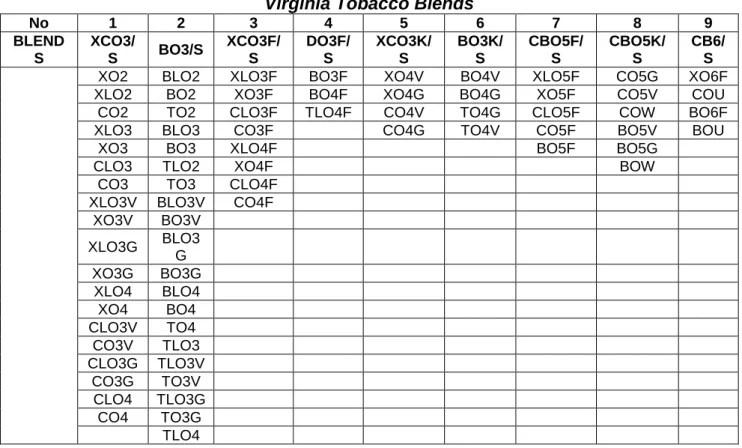
Taking in account those notations, the ancient method of fermentation of tobacco leaves for industrial use was replaced by new one – artificial drying and forming mixtures of tobacco with similar qualities (same foliar floor, same color and same consistency) – table 2.
Table 2
Virginia Tobacco Blends
No 1 2 3 4 5 6 7 8 9
BLEND S
XCO3/
S BO3/S
XCO3F/ S DO3F/ S XCO3K/ S BO3K/ S CBO5F/ S CBO5K/ S CB6/ S
XO2 BLO2 XLO3F BO3F XO4V BO4V XLO5F CO5G XO6F
XLO2 BO2 XO3F BO4F XO4G BO4G XO5F CO5V COU
CO2 TO2 CLO3F TLO4F CO4V TO4G CLO5F COW BO6F
XLO3 BLO3 CO3F CO4G TO4V CO5F BO5V BOU
XO3 BO3 XLO4F BO5F BO5G
CLO3 TLO2 XO4F BOW
CO3 TO3 CLO4F
XLO3V BLO3V CO4F
XO3V BO3V
XLO3G BLO3
G
XO3G BO3G
XLO4 BLO4
XO4 BO4
CLO3V TO4
CO3V TLO3
CLO3G TLO3V
CO3G TO3V
CLO4 TLO3G
CO4 TO3G
TLO4
In 2013 due a small quantity received were established only 5 blends, with particular features generated by quality of mixture and request of the buyers (tobacco processors on the free market). The blends were:
1. XCO3/S – a good mixed tobacco formed from base (X) and under middle (C) leaves, with orange color (O), with few defects (C3) as strips (S);
2. BO3/S - means good tobacco formed from middle floor leaves consists of (B) and top (T), orange color (O), with few defects (3) the form of strips (S);
3. XCO4/S – lowmixed tobacco formed from under middle leaves (C), base leaves (X) with, orange color in most of them (O) and defects (4/S);
4. BO4/S– low mixed tobacco formed from middle leaves + top leaves (most of them from middle B) with defects, of under average quality;
5. CBO6/S – poor quality tobacco mixture, with leaves from middle part and top of the plant and lots of defects.
RESULTS AND DISCUSSION
142
Using the international rating system we observe that in the received lots the most important fraction were leaves from under middle and middle part of the plant of 39% and respectively 37.9%, followed by the leaves from base level of 22,3% and a very small part of leaves from the top, only 0.8% (table 3).
Table 3
Results related the rated lots of Virginia tobacco
NO. GRAD QUANTITY
(kg)
FRACTION (%)
1. XO3G 17952 2.3
2. XO3,5G 25930 3.3
3. XO4G 88705 11.3
4. XO5G 28699 3.7
5. XO6F 13455 1.7
TOTAL 174741 22.3
6. CO3G 95744 12.2
7. CO3,5G 59841 7.6
8. CO4G 99141 12.6
9. CO5G 44353 5.7
10. COU 6850 0.9
TOTAL 305929 39.0
11. BO3G 81326 10.4
12. BO3V 42290 5.4
13. BO4 32530 4.1
14. TO3G 6506 0.8
15. BO4G 62930 8.0
16. BO5G 13110 1.7
17. BM4G 55064 7.0
18. BO6F 10120 1.3
TOTAL 297370 37.9
TOTAL TOP LEAVES 6276 0.8
TOTAL GENERAL 784546 100
B. Results regarding the quality of processed tobacco of formed blends
Under the processing of tobacco, at XCO3/S blend were used the follow fractions (figure 1):
Strips = 127.000 kg (635 boxes) – 75%;
Long nervure - N.L. = 27.800 kg (139 boxes) – 16%; Short nervure - N.S. = 8.400 kg (42 boxes) – 5%; Short strips - S.S. = 5.850 kg (39 boxes) – 4% TOTAL = 169.050 KG
143
Figure 1 – Finished product of XCO3/S
The second tobacco blend, BO3/Scontains the follow fractions (figure 2): Strips = 103.200 kg (516 boxes) – 74%;
Long nervure - N.L. = 24.400 kg (122boxes) – 17.5%; Short nervure - N.S. = 7.400 kg (37boxes) – 5.5%; Short strips - S.S. = 4.350 kg (29 boxes) – 3% TOTAL = 139.350 KG
Analyzing the material brought to trial, this blend is observed that 20% of the volumes is BO4 degree, and compared with XCO3/S blend proportion of small strips decreased by one percent. This is because tobacco leavesfrom middle floor and top has a higher peak consistency.
Figure 2 – Finished product of BO3/S
The third tobacco blend, XCO4/Scontains the follow fractions (figure 3): Strips = 151.000 kg (755 boxes) – 74%;
144
In this blend is observed that the percentage of small strips increased to 7%, which shows that introduced tobacco,has low quality. A consequence of poor quality and yield is low performance, leading to loss of 16%, compared with only 10.9% in blenders XCO3/S, respectively BO3/S. Also picking is very high, about 7%, compared to 4-5% as in XCO3/S and BO3/S.
Figure 3 – Finished product of XCO4/S
The tobacco blendBO4/Scontains the follow fractions (figure 4): Strips = 78.400 kg (392 boxes) – 72%;
Long nervure - N.L. = 20.200 kg (101boxes) – 19%; Short nervure - N.S. = 4.200 kg (21boxes) – 4%; Short strips - S.S. = 4.800 kg (24boxes) – 5% TOTAL = 107.600 KG
Analyzing the results obtained in this blend, we see a higher percentage of NL compared to the other blends, because grades BO4G, BO5G or middle BM4G have tobacco, which has well developed main stem.In terms of picking tobacco, the percentage is 4.8 to 5%, and technological loss is about 13%, too high.
145
The last tobacco blendCBO6/Scontains the follow fractions (figure 5): Strips = 39.400 kg (197 boxes) – 73%;
Long nervure - N.L. = 6.600 kg (33boxes) – 12%; Short nervure - N.S. = 2.200 kg (11boxes) – 4%; Short strips - S.S. = 5.550 kg (37boxes) – 11% TOTAL = 53.750 KG
Analyzing the results obtained in this blend, which is the lowest quality, with degrees and picking apart the latest results from the other blends, there is doubling the amount of small strips (11% versus 5% for the other blends) and the increase of technological losses above 25%.
Figure 4 – Finished product of CBO6/S
CONCLUSIONS
On Virginia F.I. tobacco international rating systems results obtained from the blends of tobacco processing formats, leading to conclusions that may constitute recommendations for tobacco processors:
Determination of tobacco without intermediate notation drying defect and between 3 and 4 to 3.5;
Elimination of balls and boxes of tobacco major defects and do not correspond blend is on the line, thus avoiding the high percentage of picking (especially tobacco);
The supply of tobacco to tables that contain tobacco blends middle and under top leaves due to the high proportion of foreign bodies, particularly child and grass; Processing and CO5G and XO5G separate degrees, given the poor quality of the
tobacco that influenced results in Blend XCO4/S, resulting in a low yield, high technological losses (16%) and high percentage of small strips (about 7%);
146
BIBLIOGRAPHY
1. Aniţia N., Marinescu P., 1983 – Tehnologia tutunului. Editura Tehnică, Bucureşti. 2. Aniţia N., Marinescu P., 1993 – Fiziologia şi biochimia tutunului. Editura Tehnică,
Bucureşti.
3. Bianchini E., Ranocchia C., Cappelletti M., 1996 – La cura del tabacco VirginiaBright. DCCT Perugia, Italia.
4. Bîlteanu, Gh., 1993 –Fitotehnie,vol.2.Editura Ceres, Bucureşti.
5. Duţu Maria, Duţu A., 2000 – Manufactura de tutun. Editura Belvedere, Bucureşti. 6. Feinhals, D.J., 1930- Privire scurta asupra istoriei tutunului. Buletinul tutunului nr.2 7. Gavriliu , D.I. , 1929 – Contribuţiuni la istoricul tutunului; Editura Viaţa
Românească. Iaşi.
8. Institutul Român de Standardizare, 1994 – Standard Român – SR 4895, Bucureşti.
9. Institutul Român de Standardizare, 1994 – Standard Român – SR 13334, Bucureşti.
10. Jilavu ,St. 1987-Influenta densităţii plantelor asupra producţiei si calităţii tutunului Virginia 496.
11. Ministerul Agriculturii si Industriei Alimentare, 1978- Tehnologia Tutunului, Bucureşti.
12. Mihăescu, P.E., 1931 –Tutunul in trecutul Tarii Româneşti şi al lumii întregi. Editura Cartea Românească, Bucureşti.
13. Larino,M. , 2005 - Sistema di classifica dei gradi interni Virginia.
14. Transcatab S.P.A., 2000 – Manuale di gestione della produzione. Caserta, Italia 15. Trifu ,I. , 1958 –Tehnologia uscării si fermentării tutunului..Editura Tehnică.
Bucureşti.
16. Trifu I. ,Gavriliu D., 1953-Tehnologia tutunului. Editura Tehnica. Bucureşti.
17. Păunescu, A.D., Păunescu Marilena, 2000- Tipurile de tutun cultivate in Romania; III.,Tutunul de tip Virginia; Cereale si plante tehnice nr.10, Bucureşti.
18. Păunescu, A.D., Păunescu Marilena, 2001 –Tehnologia culturii tutunului. Editura Condor, Bucureşti.
19. Regia Autonoma a Tutunului, 1994- Tehnologia culturii tutunului. Bucureşti.
20. Rac C., 2005 –Instrucţiuni de folosire a utilajelor pentru procesarea tutunului. Zimnicea.