Root cause detection of call drops using feedforward neural network
K R Sudhindra* V SridharPeople’s Education Society College of Engineering, Mandya 571401, India
* E-mail of the corresponding author: [email protected]
Abstract
Call drop rate in GSM (Global System for Mobile Communication) network is an important key performance indicator (KPI) that directly affects customer satisfaction. The delay in identification of exact call drop reason because of multiple reasons involved in it would results in poor customer satisfaction. The TCH (traffic channel) call drops due to three different hardware causes are collected from live GSM network for 10 days and are represented in time domain. Time domain features such as mean, maximum, standard deviation etc. are extracted from each type of call drop signal which is used to train the feedfoward neural network. FF neural network is made as decision making classifier, feature vector is inputted and root cause detection information is outputted.
Keywords: TCH call drops, neural network, GSM
1. Introduction
TCH (Traffic channel) drop rate is one of the major KPI that affect the performance of live GSM network. The TCH drop is the abrupt disconnection of call after traffic channel is allocated. The multiple causes of call drops in live network will delay the process of call drop detection and its elimination from the network which will result in poor customer satisfaction. The relation of call drops with handover and its effects on performance is exclusively discussed in (Wahida Nasrin and Md Majharul Islam, 2009). The effect of user mobility on call drops in live GSM network considering different patterns for user mobility was discussed in (A.G. Spilling and A.R. Nix, 2000). The influence on handover failures on TCH call drops for different types of calls are discussed in (D.Lam, D.C Cox and J.Widom,1997).In [A. Kolonits,1997] the lognormal hypothesis for distribution of the call holding time of both the normally terminated and the abnormal dropped calls has been studied. The phenomena of TCH call drops have been classified, verifying that handover failure become negligible in a well-established cellular network. All the previous works implicitly assumes that proper radio planning has been done and there is no equipment failure or network outage. In live network there are multiple causes for call drops identifying of which requires rich hands on experience on the network. In many cases root cause detection of call drops will consume lot of time which results in customer dissatisfaction. A novel method of root cause detection of TCH call drops using artificial neural network is discussed in this paper.
2. Methodology
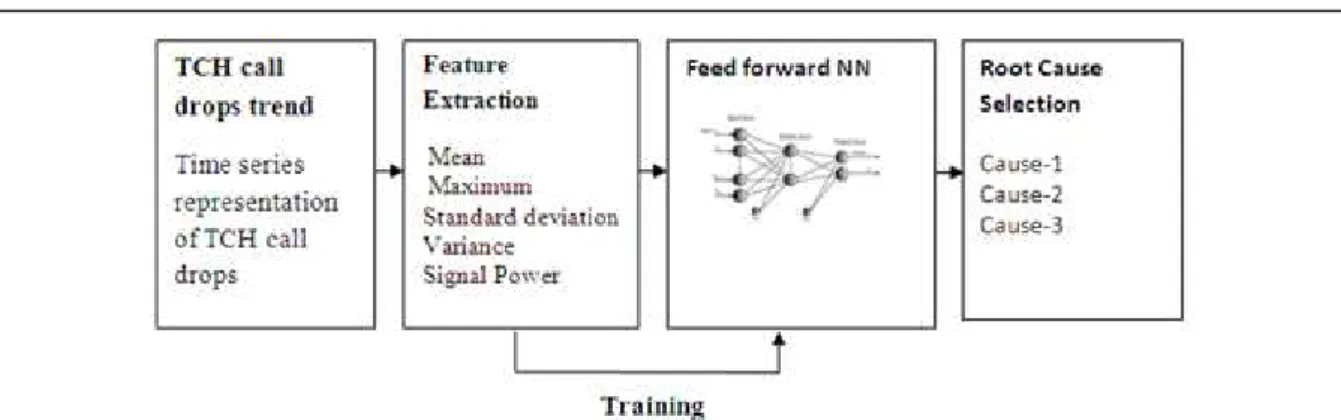
Root cause detection of TCH call drop based on feed forward (FF) neural network using Levenberg-Marquardt training algorithm is designed. The block diagram of proposed system is shown in Figure 1. The TCH call drop trends due to three different hardware causes are collected for 10 days and are represented in time domain. The next step is to extract features from the signal representing TCH call drops and construct eigenvector for each cause using
Figure 1. Block diagaram of root cause detection of TCH call drops
2.1Time domain representation of TCH call drops
The three major BTS hardware faults such as HDLC (High Level Data Link Control) communication between CMB (control and maintenance board) and FUC(frame unit control) broken, Abis control link broken alarm and PA(Power Amplifier) forward Power (3 db) alarm contributed for call drops in live network are considered for study in the proposed system. The TCH call drops due to three different causes are collected for duration of 10 days with a sampling time of 15 minutes and are represented in time domain as shown in Figure 2 to Figure 4. The time domain representation TCH call drops shows unique characteristics for different hardware faults which are significant finding that is used for feature extraction required for root cause identification. These data is used as input for
proposed root cause detection system.
Figure 3. Abis control link broken alarm
Figure 4. PA Forward Power (3 db) alarm
2.2 Feature Extraction
Five feature parameters such as mean, minimum, maximum, standard deviation, variance and signal power are determined for each signal sample and standard feature vector is constructed for each fault type. Euclidean distance of every two feature vectors can be calculated with the Euclidean distance formula and then compare the size of the Euclidean distances. If Euclidean distances are significantly different and balanced between them, then feature vectors are ideal (Yanhua Zhang and Lu Yang, 2010). These feature vectors are used for fault detection.
2.3 Root cause detection of call drops using feedforward neural network
Three layer feedforward artificial neural network (ANN) which is used in the proposed model is discussed in this section. Computation nodes are arranged in layers and information feeds forward from layer to layer via weighted connections as illustrated in Figure 5. Circles represent computation nodes (transfer functions), and lines represent weighted connections. The bias threshold nodes are represented by squares. Mathematically, the typical feedforward network can be expressed as shown in equation (1).
y
i=
Φ
o[
C
Φ
h(
Bu
i+
b
h)
+
b
o]
(1)
Figure 5. Three layer feed forward neural network
Where yi is the output vector corresponding to input vector ui, C is the connection matrix ( matrix of weights) represented by arcs( the lines between two nodes) from the hidden layer to the output layer. B is the connection matrix from the input layer to the hidden layer, and bh and bo are the bias vector for the hidden and output layer, respectively, Φh (·) and Φo (·) are the vector valued function corresponding to the activation(transfer) functions of
the nodes in the hidden and output layers, respectively. Thus, feedforward neural network models have the general structure of equation (2).
y
i=
f
(
u
)
(2)
function “purelin” is adopted as transfer function of output layer. Levenberg-Marquardt BP training function is adopted as network training function whose performance index is “mse” and training target is 0.01. After training, the neural network can be given problems that are similar to the ones that it was trained on and it would make decisions about the data that it is currently processing.
3. Results and discussion
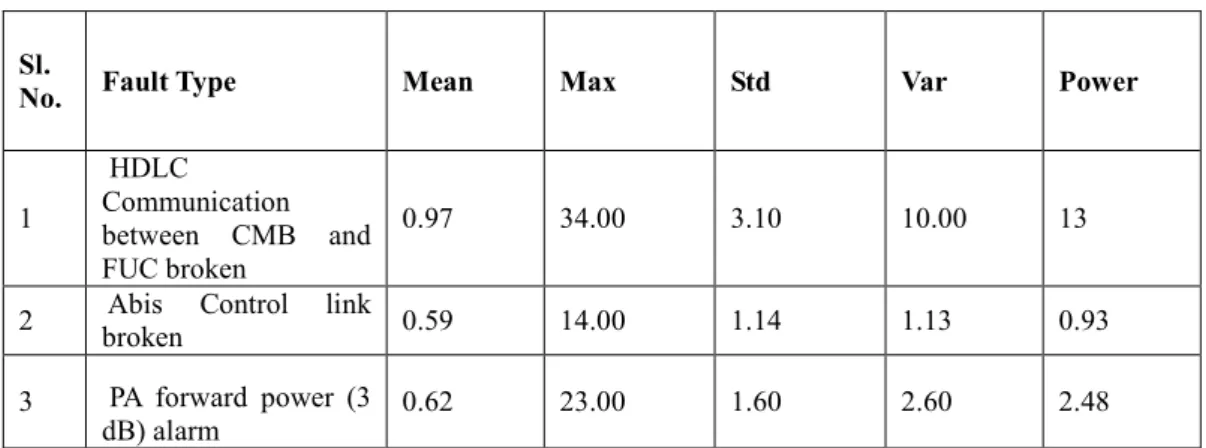
Five feature parameters such as mean, maximum, standard deviation, variance and signal power are found using TCH call drop time series signal and used as feature vector for fault detection. Table 1 shows the characteristics
parameters of TCH call drop time series signal.
Table 1. Characteristics parameters of TCH call drop time series signal
Sl.
No. Fault Type Mean Max Std Var Power
1 HDLC Communication between CMB and FUC broken 0.97 34.00 3.10 10.00 13
2 Abis Control link
broken 0.59 14.00 1.14 1.13 0.93
3 PA forward power (3
dB) alarm
0.62 23.00 1.60 2.60 2.48
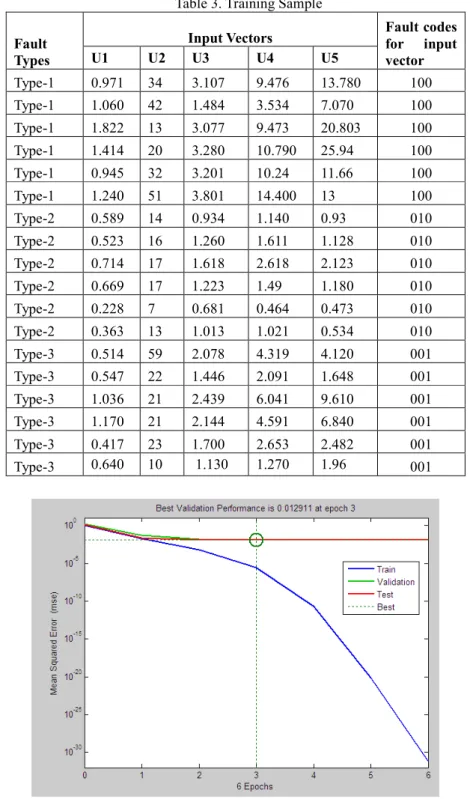
Root cause codes for HDLC communication between CMB and FUC broken (type1), Abis control link broken alarm (type2) and PA forward Power (3 db) faults (type 3) are designed in Table 2. Part of training samples is shown in Table 3. LM algorithm is used to train the feed forward neural network. Network training error curve is shown in figure 6.
Table 2. Fault type code design
Parameters Fault Types
Type-1 Type-2 Type-3
Table 3. Training Sample
Fault Types
Input Vectors Fault codes for input
vector U1 U2 U3 U4 U5 Type-1 0.971 34 3.107 9.476 13.780 100 Type-1 1.060 42 1.484 3.534 7.070 100 Type-1 1.822 13 3.077 9.473 20.803 100 Type-1 1.414 20 3.280 10.790 25.94 100 Type-1 0.945 32 3.201 10.24 11.66 100 Type-1 1.240 51 3.801 14.400 13 100 Type-2 0.589 14 0.934 1.140 0.93 010 Type-2 0.523 16 1.260 1.611 1.128 010 Type-2 0.714 17 1.618 2.618 2.123 010 Type-2 0.669 17 1.223 1.49 1.180 010 Type-2 0.228 7 0.681 0.464 0.473 010 Type-2 0.363 13 1.013 1.021 0.534 010 Type-3 0.514 59 2.078 4.319 4.120 001 Type-3 0.547 22 1.446 2.091 1.648 001 Type-3 1.036 21 2.439 6.041 9.610 001 Type-3 1.170 21 2.144 4.591 6.840 001 Type-3 0.417 23 1.700 2.653 2.482 001 Type-3 0.640 10 1.130 1.270 1.96 001
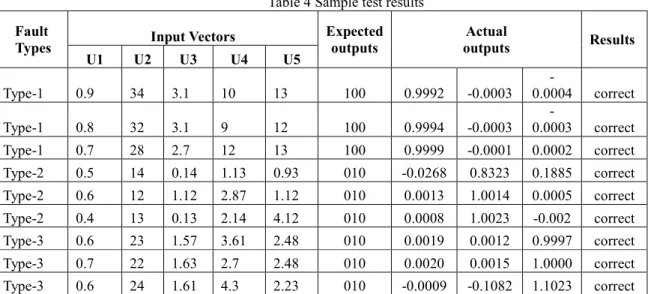
Table 4 Sample test results
Fault
Types Input Vectors
Expected outputs Actual outputs Results U1 U2 U3 U4 U5 Type-1 0.9 34 3.1 10 13 100 0.9992 -0.0003 -0.0004 correct Type-1 0.8 32 3.1 9 12 100 0.9994 -0.0003 -0.0003 correct Type-1 0.7 28 2.7 12 13 100 0.9999 -0.0001 0.0002 correct Type-2 0.5 14 0.14 1.13 0.93 010 -0.0268 0.8323 0.1885 correct Type-2 0.6 12 1.12 2.87 1.12 010 0.0013 1.0014 0.0005 correct Type-2 0.4 13 0.13 2.14 4.12 010 0.0008 1.0023 -0.002 correct Type-3 0.6 23 1.57 3.61 2.48 010 0.0019 0.0012 0.9997 correct Type-3 0.7 22 1.63 2.7 2.48 010 0.0020 0.0015 1.0000 correct Type-3 0.6 24 1.61 4.3 2.23 010 -0.0009 -0.1082 1.1023 correct 4. Conclusions
The time series representation of TCH call drops shows unique characteristics for different hardware faults. These characteristics help to extract time domain features and construct Eigen vector for identifying root cause of call drops. Root cause detector of TCH call drops using feedforward neural network is designed and LM algorithm is used to train the network from the constructed feature vectors. The efficiency of the network can be improved by training the network with large number of samples.
5. Acknowledgment
The authors would like to thank IDEA Cellular Ltd, Bangalore to have made possible the access to the data used for this study.
References
Wahida Nasrin, Md Majharul Islam Rajib,“An analytical approach to enhance the capacity of GSM frequency hopping networks with intelligent Underlay-overlay” Journal of communication, Vol 4,No. 6, July 2009.
A.G. Spilling and A.R. Nix, “Performance enhancement in cellular networks with dynamic cell sizing” IEEE PIMRC 2000.
D.Lam,D.C Cox and J.Widom “Teletraffic modeling for personal communication services” IEEE communications Magazine, Vol. 35, No. 2, Feb 1997,pp 79-87.
A. Kolonits, “Evaluating the Potential of Multiple Re-Use Patterns for Optimizing Existing Network Capacity” IIR Maximizing Capacity Workshop, London, June 1997.
K R Sudhindra received Bachelor of Engineering degree in Electroncs and communication from Mysore University, India in 1999 and M.Sc ( Engg). by research in faculty of Electrical Engineering sciences from Visvesvaraya Technological University, India in 2007. He is currently a Ph.D student of Department of Electronics and Communication Engineering, PESCE, Karnataka, India. He has total 5 years of experience in Telecom Industry. His research interests include operational research, signal processing & wireless communication.
V Sridhar has obtained his Ph.D from Indian Institute of Technology (IITD), New Delhi in the year 1996. He obtained his B.E (E&C) from University of Mysore in the year 1980 and M.E (Electronics & Telecommunications) from Jadavpur university, Calcutta in the year 1986. Presently he is serving as the Principal, PESCE, Mandya. He has more than 29 years of teaching, research and administrative experience.His major areas of research interest are Bio-medical instrumentation, Telemedicine, VLSI Design and Mobile communication. He has to his credit more than 40 research papers in national /international journals and conferences.