Sheffield Development Framework
Core Strategy
Adopted March 2009
Sheffield Development Framework
Core Strategy
Adopted by the City Council on 4th March 2009
Development Services Sheffield City Council Howden House 1 Union Street Sheffield S1 2SH
Availability of this document
This document is available on the Council’s website at
www.sheffield.gov.uk/sd
f
If you would like a copy of this document in large print, audio format ,Braille,
on computer disk, or in a language other than English,please contact us for
this to be arranged:
ltelephone (0114) 205 3075, or
le-mail [email protected], or
lwrite to:
SDF Team
Development Services
Sheffield City Council
Howden House
1 Union Street
Sheffield
S1 2SH
Sheffield City Council
INTRODUCTION
Chapter 1 Introduction to the Core Strategy 1
What is the Sheffield Development Framework about? 1
What is the Core Strategy? 1
PART 1: CONTEXT, VISION, OBJECTIVES AND SPATIAL STRATEGY
Chapter 2 Context and Challenges 5
Sheffield: the story so far 5
Challenges for the Future 6
Other Strategies 9
Chapter 3 Vision and Objectives 13
The Spatial Vision 13
SDF Objectives 14
Chapter 4 Spatial Strategy 23
Introduction 23
Spatial Strategy 23
Overall Settlement Pattern 24
The City Centre 24
The Lower and Upper Don Valley 25
Other Employment Areas in the Main Urban Area 26
Housing Areas 26
Outer Areas 27
Green Corridors and Countryside 27
Transport Routes 28
PART 2: SPATIAL POLICIES
Chapter 5 Introduction to Policies 29
Chapter 6 Promoting Economic Prosperity and Providing Sustainable Employment 33
CS1 Land for Employment and Economic Development 33
CS2 Business and Industrial Development on Brownfield and Greenfield Land 35
CS3 Locations for Office Development 35
CS4 Offices in the City Centre 37
CS5 Locations for Manufacturing, Distribution/Warehousing and other Non-office
Businesses 38
CS6 Manufacturing and the City Centre - Transition Areas 39
CS7 Meadowhall 40
CS8 Tinsley Park 42
CS9 Attercliffe/Newhall and Parkway/Kettlebridge 43
CS10 Business and Industry in the Upper Don Valley 43 CS11 Employment Locations in the North-East Urban Area 44
CS12 Blackburn Valley 45
CS13 Employment and Services in Mosborough/Woodhouse 46 Chapter 7 Enriching the Sheffield City Region as the Most Sustainable Location for Regional
Services, Jobs and Facilities 49
CS14 City-wide Distribution of Shopping and Leisure Development 49 CS15 Locations for Large Leisure and Cultural Development 50
CS16 Rail Connections 50
CS17 City Centre Quarters 51
CS18 Shopping in the City Centre 53
CS19 Cultural Facilities in the City Centre 55
CS20 The Universities 55
CS21 The Boulevard of Sport 56
Chapter 8 Creating Attractive, Sustainable and Distinctive Neighbourhoods 59
CS22 Scale of the Requirement for New Housing 59
CS23 Locations for New Housing 62
CS24 Maximising the Use of Previously Developed Land for New Housing 64
CS25 Priorities for Releasing Land for New Housing 65
CS26 Efficient Use of Housing Land and Accessibility 67
CS27 Housing in the City Centre 68
CS28 Housing in Attercliffe and Darnall 69
CS29 Housing in the Upper Don Valley 70
CS30 Jobs and Housing in the Sheaf Valley and Neighbouring Areas 70
CS31 Housing in the South West Area 72
CS32 Jobs and Housing in Chapeltown/Ecclesfield 73
CS33 Jobs and Housing in Stocksbridge/Deepcar 75
CS34 District Centres 76
CS35 Darnall District Centre 78
CS36 Hillsborough District Centre 78
CS37 Firth Park, Spital Hill and Chaucer District Centres 79
CS38 Manor Top District Centre 80
CS39 Neighbourhood Centres 81
Chapter 9 Providing for Opportunities, Well-Being and Quality of Life for All 83
CS40 Affordable Housing 83
CS41 Creating Mixed Communities 83
CS42 Locations for Gypsy and Traveller and Travelling Showpeople Sites 84
CS43 Schools 85
CS44 Health Centres 86
CS45 Quality and Accessibility of Open Space 87
CS46 Quantity of Open Space 88
CS47 Safeguarding Open Space 89
CS48 Open Space and Riversides in the City Centre 91
CS49 Education and Leisure in the Upper Don Valley 92
CS50 Parkwood Springs and the Parkwood Landfill Site 93 Chapter 10 Enabling People and Goods to Move Conveniently and by Sustainable Forms
of Transport 95
CS51 Transport Priorities 95
CS52 Key Route Network 96
CS53 Management of Demand for Travel 98
CS54 Pedestrian Routes 100
CS55 Cycling Routes 101
CS56 Priority Routes for Bus and Bus Rapid Transit 102 CS57 Park-and-Ride and Car Parking in the City Centre 104
CS58 Freight 106
CS59 New Roads 106
CS60 Transport in the City Centre 108
CS61 Pedestrian Environment in the City Centre 110
CS62 Access to Wider Employment Opportunities for Residents in the North-East Urban
Area 111
Chapter 11 Global Environment and Natural Resources 113
CS63 Responses to Climate Change 113
CS64 Climate Change, Resources and Sustainable Design of Developments 114
CS65 Renewable Energy and Carbon Reduction 116
CS66 Air Quality 118
CS67 Flood Risk Management 119
CS68 Waste Development Objectives 122
CS69 Safeguarding Major Waste Facilities 124
CS70 Provision for Recycling and Composting 125
Chapter 12 Prizing, Protecting and Enhancing Sheffield’s Natural Environment and Distinctive
Urban Heritage 127
CS71 Protecting the Green Belt 127
CS72 Protecting Countryside not in the Green Belt 128
CS73 The Strategic Green Network 129
CS74 Design Principles 131
CS75 Improvements to Gateway Routes into and through the City 133
CS76 Tall Buildings in the City Centre 134
APPENDICES
Appendix 1 Implementation of the Core Strategy Policies 137 Appendix 2 Core Strategy Targets and Output Indicators 173
Appendix 3 Superseded Policies 181
Appendix 4 Relationship Between Policies, Objectives and Options 183 Appendix 5 Achievement of the Spatial Vision through the Policies 189
Appendix 6 Core Strategy Background Reports 195
Appendix 7 Implications for Development Types and Areas of the City 197
Sheffield Core Strategy
Chapter 1 Introduction to the Core Strategy
What is the Sheffield Development Framework about?
1.1 The Sheffield Development Framework is the City Council’s Local Development Framework, prepared in accordance with the Planning and Compulsory Purchase Act 2004. It comprises a set of planning documents that show how:
the city will develop spatially different land uses will be located
the environment will be protected and enhanced areas and buildings will be designed
places in the city will be connected through the location of new development and provision of transport.
What is the Core Strategy?
1.2 The Core Strategy provides the overall spatial strategy for the Framework. It answers the question, ‘At a strategic level, what is going to happen, where, and how is it going to happen?’ It sets out for the period to 2026 the overall vision for the city, the relationships between the areas within it and how different factors come together in each area.
1.3 The Core Strategy has two parts:
Part 1:Context, Vision, Objectives and Spatial Strategyhow Sheffield has evolved to date, the new challenges it faces, the wider policy context, the overall vision and objectives for all of the Framework’s documents and the overall spatial strategy. Part 2:Spatial Policiesset out how the vision is taken forward through the policies for the city as a whole and areas within it.
1.4 The Core Strategy is one part of the Sheffield Development Framework. It is the pre-eminent document and all other documents should flow from it. However, there are three important things that it does not do, for which it is necessary to consult two other documents that also form part of the Framework.
1.5 Firstly, the Core Strategy does not generally set out the rules and guidelines for decisions about applications for planning permission for new development. It does contain the overall objectives and spatial context for decisions about particular developments but the specific guidance is set out in theCity Policiesdocument, which contain the policies to promote sustainable design and safeguard the environment.
1.6 Secondly, the Core Strategy does not allocate specific sites. These are identified in the City Sitesdocument. This document will be subject to more frequent review than the Core Strategy.
1.7 Thirdly, the Core Strategy provides only the broad outline of spatial policy. It does not identify sites that can be defined precisely on a map. To find out what the Sheffield
Development Framework proposes for specific areas and sites, you will need to look at the
Chapter 1 : Page 1 Sheffield Core Strategy
Proposals Map. The Core Strategy, with its Key Diagram, contains the basic principles for the Proposals Map, but not their detailed application.
1.8 Although the Core Strategy does not go into great spatial detail, it is sufficiently specific to form a meaningful policy context for future individual area action plans and major schemes. The Core Strategy should be used alongside the City Policies and City Sites documents and the Proposals Map when considering applications for planning permission for proposals of strategic significance.
1.9 The Core Strategy seeks to be both more comprehensive and more explicit about spatial policy than preceding plans for Sheffield have been. Previous plans have tended to be more implicit about spatial issues and to say little about outcomes. Much was left to be decided through decisions about planning applications with reference to the more regulatory policies of the Unitary Development Plan.
1.10 Even now, it is recognised that not all the spatial issues have yet been resolved and some will need to be followed up as the availability of resources becomes clearer. For these issues, the present Core Strategy provides a starting point for further strengthening and revision in any subsequent review. This might be after a five-year period and, in the meantime, matters not resolved through the spatial policies will be informed by annual monitoring of the Core Strategy and the application of the criteria in the City Policies document.
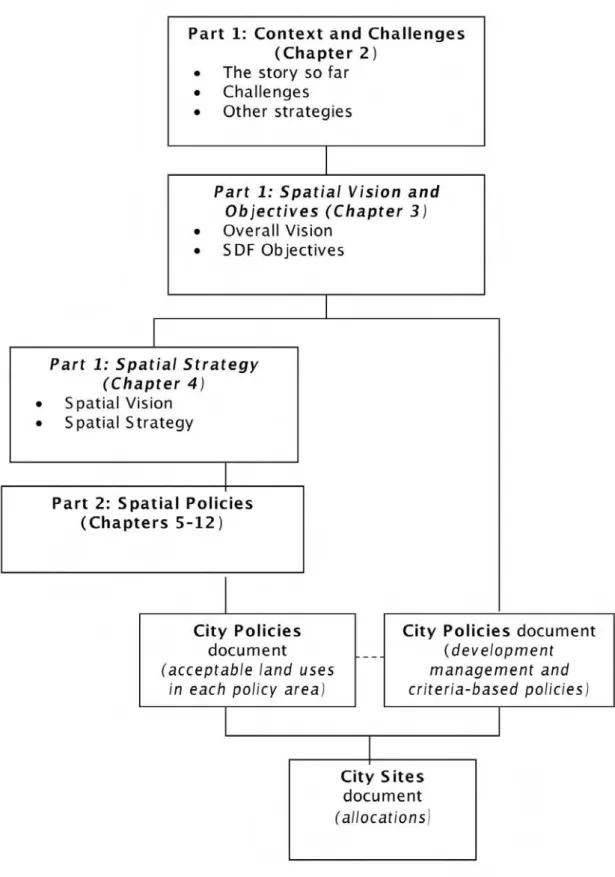
1.11 The structure of the Core Strategy reflects the structure of the overall Framework. The first two chapters present the context both for the spatial policies that form the greater part of the Core Strategy and also for the City Policies document. The structure is summarised in Figure1.1.
Chapter 1 : Page 2 Sheffield Core Strategy
Figure 1.1: Structure of the Core Strategy
Chapter 1 : Page 3 Sheffield Core Strategy
Chapter 1 : Page 4 Sheffield Core Strategy
PART 1: CONTEXT, VISION, OBJECTIVES
AND SPATIAL STRATEGY
Sheffield Core Strategy
Chapter 2 Context and Challenges
Sheffield: the story so far
2.1 Sheffield is at a turning point in its development and the purpose of the Sheffield Development Framework is to help shape the city’s continuing evolution over the period to 2026.
2.2 Sheffield’s origins as a major city lay in the wide range of local natural resources for making iron and steel, for which the city achieved world renown. As a result, heavy industry came to fill much of the three main valleys of the Don and Sheaf that converged on the old town centre. Rail connections drew its Pennine-edge location into the national network. Sheffield maintained its distinctive role as a steel city and centre of heavy manufacturing into the second half of the last century and steel and manufacturing continue to form an important part of the economy.
2.3 Early economic and population growth led to major physical expansion with densely built terraces close to workplaces in the valleys and less intensively developed, leafier, stone-built suburbs, mainly in the west. The new housing was supported by local services and facilities in district centres and the creation of extensive and attractive parks. These continue to be an important part of the city’s heritage.
2.4 The expansion of the city continued through much of the 20th century with the development of large Council estates with their planned neighbourhood centres in the north and south-east of the city. Private housing was built in other areas and significant segregation developed between the privately owned and publicly rented housing areas. This continues to affect the structure of the present housing market. Development extended well into Derbyshire, leading in 1967 to a major enlargement of the administrative area of the city to incorporate this and accommodate a large, planned extension to the south-east, at Mosborough. 2.5 The second half of the last century saw significant change and renewal. Much of the city
centre was rebuilt in the 1950s and 1960s. There was major clearance of 19th century terraces that had become unfit, with rehousing in outer estates. The opening of the M1 and the Sheffield Parkway helped to connect the city with the new motorway network whilst Sheffield went on to develop a national reputation for its public transport. The universities and hospitals expanded considerably, not only serving the city but also becoming national centres of excellence. Air quality improved dramatically. Conservation areas were designated, reflecting the heritage value of parts of the suburbs, and the natural setting of the city was given protection as Green Belt.
2.6 But, in the final two decades, the city entered a period of considerable upheaval. Closures of major steelworks and related manufacturing and engineering businesses led to a serious loss of jobs. Derelict sites opened up in the industrial valleys. The city began to explore new roles but the prospects for new commercial development were unpromising,
overshadowed by more successful neighbouring cities. When new jobs came, many were initially unskilled and low-paid. Shopping in the City Centre lost ground, comparing poorly with other major cities. Deregulation of public transport led to a marked fall in the use of the buses and traffic congestion became a problem in some corridors and approaches to the City Centre and at motorway junctions. Air quality worsened in areas of greatest traffic
Chapter 2 : Page 5 Sheffield Core Strategy
growth. Demand for housing in large parts of the north and southeast sectors of the main urban area declined seriously whilst the market in the southwest experienced overheating. 2.7 The city took early action to tackle these challenges. Redevelopment on the sites of former steelworks included the Meadowhall Shopping Centre and the Don Valley Athletics Stadium and Arena, whilst new businesses were developed on other sites in the Don Valley. A range of other sports and leisure activities were created in former industrial areas. Creative and cultural facilities developed in declining industrial inner areas. The Supertram network opened up sites in the Don Valley and improved connections with Mosborough. The gap between city and national levels of unemployment narrowed but it remained significant. By 1999, economic prosperity was still below 75% of average GDP for the European Union. 2.8 Following designation as a European Union Objective One area in 2000, the process towards
transformation has accelerated. Additional resources have been invested in the city and the results have become more visible. Implementation of the Objective One Integrated Development Programme and Sub-Regional Investment Plan has led to new investment and environmental improvements, as in the Heart of the City (including the Peace Gardens and the Winter Garden), around the City Hall and at the rail station. There is now a buoyant market for office space, with the growth of the administrative, financial and legal sectors in the City Centre. Businesses in metallurgy, bioscience and other knowledge-based sectors, often linked to the universities, are expanding. Major redevelopment and consolidation of the central shopping area is about to start in the New Retail Quarter. City Centre living, led by student housing schemes but now including more upmarket demand, is resulting in many new apartments. This is attracting demand for more services in the City Centre and providing an alternative use for industrial heritage buildings. Demand also continues to be strong for employment and associated uses in the Don Valley.
2.9 Transformation is extending deeper into the neighbourhoods. The Housing Market Renewal initiative is starting to raise demand and improve the wider environment in previously low-demand neighbourhoods. Wider mixes of housing are occurring in areas of formerly monochrome Council housing. Renewal initiatives are aiming to close the gap between the deprived and more affluent neighbourhoods by improving conditions in previously
disadvantaged areas.
2.10 A potential new strand in the city’s development is emerging in response to the urgent global challenge of combating climate change. Arising in part from the city’s green reputation based on its local environment, there are early initiatives to make a positive contribution to the global environment, for example, by promoting greener forms of design.
Challenges for the Future
2.11 The purpose of the Sheffield Development Framework is to support the next phases of the city’s ongoing regeneration by providing the statutory framework for guiding the spatial pattern of change, and the quality of the environment and forms of design. This will mean continuing and improving what has already been started and also anticipating the more recent trends in society and new needs and opportunities. The following challenges need to be addressed.
Chapter 2 : Page 6 Sheffield Core Strategy
2.12 Challenge 1: Economic transformation A key challenge in the face of decline of the older metal and related industries is to move from recent economic recovery to real transformation and so secure jobs for the future. This will mean increasing the proportion of the city’s economy in sectors with good growth prospects, such as in services,
knowledge-based businesses, advanced manufacturing and sustainable technologies. The challenge is to help provide land, services and environments that will draw investment and make the city attractive for skilled workers.
2.13 Challenge 2: Serving the city region Sheffield developed primarily as a large
manufacturing city rather than a fully operational regional centre. But there is now the need and opportunity to serve and support its wider region as an effective core city and this includes parts of north Derbyshire and north Nottinghamshire as well as traditional partner districts in South Yorkshire. This also requires good connections within the City Region and with other core cities and regions in terms of both transport and information networks. The challenge is to build on recent successes, to provide for new core city businesses, to support the strengthening of shopping, leisure and other services for the region and to improve sustainable communications with the rest of the region and beyond.
2.14 Challenge 3: Transforming housing markets Demand has increased in certain areas of the city such as the south-west, where the market has overheated, and it has declined seriously in others, such as the north and inner south-east, causing them to become run-down and to need revitalising. The challenge is to support ongoing programmes to help restore demand in those areas where it has grown weak and to enable them to contribute fully to meeting the city’s need for new housing.
2.15 Challenge 4: Successful, attractive neighbourhoods The older parts of the city have strongly defined neighbourhoods, some of which focus on district centres, and Sheffield is sometimes known as a city of villages. This structure contributes to the city’s distinctive character and sense of community. The challenge is about developing this legacy. Other areas are less well provided for, and these include many areas where the housing market needs revitalising. One way will be improving the neighbourhoods in which the housing is set, including environment and services. In both types of area the development and viability of district and neighbourhood services will need to take account of increasing mobility and the opportunities to choose alternative services further afield. The challenge is to promote neighbourhood identity and development and support district and neighbourhood services and facilities wherever opportunities arise.
2.16 Challenge 5: Opportunities for all This challenge relates to areas and to groups of people. Contrasts in quality of life between different parts of the city are partly a legacy of its history but continuing social diversity, based, for example, on class, income or ethnic grouping, can reinforce this. The challenge is to help close this gap. For example, new jobs should benefit areas of high unemployment and not just the already more successful communities. But, some groups of people are potentially disadvantaged regardless of the area they live in. Transformation of the city should mean all of its people enjoying the benefits. So, it should include providing for education and training for all who need it. A proportion of the population experiences mobility impairments and are disabled by inaccessible environments. Inclusive environments must be created that do not prevent them from fully participating in the life of their communities. The challenge is to improve the services available in disadvantaged areas and promote opportunities for housing, jobs,
Chapter 2 : Page 7 Sheffield Core Strategy
education and the meeting of other community needs, through inclusive design and in locations that are accessible for all who need them.
2.17 Challenge 6: Promoting health and well-being for all Safeguarding and renewal of the city’s neighbourhoods needs to take account of all aspects of the quality of life of those who live there, including safety, health and freedom from disturbance. In particular, Sheffield already has a high proportion of elderly people and longer life expectancy will lead to further ageing of the city’s population. Health and well-being mean providing for their needs, which will often benefit other groups as well. The challenge is to design environments that promote safety, health and a sense of well-being for all.
2.18 Challenge 7: Connecting up the city Higher incomes and greater economic specialisation will continue to increase the demand and need to travel. Rising expectations about individual choice and quality of life will also contribute to increased mobility. The different parts of the city need to be well connected for both people and goods to move about, enabling each part of the city to relate to other areas. This will complement connections to other parts of the city region and beyond. The challenge is, whilst also meeting objectives for reducing impacts on the environment, to help develop transport systems within the city to enable people and goods to move about conveniently.
2.19 Challenge 8: Efficient use of the transport network Connecting up the city will depend on making the best possible use of existing routes, given the limited physical scope for increasing roadspace and the impossibility of satisfying the high level of hidden demand by making small additions. The need is greatest where demand is highest, as around the City Centre, at the motorway junctions and in corridors, for example, in South-West Sheffield. Growth in traffic could lead to congestion that would frustrate the city’s aspirations for sustainable transformation. The challenge is to manage development and demand for travel to make the best use of available route capacity.
2.20 Challenge 9: Reducing the need to travel Whilst some growth in mobility will be essential for the future economy, the city can be made to work more effectively if the distances people need to travel can be contained or reduced. Motorised travel also contributes significantly to air pollution and to carbon emissions that give rise to climate change and these are increased if developments are unnecessarily dispersed. Many people would prefer to have a good range of more local facilities and services and the legacy of district centres, parks and other facilities can contribute to this. The challenge is to support and locate
developments so as to minimise the distances that people have to travel.
2.21 Challenge 10: Supporting sustainable transport For those trips that do have to be made a much greater proportion will need to be by walking, cycling and public transport. This would also make a significant contribution to reducing carbon emissions and air pollution, release roadspace to benefit all users and the economy as a whole, and provide for those without access to a car. It would therefore contribute to addressing several of the other strategic challenges for the city. Sheffield has already had experience of an excellent and well used public transport network but this legacy has suffered decline and much needs to be done to make sustainable transport a more genuinely attractive choice for the future. The challenge is to create an environment and transport network in which it becomes a more attractive choice to walk, cycle or travel by public transport.
Chapter 2 : Page 8 Sheffield Core Strategy
2.22 Challenge 11: Sustainable design and development Sheffield has the potential to generate much more of its own energy by sustainable means that reduce carbon emissions. The design and layout of buildings could contribute to a reduction in the consumption of energy and emission of greenhouse gases. Meanwhile, some change in climate is certain to occur and it will be necessary to adapt to this in the future development of the city. The challenge is to help, through the development process, to achieve the potential for reducing greenhouse gases and the impacts of climate change.
2.23 Challenge 12: Sustainable use of natural resources Responsible use of the city’s physical resources is a key part of a better future. Air and water pollution, noise, land contamination and dereliction have long blighted parts of the city at various times and affected people’s health and well-being and this is a legacy that needs to be remedied. Climate change means that the areas subject to flood risk are growing. Increasing
consumption tends to increase waste and its demands on land need to be minimised. The challenge is to help ensure that the physical environment is safe and healthy, that land is used efficiently and waste is minimised, recycled and processed sustainably.
2.24 Challenge 13: A city that prizes its green environment The setting of Sheffield in its ‘golden frame’, with its hills and valleys and the heritage of trees and parks, continues to be a major asset that is appreciated by residents and visitors alike. The natural environment with its variety of wildlife is valuable in its own right but can also contribute to the economic and social vitality of the city. The green spaces within the built-up areas make an important contribution to the life of the city. The challenge is to protect and enhance the city’s natural assets both to support the regeneration of the city and as features of value in their own right. 2.25 Challenge 14: A city with character Sheffield has a distinctive location, history and
townscape and this is a further potential key to its transformation. This will mean bequeathing to future generations the best of the legacy from the past, including its heritage as a
world-class steel producer. The challenge is to protect and enhance the best of its buildings, townscape and urban setting.
2.26 Challenge 15: Urban areas that look good and work well Major changes are already taking place to the appearance of the city, notably in the City Centre and in neighbourhoods needing renewal. These will continue, transforming both the image and reality of life and work here. This will involve planning and pressing for good design, safeguarding areas where the environment is already acceptable and supporting improvements in places that have become run-down. The challenge in all types of area is to ensure high-quality design and environments that reflect the needs of users of spaces and buildings and enhance the city as a whole.
Other Strategies
2.27 These are not just challenges for the Sheffield Development Framework. They are already being addressed in varying degrees by a range of strategies and policies at city, regional and national levels. They provide the policy context for the vision of the Sheffield
Development Framework and include the:
Sheffield City Strategy (Sheffield’s Sustainable Community Strategy, produced by the Sheffield First Local Strategic Partnership) and other strategies under its umbrella
Chapter 2 : Page 9 Sheffield Core Strategy
South Yorkshire Second Local Transport Plan 2006-2011 Housing Market Renewal ‘Pathfinder’ strategy
Sheffield City Region Development Programme element of the Northern Way South Yorkshire Spatial Vision
Regional Spatial Strategy (the Yorkshire and Humber Plan) Regional Economic Strategy
Securing the Future: the UK Government Sustainable Development Strategy National planning policy statements and guidance
2.28 The Sheffield City Strategy sets out the overall vision, aims and targets for the city and provides the wider context for a range of supporting partnership strategies and for the Sheffield Development Framework. In turn, the Local Development Framework provides the spatial expression of the Community Strategy. Reflecting this complementary relationship, the Sheffield Development Framework shares the vision of the City Strategy. This vision embraces the challenges set out in the previous section and is that:
Sheffield will be a successful, distinctive city of European significance at the heart of a strong city region, with opportunities for all.
Our approach to achieving this vision will be built upon three key principles:
Prosperity: We will actively seek to make the city competitive in economic terms, attracting investment and providing an environment that enables wealth to be created.
Inclusion: We will promote access to opportunities and services, so that all residents can take advantage of the benefits of living in the Sheffield area. S ustainability: Our actions will meet the needs of the present without compromising the ability of future generations to meet their own needs.
2.29 The City Strategy is developed around five themes, which are (1) Strong economy, (2) Successful neighbourhoods, (3) Inclusive, healthy communities, (4) Great place to grow up and (5) Environmental excellence. It sets out five big ambitions for Sheffield’s transformation, where gradual improvement is not sufficient and a ‘step’ change is needed over the next ten years:
Sheffield to have an economy that matches the best cities in Europe Sheffield to establish excellence in its public transport system
Every neighbourhood to be a successful neighbourhood
Everyone to be able to fulfil their potential through learning and enterprise Sheffield to be an attractive and sustainable, low-carbon city.
2.30 The Sheffield Development Framework is required to conform generally with the Regional Spatial Strategy. The draft Regional Spatial Strategy addresses many of the challenges identified above and its spatial vision includes:
Developing Sheffield as a major Regional Centre offering high order shops and services, as well as jobs and homes needed to serve its extended city region
Chapter 2 : Page 10 Sheffield Core Strategy
Focussing most new development on the four urban centres of South Yorkshire with particular emphasis on the city centres and inner areas
Supporting the role of Sheffield as a major provider of jobs and the regeneration of much of the City Centre, with a range of quarters, and further regeneration of the Don Valley
Supporting the roles of Chapeltown and Stocksbridge as Main Towns Maintaining the strategic extent of the South Yorkshire Green Belt
2.31 The Sheffield Development Framework has a statutory responsibility to “contribute to the achievement of sustainable development”. This is defined in the UK Sustainable
Development Strategy as enabling people throughout the world to satisfy their basic needs and enjoy a better quality of life, without compromising the quality of life of future generations. It identifies four priority areas for action:
Sustainable consumption and production Climate change and energy
Natural resource protection and environmental enhancement Sustainable communities.
2.32 Sustainable communities should embody the principles of sustainable development and should be:
Active, inclusive and safe Well run
Environmentally sensitive Well designed and built Well connected
Thriving Well served Fair for everyone.
2.33 The Sheffield Development Framework is required to integrate the strategic and policy themes of these and other documents and apply them to the spatial and land-use challenges for the city. The strands are brought together in the planning vision and objectives for Sheffield in Chapter 3 below.
Chapter 2 : Page 11 Sheffield Core Strategy
Chapter 2 : Page 12 Sheffield Core Strategy
Sheffield Core Strategy
Chapter 3 Vision and Objectives
The Spatial Vision
3.1 The spatial vision for the Sheffield Development Framework reflects the massive changes still needed to regenerate the city and it takes up two recurring themes in existing strategies. Both reflect the long-term nature of the strategy, which looks ahead to 2026. The first is transformation, as the city rises from the crises of recent decades into a new era of success. The second issustainability, ensuring that the change is indeed transformational and not just transitory. The twin message forms the core of the Sheffield Development Framework vision and both themes run through the City Strategy. There will sometimes be short-term tensions between these two guiding principles but the key to the long-term strategy is making them work together.
3.2 Transformation is about making Development Programme step changes that are at the heart of the visions of the Sheffield City Strategy’s and City Region. The structure of the economy needs to be transformed so that sectors with good growth prospects replace those that are static or declining. Radical change in the City will continue through the City Centre Masterplan and Regeneration Area Plans. There are still large areas where the housing market needs to be revived to make them places where more people want to live. This is the challenge for the Housing Market Renewal Pathfinder initiative in South Yorkshire, ‘Transform South Yorkshire’. Transformation is also about design and giving character and identity to areas that lack it. And it requires transport solutions that enable people to move about the city without creating unacceptable levels of congestion and pollution as the demand to travel continues to rise.
3.3 Sustainability provides the guiding principle for bringing together the challenges of economy, social inclusion, transport, the environment and resources into a single integrated strategy. The City Strategy has an ambition for Sheffield to be an attractive and sustainable low-carbon city. The Sheffield Development Framework has a critical role in this, encouraging patterns of land use, methods of travel, design of development and safeguards for resources and the natural environment that help to create sustainable-communities, and minimise harmful impacts on climate, wildlife, landscape and neighbourhoods. The spatial vision of the Sheffield Development Framework is as follows:
3.4 Sheffield will be a city that is both transformed and sustainable, and will:
1. be economically prosperous and attractive to business and new investment and
will sustain employment for all who seek it
2. enrich the Sheffield city region, as the most attractive and sustainable location
for regional services, jobs and facilities
3. have attractive, sustainable neighbourhoods where people are happy to live,
offering everyone a range of facilities and services
4. provide for opportunities, well-being and quality of life for everyone
5. enable people and goods to move conveniently and by sustainable forms of
transport
Chapter 3 : Page 13 Sheffield Core Strategy
6. respect the global environment, by reducing the city’s impact on climate change and by using resources and designing sustainably
7. prize, protect and enhance its natural environment and distinctive heritage and
promote high-quality buildings and spaces.
3.5 This spatial vision is developed in two ways, through:
Objectives to be achieved (set out below) that relate to the challenges and vision and apply to the whole of the Sheffield Development Framework. This includes the spatial policies of the Core Strategy and the development management policies of the City Policies document.
Aspatial strategyinformed by the objectives to show broadly how the city should develop geographically (Chapter 4).
SDF Objectives
3.6 This section outlines the objectives associated with each part of the overall vision and it groups them under the challenges for Sheffield identified in Chapter 2. It also shows how these objectives relate to the existing strategies and policies outlined in Chapter 2. These objectives establish the themes and direction for the Core Strategy and also for the other documents in the Sheffield Development Framework (see Figure 1.1).
A city that will be economically prosperous and attractive to business and new
investment and will sustain employment for all who seek it (Vision, part 1)
3.7 Objectives for Economic Transformation(Challenge 1):Conditions created for a balanced, diverse and sustainable high-growth economy in the Sheffield city region
S1.1
Provision for modern and high-technology manufacturing and knowledge-based services, including links with the universities and opportunities for the creation of dynamic business clusters
S1.2
Environments created, improved and conserved to attract business
investment, including high-technology manufacturing and knowledge-based services
S1.3
Housing provided to support economic transformation and provide for key workers
S1.4
Land provided for education and training facilities for developing a skilled workforce
S1.5
Cultural and leisure facilities and tourism expanded and improved. S1.6
3.8 These objectives relate strongly to the Sheffield City Strategy key principle of prosperity, its theme of a Strong Economy and its ambition to have an economy that matches the best cities in Europe. They also support the goal of High Employment and High Skills. They contribute to the Regional Spatial Strategy objective of regeneration of older areas and the City Region Development Programme theme of an innovative and creative economy. They also support enhancing the city's manufacturing strengths as identified in the Regional
Chapter 3 : Page 14 Sheffield Core Strategy
Economic Strategy. The objectives for economic transformation also take up the principle that sustainable communities are thriving ones.
A city that will enrich the Sheffield city region, as the most attractive and
sustainable location for regional services, jobs and facilities (Vision, part 2)
3.9 Objectives for Serving the City Region(Challenge 2):The City Centre and complementary areas regenerated as the core location for major expansion of business, shopping, leisure and culture
S2.1
Excellent connections with sub-regional, regional, national and international transport networks.
S2.2
3.10 These objectives reflect the role of the city as the successful core of a city region as presented in the vision of the Sheffield City Strategy, which sees Sheffield’s future in the context of a strong city region in which the city is a strong driver. The South Yorkshire Spatial Strategy recognises the need to focus new jobs and services in the main urban centres. The city region approach is supported by the Regional Economic Strategy and elaborated in the Sheffield City Region Development Programme. The draft Regional Spatial Strategy identifies Sheffield as a major Regional Centre offering high-order facilities to serve its extended city region. The review of the East Midlands Regional Spatial Strategy also identifies the districts of Bolsover, Chesterfield, NE Derbyshire and Bassetlaw as falling in Sheffield City Region. The transformed economy will be critical in achieving these objectives.
A city that will have attractive, sustainable neighbourhoods where people are
happy to live, offering everyone a range of facilities and services (Vision, part
3)
3.11 Objectives for Transforming Housing Markets(Challenge 3):
Successful housing markets across all tenures, in all areas of the city and increased demand for housing in currently deprived areas
S3.1
Unfit or low-demand housing replaced or improved so that everyone has the opportunity to live in homes that meet at least decency standards.
S3.2
3.12 These objectives support the Housing Market Renewal Pathfinder strategies and programmes of Transform South Yorkshire and their more detailed masterplans. They develop the City Strategy themes and contribute to the Regional Spatial Strategy objective of seeking wider housing opportunity and choice.
3.13 Objectives for Successful Neighbourhoods(Challenge 4):
Vital and successful neighbourhoods sustained, restored or created S4.1
Local economic and development initiatives promoted at the district and neighbourhood level to support local communities and small businesses S4.2
Chapter 3 : Page 15 Sheffield Core Strategy
Provision at district and neighbourhood level of local community, health, education, training, shopping, open space, leisure and other services and facilities.
S4.3
3.14 These objectives reflect the Sheffield City Strategy theme of Successful Neighbourhoods and contributes significantly to its ambitions for every neighbourhood to be a successful neighbourhood and for everyone to be able to fulfil their potential through learning and enterprise. They support the City Region Development Programme aspiration to an unrivalled quality of life and take up the principle that sustainable communities are active, thriving and well served. They are closely related to the challenge of Transforming Housing Markets supporting Housing Market Renewal and other neighbourhood renewal initiatives.
A city that will provide for opportunities, well-being and quality of life for
everyone (Vision, part 4)
3.15 Providing for all means meeting the needs of: People with low access to private transport
People on low incomes (who may or may not overlap with those with low access to private transport)
People requiring personal support services
People with physical disabilities, infirmities or ill-health Young children and their carers
Young people
Cultural minority groups (mainly Black or Minority Ethnic). 3.16 Objectives for Opportunities for All(Challenge 5):
Investment and renewal directed to neighbourhoods that lack adequate facilities and services or suffer from an unsatisfactory environment S5.1
The benefits of new development made available to those who are currently excluded or vulnerable
S5.2
Wider choice of housing provided through more mixing of housing types and tenures, to meet the needs of the whole community
S5.3
Workplaces located where they are accessible to all by a range of transport options, including from areas of high unemployment
S5.4
Services located, and buildings and the spaces around and between them inclusively designed, to be safe and safely accessible for all, including disabled people.
S5.5
3.17 These objectives take up the Sheffield City Strategy key principle of inclusion and its themes of Successful Neighbourhoods and Inclusive, Healthy Communities and they contribute to its ambition for everyone to be able to fulfil their potential through learning and enterprise. The objectives are not only about neighbourhoods with a high concentration of disadvantage but relate to all people in the city. They contribute to the Regional Spatial Strategy objective of social equity and inclusion and the City Region Development Programme aspiration of
Chapter 3 : Page 16 Sheffield Core Strategy
a vibrant and cosmopolitan community. They also take up the principle that sustainable communities are fair for everyone and inclusive.
3.18 Objectives for Promoting Health and Well-Being for All(Challenge 6):
A healthier environment, which includes space for physical activity and informal recreation and does not subject people to unacceptable levels of pollution, noise or disturbance
S6.1
A safer and more secure environment, minimising physical hazards and opportunities for crime
S6.2
Opportunities safeguarded for peaceful enjoyment of urban neighbourhoods and the countryside.
S6.3
3.19 These objectives reflect the Sheffield City Strategy’s key principle of inclusion and its theme of Inclusive, Healthy Communities, also taking in the issue of Low Crime. They relate to the Regional Spatial Strategy objective of limiting pollution to what is compatible with health and take up the principle that sustainable communities are active, inclusive and safe.
A city that will enable people and goods to move conveniently and by
sustainable forms of transport (Vision, part 5)
3.20 Objectives for Connecting up the City(Challenge 7):
Provision for transport and other services to improve accessibility for people getting to work and services
S7.1
Improved access by sustainable transport to areas for economic development. S7.2
3.21 These objectives contribute directly to the Sheffield City Strategy theme of a Strong Economy and the ambition for excellence in the public transport system. The City Region Development Programme envisages strong connections at every level. The objectives take up the principle that sustainable communities are well connected. Provision for additional and improved links in the short and medium term is set out in the South Yorkshire Local Transport Plan. 3.22 Objectives for Efficient Use of the Transport Network and Other Infrastructure
(Challenge 8):
Efficient use of existing transport and also of water, electricity, gas and telecommunications infrastructure
S8.1
Effective and efficient movement around the city, making best use of routes and ensuring development would not increase congestion unacceptably. S8.2
3.23 The objectives follow from the Sheffield City Strategy and sustainable communities feature of being Well Connected. They contribute to the Regional Spatial Strategy objectives of tackling traffic congestion and making the best use of existing infrastructure and reflect the emphasis of the South Yorkshire Local Transport Plan.
Chapter 3 : Page 17 Sheffield Core Strategy
3.24 Objectives for Reducing the Need to Travel(Challenge 9):
Development located to limit the distances people and goods need to travel, with mixing of land uses and increased opportunities for single journeys to serve several purposes
S9.1
High-density development focussed on the most accessible locations. S9.2
3.25 These objectives reflect national planning policy and complement the Sheffield City Strategy ambition for a sustainable, low-carbon city. They contribute to the draft Regional Spatial Strategy objective of minimising travel needs and relate to the UK Sustainable Development Strategy priority areas for action relating to consumption and energy. A crucial aspect of the objectives is applying them in the context of requirements for increased mobility and a potential tension is acknowledged here.
3.26 Objectives for Supporting Sustainable Transport(Challenge 10):
Improvements to public transport supported, and energy-efficient and low-polluting modes of travel given priority
S10.1
Walking and cycling encouraged by design of places and routes and by the location of facilities
S10.2
New development that generates significant trips carried out only in areas accessible by a choice of sustainable forms of transport.
S10.3
3.27 These objectives (relating mainly to public transport, cycling and walking) offer the principle way of resolving the imperatives of mobility on the one hand and the impacts on the environment, health and congestion on the other. In this, the Sheffield Development Framework works in conjunction with the South Yorkshire Local Transport Plan. The objectives contribute to the draft Regional Spatial Strategy objective about reducing transport related emissions and maximising use of energy-efficient modes. They reflect the key principle of sustainability in the Sheffield City Strategy and contribute to its ambitions to establish an excellent public transport system and for a sustainable, low-carbon city. Walking and cycling also contribute to the Inclusive, Healthy Communities theme of the City Strategy. Sustainable forms of transport tend to be the more widely available and reflect the principle that sustainable communities are inclusive and fair for everyone. The objectives also take up the principle that sustainable communities are environmentally sensitive.
A city that will respect the global environment, by reducing the city’s impact
on climate change and by using resources and designing sustainably (Vision,
part 6)
3.28 Objectives for Sustainable Design and Development(Challenge 11):
Developments laid out, designed and constructed to minimise carbon emissions and other harmful impacts on the climate and local environment, S11.1
to reduce obsolescence, to use energy efficiently and to work with natural processes throughout the lifetime of the building
Chapter 3 : Page 18 Sheffield Core Strategy
Renewable energy (including solar and wind power and biomass) generated in a variety of schemes and by new buildings, and in excess of regional targets
S11.2
The impact of flooding decreased by reducing surface water run-off; not developing in locations where flood risk is unacceptable, but where S11.3
development cannot be avoided and the probability of flooding is high, implementing appropriate mitigation measures.
3.29 These objectives engage directly with the challenges of climate change and energy
conservation and reflect the key principle of sustainability in the Sheffield City Strategy, its theme of Environmental Excellence and its ambition to be a sustainable, low-carbon city. They contribute to the draft Regional Spatial Strategy objective of addressing the causes and responding to the effects of climate change and they accord with the priority for action in the UK Sustainable Development Strategy about climate change and energy and to national planning policy on climate change.
3.30 Objectives for Sustainable Use of Natural Resources(Challenge 12):
Previously developed land and existing buildings in urban areas reclaimed and re-used for all types of development, in preference to greenfield land S12.1
Contaminated land restored S12.2
Air and water quality improved in excess of minimum requirements S12.3
Waste reduced, re-used, used for energy, composted or recycled and land requirements for disposal met but minimised.
S12.4
3.31 These objectives reflect the Sheffield City Strategy’s key principle of sustainability, its theme of Environmental Excellence and its ambition to be a sustainable, low-carbon city. They also support the theme of Inclusive, Healthy Communities, complementing the Air Quality Management Area initiative. They contribute to Regional Spatial Strategy objectives for making fuller use of urban land, limiting pollution and promoting the sustainable management of waste. They accord with the priority for action in the UK Sustainable Development Strategy of natural resource protection. They also take up the principle that sustainable communities are environmentally sensitive.
A city that will prize, protect and enhance its natural environment and distinctive
heritage and promote high- quality buildings and spaces (Vision, part 7)
3.32 Objectives for A City that Prizes its Green Environment(Challenge 13):
Natural and landscape features, including valleys, woodlands, trees, watercourses and wetlands, safeguarded and enhanced
S13.1
Biodiversity and wildlife habitats protected and enhanced throughout urban and rural areas
S13.2
Areas and features of particular ecological or geological value protected and enhanced
S13.3
Open space protected and improved and, where necessary, created S13.4
Chapter 3 : Page 19 Sheffield Core Strategy
Access to natural areas and countryside improved S13.5
A sustainable rural economy supported in the local countryside. S13.6
3.33 These objectives reflect the Sheffield City Strategy key principle of sustainability, its theme of Environmental Excellence and its ambition to be an attractive and sustainable city. They support the theme of distinctiveness in the City Region Development Programme. They contribute to the Regional Spatial Strategy objectives of protecting and enhancing natural assets and resources and of minimising the loss of the rural landscape, maintaining and, where possible, enhancing its diverse character. They also support the principle that sustainable communities are environmentally sensitive and the aims of the Sheffield Biodiversity Strategy.
3.34 Objectives for A City with Character(Challenge 14):
Enhanced character and distinctiveness of neighbourhoods, respecting existing local character and built and natural features to provide the context for new development
S14.1
Preservation and enhancement of buildings and areas that are attractive, distinctive or of heritage value in urban and rural settings
S14.2
The landscape and character of the villages and countryside, including the urban/rural fringe, protected and enhanced.
S14.3
3.35 These objectives take up the issue of distinctiveness in the Sheffield City Strategy vision and its theme of Environmental Excellence. They contribute to the Regional Spatial Strategy objective of protecting and enhancing historic and cultural assets and support the theme of distinctiveness in the City Region Development Programme.
3.36 Objectives for Urban Areas that Look Good and Work Well(Challenge 15)
High-quality and inclusiveness in all aspects of the design of new buildings and the spaces around and between them, with provision for everyone wishing to use them
S15.1
The built environment maintained and safeguarded in neighbourhoods where it is already acceptable
S15.2
New character and improved design and townscape in neighbourhoods where the environment has become run-down.
S15.3
3.37 These objectives also reflect the Sheffield City Strategy theme of Environmental Excellence and support the ambitions for every neighbourhood to be a successful neighbourhood and for Sheffield to be an attractive and sustainable city. They contribute to the Regional Spatial Strategy objective of making urban areas attractive, high-quality, safe places where people choose to live and they take up the principle that sustainable communities are well designed and built.
3.38 These objectives for design connect with those at the beginning of this chapter for a strong economy, illustrating the integrated nature of challenges and objectives for a comprehensive development strategy. Some of the objectives are most appropriately taken up by the spatial
Chapter 3 : Page 20 Sheffield Core Strategy
strategy and spatial policies that follow in this document. Others depend mostly on the more criteria-based policies in the City Policies document.
Chapter 3 : Page 21 Sheffield Core Strategy
Chapter 3 : Page 22 Sheffield Core Strategy
Sheffield Core Strategy
Chapter 4 Spatial Strategy
Introduction
4.1 The spatial strategy and policies are concerned with the kinds of places we want in different parts of the city, how areas relate and are connected to each other and how different needs and opportunities can be brought together in each area. The spatial strategy flows from the vision and objectives in Chapter 3 and provides the framework for the spatial policies in the rest of the Core Strategy (see Figure 1.1) and presented on the Key Diagram (see inside back cover).
Spatial Strategy
4.2 The major spatial outcomes of the vision of transformation and sustainability are as follows:
1. New development will be concentrated in the main urban area of Sheffield,
complemented by Chapeltown/High Green and Stocksbridge/Deepcar and will take place mainly on previously developed land. Average densities will be increased within the existing built-up areas rather than spreading out into the surrounding countryside, which will remain protected as Green Belt, and urban open space will be safeguarded. 2. The City Centre will be the driver for the transformation of the city’s economy, providing
sustainable new employment opportunities and excellent regional services, supported by sustainable transport and a high-quality environment.
3. The Lower and Upper Don Valleys will complement the City Centre, as primary locations for employment supported by a mix of related uses and providing for developments not appropriate in the City Centre.
4. The North-East and South-East Urban areas will have renewed housing markets and transformed environments and services. The character of all other housing areas will be safeguarded and distinctive heritage areas, in the west and elsewhere, will be conserved.
5. The outer built-up areas of Mosborough/Woodhouse, Chapeltown/High Green and Stocksbridge/Deepcar will continue to be served by jobs and services in the rest of the city but local provision will also be safeguarded and, where possible, expanded. 6. The surrounding countryside will continue to be protected from development and linked
with a network of green corridors, connecting river valley, parks, recreational areas and green spaces within the urban areas.
7. Sustainable forms of travel will enhance mobility in key corridors into the City Centre with improved public transport and provision for pedestrians and cyclists, supported by increased densities of development in centres and near high-frequency routes.
4.3 The implications of the spatial strategy and the objectives in Chapter 3 are outlined below.
Chapter 4 : Page 23 Sheffield Core Strategy
Overall Settlement Pattern
4.4 The priority for development will be in the main urban area. This includes all of the continuously built-up area and the suburban areas around the old village cores of Dore, Stannington, Grenoside, Ecclesfield, Woodhouse, Beighton and Mosborough. Development will also occur within the existing built-up areas of the separate settlements of
Chapeltown/High Green and Stocksbridge/Deepcar.
4.5 The future development of the city will be principally through the re-use of land within existing settlements rather than expansion into the countryside or into urban open space. Priority will be given to using previously developed land and existing buildings in urban areas, wherever possible, so long as they would be accessible by all forms of transport and relate well to neighbouring development and existing communities.
4.6 Local jobs, services and facilities to satisfy needs that can be met locally will be encouraged. A degree of self-containment will be supported in the Mosborough, Chapeltown and Stocksbridge areas but they will continue to be integrated with the opportunities of the wider District.
4.7 The settlement strategy supports the objectives for economic transformation, reducing the need to travel, supporting sustainable transport, sustainable use of natural resources and prizing the green environment.
The City Centre
4.8 The City Centre is recognised as a key economic driver for the City and the City Region. Since the late 1990's it has been the major focus for economic regeneration in the City, led by a City Centre Masterplan.
4.9 The City Centre is defined as the area within the Inner Relief Road together with the Kelham/Neepsend area (as shown on the Key Diagram).
4.10 The City Centre will play a crucial role in the transformation of the city’s economy and in the development of Sheffield’s role as the core city for its city region. It will be the focus for most new development of offices, shops, leisure, culture, higher education and other services.
4.11 The City Centre’s locational advantages will continue to be used to attract new businesses, including knowledge-based services, which will play a key role in transforming the economy and achieving sustainable employment. A large proportion of the new office development will be located here. The shopping area will be transformed to help it fulfil its role more effectively as the most accessible location for regional services from other parts of the city region and beyond. This concentration of development will help to increase the demand for, and quality of, public transport services. The strong market demand for housing in the City Centre will be harnessed to support and complement its primary role as a regional centre for jobs, shops and services. The distinctive historic character of the City Centre will be safeguarded and enhanced with an emphasis on the buildings associated with the Sheffield metal trades, which will be used as opportunities for regeneration initiatives.
Chapter 4 : Page 24 Sheffield Core Strategy
Improvements to the environment and design of the City Centre will continue to be made to help attract investors and users and to cater for the needs of all groups of people. 4.12 This emphasis supports the SDF objectives for economic transformation, serving the city
region, transforming housing markets and sustainable transport. It accords with the Sheffield City Strategy, the draft Regional Spatial Strategy and the requirements of sustainable development. The approach to land-use and transport will make the best use of finite road capacity, help contain congestion and moderate pollution and gases that contribute to climate change. This will be necessary to support SDF objectives for health and well-being, efficient use of the transport network and sustainable transport.
The Lower and Upper Don Valley
4.13 The Lower and Upper Don Valley will continue to complement the City Centre as strategic employment areas and will provide for businesses and workers that require different kinds of area from the City Centre. They will take advantage of current and proposed transport links and the relative attractiveness of the locations for developers. Specific gateway locations and routes will be improved to enhance the areas’ attractiveness. There will be additional locations for offices to complement the City Centre, near public transport
interchanges at Meadowhall and Hillsborough, and at Tinsley Park, where public transport provision will continue to be promoted. Development in these locations will be carefully managed to ensure that they remain complementary to the City Centre and do not detract from its primary role for new jobs and services.
4.14 Manufacturing will continue to be important in these areas, where it will be developed away from residential areas but in locations that can be reached by public transport.
4.15 Whilst business and industry will be the prime users of land in the Don Valley, they will be complemented by sports and leisure development that would not be appropriate in the City Centre or district centres. Meadowhall will continue to be a major regional draw but shopping space will remain at around its current capacity. Housing will be introduced in selected locations, subject to the creation of an acceptable living environment, including
Attercliffe/Darnall and the Infirmary Road/Langsett Road corridor and, potentially, at Meadowhall, to support regeneration of employment and provide for more homes close to workplaces.
4.16 Transport investment will be critical, including measures to offset potential congestion at motorway junctions 33 and 34 and ensure that air quality is acceptable. This will be necessary to support objectives for health and well-being, efficient use of the transport network and supporting sustainable transport. The Upper Don Valley will benefit from investment proposed for this corridor in the current Local Transport Plan.
4.17 This approach supports the SDF objectives for economic transformation with benefits for serving the city region, successful neighbourhoods and supporting sustainable transport. The Don Valley is identified in the draft Regional Spatial Strategy as a regeneration area and these locations will also provide for some more local employment from neighbouring residential areas experiencing regeneration.
Chapter 4 : Page 25 Sheffield Core Strategy