Inactive gap formation: An ERP study on the processing of extraction from adjunct clauses
Annika Kohrt, Trey Sorensen, Peter O’Neill & Dustin A. Chacón
∗Abstract.
Filler-gap (movement, extraction, displacement) dependencies are
pro-cessed
actively
, i.e., comprehenders anticipatorily commit to an interpretation of
the sentence before encountering bottom-up evidence. This suggests that
compre-henders make structural commitments to how a sentence will unfold shortly after
encountering a filler NP. However, the grammaticality of some filler-gap
depen-dencies may depend on semantic and pragmatic features of the sentence that are
not typically considered in studies on filler-gap dependencies. One particular case
is extraction from adjunct clauses, in which the filler NP may only grammatically
be understood as the object of a non-finite adjunct clause if the main verb is an
achievement predicate (e.g.,
What coffee did you arrive [ drinking
]?
Truswell
2011). We present evidence from an EEG study demonstrating that comprehenders
do not actively construct filler-gap dependencies in constructions such as these.
Instead, they “inactively” build the dependency, only after integrating semantic
information about the adjunct clause into the sentence.
Keywords.
psycholinguistics; semantics; syntax; neurolinguistics; filler-gap
depen-dencies; islands; EEG
1. Introduction.
In a sentence like (1), the phrase
the apple
is understood as the syntactic
object and semantic theme of the verb
eat
. To understand such filler-gap dependencies
1,
com-prehenders must simultaneously process the linguistic material intervening between the filler
phrase (
the apple
) and its resolution site while maintaining information about the dependency
in working memory. Top-down linguistic knowledge must also be used to identify possible
res-olution sites, e.g., identifying
ate
as a verb.
(1)
This is
the apple
that Ernie ate
.
Many results demonstrate that the psycholinguistic processes used to understand filler-gap
de-pendencies are
active
, i.e., comprehenders attempt to resolve the filler-gap dependency at the
earliest possible position in the sentence (Stowe 1986; Traxler & Pickering 1996). For
in-stance, in sentences like (2), Traxler & Pickering (1996) found increased reading times at the
verb
write
compared to controls, indicating that comprehenders had initially constructed an
analysis of the sentence in which
the city
was interpreted as the theme of the verb. However,
since
write
is not a verb that felicitously accepts
the city
as a theme, the resulting implausible
interpretation causes processing difficulty, either due to a subsequent reanalysis process or to
∗We would like to thank Jason Overfelt, Brian Reese, Claire Halpert, and Colin Phillips for comments and criti-cisms, and the audiences of the 31st CUNY Human Sentence Processing and the 54th Chicago Linguistics Soci-ety conferences for hearing earlier versions of this work. We’d also like to thank the Center for Advanced Trans-lational Sensory Sciences (CATSS) and the Minnesota Syntax-Psycholinguistics Laboratory at the University of Minnesota, and the Neuroscience of Language Lab at NYU Abu Dhabi. This work was supported by an Un-dergraduate Research Opportunity Program (UROP) award to Annika Kohrt. Annika Kohrt, University of Min-nesota ([email protected]), Trey Sorensen, University of Minnesota ([email protected]), Peter O’Neill ( [email protected]), Dustin A. Chac´on, New York University: Abu Dhabi ([email protected].)
1Also known as displacement, movement, or extraction dependencies. We will use the term “filler-gap dependency” when highlighting the aspects of relating a filler phrase and a later position over time, and “extraction” when
the surprisal of encountering this word. This increased processing cost is called
the plausibility
mismatch effect
.
(2)
This is
the city
that the author wrote enthusiastically about
.
Although active dependency formation processes are well-demonstrated, the precise
formu-lation of these processes has not been carefully described. For instance, they can be cast as
a prospective search for a resolution site that is launched shortly after encountering the filler
phrase, a re-ranking of preferred parses of the sentence (Frazier 1987; Frazier & Clifton Jr.
1989), or an anticipatory predictive process of upcoming syntactic/semantic material (Omaki
et al. 2015; Aoshima et al. 2004; Chac´on 2019). On this latter interpretation, the reason the
plausibility mismatch effect is observed in sentences like (2) is because, after encountering
the
city
, comprehenders build a sufficiently detailed analysis of the sentence in which
the city
is
interpreted as the theme of the verb and binds a projected gap in the direct object position, (3).
After encountering the verb
wrote
and incorporating it into this previously-constructed analysis,
comprehenders detect the implausible interpretation. Importantly, the plausibility mismatch
ef-fect demonstrates that comprehenders make a (syntactic and semantic) structural commitment
before
encountering the resolution site, i.e., the plausibility of the interpretation of the
depen-dency in the context of the sentence does not appear to assert an effect early in the processing
of the dependency (see also Omaki et al. 2015). Indeed, theories of active dependency
forma-tion privilege structural properties over, e.g., probability, plausibility, or predictability (Pritchett
1991; de Vincenzi 1991; Aoshima et al. 2004).
(3)
This is
the city
that. . .
Syntactic analysis: [
CPThis is [the city]i
[
CPOPi
that [
TPsubject
[
VPverb
i]]]]
Semantic analysis:
∃
x,e [city(x) & theme(e,x) &
verb
(e)]
Filler-gap dependency processes are active, but they are also selective. Although filler-gap
de-pendencies may cross indefinitely many words, (4-a), there are a set of grammatical
configura-tions that they may not cross without a significant reduction in acceptability, referred to as
syn-tactic islands (Ross 1967), (4-b). These phenomena are typically attributed to well-formedness
conditions on the representation of the sentence (Ross 1967; Chomsky 1977, 1981; Huang
1982; Uriagereka 1999; Rizzi 1990, 2013, but see Deane 1991; Kluender & Kutas 1993;
Klu-ender 1998; Hofmeister & Sag 2010). Importantly, evidence of active dependency formation
for filler-gap dependencies is not observed in island configurations. That is, comprehenders
only actively consider filler-gap dependencies that are also perceived to be acceptable. This
finding has been interpreted as reflecting a tight coupling between grammatical constraints and
processing strategies (Phillips 2006, 2013; Yoshida et al. 2014; Omaki et al. 2015). If filler-gap
dependency processing depends on fine-grained structural prediction mechanisms, as we
envi-sion, then such island-sensitivity can be characterized as a quick and accurate use of structural
information to distinguish possible vs. impossible predicted structures.
(4)
a.
This is
the apple
that Jodie knows . . . [ that Ernie ate
].
b.
*This is
the apple
that Jodie wonders [ whether Ernie ate
].
Although island phenomena are typically cast as syntactic constraints, (compositional and
con-ceptual) semantic and pragmatic factors are observed to affect the patterns of acceptability
(Goldsmith 1985; Lakoff 1986; Kehler 2002; Truswell 2007a, 2011; Szabolcsi 2006; Ambridge
& Goldberg 2008). Here, we specifically focus on the status of adjunct clauses.
Tradition-ally, tensed adjunct clauses are thought to be syntactic islands (Huang 1982; Chomsky 1986;
Cinque 1990; Uriagereka 1999), due to facts like in (5).
(5)
a.
This is
the apple
that Ernie said [that he wanted to eat
]
b. ?*This is
the apple
that Ernie cried [because he wanted to eat
]
c. ?*This is
the apple
that Ernie slept [before he ate
]
d. ?*This is
the apple
that Ernie smiled [while he ate
]
However, Robert Truswell has identified a number of semantic factors that modulate the
ac-ceptability of extraction from adjunct clauses (Truswell 2007a,b, 2011). For instance,
extrac-tion from a tensed adjunct clause is perceived to be worse than extracextrac-tion from an untensed
one, (6). Among untensed adjunct clauses, extraction from a predicate denoting an activity (in
the sense of Vendler 1967;
eating the apples
) is more acceptable when the main predicate is an
achievement (e.g.,
arrive
), rather than another activity predicate (e.g.,
work
), as in (7).
(6)
a. ?These are
the apples
that Ernie smiled [while eating
]
b. *These are
the apples
that Ernie smiled [while he ate
]
(7)
a. ?These are
the apples
that Ernie arrived [ eating
]
b. ?*These are
the apples
that Ernie worked [ eating
]
To
account
for
such
contrasts,
Truswell
proposed
that
extraction
from
an
adjunct
clause
is
grammatical
if
it’s
possible
to
construe
the
main
and
adjunct
predicates
as
codescribing
the
same
event.
Formally,
this
may
occur
if
the
event
variable
introduced
by
the
adjunct
clause
can
be
identified
with
the
event
variable
introduced
in
the
main
clause
(Kratzer
1996).
For
in-stance,
extraction
from
tensed
adjuncts,
(6-b),
is
perceived
to
be
worse
than
untensed
adjuncts,
because
the
event
variable
introduced
by
the
adjunct
clause
is
bound
by
the
existential
quan-tifier
introduced
with
tense,
(8),
thus
preventing
event
identification.
More
crucially
for
our
study,
the
contrast
in
(7)
is
explained
by
appealing
to
the
representation
of
achievement
pred-icates.
Following
Higginbotham
(200
9
),
Truswell
proposes
that
achievement
predicates
2con-tain
an
unbound
event
variable,
corresponding
to
the
events
or
state
of
affairs
preceding
the
event
of
culmination
lexicalized
by
the
predicate,
(9-a).
Thus,
the
event
variable
introduced
by
a
non-finite
adjunct
clause
containing
an
activity
predicate
can
be
identified
with
this
extra
main
clause
event
variable,
yielding
a
macro-event,
represented
by
E
in
(9-b).
This
mode
of
composition
is
unavailable
when
the
main
verb
is
an
activity
predicate,
(9-c).
(8)
J
the apples that Ernie smiled while he ate
K
=
λ
y.
∃
e[smile(e) & agent(e,ernie)] &
∃
e
0[eat(e
0) & theme(e
0,y) & apples(y)]
(9)
a.
J
arrive
K
=
λ
e.arrive(e) & E[
h
e
0,e
i
]
2Truswell also distinguishes betweentrue achievementsandpoints. True achievements lexicalize a culimnation point, and imply a previous process (represented as the unbound event variable), whereaspointlack this previous process. This can be seen in (i), adapted from (Truswell 2007b, 2011) in which the true achievementreach the sum-mitdenotes the pre-culmination process when put in the progressive aspect, whereas the pointnoticingdoes not. The analysis sketched here only applies to true achievements.
(i) a. I’m reaching the summit as we speak b. I’m noticing the problem as we speak
b.
J
arrived eating
K
=
λ
x.
∃
e,e
0[arrive(e) & E[
h
e, e
0i
] & eat(e
0) & theme(e
0,x)]
c.
J
worked eating
K
=
λ
x.
∃
e,e
0[work(e) & eat(e
0) & theme(e
0,x)]
Although the form of explanation for the contrasts above focuses on the nature of the
composi-tional semantics of the main and adjunct predicate, Truswell (2011) is cautious to observe that
aspects of pragmatics and world knowledge are relevant for determining the island status of an
adjunct clause as well. For instance, (10-b) is less acceptable than (10-a), because the event of
dripping mud on a carpet is unlikely to precede an event of entering a home, given the world
knowledge that carpets are usually indoors and not outdoors. Thus, aspects of the
composi-tional semantics (tense, lexical aspect) appear to interact with world knowledge in determining
whether a given filler-gap dependency is perceived to be acceptable. If these generalizations
are robust, then this suggests that the island status of adjunct clauses is affected by factors that
are not typically considered in theories of filler-gap dependency processing.
(10)
a.
This is
the carpet
that John exited the house [ dripping mud on
]
b.
This is
the carpet
that John entered the house [ dripping mud on
]
In our work reviewed in the next section (Kohrt et al. 2018, 2019), we have sought to
charac-terize the psycholinguistic processes involved in understanding filler-gap dependencies crossing
into adjunct clauses. Specifically, we were interested in seeing whether comprehenders were
capable of leveraging aspects of the semantics of the main predicate to selectively project a
gap in an adjunct clause. We wanted to know whether, before hearing the verb
drinking
in
a sentence like (11), comprehenders actively considered an interpretation in which
the coffee
would then be interpreted as its object.
(11)
John prepared
the coffee
that his best friend arrived at the office [
Adjunct CPdrinking
]
For sentences of this type, we failed to find the typical processing profile associated with
filler-gap dependencies. Instead, we found a novel pattern of results
3, in which processing time
in-creased for plausible filler-gap dependencies in configurations, i.e., there was an additional
processing cost associated with a plausible interpretation, rather than an implausible one. We
argued that this reflected bottom-up, “inactive” dependency completion, which we attributed
to the unusual status of extraction from adjunct clauses generally. In this paper, we strengthen
the empirical basis for this novel pattern of results by replicating this effect using
electroen-cephalography (EEG), and relate it to the broader question of what kind of parsing strategies
underpin filler-gap dependency processing.
2.
Previous findings
.
In
previous
work,
we
examined
whether
the
reported
contrast
in
(7)
is
reflected in real-time sentence processing. In contrast to much of the work on the processing
of filler-gap dependencies characterizes the processes in syntactic terms, we sought to
deter-mine whether comprehenders were capable of using semantic features of the sentence to
selec-3Colin Phillips (p.c.) points out that an increase in processing time associated with a plausible interpretation has been found for other dependencies. For instance, Kazanina & Phillips (2010) found that reading times increased in processing a cataphoric dependency (“backwards anaphora”, a coreference relation in which the pronoun precedes the antecedent) that violates a grammatical rule of Russian. They argued that this pattern of results indicates that comprehenders initially built the illicit interpretation, and then ruled it out using grammatical knowledge as a filter.tively project a gap in an adjunct clause. One hypothesis that we considered was that
compre-henders pursued a permissive strategy, and considered every non-finite adjunct clause as a
pos-sible host for a gap. This predicted evidence of active dependency formation in all non-finite
adjuncts, regardless of the identity of the main verb. Alternatively, we hypothesized that
com-prehenders could selectively apply active gap formation in non-finite adjunct clauses depending
on the semantic aspects of the previous verb phrase. If so, we predicted evidence of active gap
formation in non-finite adjunct clauses, but only if the previous verb was an achievement. This
analysis would imply that comprehenders could quickly incorporate some semantic information
into the analysis, and use this information to revise a predicted structure.
To test this, we conducted two self-paced reading experiments (reported in Kohrt et al.
2018 and Kohrt et al. 2019), using a plausibility mismatch paradigm, exemplified in (12). We
expected to find increased reading times associated with the implausible filler-gap
dependen-cies (
the report
. . .
drinking
) compared to the +Plausible controls. We did not find evidence of
a plausibility mismatch effect in the comparison of the levels of
±
Plausibility within the
lev-els of
±
Composable. Instead, we found that processing time increased when the filler was a
plausible argument, i.e., a “reverse” plausibility mismatch effect.
(12)
a.
+P
LAUSIBLE, +C
OMPOSABLEJohn prepared
the coffee
that his best friend
arrived
at the office [
Adjunct CPdrink-ing yesterday afternoon ]
b.
+P
LAUSIBLE,
−
C
OMPOSABLEJohn prepared
the coffee
that his best friend
worked
at the office [
Adjunct CPdrink-ing yesterday afternoon ]
c.
−
P
LAUSIBLE, +C
OMPOSABLEJohn prepared
the report
that his best friend
arrived
at the office [
Adjunct CPdrink-ing yesterday afternoon ]
d.
−
P
LAUSIBLE,
−
C
OMPOSABLEJohn prepared
the report
that his best friend
worked
at the office [
Adjunct CPdrink-ing yesterday afternoon ]
As a
post hoc
interpretation of this result, we suggested that comprehenders do not initially
at-tempt to build a filler-gap dependency into an adjunct clause. Instead, the semantic information
of the filler phrase is maintained while the adjunct clause is integrated into the syntactic and
semantic analysis of the sentence, (13-a). In the case of processing an achievement predicate,
integrating the adjunct clause into the global analysis of the sentence then cues the
construc-tion of a macro-event, which may also require accessing informaconstruc-tion about world knowledge
from memory, (13-b). If the filler NP is a suitable theme of the event described by the adjunct
event and this resulting macro-event, then comprehenders construct a gap in a “bottom-up”
manner, given that the main predicate-adjunct predicate complex codescribes a single event,
(13-c). This extra step in accommodating an otherwise unlicensed gap triggers increased
pro-cessing time.
(13)
a.
Step 1:
Maintain filler phrase, process adjunct clause:
Syntax
: [the coffee
i. . . [
VP[arrive] [drinking] ]
Semantics
: . . . arrive(e) & drink(e
0) & coffee(x)
b.
Step 2:
Relate events:
Syntax
: [the coffeei
. . . [
VP[arrive] [drinking] ]
Semantics
: . . . arrive(e) & drink(e
0) & coffee(x) & E[
h
e,e
0i
]
c.
Step 3:
Bottom-up gap identification:
Syntax
: [the coffeei
. . . [
VP[arrive] [drinking
i] ]Semantics
: . . . arrive(e) & drink(e
0) & coffee(x) & E[
h
e,e
0i
] & theme(e
0,x)
This contrasts with our model of typical filler-gap dependency processing in several ways.
First, instead of anticipatorily building a syntactic and semantic analysis to accommodate the
resolution of the filler-gap dependency, comprehenders construct a resolution site for the
de-pendency only after processing some of the adjunct clause. Additionally, instead of using the
presence of the filler-gap dependency to project a partial semantic structure that may result
in an implausibility, we propose that comprehenders incorporate plausibility information first,
while relating the (sub)vents described by the main clause and the adjunct clause, and then
se-lectively resolve the dependency. In other words, whereas typical filler-gap dependency involve
early commitment to specific structures which then can be either quickly confirmed or
discon-firmed, processing filler-gap dependencies resolving into an adjunct clause is a slower process
that is gated initially by building a semantic (and conceptual) representation.
However, the fine-grained interpretation that we gave these results is underdetermined by
the results themselves, e.g., there is no distinct signal in the data indexing initial surprisal that
the verb does not match the initially predicted structure vs. the hypothetical later bottom-up
gap completion process we described above. For this reason, we opted to use EEG, due to its
increased temporal latency and its increased dimensionality which allows for distinguishing
different phases of processing. Previous EEG studies on the processing of filler-gap
dependen-cies show electrophysiological activity indexing the completion of the filler-gap dependency
within several hundred milliseconds of encountering the verb, described in the next section.
However, we show that the event-related potential (ERP) record for sentences like (12) do not
diverge until significantly later than this, consistent with the inactive, meaning-driven,
bottom-up parsing strategy that we sketched above.
3. Experiment.
3.1. R
ATIONALE. The goal of the experiment is to determine whether comprehenders
ac-tively build filler-gap dependencies into adjunct clauses. Previous self-paced reading results
failed to demonstrate evidence of active dependency formation, but instead yielded an increase
in processing time for plausible sentences, which we interpreted as evidence of a bottom-up
mode of composition. However, because self-paced reading data depends on a motor response
that may not be closely time-locked with comprehension processes, it does not give a
high-resolution snapshot of the distinct phases of processing. Thus, we chose to conduct an EEG
study, because this technique has higher temporal resolution. Plus, EEG provides different
in-dices of processing (“ERP components”), which provide a more detailed picture of the
under-lying mechanisms.
Much of the discussion above has focused on the initial detection of the plausibility of
a filler-gap dependency as detected in reading times. However, Garnsey et al. (1989)
demon-strated a similar sensitivity to (im)plausibility of a filler-gap dependency in EEG. They found
that, at the verb
called
, the amplitude of the N400, a negative-going deflection that peaks around
400ms after onset of stimulus, was larger in sentences like (14-a) than in (14-b), which they
N400
P600
Later
Active-gap formation
Effect
of
−
Plausible
Effect of
+
Composable
Inactive-gap formation
Effect of
+
Plausible,
+
Composable
Table 1. Predicted results on N400 and P600 component.
attributed to the difference in plausibility of the filler-gap dependency at this point in the
sen-tence. The N400 component has traditionally been understood to index difficulty in
incorpo-rating a word or phrase into the semantic representation of the sentence (Kutas & Federmeier
2011). However, this interpretation remains controversial, e.g., amplitude of the N400
compo-nent may instead index difficulty in accessing a lexical item, with sentence-level predictions
facilitating or inhibiting these processes (Lau et al. 2008). Regardless of the precise
interpre-tation of this component, this result demonstrates that in typical active dependency formation
situations, comprehenders have incorporated some information about the relation between the
filler phrase and the verb before 200-400ms post-onset of the verb.
(14)
a.
The businessman knew
which article
the secretary
called
at home
b.
The businessman knew
which customer
the secretary
called
at home
Another component that has been identified as reflecting filler-gap dependency processes is
the P600, a positive deflection that typically begins around 600ms after onset of the
stimu-lus, which is observed in many contexts that trigger processing difficulty (King & Kutas 1995;
Kaan et al. 2000; Phillips et al. 2005; Gouvea et al. 2009). For instance, the P600 is observed
upon completion of a filler-gap dependency, and the latency of the component is affected by
the length of the dependency (Phillips et al. 2005). Thus, differences in the latency and
am-plitude of the P600 component may reflect differences in whether or when a filler phrase is
integrated into the gap site.
If comprehenders are capable of actively completing a filler-gap dependency into an
ad-junct clause, then we predict that the amplitude of the N400 component should increase for
implausible filler-gap dependencies over plausible ones, replicating the early sensitivity to
plau-sibility reported by Garnsey et al. (1989). Similarly, if comprehenders only selectively build
filler-gap dependencies into adjuncts if the previous verb was an achievement predicate, then
we predicted an effect of
±
Composability on the P600 component. By contrast, if
comprehen-ders complete filler-gap dependencies in the bottom-up fashion sketched in (13), then we
pre-dict that the ERP signal of our sentences should be similar until significantly later, e.g., after
800-1000ms. That is, if the psycholinguistic processes involved in resolving a filler-gap
depen-dency into an adjunct clause are dependent on integrating the meaning of the adjunct clause
into the analysis first, then we predict that the effect should follow the traditional
language-related ERP components associated with processing the adjunct clause verb. These predictions
are sketched in Table 1.
3.2. M
ATERIALS. We prepared 144 sets of items, with 4 items per set, using the same
de-sign as presented in (12). Each item consisted of a preamble (
John prepared
), followed by a
filler NP that was either a plausible theme of the verb located in the adjunct clause (
the coffee
,
+
Plausible) or not (
the report
,
−
Plausible). Following this, there was a relative clause
pro-noun (
that
), followed by a 3-word subject NP (
his best friend
), then either an achievement verb
(
arrived
,
+
Composable) or an activity or accomplishment verb (
worked
,
−
Composable).
Af-terwards, there was a three-word long PP (
at the office
). We tried to keep these PPs the same
across conditions within each item set, but this was not possible in all items due to the
argu-ment structures of the previous verb. However, the final word in this PP was the same across
all conditions. Afterwards, the critical region was the non-finite adjunct clause verb (
drinking
),
following by a 2 or 3 word spillover region (
late this afternoon
), which were identical across
conditions within each item set.
The verbs that we selected for the main verbs and for the adjunct verbs were controlled,
such that the
+
Composable verbs were always paired with the same
−
Composable verbs across
item sets. The pairs of main verbs were
arrive/work
,
reach/wait
,
leave/chat
,
enter/play
,
exit/ride
,
and
go/watch
. This meant that there were 24 sets of items associated with each pair of verbs.
We also sought to make the identify of the adjunct verb less predictable by counterbalancing
which non-finite adjunct verb was paired with which main verbs. There were six verbs we
used for this,
drinking, reading, singing, drawing, eating, knitting
. These verbs were selected
because they are equally interpretable as a transitive verb (i.e., with the filler NP as its direct
object) or as intransitive. This design choice was made to avoid forcing participants to
inter-pret the filler-gap dependency as resolving with this verb solely due to its transitivity
require-ments. Counter-balancing these features across all items resulted in 5 sets of items per pair of
adjunct verbs and main verb pair.
We also included 256 complexity-matched fillers, with 50% containing minor grammatical
violations, semantic anomalies, or both. The items were distributed in a
2
×
2
Latin Square
design, such that each participant saw one item from each set of items, and all the filler items.
3.3. M
ETHODS. Participants (
N
= 24
) from the University of Minnesota community sat in
a dimly lit, sound-proof room in front of a computer at the Center for Advanced Sensory
Sci-ences (CATSS). We affixed a 32 Ag/Cl electrode BioSemi cap to the participant’s scalp, and
applied conductive gel to keep each electrode’s resistance below 40 k
Ω
. Afterwards,
partici-pants were instructed to silently read sentences displayed on the screen. The sentences were
displayed in a rapid serial visual presentation (RSVP) design, in which each word
automat-ically displayed one at a time for a fixed duration of 500ms, with an 83ms word
inter-val. The last word of each sentence lasted for 900ms. Electrical potentials were recorded in
real-time, referenced to two electrodes affixed to the mastoids. Twenty percent of trials were
followed by a comprehension, and participants responded using the keyboard to provide a
re-sponse.
Participants were given feedback on the screen if they made an incorrect answer. After the
other 80% of trials, participants were instructed to press a key to advance to the next sentence.
Each sentence was preceded by a fixation cross which also appeared for 500ms. Sentences
were displayed in a random order, in 4 distinct blocks. From start to finish, the task took
ap-proximately 90 minutes. Participants were allowed to take breaks between each block, and
they communicated with the researcher through a baby monitor. Participants were compensated
20USD per hour for their time.
3.4. R
ESULTS. Before analysis, we applied a 1Hz high-pass FIR filter to the raw EEG
100ms before onset of the adjunct verb (
drinking
) to 1600ms afterwards, which contains the
next two words in the spillover region. The epochs were baselined to the average potential
100ms before onset of the adjunct verb. This word was identical within each item set across
conditions. Then, we automatically rejected epochs that exceeded a peak-to-peak threshhold of
150 mV. Three subjects had a large artefact rejection rate, and thus were excluded from
analy-sis. Two additional subjects were removed due to poor recording quality. After epoch rejection,
we then applied ICA correction to remove eye-blinks and other periodic artefacts.
We began by analyzing the traditional language-related ERP components. First, we
aver-aged each subject’s voltage at each electrode within two critical time windows: the N400 time
window (300–500ms) and the P600 time window (600–800ms). Then, we divided the
elec-trodes into 2
×
2+1 regions – left posterior (P7, P3, PO3, O1), right posterior (P8, P4, PO4,
O2), left anterior (F7, F3, AF3, Fp1), right anterior (F8, F4, AF4, Fp2), and midline (Fz, Cz,
Pz, Oz), excluding other electrodes. We then conducted two linear mixed effects models using
the lmer package in R (Bates et al. 2015; R Core Team 2017). The first mixed effects model
that we conducted had a
2
×
2
×
2
×
2
structure, with Laterality (left, right), Anteriority
(an-terior, posterior),
±
Plausibility, and
±
Composability as factors, and with participant as random
effect in these two time windows. Then, in the midline electrodes, we conducted a
2
×
2
linear
mixed effects model with
±
Plausibility and
±
Composability as factors and with participant as
a random effect.
In the N400 time window, the first mixed effects model indicated that voltage was more
negative over the entire scalp for
+
Plausible filler-gap dependencies (
β
=
−
0.80
, SE
= 0.39
,
t
=
−
2.0
,
p
= 0.04
), and
+
Plausible,
−
Composable sentences had more negative voltage in
posterior regions (
β
=
−
1.59
, SE
= 0.79
,
t
=
−
2.0
,
p
= 0.04
). However, no post-hoc pairwise
comparison conducted on this model within any of the factors was significant (
p >
0.05
).
Sim-ilarly, the mixed effects model fit to the midline electrodes had no significant intercept in this
time window (
p >
0.05
). Thus, although there were significant intercepts in the first model,
it is difficult to interpret this as a traditional N400 effect. This is because voltage was more
negative for plausible filler-gap dependencies, whereas typically N400 amplitude is more
nega-tive for words that are implausible, surprising, or unpredictable given the context. Additionally,
the N400 effect is typically observed over midline electrodes, but the significant interaction
intercept in the model suggested that the effect was driven by posterior electrodes, which is
an atypical scalp distribution for an N400 effect. The lack of traditional N400 effect is
under-scored by the lack of significant effect in the midline electrode model, where the effect would
be expected.
In the P600 time window, there were no significant intercepts in the first model (
p >
0.05
). However, the midline model showed that voltage was more negative for
−
Composable
conditions (
β
=
−
1.33
, SE
= 0.47
,
t
=
−
2.9
,
p <
0.01
). Pairwise comparisons revealed that
voltage was more positive for
+
Composable conditions over
−
Composable conditions within
both levels of
±
Plausible (
p <
0.05
), suggesting that this is an effect of the combination of the
two verb phrases, and thus does not necessarily reflect any interaction between the plausibility
of the filler-gap dependency and the identity of the previous verb phrases. Thus, this
appar-ent P600 effect may reflect processes relevant to syntactically or semantically combining the
adjunct clause to the preceding clause, not necessarily the integration of the filler NP into the
analysis.
Figure 1. Average voltage by region across conditions. Error ribbons correspond to two
stan-dard errors from the mean. Grey areas correspond to N400 time-window (300–500ms) and P600
time-window (600–800ms). Stars indicate that pairwise comparisons conducted on linear mixed
effects model revealed a significant effect in this time window. Voltages were low-pass filtered at
20Hz for graphing purposes only.
that seeks to find contiguous points in time and space (electrodes) that are exchangeable, then
conducts the significance testing within this cluster (Maris & Oostenveld 2007). This
tech-nique is useful when there is no specific spatial or temporal region that we expect to find an
effect in
a priori
. We conducted cluster-based permutation tests in 4 distinct time windows
from the onset of the verb, 500ms length each, excluding the first 10ms from onset of the
crit-ical verb to and the last 10ms of the final time window. The permutation test had a minimum
time of 10ms for the clusters, an
α
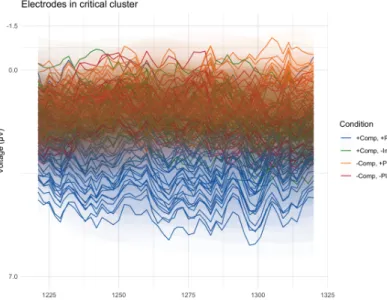
-level of 0.05, and used 5000 samples. We found a cluster
that ranged from 1236–1309ms over 21 electrodes. Spatially, this cluster was distributed over
most of the scalp, but had the strongest effect in the posterior left quadrant, around electrode
CP5. Within this cluster, there was a marginally significant interaction between
±
Plausibility
and
±
Composability (
p
= 0.09
). Although this cluster was only 70ms long, visual inspection
revealed that many electrodes appeared to demonstrate a sustained positivity for
+
Plausible,
(a) Average voltage of all electrodes across conditions in the
critical time window. (b) Scalp distribution of cluster.
(c) Average voltage by condition in electrode CP5, a representative elec-trode. The time window in grey corresponds to the time window identified in this analysis.