Undergraduate Honors Theses Psychology Department
2017
Attentional Bias Measured in the Addiction Stroop
Task for Problem Internet Gamers
Samantha Marie Rundle Western University, [email protected]
Follow this and additional works at:https://ir.lib.uwo.ca/psychd_uht
Part of theApplied Behavior Analysis Commons,Clinical Psychology Commons, and theOther Psychology Commons
This Dissertation/Thesis is brought to you for free and open access by the Psychology Department at Scholarship@Western. It has been accepted for inclusion in Undergraduate Honors Theses by an authorized administrator of Scholarship@Western. For more information, please contact [email protected], [email protected].
Recommended Citation
Rundle, Samantha Marie, "Attentional Bias Measured in the Addiction Stroop Task for Problem Internet Gamers" (2017).
Undergraduate Honors Theses. 31. https://ir.lib.uwo.ca/psychd_uht/31
Attentional Bias Measured in the Addiction Stroop Task for Problem Internet
Gamers
Samantha M. Rundle
Honours Psychology Thesis
Department of Psychology
University of Western Ontario
London, Ontario, CANADA
April, 2017
Abstract
The current study aims to determine the relationship between individuals’ attentional bias scores, measured in a modified Addiction Stroop task, with four other variables; level of involvement in Internet games, impulsivity, behavioural inhibition/activation, and sensation seeking.
Recruitment was gathered through the Psychology Sona Research Participation Pool at Western University and was exclusive to male, English speaking, non-colour blind individuals.
Participant’s completed a version of the Addiction Stroop task modified for assessment of attentional bias related to Internet gaming. Additionally, participants completed five
questionnaires: a Demographics form, the Problem Online Gaming Questionnaire (POGQ), the Barratt Inhibition Scale (BIS), the Behavioural Inhibition/Activation Systems Scale (BIS/BAS), and the Sensation Seeking Scale (SSS). E-prime measured participants’ reaction times to target and matched control words in a modified Addiction Stroop task. Results suggest that higher levels of involvement with Internet games are significantly correlated with attentional bias. This correlation is shown by highly-involved individuals having slower reaction times to target words in comparison to matched control words in the modified Addiction Stroop task. BIS scores and the inhibition factor of the BIS/BAS were significantly correlated with participant’s level of involvement with Internet games. In conclusion, results suggest that individuals with higher levels of involvement with Internet games display attentional bias indicating another similarity between Internet gaming disorder (IGD), substance use, and gambling disorders.
Attentional Bias Measured in a Modified Addiction Stroop Task for Internet Gamers
Electronic devices have shifted children’s play from outside in the real world, to inside on computers in the virtual world. Statistics show that in 2012 over one billion individuals played Internet games (Kuss, 2013). Over the last few decades, Internet gaming disorder (IGD) has become a mental and public health concern around the world (Zhang et al., 2016;
Subramaniam et al., 2016). Although the operational definition of IGD is not concrete, most researchers have adopted the definition suggested by Griffiths (2005). The definition entails characteristics the individual embodies and they include: a preoccupation with gaming, gaming used as an escape from the individual’s life, a tolerance effect where the individual must spend more time playing the game to receive the same pleasure, a withdrawal effect where the individual feels anxious and irritable when they are prevented from playing the game, negative consequences in regards to losses in family and friend relationships, and lastly, a relapse effect where an individual may abstain from playing for a period of time before reinitiating old gaming habits.
Reports of individuals portraying these characteristics indicate that they may not sleep nor eat while in lengthy sessions of online Internet gaming, consequently resulting in seizures and death (Petry et al., 2014).The purpose of the current study is to provide information relevant to whether Internet gaming might be considered a behavioural use disorder similar to how gambling is classified in the Diagnostic and Statistics Manual, fifth edition (DSM-V).
The DSM-V has included IGD in Section III as the workgroup believes that IGD warrants further consideration as a diagnosable condition. The chapter on use disorders in the DSM-V is split into two sections: substance use disorders and behavioural use disorders. Gambling as a behavioural use disorder is a new addition to this chapter in the DSM-V. One of
the reasons for suggesting IGD as a behavioural use disorder is researchers believe IGD holds many similarities with gambling use disorder in regards to the individual’s use patterns, compulsion, and loss of control (Petry et al., 2014). Alongside these individual characteristics, Griffiths and Wood (2000) suggest that gambling and video game play resemble one another on two additional levels: a psychosocial and structural conception level. The psychosocial level indicates that both gamblers and video gamers share similar reinforcement schedules when they either win or lose a game. The structural conception level indicates that the actual behaviour of gambling and Internet gaming share comparable similarities in light and sound effects.
In the past, comparing a candidate disorder with those already classified in the DSM has proven to be quite successful (Wareham & Potenza, 2010). For example, when gambling disorder was being considered as a potential use disorder, researchers focused on the many qualities that are found in substance use disorders and determined whether individuals suffering from gambling exhibited these qualities. Qualities measured included tolerance, withdrawal, adverse repercussions on social and professional roles, loss of control of consumption, and persistence despite adverse effects engendered (Achab et al., 2011).
Prior to exploring IGD as a behavioural use disorder, researchers determined the prevalence and demographics of individuals excessively playing Internet games. Research suggests that excessive Internet gamers range between the ages of 14 and 18, they are most commonly male, and represent a diverse set of cultural and economic backgrounds (Achab et al., 2011; Festl, Scharkow, & Quandt, 2012; van Hostl et al., 2011; Hussain & Griffiths, 2009, Kuss, 2013; Rehbein, Kleimann, & Mößle, 2010; Wenzel, Bakken, Johansson, Gotestam, & Øren, 2009; Zhang et al., 2016). Research indicates that 4.7% of this population is at-risk for
2010). Past research has also determined a few negative consequences which may act as criteria for IGD. These negative consequences include: excessive use of Internet games, compulsive behavioural involvement, lack of interest in other activities, negative consequences at school or at work, negative consequences with friends and family, and a deterioration of physical and mental health (Wenzel et al., 2009). These consequences are also found across substance use and gambling disorders, indicating that Internet gaming does not differ significantly from other use disorders in regards to negative consequences.
Since it is known that the explicit characteristics associated with IGD are similar to the classified substance use and gambling disorders, it is important to focus research on other characteristics associated with IGD. Three characteristics that are consistently found across substance abusers are personality traits; impulsivity, behavioural inhibition/activation, and sensation seeking (Lee et al., 2012; Donohew et al., 1999; Khosravani, Alvani & Seidisarouei, 2016). Determining whether excessive Internet gamers embody these personality traits will provide another similarity between substance use disorders, gambling disorders, and IGD’s.
Another characteristic that is consistently found across the substance use and gambling disorders is a cognitive process called attentional bias. Attentional bias is defined as the
unconscious attention and concern for specific stimuli (Zhang et al., 2016). This process was first demonstrated in individuals suffering from depression. Psychologists reported that individuals suffering from depression tended to focus on the negative aspects of every life event, success, and failure (Tucker, Stenslie, Roth, & Shearer, 1981). They coined the phrase “attentional bias” to reflect the fact that these individuals unconsciously fixate on non-task relevant stimuli and as a result have difficulty completing tasks. Research was conducted to determine if this process was evident in substance use disorders. Johnsen et al. (1994) first demonstrated attentional bias in
alcoholics and soon after, attentional bias was found across other disorders including
pathological gambling, nicotine addiction, cannabis dependency, heroin addiction, and cocaine addiction (Hønsi, Mentzoni, Molde, & Pallesen, 2013;Munafò, Johnstone, & Mackintosh, 2005; Cousjin et al., 2013; Marissen et al., 2006; Montgomery et al., 2010).
Attentional bias has been measured by many different psychological tests such as: the attentional blink task, the dual paradigm task, the visual probe task, the lexical salience task, the flicker-induced change blindness paradigm, and the modified Addiction Stroop task. Research suggests that the most common way of determining whether a disorder displays attentional bias is through the modified Addiction Stroop task (Hønsi et al., 2013).
The Original Stroop task was created by John Ridely Stroop in 1929 (MacLeod, 1991). The Original Stroop effect was found when cumulative reaction times were gathered for naming the color in which words were printed. Words in this list were the four colour words: red, yellow, green, and blue and they were each printed in one of the four colours. Words in this task were in one of two conditions: the congruent condition or the incongruent condition. In the congruent condition the ink of the word and the semantic content of the word are the same, for example the word “blue” would be written in blue ink. In the incongruent condition the ink of the word and the semantic content of the word are different, for example, the word “blue” would be written in red ink. The Stroop effect is seen when individuals take a significantly longer time to respond to incongruent words in comparison to congruent words, reflecting the fact that the participant’s attention is drawn to the irrelevant semantic content of the word instead of responding to the relevant colour the word is written in.
The Stroop task has since been modified to measure attentional bias in use disorders. Similar to the Original Stroop task, there are two word conditions: a target word condition and a
matched control word condition. Investigators create target words by selecting words that are related to the use disorder being studied. For example, if an alcoholic was participating in a modified Addiction Stroop task, a word that may elicit an emotional response could be “booze.” The second condition is the matched control word condition that involves matching the number of syllables, frequency in the English language, and number of letters to a target word.
Identical to the Original Stroop effect, an individual displays attentional bias when they are significantly slower identifying the colour of a word in one of the word conditions in comparison to the other word condition. Use disorders in the DSM-V are associated with
attentional bias in that an individual with a use disorder is slower to identify the colour of a target word than the matched control word. Revisiting the previous example, if an alcoholic sees a word that relates to alcohol use (the target word), the alcoholic would tend to focus on the irrelevant semantic content of the word in comparison to the relevant colour the word is written in, which consequently would lead to a longer time in responding to indicate the colour the word is printed in. To give an example, Lusher, Chandler, and Ball (2004) found this exact effect when determining whether alcohol dependent individuals displayed attentional bias in a modified Addiction Stroop task; alcoholics showed significantly longer reaction times to target words in comparison to matched control words. Attentional bias is thought to result from acquired
motivational and attention grabbing properties of these target words because of the sensation that they deliver to the motivational system in the brain (van Holst et al., 2012). In other words, target words act as a trigger that will make the addict think of the substance or behaviour of choice, subsequently leading them to focus on the target word content.
Some studies have examined attentional bias measured in the modified Addiction Stroop task for Internet gamers. Studies have explored gender differences, cultural differences, age
differences, and level of involvement (Zhang, 2016; Festl, 2012; Hussain & Griffiths, 2009). Although some studies have been conducted measuring attentional bias in Internet gamers, results remain ambiguous. A study conducted by Jeromin, Nyenhuis, and Barke (2016)showed that participants who play an excessive amount of Internet games do display attentional bias similar to other substance use and gambling disorders classified in the DSM-V. Participants displayed significantly longer reaction times to target words in comparison to matched control words. However, van Holst et al. (2011), states that their problem Internet gamers did not displayed attentional bias in their modified Addiction Stroop task. Instead, they found no correlation between level of problem gaming and attentional bias.
A few reasons have been offered as to why there is inconsistent evidence of attentional bias. The actual behavioural nature of Internet gaming may facilitate gamer’s abilities to
successfully display faster reaction times. Internet gamers may be extremely capable of dividing attentional abilities and motor skills due to the repetition of everyday game play. Moreover, it is possible that Internet gamers are primed to key press when exposed to target words. For
example, since Internet games require users to respond by offering a key response. It may be that when gamers see a word that is highly relevant to their game, they are primed to respond as quickly as possible. It is important to gain further clarification as to whether Internet games display attentional bias measured in the modified Addiction Stroop task, and that is what the current study aims to examine.
The Current Study
The current study will determine whether Internet gamers exhibit attentional bias in a modified Addiction Stroop task. The study involved 124 participants enrolled in the first year of their undergraduate university degree. Since past research suggests that 90% of problem
Internet gamers identify as male, the current study only recruited male participants (Rehbein et al., 2010). Likewise, past research indicates that excessive Internet gamers are found to range between the ages of 14 to 18, and the current study involved the upper age group of the gaming population (Festl et al., 2012).
The current study used target words that had been generated in a previous study. In that study Internet gamers indicated how relevant a word was to Internet gaming by ranking the word on a scale of 1 to 10, 10 indicating “Very Related to Internet Gaming” and 1 indicating “Not Related to Internet Gaming” (see Appendix B). Twenty words were chosen to be used in the current study as they were ranked 8 or greater by the gamers in the Independent study (see Appendix C). Also found in Appendix C are the matched control words crafted by the
researchers. For example, the control word “Kite” was matched to the target word “Kill” on the bases of syllable count, frequency in the English language, and letter count. The twenty target words and twenty matched control words were used to test participant’s attentional bias in the modified Addiction Stroop task.
In addition to taking part in the modified Addiction Stroop task, participants in the current study completed two questionnaires that examined participants’ involvement with Internet games; a frequency of gaming questionnaire (see Appendix D) and the Problem Online Gaming Questionnaire. Participants also filled out three questionnaires which pertain to
characteristics associated with addictive disorders: the Barratt Inhibition Scale, the Behavioral Inhibition/Activation Systems Questionnaire, and the Zuckerman Sensation Seeking Scale. These scales measure characteristics which a majority of individuals with addictions exhibit, and were used to examine whether the three traits are related to individual’s level of involvement with Internet games.
Based on past research showing similarities between Internet gaming, gambling disorders, and substance use disorders and evidence of attentional bias demonstrated in these disorders measured through the modified Addiction Stoop task, it is hypothesized that increasing levels of involvement with Internet games will be associated with longer reaction times to the target words in comparison to the matched control words. Also, since substance abusers obtain high scores in impulsivity, behavioural inhibition/activation and sensation seeking, it is
hypothesized that individuals with higher levels of involvement with Internet games will score higher on the BIS, BIS/BAS, and SSS scales.
Results from the current study will provide further evidence as to whether Internet gaming shares a characteristic or does not share a characteristic with the substance use and gambling disorders classified in the DSM-V. Evidence which suggests Internet gaming as a diagnosable disorder may result in greater opportunities for these individuals to seek help.
Method Participants
Data were collected from 124 first year undergraduate students who were recruited through the SONA Psychology Research Participation Pool at Western University. Recruitment was limited to male, fluent English speaking, non-colour blind participants. Participants with all levels of involvement with Internet games were invited to participate. Compensation for
participating was 1.0 credit towards the completion of their Psychology 1000 course requirement.
Procedure
Participants came to the lab, were greeted by the researcher and were escorted to a private room with a computer. Participants were seated approximately 12 inches away from the
computer screen. After the participant signed the consent form, the researcher explained the participant’s task; they would see a word printed in Times New Roman size 24 font in the middle of the screen written in blue, red, yellow, or green ink and would have to key press the
corresponding colour-coded key on the keyboard in front of them to indicate which colour they saw. Words presented on the screen would stay on the screen until the participant initiated a key press. A piece of paper was adhered to the top of the computer screen indicating where the colour stickers were on the keyboard.
Before the main experiment was conducted, participants were given 20 practice trials. The practice trials consisted of a row of five X’s (XXXXX) printed in the middle of the screen in one of the four colours. These trials were used to allow the participant an opportunity to practice the colour key responding task before data collection began. After the practice trials, a white screen with instructions transitioned the participant into the main experiment. As previously discussed, participants viewed either a target or matched control word in the middle of a screen and key pressed a response indicating which colour they saw. Participants responded to each target word and matched control word in the four colours, thus there were a total of 160 colored word stimuli that yielded reaction times. The Stroop task was programmed to randomly
distribute the 160 trials for each participant.
Upon completion of the Stroop task, a white screen appeared instructing the participants to continue onto Part 2 of the study. In Part 2 of the study, participants were asked to complete four questionnaires and a demographics form. The four standard questionnaires were delivered in this order: The Problem Online Gaming Questionnaire, The Barratt Impulsivity Scale, The Behavioural Inhibition/Activation Systems Questionnaire, and the Zuckerman Sensation Seeking Scale. Instructions on how to complete each questionnaire were found at the top of the
corresponding document. Upon completion of the four questionnaires and demographics form the participant was instructed to find the researcher to debrief.
Materials
Target and Matched Control Words. The Stroop task was made up of 20 target words and 20 matched control words. The 20 words that were ranked 8 or higher on a scale of 10 in regards to their relation to Internet gaming were selected as the target words for the current study. The researchers identified matched control words based on corresponding target word’s letter count, syllable count, familiarity in the English language, and visual representation (refer to Appendix C).
Stroop Task. The Stroop task was constructed and performed on E-prime. Reaction times for the participant’s key presses were calculated by E-Prime. Four stickers were placed on the A, S, K and L keys on the keyboard, each representing one of the four colours the participant used to select a response in the Stroop task (red, blue, green, and yellow, respectively). Each of the 40 words (20 target and 20 matched control words) were shown in the four colours
consequently creating 160 trials for each participant. These 160 trials were randomized across participants.
Demographic Form. Participants completed a demographic form which asked personal Internet gaming questions such as how many days the individual plays Internet games in a week (See Appendix D). The demographic form was created by the researchers because it was
pertinent to know how often the participants played Internet games, which devices they used when playing Internet games, and where they played their Internet games most often. These results aided in the understanding of the participant’s level of involvement in Internet games and their patterns of use.
Problem Online Gaming Questionnaire (POGQ). The POGQ was selected as an instrument that measures online gamers level of involvement (low-involvement gaming to high-involvement gaming) and some of the addictive qualities found in other addictive disorders (preoccupation, withdrawal, etc.). The POGQ is a 12-item self-report questionnaire measured on a 5-point Likert scale ranging from 1 being never to 5 being always. Scores could range from 12 to 60 with higher scores indicating more problematic gaming habits. The POGQ has high
internal consistency with Cronbach’s α = 0.91 and a high composite reliability greater than 0.60 (Pápay et al., 2013).
The Barratt Impulsivity Scale – Version 11 (BIS). The BIS is a 30-item self-report scale (Patton, Stanford & Barratt, 1995). Responses to each item are given on a 4-point Likert scale ranging from 1 being rarely/never to 4 being almost always/always. Scores could range from 30 to 120 with higher scores indicating more impulsivity.The BIS was selected as a measure for the current study as it is the most commonly used measure of impulsivity and has a high internal consistency with Cronbach’s α = 0.86 and a test-retest reliability of 0.81 (Poythress, 2008; Yang et al., 2007).
The Behavioural Inhibition/Activation Systems Scale (BIS/BAS). The BIS/BAS is a 24-item self-report scale (Carver & White, 1994). Responses to each item are given on a 4-point Likert scale ranging from 1 being very true for me to 4 being very false for me. Scores could range from 24 to 96with higher scores indicating more of the respective subscale predictor. Factor analysis revealed a 7-item subscale evaluating BIS qualities with Cronbach’s α = 0.74. Factor analysis also revealed three subscales evaluating BAS qualities: Drive (4 items), Fun Seeking (4 items), and Reward Responsiveness (5 items) with Cronbach’sα = 0.76, 0.66, and 0.73, respectively (Poythress, 2008). Significant positive correlations have been found between
the BIS scale and the three BAS subscales with no correlation below r = .33 (Moreira et al., 2015).
The Zuckerman Sensation Seeking Scale (SSS). The SSS was selected as a measure as it is the most widely used instrument to test sensation seeking (Roberti, Storch, & Bravata, 2003). The SSS used in the current study is a 34-item self-report measure. For each item, participant’s respond by selecting which of two given scenarios they like the most or dislike the least. For example, one item asks the participant to choose between, A. I would like a job which would require a lot of traveling or B. I would prefer a job in one location. Scores could range from 0 to 34 with higher scores indicating the individual is more likely to seek out novel and intense sensations. Past research indicates a high internal consistency ranging from Cronbach’s α = 0.83 to 0.86 (Zuckerman, Eysenck, & Eysenck, 1978).
Results
Mean reaction time for each word were calculated by averaging the four colour reaction times for a word, consequently producing one mean reaction time for each word. Subsequently, differences in each target-control word pair were calculated by subtracting the mean reaction time of the matched control word from mean reaction time of the corresponding target word for each participant. Positive values indicate that a participant, on average, reacted slower while naming colours of target words in comparison to matched control words. Once this was complete, an overall mean difference of target minus control reaction times was calculated for each participant to obtain the mean level of Stroop Interference (attentional bias). Pearson correlations were then calculated between the following variables: Stroop Interference
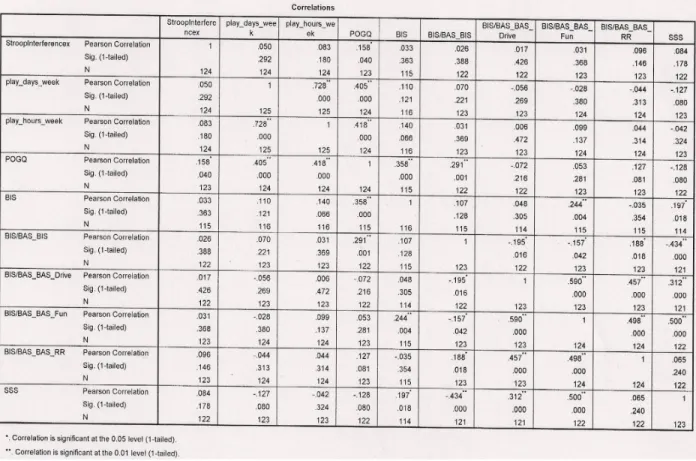
POGQ, BIS, BIS/BAS BIS factor, BIS/BAS Drive factor, BIS/BAS Fun seeking factor, BIS/BAS Reward Responsiveness factor, and SSS (see Figure 1 for the correlation matrix).
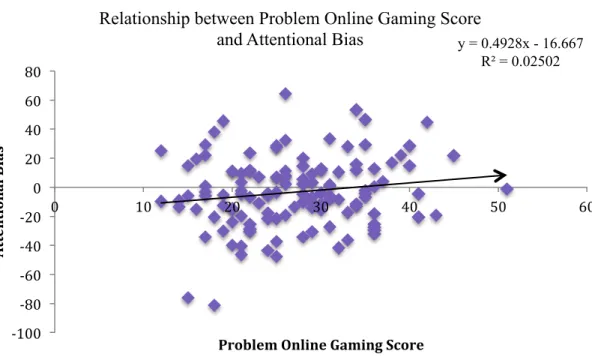
Most importantly, attentional bias scores were significantly correlated to participants’ scores on the POGQ, r = .158, n = 123, p < .05 (see Figure 2). The regression equation relating Stroop Interference to POGQ scores was ŷ = .493χ - 16.666. It is noteworthy that a POGQ score of 32 would yield a predicted Stroop interference of essentially zero since 32 is the cut point on the POGQ for identifying someone has having problems with online gaming.
Attentional bias scores did not correlate with any other variable. Additionally, but not surprisingly, the POGQ was significantly correlated the amount of days participants spent playing Internet games during the week and the amount of hours spent playing Internet games during the week; r = .405, n = 124, p < .01; r = .418, n = 124, p < .01, respectively. The POGQ was also significantly correlated with the BIS and the BIS/BAS BIS factor, r = .358, n = 115, p
<.01; r = .291, n = 122, p < .01, respectively. However the POGQ did not correlate with the other three factors in the BIS/BAS scale or the SSS.
Discussion
The main objective of the current study was to determine whether individuals with higher levels of involvement with Internet gaming portray significantly more attentional bias in the modified Addiction Stroop task in comparison to individuals with lower levels of involvement with Internet games. The current study also examined whether three personality traits
(impulsivity, behavioural inhibition/activation, and sensation seeking,) relate to participants’ level of involvement with Internet games. Results suggest that individuals with greater levels of involvement in Internet games portrayed significantly longer reaction times to target words in comparison to matched control words. Level of involvement was measured through the POGQ
Figure 1. Pearson correlation matrix showing the relationship between attentional bias (stroop interference), days per week of play, hours per week of play, POGQ, BIS, BIS/BAS, and SSS.
Figure 2. Relationship between participants’ problem online gaming scores and their corresponding attentional bias scores measured in the modified Addiction Stroop task. A significant correlation was found between the two variables and the regression equation is shown. y = 0.4928x - 16.667 R² = 0.02502 -100 -80 -60 -40 -20 0 20 40 60 80 0 10 20 30 40 50 60 A tt en ti on al B Ia s
Problem Online Gaming Score
Relationship between Problem Online Gaming Score and Attentional Bias
and attentional bias was measured through the modified Addiction Stroop task. Results support our first hypothesis stating that the more an individual plays Internet games, the more they will attend to the irrelevant semantic content of the target word while distracting from ability to perform the assigned task.
Consistent with the current study’s results, past literature states that individuals suffering from substance use and gambling disorders portray attentional bias in a modified Addiction Stroop task (Field & Cox, 2008; Boyer & Dickerson; McCusker & Gettings 1997; Molde et al. 2010). It is believed that individuals suffering from these disorders portray attentional bias due to the incentive-sensitization theory created by Robinson and Berridge (1993). This model suggests that when an individual is repeatedly exposed to an addictive substance or behavior, a
dopaminergic response is created which becomes sensitized with subsequent exposure. This process creates a strong motivation for the individual to use/partake in the behavior as they start to develop cravings. Accordingly, cues about this substance or addictive behavior then become salient to the individual as the cues grab their attention and motivate them to partake in the use of the substance or addictive behavior. The incentive-sensitization theory is clearly observed while measuring attentional bias in the modified Addiction Stroop task; individuals who partake in the use of an addictive substance or behavior will attend to substance-related target words as their attention is captured by the semantic content of each word. Consequently, these individuals take a longer time to respond to the Stroop task of naming the colour of the target word in comparison to the non-substance-related matched control words.
It is also interesting to note that past research analyzing the psychometric properties of the POGQ stated that a score of 32 points or higher on the POGQ suggests that the individual can be classified as a problem Internet gamer (Pápay et al., 2013). Similarly, the regression equation
obtained from the current study determined that those who had a score of 32 or greater on the POGQ had a greater likelihood of portraying attentional bias to target words in comparison to matched control words. This also parallels past research in substance use and gambling disorders; in the current study, those who scored higher than 32 on the POGQ could be
considered problem Internet gamers and were more likely to display attentional bias, and in past research, individuals who suffer from an addiction display attentional bias in a modified
Addiction Stroop task in comparison to controls (Field & Cox, 2008).
Besides substance use and gambling disorders, which are already classified disorders in the DSM, past research suggests that individuals who play an excessive amount of Internet games portray attentional bias to target words in a modified Addiction Stroop task (Metclaf & Pammer, 2011). The current study supports Metcalf and Pammer (2011) results by replicating their results in a larger and more general sample. Specifically, Metcalf and Pammer (2011) examined both males and females with an average age of 22 who play massively multiplayer online role-playing games. The current study expanded upon their findings by specifically focusing on the at-risk gender and age group for IGD and included all forms of Internet gaming. Although this topic is relatively novel to the IGD literature, the current study suggests that IGD shares a similarity to substance use and gambling disorders. Consequently, this may aid in the decision regarding whether IGD should be considered as a formal disorder in the DSM.
The current study also hypothesized that an individual’s level of involvement will be related to the three personality traits; impulsivity, behavioral inhibition/activation, and sensation seeking. In particular, the higher an individual’s level of involvement, the higher they will score on each trait. Impulsivity, behavioral inhibition/activation, and sensation seeking were measured through the BIS, BIS/BAS, and SSS, respectively. Results showed that the POGQ was
significantly correlated to the BIS and the inhibition factor in the BIS/BAS scale only. This suggests that individuals with higher levels of involvement with Internet games may not necessarily portray behavioural activation and sensation seeking qualities.
Past research across substance use disorders have yielded results indicating that addicts rank high in impulsivity, behavioral inhibition/activation, and sensation seeking (Lee et al. 2012; Donohew et al. 1999; Khosravani, Alvani & Seidisarouei 2016; Yen et al. 2012). Conversely, as previously mentioned, the current study yielded results supporting impulsivity and behavioral inhibition in high-involved Internet gamers, but did not yield consistent results with past research in regards to behavioral activation and sensation seeking. To the best of our knowledge,
behavioral inhibition/activation, and sensation seeking have not been examined in relation to high-involved Internet gamers.
However, both behavioral inhibition/activation and sensation seeking have been examined in gambling disorders; a modality similar to Internet gaming (Petry et al., 2014). In regards to the relation between problem gambling and the behavioral inhibition/activation
systems, past research has been equivocal. Some studies suggest that the unitary BIS factor in the BIS/BAS is related to problem gambling behavior (Atkinson, Sharp, Schmitz, & Yaroslavsky, 2012), comparable to the current study, while other studies suggest that the BIS factor is not related to problem gambling behavior (Eitle & Taylor, 2011). Similarly, past research suggests that the three BAS factors in the BIS/BAS are related to gambling disorders (Kim & Lee, 2011), while other research suggests that they are unrelated (O'Connor, Stewart, & Watt, 2009).
Likewise, past research on the relation between sensation seeking and problem gambling behavior is also equivocal. Similar to BIS/BAS in problem gambling disorders, some past research suggests that sensation seeking is related to problem gambling (Blaszczynski, Wilson,
& McConaghy, 1986; Powell, Hardoon, Derevensky, & Gupta, 1999) and some past research suggests that sensation seeking is not related to problem gambling (Allcock & Grace, 1988; Fortune & Goodie, 2010).
Although there seems to be inconsistent past literature in these traits for gambling disorders, it is important to note these discrepancies while determining whether high-involved Internet gamers need to embody these traits in order for the disorder to be classified in the DSM. While there is strong evidence in past literature indicating that these traits are present in
substance use disorders, it may be true that these traits are not prominent among the behavioral use disorders.
Limitations and Suggested Future Research
The results of this study should be interpreted in light of its limitations. Although the sample was recruited from the at-risk age group of Internet gamers, our sample is still not generalizable to this age since all participants in the current study had to be enrolled in the first year undergraduate psychology class at Western University. It may be that individual’s who play Internet games are more prominent in other degrees such as engineering or computer science. It could also be true that individuals with high levels of involvement with Internet gaming are not enrolled in university. Additionally, since there is a lack of definition defining what constitutes an at-risk gamer, it is hard to draw conclusions whether these individuals are at the same amount of risk as those suffering from substance use and gambling disorders. Lastly, the current study only focused on Internet games that are played online. While 73.8% of the current participants indicated that they play games online there are still about 25% who game on alternative formats. Therefore, the current study’s results may not account for gamers who play alternative formats of gaming.
Future research should expand upon the current study’s two hypotheses. One study conducted by van Holst et al. (2011) suggested no relationship between attentional bias scores and level of involvement with Internet gaming. We believe the reason why there is ambiguous results in past literature regarding Internet gaming and attentional bias is due to one major limitation; past research lacks a definition for problem Internet gamers and there is no established instrument which determines whether an individual has an IGD. This limitation creates problems when trying to compare the results of past literature. Researchers have used different definitions and different instruments to measure IGD, consequently yielding different results. The POGQ was implemented in the current study, as it is the most valid and reliable measure to date. Future research could expand upon this limitation by recruiting high level of involvement participants through a treatment center such as the Addiction Services of Thames Valley. This recruitment strategy would specifically select participants who are more likely to be suffering from the negative consequences associated with Internet gaming since they are seeking treatment for it. Therefore these individuals will possibly portray more addictive-like qualities comparable to individuals with substance use and gambling disorders.
Furthermore, in relation to this proposed study, it would be interesting to have a sample of individuals with relatively the same level of involvement in video gaming and measure their attentional bias, impulsivity, behavioural inhibition/activation, and sensation seeking and examine whether specific traits are more prominent in individuals who only play online, individuals who play both online and offline, and individuals who only play offline.
Lastly, without generalizing the current study’s findings, we believe future research should start to examine the clinical implications of Internet gaming becoming the second behavioural use disorder in the DSM. This implication is not only due to the current study’s
findings but is also due to the similarities between substance, gambling and IGDs in past
literature examining many of the negative consequences associated with the disorders. The three disorders legal in Ontario are alcohol use, tobacco use, and gambling. These three disorders all have a legal age restriction for use. If IGD were included in the DSM, it would be important to discuss and examine the logistics of whether there would be a legal age restriction on use. This may introduce conflict between the Internet gaming industry and clinical practice.
In conclusion, the current study yielded results indicating that individuals with higher levels of involvement with Internet gaming displayed significantly longer reaction times to target words in comparison to matched control words; consequently displaying attentional bias. This suggests that IGD shares another characteristic similar to the substance use disorders and
gambling disorder that are classified in the DSM-V. Consequently, results from the current study provide further evidence suggesting that IGD should be considered as a formal disorder in the DSM.
References
Achab, S., Nicolier, M., Mauny, F., Monnin, J., Trojak, B., & Vandel, P. et al. (2011). Massively multiplayer online role-playing games: comparing characteristics of addict vs non-addict online recruited gamers in a French adult population. BMC Psychiatry, 11(1).
http://dx.doi.org/10.1186/1471-244x-11-144
Allcock, C. C., & Grace, D. M. (1988). Pathological gamblers are neither impulsive nor sensation-seekers. Australian and New Zealand Journal of Psychiatry, 22(3), 307-311. doi:http://dx.doi.org/10.3109/00048678809161212
Atkinson, J., Sharp, C., Schmitz, J., & Yaroslavsky, I. (2012). Behavioral activation and inhibition, negative affect, and gambling severity in a sample of young adult college students. Journal of Gambling Studies, 28(3), 437-449.
doi:http://dx.doi.org/10.1007/s10899-011-9273-x
Blaszczynski, A. P., Wilson, A. C., & McConaghy, N. (1986). Sensation seeking and pathological gambling. British Journal of Addiction, 81(1), 113-117.
doi:http://dx.doi.org/10.1111/j.1360-0443.1986.tb00301.x
Boyer, M., & Dickerson, M. (2003). Attentional bias and addictive behaviour: Automaticity in a gambling-specific modified stroop task. Addiction, 98(1), 61-70.
doi:http://dx.doi.org/10.1046/j.1360-0443.2003.00219.x
Carver, C. S., & White, T. L. (1994). Behavioral inhibition, behavioral activation, and affective responses to impending reward and punishment: The BIS/BAS scales. Journal of Personality and Social Psychology, 67(2), 319-333.
Cousijn, J., Watson, P., Koenders, L., Vingerhoets, W. A. M., Goudriaan, A. E., & Wiers, R. W. (2013). Cannabis dependence, cognitive control and attentional bias for cannabis words.
Addictive Behaviors, 38(12), 2825-2832.
Donohew, R. L., Hoyle, R. H., Clayton, R. R., Skinner, W. F., Colon, S. E., & Rice, R. E. (1999). Sensation seeking and drug use by adolescents and their friends: Models for marijuana and alcohol. Journal of Studies on Alcohol, 60(5), 622-631.
doi:http://dx.doi.org/10.15288/jsa.1999.60.622
Eitle, D., & Taylor, J. (2011). General strain theory, BIS/BAS levels, and gambling behavior.
Deviant Behavior, 32(1), 1-37. doi:http://dx.doi.org/10.1080/01639620903415992 Festl, R., Scharkow, M., & Quandt, T. (2012). Problematic computer game use among
adolescents, younger and older adults. Addiction, 108(3), 592-599.
http://dx.doi.org/10.1111/add.12016
Fortune, E. E., & Goodie, A. S. (2010). The relationship between pathological gambling and sensation seeking: The role of subscale scores. Journal of Gambling Studies, 26(3), 331 346. doi:http://dx.doi.org/10.1007/s10899-009-9162-8
Griffiths, M. (2005). A ‘components’ model of addiction within a biopsychosocial framework.
Journal Of Substance Use, 10(4), 191-197.
http://dx.doi.org/10.1080/14659890500114359
Griffiths, M., & Wood, R. T. A. (2000). Risk factors in adolescence: The case of gambling, videogame playing, and the internet. Journal of Gambling Studies, 16(2-3), 199-225. Hønsi, A., Mentzoni, R., Molde, H., & Pallesen, S. (2013). Attentional Bias in Problem
Gambling: A Systematic Review. Journal Of Gambling Studies, 29(3), 359-375.
Hussain, Z. & Griffiths, M. (2009). The Attitudes, Feelings, and Experiences of Online Gamers: A Qualitative Analysis. Cyberpsychology & Behavior, 12(6), 747-753.
http://dx.doi.org/10.1089/cpb.2009.0059
Jeromin, F., Nyenhuis, N., & Barke, A. (2016). Attentional bias in excessive Internet gamers: Experimental investigations using an addiction Stroop and a visual probe. Journal Of Behavioral Addictions, 5(1), 32-40. http://dx.doi.org/10.1556/2006.5.2016.012
Johnsen, B. H., Laberg, J. C., Cox, W. M., Vaksdal, A., & Hugdahl, K. (1994). Alcoholic subjects' attentional bias in the processing of alcohol-related words. Psychology of Addictive Behaviors, 8(2), 111-115.
Khosravani, V., Alvani, A., & Seidisarouei, M. (2016). The relation of early maladaptive schemas and behavioral inhibition/approach systems to defense styles in abusers of synthetic drug: A cross-sectional study. Journal of Substance use, 21(6), 652-661. doi:http://dx.doi.org/10.3109/14659891.2015.1130184
Kim, D., & Lee, J. (2011). Effects of the BAS and BIS on decision-making in a gambling task.
Personality and Individual Differences, 50(7), 1131-1135. doi:http://dx.doi.org/10.1016/j.paid.2011.01.041
Kuss, D. (2013). Internet gaming addiction: current perspectives. Psychology Research And Behavior Management, 125. http://dx.doi.org/10.2147/prbm.s39476
Lee, H. W., Choi, J., Shin, Y., Lee, J., Jung, H. Y., & Kwon, J. S. (2012). Impulsivity in internet addiction: A comparison with pathological gambling. Cyberpsychology, Behavior, and Social Networking, 15(7), 373-377. doi:http://dx.doi.org/10.1089/cyber.2012.0063 Lusher, J., Chandler, C., & Ball, D. (2004). Alcohol dependence and the alcohol stroop
MacLeod, C. M. (1991). John ridley stroop: Creator of a landmark cognitive task. Canadian Psychology/Psychologie Canadienne, 32(3), 521-524.
Marissen, M. A. E., Franken, I. H. A., Waters, A. J., Blanken, P., van, d. B., & Hendriks, V. M. (2006). Attentional bias predicts heroin relapse following treatment. Addiction, 101(9), 1306-1312.
McCusker, C. G., & Gettings, B. (1997). Automaticity of cognitive biases in addictive behaviours: Further evidence with gamblers. British Journal of Clinical Psychology, 36(4), 543-554. doi:http://dx.doi.org/10.1111/j.2044-8260.1997.tb01259.x
Metcalf, O. & Pammer, K. (2011). Attentional bias in excessive massively multiplayer online role-playing gamers using a modified Stroop task. Computers In Human Behavior, 27(5), 1942-1947. http://dx.doi.org/10.1016/j.chb.2011.05.001
Molde, H., Pallesen, S., Sætrevik, B., Hammerborg, D. K., Laberg, J. C., & Johnsen, B. (2010). Attentional biases among pathological gamblers. International Gambling Studies, 10(1), 45-59. doi:http://dx.doi.org/10.1080/14459791003652501
Montgomery, C., Field, M., Atkinson, A. M., Cole, J. C., Goudie, A. J., & Sumnall, H. R. (2010). Effects of alcohol preload on attentional bias towards cocaine-related cues.
Psychopharmacology, 210(3), 365-375.
Moreira, D., Almeida, F., Pinto, M., Segarra, P., & Barbosa, F. (2015). Data concerning the psychometric properties of the behavioral Inhibition/Behavioral activation scales for the Portuguese population. Psychological Assessment, 27(3), 1117-1122.
Munafò, M. R., Johnstone, E. C., & Mackintosh, B. (2005). Association of serotonin transporter genotype with selective processing of smoking-related stimuli in current smokers and ex smokers. Nicotine & Tobacco Research, 7(5), 773-778.
O'Connor, R. M., Stewart, S. H., & Watt, M. C. (2009). Distinguishing BAS risk for university students' drinking, smoking, and gambling behaviors. Personality and Individual Differences, 46(4), 514-519. doi:http://dx.doi.org/10.1016/j.paid.2008.12.002 Pápay, O., Urbán, R., Griffiths, M. D., Nagygyörgy, K., Farkas, J., Kökönyei, G., . . .
Demetrovics, Z. (2013). Psychometric properties of the problematic online gaming questionnaire short-form and prevalence of problematic online gaming in a national sample of adolescents. Cyberpsychology, Behavior, and Social Networking, 16(5), 340 348.
Patton, J. H., Stanford, M. S., & Barratt, E. S. (1995). Factor structure of the barratt impulsiveness scale. Journal of Clinical Psychology, 51(6), 768-774.
Petry, N., Rehbein, F., Gentile, D., Lemmens, J., Rumpf, H., & Mößle, T. et al. (2014). An international consensus for assessing internet gaming disorder using the new DSM-5 approach. Addiction, 109(9), 1399-1406. http://dx.doi.org/10.1111/add.12457
Powell, J., Hardoon, K., Derevensky, J. L., & Gupta, R. (1999). Gambling and risk-taking behavior among university students. Substance use & Misuse, 34(8), 1167-1184. doi:http://dx.doi.org/10.3109/10826089909039402
Rehbein, F., Kleimann, M., & Mößle, T. (2010). Prevalence and Risk Factors of Video Game Dependency in Adolescence: Results of a German Nationwide Survey. Cyberpsychology, Behavior, And Social Networking, 100722182519069.
Roberti, J. W., Storch, E. A., & Bravata, E. (2003). Further psychometric support for the sensation seeking scale-form V. Journal of Personality Assessment, 81(3), 291-292 Robinson, T. E., & Berridge, K. C. (1993). The neural basis of drug craving: An incentive
sensitization theory of addiction. Brain Research Reviews, 18(3), 247-291. doi:http://dx.doi.org/10.1016/0165-0173(93)90013-P
Subramaniam, M., Chua, B., Abdin, E., Pang, S., Satghare, P., & Vaingankar, J. et al. (2016). Prevalence and Correlates of Internet Gaming Problem among Internet Users: Results from an Internet Survey. Annals Of The Academy Of Medicine, 45(5), 174-183.
Tucker, D. M., Stenslie, C. E., Roth, R. S., & Shearer, S. L. (1981). Right frontal lobe activation and right hemisphere performance: Decrement during a depressed mood. Archives of General Psychiatry, 38(2), 169-174.
van Holst, R., Lemmens, J., Valkenburg, P., Peter, J., Veltman, D., & Goudriaan, A. (2012). Attentional Bias and Disinhibition Toward Gaming Cues Are Related to Problem Gaming in Male Adolescents. Journal Of Adolescent Health, 50(6), 541-546.
http://dx.doi.org/10.1016/j.jadohealth.2011.07.006
Wareham, J. D., & Potenza, M. N. (2010). Pathological gambling and substance use disorders.
The American Journal of Drug and Alcohol Abuse, 36(5), 242-247.
Wenzel, H., Bakken, I., Johansson, A., Gotestam, K., & Øren, A. (2009). Excessive Computer game playing among Norwegian adults: Self-reported consequences of playing and association with mental health problems. Psychological Reports, 105(3F), 1237-1247.
Yang, H., Yao, S., Zhu, X., Auerbach, R. P., Abela, J. R. Z., & Tong, X. (2007). The chinese version of the barratt impulsiveness scale, 11th version (BIS-11) in adolescents: Its reliability and validity. Chinese Journal of Clinical Psychology, 15(1), 4-6.
Yen, J., Cheng-Fang, Y., Chen, C., Chang, Y., Yeh, Y., & Ko, C. (2012). The bidirectional interactions between addiction, behaviour approach and behaviour inhibition systems among adolescents in a prospective study. Psychiatry Research, 200(2-3), 588-592. doi:http://dx.doi.org/10.1016/j.psychres.2012.03.015
Zhang, Y., Lin, X., Zhou, H., Xu, J., Du, X., & Dong, G. (2016). Brain Activity toward Gaming Related Cues in Internet Gaming Disorder during an Addiction Stroop Task. Frontiers In Psychology, 7. http://dx.doi.org/10.3389/fpsyg.2016.00714
Zuckerman, M., Eysenck, S. B., & Eysenck, H. J. (1978). Sensation seeking in england and america: Cross-cultural, age, and sex comparisons. Journal of Consulting and Clinical Psychology, 46(1), 139-149. doi:http://dx.doi.org/10.1037/0022-006X.46.1.139
Zuckerman, M., Kolin, E. A., Price, L., & Zoob, I. (1964). Development of a sensation-seeking scale. Journal of Consulting Psychology, 28(6), 477-482.
Appendix A CONSENT FORM
for
Attentional Bias in Internet Gaming Users: Part 1
I have read the Letter of Information, have had the nature of the study explained to me, and all of my questions have been answered to my satisfaction. I agree to participate.
__________________________________________________________________________ Signature of Participant
__________________________________________________________________________ Printed name of participant
__________________________________________________________________________ Date
__________________________________________________________________________ Signature of person obtaining consent
__________________________________________________________________________ Printed name of person obtaining consent
__________________________________________________________________________ Date
LETTER OF INFORMATION AND CONSENT
Project Title: Attentional Bias in Internet Gaming Users
Principal Investigator + Contact: Dr. Riley Hinson, PhD, Psychology, Western University, 84649 or [email protected]
Additional Research Staff: Samantha Rundle, Honors Thesis Student
1. Invitation to Participate
You are being invited to participate in a research study examining internet gaming. In order to participate in this study you must also be male, be fluent in English, and not be color blind.
2. Why is this study being done?
Internet gaming has become very popular. We are trying to understand some of the cognitive factors related to how involved people become with internet gaming. We are interested in all levels of involvement, from an individual who does not play, to someone who plays more often.
3. How long will you be in this study?
Your participation will occur in one session that will last 60 minutes or less
4. What are the study procedures?
In this study you will be shown words on a computer screen. Your task is to indicate, by pressing a button on the keyboard, what color the words are printed in. After completing that task you will be asked to indicate how related you feel some words are to internet gaming. You will also complete a questionnaire about your involvement with internet gaming. The study will take place in a lab room on the 7th floor of the SSC.
5. What are the risks and harms of participating in this study?
There are no known or anticipated risks or discomforts associated with participating in this study. Since the study relates to internet gaming it is possible that some participants may have questions about their level of involvement with internet gaming as a result of taking part in this study. If you do have such questions you may contact Addiction Services of Thames Valley at 519-673-3242 or at their website, http://adstv.on.ca/,for some information on internet gaming.
6. What are the benefits of participating in this study?
You may not directly benefit from participating in this study but the information gathered may further the understanding of internet gaming and may be useful to agencies that provide help to people who experience problems with internet gaming.
7. Can participants choose to leave the study?
It is your choice if you wish to participate in this study. If you choose to begin
participation in this study you have the right to stop your participation at any time. If you decide to stop your participation you have the right to ask that we not use any your data that we have collected. However, once you finished your participation we cannot remove your data since it will be deidentified meaning we cannot determine which data would be yours. You have the right to not answer any questions or engage in any procedures that are part of the study. If you withdraw or choose to not answer questions or take part in procedures you will still receive the compensation you were promised.
8. How will participants’ information be kept confidential?
The information you provide will be confidential meaning that the only people who will see the individual data will be the PI and the identified Additional Research Support Staff. However, the data will not have any identifiable information on it, meaning that no one will be able to tell which responses are yours. The PI will keep the nonidentifiable data in a secure and confidential location. In accordance with Western University policy the nonidentifiable data will be kept for 5 years, after which time it will be professionally destroyed. Your individual responses or identity will not be used in any dissemination of the results of the study—results will only be reported in terms of group performance, not individual performance.
9. Are participants compensated to be in this study?
If you are a Psych 1000 student you will receive 1 research credit toward the required research credits for that course. If you are an other-than-Psych 1000 student you will receive compensation based on information contained in your course outline. If you have any questions about the compensation scheme for your course, please refer to the course outline or consult the course instructor.
10. What are the rights of participants?
Your participation in this study is voluntary. You may decide not to be in this study. Even if you consent to participate to have the right to not answer individual questions or to withdraw from the study at any time. If you choose not to participate or leave the study at any time it will have no effect on your academic standing. You do not waive any legal right by signing the consent form.
11. Whom do participants contact for questions?
If you have any questions about this research study please contact Dr. Riley Hinson, 519-661-2111 ext 84649 or [email protected]. You may also contact Samantha Rundle at
If you have any questions about your rights as a research participant or the conduct of the study, you may contact The Office of Research Ethics 519-661-3036, or [email protected]
Debriefing for Attentional Bias in Internet Gaming Users
There is interest in whether internet gaming is similar in some ways to other forms of what is called “addictive” behavior. Research has shown that people’s reactions to words related to gambling differ depending on how much gambling they do. We are interested in whether the same thing might be true for internet gaming. The purpose of this study was to see if people with different levels of involvement with internet gaming responded differently to words that are evocative of the emotions, feelings and experiences that internet games have when they play. The results will help researchers determine if internet gaming may be conceptualized in a manner similar to that of gambling. If you have any questions please feel free to contact Dr. Hinson at
[email protected] or Samantha Rundle at [email protected] . Since the study relates to internet gaming it is possible that some participants may have questions about their level of involvement with internet gaming as a result of taking part in this study. If you do have such questions you may contact Addiction Services of Thames Valley at 519-673-3242 or at their website,
http://adstv.on.ca/,for some information on internet gaming.
Here is very recent comprehensive review if you want to read more.
Honsi, A., Mentzoni, R.A., Molde, H., & Pallesen (2013). Attentional Bias in Problem Gambling: A Systematic Review. Journal of Gambling Studies, 29, 359-375.
Appendix B
We are interested in how much each of the words/phrases below may be related to internet gaming. The word/phrase may be related because it is used by people who play internet games and has a certain meaning in the world of internet gaming. Or, it may be related because it express the feelings or emotions that people have when playing internet games. We simply want to know how you, as an internet game player, would think that a word/phrase might cause a person to think about think about internet games or maybe even want to play a game. There are no right or wrong answers. For each word/phrase place a slash (/) on the line to indicate how much you think the word/phrase might make someone think about or want to play a game. And then give what you think is a meaning of that word/phrase in the world of internet gaming. Thanks.
We are not internet gamers and we have tried to generate words which we think are related to internet gaming, but we may not have done a particularly good job. We would appreciate it if you would help US out by listing any words/phrases/letters that internet gamers use, and providing a definition. This would really help us in making sure we are using words that real players use. Again Thanks.
Appendix C
Target and Matched Control Words
Target Words Matched Control Words
Kill Streak Mill Creek
Gamer Names
Console Fitness
Lag Bag
Multiplayer Sympathizer
Kill Ratio Hill Climb
RPG APB Glitch Hitch Checkpoint Lumberjack Clan Plan Leaderboard Legislators Quest Chest Avatar Guitar PWND ASAP Enemy Energy Weapon Woman Ranking Running Aimbot Again Kill Kite Achievement Anniversary
Appendix D
Demographics Questionnaire
During a typical week how many days do you play internet games of any type? And what would you estimate to be the total time (in hours) that you play internet games of any type during a typical week. (Include all gaming whether on a desktop computer, laptop
computer, smartphone, tablet, or any other device).
Number of days playing internet games during a typical week. 01234567
Total number of hours playing internet games in a typical week___________________________
Which of the following formats during do you use for gaming? Put a check beside any that you use and then circle the one that you use most often to game.
_____gaming console (e.g., Xbox, Playstation) _____desktop computer
_____laptop computer _____smart phone
_____tablet or other mobile device
_____other, please indicate what format__________________________________________
How do you play? Put a check beside any that you use and then circle the one that you use most often to game.
_____alone by yourself _____with other people present with you _____multiplayer online (others not present with you)
Where do you do most of your gaming?
_____At home, in your dorm room, or a place you call your home/residence
_____Some place outside your home/dorm/residence where you use some type of mobile device Is there some other type of place not covered by the above two? __________________________
What internet games do you play? Please give the names if possible or describe the type. Please circle the one(s) you play more often or enjoy playing the most.