Designing Immersive Virtual Environments for Cognitive Learning and Spatial Memory Tasks
A THESIS
SUBMITTED TO THE FACULTY OF THE GRADUATE SCHOOL OF THE UNIVERSITY OF MINNESOTA
BY
Christianah Adigun
IN PARTIAL FULFILLMENT OF THE REQUIREMENTS FOR THE DEGREE OF
MASTER OF SCIENCE
Pete Willemsen
c
Acknowledgements
I’d like to thank my advisor, Dr. Pete Willemsen and my research committee mem-bers, Dr. Ed Downs and Dustyn Leff, this research couldn’t be completed without your support and resolve. I am grateful to everyone whose intellectual contribution has made Spoon River possible: Charles McGregor, Sumanth Sai Kothapalli, and Tyler Grunenwald. My friends who have inspired me through their hard work and support: Sagari Raju Vatchavayi and Zach Patterson, thank you! And I thank my family for giving me the opportunities and experiences that have made me who I am.
Dedication
I dedicate this to the One without whom I couldn’t have made it this far, my mental support and source of strength, God!
Abstract
Virtual reality provides a realistic way to learn at a flexible progression and to develop skills that could be difficult to grasp in the real world. Our hypothesis is that there are certain VR affordances that educators and developers can leverage to build simulated learning experiences that can transform education and training activities. The immersive experience VR provides through real-time interaction, engagement, spatial awareness, visual representations, and media richness is useful for developing experiential learning environments. Watching a dinosaur egg hatch and the develop-ment of its complete life cycle in a virtual Jurassic world may provide more visual context than reading a textbook on the life cycle of the same dinosaur.
The goal of this study was to better understand which interaction mechanism may be better for the design of immersive virtual learning environments. We investigated the role that natural locomotion and teleportation may have on cognitive and spatial information processing in a virtual environment. The learning space is a virtual ceme-tery, and it consists of thirteen tombstones with stories about the lives of the residents of spoon river, a fictional town mentioned in Spoon River Anthology by Edgar Lee Masters. We conducted experiments by placing subjects in four different conditions: teleportation across long distances, walking across long distances, teleportation across short distances and walking across short distances. Our hypotheses are that shorter natural walking paths will produce better outcomes on the cognitive assessments and spatial memory assessments we conducted. Teleportation, while beneficial for navi-gating virtual reality from a small, confined physical space, may not provide enough continuous spatial updating and therefore may be somewhat detrimental for certain learning environments. We analyzed the results and built a linear regression model
Our data analysis revealed that:
• For definite memory recall and proprioception of the spatial layout of a virtual space, it is better to walk than to teleport.
• To visually match objects to their spatial positions, a learning space that is logically investigated through shorter distance movements is better than longer paths.
• Strong cognitive understanding is achieved if the learning space properly bal-ances exploration of the environment and discovery of information.
Contents
Contents v
List of Tables viii
List of Figures ix
1 Introduction 1
1.1 VR and Cognitive Learning . . . 1
1.2 Baddeley’s model of working memory . . . 2
1.2.1 Dual-task design . . . 4
1.3 Sustaining User’s Attention . . . 4
2 Background 6 2.1 Space Perception . . . 7 2.2 Path Integration . . . 8 2.3 Navigation Locomotion . . . 9 2.3.1 Natural Walking . . . 9 2.3.2 Teleportation . . . 10 2.4 Time-Perception . . . 11
2.5.1 Involvement . . . 12 2.5.2 Engagement . . . 12 2.5.3 Immersion . . . 12 3 Implementation 13 3.1 Study . . . 13 3.2 Setup. . . 13 3.2.1 Oculus Rift S . . . 13 3.2.2 VR Backpack PC . . . 14 3.2.3 Play Area . . . 14 3.3 Methodology . . . 15 3.3.1 Navigation . . . 15 3.3.2 Locomotion . . . 16 3.4 Pilot Study . . . 18 3.4.1 Subjects . . . 18 3.4.2 Protocol . . . 18 3.4.3 Training . . . 19 3.4.4 Experiment . . . 19 3.4.5 Spatial Test . . . 20 3.5 Subjective Variables . . . 21 3.5.1 Time Spent . . . 21 3.5.2 Attention . . . 21 3.5.3 Path Tracking . . . 23 3.6 Qualitative Assessments . . . 23
3.6.3 Spatial Memory Recreation . . . 25
4 Results 26 4.1 Environment Cognitive Assessment . . . 26
4.1.1 Performance and correlation to subjective variables . . . 27
4.2 Spatial Recall Assessment . . . 30
4.2.1 Spatial recall error and correlation to subjective variables . . . 32
4.3 Spatial Sandbox Assessment . . . 35
4.3.1 Spatial Sandbox scores and correlation to subjective variables 37 4.3.2 ANOVA : Single Factor between subjects analysis with repeated measures . . . 40
4.3.3 Other Correlation data . . . 41
4.4 Modeling Relationship between variables . . . 41
4.4.1 Estimated Marginal Means . . . 42
4.4.2 Cluster Analysis. . . 49
4.4.3 Best Model fit . . . 50
4.4.4 Correlation Matrix . . . 52
4.5 Discussion . . . 53
4.6 Presence and Experience . . . 58
5 Conclusions 59 5.1 Limitations . . . 59
5.2 Future Work . . . 59
List of Tables
4.1 Overview of results between conditions . . . 41
List of Figures
1.1 VR conceptual knowledge framework . . . 2
1.2 Baddeley’s model of working memory . . . 3
2.1 Space Perception in VR . . . 8
3.1 Oculus Rift S Head Mounted Display and Controllers . . . 14
3.2 Experiment Play Area Size is equivalent to SIVE Lab Walking Space 15 3.3 Teleport Marker changes from blue to glowing orange when controller is pointed at it . . . 17
3.4 Training Scene with an activated countdown timer above a placard . 20 3.5 Experiment Scene - front view of Spoon River Cemetery . . . 21
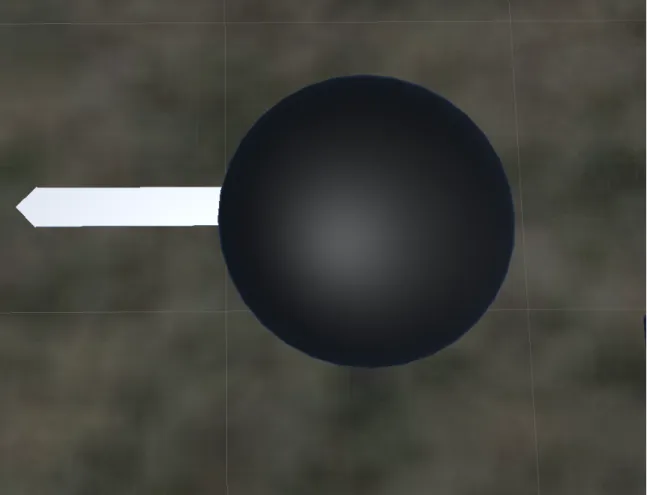
3.6 The compass arrow is rotated to point in a direction during the spatial test scene . . . 22
3.7 Using a controller, subjects perform a spatial recall test . . . 24
3.8 Sandbox measure is captured . . . 25
4.1 Average scores in each condition . . . 27
4.2 Correlation between Average Attention and Assessment Score . . . . 28
4.5 Percentage spatial recall accuracy in each condition . . . 32
4.6 Correlation between Average Attention and spatial Recall Error . . . 33
4.7 Correlation between Average Distance and spatial Recall Error . . . . 34
4.8 Correlation between Time Spent and spatial Recall Error . . . 35
4.9 Participants place tombstone cardboard cutout on a red dot in sandbox task . . . 36
4.10 Average sandbox assessment score in each condition . . . 37
4.11 Correlation between Average Attention and sandbox score . . . 38
4.12 Correlation between Average Distance and sandbox score . . . 39
4.13 Correlation between Time spent and sandbox score . . . 40
4.14 Estimated Marginal Means of Cognitive Assessment by condition . . 42
4.15 Estimated Marginal Means of Cognitive Assessment by path . . . 42
4.16 Estimated Marginal Means of Cognitive Assessment by navigation . . 43
4.17 Estimated Marginal Means of Average attention by condition. . . 43
4.18 Estimated Marginal Means of Average attention by path . . . 44
4.19 Estimated Marginal Means of Average attention by navigation . . . . 44
4.20 Estimated Marginal Means of Time spent by condition . . . 45
4.21 Estimated Marginal Means of Time spent by path . . . 45
4.22 Estimated Marginal Means of Time spent by navigation. . . 46
4.23 Estimated Marginal Means of sandbox score by condition . . . 46
4.24 Estimated Marginal Means of sandbox score by path . . . 47
4.25 Estimated Marginal Means of sandbox score by navigation . . . 47
4.26 Estimated Marginal Means of spatial recall error by condition . . . . 48
4.30 K-means shows ideal number of clusters in data set . . . 51
4.31 Model Based Clustering displays best model by classification . . . 52
4.32 Correlation Matrix . . . 53
4.33 Plot of path data of subject in Long Teleport which depicts subject taking few steps forward, backward or sideways around the teleport area 54
4.34 Plot of path data of subject in Long Walk Locomotion which depicts subject’s long distance walks back and forth with several overlaps . . 55
4.35 Plot of path data of subject in Short Teleport which depicts subject taking few steps forward, backward or sideways around the teleport area 56
4.36 Plot of path data of subject in Short Walk Locomotion which depicts subject walking continuously from start to end marker with minor over-lap from top to bottom right . . . 57
1
Introduction
Virtual Reality (VR) successfully reproduces real-world scenarios and is a good technology to observe and improve the learning experience. Scenarios that are difficult to reproduce in the real world can be simulated and closely observed in VR, and users can interact naturally and perform complex tasks that may be impractical in the real world. VR is a beneficial technology to Education as it presents significant advantage over the traditional classroom experience through simulation of realistic scenarios. Also, trainers can obtain in-depth information about the user through a safe and controlled experience.
1.1
VR and Cognitive Learning
Knowledge acquisition is trending in education, manufacturing, engineering, busi-ness, finance, and construction as a critical task. A research study found that the Federal Government increased their spending budget on knowledge acquisition soft-ware from $850 million in 2004 to about $1.1 billion in 2008 [6]. A lot of sectors struggle with being unable to successfully transfer knowledge from one part of the organization to the other [9]. Experiential learning in virtual reality provides learn-ers a hands-on, realistic learning strategy. We can adapt the conceptual knowledge framework to VR by providing cognitive motivators such as immersion, engagement,
Figure 1.1: VR conceptual knowledge framework
1.2
Baddeley’s model of working memory
The working memory capacity plays a significant role in cognition and spatial memory encoding. The cortical areas of the brain exhibit traits that affect low and high accuracy memory encoding, explained by Baddeleys working memory model [18]. Baddeley’s model suggests that memory formation is achieved through three systems in the brain: Phonological Loop, Visuospatial Sketchpad and Episodic Buffer. The phonological loop is the part of the working memory that processes auditory infor-mation. It is composed of the phonological store which configures how information is assimilated, and the articulatory process which allows repetition. The visuospatial sketchpad provides the capacity to store, break down or modify visual information. Nonverbal intelligence can be measured through the use of the visuospatial sketchpad.
memory in a multidimensional code. The study by Teramoto et al. cited that spatial information stored in the episodic buffer can be accessed and retained for a longer period.
Figure 1.2: Baddeley’s model of working memory
Some studies might exempt certain age group from VR related studies as im-proper memory encoding is linked to age-related diseases that affect one’s ability to recollect information. Cognitive load is the mental load exerted on a subject while executing a task and is largely influenced by the capacity of the working memory to process information derived from the task. After a certain threshold, high cognitive load reduces learning performance and user effectiveness [5]. The subject’s cognitive capacity affects their interaction hence measuring individual’s cognitive loads helps to determine their effectiveness in a task. There are ways to go about measuring
cog-Over-arousing or over-engaging virtual experiences can be used to get an idea of the user’s level of cognitive load limit.
1.2.1
Dual-task design
The Dual-task design paradigm requires that two separate tasks are performed at the same time, and is used in Psychology to exert cognitive load. The high mental demand imposed is due to the limited capacity of the working memory and the load from focusing on one task and shifting to a different task, known as Interference.
Modality effect is seen in how secondary tasks are designed. If the cognitive load is more than the working memory can handle, learning is reduced. The bottleneck is the limitation of the working memory, and a productive learning approach involves mastering the bottleneck [5]. The Dual-task approach is used to measure cognitive load when in studies of Modality Effect.
Certain speech-based dual tasks prompt a speech pause, a useful indicator of high load versus low load scenario. A pause could be silent or filled, and it gives the subject more time to analyze, reflect and construct an appropriate response. The pause time is used to regulate information processing, and therefore, manage cognitive load [8].
1.3
Sustaining User’s Attention
Emotional and mental states are important considerations in the learning process. According to Psychology, subjects may get to a level of attention known as flow state, a mental state in which one is fully focused, immersed and involved in the task, accompanied by loss of the sense of space and time. Not to be confused with
inability to mentally switch to a different task. The goal of a learning strategy should be to get the subject into a comfortable flow state.
2
Background
Virtual reality is going to keep changing as new technologies are developed and developers identify the improved affordances of VR that enhance virtual learning experiences. Virtual environments provide a realistic way to experience the world around us in natural progression and are created by applying dynamic/static vari-ables to models that represent complex real-life processes. Recent research found that improving the user’s level presence and engagement [3] improves the learning outcome. However, VR is not a perfect recreation of the real world, and comes with its own psychological and physiological shortcomings. Psychology studies have shown that humans learn in different ways from visual, aural, verbal, physical, logical or social cues. A study conducted years ago postulated that emotionality affects conceptual learning and that memorization can reflexively occur in a state of emotional arousal [14]. Our study focuses on learning in a virtual space that requires mental processing of cognitive information and the environment’s spatial layout.
The Cognitive Learning process is a complex cycle of voluntary and involuntary ac-tions that affect reasoning, experience and the sensory systems [4]. The practical applications of VR in experiential learning allows us to explore the complexity of the human memorization process and learning in general. The immersive experi-ence it provides through real-time interaction, engagement, spatial awareness, visual representations, and media richness makes it a viable option for experiential learning.
2.1
Space Perception
Spatial cognition is defined by distance, depth and space perceived through visual and somatosensory information [17]. We orient ourselves relatively to objects or based on object-to-object layout. The first is referred to as egocentric orientation while the latter is allocentric orientation. Egocentric perception is how one perceives other objects with respect to one’s position and orientation while allocentric perception of a space is the ability to find relative positions of objects to one another in space. In a study to assess egocentric spatial cognition in a VR Environment, no learning effect or short-term memory influence was found [2]. The experiment involved a symmetric, three storey virtual house with 24 windows, one of which is marked as the objective window through a pseudo-random sequence. The participants were tasked with walking the minimum possible distance to reach the targeted window. They found a linear trend between age and performance error, with younger participants performing better.
Figure 2.1: Space Perception in VR
2.2
Path Integration
VR simulations are known to cause mild to severe motion sickness and spatial disorientation [13]. Extensive pre-experiment training is often used to compensate for intuitive spatial reasoning. Riecke and Wiener proposed a rapid point-to-origin paradigm [15] in their study to reveal qualitative errors in visual path integration. They eliminated visual cues and navigation markers from the virtual environment and observed dependency solely on innate cues such as vestibular, proprioceptive and
non-turners used an allocentric strategy. They asserted that when a physical response such as pointing, or movement is expected; visual cues or location markers should be provided in the virtual environment. Another approach to improve performance is to extensively train users on the task.
2.3
Navigation Locomotion
2.3.1
Natural Walking
Motion-based virtual systems seek to maximize naturalness to provide an opti-mal immersive experience. It’s impossible to traverse an infinite virtual space in a finite physical space. A user responds naturally to locomotion in VR as in the real world, hence, if the virtual world mirrors the natural world, the user requires minimal training. The limitations of physical space has inspired hardware based movement devices for VR such as the Teleportation, Virtuix Omni treadmill, and hybrid control systems that mix natural movement in a confined space with virtual maneuvering. Human cognitive resources are finite and shared between perceptual tasks, which have different processing loads.
An experiment investigated the implication of simultaneous cognitive processing of spatial and verbal tasks with semi-natural virtual locomotion [11]. Participants were placed in one of three interfaces: using a Logitech Wingman gamepad, P2V interface, real walking movements around C6. Their results indicate that spatial and verbal tasks compete for the same cognitive resources.
al-mechanism to a specific sensory system can make an otherwise unnatural experience, immersive. A suspended hoverboard interface was designed for short and long dis-tance exploration in virtual reality [16]. It provided the user with a corresponding proprioception that is consistent with the perceived movement. The key is to involve the users body in the interaction sequence, providing vestibular perception/feedback. Modern alternatives such as redirected walking, arm-swinging, and treadmills intu-itively include the user’s body in the experience.
2.3.2
Teleportation
One of the shortcomings of VR is the inability to explore the limitless virtual space in a limited walking space. Teleportation is a mechanism that allows a user to be transported from one position to another without the use of natural locomotion. When users do not ”own” their movement, their perception of the space is often off. This might be attributed to the illusionary nature of teleportation and for the same reason , users often report feeling motion sick. While an instant change in viewpoint without continuous optical flow might reduce the possibility of motion sickness, it limits the user’s ability to integrate their path. The resulting spatial disorientation could be due to inability to estimate a relative distance from transitions or the realization that the experience is cognitively unrealistic [10]. Certain VR experiences might find a less realistic interaction desirable, in light of changing an event context e.g. driving a flying car. Simulating a realistic scenario on the other hand requires closely realistic interaction.
A study [12] focused on scene transitions in which users did not have control of their movement or view change. The goal was to find out which of three transition
portation, animated interpolation, and pulsed interpolation. Teleportation involved an immediate change of position. Animated interpolation allowed users to observe their state change as it occurred, and the pulsed technique provided sequences of viewpoints during the transition from the start to target state. 50% of the partici-pants in the first phase of the experiment preferred to teleport instantly. Animated interpolations was better for spatial awareness as participant could track their view changes but its downside was the unpleasant feeling of motion sickness.
When confronted with the precarious task of getting around a large virtual en-vironment in a confined walking space, teleportation makes sense. But until spatial memory can keep up with the pace at which narratives occur during teleportation, without its lingering side effects, a safer alternative is to limit the spatial space to what the natural senses can explore and recall.
2.4
Time-Perception
Not much study has been done on time perception differences between VR and real life. Our research is not studying time perception in VR, but since we expect to see elapsed time difference in our between-subject conditions, we thought it might be interesting to understand how users perceive time VR. A study evaluated time perception during walking motions [1] and found that the discomfort and complexity of worn VR gears could influence time judgment. In a pilot study where subjects were tracked via a WorldViz PPT-X4 tracking system, and walked around at their own pace in the direction of a visual target, subjects were found to overestimate time by 4.2%.
that occur through time and space perception.The brain estimates time based on in-ternal biological, physiological events or exin-ternal stimulus from the environment [7].
Tau effect affects spatial judgment of a layout due to time variation between spatial
markers i.e. time it took to get to marker one is different from time it took to get to marker two. On the other hand, kappa effect, more pronounced through visual stimuli, is a temporal perception based on sequential sensory stimuli experienced at different location i.e. the experience at marker one was longer than the experience at marker two. More studies need to explore the area of time perceptionin VR to reach a cohesive conclusion.
2.5
Terminologies
2.5.1
Involvement
Ontologists describe involvement as mental participation [19] rather than inclusion i.e. being involved with the lecture rather than just staring at the Professor.
2.5.2
Engagement
Engagement is a voluntary choice to direct one’s attention on a task e.g. engaged in a movie rather than just sitting in the audience. [19].
2.5.3
Immersion
Immersion is an experience provided through the stimulus modalities in a space. For example, someone watching a horror movie without sound and someone else
3
Implementation
3.1
Study
The purpose of our study is to investigate how navigation and teleportation tech-niques affect a user’s cognitive and spatial information processing ability in VR. Subjects are placed in one of four between-subjects conditions:
• Long Teleportation • Long Walk • Short Teleportation • Short Walk
3.2
Setup
3.2.1
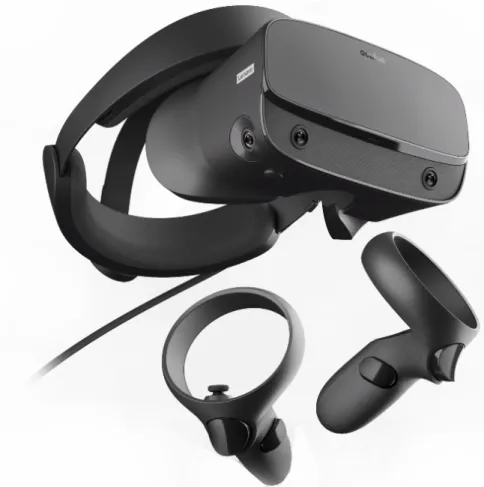
Oculus Rift S
The Head-mounted display is a sensorless PC-powered gaming oculus headset. It has a screen resolution of 2560 x 1440 and a refresh rate 80 Hz. It delivers high quality imagery and blocks see-through light.
Figure 3.1: Oculus Rift S Head Mounted Display and Controllers
3.2.2
VR Backpack PC
The CPU is a MSI VR One Backpack PC with Intel Core i7-7820HK and NVIDIA GeForce GTX 1070 graphics card.
3.2.3
Play Area
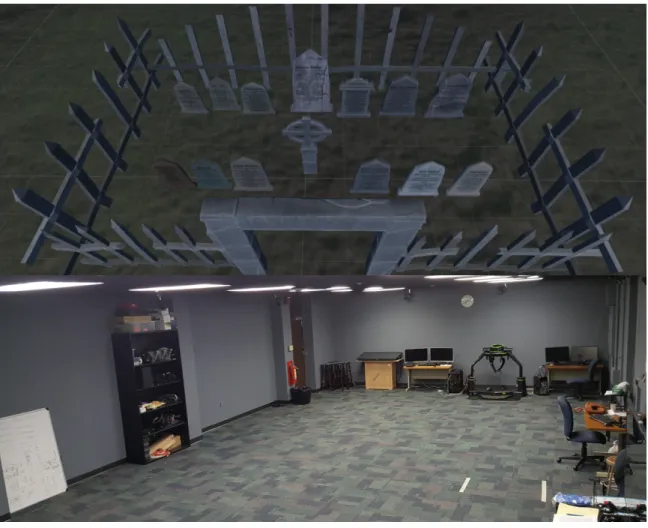
The play area is 18 by 13 feet of free walking space. The virtual cemetery perime-ters correspond to the available space in the play area and the subjects in a
locomo-boundaries of the play area size is turned off so that the virtual gates of the cemetery serve as reference boundaries.
Figure 3.2: Experiment Play Area Size is equivalent to SIVE Lab Walking Space
3.3
Methodology
• Long path: the user is presented with a choice of two farthest markers from their position.
• Short path: the user is presented with a choice of two nearest markers from their position.
Long path
The position markers are placed farthest away from the subject’s current position. Those in the teleportation condition make large random instant jumps around the virtual environment, while those in the walking condition take long walks around the environment.
Short path
The glowing blue markers that specify the next position are placed nearest to the subject’s current position. The path is sequential so that the subject follows one round of continuous walking pattern.
3.3.2
Locomotion
Natural Walking
The subject has full mobility to walk around the training and experiment scenes. They can squat, bend or reorient themselves however they choose. Natural locomotion means one walk can naturally, unconstrained, at the same pace both in the virtual world and physical walking space.
Teleportation
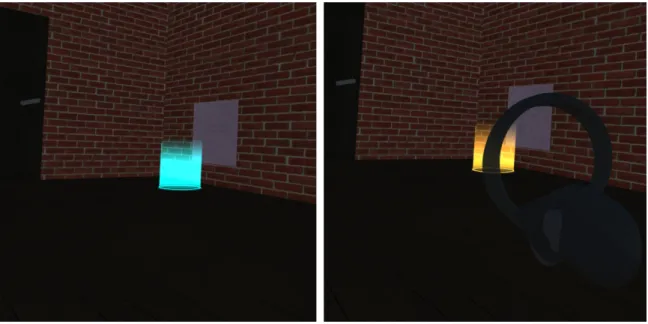
Subjects can move from their current location to another, by pointing the Oculus touch controller at a glowing blue position marker, which changes to a glowing orange and pressing the A button (right controller) or the X button (left controller). The subject is not allowed to take more than two steps forward, backward or sideways, and they can turn, squat or bend.
Figure 3.3: Teleport Marker changes from blue to glowing orange when controller is pointed at it
1 // Find c l o s e s t t o m b s t o n e
2 h i t V e c 2 . S e t ( h i t . p o i n t . x , h i t . p o i n t . z ) ;
3 // c h e c k s i f t h e t o m b s t o n e hasn ’ t b e e n v i s i t e d 4 // and l o c a t i o n marker i s t u r n e d on
6 {
7 // H i g h l i g h t
8 n e a r e s t M a r k e r = tombPlanes [ i ] . t r a n s f o r m . Ge tChild ( 0 ) . gameObject ; 9 n e a r e s t M a r k e r . t r a n s f o r m . GetCh ild ( 0 ) . gameObject . GetComponent<Renderer
>() . m a t e r i a l = h a l o . t r a n s f o r m . GetCh ild ( 0 ) . gameObject . GetComponent<Renderer>() . m a t e r i a l ; 10 } 11 12 13 // To t e l e p o r t 14 T e l e p o r t A r e a . t r a n s f o r m . p o s i t i o n = new V e c t o r 3 ( t r a n s f o r m P o s . x , 0 . 0 f , t r a n s f o r m P o s . z ) ; // T h i s p l a c e s HMD i n f r o n t o f T e l e p o r t Marker
3.4
Pilot Study
3.4.1
Subjects
We had 28 subjects in the pilot study with the age ranging between 20 - 53 years. Everyone reported feeling healthy before the experiment, and no one experienced motion sickness in the virtual environment.
3.4.2
Protocol
The subject is assigned a condition number drawn randomly from a deck of four cards. The random assignment is to reduce a cyclical selection bias which may arise from having subjects that arrive at a specific hour of the day e.g. morning, in a specific condition. An informed consent form is presented to the subject and a
Pre-fortable navigating in the environment, and then, the experiment begins. When the experiment is over, the subject is provided with an environment cognitive assessment, and brought back into VR for a spatial recall test. After the recall, the subject does a recreation of the cemetery in a sandbox task. The final task is to complete a Presence and Experience questionnaire.
3.4.3
Training
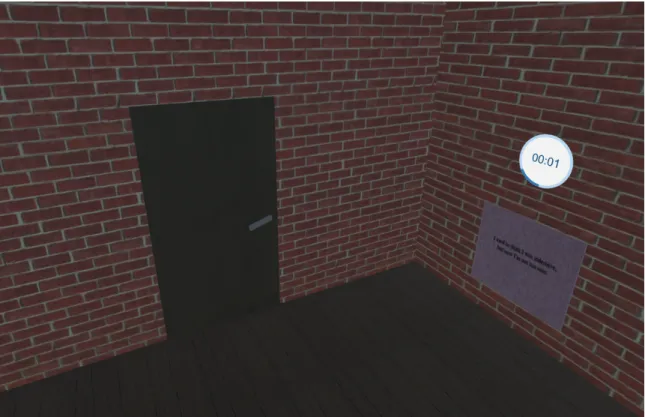
The training procedure is similar to the experiment’s for each condition. The training is designed to help the subject become familiar with the protocol of the experiment, whether it’s walking or teleporting in short or long distances. It takes place in a virtual brick room with seven placards on the wall. When the unity scene starts, two blue glowing markers appear and subjects walk or teleport to one of them. The marker will disappear and in front of it is a placard with a block of text that becomes visible. Above the placard, a timer is displayed which counts down how many seconds is left until the block of text disappears. The subject reads out loud the text to the experimenter and continues on to the next placard until all placards have been visited.
3.4.4
Experiment
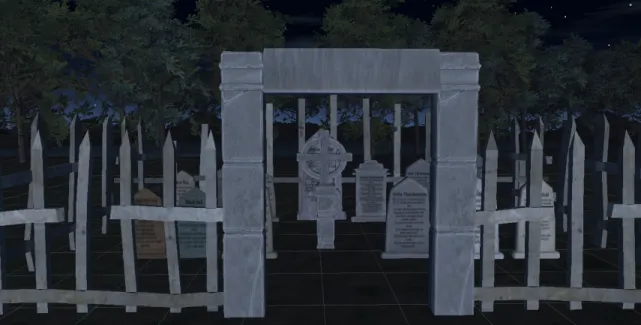
The experiment takes place in a virtual cemetery referred to as Spoon River. The cemetery is fenced and contains thirteen tombstones. Similar to the training scene procedure, the experiment starts with two blue glowing markers that light up in front of tombstones and the subjects chooses either one to go to. There is a character
Figure 3.4: Training Scene with an activated countdown timer above a placard
it, with the time left until the text disappears. The subject is informed at the start of the experiment that they must pay attention to the environment and the story as they will be assessed after.
3.4.5
Spatial Test
A replicated scene of the experiment without any of the tombstones. Subjects are place in this environment to test their memory. They are asked recall from memory the position of the tombstones they had visited.
Figure 3.5: Experiment Scene - front view of Spoon River Cemetery
3.5
Subjective Variables
Some factors such as time spent or attention in the virtual environment are sub-jective and may or may not be due to the design of the environment. For analysis purposes, they will be measured and stored during the experiment.
3.5.1
Time Spent
Time spent is evaluated in minutes from the start of the experiment until the last tombstone is read.
3.5.2
Attention
Figure 3.6: The compass arrow is rotated to point in a direction during the spatial test scene
tombstone divided by the total reading time.
attention = time eye gaze on current reading / total reading time * 100
1 v o i d c a l c u l a t e A t t e n t i o n ( )
2 {
3 frameCount = frameCount + 1 ; // u p d a t e s frame c o u n t f o r a s l o n g a s p l a n e i s a c t i v e
7
8 r a y = camera . ViewportPointToRay (new V e c t o r 3 ( 0 . 5 F , 0 . 5 F , 0 ) ) ; 9 i f ( P h y s i c s . Ra yc as t ( ray , o u t h i t ) ) 10 { 11 i f ( h i t . t r a n s f o r m . name == t r a n s f o r m . p a r e n t . gameObject . t r a n s f o r m . name ) // c h e c k s i f r a y h i t s t h e c u r r e n t t o m b s t o n e 12 { 13 h i t C o u n t = h i t C o u n t + 1 ; 14 } 15 } 16 a t t e n t i o n = h i t C o u n t / frameCount ∗ 1 0 0 ; 17 }
3.5.3
Path Tracking
The path data is a 3D vector of the x,y,z-coordinate of the subject’s position at every fixed update. It is segmented into thirteen start-to-end sequences for each tombstone in the experiment. When the experiment starts, the path data until the first tombstone has been read is recorded as the first sequence. The next sequence is from the first tombstone until the next tombstone is read. The data is used to evaluate the distance moved by subject between tombstones.
3.6
Qualitative Assessments
Each subject is required to answer multiple choice questions, a spatial pointing task and a sandbox recreation of the spatial layout of the cemetery.
3.6.1
Environment Cognitive Assessment
Twenty multiple choice questions are asked of the subjects after the experiment. The questions are the same for all subjects and graded on a scale of 0 or 1.
3.6.2
Spatial Memory Recall
A recall memory test in which subjects go back to the entrance of the cemetery and are presented with a controller to move an arrow in the direction of a tombstone. The angle at which the arrow is oriented is recorded for each tombstone that needs to be recalled.
3.6.3
Spatial Memory Recreation
Cardboard cutouts of the tombstones are presented and subjects recreate the spatial layout of the cemetery.
4
Results
A total of 28 participant data was collected from the experiments. The first experiment data had some missing values that were excluded from some evaluations.
4.1
Environment Cognitive Assessment
The environment cognitive assessment is a set of twenty multiple choice ques-tions asked of each participant after the experiment. The assessment is available in Appendix A. The breakdown of the average score in each condition is:
• Long teleportation : 11.63
• Long walking : 16.43
• Short teleportation : 15.43
• Short walking : 15.57
As expected, the long teleportation condition average score was the lowest. Most of the subjects in the condition scored below average. The other conditions have reasonably good performance with a number of long distance subjects scoring well above average. We analyzed the correlation between the assessment scores and other subjective variables that were recorded during the experiment.
Figure 4.1: Average scores in each condition
4.1.1
Performance and correlation to subjective variables
The r-value between the overall performance of subjects in the cognitive assess-ment and other variables are:
Figure 4.2: Correlation between Average Attention and Assessment Score
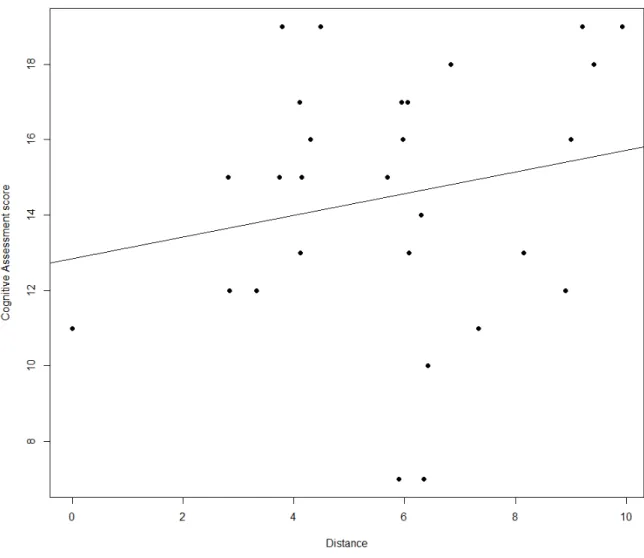
Figure 4.3: Correlation between Average Distance and Assessment Score
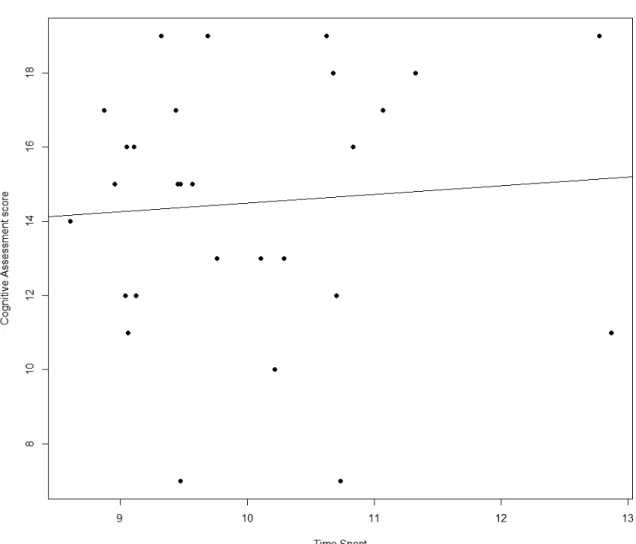
Figure 4.4: Correlation between Time Spent and Assessment Score
4.2
Spatial Recall Assessment
mentioned name on it. The error value is given by the difference between the angle of the subject’s pointing direction and the actual direction of the tombstone from the default position. We calculated the sum of error difference for all tombstones visited by the participant and for each condition, we evaluated the spatial error percentage. The percentage accuracy is henceforth derived as:
spatial accuracy % = 100 - spatial error %
The breakdown of the average percentage accuracy in each condition is:
• long teleportation : 64.5%
• Long walking : 82.3%
• short teleportation : 73%
Figure 4.5: Percentage spatial recall accuracy in each condition
The long teleportation has the least accuracy and is again the condition with the worst performance. It’s interesting to find that both locomotion conditions were the better performing conditions. The Long walking condition has the best accuracy for spatial recall.
4.2.1
Spatial recall error and correlation to subjective
vari-ables
Figure 4.6: Correlation between Average Attention and spatial Recall Error
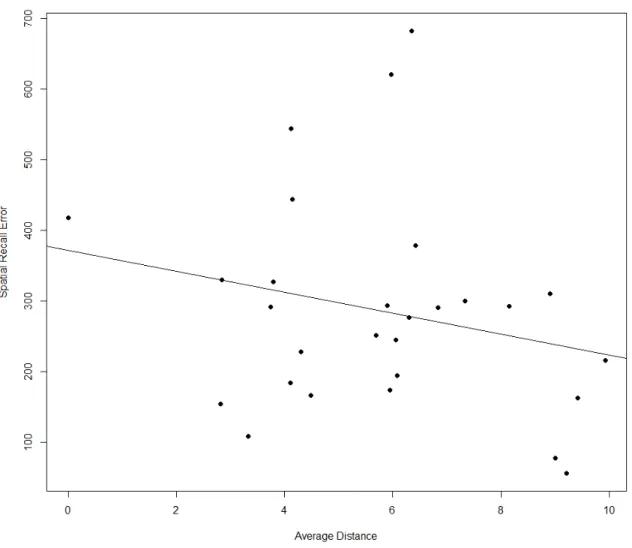
Figure 4.7: Correlation between Average Distance and spatial Recall Error
Figure 4.8: Correlation between Time Spent and spatial Recall Error
4.3
Spatial Sandbox Assessment
position, a value of 1 is given, otherwise the assigned value is 0.
Figure 4.9: Participants place tombstone cardboard cutout on a red dot in sandbox task
The average scores of subjects from each conditions are:
• long teleportation : 4.29
• Long walking : 7
• short teleportation : 8.86
Figure 4.10: Average sandbox assessment score in each condition
It’s not surprising that long teleportation condition once again has the worst average performance.
4.3.1
Spatial Sandbox scores and correlation to subjective
variables
The r-value between the overall spatial sandbox scores of subjects and other vari-ables are:
Figure 4.11: Correlation between Average Attention and sandbox score
Figure 4.12: Correlation between Average Distance and sandbox score
Figure 4.13: Correlation between Time spent and sandbox score
4.3.2
ANOVA : Single Factor between subjects analysis with
repeated measures
significant impact on the time spent in the environment (SS = 10.48, df = 3, MS = 3.49, F = 3.89, P-value = 0.021, F crit = 3.01) and distance (SS = 94.85, df = 3, MS = 31.62, F = 35.48, P-value = 8.49E-09, F crit = 3.03).
There is a significant effect of the condition on the cognitive assessment (SS = 100.86, df = 3, MS = 33.62, F = 3.77, P-value = 0.024, F crit = 3.01) and spatial accuracy (SS = 187332.30, df = 3, MS = 62444.10, F = 3.56, P-value = 0.029, F crit = 3.01), but no significant impact on the sandbox measure (SS = 55.4, df = 3, MS = 18.47, F = 1.4, P-value> .05, F crit = 3.03).
4.3.3
Other Correlation data
There were some missing pre-experiment data such as GPA, major, and academic year as some subjects weren’t students. However, for the available data, we did some correlation tests and the results prove that there is no correlation whatsoever between the subject’s age, GPA, VR experience, or gaming hours to their overall performance in the experiment.
4.4
Modeling Relationship between variables
An overview of the result from each assessment and other measures, is presented below:
Table 4.1: Overview of results between conditions
Path Navigation Type Cognitive Assessment SR Accuracy Sandbox Avg. Attention Avg. Distance Time Spent Long Teleportation 11.63 64.5% 4.29 82.12 6.33 9.43 Long Walk Locomotion 16.43 82.3% 7 88.92 8.78 11.03 Short Teleportation 15.43 73% 8.86 90.52 3.99 9.68 Short Walk Locomotion 15.57 80.2% 7.14 89.35 4.49 9.43
4.4.1
Estimated Marginal Means
Figure 4.14: Estimated Marginal Means of Cognitive Assessment by condition
Figure 4.16: Estimated Marginal Means of Cognitive Assessment by navigation
Figure 4.18: Estimated Marginal Means of Average attention by path
Figure 4.20: Estimated Marginal Means of Time spent by condition
Figure 4.22: Estimated Marginal Means of Time spent by navigation
Figure 4.24: Estimated Marginal Means of sandbox score by path
Figure 4.26: Estimated Marginal Means of spatial recall error by condition
Figure 4.28: Estimated Marginal Means of spatial recall error by navigation
4.4.2
Cluster Analysis
Using a scatterplot, we evaluated association between input variables: navigation , locomotion, attention, average time spent and distance, and outputs: cognitive score, spatial error and spatial sandbox scores. Even though there are no strong direct correlation due to outliers in every variable, there are data aggregates that highlight clustering in the data.
Figure 4.29: Clustering between variables
4.4.3
Best Model fit
With the exception of one or two outliers, subjects fall into two clusters. This is validated with a k-means clustering analysis.
Figure 4.30: K-means shows ideal number of clusters in data set
One cluster shows that those who scored above average in the cognitive assessment and lower spatial recall error and high average attention. However, having high attention doesn’t mean that the participant will score above average in the cognitive assessment or have low spatial recall error.
Figure 4.31: Model Based Clustering displays best model by classification
4.4.4
Correlation Matrix
There is significant correlation between average attention and cognitive assess-ment, spatial accuracy and sandbox. Average distance has a fairly negative correla-tion to the Sandbox i.e long distance jumps has a poor effect on egocentric percepcorrela-tion encoding. And there’s a positive effect between time spent on cognition and spatial recall but not on sandbox task.
Figure 4.32: Correlation Matrix
4.5
Discussion
Long teleportation is not the optimal learning condition for spatial or cognitive information processing. Our results revealed that egocentric perception i.e. perceiv-ing space with respect to one’s position, is best achieved by natural walkperceiv-ing and not teleporting around a virtual space while allocentric perception, i.e. perceiving how objects relate to one another in space is best achieved through short distance movements.
Figure 4.33: Plot of path data of subject in Long Teleport which depicts subject taking few steps forward, backward or sideways around the teleport area
Figure 4.34: Plot of path data of subject in Long Walk Locomotion which depicts subject’s long distance walks back and forth with several overlaps
Figure 4.35: Plot of path data of subject in Short Teleport which depicts subject taking few steps forward, backward or sideways around the teleport area
Figure 4.36: Plot of path data of subject in Short Walk Locomotion which depicts subject walking continuously from start to end marker with minor overlap from top to bottom right
walk/teleportation allowed subjects to explore and observe the space in close perime-ters without drastic viewpoint changes. However, in long teleportation, subjects don’t get to observe a gradual change as they’re instantly transported to a different perime-ter. Most got distracted by the new viewpoint and did not focus on the information presented on the tombstone. They took some time to observe their new area which in part explains why the attention values were low.
4.6
Presence and Experience
The presence and experience survey provides information about the involvement, engagement, immersion, and containment in the environment. A high percentage of subjects reported that the technology was new to them. Most subjects thought it was a fun, enjoyable, interactive and immersive experience and would do it again.The response survey is provided in the table below:
Table 4.2: Presence and Experience Survey
Question Strongly Disgree(1) 2 3 4 5 6 Strongly Agree(7)
The experience I had today using this technology was a new one for me. 1 2 2 1 1 7 14
The experience I had today with this technology was very routine for me. 18 3 2 2 2 1
This was the first time I have used technology like this before. 8 2 1 2 1 4 10
I enjoyed the experimental task I participated in today. 1 1 2 5 19
I thought that the task I participated in was frustrating. 15 6 3 2 2
I had fun participating in the experiment today. 2 1 7 18
I was disappointed participating in the task today. 24 3 1
I would like to have experiences like this again in the future. 1 2 5 5 15
I thought the task I participated in today was boring. 22 2 1 1 1
My experience today was involving. 2 4 10 12
My experience was intense. 3 6 3 7 6 2 1
i felt like I was physically inside the task environment. 2 3 4 8 11
I felt immersed in the task environment. 1 1 4 3 7 12
I felt like I was surrounded by the task environment 1 6 6 15
The virtual world was responsive to actions that I initiated. 6 14 8
I was aware of events occurring in the lab space when i was in the virtual world. 2 10 3 7 2 2 2
It was easy to manipulate objects in the virtual environment. 1 5 15 7
The virtual environment made me feel disoriented. 9 10 3 3 3
Using the control mechansims was intuitive. 1 3 4 13 7
I was proficient in moving around through the virtual environment. 1 3 9 15
The virtual display interfered with my ability to perform the required activities. 17 6 1 1 2 1
I could concentrate on the assigned tasks in the virtual environment because the control mechanisms were easy to use. 1 1 3 10 13
I felt nauseous when I was in the virtual environment. 23 4 1
My eyes felt strained when I was in the virtual environment. 12 9 1 2 3 1
The virtual environment gave me a headache. 21 4 1 2
I had problems concentrating when I was in the virtual environment. 15 6 3 1 2 1
5
Conclusions
Our results highlighted the negative effects of long teleportation on cognitive and spatial information processing. Natural walking is best for egocentric spatial en-coding while short distance movement produces optimal allocentric spatial enen-coding. Because of walking limitation in physical spaces, short distance teleportation can replace waking. This is ideal for cognitive processing as well as progressive spatial updates are important for subjects in a virtual space. When subjects teleported in long distance, a fraction of the time when the text was displayed was spent looking around at the virtual environment as they didn’t get to observe a gradual change in their viewpoint during teleportation.
5.1
Limitations
The main limitation of this pilot study is the number of participants. The exper-iment was conducted during the summer, a time when there are fewer students on campus. More experiments will be conducted over the next semester.
5.2
Future Work
message with a mention of the subject’s name. Yerkes Dodson theory postulates that there is a curvilinear relationship between performance and arousal in a complex task situation. Flashbulb Memory experiences, social presence, co-presence are exciting ideas to explore. Trying out other natural locomotion techniques such as arm swing and walk-in-place mode instead of teleportation would provide insights into ways to avoid teleportation in limited physical walking spaces.
References
[1] G. Bruder and F. Steinicke. “Time perception during walking in virtual en-vironments”. In: 2014 IEEE Virtual Reality (VR) (2014). doi: 10.1109/vr. 2014.6802054(cit. on p. 11).
[2] A. Byagowi and Z. Moussavi. “Design of a Virtual Reality Navigational (VRN) experiment for assessment of egocentric spatial cognition”. In: 2012 Annual International Conference of the IEEE Engineering in Medicine and Biology
Society. Aug. 2012, pp. 4812–4815.doi: 10.1109/EMBC.2012.6347070(cit. on
p.7).
[3] N. Collins, B. Vaughan, K. Gardiner, and C. Cullen. “Towards a Conceptual Framework for the Development of Immersive Experiences to Negotiate Mean-ing and Identity in Irish Language LearnMean-ing”. In: 2018 IEEE Games,
Enter-tainment, Media Conference (GEM). Aug. 2018, pp. 1–9. doi: 10.1109/GEM.
2018.8516523(cit. on p. 6).
[4] H. Daniels. “Educational Theories, Cultures and Learning”. In: (2012). doi: 10.4324/9780203379417 (cit. on p.6).
Traumatic Memories, and the Yerkes-Dodson Law”. In: Neural Plasticity 2007 (2007), 1fffdfffdfffd33. doi:10.1155/2007/60803 (cit. on pp. 3,4).
[6] “Federal Knowledge Management MarketView Report”. In:INPUT (2008) (cit. on p. 1).
[7] S. Grondin. “Pyschology of Time”. In: Emerald Group Publishing (2008) (cit. on pp. 11, 12).
[8] M. A. Khawaja, N. Ruiz, and F. Chen. “Think Before You Talk: An Empir-ical Study of Relationship Between Speech Pauses and Cognitive Load”. In:
Proceedings of the 20th Australasian Conference on Computer-Human
Interac-tion: Designing for Habitus and Habitat. OZCHI ’08. Cairns, Australia: ACM,
2008, pp. 335–338.isbn: 0-9803063-4-5. doi:10.1145/1517744.1517814.url: http://doi.acm.org/10.1145/1517744.1517814(cit. on p. 4).
[9] J. Kim, J. Song, and D. R. Jones. “The Cognitive Selection Framework of Knowledge Acquisition Strategy in Virtual Communities”. In:2010 43rd Hawaii
International Conference on System Sciences. Jan. 2010, pp. 1–10. doi: 10 .
1109/HICSS.2010.368 (cit. on p. 1).
[10] J. Liu, H. Parekh, M. Al-Zayer, and E. Folmer. “Increasing Walking in VR using Redirected Teleportation”. In:The 31st Annual ACM Symposium on User
Interface Software and Technology - UIST 18 (2018).doi: 10.1145/3242587.
3242601(cit. on p. 10).
[11] W. E. Marsh, M. Putnam, J. W. Kelly, V. J. Dark, and J. H. Oliver. “The cog-nitive implications of semi-natural virtual locomotion”. In:2012 IEEE Virtual
[12] K. R. Moghadam, C. Banigan, and E. D. Ragan. “Scene Transitions and Tele-portation in Virtual Reality and the Implications for Spatial Awareness and Sickness”. In: IEEE Transactions on Visualization and Computer Graphics
(2018), 1fffdfffdfffd1. doi: 10.1109/tvcg.2018.2884468(cit. on p. 10).
[13] “Motion Sickness”. In: The VR Book (2015), p. 163. doi: 10.1145/2792790. 2792806(cit. on p. 8).
[14] E. D. Ragan. “The Effects of Higher Levels of Immersion on Procedure Mem-orization Performance and Implications for Educational Virtual Environments”.
In:Presence: Teleoperators and Virtual Environments19.6 (2010), 527fffdfffdfffd543.
doi: 10.1162/pres_a_00016(cit. on p. 6).
[15] B. E. Riecke and J. M. Wiener. “Can People Not Tell Left from Right in VR? Point-to-origin Studies Revealed Qualitative Errors in Visual Path Integration”.
In:2007 IEEE Virtual Reality Conference. Mar. 2007, pp. 3–10.doi:10.1109/
VR.2007.352457 (cit. on p. 8).
[16] J. Smeddinck, D. Alexandrovsky, D. Wenig, M. Zimmer, W. Wegele, S. Juer-gens, and R. Malaka. “Hoverboard: A Leap to the Future of Locomotion in VR!?” In:Entertainment Computing – ICEC 2017. Ed. by N. Munekata, I. Ku-nita, and J. Hoshino. Cham: Springer International Publishing, 2017, pp. 218– 225. isbn: 978-3-319-66715-7 (cit. on p. 10).
[17] “Spatial Cognition in a Multimedia and Intercultural World Proceedings of the 7th International Conference on Spatial Cognition (ICSC 2018)”. In: Cognitive
Processing 19.S1 (2018), 1fffdfffdfffd76. doi: 10 . 1007 / s10339 - 018 - 0884 - 3
International Conference of the IEEE Engineering in Medicine and Biology
Society (EMBC). Aug. 2016, pp. 5550–5553.doi:10.1109/EMBC.2016.7591984
(cit. on p. 2).
[19] P. Turner and S. Turner. “Triangulation in practice”. In: Virtual Reality 13.3 (Sept. 2009), pp. 171–181.issn: 1434-9957.doi:10.1007/s10055-009-0117-2.
A
Appendix A
The Appendix includes the following items:
• Instruction Script
• Pre Experiment Questionnaire
• Environment Assessment
• Spatial Layout Questionnaire
• ANOVA Multivariate Analysis
SPOON RIVER INSTRUCTION SCRIPT Standard Procedures
Standard response if question(s) would compromise the experiment:
● “I cannot answer this question until the end of the experiment”
Emergency Procedures
● Person is the priority if a dangerous situation would arise
Hello, my name is __________ and thank you for agreeing to participate in our study. First, we’d like you to read and sign this informed consent form. Please, let me know if you have any questions.
[ Wait for them to read the form and see if they have any question ]
All information will be kept confidential and your name will not be associated with any data collected during the experiment nor with any publication of research findings.
1. Informed Consent Form 2. Pre-experiment Questionnaire
Introduction to Technology
Today, you will be putting on the Oculus Rift S Headset and wearing a backpack. First, we want you to wear a VR protective mask. There’s a knob at the back of the HMD that lets you adjust it to fit your head and a strap on top which you can tighten accordingly. You will be put in a virtual training environment to get used to the technology, and after the trainining, we will proceed with the actual experiment.
Training
You will find yourself in a brick room. Look around you and there will be purple boards on the walls and a couple of them will have blue glowing markers. Your task is to go to one of the two markers and stand directly inside. A text will appear on the board and we want you to read it out loud to us so we can confirm what you’re seeing. At the same time the text appears on the board, a countdown timer will come up above with displaying how many seconds is left before the text disappears. After the text disappears, you will look around and a pair of new markers will appear and you will repeat the procedure.
[ For Participants in Teleport condition only
[ Tell them to put on the VR headset, and hold the touch controller. Ask if they’re comfortable and confirm that they see the blue markers.]
If you point the controller at one of the glowing markers, the color should change from blue to orange. [ Confirm that the color of the marker changes. ] Good! Decide which one of the markers you want to go by pointing the controller at it, and teleport by pressing the A button (right controller) or X button (left controller).
Experiment
Now that you’re comfortable with moving around in the virtual space, we’re going to start the experiment. The environment is different from the training but the interaction is going to be just the same. You will find yourself in at the entrance of a cemetery. We want you to go/teleport to each marker and read the text on the tombstone to yourself. Pay attention to the environment you’re in and the stories you read as you’ll answer some questions at the end of the experiment.
3. Environment Cognitive Assessment 4. Spatial Pointing Task
5. Sandbox Task
Pre-Experiment Questionnaire Subject #
Please answer these questions to the best of your ability. If you do not feel like answering a question, leave it blank.
Please state your relationship with the University: Student
Staff Faculty
Duluth Community Member Other
If you are a student, what is your major? _________________ Age _____ Gender _________
How are you feeling today?
1=Not Well, Very Sick 2 3 4=OK 5 6 7=Great! Very Healthy
To what extent have you experienced motion sickness? _____________________
Have you ever been diagnosed with any brain-related condition or disease: recent concussions, meningitis, spinal cord injury, Parkinson’s, Alzheimer’s, dementia, encephalitis, epilepsy, and/or restless leg syndrome? Y N
Approximately how many hours in the last month have you used
virtual reality systems? _____________________ How much total experience do you have with virtual reality systems. Please select one option:
0-5 hours 5-30 hours 30-60 hours 60-100 hours 100+ hours
If you have had used virtual reality, please describe the types of experiences (such as games, simulations, movies or other immersive activities) that you have participated in including how you interacted with the virtual objects and environment.
If you have had experience with virtual reality, please indicate which virtual reality systems you regularly use: Oculus Rift HTC VIVE PlayStation VR Samsung Gear VR Google Cardboard Other ___________________________________
Approximately how many hours each week do you play video games (on phones, consoles, digital media, web pages, etc…) _________________
Current Overall College GPA _____ (Mark here if you are a freshman and do not have a GPA yet ________)
Academic Year: Freshman_____ Sophomore_____ Junior_____ Senior ____ Senior+ ____ Grad ____
What college are you affiliated with? a. _______College of Liberal Arts
b. _______Labovitz School of Business & Economics c. _______School of Fine Arts d. _______Swenson College of Science & Engineering e. _______CEHSP f. Other(specify) _____________________________
Environment Assessment
Participant #: ___________________________ Condition: ______________
1. Who is responsible for most of the deaths in Spoon River? Holden the Cook
Petrus Van Tassel Hessian Soldier Aaron Hatfield
2. Who was the little girl in the story that died after the cook tricked her into getting spoiled fruits and vegetables from the trash behind the store?
Minerva Jones Daisy Hatfield Nellie Throckmortin Marie Rhodes
3. Which of the following residents worked for Spoon River Cemetery? Silas Rhodes
Butch Welty Blind Jack Peter Hatfield 4. Who owned a Lumber mill?
Aaron Hatfield Hodd Hatfield Rolf Rhodes Petrus Van Tassel 5. Who owned a general store?
James Lindsay Minerva Jones Justice Rhodes Marie Rhodes
6. Which of the following people were not married? Petit the Poet
Daisy Hatfield
Katrina Ecker Van Tassel Hodd Hatfield
7. Who was the nurse in town? Minerva Jones Daisy Hatfield Nellie Throckmortin None of the above
8. Among these people, who has a wooden grave marker? Blind Jack
Hessian Soldier Petit the Poet Holden the Cook
9. Who could barely hold a job because he was always unfit? Editor Whedon
Frances Throckmortin Blind Jack
Petit the Poet
10. Who got caught under a wagon wheel? Hessian Soldier
Blind Jack Butch Welty Aaron Hatfield
11. Who had rich, important friends? Lindsey Jones
Frances Throckmortin Editor Whedon Aaron Hatfield
12. Whose business was booming? Minerva Jones
Butch Welty Holden the Cook
Editor Whedon
13. Who’d become the richest man in town? Minerva Jones
Butch Welty Holden the Cook Editor Whedon 14. Who knew the whole story?
Butch Welty Petit the Poet Editor Whedon Daisy Hatfield
15. Which of the residents died after eating an apple? Daisy Hatfield
Nellie Throckmortin Butch Welty None of the above
16. Who killed the Hessian Soldier? Frances Throckmortin Holden the Cook Butch Welty None of the above
17. How many tombstones belonged to the Throckmortin family? One (1)
Two (2) Three (3) Four (4)
18. How many families (of more than one person with the same last name) were in the cemetery?
One (1) Two (2) Three (3) Four (4)
Hero Villain Hard-worker Father
20. What was Hodd Hatfield’s profession: Lumberjack
Newspaper Editor Doctor
Spatial Layout Questionnaire
Participant #: ___________________________ Condition: ______________
[Note: All participants get asked these questions and use a joystick controller they are holding to point in the direction where they believe the landmark is located. This is done outside of virtual reality in the lab environment.]
1. Point to the location of Hessian Soldier’s tombstone from your current position. 2. Point to the location of Editor Whedon’s tombstone from your current position. 3. Point to the location of Hodd Hatfield’s tombstone from your current position. 4. Point to the location of Minerva Jones’s tombstone from your current position. 5. Point to the location of Blind Jack’s tombstone from your current position. 6. Point to the location of Nellie Throckmortin’s tombstone from your current position. 7. Point to the location of Butch Welty’s tombstone from your current position. 8. Point to the location of Daisy Hatfield’s tombstone from your current position. 9. Point to the location of Frances Throckmortin’s tombstone from your current position. 10. Point to the location of Sara Throckmortin’s tombstone from your current position.
GLM AvgAttention TimeSpent AvgDistance Sandbox CognitiveAssessment AvgSpatialA ngleError BY
Condition PathType NavigationType /CONTRAST(NavigationType)=Repeated /METHOD=SSTYPE(3)
/INTERCEPT=INCLUDE
/POSTHOC=Condition(BONFERRONI)
/PLOT=PROFILE(Condition PathType NavigationType) TYPE=BAR ERRORBAR=SE(1) MEA NREFERENCE=NO
/PRINT=DESCRIPTIVE ETASQ OPOWER HOMOGENEITY /CRITERIA=ALPHA(.05)
/DESIGN= Condition PathType NavigationType Condition*PathType Condition*Navi gationType
PathType*NavigationType Condition*PathType*NavigationType.
General Linear Model
Notes Output Created Comments Input Data Active Dataset Filter Weight Split File N of Rows in Working Data File
Missing Value Handling Definition of Missing
Cases Used 24-JUN-2019 11:47:43 /Users/willemsn/Navigat ionLearning_2019_Analy sis/data_AsOf_0623201 9_1546.sav DataSet1 <none> <none> <none> 2 8 User-defined missing values are treated as missing.
Statistics are based on all cases with valid data for all variables in the model.
Notes
Syntax
Resources Processor Time
Elapsed Time GLM AvgAttention TimeSpent AvgDistance Sandbox CognitiveAssessment AvgSpatialAngleError BY Condition PathType NavigationType /CONTRAST (NavigationType) =Repeated /METHOD=SSTYPE(3) /INTERCEPT=INCLUDE /POSTHOC=Condition (BONFERRONI) /PLOT=PROFILE (Condition PathType NavigationType) TYPE=BAR ERRORBAR=SE(1) MEANREFERENCE=NO /PRINT=DESCRIPTIVE ETASQ OPOWER HOMOGENEITY /CRITERIA=ALPHA(.05) /DESIGN= Condition PathType NavigationType Condition*PathType Condition*NavigationTyp e PathType*NavigationTyp e Condition*PathType*Nav igationType. 00:00:02.17 00:00:02.00 Page 2
Between-Subjects Factors Value Label N Condition 1 2 3 4 PathType 0 1 NavigationType 0 1 Long Teleportation 7 Long Locomotion 7 Short Teleportation 6 Short Locomotion 7 Short Path 1 3 Long Path 1 4 Teleportation 1 3 Locomotion 1 4 Descriptive Statistics
Condition PathType NavigationType Mean
AvgAttention Long Teleportation Long Path Teleportation
Total
Total Teleportation
Total Long Locomotion Long Path Locomotion
Total
Total Locomotion
Total Short Teleportation Short Path Teleportation
Total
Total Teleportation
Total Short Locomotion Short Path Locomotion
Total
Total Locomotion
Total
Total Short Path Teleportation
Locomotion Total Long Path Teleportation
Locomotion Total 82.1159600 10.9271800 82.1159600 10.9271800 82.1159600 10.9271800 82.1159600 10.9271800 88.9161695 6.23625680 88.9161695 6.23625680 88.9161695 6.23625680 88.9161695 6.23625680 90.5155781 4.43157226 90.5155781 4.43157226 90.5155781 4.43157226 90.5155781 4.43157226 89.3542836 5.99865395 89.3542836 5.99865395 89.3542836 5.99865395 89.3542836 5.99865395 90.5155781 4.43157226 89.3542836 5.99865395 89.8902657 5.15149080 82.1159600 10.9271800 88.9161695 6.23625680 85.5160647 9.24709906 85.9927068 9.32092664 Page 3
Descriptive Statistics
Condition PathType NavigationType Std. Deviation N
AvgAttention Long Teleportation Long Path Teleportation
Total
Total Teleportation
Total Long Locomotion Long Path Locomotion
Total
Total Locomotion
Total Short Teleportation Short Path Teleportation
Total
Total Teleportation
Total Short Locomotion Short Path Locomotion
Total
Total Locomotion
Total
Total Short Path Teleportation
Locomotion Total Long Path Teleportation
Locomotion Total 10.9271800 7 10.9271800 7 10.9271800 7 10.9271800 7 6.23625680 7 6.23625680 7 6.23625680 7 6.23625680 7 4.43157226 6 4.43157226 6 4.43157226 6 4.43157226 6 5.99865395 7 5.99865395 7 5.99865395 7 5.99865395 7 4.43157226 6 5.99865395 7 5.15149080 1 3 10.9271800 7 6.23625680 7 9.24709906 1 4 9.32092664 1 3 Page 4
Descriptive Statistics
Condition PathType NavigationType Mean
AvgAttention
Total
Total Teleportation
Locomotion Total
TimeSpent Long Teleportation Long Path Teleportation
Total
Total Teleportation
Total Long Locomotion Long Path Locomotion
Total
Total Locomotion
Total Short Teleportation Short Path Teleportation
Total
Total Teleportation
Total Short Locomotion Short Path Locomotion
Total
Total Locomotion
Total
Total Short Path Teleportation
Locomotion Total Long Path Teleportation
Locomotion Total
Total Teleportation
Locomotion Total
AvgDistance Long Teleportation Long Path Teleportation
Total
Total Teleportation
Total Long Locomotion Long Path Locomotion
Total Total Locomotion Total 85.9927068 9.32092664 89.1352265 5.88296297 87.6221615 7.74359311 9.43047700 .773646879 9.43047700 .773646879 9.43047700 .773646879 9.43047700 .773646879 11.0323343 .826864478 11.0323343 .826864478 11.0323343 .826864478 11.0323343 .826864478 9.68077683 .792646020 9.68077683 .792646020 9.68077683 .792646020 9.68077683 .792646020 9.43290457 .259703496 9.43290457 .259703496 9.43290457 .259703496 9.43290457 .259703496 9.68077683 .792646020 9.43290457 .259703496 9.54730715 .558615445 9.43047700 .773646879 11.0323343 .826864478 10.2314056 1.13253357 9.54600000 .760209579 10.2326194 1.01755811 9.90202489 .952192585 6.33318107 .482162236 6.33318107 .482162236 6.33318107 .482162236 6.33318107 .482162236 8.77895482 1.01342320 8.77895482 1.01342320 8.77895482 1.01342320 8.77895482 1.01342320 3.99702223 1.14416558 Page 5