DigitalCommons@University of Nebraska - Lincoln
Biological Systems Engineering: Papers and
Publications
Biological Systems Engineering
6-2016
Efficiency of chlorophyll in gross primary
productivity: A proof of concept and application in
crops
Anatoly A. Gitelson
University of Nebraska at Lincoln
, [email protected]
Yi Peng
Wuhan University
Andrés Viña
Michigan State University
, [email protected]
Timothy J. Arkebauer
University of Nebraska-Lincoln
, [email protected]
James S. Schepers
University of Nebraska-Lincoln
, [email protected]
Follow this and additional works at:
https://digitalcommons.unl.edu/biosysengfacpub
Part of the
Bioresource and Agricultural Engineering Commons,
Environmental Engineering
Commons, and the
Other Civil and Environmental Engineering Commons
This Article is brought to you for free and open access by the Biological Systems Engineering at DigitalCommons@University of Nebraska - Lincoln. It has been accepted for inclusion in Biological Systems Engineering: Papers and Publications by an authorized administrator of
DigitalCommons@University of Nebraska - Lincoln.
Gitelson, Anatoly A.; Peng, Yi; Viña, Andrés; Arkebauer, Timothy J.; and Schepers, James S., "Efficiency of chlorophyll in gross primary productivity: A proof of concept and application in crops" (2016).Biological Systems Engineering: Papers and Publications. 494. https://digitalcommons.unl.edu/biosysengfacpub/494
1. Introduction
To optimize productivity under variable environmental
condi-tions and changing resource availability, plants modify the effi -ciency of use of key resources involved in photosynthesis, includ-ing solar radiation, water, and nutrients (e.g., Field, 1991; Field et al., 1995; Goetz and Prince, 1999). A vast literature exists on optimization patterns of plant productivity through maximizing
the efficiency of use of photosynthetically active radiation (PAR) (Zhu et al., 2010; Gitelson et al., 2015; Retkute et al., 2015), as
well as water, phosphorus, and nitrogen (N) (Anten et al., 1995; Anten et al., 1996; Buckley et al., 2002; Vico et al., 2013; Hikosa-ka, 2014; Osada et al., 2014) at multiple scales, from individu-al leaves to entire canopies (Field et individu-al., 1995; Goetz and Prince, 1999). Many of these studies analyze the patterns of individual
components in isolation, while fewer evaluate the combination of a limited number of components for assessing synergistic
re-lations and trade-offs (Karlsson, 1994; Herppich et al., 2002; Ali et
al., 2012; Xu et al., 2013). However, a thorough understanding of the processes behind these optimization patterns is still elusive, mainly due to limitations in the scaling of photosynthesis models
from individual leaves to entire canopies (Kull, 2002; Niinemets and Anten, 2009), as well as trade-offs in the use of different re
-sources that may prevent plants from optimizing their efficien -cies of use simultaneously (Hirose and Bazzaz, 1998).
Plant productivity (e.g., gross primary productivity, GPP) is quite sensitive to the variability of numerous interacting re-sources (Field et al., 1995; Goetz and Prince, 1999), among which
the amount of absorbed PAR and water availability are two of
the most important. Other important factors are those directly
Published in Journal of Plant Physiology 201 (2016) 101–110. doi:10.1016/j.jplph.2016.05.019 Copyright © 2016 Elsevier GmbH. Used by permission.
Submitted 4 March 2016; revised 5 May 2016; accepted 19 May 2016; published online 8 June 2016.
Efficiency of chlorophyll in gross primary productivity:
A proof of concept and application in crops
Anatoly A. Gitelson,
1,2Yi Peng,
3Andrés Viña,
4,5Timothy Arkebauer,
6and James S. Schepers
61 Israel Institute of Technology, Haifa, Israel
2 Center for Advanced Land Management Information Technologies, University of Nebraska, Lincoln, NE 68583, USA
3 School of Remote Sensing and Information Engineering, Wuhan University, Wuhan, 430079, China
4 Center for Systems Integration and Sustainability, Department of Fisheries and Wildlife, Michigan State University,
East Lansing MI 48823, USA
5 Department of Geography, University of North Carolina, Chapel Hill NC 27599, USA
6 Department of Agronomy and Horticulture, University of Nebraska-Lincoln, Lincoln, NE, 68583, USA
Corresponding author — A. A. Gitelson, Israel Institute of Technology, Haifa, Israel; email: [email protected]
Abstract
One of the main factors affecting vegetation productivity is absorbed light, which is largely governed by chlorophyll. In this paper, we introduce the concept of chlorophyll efficiency, representing the amount of gross primary production per unit of canopy chlorophyll content (Chl) and incident PAR. We analyzed chlorophyll efficiency in two contrasting crops (soybean and maize). Given that they have different photosynthetic pathways (C3 vs. C4), leaf structures (dicot vs. mono -cot) and canopy architectures (a heliotrophic leaf angle distribution vs. a spherical leaf angle distribution), they cover a
large spectrum of biophysical conditions. Our results show that chlorophyll efficiency in primary productivity is highly
variable and responds to various physiological and phenological conditions, and water availability. Since Chl is
accessi-ble through non-destructive, remotely sensed techniques, the use of chlorophyll efficiency for modeling and monitor
-ing plant optimization patterns is practical at different scales (e.g., leaf, canopy) and under widely-vary-ing environmental
conditions. Through this analysis, we directly related a functional characteristic, gross primary production with a
struc-tural characteristic, canopy chlorophyll content. Understanding the efficiency of the strucstruc-tural characteristic is of great
interest as it allows explaining functional components of the plant system.
Keywords: Crops, Maize, Primary production, PAR, Phenology, Soybean, Water status
101
involved in building and maintaining the photosynthetic ma-chinery. For instance, N is not only a component of chlorophyll but also of photosynthetic enzymes (Evans, 1989). Thus, the
ac-quisition, retention and utilization efficiency of these resources are also associated with the quantity and efficiency of the pho -tosynthetic machinery. Based on this premise, we argue that to understand the processes behind photosynthetic optimization patterns from leaves to entire canopies, rather than analyzing
the individual and/or simultaneous efficiency of each of these different resources, it is perhaps better to evaluate the efficiency of chlorophyll, as chlorophyll is one of the main components of the photosynthetic machinery. Moreover, on a mechanistic ba-sis, chlorophyll is a unique mediator in the conversion of argu-ably the most important external resource for plants, the ener-gy in light, to its internal manifestation, the chemical enerener-gy in-herent in plant biomass. Chlorophyll content (hereafter Chl) is
a very specific biophysical variable, given that Chl is not only
the result of, but also a driver of photosynthesis (Field, 1991;
Field et al., 1995). Thus, the analysis of chlorophyll efficiency
may help to understand the patterns of photosynthetic optimi-zation, namely the amount of Chl that has been produced and
how this Chl affects photosynthesis under varying environmen
-tal conditions, including differences in absorbed PAR and water
availability, among other factors.
The analysis of chlorophyll efficiency is particularly suitable
because non-destructive and remote techniques are readily
available to effectively and accurately assess the amount of Chl
present at multiple scales, from leaves (Gitelson and Merzlyak,
1997; Gitelson et al., 2006a; Fassnacht et al., 2015; Kira et al.,
2015) to entire canopies (Dash and Curran, 2004; Gitelson et al., 2005; Clevers and Gitelson, 2013). Thus, given that limitations due to scaling are reduced, the use of models based on
chloro-phyll efficiency may allow more direct assessments of plant op
-timization patterns under different environmental conditions, and in different species/plant functional types.
In this study, we analyze chlorophyll efficiency in two con -trasting crops under varying phenological stages, water treat-ments and physiological states at three sites over eight growing seasons (2001–2008). The crops evaluated (soybean and maize) cover a large spectrum of biophysical conditions, given that they
have different photosynthetic pathways (C3 vs. C4), leaf struc -tures (dicot vs. monocot) and canopy architec-tures (a heliotro-phic leaf angle distribution vs. a spherical leaf angle distribution).
2. Concept of chlorophyll efficiency
Monteith (1977) linearly related two functional characteristics, GPP and fAPAR:
GPP = (fAPARgreen × PARin) × LUE (1)
where fAPARgreen is the fraction of incident PAR (PARin) absorbed
by photosynthetically active vegetation and LUE is the efficien -cy of utilizing absorbed radiation during the photosynthesis.
As fAPAR is a functional characteristic, to analyze its variability
one needs to measure an action (i.e., light absorption).
Howev-er, fAPAR is also a surrogate of structure as it relates to structur -al characteristics such as leaf chlorophyll content, leaf area in-dex and canopy architecture.
Our goal is to directly relate a functional characteristic, gross primary production (GPP), with a structural characteristic, canopy chlorophyll content (Chl). To detect Chl, one needs to measure
its amount. While a structural characteristic, chlorophyll is a driv
-er of light absorption as well as a det-erminant of fAPAR. More -over, Chl relates to leaf chemistry. Chlorophyll is directly tied to GPP via the light reactions (i.e., electron transport reactions)
of photosynthesis. Forms of chlorophyll are the molecules that transfer electrons to acceptors in both photosystems, PSI and PSII. Chlorophyll plays a unique role in converting light into bio-mass, which is absolutely required, mechanistically. Our emphasis on chlorophyll is analogous to the focus of mechanistic models of photosynthesis on the kinetic properties of rubisco.
In our previous work (e.g., Gitelson et al., 2003, 2006b), we have related a functional characteristic, GPP, with a structural characteristic, Chl. But because GPP is more temporally dynam-ic than Chl, we incorporated a third (and external) variable that
accounts for much of that variability. Thus we included PARin (Gi-telson et al., 2003, 2006b) or, for a more accurate GPP
estima-tion, potential PAR (PARpot), which is the maximal value of inci-dent irradiation on a given day (Gitelson et al., 2012). Such inclu-sion leaves us with the relationship between a functional char-acteristic, a structural characteristic and an external characteris-tic (that is, external to the system of study):
GPP = F(Chl × PARin) (2)
This function was found to be essentially non-linear and with low dispersion of empirical values from the regression line in two crop species with contrasting structures and canopy
archi-tectures (Gitelson et al., 2006b, 2014). The efficiency of Chl in pri
-mary production was then defined as the slope of the relation
-ship between GPP and Chl × PARin, in the form:
ChlE = GPP/(PARin × Chl) (3) Combining Eqs. (1) and (3) we have:
ChlE = (fAPARgreen/Chl) × LUE (4)
This equation shows that chlorophyll efficiency represents both the efficiency of chlorophyll in absorbing PAR (i.e., fAPARgreen/
Chl) and the efficiency of the absorbed PAR to be used in pho
-tosynthesis (via LUE). In other words, the efficiency of a structur
-al characteristic can be used to assess the efficiency of two func
-tional characteristics. As such, understanding the efficiency of
the structure of a plant system allows explanation of its function.
3. Methods
3.1. Study area
Data from three AmeriFlux sites (US − Ne1, US − Ne2, and US −
Ne3) obtained during eight growing seasons (2001–2008) were
used in this study. These sites are all approximately 60-ha fields
within 4 km of each other, located at the University of
Nebras-ka- Lincoln Agricultural Research and Development Center near
Mead, Nebraska, USA. Site 1 was planted in continuous maize equipped with a center pivot irrigation system. Sites 2 and 3 were both planted in maize-soybean rotation, but the former was irrigated in the same way as site 1, while site 3 relies entire-ly on rainfall for moisture (Verma et al., 2005).
3.2. GPP measurements
For each study site, an eddy covariance tower with meteorolog-ical sensors was equipped to collect hourly measurements of CO2, water vapor, and energy fluxes. Daytime net ecosystem ex -change (NEE) values were computed by integrating the hourly CO2 flux collected during a day when incoming photosyntheti
-cally active radiation (PARin) exceeded 1 μmol m−2 s−1. Daytime
estimates of ecosystem respiration (Re) were obtained from the nighttime CO2 exchange-temperature relationship (e.g., Xu and Baldocchi, 2003). The GPP was then obtained by subtracting Re
Efficiency of chlorophyll in gross primary productivity 103 and the sign convention used here is such that CO2 flux to the
surface is positive so that GPP is always positive and Re is always
negative (Verma et al., 2005). This approach to estimate GPP has
been widely used in the context of tower flux measurements and is considered to provide reasonable estimates at field and re -gional scales (Verma et al., 2005).
3.3. Incoming PAR
The PARin measurements were collected every hour by point
quantum sensors (LI-190, LI-COR Inc., Lincoln, Nebraska) placed
in each study site 6-m above the surface pointing toward the sky.
Daytime PARin values were computed by integrating the hourly
measurements during a day when PARin exceeded 1 μmol m−2
s−1, and are presented in MJ m−2 d−1 (Turner et al., 2003). In this
study, observations under low cloud cover conditions were used to exclude crop light-limited conditions related to daily
weath-er fluctuations.
3.4. Fraction of absorbed photosynthetically active radiation
At each site, quantum sensors (LI-COR Inc., Lincoln, Nebraska) were used to measure hourly PARin, PAR reflected by the cano
-py and soil (PARout), PAR transmitted through the canopy (PAR -transm), and PAR reflected by the soil (PARsoil). The PARout was
mea-sured with point quantum sensors (model LI-190) aimed
down-ward 6- m above the ground; PARtransm was measured with line quantum sensors (model LI-191) placed at about 2-cm above
the ground, pointing upward; PARsoil was measured with line quantum sensors pointing downward about 12-cm above the ground. All the daytime radiation values were computed by
in-tegrating the hourly measurements during a day when PARin
ex-ceeded 1 μmol m−2 s−1, and fraction of absorbed PAR (fAPAR)
was then calculated as:
fAPAR = (PARin − PARout − PARtransm + PARsoil)/PARin (5)
During the vegetative stage, from the beginning of the
sea-son until maximal canopy density, fAPAR increases coincidently
with the increase in canopy Chl. However, during the
reproduc-tive stage fAPAR remains insensireproduc-tive to changes in Chl (e.g., Hat
-field et al., 1984). This occurs because both photosynthetic and nonphotosynthetic components are intercepting PAR, whereas the absorbed PAR is progressively less used for photosynthesis
(Hall et al., 1992; Viña and Gitelson, 2005). Therefore, to obtain
a measure of the fAPAR absorbed only by the photosynthetic component of the vegetation, a green fAPAR (fAPARgreen) was
calculated as (Hall et al., 1992): fAPARgreen = fAPAR × (LAIgreen/ LAItotal), in which, LAIgreen and LAItotal represent green and total leaf area index, respectively. Both LAIgreen and LAItotal were de-termined through destructive sampling taken at 10–14 day in-tervals during the growing seasons studied (Viña et al., 2011). 3.5. Canopy reflectance measurements
Canopy reflectance was measured using hyperspectral radiom
-eters mounted on an all-terrain sensor platform (Rundquist et al., 2004, 2014). A dual-fiber optic system, with two inter-cali -brated Ocean Optics USB2000 radiometers, was used to collect radiometric data in the range 400–1100 nm with a spectral res-olution of about 1.5 nm. One radiometer was equipped with a
25° field-of-view optical fiber pointed downward, to measure the
upwelling radiance of the crop, at 6-m above the top of canopy
throughout the growing season. The optical fiber from the oth -er radiomet-er was pointed upward to obtain simultaneous
inci-dent irradiance. Percent reflectance was then computed as the
ratio of upwelling radiance to incident irradiance.
Thirty-six reflectance measurements were obtained per site
during each sampling date, and their median was used as the
site reflectance. All spectral measurements were conducted be -tween 11:00 and 13:00 local time, close to solar noon, when changes in solar zenith angle were minimal. Such measurements were conducted from May to October during the growing sea-sons of 2001 through 2008, which resulted in a total of 314
re-flectance spectra for maize and 145 for soybean.
3.6. Total canopy chlorophyll content
Total canopy Chl was determined from reflectance spectra taken
at close range (6 m above the canopy) using a spectoradiome-ter (Gitelson et al., 2005). The red edge chlorophyll index CI
red-edge = (ρ760-780/ρ720-740 − 1) where ρ760-780 and ρ720-740 are reflec
-tances in the NIR range of the spectrum from 760 to 780 nm and red edge range from 720 to 740 nm, respectively, was used. CI
-rededge has been shown to be an accurate measure of canopy Chl in contrasting vegetation canopies with different architectures
and leaf structures without the need for re-parameterization (Gi-telson et al., 2005; Ciganda et al., 2009). Total canopy Chl (in g m−2) was calculated using the CI
rededge following the equation:
Chl = 3 × (CIred edge) − 0.8645 (6) For both crops combined, the coefficient of determination of this
relationship was above 0.9, the root mean square error of Chl estimation was below 0.35 g m−2 and the normalized root mean
squire error was less than 13% (Ciganda et al., 2009).
4. Results
4.1. Gross primary production and chlorophyll content
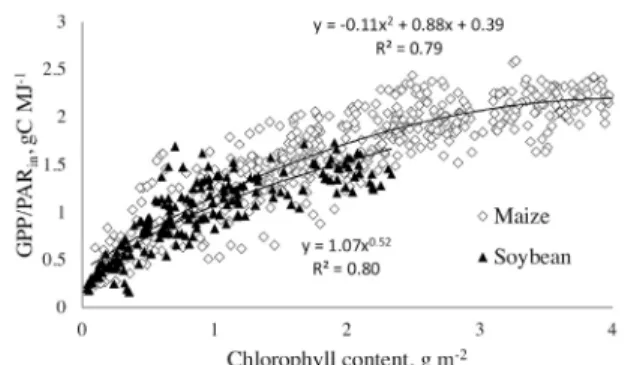
The GPP/PARin vs. Chl relationships for the maize and soybean
present-ed in Fig. 1 are close. Chl was responsible for 80% of GPP/PARin
varia-tion in soybean and 79% in maize. The relavaria-tionship of GPP/PARin vs. Chl
for both C3 and C4 crops combined exhibited an R2 = 0.84. The non-lin-earity of these relationships is noteworthy. When Chl < 1.5 g m−2, GPP
was very sensitive to Chl. However, for moderate to high Chl, when can-opy light extinction is complete or close to complete, crop photosynthe-sis was less sensitive to Chl, increasing only 30% for a doubling of Chl.in
For Chl < 1 g m−2, the relationships for both crops were very close and
there was no statistically significant difference between them (p = 0.62). However, for Chl > 1.5 g m−2 they diverged, with maize exhibiting
high-er GPP/PARin values than soybean for the same Chl (p < 0.005). Using a
more limited data set, the relationships for maize and soybean were found to be quite close to each other, leading to the conclusion that the GPP vs.
Chl × PARin relationship was almost non-species specific (Gitelson et al.,
2006b). However using a larger dataset, this study shows that the GPP/
PARin vs. Chl relationships are species specific at moderate-to-high Chl.
Fig. 1. Relationship between gross primary production (GPP) normalized
to incident PAR (PARin) and chlorophyll content in irrigated and rain -fed maize and soybean.
4.2. Chlorophyll efficiency
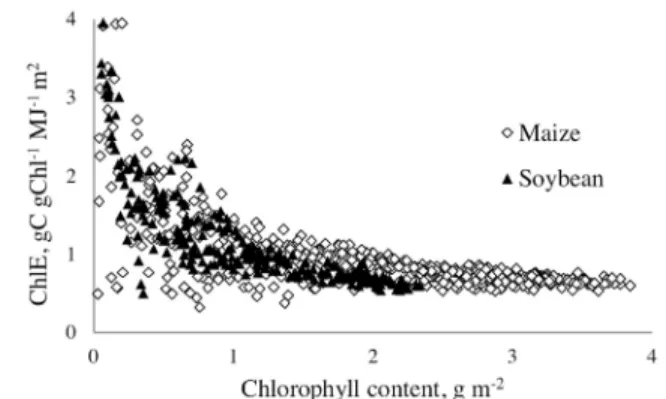
Chlorophyll efficiency decreased with increase in Chl and for the
same Chl it was widely variable, especially in the range of low to
moderate Chl (<1.5 g m−2, Fig. 2). The chlorophyll efficiency of
low Chl was high (>4 gC gChl−1m2 MJ−1) and declined more than
5 fold as Chl reached moderate values around 1.5 g m−2.
Chlo-rophyll efficiency decreased with further increase in Chl above
1.5 g m−2 but in a smaller degree. For both crops, Chl efficien
-cies almost coincided in the range of Chl < 1.5 g m−2 but were
significantly different (with higher values for maize) for higher Chl, reaching differences of about 30% for Chl around 2 g m−2.
4.3. Chlorophyll efficiency in maize
To understand the reason for the high variability of chlorophyll
efficiency for the same Chl, especially when Chl was low to mod
-erate, we examined the relationships between GPP/PARin and Chl in different phenological stages and under different water avail -abilities (Fig. 3). During the vegetative stages, from the begin-ning of the season to the time of maximal Chl, the relationships for irrigated and rainfed maize were very similar (Fig. 3A). At the sites studied, irrigation was conducted based on measurements
of soil water content. Since there was sufficient rainfall between
early May and early June, irrigation usually was not required.
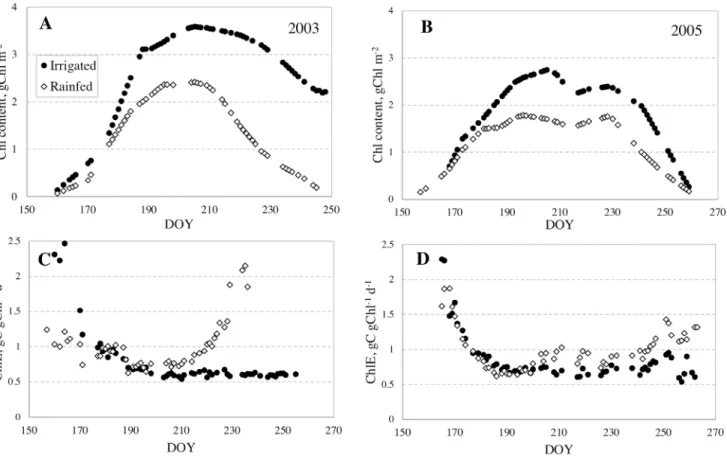
Thus, it is not surprising that the effect of irrigation was not pro -nounced during the vegetative stage, which for maize in Nebras-ka is usually completed in early July (day of year, DOY, 180–190). During the vegetative stages, Chl at irrigated and rainfed sites were quite close and diverged only at the end of this stage
af-ter DOY 180 (Figs. 4A and B). In the vegetative stages, Chl effi -ciencies at irrigated and rainfed sites decreased with increasing Chl, with minimal values corresponding to maximal crop density.
During the reproductive stages, GPP/PARin vs. Chl
relation-ships for irrigated and rainfed sites were different (Fig. 3B). At rainfed sites, the GPP/PARin vs. Chl relationship was close
ex-hibiting an R2 = 0.87 while it was much more scattered at irri -gated sites (R2 = 0.79). Importantly, for the same Chl, GPP/PA
-Rin was higher at rainfed than at irrigated sites. During this stage, Chl contents at irrigated and rainfed sites were substantially dif-ferent with irrigated sites exhibiting considerably higher values
than rainfed sites (Fig. 4A and B). The difference in Chl efficien
-cies became notable when the difference in Chl reached maxi -mal values (around DOY 200, Fig. 4C and D) with chlorophyll
ef-ficiency at rainfed sites higher than at irrigated sites. Thus, the water treatment played a significant role in the primary produc -tion of maize.
It is important to underline that during the vegetative stag-es (DOY before 180), “the same Chl” in irrigated and rainfed sites occurred on almost the same dates (Fig. 4A and B), but
this was not the case during the reproductive stages. For exam-ple, in 2003 (a dry year; Fig. 4A) a Chl of about 2 g m−2 occurred
in the rainfed site during the early reproductive stage (around DOY 215) while in the irrigated site it occurred at the end of the season, i.e., more than one month later (DOY around 250, early
grain fill stage). In wetter years (e.g., 2005) the difference in the
timing of reaching “the same Chl” in irrigated and rainfed sites during the reproductive stage was smaller but never less than 15–20 days (Fig. 4B). Thus, the same Chl at irrigated and rainfed
sites occurred at different stages of maize development, at dif
-ferent PARin, and at different photosynthetic activities. These dif -ferences in plant development are a source of variability in the
chlorophyll efficiency in crops with different water treatments. Chlorophyll efficiency was affected by maize phenology (Fig.
3C and D); it was slightly higher in irrigated sites during the veg-etative stage than in the reproductive/senescence stage. The
op-posite occurred in rainfed sites where Chl efficiency was higher in
the reproductive stages than in the vegetative stages. For both
irri-gated and rainfed maize, chlorophyll efficiency was the highest at
the beginning and at the end of the season, with minimal values in the middle of the season as canopy Chl peaked (Fig. 3C and D).
Despite the differences mentioned above, the GPP/PARin vs.
Chl relationship in maize during eight years of observations was
strong, with Chl explaining about 80% of the GPP/PARin
varia-tion (Fig. 1). During the vegetative stages this relavaria-tionship was
even stronger, explaining more than 90% of GPP/PARin varia-tion (not shown).
4.4. Chlorophyll efficiency in soybean
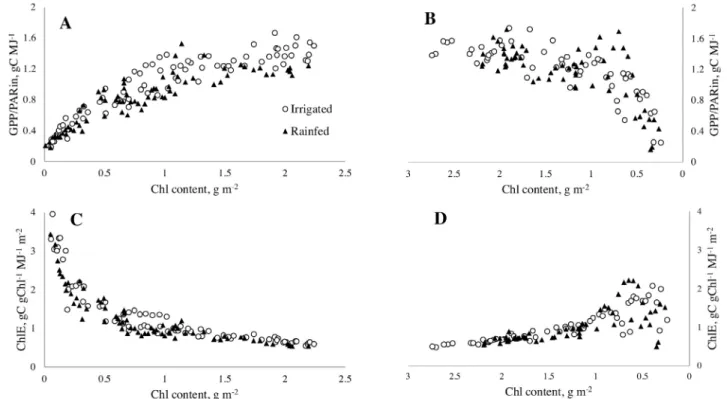
The relationship between GPP/PARin and Chl for soybean is shown in Fig. 5. During the vegetative stages, from the begin-ning of the season to the time of maximal Chl, the relationships for irrigated and rainfed soybean were similar, with somewhat
higher Chl efficiencies in the irrigated sites (Fig. 5A and C). In Ne -braska, soybean is planted later than maize, thus irrigation was applied at soybean sites during the vegetative stages.
During the reproductive stages, the GPP/PARin vs. Chl
rela-tionships were almost flat over the range of Chl from 2.7 g m−2
to around 1 g m−2, showing low sensitivity of GPP to a decrease
in Chl. In senescence, as Chl declined below 1 g m−2, a sharp
de-crease of GPP occurred (Fig. 5B). Chlorophyll efficiency inde-creased
with a decrease in Chl, exhibiting a small variability during the reproductive stages and a larger variability during senescence.
Fig. 6 shows the temporal behavior of Chl (A and B) and
chlo-rophyll efficiency (C and D) in soybean for two years with differ -ent temperature and precipitation regimes. By comparison, 2002 was a dry year while 2006 was wetter although a short stage of high temperatures occurred in July and August. In 2002, Chl at the rainfed and irrigated sites were almost equal at the
begin-ning of the season before DOY 190 (Fig. 6A). Chlorophyll efficien -cy was highest at the beginning of the season and decreased as Chl increased (Figs. 6A and C) in both irrigated and rainfed sites, although the irrigated site exhibited higher values overall. The
difference in Chl between the irrigated and rainfed sites became
noticeable around DOY 200 and continued to increase thereafter, reaching maximal values around DOY 220 (Fig. 6A). Chlorophyll
ef-ficiency in the rainfed site became higher than in the irrigated site
and remained higher until the end of the season (Fig. 6C). Thus, as was observed in maize (Fig. 4), while Chl in the rainfed site be-yond DOY 210 was smaller than in irrigated site (Fig. 6A), chloro
-phyll efficiency in the rainfed site was considerably higher than in
the irrigated site (Fig. 6C). A smaller difference in Chl between the
irrigated and the rainfed sites occurred in 2006 (Fig. 6B). Howev-er, while beyond DOY 210 Chl in the rainfed site was smaller than
in irrigated site, its efficiency was higher (Fig. 6D). Fig. 2. Relationships between chlorophyll efficiency (ChlE) and chloro
Efficiency of chlorophyll in gross primary productivity 105
Fig. 3. Relationships GPP/PARin vs. chlorophyll content (A and B) and chlorophyll efficiency vs. chlorophyll content (C and D) at irrigated and rainfed
maize sites in vegetative stages (A and C) and reproductive stages (B and D) in 2001 through 2008.
Fig. 4. Temporal behavior of canopy chlorophyll (Chl) content (A, B) and chlorophyll efficiency (C, D) at rainfed and irrigated maize in 2003 (dry year) and 2005 (moderate weather conditions). Difference in Chl and in chlorophyll efficiencies between irrigated and rainfed sites was higher in the dry year (2003). Maximal difference in chlorophyll efficiency occurred when difference in Chl was the highest.
The main features of the relationship between chlorophyll
efficiency and Chl seen in maize were also evident for soybean.
However, while 12 irrigated and four rainfed maize sites were
studied, only three rainfed and three irrigated soybean sites were
studied. The richer data set for maize allowed a more defini
-tive view of the decrease in chlorophyll efficiency at irrigated
Fig. 5. Relationships GPP/PARin vs. chlorophyll (Chl) content (A and B) and chlorophyll efficiency vs. chlorophyll content (C and D) at irrigated and
rainfed soybean sites in vegetative stages (A and C) and reproductive stages (B and D) in 2002, 2004 and 2006.
Fig. 6. Temporal behavior of canopy chlorophyll (Chl) content (A, B) and chlorophyll efficiency, ChlE (C, D) in rainfed and irrigated soybean in 2002
(dry year) and 2006 (moderate weather conditions). Difference in Chl and in chlorophyll efficiencies between irrigated and rainfed sites was much higher in dry year 2002 than in 2006. Maximal difference in chlorophyll efficiency occurred when difference in Chl was the highest.
Efficiency of chlorophyll in gross primary productivity 107 compared to rainfed sites. A similar difference was observed in
soybean (Fig. 6), however, this difference was not as pronounced
as it was in maize.
Despite the differences mentioned above, the GPP/PARin vs. Chl relationship in soybean during the three years of observations was
close; Chl explained 80% of the GPP/PARin variation (Fig. 1). Dur-ing the vegetative stages this relationship was stronger, with Chl
explaining 88% of the GPP/PARin variation (not shown). 4.5. Effect of water status on chlorophyll efficiency
For maize, Chl was smaller at the rainfed sites and the difference
in Chl was larger for years with higher temperature and low-er precipitation. Howevlow-er, the chlorophyll efficiency at the rain -fed sites was higher than at the irrigated sites. The ratios of GPP,
fAPAR and Chl at irrigated-to-rainfed sites give insight into the differences in chlorophyll efficiencies affected by water treat
-ment (Fig. 7).
At the rainfed site in a dry year (2003), soil moisture at DOY 210 was less than half of that at the irrigated site and remained almost invariant until the end of the season. Due to water
de-ficiency, the irrigated-to-rainfed ratio of Chl steadily increased
reaching 3.5 at DOY 230 and 12 at DOY 245 (not shown in Fig.
7A). However, when the irrigated-to-rainfed ratio for Chl was equal to 2, the irrigated-to-rainfed ratio for fAPAR was close to
one. Until DOY 220, the higher Chl in the irrigated site did not alter the amount of absorbed radiation. This suggests that the depth of light penetration inside the dense irrigated maize can-opy was so limited that the so-called “illuminated chlorophyll” (Gamon, 2015) was the same as the one in rainfed canopies with
lower Chl. With further increase in the irrigated-to-rainfed ratio of Chl above 2 the irrigated-to-rainfed ratio of fAPAR increased;
however, the slope of this increase was 5-fold smaller than the slope of increase in the irrigated-to-rainfed Chl ratio.
The low sensitivity of fAPAR to Chl in the irrigated site affect -ed the sensitivity of GPP to Chl. From the beginning of the sea-son until DOY 225 when the irrigated-to-rainfed ratio of Chl ex-ceeded 3, the irrigated-to-rainfed ratio of GPP was close to one.
When Chl in the irrigated site was 3-fold higher than in the rain -fed site, GPP was only 30% higher. Further increases of the irri-gated-to-rainfed ratio of Chl above 3.5 corresponded to some increase in GPP. However, when the irrigated-to-rainfed ratio of Chl reached a value of 12, the irrigated-to-rainfed ratio of
fAPAR was 2.7, while the irrigated-to-rainfed ratio of GPP was
just below 2.
For soybean in 2002, the irrigated-to-rainfed ratios of
bio-physical characteristics (Chl, fAPAR and GPP), as well as chloro
-phyll efficiency are shown in Fig. 8. At the peak of the season,
canopy Chl in the irrigated site was 2.6-fold higher than in the rainfed site. However, this corresponded only to a 25% increase
of fAPAR and GPP, thus, chlorophyll efficiency at the irrigated site
was half that of the rainfed site.
In both crops, the higher amounts of Chl produced at
irrigat-ed sites were less effective as drivers of photosynthesis than Chl produced at the rainfed sites with limited water resources. Due to the limited water supply, leaf Chl decreased; this led to an in-crease of leaf transmittance and an inin-crease in the optical depth
of the canopy in the PAR spectral region. Thus, the amount of il
-luminated chlorophyll related to APAR became higher and chlo
-rophyll efficiency increased. Thus, PAR absorption by the rain
-fed canopy was close or equal to the PAR absorption by the irri -gated canopy with higher Chl. In maize, a 50% higher Chl in the
irrigated vs. rainfed sites did not bring any difference in fAPAR.
In soybean, 2.6-fold higher Chl in the irrigated site produced a
30% difference in fAPAR.
5. Discussion
The GPP/PARin vs. Chl relationship was found to be essentially
non-linear with a higher slope at the beginning of the season and in the end of the reproductive stage than through the
mid-dle of the season. Thus, chlorophyll efficiency was the highest
at the beginning of the season when the canopy density/vege-tation fraction was small, leaf Chl was moderate to high and the
entire canopy was illuminated. Chlorophyll efficiency was also
high at the end of the season when leaf Chl decreased while to-tal LAI remained quite high.
Thus, chlorophyll worked very effectively for primary pro -duction at the beginning and at the end of the season when the canopy density and leaf area index were small to moder-ate. In addition, since leaf N content typically decreases dur-ing the reproductive stage (e.g., Muchow, 1988; Uhart and
An-drade, 1995), chlorophyll efficiency may also decrease. Muchow and Davis (1988) showed that, in maize, radiation use efficiency
was more sensitive to N supply than was radiation interception. Therefore, late in the reproductive stage, when leaf N contents may in fact be lower, particularly at the irrigated compared to the rainfed site, photosynthetic capacity, which is strongly relat-ed to N content, would also be smaller.
In the vegetative stage, with the increase in canopy densi-ty, self-shadowing increases. During this time, the depth of light penetration inside the canopy (which is inversely proportional to leaf absorption, Merzlyak and Gitelson, 1995) becomes limit-ed by the upper leaf layers. As a result, with an increase in green
LAI, the fAPAR stops increasing and remains almost insensitive to
changes in green LAI (Figs. 3 B and 4 B in Gitelson et al., 2014). This is especially pronounced in soybean (a planophile), where
fAPAR remains almost invariant as green LAI increased from 3
to more than 5.
Chlorophyll efficiencies of maize and soybean differed signif -icantly at moderate to high Chl. The likely reason for this is the
different canopy structures of these crops. Canopy structure/leaf angle distribution strongly affects fAPAR (e.g., Huemmrich, 2013).
Unlike the maize canopy that is “open” to incident light
(spheri-cal), allowing a significant fraction of incident light to penetrate
directly inside the canopy, the soybean canopy is more “closed” to light penetration (planophilic). In addition, in a maize canopy, leaf Chl and green LAI gradually increase from the top of canopy, reaching maximal values in the middle of the canopy (Ciganda et al., 2008). Thus, leaf transmittance of the upper leaf layers of maize is higher than that of the top-of-canopy soybean leaves, which supports a high light level in the middle of the maize can-opy. In the soybean canopy, leaf Chl is distributed more evenly than in maize canopy. The light transmitted by the uppermost soybean leaf layer inside the canopy is only 1–2% in the blue and red ranges of the spectrum and does not exceed 3–5% in the green (Gitelson et al., 2006a). The “closed” soybean cano-py structure and lower light inside the canocano-py (as compared to that of maize at moderate to high canopy density) may be one
of the reasons for the lower chlorophyll efficiency in soybean,
due to documented diminishing returns from N investment at low light conditions (Gulman and Chu, 1981).
Plant canopies are constructed so that the distribution of the photosynthetic capacity parallels the gradient of incident radi-ation inside the canopy (Field, 1991). The distribution of
photo-synthetic capacity depends on LAI. While at low LAI an optimal
canopy yields less than a 5% increase in daily production than a canopy with a uniform distribution of capacity (Field, 1983), the advantage of an optimal canopy may be more than 100% when
LAI is high. This effect may be another reason for the difference in chlorophyll efficiencies in maize, with closer to optimal pho -tosynthetic capacity distribution, compared to soybean.
As a driver of photosynthesis, decreased canopy Chl was very
effective in capturing light, facilitating deeper light penetration
inside the canopy and maximizing photosynthetic rate under
conditions of limited water availability. Such effective use of lim -ited resources is remarkable. It demonstrates the elastic adapta-tion of plants to environmental condiadapta-tions.
In spite of the wide seasonal variation of Chl efficiency in
both crops, LUE remained, if not constant, remarkably
invari-ant. LUE was less affected by severe water stress than Chl and fAPAR. During a dry year, when maize irrigated-to-rainfed ratio
of Chl exceeded 2.5, the irrigated-to-rainfed ratio of LUE
oscillat-ed around one (Fig. 7B). It was only when the irrigatoscillat-ed-to-rain -fed Chl ratio increased to 5, and the irrigated-to-rain-fed
chloro-phyll efficiency ratio dropped to 0.4, that the LUE at the irrigat -ed site decreas-ed 20% as compar-ed to the rainf-ed site. This was also the case for soybean during a dry year, where irrigated-to-rainfed LUE ratio was remarkably invariant during the growing season, oscillating around one, while the irrigated-to-rainfed ra-tio of Chl exceeded 2.6 and the irrigated-to-rainfed rara-tio of Chl
efficiency dropped below 0.4 (Fig. 8).
Factors that constrain productivity, like low resource
avail-ability, may reduce GPP by reducing APAR, LUE or both (Field,
1991). The results of this study indicate that if a limitation in re-source availability occurs in a stage during which the plant has the capacity to respond by altering canopy characteristics to “balance” its available resources, the response is a change in
APAR such that LUE remains relatively invariant. Thus, in both
rainfed maize and soybean, water stress resulted in a decrease of GPP comparable to those of the irrigated sites, however LUE
was not affected.
Extensive study of the GPP vs. APAR relationship for maize and soybean showed that GPP and APAR are highly correlated
with limited scattering of the points (in maize R2 = 0.9 and in soybean R2 = 0.83, Gitelson et al., 2015). Remarkably, the GPP vs. APAR relationships were not statistically different for irrigat -ed and rainf-ed maize (p = 0.94), soybean (p = 0.69) and for both crops combined (p = 0.29).
Efficient resource use is an indication of limited resource avail-ability and high resource acquisition costs that result in an op-timization of resource allocation, which then results in a maxi-mization of carbon gains and a convergence on a narrow range of LUE (Field, 1991; Goetz and Prince, 1999). These results thus
confirm those of Goetz and Prince, (1999) who found a conver
-gence in the amount of GPP per unit of APAR (i.e., LUE).
Net primary production (Field et al., 1995) and GPP (Goetz and Prince, 1999) are basically integrators of resource availability with plant processes tending toward making all resources equally
limiting (Bloom et al., 1985). In this study, the most limiting fac-tor was water; in reaction to water stress, plants decreased an-other resource, absorbed light, by decreasing Chl and making absorbed light also limiting.
Rainfed sites in dry years presented extreme cases of resource imbalance. When water is limiting and plants cannot redirect
harvest potential to other resources, then plants do not invest in light harvesting over that which can be utilized for growth. By decreasing Chl, the plant decreases light harvesting, making the
absorbed light more effective for photosynthesis than when Chl is higher. The decrease in Chl is the result of effective use of lim -ited resources in accord with the resource balance perspective. Irrigated sites may be seen as examples of “wasteful alloca
-tion” of resources (Goetz and Prince, 1999), with development of unnecessary light harvesting and photosynthetic machinery. However, it is also possible that the N stored in these seeming-ly “unnecessary” components is later remobilized into the grain.
Fig. 7. Temporal behaviors of irrigated-to-rainfed ratios of (A) chlorophyll content (Chl), fraction of absorbed photosynthetically active radiation
(fAPAR), gross primary production (GPP) and chlorophyll efficiency (ChlE). (B) Chlorophyll efficiency (ChlE) and light use efficiency (LUE) at maize sites
in a dry year. DOY is day of year.
Fig. 8. Temporal behaviors of irrigated-to-rainfed ratios of (A) chlorophyll content (Chl), fraction of absorbed photosynthetically active radiation
(fAPAR), gross primary production (GPP) and chlorophyll efficiency (ChlE), and (B) chlorophyll efficiency (ChlE) and light use efficiency (LUE) at soy -bean sites in 2002.
Efficiency of chlorophyll in gross primary productivity 109
This underlines the importance of finding the precise balance for
irrigation as well as for N use. Both are sensitive to a number of
controls and finding that balance requires an understanding of the effects of each control.
6. Conclusions
This study introduced the concept of chlorophyll efficiency of
primary production, which gives insights into the processes be-hind photosynthetic optimization patterns from leaves to entire canopies. Chlorophyll is one of the main components of the
pho-tosynthetic machinery and its efficiency was found to be widely
variable and very sensitive to crop physiology, phenology and
water status. Chlorophyll efficiency is greatly affected by green
LAI and canopy chlorophyll content, diminishing in dense crops.
With a decrease of water supply, and thus Chl content, chloro
-phyll efficiency increases optimizing the use of resources. De
-spite the very wide variability of chlorophyll efficiency, light use efficiency remained if not constant, remarkably invariant, sup -porting the concept of an optimization of resource allocation and the functional convergence hypothesis in vegetation with
very different physiological states and subjected to different en -vironmental conditions. Since chlorophyll content is accessible through non-destructive, remotely sensed techniques, the use
of chlorophyll efficiency for modeling and monitoring plant op
-timization patterns is practical at different scales (e.g., leaf, can
-opy) and under different environmental conditions.
Acknowledgments — We gratefully acknowledge the work of Field,
(1991), Field et al. (1995) and Goetz and Prince (1999) for inspiring this inquiry. This research was supported by Lady Davis and Marie Curie In-ternational Incoming Fellowship to AG, and partially supported by the
NASA NACP program and the U.S. Department of Energy. We sincere -ly appreciate the support and use of facilities and equipment provided by the Center for Advanced Land Management Information Technolo-gies (CALMIT) and data from the Carbon Sequestration Program, both at the University of Nebraska-Lincoln.
References
Ali, H., Tariq, N., Ahmad, S., Rasheed, M., Chattha, T.H., Hussain, A., 2012. Growth and radiation use efficiency of wheat as affected by different irrigation levels and phosphorus application meth -ods. J. Anim. Plant Sci. 22, 1118–1125.
Anten, N.P.R., Schieving, F., Werger, M.J.A., 1995. Patterns of light and
nitrogen distribution in relation to whole canopy carbon gain in C-3 and C-4 monocotyledonous and dicotyledonous species. Oecologia 101, 504–513.
Anten, N.P.R., Hernandez, R., Medina, E.M., 1996. The photosynthet -ic capacity and leaf nitrogen concentration as related to light re-gime in shade leaves of a montane tropical forest tree, Tetror-chidium rubrivenium. Funct. Ecol. 10, 491–500.
Bloom, A.J., Chapin III, F.S., Mooney, H.A., 1985. Resource limitation in plants − An economic analogy. Annu. Rev. Ecol. Syst. 16, 363–392.
Buckley, T.N., Miller, J.M., Farquhar, G.D., 2002. The mathematics of linked optimisation for water and nitrogen use in a canopy. Sil-va Fennica 36, 639–669.
Ciganda, V., Gitelson, A.A., Schepers, J., 2008. Vertical Profile and
temporal variation of chlorophyll in maize canopy: Quantitative
“Crop Vigor” indicator by means of reflectance-based techniques. Agron. J. 100, 1409–1417.
Ciganda, V., Gitelson, A., Schepers, J., 2009. Non-destructive deter-mination of maize leaf and canopy chlorophyll content. J. Plant
Physiol. 166, 157–167.
Clevers, J.G.P.W., Gitelson, A.A., 2013. Remote estimation of crop
and grass chlorophyll and nitrogen content using red-edge bands on Sentinel-2 and-3. Int. J. Appl. Earth Obs. Geoinf. 23, 344–351.
Dash, J., Curran, P.J., 2004. The MERIS terrestrial chlorophyll index. Int. J. Remote Sens. 25, 5003–5013.
Evans, J.R., 1989. Photosynthesis and nitrogen relationships in leaves of C3 plants. Oecologia 78, 9–19.
Fassnacht, F.E., Stenzel, S., Gitelson, A.A., 2015. Non-destructive esti-mation of foliar carotenoid content of tree species using merged
vegetation indices. J. Plant Physiol. 176, 210–217.
Field, C.B., Randerson, J.T., Malmström, C.M., 1995. Global net prima
-ry production: combining ecology and remote sensing. Remote Sens. Environ. 51, 74–88.
Field, C.B., 1983. Allocating leaf nitrogen for the maximization of car-bon gain: leaf age as a control on the allocation program.
Oeco-logia (Berlin) 56, 341–347.
Field, C.B., 1991. Ecological scaling of carbon gain to stress and
re-source. In: Mooney, H.A., Winner, W.E., Pall, E.J. (Eds.), Response of Plants to Multiple Stresses. Academic Press, San Diego, pp. 35–65.
Gamon, J.A., 2015. Reviews and syntheses: optical sampling of the flux tower footprint. Biogeosciences 12, 4509–4523. http://www. biogeosciences.net/12/4509/2015/
Gitelson, A.A., Merzlyak, M.N., 1997. Remote estimation of chlo
-rophyll content in higher plant leaves. Int. J. Remote Sens. 18, 2691–2697.
Gitelson, A.A., Verma, S.B., Vina, A., Rundquist, D.C., Keydan, G.,
Leavitt, B., Arkebauer, T.J., Burba, G.G., Suyker, A.E., 2003. Novel
technique for remote estimation of CO2 flux in maize. Geophys. Res. Lett. 30 (9), 1486.
Gitelson, A.A., Viña, A., Ciganda, V., Rundquist, D.C., Arkebauer, T.J., 2005. Remote estimation of canopy chlorophyll content in crops. Geophys. Res. Lett. 32, L08403.
Gitelson, A.A., Keydan, G.P., Merzlyak, M.N., 2006a. Three-band mod -el for noninvasive estimation of chlorophyll, carotenoids, and
anthocyanin contents in higher plant leaves. Geophys. Res. Lett.
33, L11402.
Gitelson, A.A., Viña, A., Verma, S.B., Rundquist, D.C., Arkebauer, T.J., Keydan, G., Leavitt, B., Ciganda, V., Burba, G.G., Suyker, A.E., 2006b. Relationship between gross primary production and chlorophyll
content in crops: implications for the synoptic monitoring of
veg-etation productivity. J. Geophys. Res.: Atmos. 111, D08S11. Gitelson, A.A., Peng, Y., Masek, J.G., Rundquist, D.C., Verma, S., Suyk
-er, A., Bak-er, J.M., Hatfield, J.L., Meyers, T., 2012. Remote estima
-tion of crop gross primary produc-tion with Landsat data. Remote
Sens. Environ. 121, 404–414.
Gitelson, A.A., Peng, Y., Arkebauer, T.J., Schepers, J., 2014. Relation -ships between gross primary production, green LAI, and canopy chlorophyll content in maize: implications for remote sensing of
primary production. Remote Sens. Environ. 144, 65–72.
Gitelson, A.A., Peng, Y., Arkebauer, T.J., Suyker, A.E., 2015. Productivi-ty, absorbed photosynthetically active radiation, and light use
ef-ficiency in crops: Implications for remote sensing of crop prima
-ry production. J. Plant Physiol. 177, 100–109.
Goetz, S.J., Prince, S.D., 1999. Modelling terrestrial carbon exchange and storage: Evidence and implications of functional convergence
in light-use efficiency. Adv. Ecol. Res. 28, 57–92.
Gulman, S.L., Chu, C.C., 1981. The effects of light and nitrogen on
photosynthesis leaf characteristics, and dry matter allocation in the chaparral shrub Diplacus aurantiacus. Oecologia 49, 207–212. Hall, F.G., Huemmrich, K.F., Goetz, S.J., Sellers, P.J., Nickeson, J.E.,
1992. Satellite remote sensing of surface energy balance:
Suc-cess, failures and unresolved issues in FIFE. J. Geophys. Res. 97,
Hatfield, J.L., Asrar, G., Kanemasu, E.T., 1984. Intercepted photosyn
-thetically active radiation estimated by spectral reflectance. Re
-mote Sens. Environ. 14, 65–75.
Herppich, M., Herppich, W.B., von Willert, D.J., 2002. Leaf nitrogen
content and photosynthetic activity in relation to soil nutrient availability in coastal and mountain fynbos plants (South Africa).
Basic Appl. Ecol. 3, 329–337.
Hikosaka, K., 2014. Optimal nitrogen distribution within a leaf can
-opy under direct and diffuse light. Plant Cell Env. 37, 2077–2085. Hirose, T., Bazzaz, F., 1998. Trade-off between light-and
nitrogen-use efficiency in canopy photosynthesis. Ann. Bot. 82, 195–202. Huemmrich, K.F., 2013. Simulations of seasonal and latitudinal vari
-ations in leaf inclination angle distribution: implic-ations for
re-mote sensing. Adv. Rere-mote Sens. 2, 93–101.
Karlsson, P.S., 1994. Photosynthetic capacity and photosynthetic nu
-trient-use efficiency of Rhododendron lapponicum leaves as re -lated to leaf nutrient status, leaf age and branch reproductive
status. Funct. Ecol. 8, 694–700.
Kira, O., Linker, R., Gitelson, A., 2015. Non-destructive estima -tion of foliar chlorophyll and carotenoid contents: Focus on informative spectral bands. Int. J. Appl. Earth Obs. Geoinf. 38, 251–260.
Kull, O., 2002. Acclimation of photosynthesis in canopies: Models and limitations. Oecologia 133, 267–279.
Merzlyak, M., Gitelson, A.A., 1995. Why and what for the leaves are
yellow in autumn? On the interpretation of optical spectra of senescing leaves (Acer platanoides L.). J. Plant Physiol. 145 (3), 315–320.
Monteith, J.L., 1977. Climate and the efficiency of crop production in Britain. Philos. Trans. R. Soc. Lond. 281, 277–294.
Muchow, R.C., Davis, R., 1988. Effect of nitrogen supply on the com -parative productivity of maize and sorghum in a semi-arid
tropi-cal environment II. Radiation interception and biomass accumu
-lation. Field Crops Res. 18, 17–30.
Muchow, R.C., 1988. Effect of nitrogen supply on the comparative
productivity of maize and sorghum in a semi-arid tropical
en-vironment I. Leaf growth and leaf nitrogen. Field Crops Res. 18,
1–16.
Niinemets, Ü., Anten, N.P., 2009. Packing the photosynthetic ma-chinery: From leaf to canopy. In: Nedbal, L. (Ed.), Photosynthesis in Silico. Kluwer Academic Publishers, Netherlands, pp. 363–399.
Osada, N., Yasumura, Y., Ishida, A., 2014. Leaf nitrogen distribution in relation to crown architecture in the tall canopy species, Fa-gus crenata. Oecologia 175, 1093–1106.
Retkute, R., Smith-Unna, S.E., Smith, R.W., Burgess, A.J., Jensen, O.E.,
Johnson, G.N., Preston, S.P., Murchie, E.H., 2015. Exploiting het-erogeneous environments: Does photosynthetic acclimation
op-timize carbon gain in fluctuating light? J. Exp. Bot. 66, 2437–2447. Rundquist, D.C., Perk, R., Leavitt, B., Keydan, G.P., Gitelson, A.A., 2004.
Collecting spectral data over cropland vegetation using machine-positioning versus hand-machine-positioning of the sensor. Comput.
Elec-tron. Agric. 43, 173–178.
Rundquist, D.C., Gitelson, A.A., Leavitt, B., Zygielbaum, A., Perk, R., Keydan, G.P., 2014. Elements of an integrated phenotyping sys -tem for monitoring crop status at canopy level. Agronomy 2014 (4), 1.
Turner, D.P., Urbanski, S., Bremer, D., Wofsy, S., Meyers, T., Gower, S.T., et al., 2003. A cross-biome comparison of daily light use efficien -cy for gross primary production. Global Change Biol. 9, 383–395.
Verma, S.B., Dobermann, A., Cassman, K.G., Walters, D.T., Knops, J.M.,
Arkebauer, T.J., Suyker, A.E., Burba, G.G., Amos, B., Yang, H., 2005. Annual carbon dioxide exchange in irrigated and rainfed
maize-based agroecosystems. Agric. For. Meteorol. 131, 77–96.
Viña, A., Gitelson, A.A., 2005. New developments in the remote esti-mation of the fraction of absorbed photosynthetically active
ra-diation in crops. Geophys. Res. Lett. 32, L17403.
Viña, A., Gitelson, A.A., Nguy-Robertson, A.L., Peng, Y., 2011. Com
-parison of different vegetation indices for the remote assess
-ment of green leaf area index of crops. Remote Sens. Environ. 115, 3468–3478.
Vico, G., Manzoni, S., Palmroth, S., Weih, M., Katul, G., 2013. A per -spective on optimal leaf stomatal conductance under CO2 and light co-limitations. Agric. For. Meteorol. 182, 191–199. Xu, L., Baldocchi, D.D., 2003. Seasonal variation in carbon dioxide
ex-change over a Mediterranean annual grassland in California.
Ag-ric. For. Meteorol. 123, 79–96.
Xu, W.Z., Deng, X.P., Xu, B.C., 2013. Effects of water stress and fer -tilization on leaf gas exchange and photosynthetic light-re-sponse curves of Bothriochloa ischaemum L. Photosynthetica 51, 603–612.
Zhu, X.G., Long, S.P., Ort, D.R., 2010. Improving photosynthetic effi