Contact
Questions about the research project may be directed to [email protected]. For more information, please visit www.de.dariah.eu.
What is DARIAH-DE?
DARIAH-DE supports digitally-enabled research and teaching in the arts and humanities. The project is developing a research infrastruc-ture which will offer tools, core services, and access to research data as well as materials for research and education in the Digital Humani-ties (DH).
Profile
DARIAH-DE is the German national contribution to the European research infrastructure “DARIAH-EU—Digital Research Infrastructure for the Arts and Humanities” .
www.dariah.eu
Currently, 17 partner institutions from the fields of information technology as well as the arts and humanities are involved in DARIAH-DE, including universities, data centres, disciplinary institutions, one academy, one commercial partner, and one library.
Project coordination: Göttingen State and Uni-versity Library
Funding: Federal Ministry of Education and Research (BMBF) project reference number 01UG1110A – M
Duration: The construction phase of DARIAH-EU is initially scheduled to be completed in 2016.
About the project
A
bout the pr
ojec
About DARIAH-DE
The central mission of DARIAH-DE is to enable the interoperability of tools and research data. Following internationally valid and accepted standards and policies, the project aims at ensur-ing their long-term preservation and future use. DARIAH-DE also supports and advises research-ers as well as research projects in planning humanities research initiatives within a digital environment.
Effective ways of handling digital resources, concepts, and methods in the Digital Humanities must be introduced into training and instruction for humanities researchers at all educational and career levels. In close consultation with discipli-nary communities, existing study and training courses are being coordinated, made more visible, and, if necessary, developed more fully. Moreover, DARIAH-DE is developing individual qualification modules, such as international workshops for experts dealing with specific themes.
In order to establish digital research in the arts and humanities, it is necessary to enhance knowledge of digital research methods and practices. The use and application of these processes is supported by special tools and services that will be designed, adapted, and made available as a basic infrastruc-ture within the context of DARIAH-DE.
In order to emphasize the added value of Digital Humanities methods, services, and tools, discipline-specific requirements in the form of concrete research questions have been identi-fied. Based on these specifications, individual solutions in the form of “demonstrators” have been developed to demonstrate both specific methods and the overall potential for research in the Digital Humanities.
Research data form an essential basis for scien-tific work during the entire research process, from collecting and analysing data to publica-tion and the subsequent use by third parties. Unrestricted access is one requirement that is of central importance for working with research data. DARIAH-DE evaluates, discusses, and recommends standards for data, metadata, licensing, and tools as well as for procedures and organisational structures.
This infrastructure will enable researchers to carry out research in an increasingly digital environment, across disciplines and institutions in collaborative ways and towards sustainable results.
Interaction of DARIAH-EU and
DARIAH-DE
DARIAH-EU is one of 48 projects on the roadmap of the European Strategy Forum on Research Infra structures (ESFRI). The European Com-mission initiated ESFRI in 2002 as a strategic instrument to encourage the scholarly integra-tion of Europe and to strengthen its internaintegra-tional competitiveness.
The purpose of ESFRI is to support a coherent and strategic approach towards research infra-structures in Europe as well as multilateral initia-tives which will lead to better use and develop-ment of research infrastructures on a European and global level.
In order to provide the European research networks with a robust organizational and legal form, the European Commission developed the European Research Infrastructure Consortium (ERIC) as a legal entity which is recognized by all EU member states.
DE is the German contribution to DARIAH-EU. Apart from DARIAH-DE, several other national DARIAH activities are in place, e.g. in France, the Netherlands, Denmark, and Austria—to name just a few. Together, the pieces of this puzzle fit to form DARIAH-EU, the European integrated research
Further information on ESFRI:
ec.europa.eu/research/esfri
Further information on DARIAH-EU:
www.dariah.eu
What are the Digital Humanities?
The Digital Humanities are a field of research at the intersection of applied computer science and the arts and humanities. In this context, complex ICT-supported methods and tools are systematically explored, developed, and applied to find new questions in the arts and humanities and to find new answers to traditional research questions.The research opportunities will be enhanced through distributed heterogeneous digital research data as well as by specific methods such as digital editing, quantitative text analysis, dynamic visualization of complex data, and the use of interactive historic atlases.
A
bout the pr
ojec
DHd-Blog: www.dhd-blog.org
The DHd blog “Digital Humanities im deutschsprachigen Raum” was established under the leadership of DARIAH-DE and the TextGrid consortium which is developing a virtual research environment for textual studies in the digital humanities. It explores current DH discussions in Germany, Austria, and Switzerland, provides information about current develop-ments and technologies, and reports on current research projects. Moreover, it is a platform for information exchange by drawing attention to current funding initiatives, events, and job advertisements.Since the goal is to involve all the active Gerlanguage partners in this field, the editorial man-agement of the blog is carried out by DH experts from Germany, Austria, and Switzerland.
www.dhd-blog.org
Are you a Digital Humanities expert and would like to support us with your blogging? Please contact
Affiliated projects
Several projects, some working on a European level, are already using the DARIAH-DE infra-structure. A list of DARIAH-DE affiliated projects is available at
www.de.dariah.eu
Is your project or your research group interest-ed in working with DARIAH-DE? Please contact
research resources such as data, analysis and processing tools, as well as scientific instrumenta-tion and services.”
Virtual Research Environments: A Guide, Priority Initia-tive “Digital Information” of the Alliance of German Science Organisations, 2011, p. 1, www.allianzinitiative. de/fileadmin/user_upload/Leitfaden_VRE_en_01.pdf
Virtual Research Environments
Virtual Research Environments (VRE) are essential components of modern research infrastructures as well as a complex and steadily evolving con-cept. DARIAH-DE uses the following definition of VREs from the Alliance of German Science Orga-nisations Priority Initiative “Digital Information”: “A virtual research environment is defined as a plat-form which allows multiple researchers in different locations to work together seamlessly. In terms of content, virtual research environments potentially support the entire research process — from the col-lection, discussion and further processing of data right through to the publication of results. From a technological perspective, virtual environments are based primarily on software services andcom-Dig ital Humanities Resear ch
DARIAH-DE: Digital
Humanities Research
VRE model (“Blueprint”)
Scholars in the arts and humanities consider VREs to be increasingly important instruments for their research, much like those in the natural sciences who have long employed VREs as part of their scientific work. DARIAH-DE will produce a VRE model or blueprint to guide scholars and developers in the arts and humanities as they work on designing and implementing new or modified VREs. The document will be based on the guideline for VREs published by the Alliance of German Science Organisations Priority Initia-tive “Digital Information”.
The document will contain:
1. A list of questions that can guide the con-versations between developers, scholars, and other involved parties
2. The technical features that will be essential for almost every VRE, e.g., user authentica-tion and rights management
3. An overview of past and present VRE fun-ding opportunities
4. A section on the problems experienced by other VRE projects and ideas for avoiding these in your own project.
DARIAH-DE use cases
(Demonstrators)
DARIAH-DE is planning and developing tools and services, or demonstrators, for the arts and humanities in cooperation with partner institu-tions. DARIAH-DE demonstrators exemplify the opportunities presented by Digital Humanities and showcase how the DARIAH infrastructure can support researchers in their scholarly work.
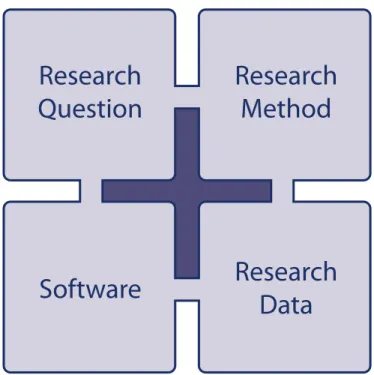
Each DARIAH-DE demonstrator serves as an ex-ample that illustrates the added value of digital methods. For representing prototypical research processes and creating significant use cases,
Fig. 1: Components of DARIAH-DE Demonstrators.
Research
Question
Software
Research
Method
Research
Data
each demonstrator is oriented around four com-ponents: research question, research method, software, and research data.
Dig
ital Humanities
Resear
Relationship to DARIAH
Appropriate Scope
Sustainability
Relevance and Visibility
in the Research Community
Relationship between
Effort and Resources
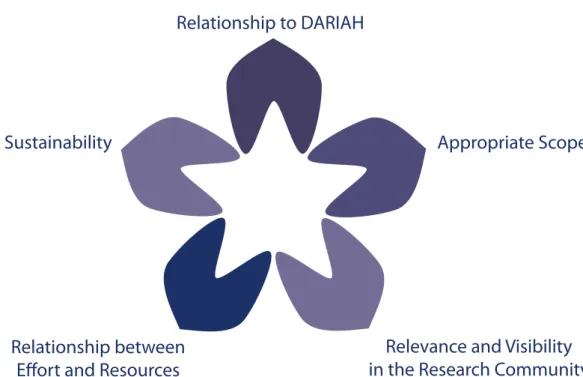
In order to provide well directed and sustainable support for humanities research, much attention was focused during the concept phase on the following five essential criteria:
The following DARIAH-DE demonstrators are cur-rently under development:
▪
Archive-in-a-Box:Recommendations and concepts for an archive system for data centres and research networks in the arts and humanities.
▪
Exploring TextGridRep with Voyant:Combinations of the Voyant suite of tools and the TextGrid Repository‘s collection of texts.
▪
Generische Suche (Generic Search):Distributed metasearch on collections and resources deposited in DARIAH registries.
▪
Geo-Browser:Re-use of the Europeana 3D interface for pre-senting spatial data in a temporal context.
▪
Interoperabilität durch Normdaten (Inter-operability by means of authority files):Semantic combination of research data with different provenances using authority files.
▪
MEISE (Music Encoding Initiative Score Editor):Specialized music score editor in combination with the standard MEI (Music Encoding Initia-tive) for encoding written musical notation.
▪
Monasterium Virtuelles Deutsches Urkun-dennetzwerk (Monasterium Virtual Charters Net):Distributed research environment of medieval and early modern age charters from German archives.
▪
Personendaten-Repositorium (Person Data Repository):Development of and access to an architecture for aggregating heterogeneous prosopogra-phical data sets.
▪
Virtuelles Skriptorium St. Matthias (Virtual Scriptorium of St. Matthew):Digitisation and permanent storage of histo-rical material from the medieval Benedictine library St. Matthew in Trier.
Dig
ital Humanities
Resear
Research about Digital
Humani-ties (DARIAH Bibliography)
The DARIAH Bibliography is a selective bibliogra-phy which is freely available online: www.zotero. org/groups/dariah_bibliography. It was pro-duced collaboratively and will be updated and expanded with new sections on a regular basis. The bibliography is organized into sections on various topics in the Digital Humanities. Currently, bibliographical information about the following topics is available: “Perspectives on Digital Humanities”, “Text Analysis”, “Virtual Research Environments”, “Software and Services”, “Digital Humanities Theses“ and “Digital Scholarly Publishing”.
Because the bibliography is based on Zotero, some useful functions can be used free of charge with a plug-in for Firefox or by using the Zotero application itself. For further information about Zotero, please refer to: www.zotero.org/support.
www.zotero.org/groups/dariah_bibliography If you have any questions about DH research in DARIAH-DE, please contact
Access to research data
(Collection Registry, Schema
Registry, Generic Search)
Scholars in the arts and humanities use different media types for their academic activities: images, handwritten notes, printed texts, geodata, ar-chaeological artefacts, musical scores, video, and many more, which are all increasingly available in digital formats. Few remaining content and methodological barriers exist to hinder discovery in the arts and humanities.
Access to research data is therefore one of the most important aspects in digital research. But because of the diversity of digital data sources and the contained data collections, access to research data can become a complex and some-times even insurmountable barrier for research-ers.
Schema Registry and Collection
Registry
A Schema Registry is being developed as one of the central elements of the DARIAH-DE research infrastructure. The interoperability between re-search data of different institutional and discipli-nary origins is made possible through mappings and metadata crosswalks.
A mapping defines a relation between two or
more metadata schemas. A crosswalk transfers data according to a specific schema into a new data structure based on mappings. The source data remain untouched in their decentralised collections. The collections are registered in a Collection Registry which is a central element of the research infrastructure of DARIAH-DE.
Dig
ital Humanities
Resear
Generic Search
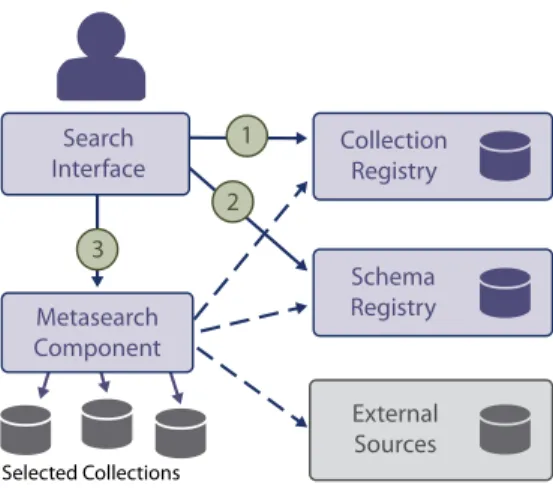
DARIAH is developing a generic search function-ality from abstracting from the heterogeneity of collections as well as their data and metadata schemas. It establishes and follows semantic links between structurally distinct collections and their concrete resources. This is achieved by means of crosswalks which connect not only data elements from different data formats and standards, but also map data types and values. The generic search provides two complementary dimensions for searching within data depend-ing on the variety of collections to be searched at the same time: a broad search in a large set of collections or an intensive search in a small set of collections. The user can move in these dimen-sions by selecting or deselecting collections. With a large set of collections, only few semantic links between all collections are followed. This reduces the variety of available search conditions but expands a search query to a large dataset. If no semantic relations are defined, the search reduces to a cross collection full-text search. In preparation for a search, the search interface interacts with the Collection Registry as well as the Schema Registry. The search parameters are defined by the user. For the interpretation of schemata as well as the resolution of references in the research data and metadata, the generic
search operates with external sources such as the Getty Thesaurus of Geographic Names for geographical normative data or the “Gemein-same Normdatei” (GND), the German universal authority file, for persistent identifiers for per-sonal names.
Fig. 4: Generic Search.
If you have any questions regarding research data in DARIAH-DE, please contact
[email protected] 1 3 2 External Sources Selected Collections Search Interface Metasearch Component Collection Registry Schema Registry
Treatment of research data
Interoperability, sustainability, and the persis-tence of data as well as confidence in their qual-ity are topics of central importance both from a generic and a subject-specific perspective. The sustainable use of research data allows for the re-use of research data beyond all subject-specific, institutional, and national borders. The prerequi-site for a functional research infrastructure is the long-term archiving and accessibility of research data and metadata, including descriptions of the research data that are as accurate as possible.
Application of standards
DARIAH-DE offers a variety of options for re-searchers to facilitate their involvement with new research projects, and digital data management in particular.
The recommendations issued by DARIAH-DE for the use of data standards are directed towards specific fields of the arts and humanities and can be used directly by researchers for their research work and projects. Issues of quality and the persistence of digital research data can already be addressed—especially in terms of their interoperability—during the planning phase of the project. Rec ommenda tions for r esear chers
DARIAH-DE:
Recommenda-tions for researchers
The compliance with and further development of special standards as well as the instalment of quality control management—e.g. by validation of metadata and a transparent management of different versions—guarantee the reliability and trustworthiness of the registered research data. The DARIAH-DE project focuses on the following standards for research data and metadata:
▪
ADeX – Archaeological Data eXchange:Standard for the exchange of archaeological subject data
▪
CEI – Charters Encoding Initiative:Standard for encoding historical charters
▪
TEI – Text Encoding Initiative:Standard for encoding textual data
▪
EpiDoc – Epigraphic Documents:Standard for encoding epigraphic inscriptions in TEI XML
▪
CIDOC-CRM – CIDOC Conceptual Reference Model:Ontology for cultural heritage data
▪
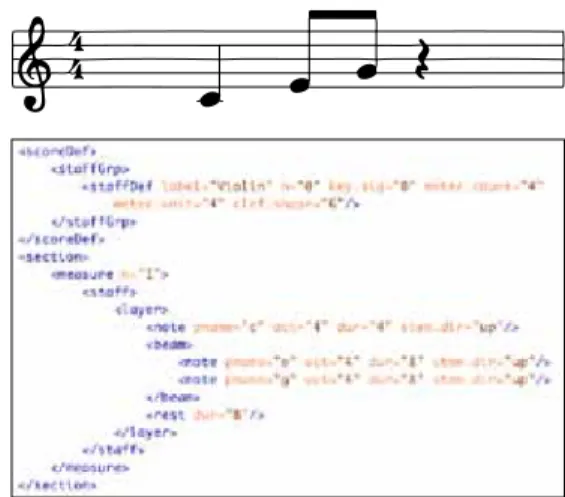
MEI – Music Encoding Initiative:Standard for encoding music scores
Fig. 5: Example encoded in MEI with the corresponding musical score.
The application of internationally well-accepted standards such as those listed above is an ef-fective and urgently recommended means to guarantee the interoperability, consistency, and sustainability of research data.
Licensing and legal issues
In addition to the technical challenges, legal is-sues surrounding the use of research data which arise in part from subject-specific requirements also need to be considered. For this reason, in DARIAH-DE data licences and related legal ques-tions are scrutinized with regard to sustainability and interoperability in order to issue recommen-dations for their proper treatment.
Your own repository
(Archive-in-a-Box)
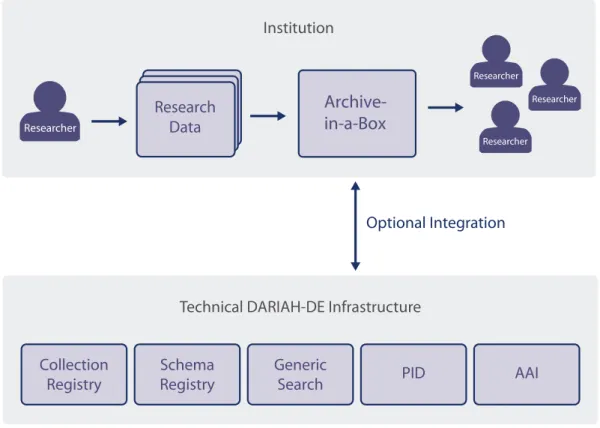
Researchers often possess research data which they would like to archive in a controlled and sustainable manner. An Archive-in-a-Box offers a concept to store and manage research data in digital collections, or data repositories, by means of local and technical archival systems for the arts and humanities, research centres, and research communities.
Easy to install packages (free of charge) offer pos-sibilities to produce collections or transfer exist-ing data without previous knowledge or signifi-cant efforts. Each of the recommended platforms offers connectivity to current and future digital humanities trends—well documented, making the best practical use of available resources,
well as data and metadata formats (TEI, Dublin Core, OAI-PMH, etc.).
If DARIAH-DE’s recommendations are followed, digital documents can be accessed collabora-tively and administered in an intuitive manner. A further advantage is that documents can be quickly and easily transferred into DARIAH-DE’s research infrastructure, which offers the follow-ing features:
▪
management of users and user roles, login via secure authentication,▪
unambiguous electronic tagging of single documents for long-term accessibility,▪
access to DARIAH-DE‘s search functions as well as research data schemas, and muchmore. Rec ommenda tions for r esear chers
Fig. 6: Archive-in-a-box (recommendation).
Setting-up and archiving one’s own collection or the transfer of existing data into a collection is now possible without pre-existing knowledge.
If you have any questions regarding research data in DARIAH-DE, please contact
[email protected] Researcher Researcher Researcher Researcher
Institution
Technical DARIAH-DE Infrastructure
Optional Integration
Archive-in-a-Box
Research
Data
Collection
Registry
Schema
Registry
Generic
DARIAH-DE:
Research Infrastructure
In order to offer tools for research in the digital humanities, a reliable and stable technical infra-structure comprising hardware and software is necessary, together with management, admin-istration, and oversight. In addition, this infra-structure forms the basis for the future develop-ment of other tools or complete virtual research environments. For this reason, DARIAH sees as one of its main responsibilities the support of smaller research projects or individual research-ers in particular who do not have the opportu-nity to set up their own research infrastructure. DARIAH-DE also serves as a point of contact for larger research networks and data centres.
DARIAH-DE portal – de.dariah.eu
All components presented in this brochure as well as further information will be made accessi-ble through and interactively linked to each oth-er in the DARIAH-DE portal. Usoth-ers will be offoth-ered a specially prepared browser view. The data from the registries will also be available for automatic data processing in the semantic web as Linked Data. In this manner all of the available data can be collected into the DARIAH-EU data pool. The DARIAH-DE portal will be developed to a central meeting point for all digital infrastructural needs for scholars in the arts and humanities.
Resear ch Infr astruc tur e
Behind the scenes (How our tools function)
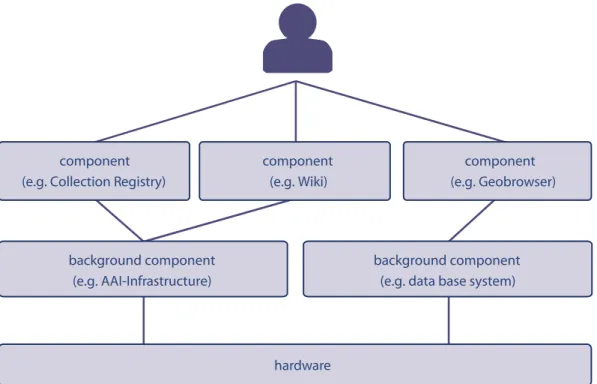
The technical DARIAH infrastructure is a service-oriented architecture and comprises many independently utilizable software components. The user accesses the infrastructure mainly via web applications. Examples for software services directly available to the user are the
demonstra-tors or the collection registry. These software components are supported by other software components which perform their tasks in the background, invisible to the user.
Fig. 7: DARIAH-DE infrastructure.
component (e.g. Collection Registry)
component (e.g. Wiki) component (e.g. Geobrowser) background component (e.g. AAI-Infrastructure) background component (e.g. data base system)
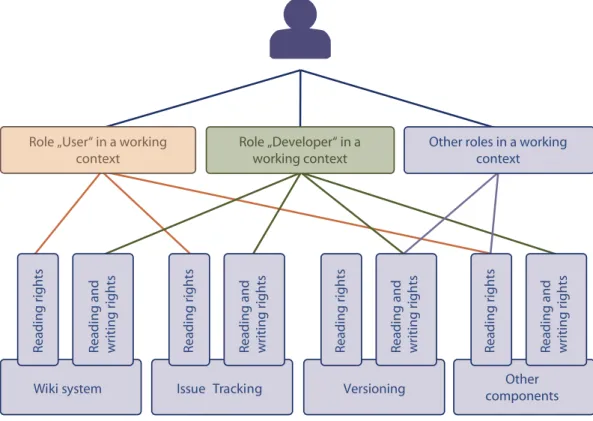
The software components are distributed across several computing centres. Each computing centre takes over distinct responsibilities. This division is of major importance as the computing centres can best contribute to the infrastructure by focusing on their own specific resources, ex-perience, and competence. Centralized access to all the software components ensures markedly simpler use of the research infrastructure. All components of the technical DARIAH-DE infrastructure utilize a central authentication and authorization scheme. This enables users to ac-cess the different components with only a single user name and password. A comprehensive rights management system ensures that users access an area in the infrastructure that is similar to a workspace and to which only they them-selves and their project colleagues have access. In this way, a user’s data is stored and secured from unintended access in the same way as the metadata schemes in a schema registry or source code in a version control system.
Long-term preservation
(Bitstream Preservation,
Persis-tent Identifiers, Provenance)
Research data take on a variety of different forms and are one of the most important outcomes of research projects. In conjunction with the
the findings of the research project and the basis for further work on the same or related topics. Therefore, research data must be preserved for the long term and be made accessible and reusable. To this end, DARIAH-DE is developing bitstream preservation components that ensure the correctness of binary data for long periods. In combination with a persistent identifier service, data become identifiable and, therefore, citable. In addition to data produced as an outcome of a research project, DARIAH-DE also considers research data to encompass information about the workflow processes employed to create and transform the data. This is usually referred to col-lectively as data provenance. During the creation and transformation of data, sufficient informa-tion about processing steps, utilized equipment, or software, as well as other relevant aspects are stored together with the data to document the entire data lifecycle. DARIAH-DE compiles with guidelines and best practices for the creation of provenance data. Following such guidelines ensures interoperability between research data as well as its reuse across project borders.
Resear ch Infr astruc tur e
Data processing
(Research Software Hosting)
In addition to providing a distributed bitstream preservation layer, DARIAH-DE is also investi-gating solutions for offering access to highly-scalable, distributed computing resources. This is achieved by establishing an application environment in which specialized research software services are hosted. In this generic ap-proach, users can transfer their software services or request instances of existing services in the distributed application hosting environment and enjoy the reliability, scalability, and availability of infrastructures provided by the leading German computing centres participating in the project. The services can also be integrated, as far as required, with the general DARIAH-DE services (such as AAI, monitoring, etc.) Beyond this ap-plication hosting environment, cloud-based solutions are being investigated to provide users with quick, on-demand access to computing resources. These can then be used for scientific computation, and released afterwards. A long-term goal of this activity is to provide workspaces for compute-intensive tasks which will make it easier to access typical DARIAH-DE resources and services.
Tools for programmers
(Developer Portal)
DARIAH-DE offers an environment for software development. For this purpose, DARIAH-DE has set up a developer portal which offers standard tools to help developers to create, test, and maintain source code. Each arts and humanities software project can obtain a complete devel-opment environment on demand to support its development activity. The login data are synchronized with the DARIAH-DE AAI service and allow developers to work concurrently on different projects. An advanced authentication system ensures that users only access the specific areas and functions to which they are assigned. Currently the developer portal offers the follow-ing components:
▪
Source code management with Subversion▪
Issue tracking with JIRA▪
Wiki system with Confluence▪
Continuous integration with Jenkins▪
Sonar for code quality management▪
Software artefact management with ArchivaFig. 8: DARIAH-DE Developer Portal.
Interoperability
In addition to crosswalks, DARIAH-DE seeks to define recommendations and best practices to increase the interoperability of research data across institutions and disciplines. How can historians integrate data from archaeology? What
re-use, and integrate data from other institutions and disciplines? These are some of the crucial as-pects to consider when building an infrastructure which aims to cater to the arts and humanities as a whole. Interoperability is in itself a rather broad
Role „User“ in a working context
Wiki system Issue Tracking Versioning componentsOther
Role „Developer“ in a working context
Other roles in a working context
Reading rights Reading and writing rights Reading rights Reading and writing rights Reading rights Reading and writing rights Reading rights Reading and writing rights
Resear ch Infr astruc tur e
protocols and machine interfaces for access-ing data, interoperability of data and metadata formats, adoption of open data licenses, and the use of machine-readable license formats.
How to get involved in building
the infrastructure
All components in the technical DARIAH-DE re-search infrastructure provide interfaces utilizing widely accepted open standards to ensure the interoperability of DARIAH-DE with other infra-structures as well as additional, yet to developed or externally provided components. In addition, DARIAH-DE is drafting technical guidelines and best practices documentation to orient software developers not yet familiar with the infrastruc-ture on how best to integrate their products with DARIAH. This guarantees that DARIAH-DE can continue to be extended in the future to meet the specific requirements of individual projects.
If you have any questions regarding the techni-cal infrastructure in DARIAH-DE, please contact
If you would like to use the DARIAH-DE infra-structure, please contact
DARIAH-DE: Teaching
Digital Humanities
Trainings and Workshops
DARIAH-DE is developing training sessions and workshops targeted at specific groups: experts/ specialists, lecturers, postgraduates, and
gradu-ate students. These include workshops with methodological and subject-specific concentra-tions.
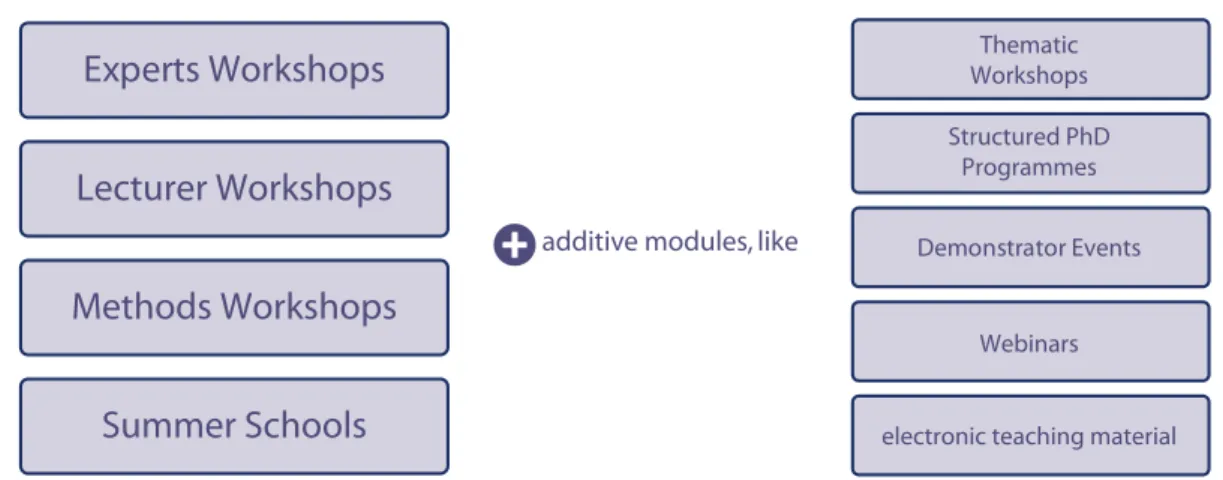
Fig. 9: DARIAH-DE training modules.
Experts Workshops
Lecturer Workshops
Methods Workshops
Structured PhD Programmes Webinars electronic teaching materialThematic Workshops
Demonstrator Events
Summer Schools
additive modules, like
The above illustration shows the four basic types of DARIAH-DE training sessions which can be supplemented with additional modules. For example, the additional modules can be taught in structured doctoral programs as “Methods Workshops” in which young scholars can develop new, subject-specific approaches in response to specific research questions.
The “Demonstrator Events” modules are practi-cal, hands-on workshops that show and test new tools, services or Virtual Research Environments (VREs) by means of demonstrators. A “Lecturer Workshop” could be also linked with the module “Thematic Workshops” to discuss research ques-tions in an innovative new ways. All workshops can be supported by e-learning or online-training (webinars) as accompanying online-training material to complement the DARIAH-DE training modules.
The DARIAH-DE training sessions and workshops are organized in cooperation with national and European partner universities and partner institutions. Their implementation is not limited only to DARIAH-DE consortium partners—the DARIAH-DE project network welcomes new partnerships.
DH Curricula and
study programmes
DARIAH has collected and disseminated informa-tion about study programs in the Digital Humani-ties. Free copies of a brochure on all programs in Germany and Austria can be requested by contacting
A digital version is available at
www.cceh.uni-koeln.de/dh-degrees-2011
An updated list of these degrees is maintained at
www.dig-hum.de/studienstandorte
DARIAH actively participates in efforts to coor-dinate curricula in the Digital Humanities—on the national level as well as in the international context. Above and beyond this a study is under-way to research the extent to which the Digital Humanities have already been integrated into the course offerings of established disciplines in the humanities.
If you have any questions regarding workshops and curricula in DARIAH-DE, please contact
Abbreviations and URLs
Abbreviations
ADeX Archaeological Data eXchange
BMBF Bundesministerium für Bildung und Forschung
Federal Ministry of Education and Research
CEI Charters Encoding Initiative
CIDOC-CRM CIDOC Conceptual Reference Model
DARIAH-DE Digital Research Infrastructure for the Arts and Humanities
DARIAH-EU Digital Research Infrastructure for the Arts and Humanities
DH Digital Humanities
DHd-Blog Digital Humanities in the German-speaking area
EpiDoc Epigraphic Documents
ESFRI European Strategy Forum on Research Infrastructures
ERIC European Research Infrastructure Consortium
GND Common authority files
MEI Music Encoding Initiative
MEISE Music Encoding Initiative Score Editor
OAI-PMH Open Archives Initiative—Proto-col for Metadata Harvesting
TEI Text Encoding Initiative
URLs
BMBF www.bmbf.de Brochure on DH Curricula www.cceh.uni-koeln.de/dh-degrees-2011 DARIAH Bibliography www.zotero.org/groups/dariah_bibliography DARIAH-DE www.de.dariah.eu DARIAH-EU www.dariah.eu DHd-Blog www.dhd-blog.org ESFRI ec.europa.eu/research/esfri/ List of DH Curricula www.dig-hum.de/studienstandorte TextGrid www.textgrid.deVRE Guide of the Allianz-Initiative www.allianzinitiative.de/fileadmin/ user_upload/Leitfaden_VRE_de.pdf Zotero Support www.zotero.org/support
Email addresses
[email protected] [email protected] [email protected] [email protected] [email protected] [email protected] [email protected] [email protected]Imprint
Publisher
DARIAH-DE
c/o Niedersächsische Staats- und Universitätsbib-liothek Göttingen
Abteilung Forschung und Entwicklung Papendiek 14
37073 Göttingen
Typesetting & Layout
Heck – Visuelle Kommunikation
Patrick Heck Thebäerstraße 55 54292 Trier
Icons
Font Awesome fortawesome.github.com/Font-AwesomePrint run 2,500 copies Revision: June 2012
This work is licensed under a Creative Commons Attribution-ShareAlike 3.0 Germany License.
creativecommons.org/licenses/by-sa/3.0/
DOI: 10.3249/webdoc-3590
resolver.sub.uni-goettingen.de/ purl/?webdoc-3590
DARIAH-DE is exploring and developing a digital research infrastructure for the arts and humani-ties. For this purpose, DARIAH-DE is designing new curricula, evaluating and developing digitally-supported research methods and processes, and preparing concepts for the use and management of research data in addition to supplying a tech-nical core infrastructure.