UDe: 007.5:316.77 Preliminary comrnunication
COMMUNICATION PROBLEMS IN INFORMATION SYSTEM
AND SOFTWARE DEVELOPMENT
Goran Bubaš, Željko Hutinski, Dragutin Kermek
University of Zagreb, Faculty ofOrganization and Informaties, Varaždin, Croatia e-mail: {gbubaslzhutinskldkermek}@foi.hr
A survey was performed on 227 informatian technology (IT) professionals to investigate communication problems related to informatian system (IS) and software development. As a result of data analyses amore precise estimate was possible of the level of communication problems associated with various segments of communication in IS and software development, as well as an identification of theorigins of such problems. Highest degree of difJiculty wasfound in relation to communication with clients / users that ispredominantly caused by their lack of IS and IT related knowledge ar experience.
Keywords:
information system design, software engineering, communication, users, team work, education.1.
INTRODUCTION
Effective communication is
viewed as an essential element in software
engineering
and
information
system
development
[13;
17;
22].
For
instance,
effective
communication can increase the potential for knowledge sharing and creation, as well
as reduce task and role ambiguity
[16].
Accordingly,
much importance is placed on
communication skills
in the education of information technology professionals [3; 14;
18;21;24;26].
Non-technical skills,
like people skills and problem solving skills, are considered
almost as important as technical skilIs in the IT professional arena [5; 27].
More
specificaIIy,
information
system
professionals
could
also
benefit
from
trust
development skills
[2],
teamwork skills
[23],
human facilitator
skills
[4],
change
agentry skills
[20], and
emancipator skills [9]
.
After investigating the structure of
competence in communicative
interaction
with
cIients / users [7], as well as various aspects of information technology related
communication activities of IT professionals
like
presenting,
selling,
promotion,
education of clients / users, and team work
[6],
the communication problems associated
with the phases of IS and software development process were brought to focus of
attention in this research.
However,
it must be noted that communication related issues
regarding
the phases of IS and software
development
have previously
been
investigated in a proposition for introducing trained technical communicators in that
process [19], in an analysis of project communication from the metrics perspective
[12],
and in a review of specific factors that influence project communication and
project success [Il].
G. Bubaš.
t
.Hutinski. D.
Kermek. Communication problems in IS and software development2. CLASSIFICA TION OF COMMUNICATIONS ACTIVITIES
The most common phases of IS and software development are associated with
activities of
analysis, design, coding, testing,
and
implementation.
For instance, when
vi
e
wed as a life cycle
,
the major phases of an information system development would
be [I, pp
.
70-73]: (a) feasibility study, (b) system investigation
,
(c) system analysis, (d)
system design, (e) implementation, and (f) rev
i
ew and maintenance.
Howe
ve
r
,
when the activities related to IS and software development are obser
v
ed
from a
prof
e
ssional communications p
e
r
s
p
e
ctive,
more diverse sets or class
e
s of
acti
v
ities could be d
i
stinguished
:
conceptualizing the preliminary proposal of the IS or software
a
pplication(s)
;
identifying specific requirements
;
preparing the presentation of the offer / concept;
presenting the offer / concept of the IS or software applications;
definition of the software development project plan;
team member definition and task distribution;
work on design and coding;
optimization of the prototype IS or software application(s)
;
testing at the site of the client / user;
implementing at the site of the client / u
s
er
.
Of course, for such specific activities, professional communication
could be
predominantiy directed towards
c/ients
I
us
e
rs,
or performed within the
expert team
that designs the system. Furthermore, some of those activities may not always be
present or performed in the same sequence
,
as they were previously listed, in all cases
of IS and software development
.
StiI1,such a list of communication relevant classes of
activities could be used for a preliminary survey of communication problems in IS and
software development
.
The following rationale supports the proposed set of communication activities
.
First, preliminary business proposals are occasionally given to clients / users even
before the needed IS or software is fully developed, or specified in detail
.
After
obtaining preliminary client / user interest, the requirements could be more precisely
investigated to prepare the final concept of the IS or software offered during an official
presentation
.
A precise definition of the project plan could precede or succeed such a
presentation as well as the definition of team members. After the work on design and
coding, optimization of prototype (preliminary version) IS or software could be
performed before it reaches the site of th
e
client / user, while final testing and
implementin
g
usually takes place at the location of the client / user
.
3. PROBLEM
The objective of this research was to perform an introductory investigation of
some
typical communication circumstances
in IS and software development, as well as
of the
intensit
y
a
nd
causation
of communication problems in various segments of that
process
.
Zbornik radova, Volume24,Number 1(2000)
4.METHOD
A survey was used to investigate the intensity and causation of the problems that come forth in various segments of the communication proces s associated with IS and software development. The subjects in the survey were IT professionals engaged in activities of seli ing, managing, design ing, implementing, and maintaining of information systems and/or software applications.
4.1. Instrument
The questionnaire used in the survey consisted of 6 demographic questions and 10 questions that asked for assessment of the degree of communication problem for a specific point / segment in communication during IS and software development. The rating was performed on a 0-5 point Lickert type scale ranging from
no problems
/
insignificant dif]iculties
(i.e."O"),
on the one side, togreat problems / notabl
e
dif]iculties
(i.e. "5"), on the other side of the scale. An open-end ed question was used with each rating scale to collect data on the origin or cause of communication problem for that specific point in communication, as well as about the actors who are involved in creating the difficulty.4.2. Respondents
The respondents in the survey were 227 Croatian IT professionals who predominantly held a degree in informatics / IS development, electrical engineering / computer science, and economy / business cybemetics. Most of the respondents were engaged in software engineering and information system design, and others were predominantly employed in manageriai work, presentations and seli ing. On the average, the respondents had 9 years of work experience. Their work environments had 1-5000 employees, as well as 1-150 IT professionals (10 on the average).
4.3. Data analysis
Analyses of survey data were performed by standard statistical methods and exploratory factor analysis (principal components method with Varimax rotation), as well by classification of responses to open-ended questions.
5. RESULTS AND DISCUSSION
Three types of resuits were obtained from data analyses. First, average ratings of the degree of communication problem were obtained for each of the analyzed segments of communication during IS and software development. Then, an exploratory factor analysis was performed to investigate the basic structure of communicative interaction in that process. Finally, the predominant causes of communication problems were identified from the responses to open-ended questions in the survey.
G.Bubaš,
t.
Hutinski, D. Kermek. Communication problems in IS and software development 3,0 2,01,0
!! c:'"
Ee
·5 c-e
<.>""
·0'
"
o. (f) OI c:~
c:'
"
~
'"
:::: o'
"
;; 'o c:~
'"
c
'
"
(f)e
o.'"
;; OI c: .i::'"
o.e
o..'"
(f) ::::r c: .2 ::; .D:s
(f) 'o .>< (f) 2 -o c:'
"
c:~
·c <;::'"
-o L'
"
.D E'
"
E E'"
~
OI c: 'oo <.> -o c:'"
c: OI u;'
"
-o c: o~
o:
:
u;-e
o~
.~ a. o.'"
<1> o. z-Be
o. 'o c:~
'"
N ·E 'E. o'
"
(f) ::::r ('"
:f):::rc
.~ U <1> ;;-
o .!!! ·iii'"
;; 1ii c: o~
c:'"
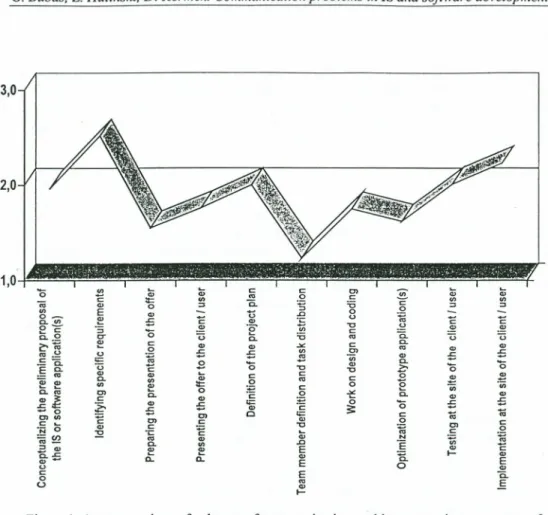
E <1> a. .EFigure 1.Average ratings of a degree of communication problems at various segments of communication during IS and software development
5.1
.
Average ratings of a degree of communication problems
The main resu Its obtained by the analysis of ratings of a degree of communication problems for a specific point / segment in communication during IS and software development are presented in
Figure 1.
The highest average rating of a degree of communication problems was associated withide
n
t
i
fying specific requirements
when communicating with clients / users, as well as with theimp
l
ementation at the site of
the cli
e
nt / us
e
r
.
Also, the lowest degree of communication problems was associatedwith the
team m
e
mber definition and task distribution
.
In fact, somewhat higher degrees of communication problems were related tocommunication activities with
c
lients
/
users.
However, thedefinition of th
e
project p
l
an
communication segmentreceived a rather high average rating as well.
5.2
.
Factor analysis of ratings of the degree of communication problem
When exploratory factor analysis was performed on the ratings data to investigate
Zbornik radova, Volume24,Number 1(2000)
development, three factors were found that together explained 57% of the variance
(each factor had eigenvalue greater than 1.0 and explained more than 10% of the
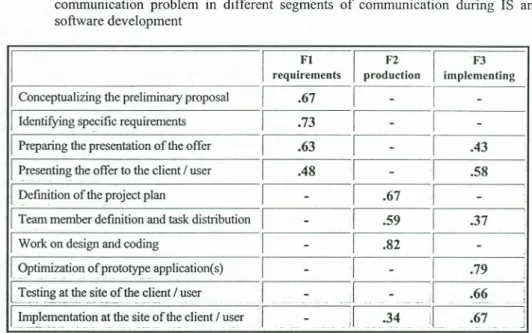
variance). The uncovered factor structure is displayed in
Table 1.Even though this
structure is not fully transparent, it does outline the
three most general phasesin the
composition
of
communication
problems
associated
with
IS
and
software
development, i.e
.
the
proposal-requirements-sellingphase
(F1),the
organizing-design-coding or
productionphase
(F2),and the
optimization-testing-implementingphase
(F3).
It must also be emphasized that considerable projections of variables related to
preparing the presentation and presenting the ojJer
and the variable
team memberdefinition and task distribution
on the third factor named
implementing(F3)
,
as
displayed in
Figure1, could indicate that problems unresolved in the previous
communication segments could negatively reflect on the interaction in this final phase
in the structure of communication during IS and software development.
Table I. ResuIts of the exploratory factor analysis of the ratings of the degree of
comrnunication problem in different segments of comrnunication during IS and
software development
I
I
requirementsFlI
productionF2I
implementingF3I
Conceptualizing the preliminary proposalI
.
67
I
-
I
-I
Identifying specific requirementsI
.73
I
-
I
-I
Preparing the presentation of the offerI
.63
I
-
.43
I
~r~sentin? the offer to the clientIuserI
.48
I
-
.58
I
I?efmition of the project planI
-
I
.67
-I
Team member definition and task distributionI
-
I
.
59
.37
I
Work on design and codingI
-
I
.82-I
<':>Ptimizationofprototype application(s)I
-
I
-
.79
:
[Testing at the site of the clientIuser
I
.
J
.66
______ • ___ • __ ••__ ••••• __ • __ 0--••___•___o _ __
-
-
j.--- ---'.--
-11~~le~~n~tion a~the si~~of th~ clientl user
I
-
.......
,
I
.
. ...34
...Ju
.67
J
!*
Projections of variables that are most representative for each factor are written in boldface; factorloadings below 0.30 are not presented.
5.3. Causes of communication
problems in IS and software development
After rating the degree of communication difficulty in relation to certain points /
segments in communication during IS and software development, the respondents in
the survey were asked to state the causes of communication problems, as well as the
actor(s) who are commonly involved when communication problems occur. The
results of the analyses of their responses are briefly presented for each communication
segment with a comment on the average rating of a degree of communication
problems presented in
Figure 1.G.Bubaš.
t
.
Hutinski. D.Kermek Communication problems in IS and software developmenta)
Conceptualizing the preliminary proposaloj the IS or soJtware application(s).This
segment received a moderately high average rating of the level of communication
difficulty. The communication problems were mostly caused
by poorly defined necessities oj clients / users,as well as by their
lack oj IT related knowledge and resistance to ehange.Also, the IT professionals were characterized by insufficient
domain knowledge together with an excessive use oftechnical terminology.
b) Identifying speeifie requirements;
The highest average rating of a degree of
communication problems in IS and software development was found in relation to
this segment of communication that involves customers / users in providing
information about system requirements. More than 50% of the respondents rated
difficulties in communication at this stage from
moderateto
great / notable(i.e.
in the range Jrom3
to5 on a 0
-
5 point scale)
.
Responses regarding the causes of
difficulties were predominantly related to deficiencies in a
problem definitionlike
imprecision
,
incompleteness,
misunderstanding,
inferior problem
assessment,
unclear goals, and unawareness of complete necessities, where both the client / user
and IT expert were involved
.
Other significant causes of difficulties were related to
the already mentioned lack of IT knowledge and resistance to change on behalf of
clients / users, as well as by the lack of doma in knowledge by IT professionals.
e)
E.reparing thepresentation oj the offer / eoneept.This stage was characterized by a
rather low degree of average difficulty in communication. Also, there were very
diverse types of responses conceming the causes of communication problems.
However, most of them were related to
the business presentation aspeet oj communicationas, for instance, the possibility of not achieving satisfactory clarity
and comprehensiveness,
the inadequate selection of presentation content, the
inappropriate proportion of time used for oral presentation versus software
demonstration, the deficiency in adaptation to the audience profile etc
.
The
difficulties were also related to obstacles connected with the client / user resistance
to change, the lack of IT knowledge, and the inadequate problem definition.
d)
Presenting the offer / eoneept oj the IS or soJtware applieation(s).A fairly low
degree of difficulty at this point in communication during IS and software
development is perhaps associated with the common atrnosphere of presentational
communication
that is characterized by
Jormality and eonciseness.Still, the
problem is caused by different levels of details in the presentation of the system
that is wanted by various representatives of clients / users. Insufficiency of simple
persuasive
efforts succeeded by disproportionate
technical
elaboration were
another source of difficulty, as well as poor adaptation to the IT knowledge level of
clients / users.
e) Definition oj the soJtware development projeet plan.
Slightly more than 1/3 of the
respondents rated the difficulties in communication at this point from
moderateto
great / notable
(i.e.
in the range Jrom3
to5 on a 0-5 point scale). Therefore, this
segment in communication
during IS and software development
could be
considered as having amoderate degree of communication problem. The identified
causes of difficulties were mostly associated with the
shortage oj timeand,
especially, with problems conceming
deadlines,whether they were unreasonable
,
Zbornik radova, Volume
24,Number
1(2000)associated
with insufficient assessment
and lack of infonnation
about the
necessities of clients / users or
deficits in requirements specification,
along with the
unclear vision of the integrated system as a whole.
Conceptual differences among
team members were also noticed as a source of problem, as well as deficiency of
team members either in number or qualification.
j)
Team member definition and task distribution.
This was the point with the least
average difficulty in communication during IS and software development
.
The
predominant causes of potential problems were related to the
shortage of IS and
software experts
and also to their
work over/oad,
particularly of those with greater
expertise. Other problems were associated with
managers who had insujJicient
insight into competencies of individual IT workers,
as well as with
their inclination
towards inadequate task distribution that overlooked individual specialization,
interest, ajJinity, and availability of team members.
Additional problems were
connected with lack of problem domain specialists and difficulties in coordinating /
organizing people and tasks.
g) Work on design and coding.
This stage received a somewhat lower degree of
average estimate of difficulty in communication. The predominant problem was
related to
deadlines
that were either set too close, inadequately estimated, or
uncoordinated. Other communication problems were associated
with improperly
defined tasks and objectives.
Dissonance among team members, confrontation over
different concepts, inadequate interpersonal relations, lack of team spirit, and
deficient team communication
were also noted as sources of communication
problems. Finally, supplements to the original design once the coding process had
started, as well as incompatibility
of different
programmed
modules were
mentioned as well
.
h)
Optimization of the prototype IS or software application(s).
A rather low degree of
average estimate of communication problems was found also at this stage. The
existing difficulties were caused mostIy the by
noncompliance with deadlines,
delays in software completion,
and
lack of time.
Other sources of difficulty were
reIated to the
additional requests for
changes in requirements specification
(sometimes at the last moment), vagueness in project definition, disorganized and
insufficientIy specified (sometimes unreasonable) dema nds from cIients / users,
and also to lack of cooperation and poor feedback from cIients / users.
i)
Testing at the site of the client / user.
This stage in communication during IS and
software development had a moderately high average rating of communication
difficulty.
The causes of problem were predominantIy
associated
with the
resistance to change and novel IT technology,
as well as with the
unsatisfactory IT
related knowledge and skills of clients / users.
Inadequate or insufficient test data
for evaluation of the system, as well as the lack of time to perfonn the testing were
also identified
as causes of difficulty.
Poorly
defined
requests,
additional
requirements, unreasonable expectations, deficient cooperation,
contrasting "tastes"
for various features of the user interface, and different interpretations of earlier
agreements were specified as a further source of communication problems between
IT specialists and cIients / users.
G.Bubaš,
t.
Hutinski, D. Kermek. Communication problems in IS and software developmentj)
Implementing at the site of the client / user.
A rather high average rating of
communication difficulty was found at this conclusive point of communication
dur
i
ng IS and software development
.
In fact, about 45% of the respondents rated
the difficulties in communication at this stage from
moderate
to
great / notable
(i
.
e
.
in the range from
3
to
5 on a 0-5 point scale)
.
Most communication problems
conceming the implementation process were caused by the
resistanc
e
to change
and fear of IT,
together with the
lack of familiarity with IT that negati
ve
l
y
ajJects
it
s
utili
z
ation,
and the
inejJ
e
cti
v
e participation of client
s /
users in training
that is
performed to facilitate adoption of IT
.
Numerous causes or origins of communication problem
s
that appear at various
stages of IS and software development were identified in this survey. Some of them
ar
e
related to the
communication with cli
e
nts / users,
while others appear in the
int
e
ra
c
tion among members of project teams and their sup
e
riors.
Perhaps the most
pr
e
valent cause of communicat
i
on difficulty is lack of IT related knowledge that
characterizes clients / users and their resistance to change in their work
e
nvironment
th
a
t is brought forth by the introduction of novel technology [see also
:
6]
.
In addition,
when IT specialist
s
are taken into account, the communication problems ar
e
most
often caused by deficiency in requirements specification, improper planning
,
and time
pr
e
ssure
.
6. CONCLUSION
Professional communication
in the process of IS and software development
involves
difJ
e
r
e
nt parties
that are engaged in designing, producing and utilizing
complex systems
.
Communication
probl
e
ms
that arise at such endeavors
may
significantly affect their outcomes
.
Therefore, insights into typical causes of those
problems could be an important component oftheir resolution
.
In concordance with the findings that communicative interaction is most frequent
in the initial and final stages of software development [see: 12]
,
the highest degrees of
communication problems were found to exist in (a) the
requirements specification
phase and (b) the
implementation
phase of communication during IS and software
de
v
elopment (see
Figure
1)
.
In both phases
c
lients / users are very much involved in
the communication process and the knowledge gap between them and IT professionals
(regarding IT and the problem domain) is themain source of difficulty
.
Furthermore, there are indices that communication problems are structured in three
global
doma ins
or
communication
stages
/
environments
that
were
named
r
e
quirements (FI),production
(F2), and
implementing
(F3), as illustrated by the results
of factor analysis in
Table 1
.
These environments are quite diverse conceming their
temporal, spatial
,
soc
i
al and problem attributes. Still, communication problems that are
unre
s
olved in a preceding st
a
ge / environment are probably ref1ected in the succeeding
st
a
ge(s)
.
Finally,
num
e
rous caus
e
s of communi
c
ation problems
were identifi
e
d
by the
analyses of responses to open-ended questions in our survey. They are relevant for
Zbornik radova, Volume24,Number 1(2000)
management. Both information technology professionals (especially team leaders and
project managers) and educators of future IS and software developers could make use of such data to improve their communication practices. Therefore, further studies should investigate those problems and possible solutions.
IT professionals are increasingly required to interact closely both with
technologists and non-technical users [13] and quality of their communication
considerably affects client / user satisfaction [25], as well as team performance [16].
Resuits of this survey indicate that education of IT professionals should be more focused on project communication and experience [see also: 15], but not with an emphasis on written and oral communication skills alone [e.g. 26]. In fact, multiple non-technical capabilities are considered to be important to IS professional s that enable more effective communication, interpersonal relations, problem solving, and
management [10]. Considering the diversity of communication problems identified in
our survey, more advanced communication skills and practices and, perhaps, even the selection of IT personnelon the basis of their communication related skills and traits [8] are very much needed since effectiveness of their communicative performance could greatly affect the successfulness of IS and software development projects.
REFERENCES
[1] D. E. Avison, H. U. Shah. The Information Systems Development Life Cycle: A First
Course inInformation Systems. McGraw-Hill, London, UK, 1997.
[2] D. Bandow. Working with the Borg: Trust, systems development and dispersed work groups. Proceedings of the 1998 Conference on Computer Personnel Research. Boston, MA, USA, 163-169, March 26-28, 1998.
[3] J. D. Becker, R. G. Insley, M. L. Endres. The effects of customized sk:ills training on undergraduate information systems majors. Proceedings of the 1997 Conference on
Computer Personnel Research. San Francisco, CA, USA, 49-61, April 3-5, 1997.
[4] C. M. Beise, F. Niederman, P. M. Beranek. Facilitating technology-supported group work: A new category of IS personnel. Proceedings of the 1992 ACM SIGCPR
Conference on Computer Personnel Research. Cincinnati, OH, USA, 250-258, April 5-7,
1992.
[5] Bridging the Gap: Information Technology Skills for a New Millenium. Information
Technology Association of America, ITAA [Research Summary]. Arlington, VA, USA, at http://www.itaa.org/workforce/studieslhwOOexecsumm.htm. 2000.
[6] G. Bubaš. Prilog istraživanju obrazovnih potreba informatičara na području komuniciranja s korisnicima. V. International Symposium "Information Systems '94".
Varaždin, Hrvatska, IV 1-8, 1994.
[7] G. Bubaš, B. Aurer. Non-technical competencies required for information technology professionals: How to effectively interact with cIients/users. Zbornik radova, 22( 1), 41-52, 1998.
[8] A. P. Calitz, M. B. Watson, G.de V de Kock. Identification and seIection of successful future IT personnel in a changing technological and business environrnent. SIGCPR '97,
Proceedings of the 1997 Conference on Computer Personnel Research. San Francisco,
G.Bubaš, Ž.Hutinski, D. Kermek. Communication problems in IS and software development
[9] B.Dahlbom, L.Mathiassen. The future of our profession. Communications of the A CM,
40(6),80-89, 1997.
[10] G. B. Davis, J. T. Gorgone, 1.D.Couger, D. L.Feinstein, H.E. Longeneeker, Jr.IS'97:
Model Curriculum and Guidelines for Undergraduate Degree Programs in Information Science. Association of Information Technology Professionals, Park Ridge, IL, USA,
1997.
[II] V. Dušak, N. Vrček. Information technology as a prerequisite of successful project
communication. Informatologia, 32(3-4), 137-273, 1999.
[12] A. H. Dutoit, B. Bruegge. Communication metri es for software development. IEEE
Transactions on Software Engineering, 24(8), 615-628,1998.
[13] T. W. Ferratt, R.Agarwal, J. E.Moore, C.V. Brown. Observations from "the front": IT
executives on practices to recruit and retain information technology professionals.
Proceedings of the 1999 ACM SIGCPR Conference on Computer Personnel Research.
New Orleans, LA, USA, 102-112, ApriI8-10, 1999.
[14] P. A.Freeman. Elements of effective computer science. Computer, 30( 11),47-48, 1997.
[15] D. Garlan, D. P. Gluch, 1. E. Tomayko. Agents of change: Educating software
engineering leaders. Computer, 30(11), 59-65, 1997.
[16] P.J. Guinan, S. Faraj. Reducing work related uncertainty: The role of communication
and control in software development. 3Ist Hawaii International Conference on System
Sciences. Kohala Coast, HI, USA, 73-82, January 6-9, 1998.
[17] J. E. Haines. The case for more relevant computing skills. Computer, 30( II), 55-56,
1997.
[18] M. R. Hei!. Preparing technical communicators for future workplaces: A model that
integrates teaming, professional communication skills, and a software development
process. Proceedings of theSeventeenth Annual International Conference on Computer
Documentation. NewOrleans, LA, USA, 110-119, September 12-14, 1999.
[19] J. K. Horberg. A future for professional communicators in software engineering.
Conference Proceedings on Technical Communications at the Great Divide. Banff,
Canada, 76-87, October 2-5, 1994.
[20] M. L. Markus, R.I. Benjamin. Change agentry: The next IS Frontier. MIS Quarterly,
20(4),385-407, 1996.
[21] W. M. McCracken. Counterpoint - SE education: What academia can do. IEEE
Software, 14(6),27-29, 1997.
[22] E. G. McGuire, K.A. Randal!. Proces s improvement competencies for IS professionals:
A survey of perceived needs. Proceedings of the 1998 Conference on Computer
Personnel Research. Boston, MA, USA, 1-8, March 26-28, 1998.
[23] R. Nath, A. L. Lederer. Team building for IS success. Information Systems
Management, 13(2),32-37, 1996.
[24] S. H. Nielsen, L. A. von Hellens, A. Greenhill, P. Halloran, R. Pringle. IT degree
studies and skills development for learning organizations. Proceedings of the 1999
ACM SIGCPR Conference on Computer Personnel Research. New Orleans, LA, USA,
261-267, April 8-10, 1999.
[25] R. Pressman. Fear of trying: The plight of rookie project managers. IEEE Software,
Zbornik radova, Volume24,Number 1(2000)
[26] S. L. Sullivan. A software project management course role-play-team-project approach emphasizing written and ora! communication skills. Proceedings of the Twenty-Fourth
SIGCSE Technical Symposium on Computer Science Education. Indianapo!is, IN, USA,
283-287, February 18-19,1993.
[27] L. A. von Hel1ens, R. Pringle, S. H. Nielsen, A. Greenhi!l. Peop!e, business and IT skiIIs: The perspective of women in the IT industry. Proceedings of the 2000 ACM
SIGCPR Conference on Computer Personnel Research. Chicago, IL, USA, 152-157,
April 6-8, 2000. Received: 14 June 2000 Accepted: 20 November 2000 Goran Bubaš Željko Hutinski Dragutin Kermek
KOMUNIKACIJSKI
PROBLEMI U RAZVOJU INFORMACIJSKIH
SUSTAVA I PROGRAMSKIH APLIKACIJA
Sažetak
U istraživanju komunikacijskih problema koji su povezani srazvojem informacijskih sustava i
programskih aplikacija provedeno je anketno istraživanje na227 stručnjaka za informacijske
tehnologije (IT). Na osnovi obrade anketnih podataka dobivena je preciznija procjena razine
komunikacijskih problema vezanih za različite segmente procesa komunikacije prilikom
razvoja informacijskih sustava iprogramskih aplikacija, a utvrđeni su i mnogi uzroci takvih
problema. Najveća razina poteškoća utvrđena je u odnosu na komunikaciju sklijentima /
korisnicima, što je većinom uvjetovano njihovim nedostatnim znanjem iiskustvom u odnosu
na informacijske sustave i informacijsku tehnologiju.
Ključne riječi: razvoj informacijskih sustava, programsko inženjerstvo, komunikacija,