Towards an understanding of social software: the case of Arinia
Stuart J. Barnes University of East Anglia, UK Stuart.Barnes @uea.ac.uk Martin Böhringer Chemnitz University of Technology, Germany [email protected] Christian Kurze Chemnitz University of Technology, Germany [email protected] Jacqueline Stietzel Chemnitz University of Technology, Germany [email protected]Abstract
This paper presents the case of Arinia, a custom-made piece of social software with strong similarities to today’s microblogging applications. Arinia has been in use in a medium-sized technology company for more than 10 years; therefore, it is considered that the software is a valuable source of insights into the underlying principles of microblogging in an enterprise context. Due to the unique nature of the case we used an interpretive approach to learn about Arinia, its users and their contexts, involving semi-structured interviews, a survey, quantitative usage data and an excerpt from the posting base in order to achieve a comprehensive view on the case. The results suggest that there is reasonable potential in sharing micro-level information inside organizations. In particular, the findings provide evidence of enabling factors and allow us to introduce the concept of the ‘information food chain’. Together, these findings present a foundation for further research on current microblogging applications.
1. Introduction
The rising popularity of Twitter has recently encouraged ideas about how to leverage the microblogging approach within the enterprise. There are a number of professional software tools and early case studies are available. Notwithstanding, it is still not clear exactly what microblogging – and especially enterprise microblogging – really means. This discussion in the blogosphere and in various research papers shows that microblogging is more than a short form of blogging. Rather it could be seen as an approach for sharing activity information and information „nuggets‟ implemented with social software components (e.g. communities, profiles and open API).
This paper presents the case of Arinia – a custom-made piece of social software. While its technology and appearance do not fulfill modern expectations for
software its usage is very similar to microblogging applications today. Since Arinia has been in use for more than ten years now this unique case provides valuable source of insights into the underlying principles of microblogging in an enterprise context. In this paper we use an interpretive approach in order to achieve a comprehensive view of the case.
The organization of this paper is as follows. We discuss microblogging and its historical predecessors in the following section before describing the research methodology in section 3. The case is presented in section 4 starting with a background overview followed by an in-depth analysis of the findings. Finally, section 5 presents a discussion of the results and draws conclusions and implications for research and practice.
2. Background
The principle of microblogging is best known via its most famous application, Twitter. Users have their own public microblog where they can post short updates. Other members can be „followed‟ by adding them to one‟s personal network. As with weblogs, the messages appear in chronological order on the user‟s start page. Microblogging services often support a wide range of contribution possibilities. For example, messages to Twitter can be posted via mobile text messages, desktop clients or several third party applications.
Microblogging is a very new type of application. Research papers on the topic are still rare. While a good body of knowledge is developing around Twitter itself ([2], [5], [7], [8], [9], [11], [15]) there is less research on the further development of microblogging for adoption in the enterprise ([3], [4]) and conceptual improvements of the approach due to enhanced technology ([13], [14]) or better visualization [1].
The application of microblogging to the enterprise is a heavily discussed topic among practitioners. Gartner suggest that “by 2011, enterprise microblogging will be a standard feature on 80 percent
of social software platforms” [6]. Various companies have followed the trend and subsequently launched tools for professional microblogging. However, the development of these enterprise applications is mostly built on the „Twitter model‟ – in an attempt to emulate its success – and they typically do not publish usage statistics.
As yet, there is no published research demonstrating that existing theory can be used to explain the microblogging phenomenon sufficiently. Erickson tried to apply Erickson and Kellogg‟s construction of social translucence to Twitter but found that it was only partly supported [5]. Barnes & Böhringer used an extended model of IS continuance to explain Twitter use continuance [2]. While this work succeeded in explaining drivers of Twitter usage it does not explain initial adoption of microblogging and what the cognitive and social reasons could be. In learning from the Arinia case we are going to go a step further in finding a reasonable and richer explanation model for microblogging usage.
3. Research Methodology
Due to the unique nature of the case being studied we applied an interpretive approach to learn about Arinia, its users and their contexts [17]. However, as suggested by Yin we use other sources of data to achieve a triangulation and hence a higher validity of our results [19, pp. 114-118].
Walsham claims that interpretive researchers by definition cannot be objective as they always are influenced by their subjective views [18]. In our case we have a background of previous research on microblogging and are especially interested in the implications of the Arinia case with respect to this phenomenon. Researchers with a dissimilar focus may have achieved slightly different results as they would have asked different questions.
The first step of our research was a preliminary study of Arinia. Based on a demonstration of the tool and a discussion with the company‟s CEO we developed a first impression of the case. Using these insights we created a semi-structured interview which was structured into various parts: „usage behavior‟, „perceived advantages‟ and „perceived disadvantages‟. The company was asked to suggest users of Arinia with heterogeneous backgrounds and different usage habits. Overall, we had 8 interview partners from a wide range of corporate functions including sales, marketing, production, procurement and R&D. The interviews took place during March 2009. They were recorded onto an audio capture device and later
transcribed. The length of the interviews differed between 20 and 45 minutes.
The interviews were analyzed using a loose, qualitative coding procedure. They were first structured through categories resulting from the preliminary study. Both the preliminary study and the main interviews were analyzed using open coding to identify salient concepts. In analyzing the interviews we discovered several significant patterns, but also noted opposite opinions whenever they emerged.
In order to evaluate the findings with a broader sample of participants we conducted a survey (n=35; representing 85% of Arinia‟s users) with concepts developed from the interviews. We extracted key statements which either were said jointly by several participants or were rated to be controversial by the researchers. These were coded into short propositions and survey participants were asked to rate their agreement with these statements using a 5-item Likert scale (1 = strongly disagree; 5 = strongly agree). Additionally, there were two additional questions asking about reading/writing frequency (5-item coding: 1 = never/very seldom, 2 = once per month, 3 = once per week, 4 = once per day, 5= several times per day) and the duration for writing a posting (5-item nominal coding: less than 1 minute, 1 minute, 5 minutes, 10 minutes, or more than 10 minutes). Finally, we asked for the organizational unit of the participant and provided a field for free comments. The survey was implemented using an online survey tool (LimeSurvey). The link was published in Arinia including a reminder posting after one week. The survey was open for 15 days.
Further, we had the possibility to study an excerpt from the tool‟s posting base and the tool itself (i.e. the web interface). This enabled us to validate our findings in conducting a hermeneutic text analysis [10]. We also looked at a specific „pinboard‟ in detail (see below for description of the system and the pinboard feature); this was a typical project pinboard for an already finished project. The results of the text analysis enhanced our understanding of Arinia‟s characteristics and represent the principal evidence for our assessment regarding the tool‟s similarity to microblogging.
Finally, we used quantitative usage information in the study. This data includes anonymous user profiles and the complete pattern of historical usage development dating from 1998.
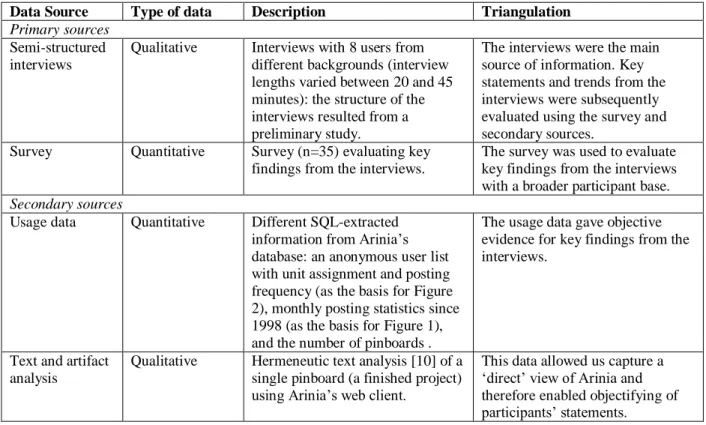
Data triangulation from the four sources – interviews, survey, text analysis, and usage data – ensures a comprehensive view of the case using multiple perspectives. A summary of the sources and how they were triangulated is given in Table 1.
4. Case study
4.1. Setting
Arinia is a custom-made development of Megware, a Germany-based manufacturer of high-performance computers and IT technology. The company‟s focus is on customer-oriented, tailor-made and innovative system solutions and services, and it is engaged in research and development, production, consultation and distribution. Founded in a garage in 1990, the company is now a high-tech-oriented firm operating in the highly knowledge-intensive IT sector.
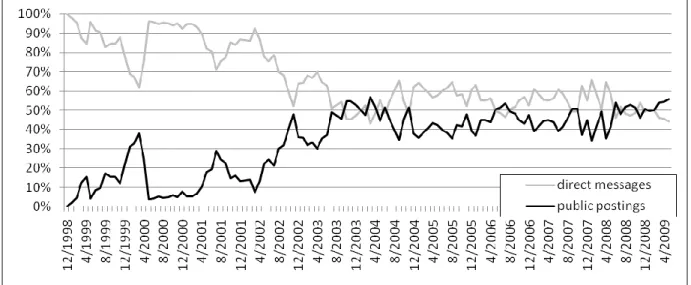
The history of Arinia dates back to the 1990s when Megware was in the retail business and ran more than 30 subsidiaries in different German cities. At this time, the tool was developed as a fast and secure internal alternative to email. Accordingly, the email-like direct messages were the main functionality of the program. However, Arinia had another feature: the so-called „pinboard‟. This was meant for the broadcasting of announcements to staff. While this played a secondary role at the beginning, the share of usage of the pinboards increased substantially until a steady
equilibrium of equal usage was reached between direct and public messages (see Figure 1). While the use of pinboards is part of the company‟s policy today its rising adoption was user-driven. Interestingly, this development correlates with a major transition in Megware‟s strategy as it transformed itself from a consumer- and small business-oriented IT manufacturer with multiple subsidiaries to a highly specialized supplier of complex high-performance systems after the dot-com crash of 2000. Today, the company has approximately 45 employees.
The functionality of Arinia is surprisingly similar to microblogging. First of all, our text analysis showed that the character of the postings is short. Most interview partners and survey participants need circa one minute or less to write a posting. Typical postings include: “Call with customer .... He asked for ...” or “Task closed”. Secondly, as with Twitter, new postings can be in reply to former postings. Third, postings are open to a wide range of users without explicit addressees. Furthermore, there are a number of software clients for Arinia: next to the most-used desktop client there is a web client and a mobile client for Blackberry devices. The latter is heavily used by the company‟s executive board and salespersons.
Data Source Type of data Description Triangulation
Primary sources
Semi-structured interviews
Qualitative Interviews with 8 users from different backgrounds (interview lengths varied between 20 and 45 minutes): the structure of the interviews resulted from a preliminary study.
The interviews were the main source of information. Key statements and trends from the interviews were subsequently evaluated using the survey and secondary sources.
Survey Quantitative Survey (n=35) evaluating key findings from the interviews.
The survey was used to evaluate key findings from the interviews with a broader participant base.
Secondary sources
Usage data Quantitative Different SQL-extracted information from Arinia‟s database: an anonymous user list with unit assignment and posting frequency (as the basis for Figure 2), monthly posting statistics since 1998 (as the basis for Figure 1), and the number of pinboards .
The usage data gave objective evidence for key findings from the interviews.
Text and artifact analysis
Qualitative Hermeneutic text analysis [10] of a single pinboard (a finished project) using Arinia‟s web client.
This data allowed us capture a „direct‟ view of Arinia and therefore enabled objectifying of participants‟ statements. Table 1. Data sources and triangulation.
However, not surprisingly, there are differences between Arinia and today‟s Twitter-like tools. A basic distinction is the concept of multiple pinboards. This means that one can create a new pinboard that is either public or only open to selected members. This concept was also discovered before in an earlier case study of the software tool Communote, the developers of which consider as a microblogging tool [3].
Further, due to its early creation date, Arinia has strong borrowings from Usenet clients. The postings are shown in a threaded discussion view instead of the strictly chronological order that is used by microblogging tools (although there is an exception: P2, the microblogging frontend for Wordpress, also comes with a threaded discussion view). Arinia also uses the concept of read/unread postings, which is not the case for most of the microblogging applications, and comes without the typical following/followers functionality. The latter seems not to be necessary as the company, with its 45 employees, has a separate and stable social network. Instead of social networking users can decide to subscribe respectively to „follow‟ or unsubscribe respectively to „unfollow‟ a certain pinboard.
Nevertheless, due to the similarities to microblogging Arinia can be considered a very near relative of the web 2.0 tool. Therefore, insights from this particular case study could provide valuable implications for microblogging research.
4.2. Usage behavior: the ‘information food chain’
Arinia is an integral part of the company‟s communication and information management
architecture. All interview participants told us that they login to the program and read new postings first when they arrive at work. Nearly all read new postings several times during the day. This finding was clearly supported by the survey data.
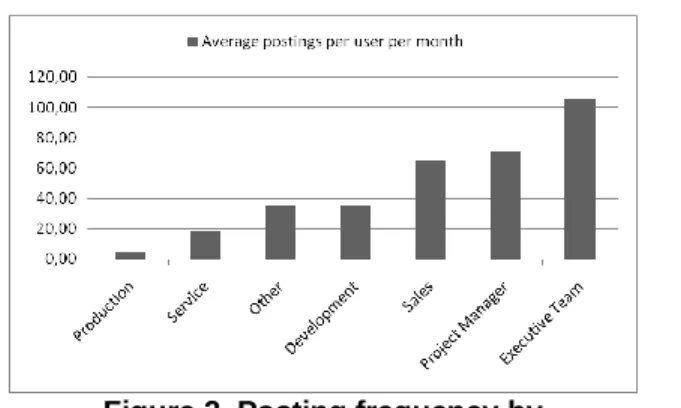
A broader spectrum of usage behavior can be found in writing postings. While some users considered Arinia as their main tool for task delegation and communication others post content only once a week or less. The survey data suggested a correlation between posting frequency and business unit and the quantitative usage statistics clearly supports this connection. Figure 2 visualizes the distinct differences in content production dependent on the user‟s business unit based on objective usage data. The four members of the executive team each post more than 100 postings per month with the most active user posting 214 „Arinias‟ – an average of ten per working day.
At the other end of the spectrum we find users with less than 3 postings per month – all belonging to the production unit. These people use Arinia in breaks only as they do not work at a desk. However, they still read postings at least once a day. Therefore, their temporal absence of a PC cannot be the main reason for their weak contribution.
In our interviews we found that these users entirely support Arinia and state that they rely on its information. Notwithstanding, they have the feeling that their own information is not that important to other users. One person further stated that she likes talking with people face-to-face more than using computer-mediated communication. While she was aware of the possible loss of information in ignoring Arinia as a publishing tool she said that she would know who the addressee of the information would be and therefore
could go there directly as this person in most cases would work just next door.
The usage habits between the two poles of „heavy‟ and „light‟ message posters clearly appears to follow a concept we might call an „information food chain‟ – following the biologic concept of eating relationships in ecosystems. Our interviews showed that the executive team, sales persons and project managers are the entry point for the majority of the company‟s information. Other units such as R&D or services use this information as the foundation for their work and therefore for their own information production. At the end of the information food chain is the production unit. While workers within the production unit need information from other units they do not reproduce information for others since their output is predominantly not information but a physical product.
This observation fits with the standard workflow of Arinia. Although there are some cross-sectional pinboards the whole company and therefore Arinia is organized towards the customer. The sales persons create a pinboard when they first gain deeper contact with a prospective customer. This information space is the central communication platform for the project including quotation, development, production and service. In using this principle Arinia contains circa 7200 pinboards with more than 100,000 postings. There are pinboards with only a few postings (e.g. if a quotation does not lead to an order) and highly-frequented ones.
In our interviews we were particularly interested in the relationship between Arinia and other tools. Surprisingly, there were no signs of problems due to the „media break‟ between e-mail for external and partly internal use (i.e. the forwarding of external e-mails) and Arinia. By and large this finding was also supported by the survey data with a minority of 17% of respondents agreeing to a problem with respect to the media break. We would have expected to hear complaints on this topic, especially from the power users. However, they managed very well by utilizing
„copy and paste‟ functionality if email content needed to be reused. Further, a member of the executive team even emphasized that the media break acts as security wall as well as a break between internal communication (which could be informal) and external communication (which would be at another level).
More problematic than the media break seemed to be the choice between different communication channels. We asked questions in the interviews as well as in the survey regarding whether there would be problems in choosing the right channel for a piece of information. While the majority of participants did not have any problems at all there were users who strongly agreed that there was indeed an issue. They stated that they often had uncertainties about whether some contents belonged to a pinboard in Arinia, a direct message or another channel (especially face-to-face communication). Further, the R&D unit also used a wiki for project data. In this case it seems to be a difficult discussion to decide which tool to use.
The majority of users even found value in Arinia in times of absence – such as holidays or after the end of work. They stated that they could avoid the typical lack of information after a longer absence. Further, the executives suggested that the use of Arinia leads to a better connection with long-term absentee employees (e.g. those on maternity leave). Related to that, our findings show that Arinia is clearly the company‟s central communication platform. We asked participants to define the importance of different communication channels following Quan-Haase et al. [12]. Arinia clearly rates as more important than email, instant messaging, phone calls and even face-to-face communication. The latter is the closest alternative with 40% of users not agreeing that Arinia is more important (see Figure 3).
Our final observation related to the use of Arinia is the relative importance of „Arinias‟ compared to Twitter postings. Most users read or at least scan through every posting. This also correlates to an earlier Figure 2. Posting frequency by
organizational unit.
Figure 3. Importance of Arinia compared to face-to-face communication.
case study on enterprise microblogging [3]. In both cases organizations were medium-sized with fewer than 100 microblogging users. It seems clear that such behavior would not be possible in cases with a much larger social network. We would expect users in these cases to act like Arinia‟s users after a longer period of absence from the system: in these situations they typically concentrate on the most important topics and persons and do not read other postings.
4.3. Perceived advantages: awareness and communication
The participants reacted in very different ways on the question of Arinia‟s advantages. While some stated a number of points, others appeared as if they had never even considered this issue before. We explain this observation with reference to the long existence of Arinia. The tool is an accepted part of the company‟s communication toolset. One participant told us that “Arinia is part of our equipment. It is not a question whether to use it or not.” Advantages are relative opinions and it was noticeable that employees who had belonged to the company for several years generally not possess this automatic comparison (all but one of the interview participants had worked for Megware for five or more years). In these cases we assisted respondents by asking them to imagine that they did not currently have Arinia, which further helped them to work out perceived advantages.
First of all, our interview participants stated that Arinia would provide good support for communication. One survey participant enthusiastically wrote in the free comment box: “Arinia is the best tool for communication to my knowledge. It optimizes collaboration to a maximum.” Except for one participant who was very new to the company everybody talked about the software tool in a very familiar, even intimate, way like it was a „good old friend‟.
Further, Arinia was seen as a good way for „getting things done‟. One person told us that “Arinia has no engaged tone”. Thus, it appeared to be a perfect tool for closing tasks. In publishing information via Arinia it reaches the recipient as well as other stakeholders. This observation might be an interesting starting point for further research. We will come back to it in the discussion chapter.
The interview sessions showed that Arinia is a core source of information for all participants. However, it was conspicuous that they often named information in the sense of „what is going on‟. We had a more detailed look into this matter in the survey when we asked for opinions with respect to the two statements:
“Arinia provides me with important information for my direct tasks” and “Arinia provides me with information about my colleagues‟ activities”. While no survey participant disagreed with either of the statements the distribution of positive answers was different: 69% strongly agree in the information awareness of colleagues, while only 51% give this rating to the statement on important information for one‟s direct work (see Figure 4). This finding suggests that Arinia mainly supports a general information awareness rather than specific information delivery.
A corresponding issue is the decreased need for meetings. One interview participant stated that meetings are only scheduled if there is something to discuss which is too lengthy to write about in Arinia or too vague to have a structured online debate (“We only need meetings when we have more to say as one can write down”). Other interviews and the survey results supported this finding. It was also stated that if meetings were scheduled the results and discussion protocol would consequently be posted into Arinia to contribute to its knowledge base.
4.4. Perceived disadvantages: data protection and a loss of human interaction
To further learn from the Arinia case and to assist in building successful microblogging applications in the future we considered that capturing perceived disadvantages would be an important source of information. Our interviews suggested three classes of problems with the software: personal, cultural and tool-related.
Personal reasons cited against Arinia were manifold. We questioned respondents who clearly were fans of direct face-to-face communication. They used Arinia as a reader but did not accept it as their main medium for communication. For example, one individual stated that it would cost too much time to write a posting and the „human element‟ would be lost.
Figure 4. Arinia provides information about colleagues.
However, this perceived disadvantage seems to affect not only Arinia but the whole class of computer-mediated communication tools.
Further, Arinia seems to require improved skills for media usage. As with today‟s microblogging applications there are new postings appearing at virtually anytime. Some participants told us that they restrict themselves not to look at new postings too often. Others conceded that they might be distracted by curiosity. The survey data supports this wide spectrum of media usage skills. The ratings for our statement “Arinia encourages me to deal with things which do not belong to my own responsibilities” are rather diverse with 60% of respondents disagreeing, 23% agreeing and 18% being neutral. There are different ways within Arinia in which to highlight new postings. Several participants told us that they deliberately disabled the option which signals new postings (with a blinking icon in the status bar) to avoid distraction.
The second class of perceived disadvantages is cultural. The company has an open and informal culture. Most interview participants stated that it is the same in Arinia and that style and formal aspects are not overly important. However, there were also opposite opinions and the survey underpins these heterogeneous perceptions. The statements “I read and correct a posting carefully before I send it” and “A posting should be well formulated (no keypoints)” had disagreement from 31% and 42% of respondents and agreement from 43% and 28% of respondents respectively (with 26% and 20% neutral). This shows that the perceived rules of Arinia are very different. Further evidence for this includes the responses from participants who partly complained about other users that tended to be too informal in their communication and not sufficiently work-focused.
A more serious problem than different opinions on the appropriate style of communication was the matter of work observation via Arinia. Naturally, one‟s activities can be tracked if he or she writes them in a microblogging-like tool. Although no-one stated it clearly and overtly, in several interviews we „read between the lines‟ to interpret this issue might affect people‟s contribution to Arinia. One person said “what I tell Arinia I tell the company” and therefore one would have to think carefully before posting information. To further examine this issue we asked for ratings of the statement “I see Arinia as observation of my work” in the survey. While the majority of participants disagreed with this statement (47% strongly disagree and 38% disagree), some 22% were neutral and one participant strongly agreed. At first glance these numbers appear to suggest that there are few problems with fears of „surveillance‟. However, as discussed before, the company is small and people,
including the executive team, work very closely together. A proportion of one quarter of respondents who exhibit uncertainty over observation fears in this context signals that there could be a serious problem when translating to larger and more hierarchical organizations. However, this assertion is hypothetical and further detailed research is needed to draw the right conclusions on this point.
Finally, we found a number of perceived tool-related shortcomings. These problems included usability issues (e.g. font size and the „old-fashioned‟ interface) and functional shortcomings (e.g. a feature request for calendar functionality). The biggest complaint related to the search functionality. Many users search for older postings (86% of the survey participants). Several interview participants stated that the keyword search was too weak to efficiently find information. They often use filtering for a specific pinboard and for a certain time period. This requires that the user already knows the information and only has to recover it. Arinia‟s public posting base contains over 100,000 items today. With every item being potentially worthy it can be seen as major challenge to leverage appropriate filtering mechanisms.
Related to this issue is the problem of personal names in the software. Arinia does not understand the @<username> syntax of recent microblogging software. In Arinia, users simply write the real-world name if they want to address somebody (i.e. „Peter could you please…‟). The result is that users have to scan postings for their name when there might be a new task or question for them. This method leads to the probability of errors and furthermore surfaces issues regarding whether users concentrate on their name or on interesting key words and facts.
5. Discussion and conclusions
In this paper we have presented the case of Arinia, a custom-made piece of software, dating from 1998, with strong similarities to today‟s microblogging applications. We have provided context to the case and have discussed usage behavior, perceived advantages and perceived disadvantages.
During the discussion of usage behavior we developed the concept of the „information food chain‟. This concept describes the strong differences in the usage frequency of different units.
Arinia is a well established tool for sharing micro-level information. The tool was designed independently from today‟s microblogging approach. However, it is very similar to these tools. This implies that the shared functionality of Arinia and microblogs in general are a „best practice‟ for sharing micro-level information. From a microblogging point of view, the
differences between the two approaches are a very interesting source of information. As Arinia has proven its usefulness over many years of usage it is a topic for further research to understand and explain the different solutions to the same problem in order to get insights for microblogging applications. On the other hand, new functionalities from microblogging could enrich Arinia.
The most obvious differences are the multi-microblog approach and the missing character limit. Our interviews showed that Arinia‟s users leveraged the multiple pinboards as thematic orientation both for contributing and consuming information. Such an orientation is missing in microblogging applications. From a web 2.0 point of view the multiple pinboards could be interpreted as a forced tag for every posting. In using a pinboard one enriches a posting with contextual information and therefore with a tag. The approach seems elegant as it also solves the task of rights management; Arinia uses the forced context as reference for rights settings.
Furthermore, the lack of a character limit in Arinia provides implications for the discussion regarding whether the character limit seen in Twitter (140 characters) is necessary for microblogging. Arinia works without such a limit and postings are nevertheless short.
The advantage of „the missing engaged tone‟, discussed above, suggests a link to task closure theory [16]. This theory explains communication behavior via a medium‟s ability to close communication tasks. A possible reason for the success of microblogging could therefore be its good ability to close tasks. Further research is needed to test this hypothesis.
A common future task of Arinia and microblogging in general is discovery of information within the created information silo. The example of Arinia shows how big these silos can get and our research shows that single search functionality is not enough for finding the „needle in the haystack‟.
Arinia is the main communication platform of the observed company and in the words of one respondent the software “is the best tool for communication”. While it also provides information for one‟s direct work it was an interesting finding that it is even more popular in creating awareness about the colleagues‟ activities. Our results regarding the problems of Arinia showed that shortcomings of the tool itself play a minor role. The main issues are personal attitudes and cultural problems. The latter could be a serious problem in organizations with a higher degree of organization and formalization than in the company studied here.
In conclusion, the case examined here underpins the current hype of microblogging and its adoption
within the enterprise. It suggests that the approach of shared micro-level information can be gainfully used in professional contexts.
6. Acknowledgements
We want to thank all the employees at Megware, and especially our interview partners for their cooperation.
7. References
[1] Y. Assogba and J. Donath, “Mycrocosm: Visual Microblogging,”, Proceedings of the Forty-Second Hawaii International Conference on System Sciences (HICSS-42), IEEE Computer Society, Los Alamitos, CA, USA, 2009 2009, pp. 1-10.
[2] S.J. Barnes and M. Böhringer, “Continuance Usage Intention in Microblogging Services: The Case of Twitter”, Proceedings of the 17th European Conference on Information Systems (ECIS), 2009.
[3] M. Böhringer and A. Richter, “Adopting Social Software to the Intranet: A Case Study on Enterprise Microblogging”, Proceedings of the M&C conference, September 6-9, Berlin, 2009, in press.
[4] M. Böhringer and D. Röhrborn, “Awareness durch Microinformationen: Anwendungsvorteile von Social Software in der informellen Projektkommunikation am Beispiel des Projekt-Microblogs ProMIC”, Proceedings of GeNeMe 2008 - Virtuelle Organisation und Neue Medien, 2008, pp. 161-176.
[5] I. Erickson, “The Translucence of Twitter”, EPIC 2008, Ethnographic Praxis in Industry Conference, 2008, pp. 58-72.
[6] Gartner (Ed.), “Gartner Highlights Four Ways in Which
Enterprises Are Using Twitter”, 2009,
http://www.gartner.com/it/page.jsp?id=920813.
[7] C. Honeycutt and S.C. Herring, “Beyond Microblogging: Conversation and Collaboration via Twitter”, Proceedings of the Forty-Second Hawaii International Conference on System Sciences (HICSS-42), IEEE Computer Society, Los Alamitos, CA, USA, 2009, pp. 1-10.
[8] B.A. Huberman, D.M. Romero, and F. Wu, “Social networks that matter: Twitter under the microscope”, First Monday, 14(1), 2009.
[9] A. Java, X. Song, T. Finin and B. Tseng, “Why we twitter: understanding microblogging usage and communities”, Proceedings of the 9th WebKDD and 1st SNA-KDD 2007 workshop on Web mining and social network analysis, 2007, pp. 56-65.
[10] H.K. Klein, and M.D. Myers, “A Set of Principles for Conducting and Evaluating Interpretive Field Studies in Information Systems”, MIS Quarterly, 23(1), 1999, pp. 67-93.
[11] B. Krishnamurthy, P. Gill and M. Arlitt, “A few chirps about twitter”, WOSP '08: Proceedings of the first workshop on Online social networks, 2008, pp. 19-24.
[12] A. Quan-Haase, J. Cothrel, and B. Wellman, “Instant messaging for collaboration: A case study of a high-tech firm”, Journal of Computer-Mediated Communication, 10(4), 2005, 120-121.
[13] A. Passant, T. Hastrup, U. Bojars and J. Breslin, “Microblogging: A Semantic Web and Distributed Approach”, Proceedings of the 4th Workshop on Scripting for the Semantic Web, CEUR Workshop Proceedings, CEUR-WS.org/Vol-368/paper11.pdf, 2008.
[14] D.R. Sandler and D.S. Wallach, “Birds of a FETHR: Open Decentralized Micropublishing”, 8th International
Workshop on Peer-to-Peer Systems (IPTPS '09) April 21, 2009, Boston, MA, 2009.
[15] D.J. Skiba, “Nursing Education 2.0: Twitter & Tweets”, Nursing Education Perspectives, 29(2), 2008, pp. 110-112.
[16] D. Straub and E. Karahanna, “Knowledge Worker Communications and Recipient Availability: Toward a Task Closure Explanation of Media Choice”, Organization Science, 9(2), 1998, pp. 1047-7039.
[17] E.M. Trauth and L.M. Jessup, “Understanding Computer-Mediated Discussions: Positivist and Interpretive Analyses of Group Support System Use”, MIS Quarterly, 24(1), 2000, pp. 43-79.
[18] G. Walsham, “Interpretive case studies in IS research: nature and method”, European Journal of Information Systems 4(2), 1995, pp. 74-81.
[19] R.K. Yin, “Case study research - design and methods”, Fourth Edition, Sage Publications, 2009.