A PILOT RANDOMIZED CONTROLLED TRIAL COMPARING THE OUTCOME OF SUSTAINED LOW EFFICIENCY DAILY DIALYSIS (SLEDD) WITH SUSTAINED LOW EFFICIENCY DAILY DIAFILTRATION (SLEDD-F) IN CRITICAL CARE PATIENTS WITH ACUTE KIDNEY INJURY
Dr Mohd Nor Azri Ab Wahab MMed Anesthesiology
Department of Anesthesiology
School of Medical Sciences, Universiti Sains Malaysia
Health Campus, 16150 Kelantan, Malaysia
Introduction: Acute Kidney Injury (AKI) is common in Critical Care patient and cause significant increase mortality and morbidity. Early management of Renal Replacement Therapy with correct dose and suitable modality is an essential intervention in severe AKI. Hybrid therapy like Sustained Low Efficiency Daily Dialysis (SLEDD) has emerged as an alternative to CRRT in Intensive Care Unit (ICU) patients. Sustained Low Efficiency Daily Diafiltration (SLEDD-f), which contains both diffusion and convection principles, also suggested to provides stable renal replacement therapy. Thus, we formulated this study to compare the outcome
between the administration of SLEDD and SLEDD-f in Critical Care patient with Acute Kidney Injury.
Objectives: The objective of this randomized control trial is to compare the Intensive Care Unit (ICU) Survival between SLEDD and SLEDD-f in Critical Care patient with Acute Kidney Injury. The specific objective is to compare Length of Stay in ICU and Hospital, Days of Ventilatory support, as well as control of acid base balance, small solute (urea and creatinine) and electrolytes (sodium and potassium) between SLEDD and SLEDD-f.
Methods: Fourteen patient, with Acute Kidney Injury in Critical Care were selected with selection criteria were randomized into two group to received either Sustained Low Efficiency Daily Dialysis (SLEDD) or Sustained Low Efficiency Daily Diafiltration (SLEDD-f) for Renal Replacement Therapy. Selected parameters and blood investigation were recorded and compared including ICU predicted score, acid base status, renal function test, urine output and electrolytes are all taken during admission to hospital and critical care, before initiating the dialysis, day one after starting the dialysis until discharged from critical care and hospital, as well as during follow up until 42 days after dialysis. 3 month mortality also been recorded.
Results: In both SLEDD and SLEDD-f group, the distributions of social-demographic, medical background status, as well as ICU predicted mortality like SOFA, SAPS II and APACHE II were similar. 85.7% of the AKI was due to sepsis while 14.3% due to multifactorial
cause. Overall, there is no significant differences of outcome distribution (ICU and hospital survival, length of ICU and hospital stay; and duration of ventilatory support) and parameter distribution (urea, creatinine, sodium, pottasium and acid base balance) between patients receiving SLEDD and SLEDD-f technique (p>0.05). Mortality rate at day 60 reveals no significant difference in between both modalities with SLEDD having 42.9% mortality and SLEDD-f 14.3 % (p=0.554). In general, patients in SLEDD-f group have a shorter duration of ICU stay (median, 11 days [IQR 5 to 37 days]), duration of ventilation (median, 5 days [IQR 4 to 33 days]) and have a higher ICU survival (85.7%) compare to SLEDD group, but this was not statistically significant. Meanwhile, SLEDD have a shorter duration of hospital stay (median, 25 days [IQR 16 to 29 days]) and this may result from higher mortality compare to SLEDD-f as the survivor may have prolonged length of stay at hospital.
Conclusion: The administrations of SLEDD and SLEDD-f in ICU patients with AKI are feasible and comparable in terms of ICU survival, Length of ICU stay, Days of Ventilatory support as well as control of small solutes, electrolytes and acid base balance. Therefore, SLEDD-f can be used as an alternative therapy other than the conventional SLEDD with shorter duration of 4 hours as compared to SLEDD of 6 hours.
Associate Professor Dr Saedah Ali: Supervisor Professor Dr Shamsul Kamalrujan: Co-Supervisor
A PILOT RANDOMIZED CONTROLLED TRIAL
COMPARING THE OUTCOME OF SUSTAINED LOW
EFFICIENCY DAILY DIALYSIS (SLEDD) WITH
SUSTAINED LOW EFFICIENCY DAILY
DIAFILTRATION (SLEDD-f) IN CRITICAL CARE
PATIENTS WITH ACUTE KIDNEY INJURY
DR MOHD NOR AZRI AB WAHAB
MD (UKM)
DISSERTATION SUBMITTED IN PARTIAL FULLFILLMENT OF THE
REQUIREMENTS FOR THE DEGREE OF MASTER OF MEDICINE
(ANESTHESIOLOGY)
UNIVERSITY SAINS MALAYSIA
2015
ii
ACKNOWLEDGEMENT
In the name of Allah, the most Gracious and the most Merciful, I pray to thank Him as He gave me the strength, courage and health to complete my dissertation.
I would like to take this opportunity to thank all those involved in the preparation of my dissertation and subsequently the completion of this manuscript. My appreciation to my supervisor, Associate Professor Dr Saedah Ali, Lecturer in the Department of Anaesthesiology and Intensive Care, School of Medical Sciences, USM for her valuable advice and encouragement. Sincere appreciation also goes to co-supervisor, Professor Dr Shamsul Kamalrujan, Head of Department, Department of Anaesthesiology and Intensive Care and also other lecturers. Also thank you to Associate Profesor Dr Azreen Syazril Adnan, Nephrologist and Lecturer in the Department of Medicine, USM and statistician, Dr Sabrizan Osman.
Special thanks to my beloved family especially my parents; Hj Ab Wahab Ahmad and Hjh Mariah Abdullah, my wife; Puan Raudhah Arshad, and our wonderful children; Nur Amni Nuwairah, Ahmad Mus‘ab and Ahmad Nu‘man for their endless support, prayers and patience throughout my life. Without them it would be impossible for all my achievement to come true. Not forgetting to lecturers, specialist, medical officers and staff nurses of Haemodialysis Unit, Anaesthesia and Intensive Care in Hospital Universiti Sains Malaysia for their help and kindness. Also to all patients who willingly participated in the study because without them, this research may not be completed.
iii
TABLE OF CONTENTS
CONTENTS Page
ACKNOWLEDGEMENTS ii
TABLE OF CONTENTS iii
LIST OF TABLES vii
LIST OF FIGURES ix
LIST OF ABBREVIATIONS xi
ABSTRAK - Bahasa Melayu xiv
ABSTRACT - English xvii
CHAPTER
1 INTRODUCTION 1
1.1 OBJECTIVES OF THE STUDY 4
2 LITERATURE REVIEW 5
2.1 ACUTE KIDNEY INJURY (AKI) 5
2.2 DEFINITION & CLASSIFICATION OF AKI 7
2.2.1 RIFLE Classification 8
2.2.2 AKIN Classification 10
2.2.3 Comparison between RIFLE & AKIN Classification 11
2.3 ACUTE KIDNEY INJURY IN CRITICAL CARE 13
iv
2.5 MANAGEMENT OF ACUTE KIDNEY INJURY IN CRITICAL CARE 28
2.5.1 Prevention of AKI 29
2.5.2 Medical Therapy for AKI 30
2.5 RENAL REPLACEMENT THERAPY 31
2.6 RENAL REPLACEMENT THERAPY FOR AKI 37
2.6.1 Sustained Low Efficiency Daily Dialysis (SLEDD) 39 2.6.2 Sustained Low Efficiency Daily Diafiltration (SLEDD-f) 44
2.7 OUTCOME & PROGNOSIS OF AKI 47
2.7.1 Complication of AKI 47
2.7.2 Mortality in AKI 48
2.7.3 Recovery of Kidney Function 50
2.7.4 End Stage Renal Disease 50
2.8 SEVERITY SCORING SYSTEMS IN CRITICALLY ILL 52
2.8.1 APACHE II 53
2.8.2 SOFA Score 57
2.8.3 SAPS II Score 59
2.8.4 Severity Scoring System And Critical Care Survival 60
3 METHODOLOGY 62 3.1 STUDY DESIGN 62 3.2 INCLUSION CRITERIA 63 3.3 EXCLUSION CRITERIA 64 3.4 METHODS 65 3.5 STATISTICAL ANALYSIS 69
v 4 RESULTS 70 4.1 DESCRIPTIVE ANALYSIS 70 4.1.1 Socio-Demographic Distribution 70 4.1.2 Medical Background 72 4.1.3 Admission Status 73 4.1.4 ICU Scoring 74
4.1.5 Small Solutes, Electrolytes and Acid Base 75
4.1.6 Outcome 78 4.2 STATISTICAL ANALYSIS 79 4.2.1 Socio-Demographic Distribution 79 4.2.2 Medical Background 80 4.2.3 Admission Status 81 4.2.4 ICU Scoring 82
4.2.5 Small Solutes, Electrolytes & Acid Base 83
4.2.6 Outcome 86
4.2.7 Survival Analysis 87
4.3 SMALL SOLUTE, ELECTROLYTES AND ACID BASE BALANCE 90
4.3.1 Urea 90 4.3.2 Creatinine 91 4.3.4 Potassium 92 4.3.5 Sodium 93 4.3.6 Lactate 94 4.3.7 Bicarbonate 95 4.3.8 pH 96 4.3.9 CRP 97
vi
5 DISCUSSION 98
5.1 METHODOLOGY 98
5.2 DEMOGRAPHIC CHARACTERISTIC 100
5.3 ICU SURVIVAL & MORTALITY 101
5.4 LENGTH OF STAY IN ICU & HOSPITAL 103
5.5 DAYS OF VENTILATORY SUPPORT 104
5.6 SMALL SOLUTE, ELECTROLYTES & ACID BASE BALANCE 105
5.6.1 Urea & Creatinine 105
5.6.2 Electrolytes 106
5.6.3 Acid Base Balance 106
5.6.4 CRP 106
6 SUMMARY & CONCLUSION 107
6.1 SUMMARY 107 6.2 CONCLUSION 109 7 LIMITATION 110 8 RECOMMENDATION 112 REFERENCES 113 APPENDICES 125
Appendix 1: Patient Information And Consent Form Appendix 2: Data Collection Sheet
vii
LIST OF TABLES
Table Title Page
Table 2.1 Staging Of AKI (KDIGO 2012) 10
Table 2.2 A Comparison Of The RIFLE And AKIN Definition And Classification Schemes For AKI
12
Table 2.3 Risk Factors For AKI 16
Table 2.4 Risk Factor Associated With AKI In Cardiac Surgery 23 Table 2.5 Studies Evaluating The Association Between Selected
Medications And Risk Of AKI
25 Table 2.6 Risk Factors Of Radio Contrast Induce Nephropathy 26 Table 2.7 Theoretical Advantages And Disadvantages Of CRRT, IHD,
SLED, And PD
38
Table 2.8 APACHE II Scoring Systems 55
Table 2.9 Interpretation Of APACHE II Score 56
Table 2.10 SOFA Score 58
Table 4.1 Socio-Demographic Characteristics Distribution Between Patients Receiving SLEDD And SLEDD-f Technique
71
Table 4.2 Medical Background Status Characteristics Distribution
Between Patients Receiving SLEDD And SLEDD-f Technique
72 Table 4.3 Admission Status Characteristics Distribution Between Patients
Receiving SLEDD And SLEDD-f Technique
73 Table 4.4 ICU Scoring Distribution Between Patients Receiving SLEDD
And SLEDD-f Technique
74 Table 4.5 eGFR, Small Solutes, Electrolites And Acid Base Balance
Parameter Distribution Between Patients Receiving SLEDD And SLEDD-f Technique
viii
Table 4.6 Outcome Distributions Between Patients Receiving SLEDD And SLEDD-f Technique
78 Table 4.7 Socio-Demographic Characteristics Distribution Between
Patients Receiving SLEDD And SLEDD-f Technique
79 Table 4.8 Medical Background Status Distribution Between Patients
Receiving SLEDD And SLEDD-f Technique
80 Table 4.9 Admission Status Distribution Between Patients Receiving
SLEDD And SLEDD-f Technique
81 Table 4.10 SOFA, APACHE II And SAPS II Distribution Between Patients
Receiving SLEDD And SLEDD-f Technique
82 Table 4.11 eGFR, Small Solutes, Electrolites And Acid Base Balance
Parameter Distribution Between Patients Receiving SLEDD And SLEDD-f Technique
83
Table 4.12 Outcome Distributions Between Patients Receiving SLEDD And SLEDD-f Technique
84 Table 4.13 Mean And Median Survival Time For Patients Receiving
SLEDD And SLEDD-f Technique
88
Table 4.14 Association Between ICU Scoring And Length Of Stay With Mortality At 3 Months
ix
LIST OF FIGURES
Figure Title Page
Figure 2.1 Conceptual Model of AKI 6
Figure 2.2 RIFLE Criteria for Acute Renal Dysfunction 9
Figure 2.3 Risk of AKI Varies by Definition Used and Timing of Assessment
14 Figure 2.4 Aim of Therapies According to Phase of AKI or ARF 28 Figure 2.5 Approach to Renal Replacement Therapy in AKI 33 Figure 2.6 Schematic Representation of Hemodialysis, Hemofiltration and
Hemodiafiltration
36
Figure 2.7 Fresenius ArRT-Plus Machine 4008S 43
Figure 2.8 Fresenius ArRT-Plus Machine 5008S 46
Figure 2.9 Hospital Survival for AKI 49
Figure 2.10 Long-term Survival Stratified by CKD and AKI 51 Figure 2.11 Predicted Mortality Against APACHE II Score 61
Figure 3.1 Flow Chart of the Study 68
Figure 4.1 Kaplan Meier Survival Analysis of Hospital Survival Between Patients Receiving SLEDD And SLEDD-f Technique
87 Figure 4.2 Urea Progressions For Cases Using SLEDD And SLEDD-f
Technique
90 Figure 4.3 Creatinine Progressions For Cases Using SLEDD And SLEDD-f
Technique
91 Figure 4.4 Potassium Progressions For Cases Using SLEDD And SLEDD-f
Technique
x
Figure 4.5 Sodium Progressions For Cases Using SLEDD And SLEDD-f Technique
93 Figure 4.6 Lactate Progressions For Cases Using SLEDD And SLEDD-f
Technique
94 Figure 4.7 HCO3 Progressions For Cases Using SLEDD And SLEDD-f
Technique
95 Figure 4.8 PH Progressions For Cases Using SLEDD And SLEDD-f
Technique
96 Figure 4.9 CRP Progressions For Cases Using SLEDD And SLEDD-f
Technique
xi
LIST OF ABBREVIATIONS
AKI Acute Kidney Injury
AKIN Acute Kidney Injury Network
ARF
APACHE II score
Acute Renal Failure Acute Physiology And Chronic Health Evaluation Score APS
AUC
Acute Physiology Score Area Under The Receiver Operating Curve
BMI Body Mass Index
CABG Coronary Artery Bypass Grafting
CKD Chronic Kidney Disease
CI Confidence Interval
CIN CRRT
Contrast Induce Nephropathy Continuous Renal Replacement Therapy
CRP C-Reactive Protein
CVVH Continuous Venovenous Haemofiltration
xii
ESRD End Stage Renal Disease
eGFR GCS
Estimated Glomerular Filtration Rate Glasgow Coma Scale
HUSM Hospital Universiti Sains Malaysia
ICU Intensive Care Unit
IHD Intermittent Hemodialysis
IQR KDIGO
Interquartile Ratio Kidney Disease Improving Global Outcomes
LOS Length Of Stay
OR Odds Ratio
PIRRT Prolonged Intermittent Renal Replacement Therapy
RIFLE Risk, Injury, Failure, Loss, End Stage
RRT Renal Replacement Therapy
SAPS II score Simplified Acute Physiology Score
SOFA Sequential Organ Failure Assessment
sCr SD
Serum Creatinine Standard Deviation
xiii
SLEDD Sustained Low Efficiency Daily Dialysis
SLEDD-f Sustained Low Efficiency Daily Diafiltration
SPSS Statistical Package For The Social Sciences
UF Ultrafiltration
xiv
ABSTRAK
Tajuk: Kajian Kawalan Pilot Secara Rambang membandingkan hasil Sustained Low Efficiency Daily Dialysis (SLEDD) dengan Sustained Low Efficiency Daily Diafiltration (SLEDD-f) di kalangan pesakit yang mengalami kegagalan buah pinggang akut (AKI) di wad rawatan rapi.
Latar Belakang: Kecederaan buah pinggang akut (AKI) kerap berlaku di kalangan pesakit di wad rawatan rapi dan menyebabkan peningkatan kadar kematian dan morbiditi yang ketara. Rawatan awal Terapi Penggantian Buah pinggang (RRT) dengan modaliti dan dos yang bersesuaian adalah rawatan sokongan yang penting bagi pesakit yang mengalami AKI yang teruk. Terapi hibrid seperti Sokongan Dialisis Harian Kecekapan Rendah Berterusan (SLEDD) telah muncul sebagai alternatif kepada CRRT untuk pesakit di unit rawatan rapi (ICU). Manakala Sokongan Diafiltrasi Harian Kecekapan Rendah Berterusan (SLEDD-f), yang mengandungi kedua-dua prinsip difusi dan konveksi, turut dikatakan sebagai menyediakan rawatan penggantian buah pinggang yang stabil. Oleh itu, kami menjalankan kajian ini untuk membandingkan hasil diantara rawatan SLEDD dan SLEDD-f di kalangan pesakit unit rawatan rapi yang mengalami AKI.
xv
Objektif: Objektif umum kajian pilot rawak kawalan ini adalah untuk membandingkan survival ICU diantara SLEDD dan SLEDD-f di dalam rawatan pesakit kritikal dengan AKI. Objektif khusus pula adalah untuk membandingkan di tempoh masa di ICU dan Hospital,tempoh sokongan ventilasi, serta imbangan asid base, kestabilan garam larut (urea dan creatinine) dan elektrolit (sodium dan pottasium) diantara SLEDD dan SLEDD-f.
Kaedah: Empat belas pesakit, dengan kecederaan buah pinggang akut didalam Wad Rawatan Kritikal, dipilih melalui kriteria pemilihan yang ditetapkan telah dibahagikan secara rambang kepada dua kumpulan untuk menerima samada SLEDD atau SLEDD-f sebagai rawatan Penggantian Buah pinggang. Parameter tertentu dan penyiasatan darah direkodkan dan dibandingkan termasuk skor ICU (APACHE II, SAPS II dan SOFA), status imbangan asid-base, ujian fungsi renal, elektrolit semuanya direkod dan dibandingkan semasa kemasukan ke hospital, wad rawatan rapi ICU, sebelum memulakan dialisis, hari pertama dialisis sehingga keluar dari unit rawatan rapi dan hospital, serta semasa susulan sehingga hari ke 42. Kematian pada hari ke 60 dan bulan ketiga juga direkodkan.
Hasil: Dalam kedua-dua kumpulan SLEDD dan SLEDD-f, taburan status demografi sosial dan latar belakang perubatan, serta skor ICU adalah sama. 85.7% pesakit AKI adalah disebabkan oleh sepsis manakala 14.3% disebabkan oleh punca multifaktorial lain Secara keseluruhan, tidak ada perbezaan yang signifikan di dalam taburan hasil (Survival ICU dan hospital, tempoh masa di ICU dan hospital, serta tempoh sokongan ventilasi) dan taburan parameter yang dikaji (urea, creatinine, sodium, potasium dan imbangan asid-base) di antara pesakit yang menerima rawatan SLEDD dan SLEDD-f (p> 0.05). . Kadar kematian keseluruhan pada hari ke 60 atas sebarang sebab menunjukkan tiada perbezaan signifikan diantara kedua-dua kumpulan dengan
xvi
SLEDD 42.9% dan SLEDD-f 14.3%. Umumnya pesakit dalam kumpulan SLEDD-f mempunyai tempoh masa yang lebih pendek di ICU(median, 11 hari [IQR 5-37 hari]), tempoh sokongan ventilasi (median, 5 hari [IQR 4-33 hari] ) dan survival ICU yang lebih tinggi (85.7%) berbanding dengan kumpulan SLEDD, tetapi ini tidak signifikan secara statistik. Sementara itu, SLEDD mempunyai tempoh masa di hospital yang lebih rendah (median, 25 hari [IQR 16-29 hari]) dan ini boleh disebabkan kadar mortaliti yang lebih tinggi (42.9%) berbanding dengan SLEDD-f, Ini mungkin disebabkan mereka yang hidup terus tinggal lama di dalam hospital.
Kesimpulan: Rawatan SLEDD dan SLEDD-f dikalangan pesakit ICU dengan AKI adalah boleh dijalankan dan setanding dari segi survival ICU dan hospital, tempoh masa di ICU dan hospital, tempoh sokongan ventilasi, serta kawalan elektrolit (sodium dan potasium), bahan larut (urea dan creatinine) dan imbangan asid-base. Oleh itu, SLEDD-f boleh digunakan sebagai terapi alternatif pesakit AKI selain rawatan konvensional SLEDD, dengan tempoh 4 jam yang lebih ringkas dengan diffusi dan konveksi berbanding 6 jam SLEDD.
xvii
ABSTRACT
Title: A Pilot Randomized Controlled Trial Comparing the Outcome of Sustained Low Efficiency Daily Dialysis (SLEDD) with Sustained Low Efficiency Daily Diafiltration (SLEDD-f) in Critical Care Patients with Acute Kidney Injury
Background: Acute Kidney Injury (AKI) is common in Critical Care patient and cause significant increase mortality and morbidity. Early management of Renal Replacement Therapy with correct dose and suitable modality is an essential intervention in severe AKI. Hybrid therapy like Sustained Low Efficiency Daily Dialysis (SLEDD) has emerged as an alternative to CRRT in Intensive Care Unit (ICU) patients. Sustained Low Efficiency Daily Diafiltration (SLEDD-f), which contains both diffusion and convection principles, also suggested to provides stable renal replacement therapy. Thus, we formulated this study to compare the outcome between the administration of SLEDD and SLEDD-f in Critical Care patient with Acute Kidney Injury.
Objectives: The objective of this randomized control trial is to compare the Intensive Care Unit (ICU) Survival between SLEDD and SLEDD-f in Critical Care patient with Acute Kidney Injury. The specific objective is to compare Length of Stay in ICU and Hospital, Days of
xviii
Ventilatory support, as well as control of acid base balance, small solute (urea and creatinine) and electrolytes (sodium and potassium) between SLEDD and SLEDD-f.
Methods: Fourteen patient, with Acute Kidney Injury in Critical Care were selected with selection criteria were randomized into two group to received either Sustained Low Efficiency Daily Dialysis (SLEDD) or Sustained Low Efficiency Daily Diafiltration (SLEDD-f) for Renal Replacement Therapy. Selected parameters and blood investigation were recorded and compared including ICU predicted score, acid base status, renal function test, urine output and electrolytes are all taken during admission to hospital and critical care, before initiating the dialysis, day one after starting the dialysis until discharged from critical care and hospital, as well as during follow up until 42 days after dialysis. 3 month mortality also been recorded.
Results: In both SLEDD and SLEDD-f group, the distributions of social-demographic, medical background status, as well as ICU predicted mortality like SOFA, SAPS II and APACHE II were similar. 85.7% of the AKI was due to sepsis while 14.3% due to multifactorial cause. Overall, there is no significant differences of outcome distribution (ICU and hospital survival, length of ICU and hospital stay; and duration of ventilatory support) and parameter distribution (urea, creatinine, sodium, pottasium and acid base balance) between patients receiving SLEDD and SLEDD-f technique (p>0.05). Mortality rate at day 60 reveals no significant difference in between both modalities with SLEDD having 42.9% mortality and SLEDD-f 14.3 % (p=0.554). In general, patients in SLEDD-f group have a shorter duration of ICU stay (median, 11 days [IQR 5 to 37 days]), duration of ventilation (median, 5 days [IQR 4 to 33 days]) and have a
xix
higher ICU survival (85.7%) compare to SLEDD group, but this was not statistically significant. Meanwhile, SLEDD have a shorter duration of hospital stay (median, 25 days [IQR 16 to 29 days]) and this may result from higher mortality compare to SLEDD-f as the survivor may have prolonged length of stay at hospital.
Conclusion: The administrations of SLEDD and SLEDD-f in ICU patients with AKI are feasible and comparable in terms of ICU survival, Length of ICU stay, Days of Ventilatory support as well as control of small solutes, electrolytes and acid base balance. Therefore, SLEDD-f can be used as an alternative therapy other than the conventional SLEDD with shorter duration of 4 hours as compared to SLEDD of 6 hours.
1
CHAPTER 1: INTRODUCTION
Acute Kidney Injury (AKI) is a common clinical problem encountered in critically ill patient. It characteristically portends an increase in morbidity and mortality (Baghshaw et al. 2005). Despite technical advancement in the management of Acute Kidney Injury over the last 50 years, critically ill patients with AKI remain to demonstrate high mortality rates.
In the absence of any effective pharmacologic therapies of AKI, the management of AKI is remains supportive and prevention of the progression of the illness, focused on optimizing fluid balance, maintaining nutrition, treating electrolyte and acid base disturbances, adjusting the dose of medications excreted by the kidney, and avoiding secondary hemodynamic and nephrotoxic renal injury (Palevsky 2013). However early management of Renal replacement therapy is often considered as an essential intervention.
RRT modalities have evolved over time, in parallel with technological advances, to offer better patient tolerability and solute removal. However ‗ideal‘ RRT setting remain controversial and delivery of standard RRT prescription is unlikely globally due to the high cost and need of specialized staff, which are unlikely to be sustainable in resource-limited settings (Jamal et al. 2014). Generally, the aims of treatment are to control fluid volume, correct acid-base
2
abnormalities, improve ureamia, promote renal recovery and improve mortality without causing complications (Oreilli et al. 2005). Solute removal during RRT occurs by convection and/or diffusion. Conventional dialysis uses diffusion for solute removal, whereas haemofiltration techniques employ convection. In some instances, both diffusion and convection are combined, as in haemodiafiltration.
Sustained Low Efficiency Daily Dialysis (SLEDD) has emerged as an alternative to CRRT in the management of hemodynamically unstable patient with AKI. In critically ill patients, the administration of SLEDD is feasible and provides comparable hemodynamic control and solute control to CRRT (Fieghen et al. 2010). Marshall et al 2004 also suggested that Sustained Low Efficiency Daily Diafiltration (SLEDD-f) provides stable renal replacement therapy with good clinical outcome with satisfactory logistic elements of SLEDD-f delivery by ICU nursing personnel. Therefore, both SLEDD and SLEDD-f have been considered as a viable alternative to CRRT in this setting.
this development encourage us to compare the intensive care unit survival, days of ventilatory support, length of stay in ICU, mortality and renal recovery; as well as acid base balance and solute control between SLEDD and SLEDD-f in critical care patient with acute kidney injury. At the moment, there is no similar prospective or retrospective study done on comparing SLEDD and SLEDD-f in critical care patients with AKI.
3
Thus the rationale of carrying out this pilot study is to compare SLEDD with SLEDD-f outcomes. With this comparison, SLEDD-f can be used as an alternative therapy other than the conventional SLEDD. SLEDD-f in this study focuses on a shorter duration of 4 hours as compared to SLEDD of 6 hours. With the additional diffusion SLEDD-f is seen to be able to clear larger molecules mainly in patients with sepsis however no studies have performed SLEDD-f in 4 hours. The main reason to shorten the time is with regards of the cost and hemodialysis nurse time conducting the dialysis session.
4 1.1 OBJECTIVES OF THE STUDY
1.1.1 General Objectives
The aim of this study is to compare the survival and mortality of the critical care patients with acute kidney injury receiving either Sustained Low Efficiency Daily Dialysis (SLEDD) or Sustained Low Efficiency Daily Diafiltration (SLEDD-f).
1.1.2 Specific Objectives
1. To compare ICU and hospital length of stay between SLEDD and SLEDD-f in critical care patients with acute kidney injury.
2. To compare days of ventilatory support between SLEDD and SLEDD-f in critical care patients with acute kidney injury.
3. To compare the control of small solutes and acid base balance between SLEDD and SLEDD-f in critical care patients with acute kidney injury.
1.2 RESEARCH HYPOTHESIS
There is no significant different in survival, mortality, length of stay, days of ventilatory support, the control of small solutes, electrolytes and acid base balance between SLEDD and SLEDD-f in critical care patients with Acute Kidney Injury.
5
CHAPTER 2: LITERATURE REVIEW
2.1 ACUTE KIDNEY INJURY
Acute kidney injury, previously known as acute renal failure. it is an abrupt and sustained decrease in renal function causing disturbances in fluid, electrolyte and acid base balance. Several experimental models have identified pathophysiologic mechanism associated with ARF (Lieberthal et al.2000). It is evident that ARF can result from alterations in renal perfusion, changes in glomerular filtration, and tubular dysfunction and that correction of these factors can ameliorate the effects of ARF (Heyman et al. 2002). Several new potential interventions have been developed showed to alter the course and established ARF in experimental model based on the identification of the underlying mechanism (Wang et al. 1997). These resulted in improvement in the prevention of the ARF due to radiocontrast agent, aminoglycoside antibiotics and rhabdomyolysis (Block et al. 2002). In addition, there are advances in dialysis with the availability of Continuous Renal Replacement Therapies (CRRT), despite intermittent haemodialysis and acute peritoneal dialysis (Tonelli et al. 2002).
Renal dysfunction is a complex syndrome including several different clinical pictures and etiologies (Ricci Z 2013). For this reason, the term Acute Kidney Injury (AKI) has been replaced the former expression ―Acute Renal Failure‖ and proposed a conventional definition
6
of acute changes in renal function. It is clear that renal dysfunction ranges from low level or risk of being injured, to an actual injury with reduced renal function, to a definitive failure with severely reduced or lost renal physiology.
Figure 2.1 Conceptual Model of AKI (Adopted from National Review Nephrology 7)
Figure 2.1 demonstrated the new conceptual model of AKI which incorporates changes in renal function and structure. It also illustrates the potential inverse relationship that may exist between changes in renal function as well as renal structure as captured by injury biomarkers. Risk incorporates both patient susceptibilities (for example, advanced age) as well as exposures (for example, sepsis). When susceptibilities are great, exposure may be limited but still result in AKI (Murugan et al. 2011).
7 2.2 DEFINITION AND CLASSIFICATION
The Acute Dialysis Quality Initiative (ADQI) reported in 2002 that 35 definitions were used in medical literature of ARF, creating much confusion and making comparisons difficult (Bellomo 2004). Different authors have chosen different methods accessing renal function and different degrees of abnormality for diagnosis of ARF. Therefore, there were efforts to make a consensus definition and a level of similar classification to that achieved by two other common ICU syndromes; sepsis and acute respiratory distress syndromes (Kellum et al 2004). This standardized case definition of ARF is necessary for comparisons of outcome across studies, development of prognostic systems, interpretation of therapeutic interventions and for design of multicenter studies. It also needs to classify the severity of the syndrome.
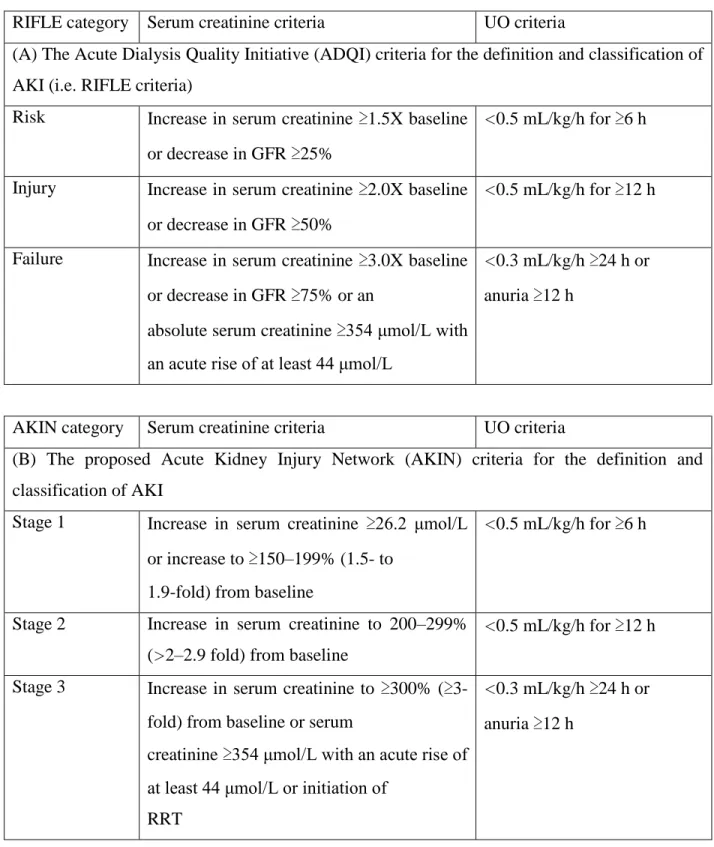
There is a consensus definition of acute kidney injury by the Acute Dialysis Quality Initiative (ADQI). These RIFLE (risk, injury, failure, loss, end stage) criteria (Figure 2.1) have been broadly supported with minor modifications by the Acute Kidney Injury Network (AKIN) (Table 2.1) and both definitions have now been validated in thousands of patients and seem to work similarly to each other. A new consensus definition merging the RIFLE criteria and the AKIN definition has emerged from the Kidney Disease: Improving Global Outcomes (K-DIGO) group (KDIGO 2012).
8 2.2.1 RIFLE Classification
Through the persistent efforts of same group, with the advocacy to develop a consensus definition, ADQI published its consensus definition of ARF, using the set of criteria called RIFLE Classification in 2004 (Bellomo et al.2004) The acronym RIFLE stands for three increasing severity classes and two outcome class
a. Risk of Renal Dysfunction (R) b. Injury to Kidney (I)
c. Failure of Kidney Function (F) d. Loss of kidney Function (L) e. End Stage Kidney Disease (E)
The three severity grades are defined based of a relatives increase in serum creatinine (sCr) or a period of decrease urine output, which is the worse. Glomerular Filtration Rate (GFR) is calculated as an increase of sCr above the baseline sCr level. When the baseline sCr is unknown and there is no past history of Chronic Kidney Disease (CKD), sCr is calculated using the Modification of Diet in Renal Disease; formula for assessment of kiney function, assuming a GFR of 75ml/min/1.73m², as recommended by the ADQI workgroup (Figure 2.2)
9
By defining the syndrome of acute changes in renal function broadly, RIFLE Classification moved beyond ARF. Hence, after the meeting in Vicenza, Italy in September 2004, the ADQI group and representatives from three societies; American Society of Nephrology, International Society of Nephrology and National Kidney Foundation, and the European Society of Intensive Care, have proposed the term Acute Kidney Injury (AKI) as mentioned above, to reflect and encompass the entire spectrum of ARF, from minor changes in renal function to requirement for RRT recognizing that an acute decline in kidney function is often secondary to an injury that causes functional or structural changes in kidney.
10
2.2.2 Acute Kidney Injury Network Classification (AKIN)
Acute Kidney Injury Network (AKIN) is a proposed change to RIFLE Classification by an international multidisciplinary organization composed of nephrologist and intensivist. The diagnostic criteria according to AKIN are an abrupt reduction in kidney function within 48 hour. The criteria include both an absolute and a percentage change in sCr to accommodate variation related to age, gender, and body mass index and to reduce the need for a baseline sCr but do require at least two sCr values within 48 hours. The urine output criterion was including based on the predictive importance of this measure but with the awareness that the urine output may not be measured routinely in unit of non-intensive care settings. It is assumed that the diagnosis based on the urine output criterion alone will require exclusion of urinary tract obstructions that reduce urine output or of other easily reversible causes of reduced urine output. It should be used in the context of the clinical presentation and following adequate fluid resuscitation when applicable.
Table 2.1 Staging of AKI (KDIGO 2012)
AKIN STAGE Urine output criteria
1 Serum creatinine increases ≥ 26.5µmol/l (≥0.3 mg/dl)
OR increase to 1.5-2.0 fold from baseline.
<0.5 ml/kg/h for 6 hours
2 Serum creatinine increase ≥2.0-3.0 fold from baseline. <0.5 ml/kg/h for 12 hours 3 Serum creatinine increase > 3.0 fold from baseline OR
serum creatinine ≥354 µmol/l (≥4.0 mg/dl) with an acute increase of at least 44 µmol/l (0.5 md/dl) OR need for RRT.
<0.3 ml/kg/h for 24 hours OR anuria for 12 hours
11
2.2.3 Comparison between RIFLE and AKIN Classification
Both criteria were developed to facilitate clinical investigation and comparison across study populations. Baghshaw et al.2008 have demonstrated the epidemiology data comparing RIFLE and AKIN in critically ill patient (Table 2.2). The AKIN definition and classification incorporates sCr, urine output and time, no longer GFR compare to RIFLE classification. AKIN also reduce the need for baseline sCr but does require at least two sCr values within 48 hours. AKIN also proposed that stages 1, 2 and 3 to be used instead of Risk, Injury and Failure; and the two outcome clsasses Loss and End-stage. Another important change from RIFLE classification is patient will be categorized as stage 3 (failure) if they treated with RRT irrespective of what their sCr or urine output is at the point of initiation. However, the AKIN criteria could also improve the sensitivity of the AKI diagnosis but do not improve on the ability of the RIFLE criteria in predicting shot term outcome such as hospital mortality of critically ill ICU patients (Chang CH et al. 2010).
12
Table 2.2. A comparison of the RIFLE and AKIN Definition and Classification Schemes for AKI
RIFLE category Serum creatinine criteria UO criteria
(A) The Acute Dialysis Quality Initiative (ADQI) criteria for the definition and classification of AKI (i.e. RIFLE criteria)
Risk Increase in serum creatinine ≥1.5X baseline or decrease in GFR ≥25%
<0.5 mL/kg/h for ≥6 h
Injury Increase in serum creatinine ≥2.0X baseline or decrease in GFR ≥50%
<0.5 mL/kg/h for ≥12 h
Failure Increase in serum creatinine ≥3.0X baseline or decrease in GFR ≥75% or an
absolute serum creatinine ≥354 μmol/L with an acute rise of at least 44 μmol/L
<0.3 mL/kg/h ≥24 h or anuria ≥12 h
AKIN category Serum creatinine criteria UO criteria
(B) The proposed Acute Kidney Injury Network (AKIN) criteria for the definition and classification of AKI
Stage 1 Increase in serum creatinine ≥26.2 μmol/L or increase to ≥150–199% (1.5- to
1.9-fold) from baseline
<0.5 mL/kg/h for ≥6 h
Stage 2 Increase in serum creatinine to 200–299% (>2–2.9 fold) from baseline
<0.5 mL/kg/h for ≥12 h Stage 3 Increase in serum creatinine to ≥300% (≥
3-fold) from baseline or serum
creatinine ≥354 μmol/L with an acute rise of at least 44 μmol/L or initiation of
RRT
<0.3 mL/kg/h ≥24 h or anuria ≥12 h
13
2.3 ACUTE KIDNEY INJURY IN CRITICAL CARE
The incidence of AKI is increasing, with mortality associated with AKI remains unacceptably high. Increasing severity correlates with increasing mortality. A systematic review of 312 cohort studies which include 49 million patients found that AKI occurred in one in five adults and one in three children hospitalized with acute illness (Rewa & Baghshaw 2014). In large retrospective cohort studies (n=49518), 1% of hospitalized patients had evidence of subacute kidney injury, with a relative changes in serum creatinine fulfilling the RIFLE classification for AKI, which associated with increase hospital mortality.
Several large cohort studies have focused on describing the incidence in intensive care settings (Andrikos et al. 2009, Baghshaw et al. 2007). The incidence of AKI among patients admitted to Intensive Care Unit (ICU) was 5.7%, in a large multinational study, using the definition of AKI as urine output <200ml in 12 hour; serum urea >30mmol/l or initiation of RRT. Subsequent cohort studies that integrated consensus definition of AKI and used administrative databases reported AKI incidence in ICU setting is 16%-39% (Baghshaw et al 2008, Ostermann et al. 2007). The marked increase incidence in these studies is likely attributable to application of consensus AKI criteria as intended, with inclusion of urine output criteria. Malaysian Registry of Intensive Care Report 2013 reported that incidence of AKI within 24 h of ICU admissionis approximately 14%, with 15% of all critically ill patients receiving RRT at some point. Approximately half of the patients that develop AKI (49.3%) receive RRT. AKI was associatedwith an in-hospital mortality rate of 41.4%, and is encountered in up to 80% of patients presenting with severe sepsis and multi-organ failure (Tong et al. 2013).
14
Figure 2.3 Risk of AKI Varies by Definition Used and Timing of Assessment (Adopted from National Review of Nephrology)
Figure 2.3 showed the relationship between application of RIFLE criteria and the apparent incidence of AKI varies according to the definition used and the time at which it is applied, which can lead to underestimations in the incidence of AKI.
15 2.4 RISK FACTOR FOR AKI
A wide variety of risk factor have been described for the development of AKI in the ICU but there is no clear understanding of what risk factors confer the highest risk for the development of AKI despite assessment and studies in diverse populations. Impact and the association of those risk factors need a better understanding for designing predictive models of high risk patients and to create preventative strategies that might benefit patient from developing lethal condition. Kolhe et al 2008 has showed that there is lack of meaningful predictive models in mixed and medical ICU where most of the prediction models have focused on the impact on mortality of AKI in ICU patients.
The causes of AKI in ICU patients is commonly represent multifactorial etiologies, both patient and procedure related. Patient related factors such as increasing age, hypertension, diabetes mellitus, cardiac failure, peripheral vascular disease, cerebrovascular disease and preexisting CKD; are often more strongly associated with postoperative mortality than procedure related factors. Whereby high risk procedure or operation such as cardiopulmonary bypass, emergency surgeries, prolonged surgical period; will serve as a predisposing factor for AKI postoperatively. (Liano et al 1998)
There are several ways to classify the risk factor for AKI. Caused of AKI are also frequently categorized as pre-renal, intrinsic renal and post renal. However, this can oversimplifies the overlapping pathologic mechanism underlying AKI. Baghshaw et al 2014 classified the risk factor into non modifiable and potentially modifiable risk factor as described in table 2.3
16 Table 2.3 Risk Factors for AKI
Non-modifiable Potentially modifiable
■Old age ■Male sex ■Black race
■Pre-existing chronic kidney disease
■Proteinuria or elevated albumin-to-creatinine ratio
■Hypertension ■Diabetes mellitus
■Chronic liver disease and/or complications of portal hypertension
■Heart failure and/or decreased ejection fraction
■Coronary artery disease and/or recent myocardial infarction
■Chronic obstructive pulmonary disease ■Peripheral vascular disease
■Malignancy ■Anaemia ■Critical illness ■Sepsis ■Trauma ■Cardiac surgery
■Major noncardiac surgery ■Exposure to radiocontrast media ■Fluid overload
■Fluid resuscitation with synthetic colloids (hydroxyethyl starch) or chloride rich solutions (0.9% saline)
■Drug toxicity, drug interactions or nephrotoxic medications
17 2.4.1 Extreme of Age
Elderly and very young patients are particularly susceptible to AKI. Hospitalised children are at increased risk up to 50% of acutely ill children developed AKI; most commonly in association with major surgery with or without sepsis. Although older age has consistently been shown to increase the risk of AKI (Coca et al 2011), elderly patients with AKI are far less likely to receive RRT than are younger patients. GFR is thought to decrease by 1% per year over the age of 20 years due to a progressive loss of renal cortical glomeruli. There is a 50% decrease in the tubular function ageing, with reduced renal concentrating ability and free water clearance. An observational study suggested that critically ill patient with AKI are increasingly older, due to the physiologic ageing of the kidneys, impaired renal recoverability, multiple comorbidities, ere more probably septic and have greater severity of illness and organ failure.
2.4.2 Proteinuria
Preexisting proteinuria is a risk factor for the development of AKI among hospitalized patients. In patient with proteinuria and eGFR more than 60ml/min/1.73m², the adjusted risk of AKI was 4.4 fold higher than in those with no proteinuria (James 2010). A similar increased of risk of AKI associated with elevated urine albumin to creatinine ratio was further increase by declining eGFR. In a large cohort of patients undergoing cardiac surgery, increased urine albumin to creatinine ratio independently predicted post-operative AKI and improved clinical risk prediction. It also associated with increased dialysis risk, mortality and prolonged ICU and hospital stay.
18 2.4.3 Comorbid disease
Overt CKD is an independent risk factor for development of AKI, non-recovery of renal function and progression to End Stage Renal Disease (ESRD). It also a recognized risk factor for development for death, cardiovascular events and hospitalization. Evidence by its integration into numerous clinical practice guidelines and risk prediction score for development of post procedural and need for RRT, CKD is one of strongest predictors to AKI.
In addition, non-renal comorbid diseases also modify the risk of AKI such as Diabetes Mellitus, hypertension, cardiovascular disease, peripheral vascular disease, chronic liver disease and chronic obstructive pulmonary disease. Comorbidities reportedly set the backstage of the subsequent renal injury, through the interplay of disrupted renal autoregulation, pre-existing renal damage and concomitant use of nephrotoxic medication (Leung et al 2012).
2.4.4 Sepsis
Sepsis or Systemic Inflammatory Response Syndrome (SIRS) by means of its glomerular hemodynamic alterations, induction of reactive oxygen species and oxidative stresses, and tubular ischemic injury can contributes to AKI development. The toxic effect of sepsis on AKI do not appear to be specific to bacterial or pathogen; as H1N1 influenza pandemic in 2009 demonstrated that viral infections caused significant rates up to 51% ( Martin et al 2011). Sepsis is known precipitating factor of AKI and the development of AKI, as well as it will further predispose the episode of sepsis. AKI occurs most commonly in association with sepsis and marked increase in risk of adverse outcome in ICU. A multicenter cohort study (Baghshaw et al 2009) found that 64.4% of critically ill patients with septic shock developed AKI within
19
24 hour of ICU admission. Delay in administration of appropriate antimicrobial therapy after the onset of hypotension was associated with increased risk of AKI. Higher RRT use and risk of death has been reported in patients with sepsis occurring after AKI compared with patient without sepsis (Mehta et al 2011).
Furthermore, current sepsis resuscitation guidelines advocate aggressive volume resuscitation for patient presenting with severe sepsis in an effort to improve overall survival according to Spoelstra De Man 2008. However, the Sepsis Occurrence in Acutely Ill (SOAP) trial demonstrated an increased AKI developing within the first 48 hour of ICU admission in those patients with a fluid balance (Vincent et al 2006). A post hoc analysis revealed that the early and aggressive volume resuscitation can improved outcomes, but patient with more fluid balance subsequently developed AKI (Dellinger 2008). It suggest the benefits of fluid administration may be time sensitive (Payen et al 2008).
2.4.5 Trauma
AKI occurs in trauma patient up to 31% (Vivino et al 1998). It is due to multifactorial causes such as hemorrhagic shock, abdominal compartment syndrome and rhabdomyolysis. Rhabdomyolysis accounts 28 of trauma associated AKI requiring dialysis (Sharp et al 2004). Abdominal compartment pressure more than 12mmHg is associated with AKI as kidney are an early sensors of intrabdominal hypertension. Therefore a sustained increased in intra-abdominal pressure more than 20mmHg in association with new organ dysfuntion will be associated with AKI in 30% of cases (Cheatham et al 2007 and De laet et al 2007).
20 2.4.6 Fluid Resuscitation and Overload.
In particular in patient with sepsis, randomized trial of fluid resuscitation using the synthetic colloid hydroxyethyl starch compared to crystalloid have shown higher risk of AKI and RRT use (Myburgh et al 2012 and Perner et al 2012). Administration of chloride rich solution compared to balanced crystalloid also associated with increased risk of AKI and RRT use (Yunos et al 2012) due to chloride loading that might result in deleterious changes in renal hemodynamics and contributes to excess fluid retention. Fluid overload is increasingly associated with AKI Grams et al 2011) as well as increased mortality. Numerous mechanisms might contribute to the adverse renal consequences of fluid overload including increased systemic venous pressure, renal specific parenchymal edema, intra-abdominal hypertension, and the physiological effect of intervention to treat fluid overload such as diuretic therapy and mechanical ventilation.
2.4.7 Hypotension
Baghshaw et al 2009 studied the relationship of hypotension and AKI or mortality focused on septic shock patient. It reported that the severity and duration of hypotension are bith significant risk factor of AKI development in ICU patient. Odds of AKI increase by 3% in every 1mmHg decrease in mean arterial pressure (MAP) below 80mmHg. As the degree of hypotension worsened, the increased risk of AKI from each additional hour of continuous hypotension more than double for each 10mmHg drop in MAP below 80mHg (Li Wei et al 2010). Brienza et al 2009 also demonstrated that 80% of patient with post-operative AKI having an episode of haemodynamic instability in the peri-operative period.
21 2.4.8 Major and High Risk Surgery
Both cardiac surgery and major non-cardiac surgeries is associated with increased risk of AKI; as its incidence is modified by the burden of baseline susceptibilities and perioperative factors. Perioperative risk factors included older age, higher BMI, comorbid disease and high risk or emergency surgeries.
The incidence of AKI in hospitalized patient ranges from 18% to 47% depending on definition used (Carmichael et al. 2003). Several high risk procedures or surgeries such as cardiac surgeries with CPB, combined valve and coronary artery bypass grafting (CABG)surgery, emergent surgeries, increased intra-abdominal pressure in major abdominal surgery or lengthy surgery period, serve as predisposing factor for AKI after operation (Loef et al. 2005). These are associated with either poor renal perfusion or decrease renal reserve. The BEST Kidney (beginning and ending supportive therapy for the kidney) trial confirmed that the major surgery is the second leading cause of AKI (34%) in the critically ill patients in the intensive care settings with overall mortality of 60.3% (Uchino et al. 2005). United Kingdom Intensive Care National Audit and Research Centre Case Mix program showed the surgical admissions accounted for 16.4% admissions with severe AKI in the first 24 hours. It was respectively accounted by 5.6% elective and 10.8% emergency cases.
22 2.4.9 Cardiac and Vascular Surgery
The estimated incidence of AKI in patients undergoing cardiac surgery is between 11% to 30%; which was designed using RIFLE and KDIGO criteria or as a 50% increase in serum creatinine(Ho J et al.2012 and Bastin et al. 2013). Severe AKI requiring RRT occurs in an estimated 1% to 2% of these patients. Several studies have examined the risk factors associated with the development of AKI after Cardiopulmonary bypass (CPB) surgery, with valvular procedure associated with a higher risk. Typical CABG has the lowest incidence of AKI approximately 2.5% and dialysis dependent approximately 1%, followed by valvular surgery with an incidence of AKI of 2.8% dialysis dependent of 1.7%. The highest risk group includes combined coronary artery and valvular surgery with an incidence of AKI of 4.6% and dialysis dependent of 3.3% (Abraham et al. 2005 and Grayson et al. 2003).
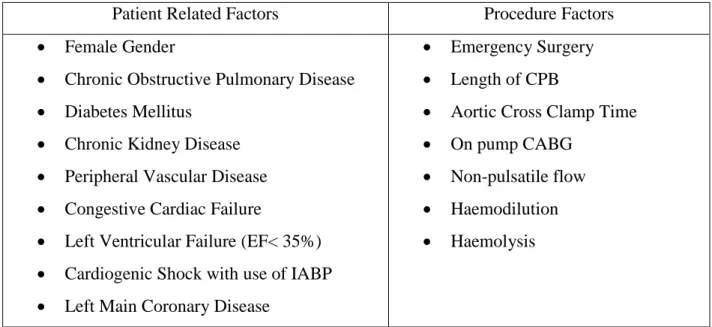
Certain risk factors have been repeatedly associated with an increased risk of AKI, in almost all studies, including female gender, reduced left ventricular function or the presence of congestive heart failure, diabetes, peripheral vascular disease, preoperative use of an intra-aortic balloon pump, chronic obstructive pulmonary disease, the need for emergent surgery and an elevated preoperative sCr. Almost all of the defined risk factors related to either impaired renal perfusion or decreased renal reserve.The strongest predictors of post-operative AKI among clinical risk scores are baseline kidney function and KD status. Patients with decreases in serum creatinine level from baseline immediately after surgery were less likely to develop AKI compared to those whose serum creatinine level increased after surgery.
23
Table 2.4 Risk Factor Associated with AKI in Cardiac Surgery
Patient Related Factors Procedure Factors
Female Gender
Chronic Obstructive Pulmonary Disease Diabetes Mellitus
Chronic Kidney Disease Peripheral Vascular Disease Congestive Cardiac Failure
Left Ventricular Failure (EF< 35%) Cardiogenic Shock with use of IABP Left Main Coronary Disease
Emergency Surgery Length of CPB
Aortic Cross Clamp Time On pump CABG
Non-pulsatile flow Haemodilution Haemolysis
24 2.4.10 Exposure to Nephrotoxins
Population based studies have shown an increased risk of hospitalization-requiring AKI up to 20% of all cases of AKI in ICU following initiation or exposure to commonly prescribed medication including high potency statins, proton pump inhibitors, non-steroidal inflammatory drugs, fluoroquinolones, fibrates and highly active anti-retroviral therapies (Uchino et al. 2005). The mechanism of medication induced AKI is variable and includes direct tubular toxicity, acute interstitial nephritis and haemodynamics perturbations.
Similarly AKI is increasingly associated with adverse drug interactions, toxicity, inappropriate prescriptions, failure of clinician to adjust for kidney function when calculating dosages in at risk patients and continued exposure to nephrotoxins during AKI. Worsening AKI and hypotension is the most common, potentially avoidable, adverse drug reactions, with angiotensin-converting-enzyme inhibitors and antithrombotics commonly implicated. Hospitalized patients, particularly those in ICUs, are often exposed to multiple concurrent nephrotoxins. Antimicrobials are common sources of avoidable nephrotoxicity and exposure to contrast media is also frequently associated with AKI in hospitalized patients (Nash K et al. 2002).