Dynamic Strict Fractional Frequency Reuse for
Software-Defined 5G Networks
Anteneh A. Gebremariam
∗, Tingnan Bao
†, Domenico Siracusa
‡,
Tinku Rasheed
‡, Fabrizio Granelli
∗and Leonardo Goratti
‡∗Department of Information Engineering & Computer Science (DISI), University of Trento, Trento, Italy †EIT ICT Labs - ITA(KTH+UNITN), Trento, Italy
‡CREATE-NET, Via Alla Cascata 56/D, 38123 Trento, Italy
Emails: [email protected], [email protected],{name.surname}@create-net.org, [email protected]
Abstract—The surge of mobile data traffic has spurred
academia and industries to begin developing 5G networks. 5G is meant to overcome limitations of 4G cellular technology relying on the dominant trend of mobile network densification with the deployment of small cell base stations. To accelerate this process, low complexity and inexpensive remote radio heads (RRHs) are deployed massively and connected to a centralized pool of resources. In this work, we study the problem of inter-cell interference (ICI) which arises in frequency reuse one multi-tier 5G networks. We entrust the management of RRHs to a software-defined network controller and we take advantage of network functions virtualization. Our contributions consist of proposing Dynamic Strict Fractional Frequency Reuse (DSFFR), a method to relieve ICI which dynamically divides the small cell area in a different number of sectors. Furthermore, we formulate a joint scheduling problem composed of two schedulers which operate at different time granularity to transmit downlink packets. Modeling the coverage area with the tool of stochastic geometry and solving with simulations the joint scheduling problem, we are able to show that DSFFR outperforms the static scheme. Performance are addressed in terms of spectral efficiency and packet blocking probability
Index Terms—5G, Small Cells, Software–Defined Networking,
FFR, Spatial Scheduling, SINR, MCS.
I. INTRODUCTION
Fueled by booming mobile data traffic the ever-growing ca-pacity demand is motivating as efficient as possible utilization of the scarce spectrum resources. With the deployment of the 4G UMTS Long Term Evolution (LTE) cellular technology and its advanced version (LTE-A), base stations are deployed in unplanned fashion using frequency reuse one (FR1). To cope
with increasing traffic volumes, both academia and industry have started the quest for cellular communications beyond 4G, or in other words 5G technology [1]–[3].
The dominant trend in 5G of network densification passes through massive deployment of small cell (SC) base stations [4], which will allow mobile operators to significantly lower CAPEX and OPEX. Small cells can be distinguished in terms of their capabilities and consequent complexity of the devices. In general, SCs have a small form factor and smaller radio fingerprint than macro base stations (MBSs) and are meant to provision user equipments (UEs) with higher data rates both in uplink and downlink. Currently, SCs can be distinguished between RRH and more complex radio unit (RU). RRHs are
equipped with antenna and radio front-end and in the Cloud Radio Access Network (C-RAN) approach [5] are connected to a remote pool of centralized resources through high capacity and low latency fronthaul connection. High capacity backhaul is then connecting the centralized pool of resources to the operator’s Evolved Packet Core (EPC).
Although the advantages of SCs deployment are evident, several challenges such as ICI need to be faced still. In multi-tier 5G networks which come from the deployment of SCs overlaying MBSs, software-defined networking (SDN) is the enabler to manage the mobile network in an unprecedented flexible manner. Centralized pool of resources or base band units (BBUs), exemplified by a server farm of general pur-pose and DSP processors, allow controlling large deployment of RRHs over space whereby suitable network abstraction models. Furthermore, making use of network functions vir-tualization (NFV), typical tasks that pertain to medium access control (MAC) and radio resource management (RRM) can run in virtual machines. Management of inter-cell interference in orthogonal frequency division multiple access (OFDMA) heterogeneous 5G networks is a crucial point to foster spatial reuse. Indeed, ICI management can be accomplished with unprecedented flexibility in the centralized pool of resources in combination with SDN control and NFV.
In this paper, we propose DSFFR which relies on the spatial scheduling of downlink packets destined to UEs alleviating in-terference at the same time. In FFR techniques, the frequency band is partitioned in N + 1 sub-bands with one band for interior users common to all the SCs (i.e. FR1 area) andN
different bands for other sector UEs. Unlike static FFR in which the well known 1-3 scheme which uses N = 3 bands is adopted for MBSs, we assume that a small cell coverage area can be dynamically divided in a different number of sectors to take into account traffic loads and interference suffered from interior and cell edge users. We assume that different sectors can be served by different antennas which are physically connected to the same pool of processing resources. In this way each sector can be seen as a separate sub-network implementing its own scheduling rules. In this work, as in [6], we develop a joint scheduling problem which is used to establish association between packets to transmit, sectors in the cell and antenna elements, including the selection of the
best possible modulation and coding scheme (MCS) to use for each packet. Our main contribution is to study the joint scheduling of packets in combination with DSFFR, which dynamically changes the number of cell sectors, as well as the coverage of the FR1 area. The number of sectors is
practically changed enabling a different number of antenna elements and beamwidth. Furthermore, we rely on the tool of stochastic geometry to model the coverage probability of users in the interference-limited network. Our results will show that DSFFR outperforms the static scheme in terms of spectral efficiency and packet blocking probability.
The reminder of the paper is organized as follows. Section II describes the related works in the area. In Section III, the system architecture and assumptions are presented. The system analysis where the proposed algorithm is discussed in Section IV. The simulation results are presented in Section V. Finally, conclusions are drawn in Section VI.
II. RELATEDWORK
Several research papers can be found in the literature which aim to mitigate interference and improve radio resource utilization. In [7], Strict FFR technique to obtain a better overall network throughput and cell-edge user experience as compared to soft frequency reuse (SFR) was presented. In one case, the available bandwidth is partitioned statically inN+ 1
sub-bands (Strict FFR) and in the second inN bands (SFR), which is less efficient in terms of resource utilization. In [8] it is proposed a dynamic FFR technique assuming an asymmetric cell load distribution and using graph coloring to improve the cell throughput with respect to conventional FFR technique. Since the approach is based on the conventional static FFR, it cannot fully solve the inherent inefficiencies in resource utilization. In [6] the authors propose a way to further improve bandwidth utilization in Static FFR. Indeed they study a joint scheduling algorithm that includes scheduling decisions for all sectors inside a MBS area. The joint scheduling is proved to be an NP-hard problem, and to solve it in polynomial time the authors developed an efficient algorithm with the worst case performance guarantee. In [6] the partition of bandwidth resources is static across the predetermined cell sectors or scheduling areas. Moreover, the joint scheduler resides in the MBS which does the scheduling in distributed manner resulting in a lower degree of freedom in improving the overall system interference. In [9] existing FFR techniques (i.e., Strict FFR, SFR, and FFR-3) are evaluated in OFDMA-based two-tier (i.e. MBS and SCs) network and a technique called optimal static FFR (OSFFR) is proposed. OSFFR statically divides the available bandwidth in seven sub-bands and manually assign different frequency bands to the SCs to mitigate interference. A. Contribution of the work
In this work we propose DSFFR, a new approach to the scheduling of downlink packets in small cell networks which, to the best of our knowledge, is different from previous solutions. We assign packets waiting for transmission in dif-ferent scheduling areas to relieve ICI, dynamically dividing
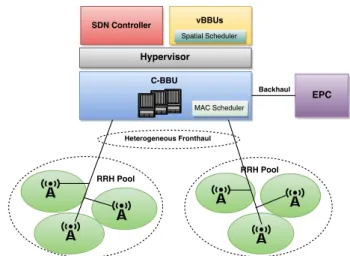
Fig. 1: C-RAN system architecture including SDN control and NFV.
the SC area in different sectors. This is indeed particularly important for cell edge users. We formulate a joint scheduling problem which takes care of radio resource management. The joint scheduling is the combination of two schedulers which operates at different time granularity. On a longer time scale the spatial scheduler decides how to divide the SC area, whilst on a finer time scale the MAC scheduler decides the MCS to use. The way we devise the joint scheduling problem provides several advantages over other approaches available in the literature. Indeed, dynamically dividing the SC area in different sectors we manage to schedule pack-ets in different orthogonal sub-bands using DSFFR, which better adapts to users’ concentration and traffic loads. We model the coverage area using stochastic geometry and the joint scheduling problem in terms of Multi-Choice Knapsack (MCKP) and Generalized Assignment Problem (GAP). They are two known NP-hard problems which can be solved using efficient approximation algorithms.
III. SYSTEMARCHITECTURE ANDASSUMPTIONS The system architecture in which we apply the proposed solution to the joint scheduling problem is shown in Fig. 1. The architecture is essentially that of C-RAN, in line with the software-defined RAN architecture in [5]. A Cloud BBU (C-BBU) is made of a central pool of resources in a data center and is physically connected to several RRHs. The crucial issue for this architecture is to provide high capacity and low latency fronthaul and backhaul connections (e.g. to support CPRI) to ensure that control decisions are timely delivered to the RAN. For the fronthaul microwave E-band, millimeter wave or optical fiber serve the purpose. The hypervisor virtualizes the C-BBU providing the environment for the virtualization of the underlying network resources. The C-BBU functionalities are virtualized in the central pool of resources as virtual BBUs (vBBUs). The SDN controller manages the network to forward packets from/to the UEs. vBBUs enable efficient radio resource allocation, interference and mobility management at
the global network level. The spatial scheduler operates as a virtual network function (VNF) which is part of vBBU functions. We remark that the depicted architecture shows the logical connection between the proposed spatial scheduler and the radio elements, and therefore it is a simplified version of the architecture shown in [5].
The goal of our work is to solve the joint scheduling prob-lem of downlink packets destined to different UEs in a SC area and queued in the C-BBU using the spatial scheduler and the MAC scheduler, which operate at different time granularity as mentioned. In our work, the Signal-to-Interference-plus-Noise-Ratio (SINR) threshold βFR, the beamwidth and number of
antennas can be selected by the spatial scheduler on a time scale of every 10 ms (i.e. LTE radio frame - RF), whereas the MCS is decided by the MAC scheduler for each packet every 1 ms (i.e. Transmission Time Interval - TTI). Consequently, we assume that the number of sub-bands to use for DSFFR is decided each RF although this time scale of operation could be even relaxed.
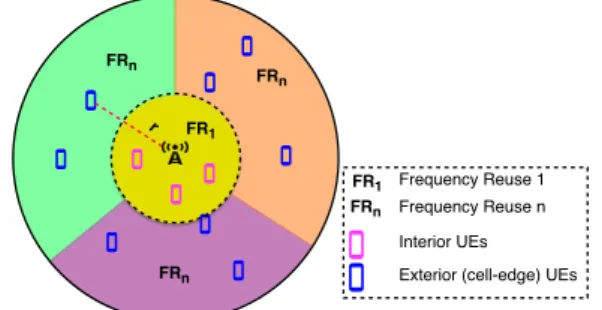
After the spatial scheduler VNF has been created (this is not showed in the simplified system architecture) and it is executed in the C-BBU, different antenna elements can be pooled to-gether and antenna beamwidth selected. The spatial scheduler is meant to relieve ICI applying DSFFR, dynamically dividing the cell area in different sectors or scheduling areas. In each scheduling area packets are transmitted with the best MCS depending on the instantaneous SINR value. At first, the cell is divided in interior and exterior areas dynamically tweaking a suitably defined SINR threshold. Depending on the number of antennas and beamwidth selected, the cell is further divided in sectors. The interior area is FR1 and the other sectors are
denoted by FRn, withn= 1÷Nindexing also the distinct sub-bands. In the remainder, we assume that an RRH is equipped with multiple antennas which are used to transmit packets in the different sectors.
Other general assumptions include that SC locations are modeled with a homogeneous Poisson Point Process (PPP) of intensityλ. Based on the PPP assumption, we compute the probability of coverage using the tool of stochastic geometry in an interference-limited network under the hypothesis of distant dependent path-loss and Rayleigh distributed fading. The coverage probability is computed in closed form assuming that ambient noise can be neglected. For each packet to transmit we randomly assign a SINR selected from six non-overlapping intervals of SINR values corresponding to six different MCSs. A packet is assumed successfully received if the instantaneous SINR exceeds the threshold for detection β. After applying DSFFR we assume the ICI problem solved and that the reception of a packet is affected only by distance dependent path-loss and Rayleigh distributed fading. The performance indicators we compute are the spectral efficiency of the system with DSFFR in place and packet blocking probability.
IV. SYSTEMANALYSIS
Similar to [6], we solve the problem of joint scheduling of downlink packets in a SC area. Considering the system
Fig. 2: Distribution of UEs within the selected small cell.
architecture in Fig. 1, we assume that radio resource manage-ment decisions are taken by the spatial scheduler residing in virtual BBUs and distributed to each RRH through the high performing fronthaul. In this study, we focus on a reference small cell area which is divided in different sectors applying DSFFR to relieve the ICI problem.
As in strict FFR, the cell is divided in interior (i.e FR1) and
exterior (i.e FRn) areas. As mentioned already, we propose to partition dynamically the cell area in a different number of sectors selecting a different number of antenna elements and beamwidth θ. We further dynamically adjust the SINR threshold to decide the size of the FR1 zone. In this way,
we can adjust the proportion of exterior and interior UEs to be served. Using strict FFR, the system bandwidth W is partitioned into N + 1 sub-bands of different size. The first step is to compute the probability of coverage, which is an input to our joint scheduling problem.
A. Probability of Coverage
In this section, we show how to obtain the probability of coverage (pc) in cellular networks for the downlink. The
coverage probability is computed based on the SINR assuming that a reference UE makes the attempt to connect to the RRH which transmits the strongest signal (see Fig. 2). In general, UEs may belong to the inner area (FR1 sub-band), whilst
exterior UEs to one of the other sectors (nth sub-band). It is then the responsibility of the spatial scheduler to assign the UE for instance to a less loaded sector served by another antenna.
We define the SINR as γ := Ptgr−α/ Pσ + P
mPtmgmr−mα
, wherer denotes the random variable (r.v.) of the distance between the randomly selected UE (i.e. ref-erence handheld) and the nearest radio head. Parameter α
is the path-loss exponent, Pt is the transmit power of a
RRH, g is the power fading coefficient andrmis the random distance between the mth interfering SC downlink signal and the reference UE. Furthermore, gm and Ptm are the fading coefficient and transmit power of the mth interferer, respectively. Pσ is the ambient noise power. We can now specify pc as the probability to receive a radio signal above a
certain thresholdβ as follows
pc λ, β, α
Relying on [10] [11], we introduce the threshold βFR
to distinguish between packets addressed to UEs in FR1
or FRn areas. This can be done defining the probability
pFFR := P(ˆγ > β|γ < βFR), where γˆ is the SINR of a
packet transmitted in one of the N sub-bands after applying FFR. At first, we compute the coverage probability of an exterior UE sincepFFR determines the size of the scheduling
areas in which MC-GAP is applied. The probability pFFR
was developed for the reference UE in [10] in terms of the probabilitypc, which can be written for an interference limited
environment in which noise is neglected (Pσ ≈0) as follows
pc(β, λ, α, N) = 1 1 +N−1ρ(β, α) , (2) withρis expressed as ρ(β, α) =β2/α Z ∞ β−2/α 1 1 +xα/2dx . (3)
The above integral was solved in closed form forα >2using mathematica ρ(β, α) =β−2/α2πcsc( 2π α) α −2F1 1, 2 α, 2 +α α ,−β −1 , (4) with2F1 the hypergeometric function. ThenpFFR is given by
pFFR= pc(β, λ, α, N) 1−pc(βFR, λ, α,1) − (5) 1 (1−pc(βFR, λ, α,1))(1 + 2ζ(β, βFR, α, N)) , whereζ(β, βFR, α, N)= Z ∞ 1 h 1− 1 1 +βFRx−α 1− 1 N(1− 1 1 +βx−α) i xdx . (6) Unlike [10], wherepFFR was explicitly provided only for
the case α = 4, in this paper equation (6) was evaluated in mathematica for any value ofα >2andβ→βFR as follows
ζ(βFR, α, N) = (7) βFR 2α(1 +βFR) " −βFR 2−2α+ (α−2)(1 +βFR) α−1 × 2F1(1,2−2/α,3−2/α,−βFR) + 2(1 + 1 N)× −2 +α+ 2(1 +βFR)2F1(1,αα−2,2−2α,−βFR) α−2 #
In an OFDMA system with bandwidthW andNbRBs, the
fraction of RBs allocated to the exterior area is written as
Next= (1−pFFR(βFR))×Nb. (8)
Depending on the selection of the number of antenna elements and beamwidth θ we shall assign N = 2π/θ. In this way the amount of RBs in each cell sector for exterior UEs can be computed as bNext/Nc, where b·c is the highest integer
number smaller thanbNext/Nc. The remaining RBs are then
allocated to the interior UEs.
B. MC-GAP Algorithm
MC-GAP is the combination of the two NP-hard problems MCKP and GAP. MCKP tries to find the best MCS for each packet transmitted in a single scheduling area based on the corresponding SINR value. We assume the SINR lays within the interval ranging from a minimum to a maximum value, divided in six equally spaced sub-intervals. To each SINR value it corresponds a specific Channel Quality Indicator (CQI) and MCS. GAP tries to schedule packets considering that the cell is first divided in interior and exterior areas using
pFFR and then further partitioned depending on the number
of antennas and beamwidth θ.
Algorithm 1 Proposed Joint Scheduling Algorithm 1: procedure J ointScheduling
2: foreach Npktnumber of packets do
3: foreach sector angleθi do 4: Ni = 2θπi
5: foreach SINR thresholdβFRj do 6: Compute pFFR(βFRj) 7: Next = f loor(1−pFFR(βFRj))Nb 8: Nint =Nb -Next 9: Bij(int) = Nint 10: Bij(ext) =Next/Ni 11: Bij =B (int) ij S Bij(ext) 12: <pij,wij>=Generatep,w(Npkt, χ) 13: PM axij = 0 14: PM axij temp(Npkt, χ) = MC−GAP(Bij, Ni+ 1,pij,wij) 15: if PM axij < PM axij temp(Npkt, χ)then 16: PM axij = PM axij temp(Npkt, χ) 17: end if 18: end for 19: end for 20: end for
21: Save the optimal parameter configurations 22: end procedure
C. Joint scheduling algorithm
Algorithm 1 illustrates the joint scheduling problem, in whichχ denotes the packet size in bits, Npkt the number of
downlink packets to transmit, while pandware respectively the vectors of profits and weights for theNpktpackets. Lines
1-11 stands for the spatial scheduler VNF executed every radio frame (see Fig. 1). The remaining lines stands for the MAC scheduler executed every TTI relying on solving the MC-GAP. Spatial Scheduler: - It implements the DSFFR we propose and determines theNi+ 1 sub-bands to use, which we index withni= 1÷Ni for eachθi. For each SINR thresholdβFRj, this scheduler performs computation of pFFR(βFRj), as well
as the number of RBs to allocate in each sub-bandBij. MAC Scheduler: -It is responsible for executing the MC-GAP algorithm such that the normalized spectral efficiency of the network is maximized (PM axij (Npkt, χ) in Algorithm
1). To each packet k = 1÷Npkt waiting for transmission,
the MC-GAP assigns a certain weight (wk
ij) depending on the packet size (i.e. the number of RBs needed to transmit that packet) and profit (pk
ij), as shown in the equations below.
wkij= χ 2×7×12×b×Rc (9a) pkij = b×Rc×(1−PEP)×df b[64QAM,3/4]×R[64QAM,3/4] c , (9b)
whereb andRc are the number of bits/symbol and the code
rate in the MCS selected to transmit the packet, respectively.
b[64QAM,3/4] and R[64QAM,3/4]
c represent the number of bits
and coding rate for the best possible MCS selection anddf is
the fraction of packet payload excluding overhead. V. RESULTS
We evaluated the performance of the joint scheduling prob-lem for downlink packets whereby numerical simulations. The general setup for simulations is based on the system model explained in Section III and the analysis carried out in Section IV. We run simulations for an increasing number of packets waiting for transmission in downlink, thus increasing the network traffic load. For each value of the number of packets, the joint scheduling problem is solved using approximation algorithms of MCKP and GAP as in [6]. Packets are generated at the beginning of each radio frame and the transmission is scheduled every TTI. As showed in eq. (9b), the profit is com-puted taking into account the effect of coding and overhead in the packet, as well as the transmission over the radio channel in terms of packet error probability (PEP). Packet overheaddf
is assumed fixed, whereas the effect of coding is taken into account by the code rateRc, which changes depending on the
MCS selected along with the number of bits b. The test for accepting/rejecting a packet at the receiving UE is based on comparing the PEP, a value randomly generated between zero and one, with a threshold value. Hence, we compute the packet success probability (ps) assuming distant dependent path-loss
and Rayleigh fading and that after applying DSFFR the ICI is completely solved, as follows
ps=P SNR> β) = exp −
β Pt
rα
, (10)
where SNR is the signal-to-noise-ratio. Hence, a packet is rejected if the PEP is greater than 1 − ps and accepted
otherwise.
A. Performance indicators
We provide definition of the performance indicators we have selected to evaluate the joint scheduler where a number of simulations were conducted to have a statistical avarage. Normalized Spectral Efficiency: it was provided already in Section IV-C by eq. (9b) as the number of useful bits which can be achieved with respect to the best possible MCS, including code rate, overhead and loss of packets transmitted over the radio channel.
Packet Blocking Probability: The ratio between the number of dropped (Nd) and the number of transmitted (Nt) packets.
TABLE I: System parameter setting
Parameter Value System Bandwidth W= 20MHz
Packet Size (χ) 32,128,and256Bytes Transmit Power (Pt) 46dBm α 2.1and4 λ 0.15 β [-10 5] dB forα= 2.1 [-5 10] dB forα= 4 θ [9001200] MCS [QPSK,1/2],[QPSK,3/4],[16QAM,1/2]
[64QAM,1/2],[64QAM,2/3],[64QAM,3/4]
Number of Generated Packets
0 50 100 150 200 250 300 350 Blocking Probability 0 0.1 0.2 0.3 0.4 0.5 0.6 0.7 0.8 0.9 1 DSFFR-32 Bytes DSFFR-128 Bytes DSFFR-256 Bytes Static-32 Bytes Static-128 Bytes Static-256 Bytes
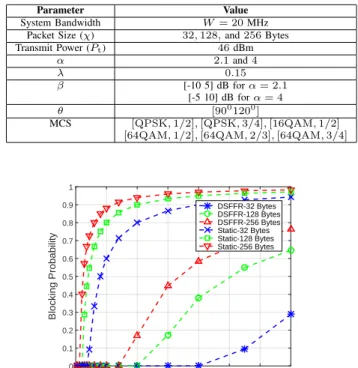
Fig. 3: Blocking probability comparison between DSFFR and static case for α= 2.1.
B. Numerical Results
Numerical simulations were carried out in MATLAB with numerical parameters shown in Table I. We assumed a system bandwidth ofW = 20MHz and results are provided for values of the packet size equal to 32, 128 and 256 bytes. Every TTI a different number of packets is scheduled for transmission and for each packet profit and weight are computed based on the CQI value. The CQI depends on the SINR, which is a value randomly generated that can fall within any of the six sub-intervals dividing the whole SINR range. Every TTI the MC-GAP algorithm is executed to find the most suitable MCS for transmitting packets in the different Ni+ 1 sub-bands.
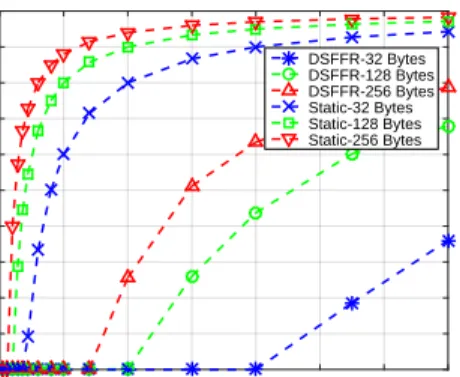
Fig. 3 and Fig. 4 show the blocking probability versus the number of packets generated every RF compared with the same joint scheduling problem in which static strict FFR scheme is used. The first figure is for path-loss exponent
α= 2.1and the second forα= 4. In both cases, DSFFR pro-vides significantly lower blocking. We notice that increasing the packet size the blocking probability increases and since the test for accepting packets is based on the SNR, the blocking probability for α= 2.1 is slightly better than forα= 4.
Fig. 5 and Fig. 6 show the normalized spectral efficiency versus the number of packets generated every RF forα= 2.1
andα= 4, respectively. Both results highlight that our method outperforms the static scheme. The results show also that our solution not only provide higher spectral efficiency but that the system is more stable when the traffic in the network is increased. As for the results presented in Fig. 3 and Fig. 4,
Number of Generated Packets 0 50 100 150 200 250 300 350 Blocking Probability 0 0.1 0.2 0.3 0.4 0.5 0.6 0.7 0.8 0.9 1 DSFFR-32 Bytes DSFFR-128 Bytes DSFFR-256 Bytes Static-32 Bytes Static-128 Bytes Static-256 Bytes
Fig. 4: Blocking probability comparison between DSFFR and static case forα= 4.
Number of Generated Packets
0 50 100 150 200 250 300 350
Normalized Spectral Efficency
0 0.1 0.2 0.3 0.4 0.5 0.6 0.7 0.8 DSFFR-32 Bytes DSFFR-128 Bytes DSFFR-256 Bytes Static-32 Bytes Static-128 Bytes Static-256 Bytes
Fig. 5: Normalized spectral efficiency of DSFFR compared with the static case for α= 2.1.
Number of Generated Packets
0 50 100 150 200 250 300 350
Normalized Spectral Efficency
0 0.1 0.2 0.3 0.4 0.5 0.6 0.7 0.8 DSFFR-32 Bytes DSFFR-128 Bytes DSFFR-256 Bytes Static-32 Bytes Static-128 Bytes Static-256 Bytes
Fig. 6: Normalized spectral efficiency of DSFFR compared with the static case for α= 4.
increasing the packet size the spectral efficiency decreases. This can be explained considering that the MC-GAP blocks more packets in each TTI due to insufficient resources.
VI. CONCLUSIONS
In this paper we proposed DSFFR, a novel technique to mitigate ICI in small cell networks. We assumed that small cells are deployed in terms of remote radio heads controlled by a central pool of resources. Therefore, we formulated a joint scheduling problem in which two schedulers operate on different time scales. In particular, we proposed to use a spatial
scheduler implementing DSFFR which possibly changes the number of antennas and the antenna beamwidth to partition the cell area in different sectors every LTE radio frame. The joint scheduling was formulated as a Knapscak problem and solved using approximation algorithms. Furthermore, we tack-led the problem of modeling cell coverage whereby stochastic geometry. Numerical results have shown that our approach outperforms static FFR for the same network conditions. Fu-ture development of this work will concentrate on improving the performance of the MC-GAP algorithm since it only guarantees the worst case performance.
ACKNOWLEDGMENT
This work was supported by the European Union through the XHAUL project (H2020-ICT-2014/671598).
REFERENCES
[1] NTT DOCOMO, INC, “5G Radio Access: Requirements, Concept and Technologies,” NTT, DOCOMO, White Paper, July 2014.
[2] Qian (Clara) Li, Huaning Niu, Apostolos (Tolis) Papathanassiou, and Geng Wu, “5G Network Capacity Key Elements and Technologies,”
IEEE Vehicular Technology Magazine, pp. 71–78, Jan. 31 2014. [3] Jeffrey G. Andrews, Stefano Buzzi, Wan Choi, Stephen V. Hanly, Angel
Lozano, Anthony C. K. Soong, and Jianzhong Charlie Zhang, “What Will 5G Be?” IEEE Journal on Selected Areas in Communications, vol. 32, no. 6, pp. 1065–1082, June 2014.
[4] Naga Bhushan, Junyi Li, Durga Malladi, Rob Gilmore, Dean Brenner, Aleksandar Damnjanovic, Ravi Teja, Sukhavasi, Chirag Patel, and Stefan Geirhofer, “Network Densification: The Dominant Theme for Wireless Evolution into 5G,”IEEE Communications Magazine, vol. 52, no. 2, pp. 82–89, Feb. 2014.
[5] (2015, Oct. 12) The Benefits of Cloud-RAN Architecture in Mobile Network Expansion. [Online]. Available: http://www.fujitsu.com/downloads/TEL/fnc/whitepapers/CloudRANwp.pdf [6] Reuven Cohen, and Guy Grebla, “Joint Scheduling and Fast Cell
Selection in OFDMA Wireless Networks,” Networking, IEEE/ACM Transactions, vol. 23, no. 1, pp. 114–125, Feb. 2015.
[7] Thomas Novlan; Jeffrey G. Andrews; Illsoo Sohn; Radha K. Ganti; and Arunabha Ghosh, “Comparison of Fractional Frequency Reuse Approaches in the OFDMA Cellular Downlink,”IEEE Global Telecom-munications Conference(GLOBECOM), Miami, FL, pp. 1–5, 2010. [8] Ronald Y. Chang; Zhifeng Tao; Jinyun Zhang; and C.-C. Jay Kuo,
“A Graph Approach to Dynamic Fractional Frequency Reuse (FFR) in Multi-Cell OFDMA Networks,”IEEE International Conference on Communications, Dresden, Germany, pp. 1–6, June 14-18 2009. [9] Nazmus Saquib, Ekram Hossain, and Dong in Kim, “Fractional
Fre-quency Reuse for Interference Management in LTE-Advanced HetNets,”
IEEE Wireless Communications, vol. 20, no. 2, pp. 113–122, Apr. 25 2013.
[10] Thomas D. Novlan, Radha K. Ganti, Arunabha Ghosh, and Jeffrey G. Andrews, “Analytical Evaluation of Fractional Frequency Reuse for OFDMA Cellular Networks,”IEEE Transactions on Wireless Commu-nications, vol. 10, no. 12, pp. 4294–4305, Dec. 2011.
[11] Jeffrey G. Andrews, Franc¸ois Baccelli, and Radha K. Ganti, “A Tractable Approach to Coverage and Rate in Cellular Networks,”IEEE Transac-tions on CommunicaTransac-tions, vol. 59, no. 11, pp. 3122–3134, Nov. 2011.