Bruno Miguel de Oliveira Sousa
Multihoming Aware Optimization Mechanism
Tese de Doutoramento em Engenharia Informática (pré Bolonha)orientada por Marilia Pascoal Curado e Konstantinos Pentikousis
Departamento de Engenharia Informática da Faculdade de Ciências e Tecnologia da Universidade de Coimbra Julho de 2013 101010101010101010101010101010101010101010 101010101010101010101010101010101010101010 101010101010101010101010101010101010101010 101010101010101010101010101010101010101010 101010101010101010101010101010101010101010 101010101010101010101010101010101010101010 101010101010101010101010101010101010101010 101010101010101010101010101010101010101010 101010101010101010101010101010101010101010 101010101010101010101010101010101010101010 101010101010101010101010101010101010101010 101010101010101010101010101010101010101010 101010101010101010101010101010101010101010 101010101010101010101010101010101010101010 101010101010101010101010101010101010101010 101010101010101010101010101010101010101010 101010101010101010101010101010101010101010 101010101010101010101010101010101010101010 101010101010101010101010101010101010101010 101010101010101010101010101010101010101010 101010101010101010101010101010101010101010 101010101010101010101010101010101010101010 101010101010101010101010101010101010101010 101010101010101010101010101010101010101010 101010101010101010101010101010101010101010 101010101010101010101010101010101010101010 101010101010101010101010101010101010101010 101010101010101010101010101010101010101010 101010101010101010101010101010101010101010 101010101010101010101010101010101010101010 101010101010101010101010101010101010101010 101010101010101010101010101010101010101010 101010101010101010101010101010101010101010 101010101010101010101010101010101010101010 101010101010101010101010101010101010101010 101010101010101010101010101010101010101010 101010101010101010101010101010101010101010 101010101010101010101010101010101010101010 101010101010101010101010101010101010101010 101010101010101010101010101010101010101010 101010101010101010101010101010101010101010 101010101010101010101010101010101010101010 101010101010101010101010101010101010101010 101010101010101010101010101010101010101010 101010101010101010101010101010101010101010 101010101010101010101010101010101010101010 101010101010101010101010101010101010101010 101010101010101010101010101010101010101010 101010101010101010101010101010101010101010 101010101010101010101010101010101010101010 101010101010101010101010101010101010101010 101010101010101010101010101010101010101010 101010101010101010101010101010101010101010 101010101010101010101010101010101010101010 101010101010101010101010101010101010101010 101010101010101010101010101010101010101010 101010101010101010101010101010101010101010 101010101010101010101010101010101010101010 101010101010101010101010101010101010101010 101010101010101010101010101010101010101010 101010101010101010101010101010101010101010 101010101010101010101010101010101010101010 101010101010101010101010101010101010101010 101010101010101010101010101010101010101010 101010101010101010101010101010101010101010 101010101010101010101010101010101010101010 101010101010101010101010101010101010101010 101010101010101010101010101010101010101010 101010101010101010101010101010101010101010 101010101010101010101010101010101010101010 101010101010101010101010101010101010101010 101010101010101010101010101010101010101010 101010101010101010101010101010101010101010 101010101010101010101010101010101010101010 101010101010101010101010101010101010101010 101010101010101010101010101010101010101010
Multihoming Aware Optimization
Mechanism
Mecanismo de Optimiza¸c˜ao
com Suporte de M ´ultiplos Caminhos
Bruno Miguel de Oliveira Sousa
Department of Informatics EngineeringFaculty of Sciences and Technology University of Coimbra
A thesis submitted for the degree of
Doctor of Philosophy
Multihoming Aware Optimization
Mechanism
Bruno Miguel de Oliveira Sousa
Department of Informatics EngineeringFaculty of Sciences and Technology University of Coimbra
Thesis submitted as partial fulfillment of the requirements of Doctor of Philosophy on Infor-matics Engineering (before Bologna) in the University of Coimbra, for the award of Doctor in the domain of Telematics Networking and Communications under the care of advisor Profes-sor Marilia Pascoal Curado and co-adviProfes-sor Dr. Konstantinos Pentikousis.
Grant from Fundac¸˜ao para a Ciˆencia e a Tecnologia (FCT) SFRH/BD/61256/2009.
To my mother Alzira and to my brother Pedro, whose sacrifice and love, have tailored the person I am today.
Acknowledgements
A thesis is a work of a high magnitude, requiring the best of us. Believing in every moment, probably is the first step to arrive here. To my supervisor, It’s unfair to acknowledge the support throughout the thesis within a few words, my sincere excuses for this. You made me believe that it was possible, that the best of me could reach it with success. The remarkable guidance lead me to work with the feeling that I was performing a ‘big and important mission’ - research. I was paving the way, to a better world tomorrow, with efficient multihoming mechanisms. Dear Marilia Curado, my eternal thanks.
To my co-supervisor, Konstantinos Pentikousis, for pushing me to high limits, to overcome my limitations with success. Thanks for your courage to demonstrate that, in some moments, I could have done better, perfection is, indeed, your Lemma. Thanks for sharing and teaching me that the perfection Lemma lead us to horizons never thought before.
Life gives us friends that share knowledge life moments, that some way grow up with us. Vitor Bernardo thanks for the fruitful discussions, and I must confess that I admire your courage and dedication when you read my article with almost twenty pages, with plenty of mathematical formulas. David thank you for sharing things you just learned in the moment and for the active comments. I do remember that I’ve shared with you some LATEX tips, but afterall you became the master.
Probably, there is always someone in every project that must do the hard work. Ricardo Santos you were this one, without afraid of the job. Without you I could not have tested MeTHODICAL in the cloud, in a real testbed. Alexandre thanks for programming on the implementation of mCoA++.
Love can inspire us to move mountains. To my wife, C´elia I express my deep grat-itude, for being there in the ‘optimized’ moments and for keeping my perseverance in high levels to overcome the moments when there was no light. To my two daughters, the oldest, Susana for asking me what was the thesis about, It made me believe in it with other perspective. To the youngest, Luana whose premise is enjoying life by playing, but smart enough to understand that thesis was very important to Daddy. To you, Luana, I ask my excuses for the time stolen by the thesis.
Abstract
T
HE always best connected paradigm has gain a lot of interest in the research and scientific community. The availability of different wireless technologies and the proliferation of devices supporting multiple connections are open-ing new possibilities for users to share information everywhere and everytime. The multihoming support is being enriched to levels never before established. Indeed, users can configure devices to meet their own requirements, decrease communication costs by choosing links with no expenses associated, or opting for links that provide extended coverage. Such kind of configuration is often limited to static policies that aim the maximization of a single requirement, such as monetary cost or coverage. This approach is not efficient. For instance, if the optimization aims to decrease cost, extend coverage and increase security support simultaneously, static policies do not scale and have narrow support for multihoming goals, namely resilience, ubiquity and load sharing.Multihoming is an important aspect in computer networks. To enable higher lev-els of availability or optimize recovery processes in the presence of failures are goals that mechanisms improving resilience aim to support. Other goals, in a ubiquity as-pect, can include networks providing extended coverage but with minimized costs. To successfully achieve such goals and others, multihoming must be considered from the early phases of Internet architectures development. The choice of protocols and technologies with the best multihoming support is an important step to conceive net-work architectures that are multihoming efficient. With this concern in mind, this the-sis introduces the specification of resilience and ubiquity frameworks that assess the support of resilience and ubiquity goals in protocols. These evaluation frameworks provide a taxonomy that fully characterize multihoming goals.
Efficient multihoming support requires the optimization of multiple criteria com-prising diverse goals. This NP-hard problem considers benefits criteria providing profit and costs criteria introducing some kind of overhead. Techniques like Mul-tiple Attribute Decision Mechanism (MADM) provide ideal solutions for such kind of optimization problems, as they are not tied to a specific number of criteria. Even though, previously defined MADM techniques include criteria preferences, they do
ing with these issues in mind, this work introduces MeTHODICAL, an optimization technique that provides a complete solution for optimization within the multihoming context.
By introducing a complete optimization technique that determines optimal paths according to multihoming support, in this thesis, paths providing a better benefit/-cost ratio are selected. The introduced optimization technique includes a weighting algorithm that allows users to specify criteria preferences objectively and coherently. Moreover, MeTHODICAL addresses theNP-hard problem by specifying a technique that includes a decision stability factor to avoid side-effects and can be deployed in any scenario irrespective of the number of possible connections. The optimization tech-nique organizes hierarchically the different multihoming criteria according to their type (e.g. benefits or costs) and for each communication path. Standard measurement mechanisms are applied to determine values of the diverse multihoming criteria, as specified in the proposed resilience and ubiquity evaluation frameworks. As values of diverse criteria are collected, they are normalized and combined with the respective preferences. Ideal solutions are determined based on maximum benefits and mini-mum costs values. The distance of benefits and costs criteria of each path establishes how far a path is to the ideal solution. The path with lower benefits and costs distance is the one providing a better multihoming experience.
The performance of MeTHODICAL has been extensively analysed in different evaluation scenarios with multiple types of applications and employing diverse eval-uation metrics. Results demonstrate that MeTHODICAL improves multihoming sup-port, by choosing paths with the best benefit/cost ratio. The evaluation results also demonstrate an increase in path selection stability, and for VoIP applications, an in-crease in VoIP quality, outperforming related approaches. These results highlight that multihoming experience on end-devices can meet user expectations by employing Me-THODICAL, an efficient optimization mechanism with low computational complex-ity.
Resumo
O
paradigma de estar sempre ligado comec¸a a atingir n´ıveis nunca antes alcanc¸ados. A proliferac¸˜ao de m ´ultiplas tecnologias e de dispositivos com suporte para diversas ligac¸ ˜oes est´a a enriquecer o suporte demultihoming. Os utilizadores podem agora partilhar informac¸˜ao em qualquer lugar e em qualquer altura. Em certa medida, os utilizadores podem configurar os dispositivos para ir ao encontro das suas expetativas, para reduzir os custos de comunicac¸˜ao ao escol-her ligac¸ ˜oes sem custos associados ou optar por ligac¸ ˜oes com melhores coberturas. No entanto, este tipo de configurac¸˜ao asssenta em pol´ıticas est´aticas que tˆem por fim maximizar apenas um dos requisitos, por exemplo, o custo monet´ario ou a cobertura. Neste sentido, o suporte demultihoming associado aos objetivos de resiliˆencia, ubiq-uidade e partilha de carga, ´e bastante d´ebil.Quer a resiliˆencia quer a ubiquidade foram objeto de pesquisa nos ´ultimos anos. Contudo os diversos trabalhos apresentados at´e agora, apresentam falhas na definic¸˜ao de umaframeworkgen´erica que permita caraterizar de forma eficiente o suporte de re-siliˆencia e ubiquidade por parte de um protocolo. Tendo este aspeto em considerac¸˜ao, esta dissertac¸˜ao especifica frameworks para avaliar o suporte de resiliˆencia e ubiq-uidade de uma forma objetiva, em qualquer fase da concec¸˜ao de uma arquitetura com suporte paramultihominge com a vantagem de n˜ao requerer a intervenc¸˜ao de peritos. Um suporte eficiente demultihoming requer mecanismos de optimizac¸˜ao com su-porte para m ´ultiplos crit´erios. Este tipo de problema ´e considerado NP-hard - com-plexidade n˜ao polinomial e inclui benef´ıcios e custos como crit´erios. As t´ecnicas de optimizac¸˜ao, denominadas de Multiple Attribute Decision Mechanism (MADM) con-seguem identificar soluc¸ ˜oes ´otimas e tˆem a flexibilidade de incluir diversos crit´erios. Contudo a especificac¸˜ao de t´ecnicasMADMencontra-se incompleta visto que mecan-imos coerentes para a atribuic¸˜ao de pesos dos m ´ultiplos crit´erios n˜ao se encontram definidos, levando `a existˆencia de pesos inconsistentes e il ´ogicos. Tendo isto presente, MeTHODICAL ´e uma especificac¸˜ao completa, dado que engloba esta componente.
Com a introduc¸˜ao de uma t´ecnica completa para otimizac¸˜ao de diferentes camin-hos num cen´ario demultihoming, esta tese prop ˜oe uma soluc¸˜ao com a melhor relac¸˜ao custo/benef´ıcio. O MeTHODICAL inclui um algoritmo para definir os pesos de uma
ternativas/caminhos. Os m ´ultiplos crit´erios s˜ao organizados de uma forma hier´arquica e tendo em conta o tipo de crit´erio, ou seja, benef´ıcios ou custos. Mecanismos padr˜ao de medic¸˜ao s˜ao utilizados para medir os valores dos m ´ultiplos crit´erios. A distˆancia de cada alternativa/caminho `a soluc¸˜ao ideal permite definir o caminho que suporta
multihomingde uma forma mais eficiente.
Os resultados obtidos em diferentes cen´arios de avaliac¸˜ao, com diversos tipos de aplicac¸ ˜oes, demonstram uma melhoria no suporte demultihomingcom o MeTHODI-CAL quando comparado com t´ecnicas semelhantes. Os resultados evidenciam esta-bilidade na escolha dos caminhos e, para aplicac¸ ˜oesVoice over IP (VoIP), uma melhoria substancial da qualidade. Deve-se ainda referir que a complexidade associada aos mecanismos do MeTHODICAL ´e bastante reduzida, n˜ao ultrapassando a complexi-dade de mecanismos do estado da arte.
Foreword
T
HE work described in this thesis was conducted at the Laboratory ofCom-munication and Telematics (LCT) of the Centre for Informatics and Systems of the University of Coimbra (CISUC) within the context of the following projects:
Project CoFiMOM – Project Combating Fire with Multihoming and Mobility (CoFIMOM), PTDC/EIA-EIA/116173/2009. The candidate has been the re-sponsible for the project proposal concept definitions and for architecture def-inition and implementation.
Project TRONE – Project Trustworthy and Resilient Operations in a Network Environment (TRONE), CMU-PT /RNQ/0015/2009. The candidate was re-sponsible for the multihoming aspects in the TRONE architecture. Moreover, the candidate also managed the team performing the design and implemen-tation of advanced reconfiguration Stream Control Transport Protocol (SCTP) algorithms.
The performed work resulted in the following publications:
ä Bruno Sousa, Kostas Pentikousis, Marilia Curado, “EVA: Enhancing VoIP Ap-plications”, in proceedings of the 11th IEEE Global Communications Confer-ence Exhibition & Industry Forum (GLOBECOM), December, 2013, Atlanta, USA.
ä Bruno Sousa, Kostas Pentikousis, Marilia Curado, “Enhancing Path Selection in Multihomed Nodes”, in proceedings of the 5th International Conference on Mobile Networks and Management (MONAMI), September, Cork, Ireland, 2013.
ä Bruno Sousa, Ricardo Santos, Marilia Curado, Soila Pertet, Rajeev Gandhi, Carlos Silva, Kostas Pentikousis, “Expedient Reconfiguration in the Cloud”, in proceedings of the 18th IEEE International Workshop on Computer-Aided
ä Bruno Sousa, Kostas Pentikousis, Marilia Curado, “Multihoming: A Com-prehensive Review”, Advances in Computers, Volume 90, First Edition, July, 2013 - Elsevier, Impact Factor 0.384 [Sousa et al., 2013].
ä Antonio Casimiro, Paulo Verisimo, Diego Kreutz, Filipe Araujo, Raul Barbosa, Samuel Neves, Bruno Sousa, Marilia Curado, Carlos Silva, Rajeev Gandhi, Priya Narasimhan, “TRONE: Trustworthy and Resilient Operations in a Net-work Environment”, in the proceedings of IEEE/IFIP 42nd International Con-ference on Dependable Systems and Networks Workshops (DSN-W), 25-28 June 2012, Boston [Casimiro et al., 2012].
ä Bruno Sousa, Kostas Pentikousis, Marilia Curado,“MeTHODICAL: Multi-homing for Urban Networks”, poster of SAIL summer school, Spain, 2012.
ä Bruno Sousa, Kostas Pentikousis, Marilia Curado, “Multihoming Manage-ment for Future Networks”, Mobile Networks and Applications, MONET, August, 2011 - Springer, Volume 16, Impact Factor 1.109 [Sousa et al., 2011a].
ä Bruno Sousa, Kostas Pentikousis, Marilia Curado, “A Multiple Care of Ad-dresses Model”, in proceedings of the 16th IEEE Symposium on Comput-ers and Communications, ISCC’11, June 28 2011-July 1 2011, Kerkyra, Greece, 2011 [Sousa et al., 2011d].
ä Bruno Sousa, Kostas Pentikousis, Marilia Curado, “A Study of Multimedia Application Performance over Multiple Care-of Addresses in Mobile IPv6”, in proceedings of the 16th IEEE Symposium on Computers and Communica-tions, MediaWin’11, June 28 2011-July 1 2011, Kerkyra, Greece, 2011 [Sousa et al., 2011c].
ä Bruno Sousa, Kostas Pentikousis, Marilia Curado, “Ubiquity Evaluation Fra-mework (UEF)”, in proceedings of the 9th IFIP TC 6 international conference on Wired/Wireless Internet Communications, WWIC’11, Catalonia, Spain, on June 15-17, 2011 [Sousa et al., 2011b].
ä Bruno Sousa, Kostas Pentikousis, Marilia Curado, “Resilience Evaluation Fra-mework (REF)”, in proceedings of the 4th IEEE Ultra Modern Telecommuni-cations and Control Systems and Workshops (ICUMT), October 2010, Moscow, Russia, [Sousa et al., 2010].
The candidate has also released to the scientific community software implementa-tions:
ä mCoA++, a protocol implementing multihoming features, in the OMNeT++, namely Multiple Care of Address (MCoA), which is publicly available to the community [Sousa, 2013a].
ä MADM Evaluation Methodology, a implementation of MADM evaluation framework [Sousa, 2013b] in the R-project [Team, 2010].
In addition, the following papers are under review:
ä Bruno Sousa, Kostas Pentikousis, Marilia Curado, “MeTHODICAL: Towards the Next Generation of Multihomed Applications”, Computer Networks, 2013.
ä Bruno Sousa, Kostas Pentikousis, Marilia Curado, “Evaluation of Ubiquity Support in Mobile Computing Systems”, in Springer Handbook “Resource Management in Mobile Computing Environments”, 2013.
Contents
Contents xiii
List of Figures xvii
List of Tables xxi
List of Algorithms xxiii
List of Theorems xxv
List of Definitions xxv
Acronyms xxvii
1 Introduction 1
1.1 Motivation and Problem Statement . . . 1
1.2 Objectives and Contributions . . . 5
1.3 Thesis Outline . . . 8
2 Multihoming in IP Networks 9 2.1 Multihoming Types and Concepts . . . 10
2.1.1 Concepts . . . 10
2.1.2 End-host Multihoming . . . 11
2.1.3 End-site Multihoming . . . 12
2.1.4 Hybrid Multihoming . . . 13
2.2 Designing for Multihoming . . . 14
2.2.1 Goals . . . 14
2.2.2 Open Issues . . . 15
2.3 Operating Systems and Applications . . . 18
2.3.1 Protocols at Application layer . . . 18
2.3.2 Operating Systems and Server Applications . . . 20
2.4 Multihoming and Transport Protocols . . . 21
2.4.1 Non-Standard TCP-based Proposals . . . 21
2.4.2 PRISM . . . 23
2.4.3 MultiPath TCP . . . 24
2.4.4 Stream Control Transport Protocol and Extensions . . . 25
2.4.5 Datagram Congestion Control Protocol . . . 26
2.5 Multihoming and Mobility Management . . . 28
2.5.1 Mobile IPv6 . . . 28
2.5.2 Proxy Mobile IPv6 . . . 29
2.5.3 Multiple Care of Addresses and Flow Bindings . . . 29
2.5.4 Network Mobility . . . 30
2.6 End-host Multihoming . . . 32
2.6.1 Site Multihoming by IPv6 Intermediation . . . 32
2.6.2 Host Identify Protocol and Extensions . . . 33
2.6.3 End-Host Non-Standard Proposals . . . 34
2.7 End-site Multihoming . . . 36
2.7.1 Address Rewriting Approaches . . . 37
2.7.2 Hierarchical Approaches . . . 40
2.7.3 Map and Encapsulation Approaches . . . 43
2.8 Hybrid Multihoming . . . 47
2.8.1 Content-Centric and Service-Centric Approaches . . . 47
2.8.2 Address Rewriting Approaches . . . 50
2.8.3 Hierarchical Approaches . . . 51
2.8.4 Map and Encapsulation . . . 56
2.8.5 New and Routing-Centric Architectures . . . 61
2.9 Summary . . . 64
3 Multihoming Evaluation Framework 67 3.1 Introduction . . . 67
3.1.1 Objectives and Requirements . . . 68
3.1.2 Definitions . . . 68
3.1.3 State of the Art . . . 69
CONTENTS
3.2 Resilience Evaluation Framework . . . 73
3.2.1 Objectives & General aspects . . . 73
3.2.2 Availability . . . 74
3.2.3 Recovery . . . 77
3.2.4 Evaluation . . . 83
3.3 Ubiquity Evaluation Framework . . . 87
3.3.1 Objectives & General aspects . . . 87
3.3.2 UbiquityUM H . . . 88
3.3.3 UEF Use Case: Ubiquity in MIPv6 and HIP . . . 94
3.3.4 Evaluation . . . 99
3.3.5 Evaluation Scenario . . . 100
3.4 Summary . . . 104
4 Multihoming Aware Optimization Mechanism 107 4.1 Introduction . . . 108
4.1.1 Objectives and Requirements . . . 108
4.1.2 State of the Art . . . 109
4.1.3 Open Issues . . . 119
4.2 Taxonomy and Assumptions . . . 119
4.3 Weighting Criteria Algorithm . . . 120
4.3.1 Hierarchical Structure of Benefits and Costs . . . 120
4.3.2 Building the Judgment Matrix . . . 122
4.3.3 Weights Determination . . . 124
4.3.4 Weights Consistency . . . 125
4.3.5 Criteria Weights for Classes of Service . . . 126
4.4 Path Optimization Algorithm . . . 130
4.4.1 Measurements . . . 130
4.4.2 Network Modelling . . . 131
4.4.3 Path Optimization Algorithm . . . 132
4.4.4 Path Selection . . . 136
4.5 MADM Accuracy Evaluation Framework . . . 137
4.6 Evaluation Methodology . . . 142
4.6.1 MADM Accuracy . . . 142
4.6.2 Analytical . . . 145
4.6.3 VoIP Quality . . . 148
4.7 Results and Discussion . . . 152
4.7.1 MADM Accuracy evaluation . . . 152
4.7.2 Analytical . . . 157
4.7.3 VoIP quality . . . 165
4.7.4 Evaluation in Cloud testbed . . . 168
4.8 Summary . . . 174
5 Improving Multihoming 177 5.1 Introduction . . . 177
5.1.1 Objectives and Requirements . . . 178
5.1.2 Mobile IPv6 and Multiple Care of Address . . . 178
5.1.3 State of the Art . . . 180
5.2 mCoA++: Multiple Care of Address and Flow Bindings Model . . . 181
5.2.1 Design Considerations . . . 181
5.2.2 Classes and Nodes . . . 182
5.2.3 Headers and Mobility Options . . . 185
5.2.4 Notifications . . . 185
5.2.5 MCoA Application Support . . . 186
5.2.6 Configuration . . . 188 5.3 Evaluation Methodology . . . 189 5.3.1 mCoA++ Performance . . . 190 5.3.2 Application Performance . . . 191 5.4 Results . . . 194 5.4.1 mCoA++ Performance . . . 194 5.4.2 Applications Performance . . . 196 5.5 Summary . . . 198
6 Conclusion and Future Work 199 6.1 Summary of the Thesis . . . 199
6.2 Revisiting the Thesis Objectives . . . 200
6.3 Future Work . . . 202
References 205
List of Figures
2.1 Multihomed host . . . 11 2.2 Multihomed network . . . 12 2.3 Hybrid multihoming scenario . . . 14 2.4 PRISM architecture . . . 24 2.5 Address rewritingapproach . . . 37 2.6 Map and encapapproach . . . 43 2.7 MILSA . . . 53 2.8 LISP Mobile Node handover . . . 57 3.1 ITU-T E.800 availability model . . . 75 3.2 Availability with1:1and1+1protection models. . . 76 3.3 ITU-T M.495 enhanced recovery model. . . 77 3.4 Evaluation scenario implemented on OMNeT++ simulator. . . 84 3.5 SCTP availability measured by REF (Av) and QoR (QA). . . 85
3.6 SCTP recovery efficiency as measured by REF and QoR. . . 86 3.7 SCTP resilience as measured by REF and QoR. . . 86 3.8 MIPv6 mobility scenario. . . 96 3.9 HIP mobility scenario. . . 96 3.10 Evaluation scenario. . . 100 3.11 Ubiquity support in MIPv6 and HIP protocols . . . 101 3.12 Degree of Mobility support in MIPv6 and HIP protocols . . . 102 3.13 Handover cost of MIPv6 and HIP for different correspondent nodes . . . 103 3.14 Signalling cost of MIPv6 and HIP for different correspondent nodes . . . 103 4.1 Multiple Criteria Decision Making methods . . . 110 4.2 MeTHODICAL criteria weighting algorithm . . . 121 4.3 Benefits criteria tree . . . 121
4.4 Costs criteria tree . . . 121 4.5 MeTHODICAL path optimization algorithm . . . 131 4.6 MeTHODICAL network model. . . 132 4.7 Range of Relevant Benefits . . . 133 4.8 Range of Relevant Costs . . . 133 4.9 VoIP quality benefits tree. . . 148 4.10 VoIP quality costs tree. . . 148 4.11 Normality for analysed techniques in Dropbox scenario . . . 154 4.12 Normality for analysed techniques in Heterogeneous scenario . . . 156 4.13 CRR forDropbox-Bscenario with primary-backup model. . . 160 4.14 CRR forDropbox-Bscenario with concurrent model. . . 160 4.15 RHR and handover ratios forDropbox-Bwith primary-backup model. . . 161 4.16 RHR and handover ratios forDropbox-Bwith concurrent model. . . 161 4.17 Operator scenario CRR forprefMHweights . . . 162 4.18 Operator scenario CRR forprefTPweights . . . 163 4.19 Operator scenario RHR and handover ratios forprefMH . . . 164 4.20 Operator scenario RHR and handover ratios forprefTP . . . 164 4.21 MOS for Hybrid scenario with different buffer sizes (JB=1, 2, 4) . . . 165 4.22 MOS for Hybrid scenario with different Failure Probabilitiesfor JB=1 . . . 166 4.23 MOS for WirelessFail scenario with different Failure Probabilitiesfor JB=1 167 4.24 Mean transfer time in normal scenario . . . 169 4.25 Transfer over time in normal scenario for CD images . . . 169 4.26 Mean transfer time in Losses scenario . . . 170 4.27 Transfer over time in Loss0 scenario for CD images . . . 170 4.28 Mean transfer time in Delay scenario . . . 171 4.29 Transfer over time in Delay1 scenario for CD images . . . 171 4.30 Mean transfer time in congestion scenario . . . 172 4.31 Transfer over time in congestion scenario for CD images . . . 172 4.32 Mean transfer time in resources scenario . . . 173 4.33 Transfer over time in resources scenario for CD images . . . 173 4.34 Mean transfer time in critical and mixed scenario . . . 174 4.35 Transfer over time in mixed scenario for CD images . . . 174 5.1 Multiple Care of Address bindings illustration . . . 179 5.2 Simulation scenario for mCoA++ performance evaluation. . . 190 5.3 Simulation scenario for application performance evaluation . . . 193
LIST OF FIGURES
5.4 Handover time for Video and VoIP applications . . . 194 5.5 Total signalling cost for Video and VoIP applications . . . 195 5.6 One-way delay for Video and VoIP applications . . . 197
List of Tables
2.1 Multihoming support in application-layer protocols. . . 19 2.2 Multihoming support in non standard transport protocols. . . 23 2.3 Multihoming support in transport protocols. . . 27 2.4 Multihoming support in mobility management protocols. . . 31 2.5 End-host multihoming proposals. . . 35 2.6 End-Site multihoming proposals with address rewriting. . . 39 2.7 Hierarchical End-Site multihoming proposals. . . 42 2.8 End-Site multihoming proposals with map and encapsulation . . . 46 2.9 Hybrid multihoming proposals with content-centric approaches . . . 49 2.10 Hybrid multihoming proposals with address rewriting approaches. . . . 51 2.11 Hybrid multihoming proposals with hierarchical approaches. . . 56 2.12 Hybrid multihoming proposals with map and encapsulation approach. . 60 2.13 Hybrid multihoming proposals with new and routing-centric approach. 63 3.1 Resilience evaluation summary . . . 70 3.2 Ubiquity evaluation summary . . . 72 3.3 REF Considerations . . . 74 3.4 Configuration of SCTP failover parameters . . . 85 3.5 UEF Assumptions . . . 87 3.6 Technical capabilities of UbiComp systems in UEF . . . 89 3.7 Extensions of UbiComp systems in UEF . . . 90 3.8 Messages and procedures of mobility management . . . 95 4.1 Optimization techniques . . . 113 4.2 Multiple Attribute Decision Mechanisms (MADM) . . . 116 4.3 Used evaluation scale . . . 122 4.4 Classes of Service in ITU-T Y.1541 . . . 127
4.5 Weights of Benefits. . . 128 4.6 Weights of Costs . . . 129 4.7 Heuristics summary . . . 136 4.8 Decision matrix for 3 criteria with2kfactorial design . . . 137
4.9 Summary of performed evaluations . . . 141 4.10 Levels of each criterion for the different paths in Dropbox scenario . . . 143 4.11 Levels of each criterion for the different paths in Heterogeneous scenario 144 4.12 Weights of different experiments. . . 144 4.13 Configuration of failures sets . . . 151 4.14 Results of Dropbox . . . 153 4.15 Results of Heterogeneous scenario . . . 155 4.16 CRR ofDropbox-Ain 1:1 - primary and 1+1 - concurrent models . . . 157 4.17 RHR and Handover ratios ofDropbox-Ain 1:1 and 1+1 models . . . 158 4.18 Steadiness of quality for the different techniques. . . 165 4.19 Server usage ratio for CD and DVD images . . . 168 5.1 Classes in mCoA++ . . . 183 5.2 Data structures and methods inxMIPv6class . . . 184 5.3 mCoA++ notifications . . . 186 5.4 Applications MCoA-aware . . . 187 5.5 Values of configuration parameters per scenario. . . 189 5.6 Mean Opinion Score . . . 192 5.7 Applications Packet Loss (%) . . . 196 A.1 Ubiquity evaluation criteria summary . . . 246 A.1 Ubiquity evaluation criteria summary (continued). . . 247 A.1 Ubiquity evaluation criteria summary (continued). . . 248 A.1 Ubiquity evaluation criteria summary (continued). . . 249
List of Algorithms
4.1 MeTHODICAL criteria weighting . . . 125 4.2 MeTHODICAL path optimization . . . 134 4.3 MADM accuracy evaluation framework . . . 138 4.4 Theoretical Optimal path/Set . . . 145 4.5 Required handover . . . 146
List of Theorems
2.1 Definition (Multihoming) . . . 11 2.2 Definition (End-host multihoming) . . . 11 2.3 Definition (End-site multihoming) . . . 12 2.4 Definition (Hybrid multihoming) . . . 13 3.1 Definition (Resilience) . . . 68 3.2 Definition (Ubiquity) . . . 69 3.3 Definition (Path) . . . 69 4.1 Definition (Relevant Range) . . . 119
Acronyms
ABC Always Best Connected.
AHP Analytic Hierarchy Process.
AIS Aggregation with Increasing Scopes.
ALOC Core address space.
AMR Association Max Retrans.
API Application Programming Interface.
APT A Practical Transit Mapping Service.
AS Autonomous System.
BA Binding Acknowledgment.
BE Binding Error.
BGP Border Gateway Protocol.
BRR Binding Refresh Request.
BU Binding Update.
CCID Congestion Control IDentifier.
CCN Content-Centric Network.
CCoA Collocated Care of Address.
CN Correspondent Node.
CoT Care of Test.
CoTI Care of Test Init.
CR Consistency Ratio.
CRIO Core Router-Integrated Overlay.
CRR Correct Rankings Ratio.
DAD Duplicate Address Detection.
DCCP Datagram Congestion Control Protocol.
DHCP Dynamic Host Configuration Protocol.
DiA Distance to Ideal Alternative.
DNS Domain Name System.
DOA Delegation Oriented Approach.
DONA Data Oriented Network Architecture.
DRUID Dynamic Recursive Unified Internet Design.
ECI Ephemeral Correspondent Identifier.
ECMP Equal Cost Multipath.
eFIT Enabling Future Internet Transit.
EID Endpoint IDentifier.
ELOC Edge address space.
ESP Encapsulating Security Payload.
FARA Forwarding directive, Association, and Rendezvous Architecture.
FMIPv6 Fast Mobile IPv6.
Acronyms
FQDN Fully Qualified Domain Name.
FTP File Transfer Protocol.
GA Global Authority.
GLI-Split Global locator and Identifier Split.
HA Home Agent.
HAIR Hierarchical Architecture for Internet Routing.
HI HIP Initiator.
HIDRA Hierarchical Inter-Domain Routing Architecture.
HIP Host Identity Protocol.
hiPv4 Hierarchical IPv4.
HIT Host Identification Tag.
HMIPv6 Hierarchical Mobile IPv6.
HoT Home of Test.
HoTI Home of Test Init.
HR HIP Responder.
HRA Hierarchical Routing Architecture.
I3 Internet Indirection Infrastruture.
IANA Internet Assigned Numbers Authority.
ICMP Internet Control Message Protocol.
IDA Intra-domain Address.
IETF Internet Engineering Task Force.
ILNP Identifier Locator Network Protocol.
IPDV IP Delay Variation.
IPMIP IP network multi-pathing.
IPNL IP Next Layer.
IPsec IP Security.
IPvLX IP with Virtual Link Extension.
ISP Internet Service Provider.
IvIP Internet Vastly Improved Plumbing.
LIMA Less-Is-More Architecture.
LISP Locator Identifier Separation Protocol.
LNA Layered Naming Architecture.
Loc/ID Locator-Identifier.
MADM Multiple Attribute Decision Mechanism.
MDT Mean Down Time.
MEF Multihoming Evaluation Framework.
MeTHODICAL MulTiHOming-aware Decision-makIng meChanism for AppLi-cations.
MILSA Mobility and Multihoming support Identifier Locator Split Architec-ture.
MIP Mobile IP.
MIPv6 Mobile IPv6.
MN Mobile Node.
MPLS Multi Protocol Label Switching.
MPTCP Multipath Transport Control Protocol.
Acronyms
MUT Mean Up Time.
NA Neighbour Acknowlegment.
NAROS Name Address and Route System.
NAT Network Address Translation.
NBS Name Based Sockets.
NDN Name Data Networking.
NetInf Network Information.
NIIA Node ID Internetworking Architecture.
NIRA New Internet Routing Architecture.
NMMD Novel Method based on Mahalanobis Distance.
NNC Networking Named Content.
NRLS Name-to-Route Lookup Service.
NS Neighbour Solicitation.
NTP Network Time Protocol.
NUD Neighbour Unreachability Detection.
OS Operating System.
OWAMP One-way Active Measurement Protocol.
OWD One Way Delay.
PERM Practical End-host Multihoming.
PRISM Proxy-based Inverse Multiplexer.
QoR Quality of Resilience.
QoS Quality of Service.
RANGI Routing Architecture for the Next Generation Internet.
RD-QoS Resilience-Differentiated Quality of Service.
REAP Reachability Protocol.
REF Resilience Evaluation Framework.
RHR Required Handover Ratio.
RS Router Solicitation.
RTT Round Trip Time.
RVS RendezVous Server.
RZBS Realm-Zone Bridging Server.
SACKs Selective Acknowledgements.
SCTP Stream Control Transport Protocol.
SHIM6 Site Multihoming by IPv6 Intermediation.
SIA Switched Internet Architecture.
SILMS Scalable and Secure Identifier-to-Locator Mapping Service.
SILOS Architecture for Services Integration, controL, and Optimization for the Future Internet.
SIP Session Initiation Protocol.
SMR Solicit-Map-Request.
SNF Split Naming/Forwarding.
SST Structure Stream Transport.
TCP Transport Connection Protocol.
TFN Triangular Fuzzy Number.
TOPSIS Technique for Order Preference by Similarly to Ideal Solution.
Acronyms
TRIAD Translating Relaying Internet Architecture integrating Active Directo-ries.
TRRP Tunneling Route Reduction Protocol.
UCAN Ubiquitous Computing Application Development and Evaluation Pro-cess Model.
UEF Ubiquity Evaluation Framework.
UIA Unmanaged Internet Architecture.
UID Unique Identifier.
URI Universal Resource Identifier.
v6DH IPv6 Dual Homing.
ViAggre Virtual Aggregation.
XIA eXpressive Internet Architecture.
—Nothing in life is to be feared, it is only to be understood. Now is the time to understand more, so that we may fear less.
Marie Curie
1
Introduction
T
HIS thesis is focused on the multihoming research topic. Contributions onthis topic include the specification of a framework to assess multihoming support in protocols. Multihoming is also optimized with the specification of an optimization algorithm that enhances the way multiple available interfaces/-paths can be used. The research scope and the motivation of the thesis are further discussed together with the thesis objectives and respective contributions.
1.1
Motivation and Problem Statement
Multihoming is a term, often associated (and confused) with multiaccess, multiad-dressing, overlapping networks and multi-interface nodes terms [Bagnulo et al., 2006]. The availability of multiple interfaces and diverse addresses opens a window of op-portunities to increase resilience, improve coverage, reduce costs and optimize energy consumption. In short, multihoming aims to accomplish different goals [Espi et al., 2009]. First, resilience, as the diversity of multiple interfaces/paths can improve re-silience since upon the failure of one interface/path, another one can be employed to provide connectivity. Second, ubiquity, since multiple network interfaces, in particular
when used in a mobile and wireless network environment, enable ubiquitous access to the Internet over different media. Third, load sharing, as multiple interfaces/paths can be used simultaneously to improve throughput. Finally, flow distribution, as flows can be stripped in a dynamic way to meet user policies.
Multihoming is classified into three categories: end-host, end-site and hybrid mul-tihoming [Paul et al., 2009]. The first considers the support of mulmul-tihoming on end-nodes. The second includes multihoming support enabled at the network side. The third requires the participation of end-nodes and network to enable multihoming. When evaluating such multihoming support, researchers analyse multihoming sup-port restricted to a single metric, such as cost [Richard, 2010], or focus their analysis in a small subset of multihoming protocols [Shinta et al., 2006; de Launois and Bag-nulo, 2006; Fekete and H¨am¨al¨anen, 2009], therefore, being restricted to a certain type of multihoming (e.g. end-host multihoming).
Diverse approaches evaluating multihoming support only address one goal. For instance, resilience is evaluated for the Multi Protocol Label Switching (MPLS) [Cholda et al., 2008, 2009]. Such kind of evaluation considers resilience specific metrics, such as steady-state availability or mean downtime. Nonetheless, the evaluation method-ology is tied to MPLS, lacking a broader applicability to other protocols. Other eval-uations include recovery efficiency and the supported protection model (e.g. 1+1 or 1:N) [Pioro and Medhi, 2004]. Nevertheless, evaluations rely on the application re-quirements. Instead of considering the resilience goal, other approaches focus on the performance of Ubiquitous Computing (UbiComp) systems. The ubiquity goal can be evaluated in terms of quality, which assesses the level of capabilities (i.e. technical characteristics) and the level of extensions [Kwon and Kim, 2006; Scholtz and Con-solvo, 2004]. This evaluation is based on interviews with experts in the field (e.g. with ubiquitous computing experience). Therefore this approach requires the involvement of experts to characterize the system regarding its technical capabilities (e.g. how ef-ficient it is, how is mobility managed and what security mechanisms are included). Other approaches evaluate the performance of a UbiComp system through prototyp-ing [Kwon and Kim, 2006; Resatsch, 2010]. Nonetheless, this approach has the draw-back of requiring a working system, which has high complexity.
Multihoming is leading to enhancements in well-known protocols. Mobile IPv6 (MIPv6) [Johnson et al., 2011] is, to a large degree, the archetypical mobility man-agement protocol for IPv6 networks. Maintaining established communications while moving is similar to preserving established communications through outages in the multihoming context. MIPv6 maintains established communications while a mobile
1.1 Motivation and Problem Statement
node moves across networks. However, current MIPv6 does not fully support mul-tihoming, as it assumes that the home address does not change during the mobility management process. With such assumption, whenever there is a change in the home address, e.g. a node with multiple prefixes in the home network, MIPv6 does not support new addresses acting as the home address. Even if binding update messages convey information in advance about alternative prefixes [de Launois and Bagnulo, 2006], this may not be enough to enable session survivability, as MIPv6 procedures fail, since they rely on a single address. Considering the decreased multihoming sup-port, several extensions have been specified to enhance the MIPv6 protocol. Multiple Care of Address (MCoA) [Pan et al., 2008a] extends MIPv6 to allow the registration of multiple addresses. The mobile node is always reachable at a unique permanent IPv6 address (employed as an identifier) while several temporary addresses (Care of Addresses) are used as locators to reveal the current network location of the node. The specification of flow bindings [Tsirtsis et al., 2011a; Toseef et al., 2008] extends MIPv6 and MCoA specifications defining how multiple flows can be exchanged between two nodes, in a multihoming context. This enables to bind a particular flow to a Care of Address and use another address to receive information from other flows.
Mobile IPv6 (MIPv6) implementations are now available in operating systems and network simulators. For instance, xMIPv6 [Yousaf and Bauer, 2013] is a simulation model that implements MIPv6 in OMNeT++ and provides an accurate implementa-tion of MIPv6 and related protocols, such as the Fast Mobile IPv6 (FMIPv6) [Koodli, 2008] or the Hierarchical Mobile IPv6 (HMIPv6) [Soliman et al., 2008]. Nonetheless, xMIPv6 does not have support for MCoA or Flow Bindings. Implementation of Mo-bile IPv6 and NEMO for Linux (UMIP) [Kuntz, 2013a] enable MIPv6 and MCoA pro-tocols in Linux operating system [Kuntz, 2013b]. Moreover, there are others imple-mentations of MCoA and Flow Bindings but they are not open to the research com-munity [de la Oliva et al., 2011]. Indeed, there is a gap of MCoA implementations in network simulators, that enable experiments with multihomed configurations. This thesis introduces mCoA++, an implementation of MCoA, in the OMNeT++ simulator, which is publicly available to the community.
Multihomed nodes have different ways of using the multiple interfaces. Optimiza-tion techniques determine which paths are optimal considering multiple criteria, for instance throughput, cost and energy. TheNP-hardproblem [Muscariello et al., 2009; Xue et al., 2007] can be solved using network- or user-centric approaches. The for-mer protects the network from high loads (i.e. high number of users), as selection is controlled by the network. Nonetheless, it requires the involvement of all the access
networks, introducing communications overhead and requiring cooperation between users and networks. On the other hand, the user-centric approach is distributed as selection is controlled by the user. This enables to include user preferences, decreas-ing the complexity and avoiddecreas-ing communication overheads. Nonetheless, as users can have ‘selfish’ behaviour, there is the risk of overloading the network [Charilas and Panagopoulous, 2010].
Linear Programming (LP) [Hillier and Lieberman, 1995] and Multiple Objective Programming (MOP) [Marler and Arora, 2004] techniques provide optimal solutions, but increase complexity in terms of deployment. Moreover, for each problem or sce-nario, a specific formulation needs to be derived, as optimization goals may be dif-ferent. The optimal solution corresponds to the one with the best partial evaluations. Other kinds of optimization mechanisms are efficient for network selection. For in-stance, Markov based decision algorithms model optimization problems under the assumption that the decision can follow a certain probability distribution [Zekri et al., 2012]. Despite having accurate results, they have associated implementation issues.
Outranking Multiple Attribute Decision Mechanism (MADM) techniques [Figueira et al., 2005] are considered techniques flexible enough to accommodate quantitative and qualitative data, as the case of Analytic Hierarchy Process (AHP). MADM tech-niques have been employed in distinct areas (e.g. logistics, computer science, safety, health management) [Behzadian et al., 2012] and have low complexity. Moreover, MADM are able to accommodate several criteria no matter the research problem as-sociated [Zekri et al., 2012; Charilas and Panagopoulous, 2010]. In particular, the out-ranking MADM techniques formulate optimization by scoring the multiple path alter-natives. Indeed, the efficiency with the simplicity of such methods lead to a plethora of MADM techniques.
Simple Additive Weighting (SAW) and Multiplicative Exponent Weighting (MEW) are simple MADM techniques that combine multiple criteria and weights using sum and product functions, respectively [Kaleem, 2012]. Nonetheless, they have issues, such as weight inconsistency, as they do not consider properly the configuration of weights. More robust MADM techniques include Technique for Order Preference by Similarly to Ideal Solution (TOPSIS), Distance to Ideal Alternative (DiA) [Tran and Boukhatem, 2008] and Novel Method based on Mahalanobis Distance (NMMD) [Lahby et al., 2012], as they consider the distance to ideal solutions according to the criteria type, if costs or benefits.
Multihoming cannot be analysed solely based on one metric, such as cost, and cannot be attached to the specificities of a protocol, as well. Such kind of analysis does
1.2 Objectives and Contributions
not provide a full evaluation of multihoming and may lack a general applicability if based on a specific protocol.
Optimization techniques dealing with NP-hardproblems cannot impose deploy-ment concerns or introduce more complexity on networks that are getting each day more complex to accommodate new services. Optimization can be formulated through distinct techniques, such as LP and MADM. Flexible techniques like MADM that do not require any adaptation between different scenarios are more interesting to future networks. Nonetheless, several issues are pointed to these techniques such as the ranking identification and ranking abnormality that compromise their accuracy and efficiency.
The main goal of this thesis is the proposal of an efficient and flexible optimization algorithm for multihoming that does not have the issues of MADM techniques. More-over, such algorithm relies on the different goals, above-mentioned, that multihoming solutions must pursue, namely resilience, ubiquity and load sharing. In addition, this thesis has also been motivated by a framework to evaluate multihoming support in different protocols, through the assessment of multihoming goals achievement.
1.2
Objectives and Contributions
The main goals of this thesis are to propose a mechanism to evaluate multihoming support and a mechanism to optimize the multihoming experience of a node with multiple interfaces or paths. The specific goals of the thesis include:
G.1 Enable objective evaluation of multihoming support, promoting the com-parison between protocols, regarding the efficiency of the multihoming mech-anisms.
G.2 Propose a mechanism that can optimize the multihoming experience of a multi-interface or multi-path node. The optimization mechanism must include the criteria that is employed in the multihoming evaluation mechanism and must be efficient and without introducinghard-to-meetrequirements.
Several contributions are associated with this thesis, as summarized in the follow-ing subsections.
Multihoming Taxonomy
The multihoming concept has been objectively defined to avoid misunderstandings with related terms, such as multi-access. In addition, a state of the art has character-ized multihoming support in terms of goals and distinguished the diverse multihom-ing types, namely end-host, end-site and hybrid.
Multihoming evaluation framework
This contribution meets theG.1goal, as a framework to assess multihoming support is proposed. This framework considers multihoming goals, more specifically resilience and ubiquity to determine how efficient a protocol is regarding its multihoming sup-port.
The Resilience Evaluation Framework (REF) and the Ubiquity Evaluation Frame-work (UEF) are frameFrame-works that allow to assess resilience and ubiquity multihoming goals.
Performance assessment of multihoming evaluation framework
The performance assessment of Resilience Evaluation Framework (REF) and Ubiq-uity Evaluation Framework (UEF) was performed analytically. Diverse protocols have been employed as study cases. For instance, the Stream Control Transport Protocol (SCTP) [Eklund et al., 2009] has been studied regarding its resilience support with the primary-backup protection model included in the native specification of SCTP.
In a comparative approach, MIPv6 and HIP protocols have been assessed regard-ing their ubiquity support.
Multihoming aware optimization mechanism
MeTHODICAL is the optimization mechanism introduced in this thesis, to enhance the multihoming experience of nodes with multiple interfaces/paths. MeTHODICAL is a flexible optimization technique that enables optimal path selection by considering multiple criteria and with a low computational complexity. Moreover, MeTHODICAL follows a MADM approach, allowing users to specify weights for the diverse criteria in an objective way.
MeTHODICAL has been integrated in the architectures of Combating Fire with Multihoming and Mobility (CoFIMOM) and Trustworthy and Resilient Operations in
1.2 Objectives and Contributions
a Network Environment (TRONE) projects to enhance communications in fire-fighting scenarios and cloud environments, respectively.
Multiple Attribute Decision Mechanism accuracy evaluation framework Outranking MADM techniques, such as DiA [Tran and Boukhatem, 2008] are often evaluated subjectively or using methodologies that cannot be applied generically. This thesis includes a MADM accuracy evaluation framework that is based on Design of Experiments (DoE) [Sandanayake et al., 2008] to allow the objective comparison be-tween different MADM techniques, relying on statistical properties, such as F-statistic or coefficient of determination,R2.
Performance assessment of multihoming aware optimization mechanism MeTHODICAL has been evaluated analytically using data collected in real scenar-ios and has been assessed in a cloud testbed within the context of high-volume data transfers.
The performance assessment of MeTHODICAL was based on objective metrics that establish the correct ranking of paths and determine the required handover ra-tios. Moreover, MeTHODICAL has been compared objectively with similar tech-niques such as TOPSIS [Figueira et al., 2005] and DiA using the proposed MADM accuracy evaluation framework.
Implementation to enhance multihoming support
One final contribution that is associated to this thesis is a set of implementations to enhance multihoming support. In the TRONE project, an implementation of the op-timization algorithm has been incorporated in the TRONE architecture. Indeed, the optimization algorithm has been employed to reconfigure SCTP regarding the path to use, when multiple addresses are available in a cloud context. The mCoA++ is an implementation of the MCoA protocol, which extends the multihoming support of MIPv6. This contribution has not been left on a closed community, but instead it has been made public and available to the global research community.
1.3
Thesis Outline
The following paragraphs, briefly introduce the outline of the thesis.
Chapter 2 is the foundation chapter for multihoming and related terminology. A in-depth state of the art is provided in this chapter, where multihoming support in diverse protocols of different network layers is analysed regarding multihoming goals fulfilment.
Chapter 3, inspired on the previous chapter, introduces two evaluation frame-works, to assess the multihoming support of a protocol. Specifically, REF establishes the required formulation to assess the resilience support of a protocol. Moreover, UEF evaluates to what extent a protocol supports ubiquity and thus, can be tailored for Ubiquitous Computing (UbiComp) systems.
Chapter 4 addresses the optimization problem in multihoming contexts. A Multi-homing aware optimization technique is specified in two distinct algorithms. First, a criteria weighting algorithm is provided to allow user preferences mapping through objective and consistent weights. Second, a path optimization algorithm is speci-fied to enable optimal path selection. Indeed, path optimization, following a MADM approach, is a flexible scheme that can be adapted easily to multihoming scenarios, accommodate more multihoming and traffic performance criteria, without requiring modifications in the optimization process.
Chapter 5 introduces a case of improving the multihoming support of the MIPv6 protocol. Such improvement, relies on a software implementation of the MCoA proto-col, in the OMNeT++ simulator. Experimental results are also discussed, namely the gain in VoIP quality regarding the multihoming support that MCoA includes.
The conclusions that emerged from the research work described in this thesis, are outlined in Chapter 6.
—In 1972, Tinker Air Force Base joined the Net and [..] wanted redundant network connections. Upon hearing this news, I distinctly remember thinking “Ah, great idea!” and a second later, thinking, “O *#@* that isn’t going to work!”
John Day,Patterns in Network Architecture
2
Multihoming in IP Networks
T
HIS chapter presents the state of the art on Multihoming and Multiaccess in Internet Protocol (IP) networks. A comprehensive survey of protocols act-ing at different layers of the Transport Connection Protocol (TCP)/IP model is presented. Furthermore, protocols with some kind of support for multihoming, namely, end-host, end-site and hybrid multihoming are also analysed. An overview of multihoming support in operating systems is also included, as well as implementa-tion details in Operating Systems (OSes).Multihoming support in the diverse protocols is analysed through a candidate’s proposed taxonomy. This taxonomy considers multihoming goals fulfillment (i.e. re-silience, ubiquity, load sharing, and flow distribution). This approach of analysing multihoming support is more objective than other approaches that use only one met-ric, such as cost [Richard, 2010], or which focus only on a subset of multihoming proto-cols, such as [Shinta et al., 2006; de Launois and Bagnulo, 2006; Fekete and H¨am¨al¨anen, 2009]. The following paragraphs, present the outline of each section, in the chapter.
Section 2.1 introduces terms used in the multihoming taxonomy. Concepts related to multihoming are defined and end-host, end-site and hybrid multihoming types are
characterized.
Section 2.2 presents design considerations for multihoming solutions and identi-fies the goals that characterize multihoming. In addition, multihoming open issues are also presented.
Section 2.3 highlights protocols supporting multihoming at the application layer and discusses multihoming support in operating systems.
Section 2.4 overviews multihoming support of protocols acting at the transport layer of the Internet protocol suite.
Section 2.5 depicts IPv6 mobility management protocols and their extensions to enhance multihoming support. IPv4 mobility management procotols are excluded, as they have limitations for future mobile networks.
Section 2.6 introduces protocols supporting end-host multihoming. Such kind of protocols operate on end-nodes (i.e. user devices) and implement mechanisms to sup-port multihoming on their own.
Section 2.7 introduces protocols supporting end-site multihoming. With this type of protocols, multihoming is enabled with network assistance.
Section 2.8 provides an overview of hybrid multihoming protocols. These pro-tocols merge functionalities from end-host and end-site multihoming approaches, to enable multihoming by allowing end-nodes to take decisions with the assistance of network. The chapter concludes with Section 2.9.
2.1
Multihoming Types and Concepts
This section introduces concepts related with multihoming, such as multiaddressing, multiaccess and overlapping networks. In addition, three different types of multihom-ing are characterized, namely end-host, end-site and hybrid multihommultihom-ing.
2.1.1 Concepts
Multihoming is associated with other concepts, including multiaddressing, overlap-ping networks, multiple interfaces and overlay routing. Multiaddressing, for example, corresponds to a configuration in which multiple addresses are assigned to a given host based on prefixes advertised in different connections [Bagnulo et al., 2006]. Over-lapping networks correspond to networks that are configured in a way that there is a common area of coverage. Typically, mobile end-nodes connecting to these (over-lapping) networks must have multiple interfaces, each one specific to the technology
2.1 Multihoming Types and Concepts Multihomed Host IF 1 IF 2 prefix 3 prefix 1 prefix 2 legend: IF - interface IF n prefix n ...
Figure 2.1: Multihomed host
sustaining the respective network [Blanchet and Seite, 2011]. Overlay routing is asso-ciated with inter-domain routing techniques that improve fault-tolerance, and is only applied in an end-site context. Throught this thesis Multihoming is used as per Defi-nition 2.1.
Definition 2.1 (Multihoming)
Multihoming is an entity (host or network) configuration that has several first-hop connections to a given destination. Such connections can be accommodated through single or multiple (physical or logical) network interfaces.
Alternative definitions consider multihoming as the availability of two or more connectivity providers to offer fault tolerance and traffic engineering capabilities [Bag-nulo et al., 2006]. Or simply, a host is considered multihomed if it has multiple IP addresses [Braden, 1989].
2.1.2 End-host Multihoming
End-host multihoming is defined according to Definition 2.2.
Definition 2.2 (End-host multihoming)
End-host Multihoming is an host entity configuration that has several first-hop connections to a given destination and employs its own mechanisms to select con-nection(s).
A multihomed host with different interfaces (logical or physical) is depicted in Figure 2.1. In addition, each interface can have different network prefixes configured.
For instance, interfaceIF 1has been assigned two prefixes, namelyprefix 1andprefix 2. Moreover, the host can have multiple physical interfaces which have been associated with a single prefix, as is the case ofIF 2andIF nwithprefix 3andprefix n, respectively. This configuration is possible when virtual interfaces are assigned to a physical inter-face, as depicted in Listing 2.1. Prefix and address terms are used here interchangeably. From anend-hostperspective, a multihomed host has multiple prefixes configured on the links it connects to, thus having the possibility to explore several paths to reach a peer, as each prefix is normally advertised by different access routers.
List 2.1: Example of IPv6 aliases configuration for FreeBSD i f c o n f i g i f 1 i n e t 6 2 0 0 1 : db8 : 1 : : 1 / 4 8 a l i a s i f c o n f i g i f 1 i n e t 6 2 0 0 1 : db8 : 1 : : 2 / 4 8 a l i a s
2.1.3 End-site Multihoming
End-sitemultihoming is defined according to Definition 2.3.
Definition 2.3 (End-site multihoming)
End-site Multihoming is an network entity configuration that has several first-hop connections to a given destination.
Service Provider 1 Service Provider 2 Multihomed network MR 1 MR 2 prefix 2 prefix 1 prefix n prefix 3 legend: MR - Mobile Router
Figure 2.2: Multihomed network
End-sitemultihoming is defined in Definition 2.3, and corresponds to a site using multiple connections to the Internet to increase network reliability or improve perfor-mance [Abley et al., 2003; Dhraief and Montavont, 2008]. End-site multihoming first
2.1 Multihoming Types and Concepts
came up in the context of ARPANet back in 1972 due to the desire to have redundant network connections, thus allowing for more robust network operation [Day, 2008].
Figure 2.2 illustrates a multihomed site, which has connections to two service providers. A multihomed network can have multiple routers, such as, for example,
MR 1 connecting to Service Provider 1 andMR 2 connecting to Service Provider 2. Moreover, a single router can have several external interfaces that connect to the same or different service providers, as the example ofMR 1.
Different perspectives can be followed to consider a mobile network as multi-homed [Ng et al., 2007a; Ernst and Charbon, 2004; Choi et al., 2006]. The First ap-proach, the ownership-oriented approach that takes into account the ownership of the Home Agent (HA) and Mobile Routers. A mobile router is defined as an entity providing Internet access to the multihomed network, as mentioned above. If these network elements are controlled by a single entity, this is called the Internet Service Provider (ISP) model, otherwise it is referred to as the Subscriber/Provider model. Second, the problem-oriented approach considers the number of home agents and network prefixes advertised. Finally, theconfiguration-orientedapproach considers different parameters such as the number of home agents, the number of prefixes avail-able and the number of Collocated Care of Addresses (CCoAs).
2.1.4 Hybrid Multihoming
Hybridmultihoming is considered throughout the thesis according to Definition 2.4.
Definition 2.4 (Hybrid multihoming)
Hybrid Multihoming is an entity configuration that has several first-hop connec-tions to a given destination, which require cooperation between nodes and net-work for an efficient operation.
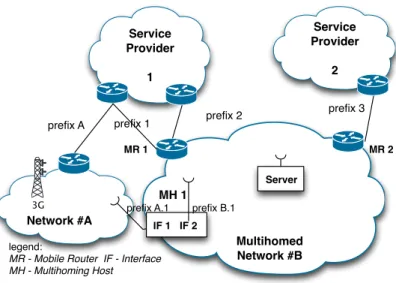
HybridMultihoming mixes both end-host and end-site characteristics, but requires the participation of end-host and network entities (e.g. servers) for full multihoming support. Most current proposals are hybrid multihoming solutions that target issues on networks, such as routing scalability, but at the same time also address drawbacks of the current TCP/IP architecture, such as the dual role of IP address (identifier and locator). According to Figure 2.3, MH1 is a multihomed host, but multihoming man-agement requires support from the network (server) to maintain the location informa-tion, so that other end-hosts in the Internet can communicate with MH1.
Service Provider 1 Service Provider 2 MR 1 MR 2 prefix 2 prefix 1 prefix 3 legend:
MR - Mobile Router IF - Interface MH - Multihoming Host 3G IF 1 IF 2 prefix B.1 prefix A.1 Server MH 1 prefix A Network #A Multihomed Network #B
Figure 2.3: Hybrid multihoming scenario
2.2
Designing for Multihoming
This section introduces the overall goals that current and future multihoming solu-tions ought to pursue. Open problems and current solution space in this research area are also presented.
2.2.1 Goals
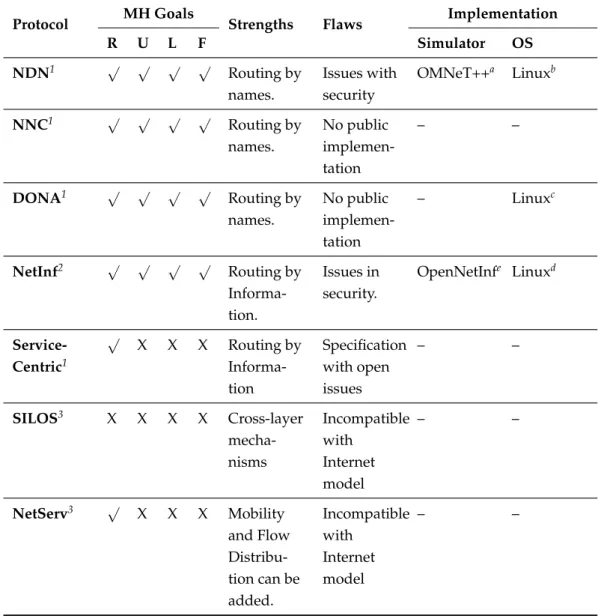
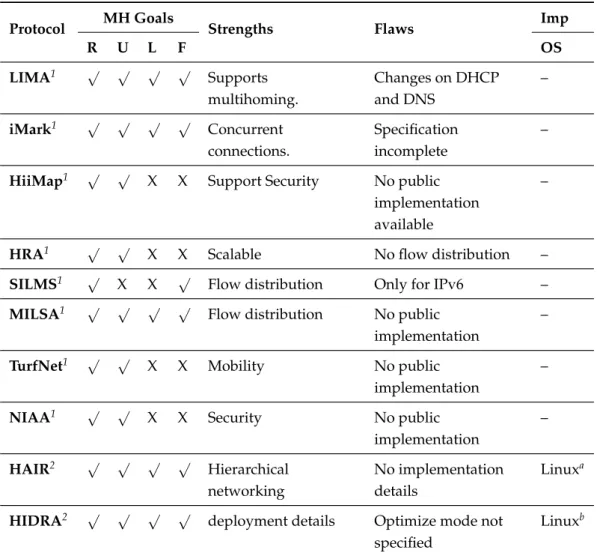
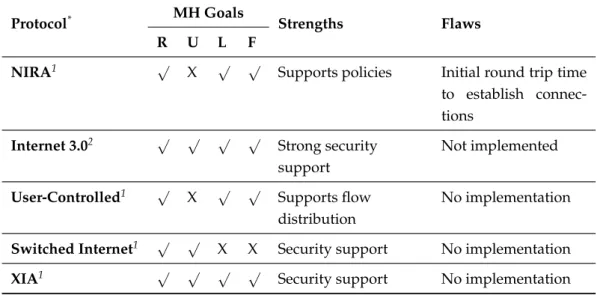
Multihoming has gained attention over the last few years [Espi et al., 2009], due to the potential benefits it can provide. In particular, multihoming solutions aim to achieve the following goals: R-Resilience,U-Ubiquity,L-Load balancing/sharing andF-Flow distribution.
The diversity of multiple interfaces/paths can improveresilienceas upon a fail-ure of one interface/path, another one can be employed to provide connectivity. For instance, as mentioned above, a primary-backupmodel is adopted by Stream Control Transport Protocol (SCTP) [Budzisz et al., 2008]. That is, if the primary path fails, the backup path can be used seamlessly without causing any application-layer service interruption. Multiple network interfaces, in particular when used in a mobile and wireless network environment, enable ubiquitous accessto the Internet over differ-ent media.
Load sharinggoes one step further than the primary-backup model, as multiple interfaces/paths can be used simultaneously to improve throughput, as for instance
2.2 Designing for Multihoming
to enable concurrent multiple transfers in SCTP [Iyengar et al., 2006].
Flow distribution, or flow stripping, offers even finer granularity than load shar-ing. Flow distribution is the ultimate goal to achieve, as it implicitly means that all previous goals are also attained. Flows are stripped, perhaps even dynamically, ac-cording to policies and preferences aiming to reduce cost, optimize bandwidth use, and minimize the effect of bottlenecks to delay-sensitive applications, among others. 2.2.2 Open Issues
As multihoming aspects are introduced in current specifications of the IP architecture, there are still several issues that need to be addressed [Montavont et al., 2008; Blanchet and Seite, 2011].
The first problem relates todefault gateway mechanisms. Current specifications use a default gateway to assure connectivity to the network. Such a mechanism in-troduces limitations in the exploration of multiple connections, as flows cannot be forwarded across different connections to meet user requirements (e.g. load balanc-ing). A simple solution is to use static routes, on a flow or destination granularity, but this type of approach is not scalable and it is difficult to manage in practice.
A second issue is related with configuration parameters. Network nodes, run-ning IPv4 or IPv6, receive specific configurations for each active connection via the Dynamic Host Configuration Protocol (DHCP) [Droms, 1997], Router Advertisement (RA) [Hagen, 2006] or other mechanisms. In these scenarios, issues such as split Do-main Name System (DNS) might occur since there is no binding mechanism between the resolution name and the destination. Split DNS refers to the case of getting differ-ent name resolution results depending on which of the available network interfaces is used to issue the DNS lookup. Solutions to overcome these issues rely on merging interface-specific to node configurations to avoid conflicting result sets, as is the case with name resolution in private networks.
Failure detectionalso poses restrictions on multihoming support. Current failure detection mechanisms do not perform well as they mainly rely on timers. For instance, existing RAs do not detect failed links on the failure event, but only on the failure of an event advertisement, which relies on timers. A solution to mitigate such problem is to use cross-layer information, such as link layer events to detect network attachment [Krishnan et al., 2007] and loss of connectivity.
Path explorationmechanisms introduce performance constraints limiting multi-homing support. Reachability between pairs of addresses must be reactive, and re-duce the overhead of signalling procedures. For instance, one strives to rere-duce the