Estrogenic plant consumption predicts red colobus monkey (
Procolobus rufomitratus
)
hormonal state and behavior
Michael D. Wasserman
a,b,⁎
, Colin A. Chapman
b,c,d, Katharine Milton
a, Jan F. Gogarten
e,
Daniel J. Wittwer
f, Toni E. Ziegler
fa
Department of Environmental Science, Policy, and Management, University of California, Berkeley, 130 Mulford Hall #3114, Berkeley, CA 94720–3114, USA b
Department of Anthropology, McGill University, 855 Sherbrooke St. West, Montreal, QC, Canada H3A 2T7 c
McGill School of Environment, McGill University, 855 Sherbrooke St. West, Montreal, QC, Canada H3A 2T7 d
Wildlife Conservation Society, 185th St. and Southern Blvd., Bronx, NY 10460, USA
eDepartment of Biology, McGill University, 1205 Dr. Penfield Ave., Montreal, QC, Canada H3A 1B1 f
Wisconsin National Primate Research Center, University of Wisconsin-Madison, 1220 Capitol Court Madison, WI 53715, USA
a b s t r a c t
a r t i c l e i n f o
Available online xxxx Keywords: Estradiol Cortisol Environmental endocrinology Herbivory Mating Phytoestrogen Aggression Kibale National Park Grooming LegumeNumerous studies have examined the effects of anthropogenic endocrine disrupting compounds; however, very little is known about the effects of naturally occurring plant-produced estrogenic compounds (i.e., phytoestrogens) on vertebrates. To examine the seasonal pattern of phytoestrogen consumption and its relationship to hormone levels (407 fecal samples analyzed for estradiol and cortisol) and social behavior (aggression, mating, and grooming) in a primate, we conducted an 11-monthfield study of red colobus (Procolobus rufomitratus) in Kibale National Park, Uganda. The percent of diet from estrogenic plants averaged 10.7% (n=45 weeks; range: 0.7–
32.4%). Red colobus fed more heavily on estrogenicMillettia durayoung leaves during weeks of higher rainfall, and the consumption of this estrogenic item was positively correlated to both their fecal estradiol and cortisol levels. Social behaviors were related to estradiol and cortisol levels, as well as the consumption of estrogenic plants and rainfall. The more the red colobus consumed estrogenic plants the higher their rates of aggression and copu-lation and the lower their time spent grooming. Our results suggest that the consumption of estrogenic plants has important implications for primate health andfitness through interactions with the endocrine system and changes in hormone levels and social behaviors.
© 2012 Elsevier Inc. All rights reserved.
Introduction
Endocrine disruption is of major concern because many synthetic chemicals pose a threat to humans and wildlife through interference
with the vertebrate endocrine system (Hayes, 2005; Propper, 2005).
Much research has focused on the physiological and behavioral effects of anthropogenic endocrine disrupting compounds, particularly those
with estrogenic activity (Colborn et al., 1993; Guillette, 2000; Hayes et
al., 2002; Milnes et al., 2006). Effects include modifying the developing reproductive system (e.g., genital deformation) and altering steroid
hor-mone profiles, gamete production, and sex-typical behaviors in exposed
adults (Hayes et al., 2002; Milnes et al., 2006). Much less is known about
the effects of consuming natural plant-produced estrogenic compounds
(i.e., phytoestrogens;Wynne-Edwards, 2001). Most primates depend
heavily on a plant-based diet, thus the consumption of estrogenic plants may have important implications for their behavior, ecology, and evolu-tion. Further, as half of all primate species are at risk of extinction (Chapman and Peres, 2001), a better understanding of the relationship between primates and naturally occurring phytoestrogens present in their foods is needed because such compounds have the potential to
alter fertility and mating behavior (Cederroth et al., 2010a; Simon et
al., 2004; Whitten and Patisaul, 2001; Wynne-Edwards, 2001). Phytoestrogen consumption has been documented to disrupt fertili-ty and affects behavior in laboratory and domesticated species, including
rodents, monkeys, sheep, and cattle, as well as humans (Adams, 1990,
1995; Cederroth et al., 2010b; Whitten and Patisaul, 2001). Due to the conservative nature of the endocrine system across vertebrates, such ef-fects are expected in wild primates feeding on similar estrogenic plant
compounds (Hayes, 2005; Thornton, 2001). Previously we confirmed
the presence of estrogenic plant foods in the diet of red colobus monkeys (Procolobus rufomitratus) of Kibale National Park, Uganda, using
tran-sient transfection assays (Wasserman et al., 2012). Three staple
Hormones and Behavior xxx (2012) xxx–xxx
⁎ Corresponding author at: Department of Anthropology, McGill University, 855 Sher-brooke St. West, Montreal, QC, Canada H3A 2T7. Fax: +1 514 398 7476.
E-mail addresses:[email protected](M.D. Wasserman),
[email protected](C.A. Chapman),[email protected](K. Milton),
[email protected](J.F. Gogarten),[email protected](D.J. Wittwer),
[email protected](T.E. Ziegler).
0018-506X/$–see front matter © 2012 Elsevier Inc. All rights reserved.
http://dx.doi.org/10.1016/j.yhbeh.2012.09.005
Contents lists available atSciVerse ScienceDirect
Hormones and Behavior
estrogenic foods with activity at estrogen receptor beta (ERβ)
made up 10% of the diet (Millettia dura [Fabaceae] young leaves,
Ficus natalensis[Moraceae] young leaves, and bark from non-native Eucalyptus grandis[Myrtaceae]), while non-staple estrogenic foods only made up 0.6% of the diet. Here, our objective was to determine if the consumption of these estrogenic plant foods by red colobus monkeys altered their physiology and behavior via interaction with their endocrine system.
Two hormonal axes are important for understanding the potential for
phytoestrogens to alter physiology and behavior. The first, the
hypothalamo-pituitary gonadal axis (HPG), plays a central role in regu-lating the development and maintenance of the mammalian reproduc-tive system through the production of sex steroids (i.e., estrogens and androgens) and their downstream effects on reproductive physiology
and behavior (Hadley, 1999; Wingfield and Sapolsky, 2003). Interference
with the HPG axis can result in altered fertility in males, due to the role of testosterone and gonadotropins in sperm production, and females, due to the role of estrogens and gonadotropins in their estrous cycle (Hadley, 1999). The second hormonal axis, the hypothalamo–pituitary adrenal axis (HPA), plays a central homeostatic role through the
produc-tion of glucocorticoids (Sapolsky, 2005; Wingfield and Sapolsky, 2003).
There is strong evidence that these two hormone axes interact as the HPA axis can suppress the HPG axis so that stress can suppress
reproduc-tion (Wingfield and Sapolsky, 2003) and estrogens can suppress the
neg-ative feedback loop of the HPA axis, thus increasing production of
glucocorticoids (Weiser and Handa, 2009).
We examined patterns of phytoestrogen consumption, fecal
hor-mone levels, and social behavior of red colobus (P. rufomitratus) in
Kibale over 11 months. Specifically, we determined how weekly
varia-tion in the time spent feeding on estrogenic plants related to fecal estra-diol and cortisol levels in adult males. As both consumption of estrogenic plants and red colobus hormone levels may vary seasonally, their relationships to rainfall and temperature were examined. Climate can mediate the relationship between phytoestrogen consumption and primate hormone levels through three main mechanisms that are not mutually exclusive: (1) its effects on food availability (i.e., if plant
phenology is linked to climatic variables) (Chapman et al., 1999;
Struhsaker, 1997), (2) its effects on phytoestrogen levels (i.e., plants contain more or less of these compounds during certain times of the
year) (Leopold et al., 1976; Mazur and Adlercreutz, 1998; Morrison et
al., 2010), and (3) its direct effects on hormone levels (i.e., primates
may suffer climate related stress) (Gogarten et al., 2012; Wingfield,
2005; Wingfield et al., 1983). To determine if any hormonal changes related to phytoestrogen consumption translated into altered social
be-havior, we examined the influence of climate, phytoestrogen
consump-tion, and hormonal status on rates of aggression and mating and time spent grooming.
Material and methods Study site and species
Kibale National Park (795 km2) is a moist evergreen forest in western
Uganda (0 13′–0 41′N and 30 19′–30 32′E) (Chapman et al., 2010). This
forest receives an average of 1696 mm annually (1990–2011; Chapman
and Chapman,unpublished data), with most falling during two rainy
seasons (Chapman et al., 2010). The Ugandan red colobus (P. rufomitratus
tephrosceles) is considered endangered by the IUCN (Struhsaker, 2008),
with the only viable population remaining in Kibale (Struhsaker, 2005).
The Kibale population consists of numerous multimale–multifemale
groups with an average group size of 65 individuals (Snaith et al.,
2008). As a forestomach-fermenting obligate folivore dependent upon
symbiotic gut bacteria for securing nutrients from its leaf based diet (Bauchop and Martucci, 1968; Chapman et al., 2002; Lambert, 1998; Milton, 1980), the red colobus is an ideal subject for examining the effects of phytoestrogens. With their specialized forestomach system,
colobines may be particularly susceptible to the estrogenic activity of plants, as has been documented for foregut-fermenting livestock (e.g.,
“clover disease”of sheep) (Adams, 1990, 1995; Bennetts, 1946). Data
show that phytoestrogens are often more active after bacterial
metabo-lism (Gultekin and Yildiz, 2006; Setchell and Clerici, 2010). For example,
a number of phytoestrogens (e.g., formononetin, daidzein) are converted to the more bioactive compound, equol, via bacterial metabolism in a
number of species, including foregut fermenters (Setchell and Clerici,
2010).
Assessment of red colobus diet and social behavior
We determined the red colobus diet, rates of mating and aggression, and time spent grooming by collecting behavioral data from one group (~70 individuals) in Kibale from August 13, 2007 to June 27, 2008 (258 days of sampling), for a total of 1327 observation hours. Data were collected six days per week from 0800 to 1300 h using scan
sam-ples offive individuals every 30 min. When feeding, plant species and
the part being consumed were identified. We calculated the percent of
diet for each item at the weekly scale by summing the number of obser-vations of feeding on each plant item, and dividing this by the total num-ber of feeding observations that week. Using these values, we calculated the percentage of the diet coming from each of the staple estrogenic foods, as well as a sum of all rare estrogenic plant foods, for each week
(n=45). A staple food was defined as a plant item that was fed on
>1% of the total time, while a rare food was any plant item that was
fed onb1% of the total time. Estrogenic activity of plant foods was tested
using transient transfection assays (Wasserman et al., 2012). We also
calculated the weekly percent of diet for each of the 13 most fed on
di-etary items as listed inWasserman et al. (2012). Behavioral data on
feeding came from 37 known individuals in the group, including 22 adult females, 13 adult males (including all ten males examined in the hormonal analyses), and two subadult males. Differences in feeding be-havior between males and females were not apparent, especially for the
three estrogenic staple foods (e.g.,M. durayoung leaf consumption was
5.2 ± 1.4% for adult males and 5.4± 1.6% for adult females), so we used our entire dataset to determine diet for the ten adult males as this likely provided the most robust and appropriate statistical sample estimate of their weekly diet.
Three types of social behavior were examined: mating, aggression, and grooming. Grooming data were collected during the scan samples and calculated as percent of time spent grooming (i.e., providing) or being groomed (i.e., receiving). Copulation rates (#/h) were
deter-mined usingad libitumobservations. Aggression rates (#/h) (i.e., sum
of number of chases andfights) were also collected throughad libitum
observations. All social behavior data used came from only the 13 adult males.
Assessment of climate and plant phenology
Rainfall and temperature data were collected from an area within the home range of the group. Trees were monitored monthly for ripe
fruits, unripe fruits, mature leaves, young leaves, andflowers
(abun-dance ranked from 0 to 4). We calculated the mean monthly pheno-logical score for the staple estrogenic plant foods to provide an
index of their availability. Young leaves ofF. natalensis(n = 2 trees)
andM. dura(n = 11) were monitored, butEucalyptus grandisbark was not because it does not vary in seasonal availability.
Assessment of fecal hormone levels
Although evidence of effects of phytoestrogen consumption similar
to those of laboratory studies are difficult to obtain infield studies,
indi-rect measures can provide evidence of changes in either the HPG or HPA axes, indicating disruption of reproductive capabilities. These hormonal effects can be examined noninvasively using the measurement of
excreted estradiol and cortisol metabolites in the feces (Heistermann et al., 1993; Touma and Palme, 2005; Wasser et al., 1988; Whitten et al., 1998; Ziegler and Wittwer, 2005). Thus, fecal samples were collected immediately upon defecation from ten known adult males (out of 13 in the group). Adult males were selected because female reproductive
state can greatly influence steroid hormone levels (Weingrill et al.,
2004). Fecal samples were collected between 0830 and 1230 h to
re-duce the contribution of diurnal variation seen in the excretion patterns
of fecal steroids (Sousa and Ziegler, 1998; Wasserman,unpublished data
for this species).
We collected samples approximately once a week for each male (n = 407). Fecal samples were immediately placed in sterile vials
and stored in a cooler with ice packs until placed in a−20 °C freezer
later that day. On the day of extraction, samples were taken from the
−20 °C freezer and thawed. Each sample was homogenized using a
spatula and 0.5 g was weighed into a test tube. We added 5 ml of 5.0 pH citrate buffer and 5 ml 95% ethanol to each fecal sample, and this fecal material solution was mixed on a homogenizer for 24 h. Steroid hormones were then separated from the fecal pellet using a centrifuge, and 2 ml of supernatant were passed through a
preconditioned solid phase extraction cartridge at a flow rate of
4 ml/min. The steroid hormones were then stored in these cartridges with both ends capped. Capped samples were stored out of direct light until analysis via radioimmunoassay (RIA) for estradiol content and enzyme immunoassay (EIA) for cortisol content by MW at the Wisconsin National Primate Research Center (WNPRC).
At WNPRC, the cartridges were washed with 1 ml of 5% methanol and the steroid hormones were collected using 2 ml of 100% methanol passed
through the cartridge at a 1 ml/minflow rate. The methanol was then
evaporated off and steroids hormones were reconstituted in 1 ml of 100% ethanol and stored in a 4 °C refrigerator until analyses. For the
estra-diol RIA, 25μL of sample were used and recovery was 107.44%±2.53%.
Parallelism was demonstrated with no significant difference between
slopes of the serial dilution of the sample pool and standard curve (p>0.05). Inter-assay variation for the high pool was 14.62% and for the low pool was 9.6%, while intra-assay variation was 4.53% for the high pool and 7.51% for the low pool. The estradiol antibody used was an-tiserum from Holly Hill Biologicals, Inc., Hillsboro, Oregon, diluted so that ~50% of the tritiated estradiol was bound in the absence of unlabeled
ste-roid (French et al., 1983). Cross-reactivity was 0.2% for estriol, 3.12% for
estrone, and less than 0.01% for all other steroids tested (i.e., testosterone, DHT, androstenedione, progesterone, cortisone, cortisol, epiandrosterone, DHEA, and androstenediol). Because the cross-reactivities with other en-dogenous estrogens were low, it is unlikely that our antibody that is
spe-cific to estradiol would have enough cross-reactivity with phytoestrogens
in the red colobus fecal samples to influence our results. For the cortisol
EIA, 50μL of sample were used and recovery was 125.27%±3.18%.
Paral-lelism was demonstrated using serial dilution curves, with no significant
difference between the sample pool and standards (p>0.05). Inter-assay variation for the high pool was 18.83% and for the low pool was 16.62%, while intra-assay variation was 6.24% for the high pool and 6.26% for the low pool. The cortisol antibody used was R4866 (anti-cortisol-BSA) developed by Stabenfeldt & Munro at the University of California, Davis. It was diluted to 1:22,000 with 50 mM bicarbonate buffer (pH 9.6), as perZiegler et al. (1995). Thefinal hormone values are given in ng of steroid hormone per g of dry feces. The dry matter content of all
fecal samples was calculated in thefield by drying 0.5 g of each
sam-ple to a constant weight. Biological validation of our cortisol EIA pre-viously showed this to be an effective index of stress for the red
colobus (Wasserman,unpublished data).
Statistical analyses
To determine if the consumption of estrogenic plant foods interfered with the endocrine system and if climate played an important mediating role in this relationship, we tested two hypotheses: (1) temporal
changes in red colobus hormonal levels were related to changes in
phy-toestrogen consumption and (2) climatic factors influenced hormone
levels directly and/or indirectly though their effects on the timing of es-trogenic plant availability and/or consumption. We used fecal estradiol level as an index of reproductive physiology and fecal cortisol level as an index of stress physiology. To determine the relative importance of phytoestrogen consumption and climatic seasonality to red colobus hor-monal state, we used stepwise regression including six predictor
vari-ables: (1)% of diet from rare estrogenic foods, (2–4)% of diet from each
of the three staple estrogenic foods (M. durayoung leaves,F. natalensis
young leaves, andEucalyptus grandisbark), (5) weekly total rainfall,
and (6) mean maximum temperature, and two outcome variables: (1) fecal estradiol and (2) fecal cortisol. We used the median of weekly estradiol and cortisol levels in our analyses since both hormone data sets were not normally distributed. We also used stepwise regression with the red colobus' 13 most fed on dietary items (11 non-estrogenic and
2 estrogenic, accounting for 66% of total diet;Wasserman et al., 2012)
and rainfall as predictor variables and fecal estradiol as the outcome var-iable to test if seasonal changes in diet, other than consumption of
phytoestrogens, influenced male reproductive state and thus hormone
levels.
To examine seasonality in diet, relationships between rainfall and the red colobus' 13 most fed on dietary items, including the three es-trogenic staple foods, were examined using Pearson correlations (n =
45 weeks). To further clarify if seasonality influenced the
consump-tion of estrogenic plants, we examined the relaconsump-tionship between
rain-fall and phenology ofM. durayoung leaves andF. natalensisyoung
leaves, as well as the relationship between their availability and the time the red colobus fed on each at the monthly level using Spearman rank correlations (n = 11 months).
To examine the influence of hormonal state, climate, and
phytoestro-gen consumption on behavior, we employed a regression tree analysis. Regression trees are ideally suited for the analysis of such complex data (De'ath and Fabricius, 2000). Data often display nonlinear relationships
and complex higher-level interactions between variables (Elith et al.,
2008). Regression trees explain variation in a single response variable
using one or more explanatory variables and exhibit a number of advan-tages over many commonly used statistics: they are non-parametric, which is often useful when considering behavioral data, well-suited for examining complex interactions in explanatory variables, and easy to
interpret (De'ath, 2007; De'ath and Fabricius, 2000). Regression trees
use a recursive partitioning approach to split the variable space into smaller regions that minimize a measure of variation within the parti-tions. We used an algorithm that split the data so as to minimize the sum of squares, where splitting continues until some stopping criterion is achieved; in this case that any additional splits do not improve the cost-complexity criterion of the tree (i.e., that increasing complexity
does not significantly improve thefit of the tree) (De'ath and Fabricius,
2000).
We built regression trees to predict: (1) % of time grooming, (2)
cop-ulation rate, and (3) rate of aggression using‘rpart’implemented in R
version 2.12.2 (R-Development-Core-Team, 2012; Therneau et al.,
2012). We predicted red colobus behaviors with median fecal cortisol
and estradiol levels, rainfall, mean maximum temperature, and the per-centage of the diet consisting of estrogenic foods (% diet from all estro-genic plants, % diet from staple estroestro-genic plants, % diet from rare estrogenic plants, and % diet from each of the estrogenic staples).
Parti-tions near the top of the regression tree reflect strong relationships
be-tween predictor and response variables, with the length of the branch corresponding to the proportion of the sum of squares explained by
each split in the tree (De'ath and Fabricius, 2000). Regression trees are
read from the base of the tree (i.e., the root) down the branches to the terminal nodes (i.e., leaves), following a number of splits at each node. The number displayed at the tip is the mean value of the
depen-dent variable in that subset of the data andnrepresents the number
0.0 20.0 40.0 60.0 80.0 100.0 Rainfall (mm) 22 23 24 25 26 27 28 29 30 31
Mean Maximum Temperature (
oC) 0.0% 5.0% 10.0% 15.0% 20.0% 25.0% 30.0% 1 3 5 7 9 11 13 15 17 19 22 24 26 28 30 32 34 36 38 40 42 44 46 Week of Study % of Diet
% Millettia dura YL % Ficus natalensis YL % Eucalyptus Bark % Nonstaple Estrogenic Parts
Dry Wet Dry Wet Dry
A
B
C
Fig. 1.Weekly (n=45) A) mean maximum temperature (°C) and B) amount of rainfall (mm) at Makerere University Biological Field Station, Kibale National Park, Uganda, with wet and dry seasons indicated. C) Percent of weekly diet from each of the estrogenic staple plant foods, as well as a sum of the percent of diet from all non-staple estrogenic plant foods, of the Ugandan red colobus monkey.
Results
Estrogenic plants in red colobus diet
On average 10.7% of the diet was from estrogenic plants (range:
0.7%–32.4% across weeks;Fig. 1C). This was mainly due to the
consump-tion of three staple estrogenic plants and alone their contribuconsump-tion to the
diet averaged 10.1% (range: 0.7%–31.0%). The red colobus fed on at least
one of the three staple estrogenic plants during each week, but never fed on all three during the same week. Of these three estrogenic staples, M. durayoung leaves were fed on most, with an average of 5.1% of the
diet and a range from none during 8 weeks to 15.5%.Eucalyptus grandis
bark was fed on second most with an average of 3.4% of the diet and a
range from none during 33 weeks to 31.0%.F. natalensisyoung leaves
were fed on least of these staple estrogenic plants with an average of 1.5% of the diet and a range from none fed on during 28 weeks to
11.8%. As for the rare (non-staple) estrogenic plant foods (Erythrina
abyssinicayoung leaves andflowers,Ficus sansibaricaunripe fruit and
young leaves,F. natalensisunripe fruit), their contribution to the diet
av-eraged 0.6%, with a range from none fed on during 33 weeks to 6.1%. Climatic variation and plant phenology
Rainfall was highly variable temporally, both between weeks during the dry seasons and wet seasons and across weeks within a particular
season (Fig. 1B). Total rainfall during the 45 weeks was 1304.5 mm,
with an average of 28.99 mm falling per week (range=0–100.33 mm).
Weekly mean maximum temperature averaged 25.7 °C (range=23.1–
30.3 °C) (Fig. 1A).
Young leaves of bothM. duraandF. natalensiswere available
through-out the study. The availability ofM. durayoung leaves was related to
rain-fall with a one-month time lag (i.e., rainrain-fall in month 1 resulted in an
increase in availability ofM. durayoung leaves in month 2; rs=0.778,
p=0.008). The availability ofF. natalensisyoung leaves was unrelated
to rainfall (rs=−0.075, p=0.836). Even though some young leaves of
F. natalensiswere available year-round, there were months when the
red colobus did not feed on them, whileM. durayoung leaves were fed
on in every month. However, there was no relationship between
propor-tion of their feeding time spent eatingM. durayoung leaves and its
avail-ability (rs=0.232, p=0.492), nor did they feed onF. natalensisyoung
leaves more when they were more available (rs=−0.041, p=0.905).
There was a positive relationship between rainfall and the time
spent feeding onM. durayoung leaves (r= 0.414, p = 0.005), while
there were no significant relationships between the time spent feeding
on any of the 11 most fed on non-estrogenic plant items, or the other two estrogenic foods, and rainfall (all p > 0.107).
Adult male red colobus fecal estradiol and cortisol levels
Fecal estradiol levels averaged 80.03 ng/g, with a range from 27.32
to 297.69 ng/g (n= 45; Fig. 2A). However, individual samples had
much greater variation in estradiol levels, with a range from 19.62 to 2237.81 ng/g (n= 407). Due to one or two individuals having extreme-ly high levels during a few weeks (e.g., 2237.81 ng/g), certain weeks had very high levels of variation, with a range in the standard error of the mean (SEM) from 1.07 to 216.95 ng/g and an average of 38.66 ng/g. Five of the weeks had one sample >1000 ng/g, while 14 weeks had one or two samples > 500 ng/g. These one or two ex-tremely high samples were responsible for the high SEM during those weeks. There was no apparent reason to suspect that these high values were a result of methodological error, as the cortisol values for these same samples were not outliers. If the samples had been contaminated or incorrectly processed, it is expected that their cortisol levels would
have also reflected this error.
Mean fecal cortisol levels averaged 71.58 ng/g dry feces, with a
range from 33.17 to 107.59 ng/g (n= 45;Fig. 2B). Individual samples
did not show as much variation for cortisol levels as they did for estra-diol levels, with a range from 18.63 to 200.12 ng/g (n= 407). The aver-age SEM was 8.67 ng/g, with a range from 1.86 to 23.12 ng/g. Influence of phytoestrogen consumption, non-estrogenic dietary items, and climate on fecal hormone levels
In the stepwise regressions predicting the median fecal estradiol levels with estrogenic dietary items and climatic variables, the best
pre-dictor was simply the percent of diet fromM. durayoung leaves (R2=
0.362, pb0.001). The relationship between fecal estradiol andM. dura
consumption was also significant when only examining weeks in which
it was fed on (r=0.574, pb0.001, n=37;Fig. 3A). The median fecal
cor-tisol levels were also best predicted by percent of diet fromM. durayoung
leaves (R2=0.128, p=0.016) in the stepwise regressions. The
relation-ship between fecal cortisol andM. duraconsumption was also significant
when only examining weeks in which it was fed on (r=0.461, p=0.004,
n=37;Fig. 3B).
In the stepwise regression predicting median fecal estradiol level that included the red colobus' 13 most fed on dietary items (11
non-estrogenic and 2 non-estrogenic) and rainfall, two significant models were
produced: 1) justM. durayoung leaves (R2=0.355, pb0.001) and 2)
M. durayoung leaves andPrunus africana young leaves (R2= 0.424,
pb0.001). AlthoughP. africanaconsumption was not related to rainfall
(r=−0.028, p= 0.855), it was negatively related to median estradiol
levels (r=−0.395, p=0.007). It is important to note that it also showed
a marginally significant negative relationship withM. duraconsumption
(r=−0.267, p= 0.076).
Influence of phytoestrogen consumption, hormonal state, and climate on social behavior
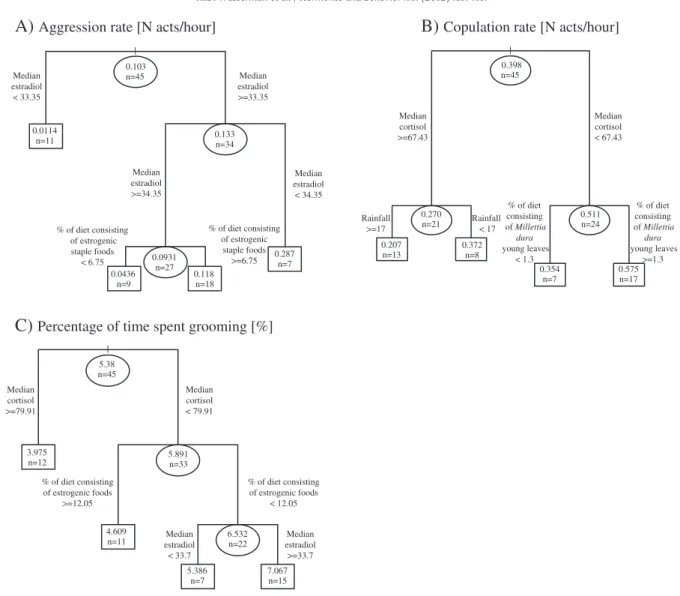
In the regression tree predicting aggression rate, we found median fecal estradiol to be the primary explanatory factor, followed by the
per-centage of diet from estrogenic staple foods (Fig. 4A; R2= 0.437), with
the highest rates of aggression associated with intermediate levels of fecal estradiol and lowest rates when estradiol was low. Estrogenic plant consumption was related to aggression rate when estradiol was greater than 34.35 ng / g, with more consumption relating to higher rates of aggression.
With copulation rate the primary split was based on median fecal cortisol levels, with more copulations when cortisol was lower, and
sec-ondary splits based on rainfall andM. durayoung leaf consumption
(Fig. 4B; R2= 0.388). Copulations were highest when median fecal
cor-tisol was low and consumption ofM. durayoung leaves was high, while
they were lowest when cortisol and rainfall were high (Fig. 4B).
With grooming time, we found median fecal cortisol levels to be the primary explanatory factor followed by the percent of all estrogenic
foods in the diet and then median estradiol (Fig. 4C, R2=0.352). Red
colobus males groomed most when cortisol was low, less estrogenic foods were consumed, and estradiol was high, while they groomed the
least when cortisol was high (Fig. 4C).
Discussion
Our results suggest that plant chemistry could act as a selective pres-sure on primates, and other herbivores, in ways that have yet to be fully appreciated because we found that adult male red colobus fecal estradiol and cortisol levels were related to the consumption of estrogenic plant foods, while social behaviors were related to both endogenous hormonal state and consumption of phytoestrogens. By altering steroid hormone levels that are important to reproductive physiology and the tendency to engage in aggressive, grooming, and mating behaviors, phytoestrogens
could directly alter thefitness of the individuals ingesting them. The
strongest relationship we documented was the positive association
leaves.M. durais a legume of the Papilionoideae subfamily, which is
known to contain estrogenic isoflavonoids (Reynaud et al., 2005). Studies
demonstrate that the ingestion of papilionoids by livestock can
dra-matically impair reproduction (Adams, 1990, 1995; Bennetts and
Underwood, 1951), and similar detrimental effects on fertility may
occur in humans (Cederroth et al., 2010a). However, it is also suggested
that phytoestrogens may provide health benefits such as cancer
preven-tion or alleviapreven-tion of menopausal disorders (Dixon, 2004; Leitman et al.,
2010; Ososki and Kennelly, 2003; Setchell and Cassidy, 1999). Based on these studies and the relationships found here, it is possible that M. duraexerted an important influence on the red colobus endocrine sys-tem. However, as red colobus have had a long evolutionary relationship with this native species, it is possible that they have evolved adaptations to protect against any potential endocrine disruption caused by ingesting
leaves ofM. dura(Wynne-Edwards, 2001).
Feeding onM. durayoung leaves also had a positive relationship
with fecal cortisol, and it is likely that the phytoestrogens interacted not only with the HPG axis, but also with the HPA axis. Studies on am-phibians have shown that anthropogenic endocrine disruptors in
pesti-cides can lead to an increase in stress hormone production (Hayes et al.,
2006). Further, estrogens are able to alter the negative feedback loop of
the HPA axis, thus changing production of glucocorticoids (Weiser and
Handa, 2009). Therefore, it is possible that the phytoestrogens of M. durayoung leaves influenced cortisol levels in red colobus. This
supports the conclusion that the consumption of estrogenic plant foods affected red colobus physiology. The relationship with fecal estra-diol may simply have been due to the RIA antibody binding to metabo-lites of the phytoestrogens passing through the monkeys, but this is unlikely due to our antibody's cross-reactivities. However, the addition-al relationship with cortisol provided strong evidence that the phytoestrogens were absorbed and affected the endocrine system through the HPG and HPA axes, since metabolites of phytoestrogens would not bind to the cortisol antibody. Increased cortisol production from phytoestrogen consumption may result in a synergistic threat to endangered primates which live in environments with unusually high proportions of estrogenic plants, both through the suppression of their
immune and reproductive systems by elevated cortisol (Sapolsky,
2005) and by altered fertility through phytoestrogen interaction with
estrogen receptors (Cederroth et al., 2010a).
The relationships found here between the consumption of estrogenic plants and red colobus hormone levels were correlative; therefore, as with any non-experimental approach, there is the possibility that these relationships were due to spurious correlations. However, by including rainfall and temperature in the multiple regressions, we have attempted
to control for other factors related to seasonality that could influence
hor-mone levels. In the tropics, rainfall is the most important factor infl
uenc-ing seasonality. Because the consumption ofM. durayoung leaves was the
only significant variable for predicting both median estradiol and cortisol
0 100 200 300 400 500 0 20 40 60 80 100 120 1 3 5 7 9 11 13 15 17 19 22 24 26 28 30 32 34 36 38 40 42 44 46 Week of Study
Mean Fecal Cortisol Level (ng / g)
Mean Fecal Estradiol Level (ng / g)
A
B
in the multiple regressions, we think this strongly supports that this
es-trogenic plant influenced red colobus hormone levels and that this
rela-tionship was not driven by another seasonal process.
Furthermore, red colobus do not have a breeding season, as births occur in all months of the year, and Kibale is known for being relatively aseasonal in terms of plant phenology and availability of primate plant
foods (Chapman et al., 2005; Struhsaker, 1997). Supporting the
aseasonality of Kibale, we found none of the other 13 most fed on dietary
items correlated with rainfall, besidesM. durayoung leaves. Thus, large
changes in red colobus male reproductive state related to dietary quality or climatic variables were not expected. Variation in the consumption of estrogenic plants remains as the most plausible explanation for the changes in hormonal state we found, and these changes could translate into variation in fertility.
Additionally, if components of the diet other than phytoestrogens were responsible for the relationships found here it would be expected that consumption of other staple dietary items would relate to rainfall (none were) and non-estrogenic items would explain variation in
estradiol levels. In the multiple regression model incorporating
non-estrogenic dietary items, non-estrogenic M. durayoung leaves explained
most of the variation in red colobus estradiol levels. Of the other 12
most fed on items, only non-estrogenicP. africanayoung leaves slightly
improved the model. However, their consumption was negatively
corre-lated with consumption ofM. duraand negatively correlated with
estradi-ol. Thus, this relationship was likely due to the red colobus feeding less on M. durain weeks they fed more onP. africana. Alternatively, there is
pub-lished evidence thatP. africanainteracts with the endocrine system as it is
used to prevent and treat prostate disorders and its extract displaces both
estrogens and androgens (Shenouda et al., 2007). Although our
previous-ly reported transfection assay did notfind this species to have estrogenic
activity at either estrogen receptor (Wasserman et al., 2012), steroidal
ac-tivity through other mechanisms may be responsible for the negative re-lationship between its consumption and estradiol levels found here. Therefore, it does not appear that the relationships between consumption of estrogenic plants and red colobus hormone levels found here were due to seasonal changes in non-estrogenic components of diet. This was
y = 92.546x + 32.718 R² = 0.33 20 25 30 35 40 45 50 55 0.0% 2.0% 4.0% 6.0% 8.0% 10.0% 12.0% 14.0% 16.0%
Median Fecal Estradiol Level (ng / g)
Percent of Diet from Millettia duraYoung Leaves
A
y = 190.52x + 56.608 R² = 0.2115 20 30 40 50 60 70 80 90 100 110 120 0.0% 2.0% 4.0% 6.0% 8.0% 10.0% 12.0% 14.0% 16.0%Median Fecal Cortisol Level (ng / g)
Percent of Diet from Millettia dura Young Leaves
B
Fig. 3.Relationships between percent of weekly diet fromMillettia durayoung leaves and A) median fecal estradiol level and B) median fecal cortisol level for weeks when the red colobus fed on that particular estrogenic plant item (n=37). Hormone levels are weekly calculations from ten adult male red colobus living in the same group at Kibale National Park, Uganda. Correlations are significant (pb0.05).
further supported by the fact thatP. africanadid not show seasonality in
consumption, whileM. duraand estradiol did.
Our results showing behavioral relationships with the consumption of estrogenic plants provided further support that the correlations found here between phytoestrogens and red colobus estradiol and
corti-sol levels had biological significance. Although estradiol levels were most
important to predicting rates of aggression and cortisol levels were most important to predicting rates of copulations and percent of time spent grooming, the consumption of estrogenic plants was secondarily impor-tant to predicting these social behaviors. We found that the greater the consumption of estrogenic plants, the more the red colobus males dis-played aggressive behaviors and copulated and the less they groomed. These results are supported by captive studies that documented changes in behavior due to phytoestrogens. In captive adult male cynomolgus
monkeys (Macaca fascicularis), a 15-month soy-based high-isoflavone
diet resulted in increased aggressive behaviors (i.e., 67% more frequent
compared to individuals fed an isoflavone-free diet) and a decrease in
affiliative behaviors (i.e., 68% less time in body contact and 30% more
time alone) (Simon et al., 2004). It was postulated that these effects
were likely due to the weaker action of isoflavones on ERβthan estradiol,
thus reducing the inhibition of the aggression‐promoting action of ERα
(Simon et al., 2004). Male rats fed a high-isoflavone diet spent less time in social interactions and had higher corticosterone response to
stress than rats fed an isoflavone-free diet (Hartley et al., 2003).
Similar-ly, the ERβagonist equol increased aggression and anxiety in male rats
that were exposed neonatally (Patisaul and Bateman, 2008).
In contrast, ourfinding that the more the red colobus fed onM. dura
young leaves the more they copulated does not agree with other studies that document fewer copulations with consumption of phytoestrogens (Jaroenporn et al., 2006; Wisniewski et al., 2003). It may be that the
nu-tritional benefits obtained from this plant item outweigh any
reproduc-tive costs through increased cortisol and estradiol or the red colobus may use this plant as a chemical cue for reproductive behavior, where males are confused by the altered physiology of females due to feeding
on the same plant (Berger et al., 1981; Higham et al., 2007; Leopold et
al., 1976). In future studies we will examine tradeoffs between nutrient content and phytoestrogen presence in the foods of the red colobus, as well as the physiological and behavioral effects of these estrogenic plants on female red colobus.
Finally, although red colobus did not feed more heavily onM. dura
young leaves when they were more available, they did feed more heavi-ly on them during weeks with more rain. This might mean that variation | Median cortisol >=79.91 % of diet consisting of estrogenic foods >=12.05 Median estradiol < 33.7 Median cortisol < 79.91 % of diet consisting of estrogenic foods < 12.05 Median estradiol >=33.7 5.38 n=45 3.975 n=12 5.891n=33 4.609 n=11 6.532n=22 5.386 n=7 7.067 n=15 | Median estradiol < 33.35 Median estradiol >=34.35 % of diet consisting of estrogenic staple foods < 6.75 Median estradiol >=33.35 Median estradiol < 34.35 % of diet consisting of estrogenic staple foods >=6.75 0.103 n=45 0.0114 n=11 0.133n=34 0.0931 n=27 0.0436 n=9 0.118 n=18 0.287 n=7
A)
Aggression rate [N acts/hour]
B)
Copulation rate [N acts/hour]
C)
Percentage of time spent grooming [%]
| Median cortisol >=67.43 Rainfall >=17 % of diet consisting of Millettia dura young leaves < 1.3 Median cortisol < 67.43 Rainfall < 17 % of diet consisting of Millettia dura young leaves >=1.3 0.398 n=45 0.270 n=21 0.207 n=13 0.372 n=8 0.511 n=24 0.354 n=7 0.575 n=17
Fig. 4.Regression trees explaining variance in A) number of aggressive interactions per hour, B) number of copulations per hour, and C) % of time spent grooming for red colobus males using median fecal cortisol and estradiol, phytoestrogen consumption, rainfall, and temperature as predictor variables. Values in the ovals represent the mean value of the dependent variable at that node and the number of samples falling along that branch. Values in the rectangles represent the leaves of the regression tree and correspond to the mean value of the dependent variable and the number of samples that fall along that particular branch. For example, in Fig. 4C; when median cortisol was lower than 79.91 and the consumption of estrogenic plants was greater than 12.05% of the diet, the mean percent of time spent grooming was 4.609% and 11 of our samples fell into this category. For a detailed description of the mechanics and interpretation of regression trees seeDe'ath and Fabricius (2000); in brief the tree is created by repeatedly splitting the data on a single explanatory variable such that the variance in the dependent variable is minimized. The splitting is continued trying all explanatory variables, until the added variance explained is outweighted by the complexity of adding more splits.
in the phytoestrogen content of these leaves in response to increased rainfall is more important than availability in determining when and how much red colobus will feed on them. This is further supported by the fact that consumption of the other 13 most fed on dietary items was not related to rainfall. Increased phytoestrogen content may either
be attractive as a form of self-medication (Forbey et al., 2009; Glander,
1980; Huffman, 1997; Strier, 1993) or act as a feeding deterrent if
phy-toestrogen consumption reduces fertility (Harborne, 1993; Hughes,
1988; Wynne-Edwards, 2001). Increases in isoflavone concentration (i.e., phytoestrogens) with increased precipitation have been
docu-mented in soybeans (Glycine max), which are members of the same
sub-family (Papilionoideae) of legumes asM. dura(Morrison et al., 2010).
Variation in the nutritional content of plant foods is important to
pri-mate diet selection (Milton, 1979; Rothman et al., 2006, 2011) and can
affect reproduction and steroid production (Lu et al., 2011), so tradeoffs
between phytoestrogen consumption and nutrient intake may be
criti-cal to a primate's decision to feed on a specific plant and warrant future
study. Conclusions
Our results show that the ingestion of estrogenic plants related to adult male red colobus fecal estradiol and cortisol levels, as well as ag-gressive, mating, and grooming behaviors. Further, rainfall was important for understanding seasonality in the consumption of certain estrogenic plant foods, but not to variation in estradiol and cortisol levels or social behaviors. Climate can affect red colobus phytoestrogen consumption and hormone levels through three main mechanisms: (1) effects on food availability/nutritional content, (2) effects on phytoestrogen levels, and (3) effects on hormone levels. Although these mechanisms are not mutually exclusive, our results suggest that the effect of rainfall on
phyto-estrogen levels ofM. durayoung leaves is the most important factor
af-fecting the timing and magnitude of red colobus feeding on estrogenic
plants. Subsequently, the amount ofM. durayoung leaves in the diet
related to changes in red colobus estradiol and cortisol levels, which
influenced social behaviors. We suggest that the consumption of
estro-genic plant foods has important implications for their health andfitness
through changes in physiology and behavior. In addition, this study raises the possibility of additive effects of natural plant-based endocrine dis-ruptors and climate change on primates, which might threaten their
long-term survival. Threefindings warrant this: (1) climate change in
the form of increased rainfall (c.300 mm more per year now as
com-pared to the early 1900's) has been documented in Kibale (Chapman et
al., 2005), (2) red colobus were found to feed more heavily onM. dura young leaves during wetter weeks, and (3) agricultural studies have doc-umented increased levels of phytoestrogens with increased rainfall in soy (Morrison et al., 2010). Further study of interactions between estrogenic plants and primates in a natural setting should provide many exciting
new discoveries relevant to a broad range offields, including medicine,
conservation, ecology, and evolution. Acknowledgments
We would like to thank the Uganda Wildlife Authority and Uganda National Council for Science and Technology for providing permission to conduct this research. MW received funding from the National Sci-ence Foundation (DDIG #0823651 and Graduate Research Fellowship Program), the International Primatological Society, the University of California, Berkeley (UCB) Department of Environmental Science, Poli-cy, and Management, UCB Center for African Studies, the UCB Chang-Lin Tien Scholars Program (funded by the Philomathia Foundation), and McGill University's Tomlinson Postdoctoral Fellowship to support this research. JFG was supported by the National Science Foundation
Graduate Research Fellowship under Grant No. (NSF 11–582). This
pub-lication was made possible in part by Grant Number P51 RR000167 from the National Center for Research Resources (NCRR), a component
of the National Institutes of Health (NIH), to the Wisconsin National Pri-mate Research Center, University of Wisconsin-Madison. This research was conducted in part at a facility constructed with support from Re-search Facilities Improvement Program grant numbers RR15459-01 and RR020141-01. This publication's contents are solely the
responsibil-ity of the authors and do not necessarily represent the official views of
NCRR or NIH. These funding sources had no involvement with our
research other than providingfinancial support. Research conducted
complied with all regulations regarding the study offield animals and
with Ugandan and U.S. laws. We would like to thank Musunguzi Hillary, Baguma Charles, Katusabe Swaibu, Mutegeki Richard, Patrick Omeja, Dennis Twinomugisha, Kaganzi Clovis, Lauren Chapman, Jessica
Rothman, and Julie Wasserman for providing assistance in thefield at
Kibale. Tyrone Hayes, Isao Kubo, Paul Falso, Alexandra Taylor-Gutt, Mariah Hopkins, Tarek Milleron, Karen Strier, and Andrew Ritchie pro-vided useful comments throughout the project. We also thank Kim Wallen and the anonymous reviewers for their insightful comments. References
Adams, N.R., 1990. Permanent infertility in ewes exposed to plant oestrogens. Aust. Vet. J. 67, 197–201.
Adams, N.R., 1995. Detection of the effects of phytoestrogens on sheep and cattle. J. Anim. Sci. 73, 1509–1515.
Bauchop, T., Martucci, R.W., 1968. Ruminant-like digestion of the langur monkey. Sci-ence 161, 698–700.
Bennetts, H.W., 1946. Metaplasia in the sex organs of castrated male sheep maintained on early subterranean clover pastures. Aust. Vet. J. 22, 70–78.
Bennetts, H.W., Underwood, E.J., 1951. The oestrogenic effects of subterranean clover (Trifolium subterraneum); uterine maintenance in the ovariectomised ewe on clo-ver grazing. Aust. J. Exp. Biol. Med. Sci. 29, 249–253.
Berger, P.J., Negus, N.C., Sanders, E.H., Gardner, P.D., 1981. Chemical triggering of repro-duction inMicrotus montanus. Science 214, 69–70.
Cederroth, C.R., Auger, J., Zimmermann, C., Eustache, F., Nef, S., 2010a. Soy, phyto-oestrogens and male reproductive function: a review. Int. J. Androl. 33, 304–316. Cederroth, C.R., Zimmermann, C., Beny, J.L., Schaad, O., Combepine, C., Descombes, P.,
Doerge, D.R., Pralong, F.P., Vassalli, J.D., Nef, S., 2010b. Potential detrimental effects of a phytoestrogen-rich diet on male fertility in mice. Mol. Cell. Endocrinol. 321, 152–160.
Chapman, C.A., Peres, C.A., 2001. Primate conservation in the new millennium: the role of scientists. Evol. Anthropol. 10, 16–33.
Chapman, C.A., Wrangham, R.W., Chapman, L.J., Kennard, D.K., Zanne, A.E., 1999. Fruit andflower phenology at two sites in Kibale National Park, Uganda. J. Trop. Ecol. 15, 189–211.
Chapman, C.A., Chapman, L.J., Gillespie, T.R., 2002. Scale issues in the study of primate foraging: red colobus of Kibale National Park. Am. J. Phys. Anthropol. 117, 349–363. Chapman, C.A., Chapman, L.J., Struhsaker, T.T., Zanne, A.E., Clark, C.J., Poulsen, J.R., 2005. A long-term evaluation of fruiting phenology: importance of climate change. J. Trop. Ecol. 21, 31–45.
Chapman, C.A., Chapman, L.J., Jacob, A.L., Rothman, J.M., Omeja, P., Reyna-Hurtado, R., Hartter, J., Lawes, M.J., 2010. Tropical tree community shifts: implications for wild-life conservation. Biol. Conserv. 143, 366–374.
Colborn, T., vom Saal, F.S., Soto, A.M., 1993. Developmental effects of endocrine-disrupting chemicals in wildlife and humans. Environ. Health Perspect. 101, 378–384. De'ath, G., 2007. Boosted trees for ecological modeling and prediction. Ecology 88,
243–251.
De'ath, G., Fabricius, K.E., 2000. Classification and regression trees: a powerful yet sim-ple technique for ecological data analysis. Ecology 81, 3178–3192.
Dixon, R.A., 2004. Phytoestrogens. Annu. Rev. Plant Biol. 55, 225–261.
Elith, J., Leathwick, J.R., Hastie, T., 2008. A working guide to boosted regression trees. J. Anim. Ecol. 77, 802–813.
Forbey, J.S., Harvey, A.L., Huffman, M.A., Provenza, F.D., Sullivan, R., Tasdemir, D., 2009. Exploitation of secondary metabolites by animals: a response to homeostatic chal-lenges. Integr. Comp. Biol. 49, 314–328.
French, J.A., Abbott, D.H., Scheffler, G., Robinson, J.A., Goy, R.W., 1983. Cyclic excretion of uri-nary estrogens in female tamarins (Saguinus oedipus). J. Reprod. Fertil. 68, 177–184. Glander, K.E., 1980. Reproduction and population growth in free-ranging mantled
howling monkeys. Am. J. Phys. Anthropol. 53, 25–36.
Gogarten, J.F., Brown, L.M., Chapman, C.A., Cords, M., Doran-Sheehy, D., Fedigan, L.M., Grine, F.E., Perry, S., Pusey, A.E., Sterck, E.H.M., Wich, S.A., Wright, P.C., 2012. Seasonal mortality patterns in non-human primates: Implications for variation in selection pressures across environments. Evolution 66 (10), 3252–3266.http://dx.doi.org/ 10.1111/j.1558-5646.2012.01668.x.
Guillette Jr., L.J., 2000. Contaminant-induced endocrine disruption in wildlife. Growth Horm. IGF Res. 10 (Suppl. B), S45–S50.
Gultekin, E., Yildiz, F., 2006. Introduction to phytoestrogens. In: Yildiz, F. (Ed.), Phytoestrogens in Functional Foods. CRC Press, Boca Raton, Florida, pp. 3–18. Hadley, M., 1999. Endocrinology, 5th ed. Prentice Hall, Upper Saddle River, New Jersey. Harborne, J., 1993. Introduction to Ecological Biochemistry, 4th ed. Elsevier Academic
Hartley, D.E., Edwards, J.E., Spiller, C.E., Alom, N., Tucci, S., Seth, P., Forsling, M.L., File, S.E., 2003. The soya isoflavone content of rat diet can increase anxiety and stress hormone release in the male rat. Psychopharmacology 167, 46–53.
Hayes, T.B., 2005. Welcome to the revolution: integrative biology and assessing the im-pact of endocrine disruptors on environmental and public health. Integr. Comp. Biol. 45, 321–329.
Hayes, T.B., Collins, A., Lee, M., Mendoza, M., Noriega, N., Stuart, A.A., Vonk, A., 2002. Hermaphroditic, demasculinized frogs after exposure to the herbicide atrazine at low ecologically relevant doses. Proc. Natl. Acad. Sci. U. S. A. 99, 5476–5480. Hayes, T.B., Case, P., Chui, S., Chung, D., Haeffele, C., Haston, K., Lee, M., Mai, V.P., Marjuoa,
Y., Parker, J., Tsui, M., 2006. Pesticide mixtures, endocrine disruption, and amphibian declines: are we underestimating the impact? Environ. Health Perspect. 114, 40–50. Heistermann, M., Tari, S., Hodges, J.K., 1993. Measurement of faecal steroids for moni-toring ovarian function in New World primates, Callitrichidae. J. Reprod. Fertil. 99, 243–251.
Higham, J.P., Ross, C., Warren, Y., Heistermann, M., MacLarnon, A.M., 2007. Reduced re-productive function in wild baboons (Papio hamadryas anubis) related to natural consumption of the African black plum (Vitex doniana). Horm. Behav. 52, 384–390. Huffman, M.A., 1997. Current evidence for self-medication in primates: a multidisciplinary
perspective. Yearb. Phys. Anthropol. 40, 171–200.
Hughes Jr., C.L., 1988. Phytochemical mimicry of reproductive hormones and modulation of herbivore fertility by phytoestrogens. Environ. Health Perspect. 78, 171–174. Jaroenporn, S., Malaivijitnond, S., Wattanasirmkit, K., Trisomboon, H., Watanabe, G.,
Taya, K., Cherdshewasart, W., 2006. Effects ofPueraria mirifica, an herb containing phytoestrogens, on reproductive organs and fertility of adult male mice. Endocrine 30, 93–101.
Lambert, J.E., 1998. Primate digestion: interactions among anatomy, physiology, and feeding ecology. Evol. Anthropol. 7, 8–20.
Leitman, D.C., Paruthiyil, S., Vivar, O.I., Saunier, E.F., Herber, C.B., Cohen, I., Tagliaferri, M., Speed, T.P., 2010. Regulation of specific target genes and biological responses by estrogen receptor subtype agonists. Curr. Opin. Pharmacol. 10, 629–636. Leopold, A.S., Erwin, M., Oh, J., Browning, B., 1976. Phytoestrogens: adverse effects on
reproduction in California quail. Science 191, 98–100.
Lu, A., Beehner, J.C., Czekala, N.M., Koenig, A., Larney, E., Borries, C., 2011. Phytochemicals and reproductive function in wild female Phayre's leaf monkeys (Trachypithecus phayrei crepusculus). Horm. Behav. 59, 28–36.
Mazur, W., Adlercreutz, H., 1998. Naturally occurring oestrogens in food. Pure Appl. Chem. 70, 1759–1776.
Milnes, M.R., Bermudez, D.S., Bryan, T.A., Edwards, T.M., Gunderson, M.P., Larkin, I.L., Moore, B.C., Guillette Jr., L.J., 2006. Contaminant-induced feminization and demasculinization of nonmammalian vertebrate males in aquatic environments. Environ. Res. 100, 3–17. Milton, K., 1979. Factors influencing leaf choice by howler monkeys: a test of some
hy-potheses of food selection by generalist herbivores. Am. Nat. 114, 362–378. Milton, K., 1980. The Foraging Strategy of Howler Monkeys: A Study in Primate
Eco-nomics. Columbia University Press, New York.
Morrison, M.J., Cober, E.R., Saleem, M.F., McLaughlin, N.B., Fregeau-Reid, J., Ma, B.L., Woodrow, L., 2010. Seasonal changes in temperature and precipitation influence isoflavone concentration in short-season soybean. Field Crop Res. 117, 113–121. Ososki, A.L., Kennelly, E.J., 2003. Phytoestrogens: a review of the present state of
re-search. Phytother. Res. 17, 845–869.
Patisaul, H.B., Bateman, H.L., 2008. Neonatal exposure to endocrine active compounds or an ERbeta agonist increases adult anxiety and aggression in gonadally intact male rats. Horm. Behav. 53, 580–588.
Propper, C.R., 2005. The study of endocrine-disrupting compounds: past approaches and new directions. Integr. Comp. Biol. 45, 194–200.
R-Development-Core-Team, 2012. R: A Language and Environment for Statistical Com-puting. R Foundation for Statistical Computing, Vienna, Austria.
Reynaud, J., Guilet, D., Terreux, R., Lussignol, M., Walchshofer, N., 2005. Isoflavonoids in non-leguminous families: an update. Nat. Prod. Rep. 22, 504–515.
Rothman, J.M., Van Soest, P.J., Pell, A.N., 2006. Decaying wood is a sodium source for mountain gorillas. Biol. Lett. 2, 321–324.
Rothman, J.M., Raubenheimer, D., Chapman, C.A., 2011. Nutritional geometry: gorillas pri-oritize non-protein energy while consuming surplus protein. Biol. Lett. 7, 847–849. Sapolsky, R.M., 2005. The influence of social hierarchy on primate health. Science 308,
648–652.
Setchell, K.D., Cassidy, A., 1999. Dietary isoflavones: biological effects and relevance to human health. J. Nutr. 129, 758S–767S.
Setchell, K.D., Clerici, C., 2010. Equol: history, chemistry, and formation. J. Nutr. 140, 1355S–1362S.
Shenouda, N.S., Sakla, M.S., Newton, L.G., Besch-Williford, C., Greenberg, N.M., MacDonald, R.S., Lubahn, D.B., 2007. Phytosterol Pygeum africanum regulates pros-tate cancer in vitro and in vivo. Endocrine 31, 72–81.
Simon, N.G., Kaplan, J.R., Hu, S., Register, T.C., Adams, M.R., 2004. Increased aggressive be-havior and decreased affiliative behavior in adult male monkeys after long-term con-sumption of diets rich in soy protein and isoflavones. Horm. Behav. 45, 278–284. Snaith, T.V., Chapman, C.A., Rothman, J.M., Wasserman, M.D., 2008. Bigger groups have
fewer parasites and similar cortisol levels: a multi-group analysis in red colobus monkeys. Am. J. Primatol. 70, 1072–1080.
Sousa, M.B., Ziegler, T.E., 1998. Diurnal variation on the excretion patterns of fecal steroids in common marmoset (Callithrix jacchus) females. Am. J. Primatol. 46, 105–117. Strier, K.B., 1993. Menu for a monkey. Nat. Hist. 102, 34–43.
Struhsaker, T., 1997. Ecology of an African Rain Forest: Logging in Kibale and the Con-flict between Conservation and Exploitation. University Press of Florida, Gaines-ville, Florida.
Struhsaker, T.T., 2005. Conservation of red colobus and their habitats. Int. J. Primatol. 26, 525–538.
Struhsaker, T.T., 2008. Procolobus rufomitratus ssp. tephrosceles, IUCN Red List of Threatened Species, Version 20112 ed. IUCN . 2011.
Therneau, T.M., Atkinson, B., Ripley, M.B., 2012. rpart: Recursive Partitioning, R package ver-sion 3.1-51.http://mayoresearch.mayo.edu/mayo/research/biostat/splusfunctions.cfm. Thornton, J.W., 2001. Evolution of vertebrate steroid receptors from an ancestral
estro-gen receptor by ligand exploitation and serial estro-genome expansions. Proc. Natl. Acad. Sci. U. S. A. 98, 5671–5676.
Touma, C., Palme, R., 2005. Measuring fecal glucocorticoid metabolites in mammals and birds: the importance of validation. Ann. N. Y. Acad. Sci. 1046, 54–74.
Wasser, S.K., Risler, L., Steiner, R.A., 1988. Excreted steroids in primate feces over the menstrual cycle and pregnancy. Biol. Reprod. 39, 862–872.
Wasserman, M.D., Taylor-Gutt, A., Rothman, J.M., Chapman, C.A., Milton, K., Leitman, D.C., 2012. Estrogenic plant foods of red colobus monkeys and mountain gorillas in uganda. Am. J. Phys. Anthropol. 148, 88–97.
Weingrill, T., Gray, D.A., Barrett, L., Henzi, S.P., 2004. Fecal cortisol levels in free-ranging female chacma baboons: relationship to dominance, reproductive state and envi-ronmental factors. Horm. Behav. 45, 259–269.
Weiser, M.J., Handa, R.J., 2009. Estrogen impairs glucocorticoid dependent negative feedback on the hypothalamic–pituitary–adrenal axis via estrogen receptor alpha within the hypothalamus. Neuroscience 159, 883–895.
Whitten, P.L., Patisaul, H.B., 2001. Cross-species and interassay comparisons of phyto-estrogen action. Environ. Health Perspect. 109 (Suppl. 1), 5–20.
Whitten, P.L., Brockman, D.K., Stavisky, R.C., 1998. Recent advances in noninvasive techniques to monitor hormone–behavior interactions. Am. J. Phys. Anthropol. (Suppl. 27), 1–23.
Wingfield, J.C., 2005. The concept of allostasis: coping with a capricious environment. J. Mammal. 86, 248–254.
Wingfield, J.C., Sapolsky, R.M., 2003. Reproduction and resistance to stress: when and how. J. Neuroendocrinol. 15, 711–724.
Wingfield, J.C., Moore, M.C., Farner, D.S., 1983. Endocrine responses to inclement weather in naturally breeding populations of white-crowned sparrows (Zonotrichia leucophrys pugetensis). Auk 100, 56–62.
Wisniewski, A.B., Klein, S.L., Lakshmanan, Y., Gearhart, J.P., 2003. Exposure to genistein dur-ing gestation and lactation demasculinizes the reproductive system in rats. J. Urol. 169, 1582–1586.
Wynne-Edwards, K.E., 2001. Evolutionary biology of plant defenses against herbivory and their predictive implications for endocrine disruptor susceptibility in verte-brates. Environ. Health Perspect. 109, 443–448.
Ziegler, T.E., Wittwer, D.J., 2005. Fecal steroid research in thefield and laboratory: im-proved methods for storage, transport, processing, and analysis. Am. J. Primatol. 67, 159–174.
Ziegler, T.E., Scheffler, G., Snowdon, C.T., 1995. The relationship of cortisol levels to so-cial environment and reproductive functioning in female cotton-top tamarins,