Faculty Publications from CYFS
Children, Youth, Families & Schools, Nebraska
Center for Research on
2014
The Past, Present, and Future of Conjoint
Behavioral Consultation Research
Susan M. Sheridan Dr.
University of Nebraska at Lincoln, [email protected]
Brandy L. Clarke
University of Nebraska-Lincoln, [email protected]
Kelly A. Ransom
Wake County Public School System, Raleigh, North Carolina
Follow this and additional works at:
http://digitalcommons.unl.edu/cyfsfacpub
Part of the
Child Psychology Commons,
Counseling Psychology Commons,
Developmental
Psychology Commons,
Family, Life Course, and Society Commons, and the
Other Social and
Behavioral Sciences Commons
Sheridan, Susan M. Dr.; Clarke, Brandy L.; and Ransom, Kelly A., "The Past, Present, and Future of Conjoint Behavioral Consultation Research" (2014).Faculty Publications from CYFS. 91.
Published in chapter 9 of William P. Erchul and Susan M. Sheridan (Eds.), Handbook of Research in School Consultation, 2nd ed. (pp. 210–247). New York, NY: Routledge.
Copyright © 2014 Taylor and Francis. Used by permission.
The Past, Present, and Future of Conjoint
Behavioral Consultation Research
Susan M. Sheridan,
1Brandy L. Clarke,
1and Kelly A. Ransom
21. University of Nebraska–Lincoln, Lincoln, Nebraska, USA
2. Wake County Public School System, Raleigh, North Carolina, USA
Children’s developmental and educational outcomes are determined through a complex interplay of biological and eco-systemic variables. In order to best understand children’s educational success, aspects of home and school contexts have been examined, for they are the two most directly influential settings in a child’s life. Among ecological variables, key indicators of children’s academic success include family engagement and family-school partnerships (Christenson, 2004). When parents engage in supportive practices for their child’s learning, benefits for children, families, educators, classrooms, and schools are re-alized Oeynes, 2007). The relevance of families’ educational influence has been widely rec-ognized by educational institutions (e.g., Harvard Family Research Project; The Office of Head Start National Center on Parent, Family, and Community Engagement), and federal policies (No Child Left Behind Act of 2001, 2002; Individuals with Disabilities Education Act, 2004) enacted to expand the role of families in the education system and to enhance family-school partnerships.
Evidence-based models that promote family engagement and family-school partner-ships are needed. Such models are especially warranted for children who are at risk for academic and school failure due to disadvantage or lack of access to educational resources. One such model that brings families and educators together via a collaborative problem-solving process and joint decision-making consultation framework is Conjoint Behavioral Consultation (CBC; Sheridan & Kratochwill, 2008). As an indirect method of service
deliv-Definition, Goals, and Objectives of CBC
CBC is defined as “a strength-based, cross-system problem-solving and decision-making model wherein parents, teachers, and other caregivers or service providers work as part-ners and share responsibility for promoting positive and consistent outcomes related to a child’s academic, behavioral, and social-emotional development” (Sheridan & Kratoch-will, 2008, p. 25). It is a conceptual and functional extension of a traditional approach to behavioral consultation (BC) that articulates several goals and objectives above and be-yond conventional consultation practice. In CBC, a consultant facilitates a collaborative partnership through a problem-solving process designed to recognize the interconnections between the home and school settings (Sheridan & Kratochwill, 1992). As a collaborative process, the unique information, values, and goals of families and educators are recog-nized and appreciated as strengths. Emphasis is placed on the relationship between family members and educational staff, and this relationship is characterized by cooperation, trust, and clearly articulated rights and responsibilities. The process extends family-centered practices (Dunst & Trivette, 1987; McWilliam, Snyder, Harbin, Porter, & Munn, 2000) and fosters and capitalizes on the strengths and capacities of families and educators. An im-portant role of the consultant is to empower parents and teachers by promoting their skills and capacities and to provide opportunities that enable these individuals to access their strengths and expertise. These principles are embedded within and embellish (rather than replace) the structured, evidence-based decision-making context of the CBC model.
The goals and objectives of CBC are summarized in table 9.1. The overarching goals include (a) promoting the academic, behavioral, and socioemotional outcomes for children through joint problem-solving; (b) encouraging parent engagement; (c) building partici-pants’ capacities; and (d) strengthening the relationship among systems on behalf of the child’s learning and development (Sheridan & Kratochwill, 2008). The CBC model is pred-icated on the belief that the process by which outcomes are achieved for children is as important as the outcomes themselves. In other words, the family-school partnership that is developed and the capacities that are built for promoting future growth are essential in fostering children’s overall well-being and development.
Table 9.1. Overarching Goals and Objectives of Conjoint Behavioral Consultation
Goals
1. Promote academic, socioemotional, and behavioral outcomes for children through joint, mutual, cross- system planning.
2. Promote parent engagement wherein parental roles, beliefs, and opportunities for meaningful participation are clear, within a developmental, culturally sensitive context.
3. Build capacities of participants (families and educators) to make data-based decisions, use evidence-based interventions, and strengthen relationships between home and school.
4. Establish and strengthen home-school partnerships on behalf of children’s learning and development, imme-diately and over time.
Outcome Objectives
3. Improve the skills, knowledge, or behaviors of all parties (i.e., family members, school personnel, and the child-client).
4. Monitor behavioral contrast and side effects systematically via cross-setting treatment agents.
5. Enhance generalization and maintenance of treatment effects via consistent programming across sources and settings.
6. Develop skills and competencies to promote further independent conjoint problem-solving between the family and school personnel.
Relational Objectives
1. Improve communication, knowledge, and understanding about family, child, and school. 2. Promote shared ownership and joint responsibility for problem solution.
3. Promote greater conceptualization of needs and concerns, and increase perspective taking. 4. Strengthen relationships within and across systems.
5. Maximize opportunities to address needs and concerns across, rather than within, settings. 6. Increase shared (parent and teacher) commitments to educational goals.
7. Increase the diversity of expertise and resources available.
Both relational and structural objectives contribute to positive outcomes for students. CBC’s relational objectives are concerned with building and promoting positive, construc-tive partnerships among systems. Structural objectives are concerned with child-focused results that occur through a problem-solving sequence inclusive of the delivery of evidence-based interventions. Recent research on the effectiveness of CBC has confirmed that the strength of the relationship that is developed between parents and teachers through the CBC process mediates the outcomes for children (Sheridan, Bovaird, Glover, Garbacz, Witte, & Kwon, 2012). Thus, the relational and structural objectives of the CBC model are equally important to its effectiveness.
Stages of CBC
The goals and objectives of CBC are achieved via four stages involving structured meetings and semi-structured, responsive contacts between the consultant, parent(s), and teacher(s). These stages include (a) conjoint needs identification, (b) conjoint needs analysis, (c) cross-setting plan implementation, and (d) conjoint plan evaluation (Sheridan, Kratochwill, & Bergan, 1996). Three of the four stages are initiated in the context of interviews with par-ents and teachers, which are described in the following sections. Although not necessarily a specified stage of consultation, preconsultation activities that may serve as an important antecedent to the process are also described. Despite CBC being formally operationalized via structured interviews, the process occurs in the context of ongoing reciprocal interac-tions, not simply a series of formal interviews. Many of the objectives for each stage occur outside the interviews (e.g., behavioral observations and feedback). Further, positive out-comes for all participants are achieved in the context of a collaborative relationship with ongoing communication and dialogue. For greater specificity of procedural details and a
Preconsultation Activities
Prior to engaging in consultation, preconsultation activities set the stage for participants to successfully engage in CBC. Expectations for the process are discussed, and background information on the child and the home-school relationship are gathered to prepare the con-sultant and consultees for working together to address the identified concerns for the child. These activities are especially important when families and schools have a history of ad-versarial interactions and relationships are strained. The preconsultation process provides an initial opportunity for parents and teachers to interact and communicate with one an-other through collaborative decision-making that they may not be typically accustomed to. Clarification of roles and expectations is important to ensure that consultees are pre-pared to fully engage in the process.
Conjoint Needs Identification
The conjoint needs identification stage provides a framework for parents and teachers to develop a collaborative, working relationship. This stage is procedurally operationalized during the Conjoint Needs Identification Interview (CNII; also known as “Building on Strengths”). During the CNII, the consultant works with consultees to identify the child’s most salient needs across home and school settings. Based on a number of potential factors (e.g., frequency, severity, importance), consultees select an agreed-upon target behavior and define it in concrete, operational, and measurable terms. Joint responsibility is encour-aged to identify the specific setting(s) and goal(s) for consultation. Consultees collabora-tively establish valid procedures for collecting baseline data across settings. Importantly, the goals of the CNII include facilitating a positive relationship between the parents and teacher. Throughout this stage, the consultant identifies the strengths and capabilities of the child, family, and school to promote competencies in all participants. The consultant also remains in close contact with consultees to assist with data collection, answer ques-tions as they arise, and encourage a working relaques-tionship.
Conjoint Needs Analysis
In the conjoint needs analysis stage of CBC, the consultant assists consultees in developing solutions across settings based on baseline behavioral data. The Conjoint Needs Analysis Interview (CNAI; also known as “Planning for Success”) provides a context for the con-sultant and consultees jointly to (a) identify ecological variables across settings that influ-ence the attainment of the behavioral goal; and (b) develop a meaningful, evidinflu-ence-based, solution-focused plan to address the target behavior across home and school. Baseline data are explored to identify setting events (i.e., environmental conditions that are distal in time or place from the target behavior but influence its occurrence, such as events occurring at home that influence experiences at school and vice versa); ecological conditions (e.g., home or classroom variables such as seating arrangement, delivery of instructions, and distrac-tions in the environment); and cross-setting variables (e.g., consistency in expectadistrac-tions or management of behavioral concerns) that may impact the target behavior. The discussion centers on environmental conditions, rather than internal causes, to effectively link
assess-student’s functioning. Efforts are made to identify the presence of common events that occur across settings and are responsible for the presentation or maintenance of the target behavior. Hypotheses are generated around environmental conditions that contribute to the target behavior, and a cross-setting plan is developed. Throughout this stage, the con-sultant continues to promote the working relationship between home and school by en-couraging and validating parents’ and teachers’ perspectives and ideas about the target behavior and plan development. Equal participation of parents and teachers, as well as shared ownership of plan development and problem solution, are encouraged.
Plan Implementation
In the third stage of CBC (cross-system plan implementation), parents and teachers imple-ment interventions in their respective settings. During this stage, the consultant remains in close contact with the family and school (e.g., via phone calls, e-mails, and personal visits) to provide support, ensure understanding of intervention procedures, and reinforce parent and teacher efforts. An expanded (i.e., cross-setting) behavioral intervention base is advantageous to encourage consistency across environments (Kratochwill & Sheridan, 1990). The partnership between parents and teachers helps to ensure cross-setting con-sistency in treatment implementation and increases the potential for generalization and maintenance of positive outcomes.
The effectiveness with which treatment agents deliver an intervention as intended with sufficient precision, reliability, and distinction (Dane & Schneider, 1998) is expected to in-fluence outcomes in consultation. For this reason, consultants use specific strategies to pro-mote treatment integrity during the plan implementation phase. Shared decision- making in the development of intervention strategies ensuring match or “fit” within a con-text (Durlak & Dupre, 2008) and performance feedback consisting of monitoring treatment implementation and providing feedback to treatment agents (Noell et al., 2005) are effec-tive methods for enhancing treatment implementation. Skills-based training with ongoing coaching support has also been found to support implementation fidelity (Fixsen, Naoom, Blase, Friedman, & Wallace, 2005). Other suggested methods for enhancing treatment in-tegrity include (a) providing consultees with specific written information regarding the plan; (b) providing training or feedback in intervention components (e.g., modeling, re-hearsing, and feedback); and (c) requesting that consultees self-monitor their adherence to the treatment plan (Noell & Gansle, this volume; Noell et al., 2005; Swanger-Gagné, Gar-bacz, & Sheridan, 2009).
Conjoint Plan Evaluation
Conjoint plan evaluation is the final stage of CBC. The aim of the Conjoint Plan Evaluation Interview (CPEI; also known as “Checking and Reconnecting”) is to analyze the behavioral data to determine the achievement of consultation goals and the efficacy of treatment plans across settings. Throughout this stage, the behavioral data are used to focus the discussion
be used to address future concerns and continue to enhance home-school relations. Re-sources, supports, and networks available to support the maintenance of consultation ob-jectives and consultees’ skill development are identified. Means for continued open communication are discussed (e.g., home-school notes, e-mail correspondence, regular phone contact, and meetings) to promote partnering and problem-solving in the future. Often, systematic methods of consultee and client follow-up are necessary to ensure maintenance of positive child outcomes and the parent-teacher relationship. If positive outcomes are not maintained, consultants conduct future problem analysis, plan develop-ment, or consultee training sessions.
The Present: CBC’s Empirical Base
Along with the articulation of the principles and practice guidelines related to CBC, em-pirical studies of the model have been accumulating since the early 1990s. Numerous stud-ies have focused on outcomes, implementation, communication processes, and social validation of CBC. Findings generally have (a) lent support to the efficacy of the model, (b) reflected promising levels of treatment integrity, (c) gleaned insights into the nature of communication patterns and relational features of practice, and (d) supported the social validity of the model.
Review of CBC Outcome Research
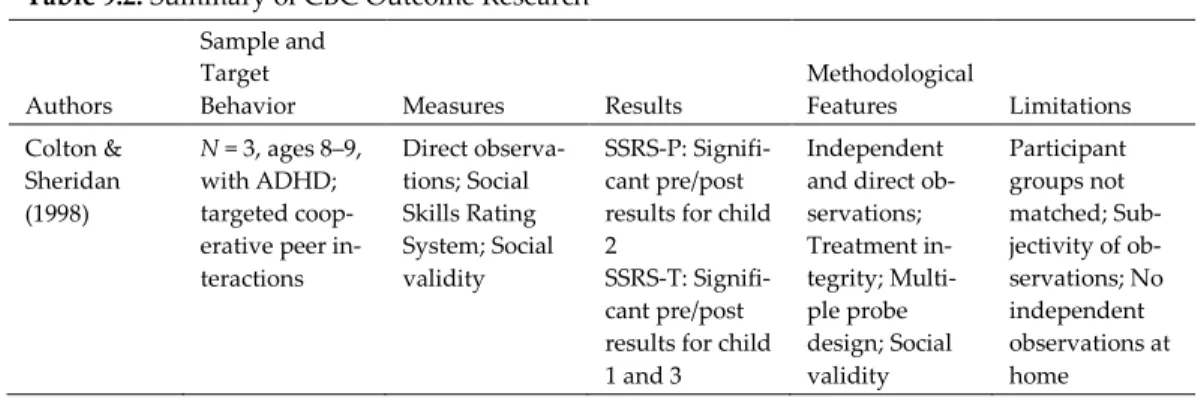
To date, a total of 21 published studies have investigated the effects of CBC using experi-mental (e.g., randomized control, multiple baseline) or case study designs and evaluating various behavioral, social-emotional, and academic concerns. Table 9.2 presents a listing of these studies summarized by authors, sample, target behavior, measures, outcomes, and methodological features (e.g., social validity assessment, fidelity information, and follow-up).
Table 9.2. Summary of CBC Outcome Research
Authors
Sample and Target
Behavior Measures Results Methodological Features Limitations Colton & Sheridan (1998) N = 3, ages 8–9, with ADHD; targeted coop-erative peer in-teractions Direct observa-tions; Social Skills Rating System; Social validity SSRS-P: Signifi-cant pre/post results for child 2
SSRS-T: Signifi-cant pre/post results for child 1 and 3
Independent and direct ob-servations; Treatment in-tegrity; Multi-ple probe design; Social validity Participant groups not matched; Sub-jectivity of ob-servations; No independent observations at home
Galloway & Sheridan (1994) N = 6, grades 1– 3; targeted math comple-tion and accu-racy Math assign-ments (comple-tion/accuracy); Social validity; Treatment in-tegrity Math Accuracy: CBC group gains ranged from 50–144%; Home-note group gains ranged from 20–84% Math Comple-tion: CBC group gains ranged from 39–133%; Home-note group gains ranged from 14–99% Permanent product measures; So-cial comparison across both groups; Treat-ment integrity; Comparison group; Social validity A–B design with replica-tions, not true experiment; In-creasing base-line trend; Lack of control over math instruc-tion; Generali-zability Gortmaker, Warnes, & Sheridan (2004) N = 1, age 5, grade K, with selective mut-ism; targeted increasing ver-bal utterances (case study) Direct observa-tions; Social validity measures; Treatment in-tegrity ES = 1.60 Direct observa-tions; Treat-ment integrity; Process integ-rity No reliability or objective treatment integrity data Illsley & Sladeczek (2001) N = 5; targeted conduct prob-lem behavior and improving parent practices and skills Direct observa-tions; Parental knowledge of behavioral principles; Videotaped parent-child interactions Positive change in child behav-ior; 4/5 parents had improve-ments in par-enting skills Direct observa-tions; Manual-ized approach; Parental behav-ior/knowledge change measures Significant variation among parents Kratochwill, Elliott, Loitz, Sladeczek, & Carlson (2003) N = 125 Head Start students; targeted exter-nalizing and in-ternalizing behavior prob-lems Direct observa-tions; Child Behavior Checklist; Responding to Children’s Behavior Checklist; Treatment integrity; Social validity ES for man-ual/video group: Aggression = –0.41/0.15 Compliance = –0.28/0.08 Other = 0.55/–0.05 Total = –0.08/0.05 Direct observa-tions; Standard-ized rating scales; Treat-ment integrity; Random assignment with control group Low power (small sample/ high variance); Not all groups randomly as-signed; High attrition rate
Lasecki, Olympia, Clark, Jenson, & Heathfield (2008) N = 4, ages 8– 12, with Type I diabetes; tar-geted increas-ing treatment compliance and managing blood glucose levels Direct observa-tions; Self- monitoring of blood glucose levels; Treat-ment integrity; Social validity measures ES for CBC/BC group: Target concern = 2.22 Blood glucose = 1.75 ES for BC group: Target concern = 1.69 Blood glucose = 0.88 Direct observa-tions; Multiple baseline design with random assignment; Treatment in-tegrity; Follow-up data Limited sam-ple; Consultant not blind to condition; Short interven-tion period Murray, Rabiner, Schulte, & Newitt (2008) N = 24, grades K–5, with ADHD and classroom im-pairment; targeted behav-ioral and aca-demic skills Daily Report Cards; Con-ners’ Rating Scales; SKAMP; Academic Per-formance Rat-ing Scale (APRS); Treat-ment integrity; Social validity measures ES on SKAMP: Attention = –0.16 Deportment = –0.24 Total = –0.31 ES on APRS: Academic skills = 0.67 Impulse control = –0.25 Academic productivity = 0.72 Total = 0.80 Standardized rating scales; Treatment in-tegrity; Ran-dom assignment with control group Small sample size; Use of ex-pert consultant limits generali-zability; Possi-bility of response bias Owens, Mur-phy, Richer-son, Girio, & Himawan (2008) N = 117, grades K–6, in under-served rural community; targeted im-proving disrup-tive behavior patterns, social functioning, and academics Disruptive Be-havior Disor-ders Rating Scale; Impair-ment Rating Scale; Student grades; Treat-ment integrity; Social validity Significant im-provement in 2/4 symptom domains (teacher); 3/6 indicators of functioning (teacher); all symptom do-mains (parent); 4/6 indicators of functioning (parent) Comparison group; Random assignment of schools; Treat-ment integrity Services pro-vided by grad-uate students rather than community providers; Strict inclusion criteria not used; Partici-pants not blind to condition
Power et al. (2012) N= 2–6; targeted 199, grades homework per-formance for students with ADHD inatten-tive and com-bined types Parent as Edu-cator Scale (PES); Parent-Teacher In-volvement Questionnaire (PTIQ); Home-work Problems Checklist (HPC); Parent-Child Relation-ship Question-naire (PCRQ); Academic Per-formance Rat-ing Scale (APRS) Significant im-provements post-interven-tion on PES (ES = 0.37); HPC (ES = 0.52); PCRQ (ES = 0.59) Maintenance at 3-month follow-up on PTIQ (ES = 0.28); PCRQ (ES = 0.33) Randomized trial; Random assignment; Treatment in-tegrity; Follow-up data High motiva-tion of partici-pating families limits generali-zability; Low baseline levels of ADHD and ODD symp-toms; Medica-tion could have influenced homework be-havior; Study conducted in clinic setting; Experience of interventionists varied Ray, Skinner, & Watson (1999) N = 1, age 5, with autism; targeted in-creasing com-pliance with low probability commands Direct
observa-tions Increased rate of compliance from 15% to 95%
Direct
observa-tions Generalizabil-ity; Lack of social validity data Sheridan, Bovaird, et al. (2012) N = 207, grades K–3, with dis-ruptive behav-ior; targeted behavioral, aca-demic, and social concerns Behavior Assessment System for Children (BASC-2); Social Skills Rating System (SSRS); Parent-Teacher Rela-tionship Scale-II (PTRS-Scale-II); Treatment in-tegrity; Social validity Significant Teacher Ratings: BASC Adaptive Skills: d = 0.39 SSRS: d = 0.47 PTRS: d = 0.47 Significant Par-ent Ratings: SSRS: d = 0.42 Randomized trial; Random assignment by classroom; Multi-method measures of treatment in-tegrity No direct be-havior observa-tions; Teachers not blind to condition; No information on control group parent-teacher interactions Sheridan, Clarke, Knoche, & Edwards (2006) N = 48, ages 6 and younger in early childhood settings; tar-geted behav-ioral concerns Direct observa-tions; PTRS-II; Social validity Mean behav-ioral outcomes: Home ES = 1.01 (SD = 1.78) School ES = 1.15 (SD = 1.44) Direct observations by parents/teach-ers No random as-signment; No independent observations; Small sample size; No direct measure of treatment in-tegrity
Sheridan &
Colton (1994) N6; targeted fear = 1, male, age of sleeping in own room
Direct
observa-tions Baseline at 0%; Gradual in-creasing trend with treatment; No overlapping data points with baseline; Follow-up at 100% Direct observa-tions; Follow-up data No control group; Lack of control over ex-traneous varia-bles; No social validity data Sheridan, Eagle, Cowan, & Mickelson (2001) N = 52, grades K–9; targeted academic, so-cial, and behav-ioral concerns Direct observa-tions; Treat-ment integrity; Social validity measures ES for home = 1.08, school = 1.11 Total ES = 1.10 (n = 66) Direct observa-tions; Process integrity; Treat-ment integrity Reliability of direct observa-tions; Limited treatment in-tegrity data; External valid-ity Sheridan, Ea-gle, & Doll (2006)
N = 125 students with one, more than one, or no forms of diver-sity; targeted academic, so-cial, and behav-ioral concerns and tested effi-cacy of CBC with diverse clients Direct observa-tions; Social validity measures; Demographic measures of diversity Mean ES for one form of diversity = 1.21 Mean ES for two or more forms of diver-sity = 1.51 Mean ES for no form of diver-sity = 1.35 Direct observa-tions; Process integrity Lack of experi-mental control; Non-random selection or group assign-ment; Limited sample size within groups; Diversity indi-cators based on parent reports Sheridan, Kratochwill, & Elliott (1990) N = 4, ages 8–9; targeted social interactions (withdrawn) Direct observa-tions; Behav-ioral rating scales; Self- report Home: Social withdrawal de-creased 1–2 SD; 3 parents re-ported social initiation in-creased 1+ SD; School: Social withdrawal and total inter-nalizing prob-lems decreased 1+ SD; Social initiation in-creased 1+ SD Independent and direct observations; Treatment in-tegrity; Multi-ple baseline design Participant groups not matched; Objectivity of behavioral observations; Lack of inde-pendent obser-vations in home
Sheridan, Ryoo, Garbacz, Kunz, & Chumney (2013) N = 207, grades K–3; targeted disruptive behaviors Parent Daily Report (PDR); Family Involvement Questionnaire– Elementary Version (FIQ-E); Parent Competence in Problem Solving Scale (PCPS); Treat-ment integrity Increase in par-ent problem solving (d = 0.697) Increase in home-school communication (d = 0.519) Child home be-haviors: Arguing (d = –0.899) Defiance (d = –1.337) Noncompliance (d = –1.049) Tantrums (d = –1.537) Family risk moderated par-ent and child outcomes Randomized trial; Random assignment by classroom; Multi-method measures of treatment in-tegrity Self-report data; Parents not blind to condition; Lim-ited to disrup-tive behaviors; Fidelity of home-based in-terventions measured indi-rectly Sheridan, Warnes, Cowan, Schemm, & Clarke (2004) N = 1, age 4, in Early Child-hood Special Education; tar-geted tantrum-ming (case study) Direct observa-tions; Social validity measures Length of tantrums decreased from 4 minutes to 1.6 minutes Social validity
measures No effect size reported; Can-not rule out threats to inter-nal validity; Generalizabil-ity Sheridan, Warnes, Woods, Blevins, Magee & Ellis (2009) N = 29, grades K–9, receiving services in a pediatric set-ting; targeted behavioral, social, and academic con-cerns Direct observa-tions; Social validity measures Mean behav-ioral outcomes: Home ES = 2.25 (SD = 2.43) School ES = 0.57 (SD = 0.96) Direct
observation Direct observations by parents/teach-ers; Lack of di-agnostic diversity of clients; No treatment in-tegrity data; Medications not recorded; Possible in-flated ES due to single-subject designs
Weiner, Sheridan, & Jenson (1998) N = 5, grades 7–9, at risk for academic fail-ure; targeted math home-work comple-tion and accuracy Permanent products; Treatment in-tegrity; Social validity measures Total ES for Homework Completion: 0.67 (completion in-creased from 45% at baseline to 69.6% at treatment) Permanent products; Mul-tiple baseline design; Treat-ment integrity; Follow-up data Instability and variability in baseline; Treat-ment integrity data not availa-ble for all participants; Assignments not standard-ized; Unknown active ingredi-ents of treat-ment Wilkinson (2005) N = 2 males, grades 4–5, with disruptive behavior dis-orders; targeted increasing on-task and com-pliant behavior (case study) Direct observa-tions; Child Behavior Checklist (CBCL); Treat-ment integrity; Social validity Mean behav-ioral improve-ment of 64% from baseline to treatment CBCL: Signifi-cant improve-ment on Attention Prob-lems, Aggres-sion, and Externalizing scales Direct observa-tions; Standard-ized rating scales; Treat-ment integrity; Follow-up data; Replication across partici-pants Lack of rigor-ous single-case design; Small sample size; Direct observa-tions by teach-ers only
Note: Readers are referred to Guli (2005) for additional methodological information and findings related to CBC research.
Common methods used to assess outcomes across studies are direct observations and behavioral rating scales. Data on acceptability, perceived effectiveness, and satisfaction have also been reported using measures such as the Behavior Intervention Rating Scale (BIRS)–Acceptability and Effectiveness factors (Elliott & Von Brock Treuting, 1991) revised for CBC (e.g., Sheridan, Eagle, Cowan, & Mickelson, 2001), the Consultant Evaluation Form (CEF; Erchul, 1987), and Goal Attainment Scaling (Kiresuk, Smith, & Cardillo, 1994). Additionally, most reported on integrity of CBC implementation.
In this section, we summarize four large-scale data-based reviews of CBC research (Guli, 2005; Sheridan et al., 2001; Sheridan, Clarke, Knoche, & Edwards, 2006; Sheridan, Eagle, & Doll, 2006). A description of individual studies follows, organized as reviews of stud-ies using (a) experimental designs and (b) case study methods. In addition to the pub-lished studies reviewed herein, a number of unpubpub-lished dissertation studies have been completed (e.g., Brown, 2004; Cagle, 2003; Colton, 1999; Finn, 2003; Illsley, 2003; Lepage, 1999; Morganstein, 2003; Moscovitz, 2004; Mulgia, 2001; Myers, 1997; Schnoes, 2003; Scope, 2003; Semke, 2011; Stephan, 1999). Due to space constraints, these will not be re-viewed, but interested readers are referred to relevant Dissertation Abstracts Interna-tional (DAI) sources for complete studies.
Reviews and Meta-analyses
An analysis of parent consultation models revealed that CBC holds promise as an evi-dence-based model. Guli (2005) conducted a comprehensive methodological review of 18 studies on parent consultation literature using rigorous criteria specified in the Procedural and Coding Manual of the Division 16 Task Force on Evidence-based Interventions in School Psychology (Kratochwill & Stoiber, 2002). Within the context of the Task Force cri-teria, CBC was found to hold promise as an evidence-based parent consultation model. Relative to other parent consultation models, CBC provided the strongest evidence for producing significant school-related outcomes. Furthermore, parent consultation studies receiving the highest ratings for key methodological features were those using a model of joint parent-teacher consultation, such as that used in CBC.
In a review of outcomes based on four years of federally funded CBC studies, the effec-tiveness of CBC interventions for 52 students with disabilities (such as behavior disorders, learning disabilities, and attention-deficit/hyperactivity disorder) or who were at risk for becoming eligible for special education services was analyzed (Sheridan et al., 2001). The average effect size for CBC case outcomes was 1.10 (SD = 1.07), with home- and school-based effect sizes averaging 1.08 (SD = 0.82) and 1.11 (SD = 1.24), respectively, with 95% confidence intervals of 0.83 and 1.36. A model fitting client age and symptom severity was found to predict school effect size relatively well (R2 = .425, Adjusted R2 = .343; p = .008), such that older clients (11 years of age and older) with less severe symptoms and younger clients (ages 5–7) with higher severity ratings prior to CBC were predicted to experience higher effect sizes. Case complexity (i.e., number of target behaviors) was not significant in the models.
In another review, Sheridan, Eagle, and Doll (2006) reported the behavioral and social validity outcomes of CBC with a sample of 125 students representing varying levels of diversity (i.e., experiencing none, one, or more than one form of diversity, such as racial, economic, or linguistic). CBC interventions yielded generally high effect sizes regardless of the presence of diversity or the number of diverse characteristics exhibited. Average effect sizes were 1.21, 1.51, and 1.35 for students experiencing one, two or more, and no forms of diversity, respectively. Social validity measures (i.e., perceptions of goal attain-ment, effectiveness, acceptability, and satisfaction) also yielded very favorable results.
To assess CBC as a form of early intervention, Sheridan, Clarke, Knoche, and Edwards (2006) tested the efficacy of the model in early childhood settings (e.g., public school kin-dergarten classrooms, private preschools, Head Start classrooms) with 48 children aged six and younger. Behavioral outcomes suggested generally positive effects, with a mean effect size of 1.01 (SD = 1.78) at home and 1.15 (SD = 1.44) at school. Various measures of social validity revealed positive ratings of goal attainment and the perceived effectiveness and acceptability of CBC, with parents tending to view CBC as slightly more effective than teachers. In addition, parents’ ratings on the Communication to Others factor and the Total Relationship score of the Parent-Teacher Relationship Scale (PTRS; Vickers & Minke, 1995)
Review of Experimental Studies
CBC research has utilized a range of experimental methods, from experimental single- subject designs (e.g., multiple baseline designs) to large-scale randomized trials. Studies examining the effects of CBC on social-behavioral as well as academic outcomes have been conducted.
Experimental studies of social-behavioral outcomes
A series of related studies using rigorous randomized controlled trial methodology exam-ined the efficacy of CBC on social-behavioral outcomes for elementary-aged students (grades K–3) with behavioral and social concerns, as well as mediating and moderating factors (Sheridan, Bovaird, et al., 2012; Sheridan, Ryoo, Garbacz, Kunz, & Chumney, 2013). Two hundred and seven students participated in a four-cohort cluster randomized exper-imental design, with classrooms assigned to treatment (i.e., CBC) or control (i.e., “business as usual”) conditions. Findings demonstrated that CBC had significant effects on child out-comes, parent outout-comes, and the parent-teacher relationship. Specifically, Sheridan, Bovaird, et al. (2012) found that relative to controls, the CBC group showed statistically significant positive changes on the teacher-rated outcome variables of interest, after con-trolling for the severity of behavior problems at baseline. Significant effects were seen on the teacher-rated Adaptive Skills factor of the Behavior Assessment System for Children-2 (BASC-2; Reynolds & Kamphaus, 2004) for CBC participants compared to controls (effect size of dRM = 0.39). In addition, CBC participants displayed greater increases on the teacher- and parent-rated Social Skills Rating System (SSRS; Gresham & Elliott, 1990), with an effect size of dRM = 0.4 7 and 0.42, respectively. In terms of the parent-teacher relationship, teach-ers in the CBC group reported greater increases in their relationships with parents (effect size of dRM = 0.47). However, there was no statistically significant difference between the CBC or control groups on parents’ reports of their relationship with teachers. Importantly, multilevel path analysis revealed that improvements in teacher-reported relationships with parents partially mediated the effects of CBC on positive changes in children’s behav-iors.
Testing student behavioral outcomes in the home setting with the same sample, Sheri-dan et al. (2013) reported that compared to children in the control group, those in the CBC group showed significantly greater decreases in arguing, defiance, noncompliance, and tantrums. Likewise, parents participating in CBC reported significantly different increases in home-school communication and parent competence in problem solving relative to control-group parents. The accumulation of family risk (i.e., low parental education, low income status, fewer than two adults in the household) moderated the effects of CBC on both parent and child outcomes. That is, greater treatment gains were observed in situa-tions of greater degrees of family risk; as the level of family risk increased so did the effects of CBC, suggesting that CBC was most effective for families who experienced the greatest degree of demographic disadvantage.
In an investigation of consultee intervention support, Kratochwill, Elliott, Loitz, Sladec-zek, and Carlson (2003) conducted a study of the differential effects of CBC on behavioral
measures experimental design, outcomes of CBC-manual, CBC-video, and control condi-tions were evaluated with a sample comprising 125 Head Start children, parents, and teachers. Parents’ goal attainment scores revealed that 75% of parents in the manual group and 95.5% of parents in the video group reported progress toward goal attainment. For teachers, 60% in the manual group and 73.1 % in the video group reported similar progress. Across the standardized outcome measures of behaviors, an average of 46.08% and 31.37% of reliable change indices (Gresham & Noell, 1993) were deemed statistically significant in the manual and video conditions, respectively, compared to 25.42% in the control condi-tion. Parents and teachers reported high rates of treatment acceptability and satisfaction with the manual and videotape treatment programs.
CBC has also been shown to be an effective means for improving social skills for socially withdrawn children and children with ADHD. Using CBC and teacher-consultation con-ditions, CBC was found to produce greater social initiations for students across both home and school settings, as opposed to teacher-consultation, which increased children’s initia-tions at school only (Sheridan, Kratochwill, & Elliott, 1990). Generalization and mainte-nance of treatment effects also appeared stronger when conjoint consultation procedures were employed. Children with ADHD have also been shown to increase positive play be-haviors with peers to a level that approached that of “normal” comparison peers via CBC interventions (Colton & Sheridan, 1998).
Experimental studies of academic outcomes
Studies investigating the effectiveness of CBC for improving academic outcomes have also yielded positive findings. In a randomized trial involving CBC, Power et al. (2012) evalu-ated the effectiveness of a family-school intervention designed to improve student aca-demic engagement, parenting skills, family involvement in education, and family-school collaboration. The intervention, Family-School Success (FSS), was comprised of CBC, daily report cards, and a behavioral homework intervention. One hundred and ninety-nine stu-dents (grades 2–6) who met criteria for attention-deficit/hyperactivity disorder (ADHD) combined and inattentive types were randomly assigned to FSS or a comparison group intended to control for nonspecific treatment effects. FSS was found to have significant effects on children’s homework performance, family involvement in education, the quality of the family-school relationship, and parenting behavior.
Following intervention, children in the FSS showed significantly greater decreases in homework inattention and task avoidance than did children in the comparison group (ES
= 0.52), according to parent ratings on the Homework Problems Checklist (HPC; Anesko, Schoiock, Ramirez, & Levine, 1987). A significant Group × Time interaction effect was found on the Parent as Educator Scale (PES), ES = 0.37, indicating that parents in the FSS group perceived themselves as significantly more effective than the comparison group in assisting in their child’s education. In addition, though no significant effect on the family-school relationship was found immediately following intervention, a significant effect was
decreases in their use of negative/ineffective discipline as assessed by the Parent-Child Re-lationship Questionnaire (PCRQ).
Murray, Rabiner, Schulte, and Newitt (2008) also studied a CBC-mediated daily report card (DRC) intervention with a sample of 24 elementary students (grades K–5) with atten-tion-deficit/hyperactivity disorder (ADHD) and academic impairment. Compared to the control group, intervention participants demonstrated greater academic productivity, with a moderately large effect size of 0.72. Moderately large and significant effects were also found on the improvement of academic skills (d = 0.67) and overall functioning as meas-ured by the Academic Performance Rating Scale (APRS; Dupal & Rapport, 1991) (d = 0.80). Average implementation of the DRC was 77.5% for teachers and 59% for parents. Accept-ability ratings showed that the DRC intervention through CBC was highly acceptable to parents, teachers, and children. Similarly, Weiner, Sheridan, and Jenson (1998) imple-mented consultation services in a group format with five junior high school students (grades 7–8) with homework concerns. Using a multiple baseline across participants de-sign moderate effect sizes were yielded for both homework completion (ES = 0.60) and accuracy (ES = 0.67). Parents and teachers reported satisfaction, acceptability, and per-ceived effectiveness of the intervention.
Experimental studies in unique practice contexts
Pediatric applications of CBC represent a new direction of research. Lasecki, Olympia, Clark, Jenson, and Heathfield (2008) compared the effectiveness of traditional behavioral consultation (BC) and CBC in reducing blood glucose levels in four medically at-risk chil-dren with Type I diabetes. A reward procedure was used to reinforce treatment compli-ance with the medical regimen. Children were randomly assigned to a reward + BC or reward + CBC condition. Data were collected for changes in blood glucose levels and reg-imen compliance from baseline to treatment. All participants showed positive changes during treatment. CBC showed average effect sizes of 1.75 in changes in blood glucose levels and 2.22 for regimen compliance, whereas ~C yielded lower average effect sizes of 0.88 for changes in blood glucose levels and 1.69 for regimen compliance. Though these data are limited to four participants, results reveal greater gains for participants in the CBC condition. Across both conditions, follow-up data for three of the four participants showed improved compliance and mental health status.
Sheridan, Warnes, et al. (2009) also explored outcomes of the CBC model when used in pediatric settings. Twenty-nine children (grades K–9) who were receiving primary pediat-ric services through a major Midwestern university medical center were referred by their pediatricians because of the presence of behavioral or social-emotional difficulties that in-terfered with their functioning at home and/or school and learning in the classroom. Client target behaviors were varied and included academic (e.g., language skills, work comple-tion, reading fluency), social (e.g., appropriate interactions), and behavioral (e.g., compli-ance, blurting) concerns. The average effect size for behavioral outcomes was 1.42 (SD = 2.0), with median effect sizes of 0.55 (school) and 1.61 (home) In addition, parent and teacher ratings of goal attainment, acceptability, and satisfaction with CBC services
re-Influenced by the methods and theories behind CBC, Owens, Murphy, Richerson, Girio, and Himawan (2008) demonstrated the adaptation of the model’s principles in an under-served geographical (i.e., rural) area. The authors studied the effectiveness of parent-teacher consultation practices for 117 children (grades K–6) with disruptive behavior prob-lems in a rural community in the Appalachian region. Treatment was comprised of a Daily Report Card (DRC) intervention, biweekly consultation sessions, and behavioral parenting sessions. At school, children in the treatment group were rated by teachers as showing significant improvement in hyperactivity/impulsivity and conduct disorder symptoms, and the trajectories of improvement were significantly different than control-group chil-dren. The treatment group also showed significant improvements in classroom function-ing, their relationship with the teacher, and overall functioning. At home, significant improvement in the treatment group was observed in relationships with peers and par-ents, family functioning, and overall functioning.
Review of Case Studies
In addition to empirical studies, systematic CBC case studies have been conducted and have proven useful in understanding the effectiveness and acceptability of CBC with var-ious target concerns, settings, and populations. The majority of these case studies have reported on behavioral outcomes. Sheridan and Colton (1994) used CBC to implement an intervention to increase a six-year-old boy’s ability to sleep in his own room at night. Through a fading of environment and positive reinforcement procedure, the child demon-strated immediate positive effects and no regression at one-month follow-up. Ray, Skinner, and Watson (1999) reported outcomes of CBC in improving aggressive and noncompliant behaviors of a five-year-old boy with autism. The student’s compliance increased signifi-cantly from baseline to treatment and generalization phases. In a paper describing CBC within a context of “family-centered” services, Sheridan, Warnes, Cowan, Schemm, and Clarke (2004) reported the use of CBC to decrease the duration of tantrums of a four-year-old male attending Early Childhood Special Education (ECSE). Behavioral data indicated that the goal was met quickly upon intervention implementation. The child’s parent and teacher both reported that their goals were completely met, as indicated via Goal Attain-ment Scaling. Wilkinson (2005) presented the positive treatAttain-ment and maintenance findings of teacher ratings of behavioral control (i.e., on-task and compliant behavior) of males (grades 4–5) diagnosed with ADHD and oppositional defiant disorder. Both studies found positive perceptions of acceptability, effectiveness, and satisfaction with consultation ser-vices by parents and teachers.
Furthermore, Illsley and Sladeczek (2001) reported the outcomes of five case studies of children with significant conduct problems, including aggression, noncompliance, and so-cially inappropriate behaviors. In addition to studying behavioral outcomes, this series of case studies sought to identify changes in parent knowledge and skill related to effective parenting practices. All children made significant progress on behaviors targeted for
inter-and were less critical of their children. However, much variability in parent outcomes was observed.
In the area of academics, Galloway and Sheridan (1994) found greater and more stable gains in six elementary (grades 1–3) students’ math completion and accuracy for students in a CBC condition versus a home-note only condition. In the social-emotional realm, Gort-maker, Warnes, and Sheridan (2004) illustrated the positive effects of a CBC-mediated in-tervention on the speaking behaviors of a five-year-old with selective mutism. Auster, Feeney-Kettler, and Kratochwill (2006) used this case study to call for the application of CBC to the treatment of anxiety disorders in school. Both Galloway and Sheridan (1994) and Gortmaker et al. (2004) revealed high levels of acceptability.
Review of Implementation Research
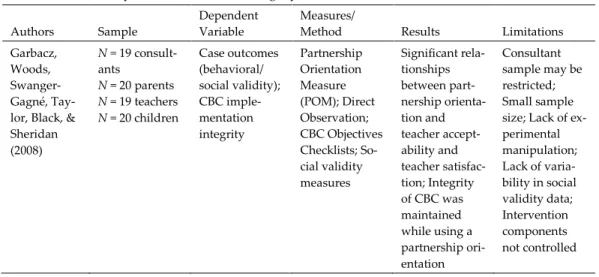
As a model for addressing student target concerns, CBC proves promising. Recently, re-search analyzing the various elements of treatment integrity within the consultation pro-cess has become a topic of interest. Within CBC, two important constructs of treatment integrity exist: intervention implementation integrity and CBC process integrity. A brief review of such research follows, and table 9.3 presents a summary of this treatment integ-rity research.
Table 9.3. Summary of CBC Treatment Integrity Research
Authors Sample Dependent Variable Measures/ Method Results Limitations Garbacz,
Woods, Swanger-Gagné, Tay-lor, Black, & Sheridan (2008) N= 19 consult-ants N = 20 parents N = 19 teachers N = 20 children Case outcomes (behavioral/ social validity); CBC imple-mentation integrity Partnership Orientation Measure (POM); Direct Observation; CBC Objectives Checklists; So-cial validity measures Significant rela-tionships between part-nership orienta-tion and teacher accept-ability and teacher satisfac-tion; Integrity of CBC was maintained while using a partnership ori-entation Consultant sample may be restricted; Small sample size; Lack of ex-perimental manipulation; Lack of varia-bility in social validity data; Intervention components not controlled
Sheridan, Swanger-Gagné, Welch, Kwon, & Garbacz (2009) N = 41 teachers N = 101 parents N = 101 chil-dren N = 7 consult-ants Reliability of treatment integrity measures; relia-bility of CBC adherence ratings Exact agree-ment by two raters coding adherence of fidelity criteria as indicated by permanent products; Standard devi-ations for all measures were computed to indicate stabil-ity of measures over time; CBC process integ-rity assessed by computing agreement of objectives met between two coders Mean % School/Home Integrity Self-Report: 91.24 (SD) = 16.82)/ 81.05 (SD = 27.42) Direct Observa-tion: 87.06 (SD = 20.16)/ NA Permanent Products: 98.57 (SD = 11.95)/ 87.82 (SD = 29.52) CBC Process Integrity: A mean of 96% of objectives de-livered; raters had exact agreement with total number of objectives met for 84% of in-terviews Interventions were individu-alized to ad-dress within-participant con-cerns, disallows computation of Cronbach’s al-pha; Sample size too small to compute Cronbach’s al-pha; No guide-lines for “acceptable” levels of stabil-ity exist; Few measures com-pleted at the same time, making point-to-point con-vergence measures im-possible Swanger-Gagné, Gar-bacz, & Sher-idan (2009)
N = 62 parents
N = 62 children Treatment integrity of intervention implementation Parent self-re-port of imple-mentation integrity; con-sultant rating of implementa-tion integrity by permanent products Strategies for maximizing home imple-mentation in-tegrity include following part-nership model in intervention development, provide ra-tionale for col-lecting integrity data, script, and package tervention in-tegrity forms, and train fam-ily on interven-tion delivery Generalizabil-ity questionable due to inten-sive treatment supports; Case study method-ology; No standardized measures of treatment integrity were used
and consultation procedures used by consultants (i.e., direct observation). Interrater agree-ment on permanent products revealed median exact agreeagree-ment of 88.68% at home and 98.57% at school. Median standard deviations were computed across time points to pro-vide a metric of the stability of measurement in self-reports, permanent product ratings, and direct observations. Findings suggested that across all measures and time points, one could expect fidelity scores to vary approximately ±l5 percentage points. CBC process in-tegrity was assessed using two trained coders who rated consultants on their adherence to the specific objectives of each structured interview. Across coders, an average of 96% of CBC objectives were met (range = 80%–100%; SD = 0.08). Raters had exact agreement on the total percentage of objectives met across 84% of the coded interviews. These prelimi-nary results revealed that high levels of intervention integrity exist across multiple meth-ods and sources, and these high levels of integrity were demonstrated regardless of the methods and sources of data.
Swanger-Gagné et al. (2009) presented descriptive findings from a large-scale consulta-tion study that introduced unique strategies to promote intervenconsulta-tion implementaconsulta-tion in-tegrity in CBC for children with behavioral concerns. Participants were separated into two groups, a general, mainstream group and a diverse, at-risk group (i.e., participants who were of low-income status, racially diverse, linguistically diverse, living in a single parent home, or who had less than a high school diploma). Strategies used with both groups in-cluded training and education, with additional strategies implemented to support families with various life challenges. Integrity was assessed through a daily parent self-report for-mat and a consultant rating of intervention implementation integrity as represented on permanent intervention products (e.g., sticker charts, home-school notes). Results from both measurement methods indicated that families in both the general and at-risk group had high intervention implementation integrity when participating in CBC.
In an exploratory study, Garbacz, Woods, Swanger-Gagné, Taylor, and Black (2008) in-vestigated the extent to which a partnership orientation in CBC predicted case outcomes and process integrity. For 20 case studies, partnership orientation scores on the Partnership Orientation Measure (POM; Sheridan et al., 2005) were compared to measures of accepta-bility, satisfaction, perceptions of effectiveness, and child performance across home and school settings. Elements of a partnership orientation include focusing on strengths, col-laborating, employing sensitivity and responsiveness, communicating effectively, and sharing information. Findings revealed that consultants were able to successfully imple-ment the CBC model with integrity while still adhering to a partnership orientation. In addition, a partnership orientation was a significant predictor of teachers’ (but not par-ents’) acceptability and consumer satisfaction.
Review of CBC Process Research
In addition to improving child outcomes, another primary objective of CBC is to engage parents and teachers in collaborative problem-solving. The manner in which the verbal processes and social context of CBC cultivate this collaborative relationship has been ex-amined. In the following paragraphs, we discuss the research on specific relational
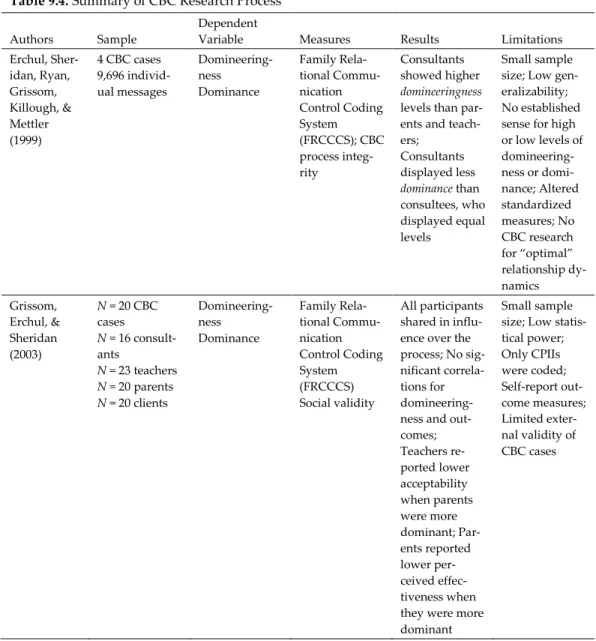
com-Table 9.4. Summary of CBC Research Process
Authors Sample Dependent Variable Measures Results Limitations Erchul, Sher-idan, Ryan, Grissom, Killough, & Mettler (1999) 4 CBC cases 9,696 individ-ual messages Domineering-ness Dominance Family Rela-tional Commu-nication Control Coding System (FRCCCS); CBC process integ-rity Consultants showed higher domineeringness
levels than par-ents and teach-ers; Consultants displayed less dominance than consultees, who displayed equal levels Small sample size; Low gen-eralizability; No established sense for high or low levels of domineering-ness or domi-nance; Altered standardized measures; No CBC research for “optimal” relationship dy-namics Grissom, Erchul, & Sheridan (2003) N = 20 CBC cases N = 16 consult-ants N = 23 teachers N = 20 parents N = 20 clients Domineering-ness Dominance Family Rela-tional Commu-nication Control Coding System (FRCCCS) Social validity All participants shared in influ-ence over the process; No sig-nificant correla-tions for domineering-ness and out-comes; Teachers re-ported lower acceptability when parents were more dominant; Par-ents reported lower per-ceived effec-tiveness when they were more dominant
Small sample size; Low statis-tical power; Only CPIIs were coded; Self-report out-come measures; Limited exter-nal validity of CBC cases
Sheridan, Meegan, & Eagle (2002) N = 13 consult-ants N = 19 parents & teachers N = 16 students 8,848 speech acts 4,986 speech exchanges Influence
Involvement Psychosocial Processes Cod-ing Scheme (PPCS); Direct observations; Social validity Participants displayed higher levels of collaboration followed by obliging state-ments with minimal con-trolling or withdrawing comments; No significant rela-tionship be-tween speech act exchanges and behavioral outcomes No control of relationship or differences among partici-pants; No study of inter-mediary varia-bles; Small sample size; All consultants trained by same re-searcher; Lack of reliability data for direct behavioral out-comes; Only CPIIs were coded; Selec-tion bias
Through an investigation of relational control, Erchul et al. (1999) sought to explain the relational communication patterns that occur within CBC. Analyses conducted with the use of relational coding systems emphasize the connectedness of individuals within a con-versation, along with the pragmatic (i.e., control-related) aspects of messages, using the constructs of “domineeringness” and “dominance.” Erchul and colleagues defined domi-neeringness as an index of an individual’s directiveness or attempt to define relationships throughout consultation, while dominance was considered an index of an individual’s demonstrated influence or success in defining the relationship (see Erchul, Grissom, Getty, & Bennett, this volume). Four CBC cases consisting of 12 interviews were coded for dom-ineeringness and dominance using the Family Relational Communication Control Coding System (FRCCCS; Heatherington & Friedlander, 1987), and results were compared to the relational communication patterns of BC in earlier work conducted by Erchul (1987). The analysis revealed that consultants and teachers participating in CBC displayed similar lev-els of domineeringness as their BC counterparts; however, CBC consultants appeared to be far less dominant than BC consultants. These findings suggest that within the CBC pro-cess, no single individual attempts to direct or influence the other members at dispropor-tionate levels; rather, communication patterns tend to be more bidirectional and reciprocal. Such evidence supports the notion that CBC is a collaborative process involving symmet-rical and reciprocal (i.e., co-equal) relationships with shared influence among participants.
In a similar study, Grissom, Erchul, and Sheridan (2003) investigated aspects of inter-personal control in CBC in relation to case outcomes. Measures of dominance and domi-neeringness were assessed using the FRCCCS and compared to outcome measures of acceptability/effectiveness of CBC, consultant effectiveness, and attainment of consultation goals. Correlational analyses involving the relational communication variables of domi-neeringness and dominance and the three outcome measures failed to produce any
signif-CBC outcome ratings. However, parent dominance was significantly related to two out-come measures. Specifically, as parents influenced the parent-consultant dyadic relation-ship, the acceptability/effectiveness ratings given by teachers were lower. In addition, parent dominance within the parent-consultant and parent-teacher dyads was associated with less favorable parental goal attainment ratings. Thus, as parents demonstrated more influence, they reported less positive behavioral outcomes for their child. Such findings illustrate that control within the consultee-to-consultee and consultee-to-consultant rela-tionships may be an important factor influencing perceptions of case outcomes.
Sheridan, Meegan, and Eagle (2002) examined the nature of the social context in CBC and its relationship to case outcomes (i.e., effect sizes, perceived effectiveness/acceptability of consultation procedures, and satisfaction with the consultant). The Psychosocial Pro-cesses Coding Scheme (PPCS; Leaper, 1991) was used to assess two dimensions of commu-nication function within CBC: influence and involvement. Influence referred to the degree to which a speech act (i.e., a phrase or utterance bound by intonation, pauses, or grammar, which conveyed a single message) attempts to control the task in consultation, or the extent to which a statement directly or indirectly influences the process. Involvement referred to the degree to which a speech act facilitates or hinders the social relationship. Direct and indirect levels of these two dimensions then create four main categories of speech acts: (a)
collaborative speech is high in both influence and involvement, (b) controlling speech is high on influence and low on involvement, (c) obliging speech is low on influence and high on involvement, and (d) withdrawing speech is low on both influence and involvement.
Descriptive analysis of speech acts in 16 CPIIs revealed that individual speech acts among participants were highly collaborative, followed by obliging, with negligible amounts of controlling or withdrawing messages. More specifically, when consultants were not making collaborative statements, they were obliging rather than controlling. In addition, effect sizes were found to be meaningful and positive. Such results indicate that not only is the social context of CBC conducive to the development of collaborative part-nerships across home and school settings, but these collaborative relationships are also effective in addressing concerns on behalf of the child.
Review of Social Validity Research
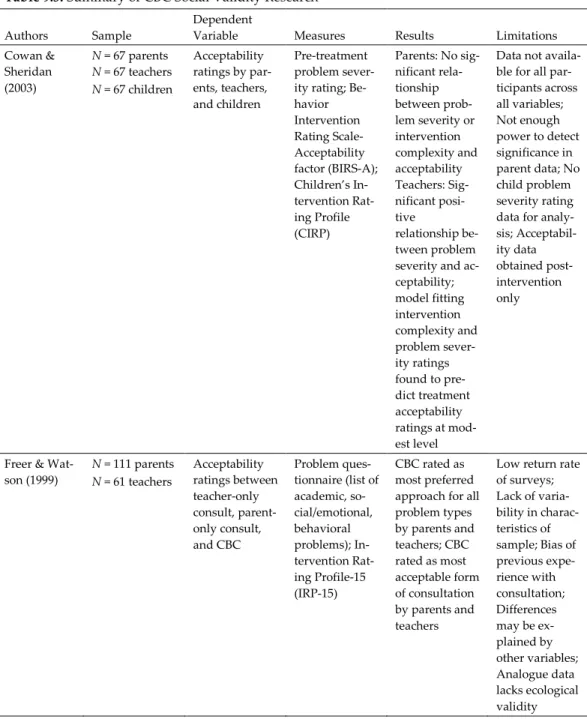
Social validity has been identified as an important research topic in consultation (Elliott, Witt, & Kratochwill, 1991). The aims of social validity research are to determine the degree to which: (a) treatment goals are socially significant, (b) treatment procedures are consid-ered socially appropriate, and (c) treatment effects are clinically meaningful. In the section that follows, a selection of research examining the acceptability and perceived effectiveness of CBC in both hypothetical and naturalistic contexts is summarized. For a complete re-view of social validity CBC research, readers are referred to table 9.5.
Table 9.5. Summary of CBC Social Validity Research
Authors Sample Dependent Variable Measures Results Limitations Cowan & Sheridan (2003) N = 67 parents N = 67 teachers N = 67 children Acceptability ratings by par-ents, teachers, and children Pre-treatment problem sever-ity rating; Be-havior Intervention Rating Scale-Acceptability factor (BIRS-A); Children’s In-tervention Rat-ing Profile (CIRP) Parents: No sig-nificant rela-tionship between prob-lem severity or intervention complexity and acceptability Teachers: Sig-nificant posi-tive relationship be-tween problem severity and ac-ceptability; model fitting intervention complexity and problem sever-ity ratings found to pre-dict treatment acceptability ratings at mod-est level
Data not availa-ble for all par-ticipants across all variables; Not enough power to detect significance in parent data; No child problem severity rating data for analy-sis; Acceptabil-ity data obtained post-intervention only
Freer &
Wat-son (1999) NN = 111 parents = 61 teachers
Acceptability ratings between teacher-only consult, parent-only consult, and CBC Problem ques-tionnaire (list of academic, so-cial/emotional, behavioral problems); In-tervention Rat-ing Profile-15 (IRP-15) CBC rated as most preferred approach for all problem types by parents and teachers; CBC rated as most acceptable form of consultation by parents and teachers
Low return rate of surveys; Lack of varia-bility in charac-teristics of sample; Bias of previous expe-rience with consultation; Differences may be ex-plained by other variables; Analogue data lacks ecological validity
Sheridan, Er-chul, et al. (2004) N = 137 parents N = 122 teach-ers N = 118 chil-dren Perceptions of
helpfulness Consultant Evaluation Form; Behavior Intervention Rating Scale – Effectiveness and Acceptabil-ity factors; Goal Attainment Scaling; Direct observations; Congruence be-tween parent and teacher rat-ings Nonsignificant relationship be-tween parent and teacher helpfulness rat-ings; Nonsig-nificant relationship be-tween parent and teacher agreement and effect sizes; Sig-nificant rela-tionships between differ-ence scores and parent accepta-bility, teacher acceptability, and parent ef-fectiveness rat-ings Reliability of observational data; Select consultant sam-ple Sheridan &
Steck (1995) Npsychologists = 409 school Perceptions of CBC (procedural ac-ceptability, sit-uational acceptability)
Consultation
Questionnaire Procedural ac-ceptability rat-ings were “highly ac-ceptable” CBC acceptabil-ity was greater than other modes of ser-vice delivery for all problem types Only nationally certified school psychologists sampled; Situa-tional accepta-bility and process accept-ability measures may assess different constructs; Self-report of atti-tudes may dif-fer from behavior Sladeczek et
al. (2001) N5, with conduct = 1; male, age problems (case study)
Perceptions of
goal attainment Goal Attain-ment Scaling; Direct observa-tion T score = 64.18, a score above 50 indicating performance above baseline expectations Generalizabil-ity; Cannot rule out threats to internal valid-ity
Sladeczek, Madden, Illsley, Finn, & August (2006) N= 118 Cana-dian school psychologists N = 12 parents Perceptions of
acceptability Consultation Questionnaire; Behavior Inter-vention Rating Scale; Survey on situational acceptability of CBC compared to other modes of service deliv-ery School psy-chologists’ rat-ings indicate positive per-ceptions of pro-cedural acceptability: M = 5.33, SD = 0.58 (with 6 be-ing very ac-ceptable) Parents’ ratings of procedural acceptability: M = 4.99, SD = 0.50 (with 6 be-ing very ac-ceptable) School psy-chologists rated CBC as most acceptable mode of service delivery across all problem types Ratings reflect hypothetical perceptions of acceptability; Small sample size of parents; Results based on voluntary responses to survey Acceptability Research
Hypothetical measures were the first to demonstrate consultee perceptions of the accepta-bility of the CBC model. An early study by Sheridan and Steck (1995) surveyed a national sample of school psychologists to examine their perceptions of CBC as an acceptable model of service delivery. In a similar study, Sladeczek, Madden, Illsley, Finn, and August (2006) used surveys to compare the perceptions of CBC acceptability by American and Canadian school psychologists. Freer and Watson (1999) compared parent and teacher ratings of ac-ceptability of teacher-only consultation, parent-only consultation, and conjoint behavioral consultation. In all of these studies, CBC was found to be a highly acceptable model of service delivery across all problem types (i.e., academic, behavioral, social-emotional) and was the preferred method for addressing these problems when compared to other modes of service delivery.
Other outcome studies have extended the CBC social validity research to measures of acceptability from field-based case work. A four-year study examining 52 CBC cases demonstrated that parents and teachers found the CBC process to be highly acceptable (Sheridan et al., 2001) as measured by the acceptability factor of the BIRS-R. Likewise, Cowan and Sheridan (2003) found that parents, teachers, and children rated interventions created through CBC as “very” to “highly” acceptable. Parents rated interventions with a reductive component as more acceptable than interventions with both positive and nega-tive components; however, no significant differences were found on the acceptability of
existed between (a) intervention complexity and treatment acceptability ratings and (b) problem severity ratings and treatment acceptability ratings. Regression analyses indi-cated that for teachers, the interaction of complexity and problem severity significantly predicted treatment acceptability ratings. These results are not unique to these outcome studies, as multiple CBC studies have investigated the acceptability of CBC and have found it to be rated as highly acceptable by parents and teachers alike.
Goal Attainment
As a common measure of perceived effectiveness in CBC, Goal Attainment Scaling (GAS; Kiresuk et al., 1994) provides a subjective account of how consultation goals have been achieved. Sheridan et al. (2001) examined the effectiveness of 52 CBC cases. GAS reports indicated that across all cases, 100% of parents and 94% of teachers rated goals as partially or fully met. In addition: Sladeczek, Elliott, Kratochwill, Robertson-Mjaanes, & Stoiber (2001) employed GAS as a treatment evaluation procedure within the context of a CBC case with a five-year-old with conduct problems. The goal of consultation was to decrease the child’s inappropriate behaviors (i.e., decrease screaming behavior at school and de-crease clinging behavior at home). The GAS worksheet was used to identify clear goals for the target behaviors: Baseline data were anchored to the “0” position (i.e., “no progress”), the best possible scenario for the target behavior was “+2” (i.e., “goal fully met”) and the worst possible scenario was “–2” (i.e., “situation significantly worse”). During the final weeks of intervention, the child’s parents and teacher both consistently rated his progress toward the intervention goals at +2 (“goal fully met”).
Continued Evolution of CBC
The trajectory of CBC research has evolved from outcome studies using single case designs to randomized trials, from studies exploring communication processes to mediational pathways, and several questions in between. Recent developments in CBC research are identifying methods to integrate the model methodically and strategically into an array of educational settings and contexts. Efforts are under way to understand issues of relevance, salience, acceptability, practicality, and efficacy in authentic and unique practice contexts. Perhaps one of the most important research directions for CBC is identifying effective methods for infusing the model into the natural and authentic practices of educational set-tings. The vast majority of CBC research has been conducted with consultants who are external to systems responsible for service delivery. This approach allows for controlled analyses but often juxtaposes the model onto existing educational and mental health ser-vices without meaningful and sustainable integration. Efforts at full dissemination in field-based practice contexts will only be possible if integration is identified as a goal (rather than implementation that is disjointed from other educational services).