ISSN(Online): 2320-9801
ISSN (Print): 2320-9798
I
nternational
J
ournal of
I
nnovative
R
esearch in
C
omputer
and
C
ommunication
E
ngineering
(An ISO 3297: 2007 Certified Organization)
Vol. 3, Issue 3, March 2015
Adaptation Backoff Exponent Mechanism in
Zigbee Sensor Network for Improving
Throughput
Priyanka Deshpande
1,Mangala S. Madankar
2M. E. Student, Department of Computer Science and Engineering, GHRCE, Nagpur, India
Assistant Professor, Department of Computer Science and Engineering, GHRCE, Nagpur, India
ABSTRACT: Wireless sensor network is an emerging technology which consists of activities like sensing, computing,
instrumenting and observing low power sensor nodes. In wireless sensor networks, maintaining the higher throughput is the main concern. Throughput of the network which is obtained from the wireless sensor network is vital issue which must be high which is measured in data packets per second in this context. The network of wireless sensors which is to be considered in this research mainly based on zigbee protocol and IEEE 802.15.4 standard and treated with cluster tree topology which is considered as a most suitable zigbee topology. The problem that sensors usually face in wireless sensor network is that when data packets are transferred from one node to another node, the throughput of the wireless sensor network decreases because of packet collisions and high network traffic. So we have proposed improved ABE mechanism which uses IEEE 802.15.4 slotted CSMA/CA to obtain the better throughput of zigbee based wireless sensor network.
KEYWORDS—Wireless sensor network, Throughput, Zigbee, IEEE 802.15.4 standard, ABE mechanism
I. INTRODUCTION
There are many advances being made in wireless communication technology in many fields like industry, medical, security, geological military etc. The wireless sensor network is an infrastructure which sense surroundings, transmitting information wireless to other nodes for sharing collaborative tasks. It composed of activities like sensing,
computing and communication elements. Recent advancement in this field has provided with standards such as IEEE
802.15.4 and Zigbee, which provides a platform for many commercial applications. Sensor nodes are the essential building blocks in sensor network. Sensors in a wireless sensor network have a variety of purposes, functions and capabilities. Throughput plays very important role in WSN, as if we obtain higher throughput, the performance of the network will automatically get increased.
ZigBee [1] is the standard based wireless technology, which is built on the top of IEEE 802.15.4 standard. Zigbee is very easy to implement and needs little power to operate. Zigbee has defined rate of 250kb/s, which is best suitable for periodic data routing. There are various advantages of Zigbee which are Low cost, reliable and self healing, easy to implement and Deploy, Standard based. There are mainly three logical devices of zigbee which are Zigbee Coordinator, Zigbee Router and Zigbee End devices which are as follows:
1. Co-ordinator (ZC): Co-ordinator is the root of the network. It is the top level device of zigbee network who initiates the network formation by assigning special identification called personal area network identification (PAN ID). It may act as a router once network is formed.
ISSN(Online): 2320-9801
ISSN (Print): 2320-9798
I
nternational
J
ournal of
I
nnovative
R
esearch in
C
omputer
and
C
ommunication
E
ngineering
(An ISO 3297: 2007 Certified Organization)
Vol. 3, Issue 3, March 2015
3. End device (ZED): End device is the poor capability device which is the last type of devices. It does not allow association or does not participate in routing. It is a kid device depending on parent devices like coordinator or router to provide the coverage and associated with it.
When we use wireless sensors which are based on zigbee are build on two aspects which are IEEE 802.15.4 standard and Zigbee protocol. The stack of wireless sensors consists of four layers which are physical layer, MAC layer, network layer, and application layer. 802.15.4 Standard deals with physical and MAC layer while network layer and application layer comes under the zigbee protocol. Physical layer is used for transmitting and receiving bits. Activation and deactivation of the radio transceiver is one of the responsibilities of physical layer. In addition, it will also useful for the energy and signal management functions. The MAC sub-layer handles all access to the physical radio channel. MAC layer is used to form a bridge between 802.15.4 standard and zigbee protocol. In MAC layer, there can be four types of frames that can be used which are data frame, beacon frame, acknowledgment frame and MAC command frame. In addition to this, it uses CSMA/CA mechanism for channel access and also useful for handling and maintaining the GTS (Guaranteed time slot) mechanism as well as PAN association and disassociation.Fig.1 shows the protocol stack of zigbee [2].
Fig.1 Protocol stack of Zigbee
ISSN(Online): 2320-9801
ISSN (Print): 2320-9798
I
nternational
J
ournal of
I
nnovative
R
esearch in
C
omputer
and
C
ommunication
E
ngineering
(An ISO 3297: 2007 Certified Organization)
Vol. 3, Issue 3, March 2015
Fig.2 Architecture of IEEE 802.15.4
ABE mechanism: To increase the throughput of the zigbee based sensor network, here we focus on ABE(adaptive backoff exponent) mechanism which is an adaptation method, in which coordinator who is the root of the network, observes the number of idle slots before data is transmitted and accordingly it adapts BE which is the contention parameter to the optimal value. The ABE mechanism [6] which is proposed in this paper mainly relies on coordinator who plays very important role by observing the channel, deriving its load, and distributing the value of the contention window to the associated devices.
II. RELATED WORK
The low rate Wireless PAN supports two types of topologies which are star topology and peer to peer topology. In star topology where the nodes can only communicate to the coordinator and in peer-to-peer topology, capable network nodes can be used to route data. If more than peer-to-peer networks will work together it will form a mesh or cluster tree topologies. Throughput of the network which is obtained from the wireless sensor network is vital issue which
must be high which is measured in data packets per second. The network throughput is defined as the time occupancy
ratio of successfully received data packets at the PAN coordinator. The behaviour of zigbee network with different topologies has been analyzed in [7]. As well as Performance analysis of IEEE 802.15.4 MAC has been discussed in [8] in detail. Furthermore, to minimize the power consumption, performance analysis of adaptive MAC algorithm has been done in [9].
There are several techniques that are used to improve the throughput of zigbee based sensor network. As the traffic load will get increased, the ratio of successfully data delivery gets reduced, resulting in less efficient performance and low throughput. For improving this performance and throughput of zigbee based wireless sensor network, various techniques were proposed. In a distributed algorithm [10], that is totally suitable for the zigbee, push pull reliable operation has been used to improve the throughput and reduce the traffic. Time Shift Grouping Access [11] is a new active period assignment method in IEEE 802.15.4 beacon mode for cluster-tree networks which proposes an important issue of throughput bottleneck which is placed at the top level of PAN. Cozi [12] is another method, which is a distributed method of packet scheduling, which is used to increase the throughput as well as to offer maximum bandwidth utilization. The objective of this method is to maximize the bandwidth utilization and to reduce transmissions in end-to-end and dissemination-based communication.
ISSN(Online): 2320-9801
ISSN (Print): 2320-9798
I
nternational
J
ournal of
I
nnovative
R
esearch in
C
omputer
and
C
ommunication
E
ngineering
(An ISO 3297: 2007 Certified Organization)
Vol. 3, Issue 3, March 2015
A. Distributed Throughput Optimization for ZigBee Cluster-Tree Networks [10]
Paper [10] describes a new algorithm to enhance the performance and optimize a throughput of zigbee cluster tree network. The drawback of this paper is traffic load will get increased and data delivery ratio is not properly from source and destination. So new algorithm called a distributed algorithm that is totally suitable for the zigbee standard has been proposed and for improving the throughput and reducing the traffic, push pull reliable operation has been used. In the zigbee cluster-tree topology, IEEE 802.15.4 MAC super frame structure is used to manage the power saving operation and it enables a light-weight tree routing protocol under a distributed address assignment policyconfigured by various system parameters.
B. Time Shift Grouping Access in IEEE 802.15.4 MAC Beacon Mode for Layered-Tree Networks [11]
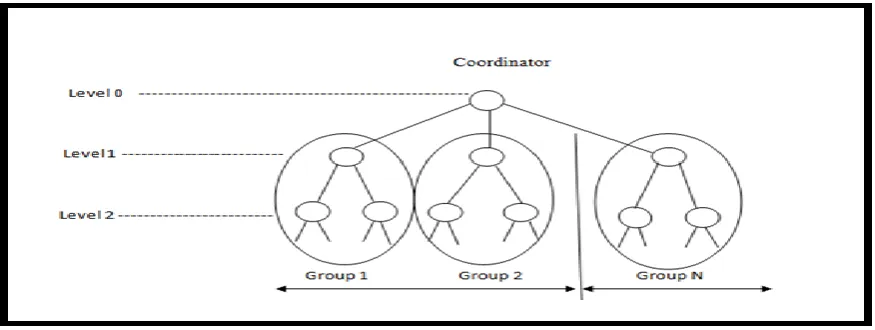
Paper [11] describes a new active period assignment method called Time Shift Grouping Access in IEEE 802.15.4 beacon mode for cluster-tree networks. In TSGA scheme, except PAN coordinator all nodes are grouped by level 1 router. It proposes an important issue that is how to assign active periods including beacon frames among multiple routers for the beacon mode in cluster-tree networks, and also for reducing collisions between them. Paper [11] also proposes an important issue of throughput bottleneck which is placed at the top level of PAN. In order to solve this issue, a new active period assignment method has been proposed in this paper. The method proposed in this paper, splits the beacon interval of PAN into two time slots. The top-level routers are partitioned into two groups using different time slots so as to balance the traffic load between slots and make full use of time resource. The objective of this technique is to enhance the performance of network throughput and to reduce energy consumption by 1/2 to 1/3. Fig. 3 shows the node structure which are grouped by level one routers [11].
Fig.3 Nodes grouping by level-one router
C. CoZi: basic Coding for better Bandwidth Utilization in ZigBee Sensor Networks [12]
ISSN(Online): 2320-9801
ISSN (Print): 2320-9798
I
nternational
J
ournal of
I
nnovative
R
esearch in
C
omputer
and
C
ommunication
E
ngineering
(An ISO 3297: 2007 Certified Organization)
Vol. 3, Issue 3, March 2015
Fig.4 Illustration of Cozi Queuing System
IV. PROPOSED METHODOLOGY
ABE (adaptive Backoff Exponent ) is an adaptation algorithm which not only supports higher back off exponents but also provides better energy consumption as well as it also provides markable improvement in the performance of the throughput of the system. It is primarily based on three important principles. The first one is the range of back off exponents should be high to the devices, in order to reduce the probability of devices which chooses the same number of back off slots for sensing the channel. The Second is to obtain a constant minimum back off exponent (macMinBE) value which is used in the standard CSMA-CA. In this algorithm, as the minimum backoff exponent is variable; so when devices want to start a data transmission they cannot start it with the same backoff exponent. And third is, the minimum backoff exponent (macMinBE) is used. The algorithm is implemented in three phases which are as follows:
Analyzing Phase
Decision Phase
Implementation Phase
[1] Analyzing Phase: The analyzing phase is repeated after every analyzing cycle. The analyzing cycle is the time during which the coordinator observes the contribution of each node to the network traffic. It is a variable that can be used to fine tune the algorithm to produce the best results. At the initiation of data transmissions the devices shall start off by setting their macMinBE to 3 as specified in the standard CSMA-CA for 802.15.4. After the initialization, the devices shall continue with their data transmissions. During this period the coordinator sums the number of packets contributed by each node until it reaches the end of the analyzing cycle.
[2] Decision Phase: The decision phase follows the analyzing phase. Thus, at the end of the analyzing phase, the coordinator has enough information on each node’s contribution to the network traffic. It shall now proceed to see if it is the time to apply a change in the macMinBE. If yes, it shall next decide which nodes should increment their macMinBE and which nodes should decrement it.
[3] The Implementation Phase: The coordinator has taken its decision and has indicated it in the beacon fields, and
ISSN(Online): 2320-9801
ISSN (Print): 2320-9798
I
nternational
J
ournal of
I
nnovative
R
esearch in
C
omputer
and
C
ommunication
E
ngineering
(An ISO 3297: 2007 Certified Organization)
Vol. 3, Issue 3, March 2015
3) STEP-3: Check if its address matches to the address list in the first four fields of the addrList. If yes, decrement its macMinBE by 1, and check if it is equal to 0. If yes, set it to 1. If its address is not listed in the first four address list, go to STEP-4.
4) STEP-4: Check if its address matches to the address list in the last four fields of the addrList. If yes, increment its macMinBE by 1. If its address is not listed, continue with the normal beacon operation.
V. SIMULATION RESULTS
The simulation model of wireless sensor based zigbee is implemented using NS2 simulator. The network of wireless sensors based on zigbee is based on the following assumptions that the network includes total eleven nodes which include one coordinator, three routers, and seven end devices.
Fig.5 Scenario of zigbee wireless sensor network while sending data from one device to other device
ISSN(Online): 2320-9801
ISSN (Print): 2320-9798
I
nternational
J
ournal of
I
nnovative
R
esearch in
C
omputer
and
C
ommunication
E
ngineering
(An ISO 3297: 2007 Certified Organization)
Vol. 3, Issue 3, March 2015
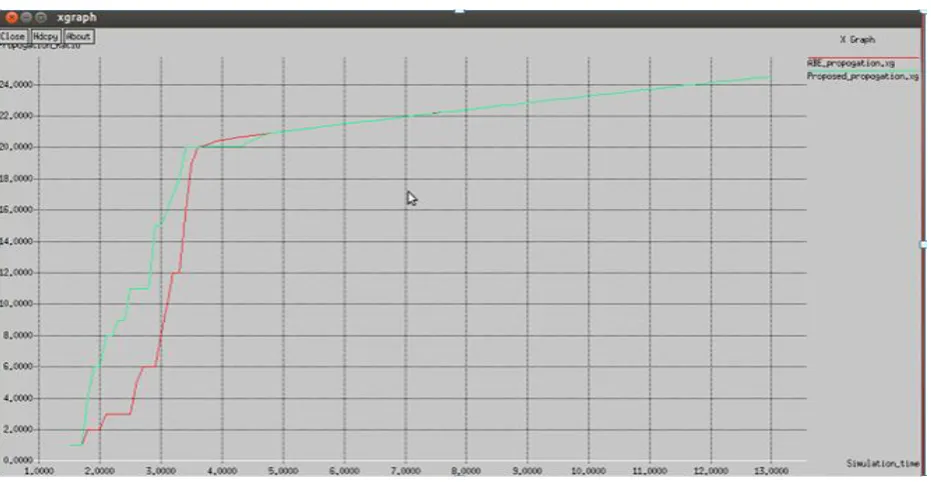
Fig.6 Graph showing propagation ratio with ABE mechanism
ISSN(Online): 2320-9801
ISSN (Print): 2320-9798
I
nternational
J
ournal of
I
nnovative
R
esearch in
C
omputer
and
C
ommunication
E
ngineering
(An ISO 3297: 2007 Certified Organization)
Vol. 3, Issue 3, March 2015
Fig.7 shows the graph of end to end delay with ABE and without ABE mechanism respectively. End-to-End delay is
defined as the average of the time taken for all data packets to reach the destination node successfully. In order to increase the throughput of the network end to end delay must be low.
VI. CONCLUSION
Wireless sensor network has a research area from past few years. Zigbee is a promising low rate PAN technology. In this paper, different methods that are used to improve the throughput of zigbee sensor network are discussed briefly. We mainly focus on ABE mechanism which increases the throughput of the zigbee sensor network. In addition, our simulation results with zigbee supported IEEE 802.15.4 standard shows that the proposed ABE method provides a good performance in terms of the end to end delay and propagation ratio parameters on which throughput of the network is depend.
REFERENCES
[1] ZigBee Alliance, “ZigBee Specifications”. Dec. 2006.
[2]Firas S. Al-Sharbaty, “Wireless Sensors Network and Acknowledgement Technique Based ZigBee System,” 6th International Conference on CSIT Electrical Engineering Mosul University, 2014.
[3]IEEE 802.15.4, “WPAN task group 4,” http://www.ieee802.org/15/pub/ TG4.html, 2006.
[4] Saad A. Khan and Fahad A. Khan “ Performance analysis of a zigbee beacon enabled cluster tree network,” ©2009 IEEE.
[5]Surender.R , P. Samundiswary , “Performance Analysis of Node Mobility in Beacon and Non-Beacon enabled IEEE 802.15.4 based Wireless Sensor Network,” International Journal of Computer Applications (0975 –8887)Volume 76–No.12, August 2013.
[6]Nazim Abdeddaim, Fabrice Theoleyre, Martin Heuss, and Andrzej Duda, “Adaptive IEEE 802.15.4 MAC for Throughput and Energy Optimization,” IEEE International Conference on Distributed Computing in Sensor Systems. 2013.
[7]Amritpal Kaur, Jaswinder Kaur, Gurjeevan Singh “Simulation and Investigation of Zigbee Sensor network with mobility support,” 978-1-4799-2572-8/14/$31.00_c IEEE 2014.
[8]Y.-K. Huang, A.-C. Pang, and H.-N. Hung, “A Comprehensive Analysis of Low-Power Operation for Beacon-Enabled IEEE 802.15.4 Wireless Networks,” IEEE Transactions on WirelessCommunications, vol. 8,no. 11, november 2009.
[9] Pangun Park, Member, IEEE, Piergiuseppe Di Marco, Student Member, IEEE, Carlo Fischione, Member, IEEE, and Karl Henrik Johansson, Fellow, “Modeling and Optimization of the IEEE 802.15.4 Protocol for Reliable and Timely Communications,” IEEE transactions on parallel and distributed systems, vol.24, no.3, march 2013.
[10] Yu-Kai Hua, “Distributed Throughput Optimization for ZigBee Cluster-Tree Networks,” IEEE transactions on parallel and distributed systems, vol. 23, no. 23, MARCH 2012.
[11] Yasushi Yamao and Satoru Takagishi, “Time shift Grouping Access in IEEE 802.15.4,” Advanced Wireless Communication Research Center, The University of Electro-Communications, 1- 4244-1457-1/08/$25.00 © IEEE 2008.
[12]Ismail Salhi, Yacine Ghamri-Doudane, Stéphane Lohier1 and Erwan Livolant, “Cozi basic coding or bandwidth utilization in zigbee sensor networks,” 978-1-4244-5638-3/10/$26.00 © IEEE 2010.
BIOGRAPHY
Priyanka Deshpande received the B.E degree in Computer science and Engineering from the Nagpur University, India, in 2012 and currently pursuing M.E.in wireless communication and computing from G. H. Raisoni college of
Engineeringand the M.E. degree
Mangala S. Madankar received the B.E degree in Computer Engineering from the Nagpur University, India, in 2004