Integrating RDI Into Learning
An evaluation of research, development
and innovation activities at FUAS institutions
Ulla Kotonen (ed.)
The FUAS Research Review is one step towards the stra-tegic intent of FUAS for 2020. The purpose of the Rese-arch Review was to give a clear and realistic picture of the research, development and innovation activities of FUAS through assessing the RDI activities of each member in-stitute and to produce strategic evaluation data that will develop the FUAS RDI activities. The Research Review produced and assessed information about the role of the RDI activities at FUAS, the current state of the RDI acti-vities at the four focus areas of FUAS, the integration of the RDI activities and education, the international aspects of the RDI activities, and the profitability, quality and in-fluence of the RDI activities. The report combines both self-evaluation and external evaluation as well as options for the development of RDI at FUAS.
The publication series of Lahti University of Applied Sciences A Research reports
B Study material
C Articles, reports and other current publications ISSN 1457-8328
ISBN 978-951-827-197-3
A publication of Lahti University of Applied Sciences,
Integrating RDI into Learning
An evaluation of research, development
and innovation activities at FUAS institutions
Lahti University of Applied Sciences
Lahti 2013
The publication series of Lahti University of Applied Sciences A Research reports
B Study material
C Articles, reports and other current publications A publication of Lahti University of Applied Sciences
Series C Articles, reports and other current publications, part 149 Editor-in-chief: Ilkka Väänänen
Layout: Sanna Henttonen ISSN 1457-8328 ISBN 978-951-827-197-3
Contents
Preface ... 6
Executive summary ... 8
The background to the FUAS research review ... 11
FUAS RDI strategy ...28
Self-evaluation...33
External evaluation ...67
Options for the development of RDI at FUAS ...81
Development of FUAS RDI in 2014 ...92
References ... 95
The FUAS Research Review evaluation was prepared by the FUAS Research Review working group (FUAS RR Team) which consisted of representatives of all FUAS universities:
HAMK University of Applied Sciences
• Riitta Hakulinen, Head of Quality Assurance
• Helena Kautola, Deputy of the Education and Research unit of Technology, Director of research of the Unit of Technology
Laurea University of Applied Sciences
• Antti Vettenranta, Director, Business Services • Tuija Hirvikoski, Director, Internationalisation of RDI
LUAS University of Applied Sciences
• Ilkka Väänänen, Director, Research
FUAS – Federation of Finnish Universities of Applied Sciences
• Ulla Kotonen, Development Manager, Research, Development and Innovations (from May 1, 2013)
• Sara Heikkilä, RR assistant/Quality assistant, FUAS Quality group
The FUAS RR Team divided its self-evaluation analysis into three main parts. First the team concentrated on RDI in the FUAS strategy 2011 – 2015 and FUAS focus areas. Second, the team focused on RDI culture in FUAS and the imple-mentation of FUAS strategy by analysing FUAS RDI structures and resources, RDI practices, RDI integration into education, innovations and entrepreneur-ship as well as the regional influence of FUAS RDI activities. Furthermore, a wide range of RDI projects were presented in order to gain a better under-standing of the forms, possibilities and problems of RDI at FUAS. Third, the SWOT analysis method was used to evaluate the strengths, weaknesses, op-portunities and threats of FUAS RDI.
Thanks are due to our international FUAS Research Review Audit Board members, Dr Jack Spaapen, Dr Jordi Molas-Gallart and Dr Matti Lähde-niemi for their valuable contribution to the future development of FUAS re-search, development and innovation activities. Their findings and recommen-dations are very important for us, and the options they presented for the de-velopment of RDI have sparked good discussion at FUAS.
Thanks also to all FUAS Research Review Team members and other FUAS members for their valuable contribution to the evaluation process. This eval-uation would not have been possible without them.
On behalf of the FUAS Research Review Team Ulla Kotonen
Development Manager, Research, Development and Innovations FUAS – Federation of Universities of Applied Sciences
Executive summary
In the FUAS Research Review, we as the audit board members assessed the RDI activities of three Universities (HAMK, LUAS and Laurea) working togeth-er in the Fedtogeth-eration of Univtogeth-ersities of Applied Sciences (FUAS). We looked at the vision and strategy developed by FUAS and the options for the contin-uous development of RDI activities in FUAS and its member universities. The RDI review is based on interviews with a broad range of individuals from the universities (ranging from the rectors via programme and focus group leaders through to researchers and students) and research client organisations, and on a review of documents including a self-evaluation report, the strategic docu-ment (Collaborate for success) and the Curriculum review.
The ambitions of FUAS are to become a strong player in the regional innova-tion ecosystem, and to enhance the connecinnova-tion with internainnova-tional, in particu-lar European, research funders and partners. Our review committee supports this ambition. To succeed, it is necessary that FUAS and its universities further develop their collaborative links with public and private regional partners and enhance their RDI capacities to enable them to participate actively in interna-tional RDI activities. In other words, the central role that FUAS sees for itself as a prime mover in the regional system, needs to be underpinned by a strong set of international RDI activities. This is an extremely challenging task since international competition is becoming increasingly fierce.
Despite these difficulties, our review shows that there are many reasons to be confident about the development of RDI into a strong FUAS function. The lead-ers of the three UASs are determined to pursue this goal, there are high-qual-ity and enthusiastic lecturers and students, and the four RDI focus areas are relevant and complement each other. These elements can be brought togeth-er to gentogeth-erate the necessary capacity to access European RDI funds. Furthtogeth-er- Further-more, the emphasis of the Horizon 2020 programme on social challenges, and multi-disciplinary, problem-driven research, will place FUAS and its universi-ties in a good position to participate in H2020 projects.
We think, however, that two areas need more attention in order to achieve this goal. First, more effort needs to be put into the development of a common agenda with the regional policy makers, and preferably with the business sec-tor. Here also, the building blocks are there: government, private sector and the universities (the so-called golden triangle) have long experience in work-ing together but have not set up a structured collaboration strategy for the re-gion as a whole. A common agenda with rere-gional partners should be part of the next FUAS strategy. Second, the possibilities that FUAS opens as an organ-isational structure should be exploited in the coming years. The three par-ticipating universities still remain independent entities, responsible for
edu-Stressing the importance of RDI and pursuing international strategies does not mean breaking the current teaching-orientation of RDI activities at the three FUAS universities. The active link between RDI activities and teaching has contributed to strengthening the quality of its professional training. Yet, to what extent should RDI continue to be seen as subordinate to the teach-ing function? In our view, FUAS faces a choice between two main models on which to base its RDI strategy:
RDI as an activity supporting teaching
In this, RDI activities are seen mainly as an element of the teaching curricula providing students with direct experience of the challeng-es that they are likely to face in their profchalleng-essional livchalleng-es when trying to develop new solutions for relevant practical problems. Projects that are best suited to this practice will be those related to innovation and entrepreneurship, and requiring moderate technical/research skills (small-step innovation). Projects calling for the application of sophis-ticated methodologies and developing state-of-the-art knowledge will be less suited to this kind of use. The challenge here is to provide a constant flow of RDI assignments with a profile that can enable the contribution of students (at either undergraduate or Masters level).
RDI as a self-determined function
RDI is seen as a set of activities that need to be pursued as an addition-al function of the UASs. In addition to teaching, RDI supports the Uni-versities of Applied Sciences by providing relevant services to society, resources to the universities and enhancing the skills and knowledge of their academic staff. Not all RDI activities need to be directly relat-ed to teaching, but staff working in projects that develop or apply fron-tier knowledge and technologies are also likely to provide more up-to-date and relevant teaching. The research function can, from this per-spective, reinforce teaching activities even when not all research pro-jects are directly linked to teaching. This strategy would require some substantial changes in the current activities and practices of the uni-versities integrating FUAS.
In the first option, the future of FUAS will be oriented mainly towards its re-gional role and RDI activities will aim at linking RDI assignments with sub-stantial teaching activities and a focus on the needs of local and regional part-ners. Within this environment, it is still possible for the FUAS universities to engage in projects addressing basic and applied research problems, pushing the knowledge frontier, but these tasks will not constitute the core of FUAS RDI strategy. Also, international collaboration will still be an option, though chances of European funding will depend on the level of integration of the three universities within FUAS. This option relies on the traditional strengths of the three universities.
In the second option, RDI is developed as a function in its own right, seek-ing its own goals. This is not meant in the traditional blue sky or ivory tower sense. The RDI function will seek relevance by maintaining the current applied and problem-oriented focus that drives RDI at FUAS. Yet, it will engage with assignments that require state-of-the-art knowledge and capacities, even if this means that the involvement of undergraduate or Masters students in the projects is not feasible. To be able to do this, the academic staff has to be up-to-date with the latest developments in their fields and maintain a hands-on knowledge of the shifting requirements and needs of research stakeholders. This up-to-date knowledge can then be transferred to students. Furthermore, this would call for the establishment of a body of research students, prefera-bly at doctoral level. Doctoral students contribute highly qualified expertise to research projects in all kinds of universities: whether technical or profes-sional, or oriented to academic research. We believe that the possibilities for FUAS universities to develop a self-determined RDI function will depend on their ability to establish a doctoral programme. If allowed to do so, this could be organised through a central FUAS “research institute”.
The two models described here clearly have different organisational conse-quences for FUAS. In the first option, the current state of affairs suffices. The three universities remain separate institutes with their own focus on innova-tive ways to integrate RDI in teaching, and gradually new collaborainnova-tive pat-terns might develop including further attunement with partners in the region. The second option demands a new set of roles for FUAS to provide active sup-port for the research function. This could be done through a “research insti-tute” able to be a contractual partner on behalf of the three universities in re-search projects, offering an institutional base for a (possibly doctoral) rere-search programme, and supporting the research activities of all interested lecturers at the three universities.
FUAS Research Review Audit Board
Chapter One
The
background
To The FuaS
reSearch
review
The FUAS Federation
Finland’s largest alliance of universities of applied sciences, FUAS − Federa-tion of Universities of Applied Sciences1 came out of a partnership between the HAMK, Lahti and Laurea universities of applied sciences. The FUAS Fed-eration was established by HAMK, Lahti and Laurea Universities of Applied Sciences to serve students, business life and the public sector in an improved capacity as well as to seize the opportunities of a strongly internationalising operating environment. Each of the FUAS institutions maintains its independ-ence and continues to be responsible for the educational, RDI and regional de-velopment tasks in the region.
HAMK University of Applied Sciences (HAMK)2 is maintained by the Häme
Municipal Federation for Professional Higher Education (HAKKY), formed by six member municipalities. HAMK employs approximately 700 personnel and has app. 8,600 students. HAMK has units in seven locations within a 100 km area of range. These units specialise in specific areas, namely culture; natural resources and the environment; natural sciences; social sciences, business and administration; social services, health and sport; technology, communication and transport; and professional teacher education. HAMK profiles itself as a future-oriented integrator of first-rate, diversified education, research and in-novation (ERI), whose aim is to support the overall development of the region.
Lahti University of Applied Sciences (LUAS)3 is one of the units in Päijät-Häme
Educational Consortium owned by 13 municipalities in the region. LUAS is located in Lahti. LUAS is a regional centre of expertise with over 5,000 stu-dents and approximately 400 personnel. LUAS has two competence areas wel-fare and business and design and technology. LUAS’s focus areas are design, environment, and the development of welfare services, and profiles are inte-grated pedagogy, practice-based innovation, and student entrepreneurship.
Laurea University of Applied Sciences (Laurea)4 operates as a limited company
(Laurea-ammattikorkeakoulu Oy). Laurea has seven campuses in Helsinki metropolitan area. Laurea employs approximately 500 personnel and has app. 8,000 students. Laurea’s focus areas are service business, expertise in nursing and coping at home, in the form of general nursing education, security and
social responsibility, and student entrepreneurship. Laurea’s profiles are ser-vice innovations and value networks, internationally acknowledged and pro-ductive research, development and innovation activity, an operating model Lbd (Learning by Developing) that promotes the development of working life by integrating learning and R&D.
The FUAS institutions have around 21,000 students, representing approx. 15% of Finland’s university of applied sciences students and 1,700 staff. FUAS em-ploys more than 170 qualified researchers. The R&D volume totals approxi-mately EUR 23 million, which accounts for around 16% of the total R&D vol-ume in Finnish Universities of Applied Sciences. The more detailed facts and figures of FUAS UASs are presented in Appendix 1 Facts and figures of HAMK, Appendix 2 Facts and figures of LUAS, and Appendix 3 Facts and figures of Laurea.
The FUAS federation is intended to ensure that the competence of three major universities of applied sciences brings advantage to the entire operating area. The FUAS institutions conduct applied research and development and offer ed-ucation working closely with the labour sector, particularly with SMEs, public administration and the third sector. It intends to play an instrumental role in building the innovation environment of the Helsinki Metropolitan Area and supporting the development of top-level expertise.
The background to
the FUAS research review
The need to evaluate research, development and innovation (RDI) activities in universities of applied sciences has been highlighted in numerous different documents (e.g. Ministry of Education and Culture 2012; Ministry of Edu-cation & the Ministry of Employment and the Economy 2009; Academy of Finland 2009). The Finnish Higher Education Evaluation Council (FINHEEC) conducted a sector-wide analysis of RDI activities at Finnish Universities of Applied Sciences during 2010 – 2012 (Maassen et al. 2012)
The aim of the evaluation conducted by FINHEEC was to produce qualitative and partially also quantitative evaluation data on the position, role, quality, effectiveness and impact of research, development and innovation work un-dertaken by the spectrum of Finland’s universities of applied sciences. The task of the FINHEEC evaluation was to produce a wide-ranging picture of the position and role of RDI activities within Finnish universities of applied sciences as part of the national and regional innovation environment, to ex-amine the integration of RDI activities and education within the universities of applied sciences, and to produce strategic evaluation data and data that will develop the activities. The main findings of FINHEEC evaluation are dis-cussed briefly in the chapter “RDI activities of Finnish Universities of Ap-plied Sciences”.
In addition to the sector-wide analysis, a number of individual UASs, including Laurea University of Applied Sciences in 2010, HAMK University of Applied Sciences in 2011 and Lahti University of Applied Sciences in 2011 (Väänä-nen 2012), have conducted their individual evaluations of RDI activities, but FUAS-level RDI analysis was lacking.
FUAS Research Review is an evaluation of the research, development and in-novation activities of FUAS Federation and its individual member UASs. FUAS Research Review includes a self-evaluation and audit by an international ex-ternal Audit Board. Research Review is performed in order to get a clear pic-ture of the current situation, to contextualise FUAS globally and to stimulate impulses for future development. The report written by the external Audit Board guides FUAS in the continuous development of the RDI activities and helps FUAS to reach its strategic aims. The strategic intent 2020 of FUAS is as follows:
The strategic intent of FUAS for 2020 is an internationally respected feder-ation of independent higher educfeder-ation institutes that strengthens the inter-national competitiveness of the Helsinki metropolitan area, offering all the higher education, research and regional development functions required by the metropolitan area’s industry, commerce and population.
The educational profile of FUAS is focused on being an international pioneer in workplace-oriented pedagogical solutions integrated into RDI.
Context of the FUAS RDI review
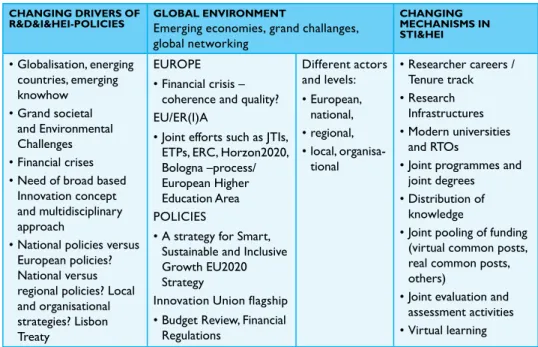
The development of FUAS and its RDI function must be seen against the back-drop of national higher education policy, European policy and internation-al developments. Given the chinternation-allenging and changing context of higher ed-ucation in Europe and the rest of the world (see figure 1), all European gov-ernments feel the urgent need to adapt their higher education systems to stay competitive and meet the ambitions set by the EU for 2020. By then, the Finn-ish government wants the Higher Education System to provide higher-quali-ty teaching and research, and to be more internationally efficient. To achieve this, several measures are being planned, including diversifying the UAS sec-tor funding system, changing their operating licenses and a change in own-ership from the regions to Limited Companies. These changes intend to pro-vide the UASs with more flexibility and adaptability to their operating envi-ronments. The main assumption lying behind these measures is the belief that larger structures will enhance the quality and efficiency of the system, mak-ing it better able to meet the regional and national needs and improve its in-ternational competitiveness. The hope is also that this will lead to more exter-nal funding, be it from local and regioexter-nal sources or from internatioexter-nal (Eu-ropean) organisations. The Federation that the three UASs have formed is part of this larger restructuring process of the Finnish higher education system.
Figure 1. Challenging and changing environment. (Halonen, 2013)
Challenging and changing environment
CHAngIng DRIvERS oF
R&D&I&HEI-PoLICIES gLobAL EnvIRonMEnTEmerging economies, grand challanges,
global networking CHAngIng MECHAnISMS In STI&HEI • Globalisation, energing countries, emerging knowhow • Grand societal and Environmental Challenges • Financial crises • Need of broad based
Innovation concept and multidisciplinary approach
• National policies versus European policies? National versus regional policies? Local and organisational strategies? Lisbon Treaty
EUROPE • Financial crisis –
coherence and quality? EU/ER(I)A
• Joint efforts such as JTIs, ETPs, ERC, Horzon2020, Bologna –process/ European Higher Education Area POLICIES
• A strategy for Smart, Sustainable and Inclusive Growth EU2020 Strategy
Innovation Union flagship • Budget Review, Financial
Regulations Different actors and levels: • European, national, • regional, • local, organisa-tional • Researcher careers / Tenure track • Research Infrastructures • Modern universities and RTOs
• Joint programmes and joint degrees
• Distribution of knowledge
• Joint pooling of funding (virtual common posts, real common posts, others)
• Joint evaluation and assessment activities • Virtual learning
As in many other European countries, the higher education network in Fin-land is still considered to be too fragmented, and stronger collaboration or even mergers (like the new Art University formed through the merger of the Sibelius Academy, the Academy of Fine Arts and the Theatre Academy) should be encouraged. Various steps are being taken to promote joint use of facility services and teacher resources across instituteal boundaries. Further-more, from the beginning of 2014 the universities of applied sciences fund-ing and regulatory structure will be adapted to improve the quality and im-pact of their operations. The operating licences of the universities of applied sciences will be reviewed from the beginning of 2014, and by the end of 2015 their admissions procedures and syllabi will have been revised in order to ex-pedite entry into higher education.5
The cornerstone of the wider European context is formed by European re-search and innovation funding structures, in particular the Framework Pro-grammes and their successor, the Horizon 2020 initiative starting in 2014, and the support given through Cohesion Policy funds (also known as Struc-tural Funds). Just before the end of June 2013, an agreement was reached about the overall European budget for the coming years. The details about the
Challenges6, which form an important orientation point for the UASs research strategy, next to the Cohesion policy or Structural Funds.
There has been a growing connection between the EU Framework Pro-grammes and its Cohesion policy to boost innovation. In FP7, several pro-grammes focused on enhancing the innovation capacity of the regions (’Re-gions of Knowledge’, ’Research Potential’ and ’Research Infrastructures’). For the next period, the EU has committed some €86 billion from Cohesion funds for actions supporting research and innovation. For the next programming period, Horizon 2020 will also contribute to research and innovation in the regions, mainly by improving policy support, in order to build efficient so called smart specialisation strategies in full cooperation with Cohesion poli-cy. Regions are expected to develop a strategy to direct spending towards re-search, innovation and training (www.Research Europe.eu, 1 August, p. 5) Considerably more funding will be made available for innovation in the SME sector (4% of the total H2020 budget), and probably there will be a “fast track to innovation” (1% of the budget). While the increased focus of the new Co-hesion policy funds on investments in research and innovation is in full ac-cordance with the Europe 2020 Strategy and the Innovation Union flagship initiative, it is also the case that it specifically aims at assisting the less devel-oped Member States (mainly the New Member States) and regions to climb the ’staircase to excellence’. (European Commission, 2013). Apparently, the New Member States are learning quickly to receive and absorb these funds, contrary to what the “innovation paradox” theory had predicted (Oughton et al. 2002).7
It is clear that a significant part of the overall European 2020 strategy is formed by emphasis on regional development through stronger collaboration between science, industry and society (the so-called ‘golden triangle’), to in-crease innovative research and development. This offers opportunities for all regions in Europe, but there will also be stiffening competition, augmented by the New Members entering the competition and the current economic crisis, which forces countries to compete even more strongly for European funds. A strong collaboration within regions between universities, industry and public sector seems to be a more pressing necessity than ever before.
5. Although not part of our remit, the audit board feels slightly worried about the word ‘ex-pedite’ in this context. If it refers to the reduction of bureaucracy associated with the ad-missions process, then of course this is something to support. If, however, it is interpreted as reducing the standards of admission, it is something to worry about, because that would ultimately weaken the position of UASs.
6. The 6 European Grand Societal Challenges are: 1. Health, demographic change and well-being; 2. Food security, sustainable agriculture, marine and maritime research, and the bio-economy; 3. Secure, clean and efficient energy; 4. Smart, green and integrated trans-port; 5. Inclusive, innovative and secure societies; 6. Climate action, resource efficiency and raw materials.
7. The so-called regional innovation paradox - the apparent contradiction between the com-paratively greater need to spend on innovation in lagging regions and their relatively lower capacity to absorb public funds earmarked for the promotion of innovation and to invest in innovation-related activities compared to more advanced regions – does not hold for a number of the New Member States such as Bulgaria and Romania (European Commission, 2011, p. 93).
RDI activities at Finnish Universities
of Applied Sciences
The Finnish University of Applied Science (UAS) sector was established at the beginning of the 1990s. Since 2003, it has been formally expected to devel-op Research & Develdevel-opment (R&D) activities, to which in 2010 an innovation function was added by the Ministry of Education and Culture.
According to the University of Applied Sciences Act (2003/351), the mission of universities of applied sciences in Finland is to provide higher education instruction based on the requirements of working life and its development, and on research and artistic premises in preparation for professional expert tasks. In addition, the universities of applied sciences must support individ-ual professional growth and the practice of research and development, which serves in university education as well as supporting working life and region-al development, and applied research and development work that takes into account the structure of industry in the region. Thus the mission of universi-ties of applied sciences underscores links with business and industry and re-gional impact. The purpose of universities of applied sciences is to generate the expertise and innovations needed by the world of business, industry and public sector. The UASs are mainly multi-disciplinary and regional institutes of higher education, which are focusing their research and development ac-tivities on serving the economic and social development needs of their region. UASs emphasise in their instituteal goals the close link between their RDI and education activities.
The Ministry of Education and Culture emphasises stronger profiles and pri-orities in universities of applied sciences in serving the development needs in the regions; the universities of applied sciences need to develop their RDI ac-tivities to increase their capacity to cater for the needs of the SMEs and service sectors in their regions in a more planned way. RDI is an essential part in the job descriptions of teaching personnel. The Ministry of Education and Cul-ture will seek to strengthen links between universities of applied sciences, re-gional development and working life. The RDI funding base is to be diversi-fied by making more efficient use of funding allocated by the Finnish Fund-ing Agency for Technology and Innovation (TEKES).
As a result of the sector-wide analysis of RDI activities at Finnish Universities of Applied Sciences conducted by The Finnish Higher Education Evaluation Council (FINHEEC), the evaluation team made following conclusions and rec-ommendations for development of RDI at Finnish UASs (Maassen et al., 2012):
Funding of RDI in the UAS sector
• The funding for the RDI activities is fragmented and lacks trans-parency. The overall basic funding level for the RDI function is too low.
• The future development potential of the RDI function is reflect-ed in the relatively rapid increase in competitive funding income, as well as in the success in acquiring EU structural development funds.
• The main Finnish agencies for the public funding of RDI activ-ities lack a clear frame of reference to determine their role in funding, and therefore also in the further development of the RDI activities of the UAS sector. As a consequence these agencies operate rather conservatively in terms of their function with re-spect to the UAS sector.
• It is important to give a clear signal that the further development of UASs’ role in RDI has political priority.
Integration of education and RDI in UAS
• With respect to the strategic orientation of RDI, there are con-vincing arguments for stimulating a better balance between RDI as an educational and pedagogical instrument and RDI as a more independent academic endeavour contributing to the applica-tion of new and existing knowledge for private and public sector problems. Such a balance should be firmly rooted in an explicit, transparent and clear RDI mission.
• Beyond an integration of RDI into the core curricular activities of regular Bachelor-level students, there are also other linkage mechanisms between RDI and education that could be further deployed. For example, the development of non-traditional edu-cational programmes and courses based on the output of RDI ac-tivities. This could also be undertaken in international coopera-tion projects, for example, in the area of lifelong learning. • The explication, quality assurance and reintegration of RDI
re-sults in teaching can be strengthening as an important element of organisational development and learning.
• The UAS sector is well-equipped and highly motivated to contrib-ute to increasing the number of high growth-oriented entrepre-neurs. The further dynamic development of the still underdevel-oped innovation and start-up component in Finland is seen as a challenging task that could be enforced by the UAS sector on the basis of corresponding governmental support, for example in the form of a distinctive national entrepreneurship programme with the necessary financial resources.
• The development of basic RDI competences and skills for Bach-elor-level students needs to be addressed and implemented sys-tematically within the Bachelor programmes’ curricula.
• The potential of Master programmes in the further development of the RDI function needs to be examined thoroughly. This po-tential can be expected to be developed with a strategic align-ment of teaching (design of master programmes and their pro-ject works) and RDI. It can therefore be recommended to con-duct a separate evaluation of the potential of, as well as the prob-lems and challenges facing the Master programmes in becoming a more substantial part of RDI activities.
Human resources management in UAS
• A focus on the integration of the three statutory tasks (edu-cation, RDI, regional development) presupposes an important change of the academic culture.
• RDI skills, competences and knowledge development should be prioritised and emphasised in staff training and staff career de-velopment.
• Innovation competences, skills and knowledge requirements need to be further clarified for staff development.
• Integrating RDI into teaching changes the traditional way of cur-ricula delivery and may create pressure to define the teachers’ 1,600 hours from a totally new perspective.
• Identifying and disseminating good practices, methods, tools and processes about RDI practices is of great importance for the benefit of further staff development in the RDI area.
• Postgraduate studies are to be encouraged and enabled for aca-demic staff. It is of the utmost importance that these postgrad-uate studies are oriented towards the specific RDI staff require-ments of the UAS sector, instead of having a general researcher training character.
International dimension of RDI
• Depending on their overall profile and (scarce) resources, and the preferred relationship with the region they operate in, indi-vidual UASs should be more specific about their internationali-sation strategy, amongst other things, when it comes to the na-ture and expected outcomes of internationalisation investments and activities, regional preferences and international RDI goals and targets.
• For further effective development of the RDI function, the par-ticipation in international RDI consortia that are successful in ap-plying for EU RDI funding programmes should be intensified. . • Despite a strong strategic focus on the enhancement of
• Since European RDI funding programmes often emphasise so-cietal and economic challenges requiring relevant levels of ex-pertise on a high, internationally competitive level, participa-tion in such programmes can be considered as an indicaparticipa-tion for RDI quality. Consequently, special attention should be paid to in-creasing participation in such programmes (especially FP7 and Horizon 2020).
• EU structural funds are a very important instrument in the com-petitive funding of RDI activities, especially serving the demands of regional innovation systems. To foster regional innovation ac-tivities and technological development especially for the benefit of SMEs, the enlarged RDI funding opportunities of the upcom-ing structural development funds should be exploited thorough-ly and used effectivethorough-ly.
Interaction with business and public sector
• UASs should become more visible for their environment, in par-ticular regarding what they can offer potential clients.
• More attention should be paid to attuning the agendas and rel-evant partners in the environment, either through small-scale bridging mechanisms or longer-term collaborative practices. • More effort should be directed towards learning how to
collabo-rate with partners in society.
Indicators for RDI
• Given the premature stage of the development of the RDI func-tion, indicators should be used to learn and improve, not to ac-count and punish.
• A practical lead in the development RDI indicators can be found in recent European projects, in particular the EDU-prof and SI-AMPI project. The key is to distinguish a number of main indi-cator categories (3 to 5), and then within these broad categories place a number of more specific indicators that are, on the one hand, representative of the general aspects of the RDI function and, on the other, leave enough room for specific differences • In doing so, the current proposals for indicators (AMKtutka,
ministry matrix) should be taken into account, but handled in the perspective of the above two-tier approach.
• It is also recommended to make use of the international (Euro-pean) developments regarding indicators. The hard work needed to develop indicators and collect robust and reliable data cannot be underestimated.
The purpose of
the FUAS Research Review
The aim of FUAS Research Review was to give a clear and realistic picture of the research, development and innovation activities of FUAS through assess-ing the RDI activities of each member institute and to produce strategic eval-uation data that will develop the FUAS RDI activities.
The specific objectives of the FUAS Research Review were to:
1. Assess the RDI activities of the participating UASs (HAMK, LUAS and Laurea), taking into account their regional, national and internation-al contexts.
2. Assess the FUAS 2011 – 2015 vision and strategy, addressing in particu-lar the four focus areas that FUAS has defined.
3. Assess the RDI strengths of the participating UAS, identify areas for de-velopment and good practices to follow.
4. Help ensure the continuous development of the RDI activities of the FUAS member UASs.
Thus the evaluation looked into RDI activities from the perspective of the four focus areas of FUAS: 1) Ensuring welfare, 2) Technological competence and entrepreneurship, 3) Societal security and integrity, and 4) Environment and energy efficiency. In addition to observing the focus areas, FUAS Research Re-view produces and assesses information concerning:
• the role of RDI activities at FUAS
• the relation of RDI activities and education • the international aspects of the RDI activities
• the profitability, quality and influence of the RDI activities. The aim of Research Review was to highlight the strengths and areas requir-ing improvement through self-evaluation and an audit by an international ex-ternal Audit Board. Research Review ensures the continuous development of the RDI activities of the FUAS member UASs. Furthermore, the FUAS Research Review provides information for the development of the FUAS quality system and for the forthcoming audit of the Finnish Higher Education Evaluation Council (FINHEEC).
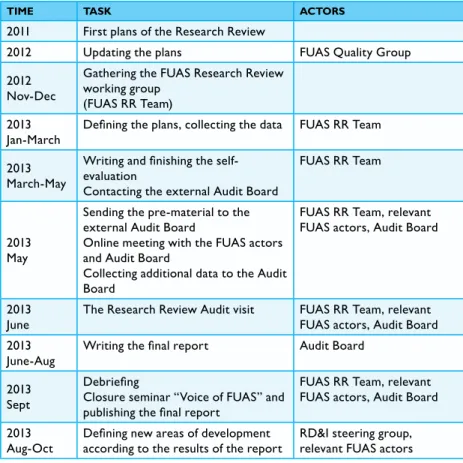
The FUAS research review process
A decision of the FUAS Research Review was made in 2011. The planning of FUAS Research Review process started by the FUAS Quality Group in 2012 and continued by the FUAS Research Review working group (FUAS RR Team). The whole FUAS Research Review process is presented in Table 1.
Table 1. FUAS Research Review timetable.
TIME TASK ACToRS
2011 First plans of the Research Review
2012 Updating the plans FUAS Quality Group 2012
Nov-Dec
Gathering the FUAS Research Review working group
(FUAS RR Team) 2013
Jan-March
Defining the plans, collecting the data FUAS RR Team 2013
March-May
Writing and finishing the self-evaluation
Contacting the external Audit Board
FUAS RR Team
2013 May
Sending the pre-material to the external Audit Board
Online meeting with the FUAS actors and Audit Board
Collecting additional data to the Audit Board
FUAS RR Team, relevant FUAS actors, Audit Board
2013
June The Research Review Audit visit FUAS RR Team, relevant FUAS actors, Audit Board 2013
June-Aug
Writing the final report Audit Board 2013
Sept
Debriefing
Closure seminar “Voice of FUAS” and publishing the final report
FUAS RR Team, relevant FUAS actors, Audit Board 2013
Self-evaluation
The FUAS Research Review working group (FUAS RR Team) produced a pro-ject plan, which outlined the obpro-jectives and tasks of the evaluation, evalua-tion areas and methods utilised.
All work on the project was collaborative between HAMK, LUAS and Laurea. The FUAS Research Review Team consisted of representatives of all FUAS uni-versities. The participants of the FUAS Research Review Team include quali-ty, RDI and management level personnel.
HAMK University of Applied Sciences
• Riitta Hakulinen, Head of Quality Assurance
• Helena Kautola, Deputy of the Education and Research unit of Technology, Director of research of the Unit of Technology
Laurea University of Applied Sciences
• Antti Vettenranta, Director, Business Services • Tuija Hirvikoski, Director, Internationalisation of RDI
LUAS University of Applied Sciences
• Ilkka Väänänen, Director, Research
FUAS
• Ulla Kotonen, Development Manager, Research, Development and Innovations
• Sara Heikkilä, RR assistant/Quality assistant, FUAS Quality group
The FUAS Research Review Team included a wide range of experience in re-search, development and innovations at universities of applied sciences. The FUAS RR Team divided its self-evaluation analysis in three main parts. First the RR Team concentrated on RDI in the FUAS strategy 2011 – 2015 and FUAS focus areas. Second, the RR Team focused on the RDI culture in FUAS and im-plementation of FUAS strategy by analysing FUAS RDI structures and resources, RDI practices, RDI integration into education, innovations and entrepreneur-ship as well as the regional influence of FUAS RDI activities. Furthermore, a wide range of RDI projects was presented in order to gain better understanding of the forms, possibilities and problems of RDI at FUAS. Third, a SWOT analy-sis was used to evaluate the strengths, weaknesses, opportunities and threats of FUAS RDI. In conclusion, based on the SWOT-analysis, the FUAS RR Team defined future success factors in which success must be achieved in FUAS RDI, what should be done in order to turn weaknesses into strengths, how current strengths can be used to react to threats, and what kind of crises may come to pass if RDI is not developed. In addition the development priorities of FUAS RDI defined by FUAS RD&I steering group were discussed.
As a result of the self-evaluation, the FUAS Research Review Team prepared a self-evaluation report. The main parts of the self-evaluation report are pre-sented in chapters two and three of this publication.
The self-evaluation material was delivered to the external auditing team in mid-May 2013 and, in June 2013, the external evaluation team conducted the onsite visit to FUAS.
External evaluation
The Audit Board consisted of two international evaluators and one Finnish evaluator. The evaluators were Dr Jack Spaapen from The Royal Netherlands Academy of Arts and Sciences, Dr Jordi Molas-Gallart from INGENIO (CSIC-UPV) and Adj. Prof. Matti Lähdeniemi from Satakunta UAS. The Chairman of the Audit Board was Dr Jack Spaapen.
Dr Jack Spaapen is senior policy advisor at the Royal Netherlands Academy of Arts and Sciences and executive secretary for the Council for Humanities. His fields are research impact evaluation, humanities research and public-pri-vate partnerships between research and industry/society. He coordinated the FP7 SIAMPI project on social impact assessment (2009 – 2011). In this project, case studies were conducted in various research areas in the arts and sciences in Spain, France, the UK and the Netherlands (www.siampi.eu). He initiated a national project to develop methods for the assessment of the societal rele-vance of research (www.eric-project.nl). He represents the Academy in sev-eral national and European networks on R&D evaluation. He co-designed the national evaluation protocol for publicly funded research (SEP) and co-organ-ised many instituteal evaluations in and outside the universities.
He was trained as a sociologist and cultural anthropologist at the Universi-ty of Amsterdam with a Ph.D. in science and technology studies. His thesis (1995) focused on developing a method for the evaluation of research in the context of policy demands, i.e. how to assess the broader, societal value of re-search. Previously he worked as a research fellow at the University of Califor-nia San Diego (UCSD), as a researcher and teacher in two departments at the University of Amsterdam (Science and Technology Dynamics and the Insti-tute for Development Research), in a commercial bureau for industrial mar-keting in Amsterdam, and in a government office for urban planning in Le-lystad. Between 1990 and 2003, he ran an advisory bureau on science and technology policy and evaluation, sci_Quest.
Professor Jordi Molas-Gallart is an economist with more than twenty years’ experience as an analyst of science, technology and innovation policies. He is a Research Professor at INGENIO, a research institute of the Spanish Council for Scientific Research (CSIC) and the Polytechnic University of Valencia. Be-fore joining INGENIO, Jordi worked for 13 years at SPRU, University of Sussex as Research Fellow and Senior Research Fellow. His research interests include science and technology policy evaluation and impact assessment, and univer-sity-industry relations. He has led and contributed to many evaluation stud-ies for the UK Economic and Social Research Council, the European Com-mission, INSERM, CSIC, Queen Mary College, the Russell Group of Universi-ties, and several Spanish regional governments among others, focusing main-ly on the anamain-lysis of the non-academic impact of research programmes. He has been a member of the European Commission “Lisbon Expert Group” for the follow-up of the research aspects of the revised Lisbon strategy. He is the author of one book, and of more than 70 articles, book chapters, monographs and reports. He is co-editor of Research Evaluation.
Adj. Prof. Matti Lähdeniemi gained a Ph.D from the University of Turku, and is an Adjunct Professor at Tampere University of Technology and at the University of Turku. He is presently working as Research and Innovation Di-rector at Satakunta University of Applied Sciences as an Accreditation As-sessor. His special fields are automation, image processing, entrepreneurship, knowledge transfer, quality and impact evaluation and RDI processes. He is the director and consulting tutor of numerous industrial projects, and a mem-ber of several groups evaluating the impact of RDI and quality at universities on a national level and RDI measures on a national and European level. He has prepared and analysed the international evaluation of RDI activities at Finnish Universities of Applied Sciences. He has written about 180 articles on the above-mentioned topics. His previous positions include Vice president and Dean (Satakunta University of Applied Sciences), professorships (Tam-pere University of Technology, University of Turku, Humboldt-Foundation), project manager in different industrial projects in Finland, Sweden, Germa-ny and Japan, and chairman or board member of several organisations and
In the first phase, the evaluation board concentrated on the FUAS Strategy 2011 – 2015 and the self-evaluation report produced by FUAS RR Team. In the second phase, the onsite visit was organised at Laurea, Tikkurila on June 17 – 19, 2013. During the onsite visit, the evaluation board concentrated on the RDI activities of the FUAS Federation. The interviews were undertaken with representatives of the FUAS Federation, the presidents and vice presidents of FUAS UASs, the chairs of FUAS RDI focus areas as well as representatives of FUAS RDI experts, RDI services, funding institutes and external stakeholders. In addition, the Audit Board discussed with representatives including pro-ject managers, teachers, students and partners of four FUAS propro-jects (ALDIGA, CONNECT, GUARANTEE and ENNE) in order to gain a better understanding of the forms, possibilities and problems of RDI in the FUAS Federation. The de-tailed onsite visit evaluation programme is presented in appendix 4.
The FUAS Research Review Audit Board submitted its report at the end of August 2013. The review report is included in this publication (Executive summary, Context of the FUAS RDI review, External evaluation, Options for the development of RDI at FUAS).
The main findings of self-evaluation and the results of external audit were dis-cussed at the Voice of FUAS day on September 10, 2013. The findings will di-rect the implementation of the FUAS strategy as well as definition of RDI de-velopment priorities and activities by FUAS RD&I steering group.
Chapter Two
FuaS rdi
STraTegy
RDI in FUAS Strategy 2011 – 2015
At FUAS, RDI is defined according to the OECD’s Proposed Standard Practice for Surveys on Research and Experimental Development as follows: “R&D comprises creative work undertaken on a systematic basis in order to increase the stock of knowledge, including knowledge of man, culture and society, and the use of this stock of knowledge to devise new applications.” The term R&D covers three activities: basic research, applied research and experimental development, including innovations. At FUAS innovations are more based on open demand and user-driven doing, using, interacting (DUI) methods than science and technology (STI). In R&D applied research at FUAS, experimen-tal development and innovations are the major activities and basic research plays a minor role.
In RDI statistics FUAS follows the R&D definition of Statistics Finland. Ac-cording to Statistics Finland, the defining criterion of R&D is that the purpose of the activity should have the presence of an appreciable element of novelty. Basic research is defined as work undertaken to acquire new knowledge, with-out any particular application in view. Applied research, on the other hand, primarily aims for a specific practical application. Product and process devel-opment (develdevel-opment work) is defined as systematic work that draws on ex-isting knowledge gained from research and/or practical experience with the aim of producing new materials, products, production processes or meth-ods and systems, or substantially improving existing ones. Innovation refers to all the measures that produce or aim to produce new or improved prod-ucts or processes, i.e. innovations. Broadly defined, innovation refers to any measure that produces or aims to produce the adoption of innovations. (Sta-tistic Finland 2009)
The strategic framework of FUAS RDI activities is based on the FUAS Strategy 2011 – 2015, EU’s growth strategy Europe 2020 (European Commission 2010), Finland’s National Programme (Valtiovarainministeriö 2012) and on A de-velopment plan of Education and Research 2011 – 2016 (Ministry of Educa-tion and Culture 2012). FUAS is a member of the regional innovaEduca-tion ecosys-tems (RIE) in the Greater Helsinki metropolitan area, which refers to the re-gions of Uusimaa, Päijät-Häme and Kanta-Häme. Hense FUAS Strategy also acknowledges the development areas of the Government report on metropol-itan policy in education, RDI and regional impact.
FUAS RDI activities are based on synergic multi-actor activities and regional smart specialisation. The strategic intent of FUAS for 2020 is an internation-ally respected federation of independent higher education institutions that strengthens the international competitiveness of the Helsinki metropolitan area, offering all the higher education, research and regional development functions required by the metropolitan area’s industry, commerce and pop-ulation.
According to the FUAS Strategy 2011 – 2015, the Research Review produces information of the chosen focus areas and ensures that the operation is com-petitive and multi-disciplinary. The RDI activities in relation to the guidelines stated out in the strategy.
The FUAS strategy 2011 – 2015 emphasises:
• international and practical RDI activities
• aligning resources, innovation activities and practical development
• close connection to EU-level research and development programmes in order to expand sources of funding
• participating in projects covering all stages of the innovation chain a multi-disciplinary way.
According to the FUAS strategy, in 2015 FUAS will work actively and take in-itiative in both Finnish and international partnership networks. Within the focus areas, cooperation is boosted with the most internationally significant universities and companies, and top experts are recruited as researchers and lecturers. FUAS is a leading network operator in the Greater Helsinki metro-politan area, key partners including Aalto University and the University of Helsinki as well as the universities of applied sciences and vocational institu-tions in the region. In all its operainstitu-tions, FUAS works closely with the labour sector, particularly with SMEs, public administration and the third sector. The educational profile of FUAS is focused on being an international pioneer in workplace oriented pedagogical solutions integrated into RDI. FUAS is an en-gine for applied research, pragmatic innovation and RDI integrated into stu-dent-oriented education in the wider metropolitan area, combining top na-tional and internana-tional actors in joint projects. RDI emphasises integrated ap-plication, transfer into practice, utilisation and commercialisation of techno-logical and social innovation. Municipalities in the region function as cus-tomer owners and increasingly stronger promoters of innovation. FUAS is a trailblazer in promoting student entrepreneurship in the wider metropolitan area. In cooperation with domestic and international operators, FUAS gen-erates partial solutions for major global challenges. These include: Global warming and tightening supplies of energy, Water and food, Ageing socie-ties and public health, and Pandemics and security.
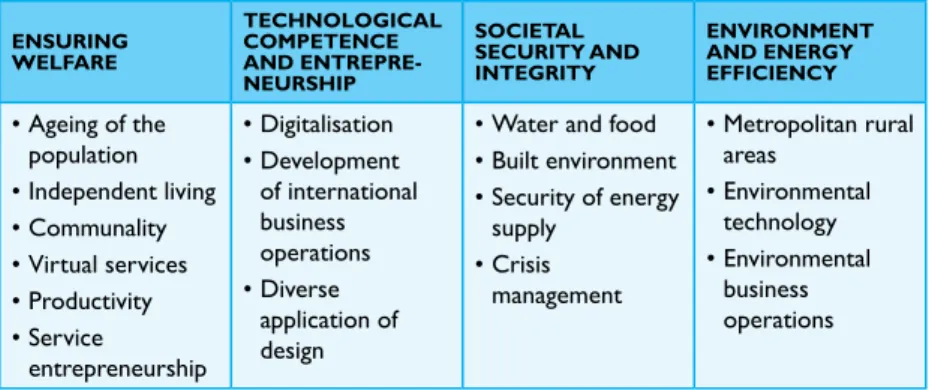
FUAS addresses global challenges by forming multidisciplinary RDI consortia and high-quality degree programmes that creatively merge four FUAS focus areas 1) Ensuring welfare, 2) Technological competence and entrepreneur-ship, 3) Societal security and integrity, and 4) Environment and energy effi-ciency. Within these focus areas are several sub-themes (Table 2).
Table 2. FUAS focus areas. EnSURIng wELFARE TECHnoLogICAL CoMPETEnCE AnD EnTREPRE-nEURSHIP SoCIETAL SECURITy AnD InTEgRITy EnvIRonMEnT AnD EnERgy EFFICIEnCy • Ageing of the population • Independent living • Communality • Virtual services • Productivity • Service entrepreneurship • Digitalisation • Development of international business operations • Diverse application of design
• Water and food • Built environment • Security of energy supply • Crisis management • Metropolitan rural areas • Environmental technology • Environmental business operations
The strengths of FUAS institutions include training a competent labour force for the needs of business, industry and public administration, and RDI with a focus on developing the wider metropolitan area. In 2011 – 2015, FUAS will be targeting its strategic measures on the following RDI areas:
• FUAS significantly fortifies international, practical RDI, which also generates new, internationally competitive content for edu-cation.
• FUAS is an engine for renewing the foundations of the innovation system in the wider metropolitan area, emphasising the joining of forces in the merging of research, innovation and practical de-velopment.
• RDI of FUAS is closely linked to EU-level R&D programmes, in-creasing and diversifying the funding sources.
• RDI of FUAS is established on international consortia, which serve as the framework for implementing joint multidisciplinary pro-jects that cover the entire innovation chain and are connected to authentic development environments.
• The RDI profile of FUAS is established on the production of par-tial services for global challenges.
In addition to these RDI specific targets, RDI is integrated into the other tar-get areas as follows:
• FUAS supports the provision of education leading to a Master’s degree and double degree, makes increasing use of internation-al experts for the degrees and connects the degrees more close-ly to RDI.
• Internationalisation of degree programmes is developed through student mobility and international RDI integrated into learning. • RDI integrated into learning is one of the key strategic objectives
of FUAS in education.
• FUAS commits to strong cooperation with society, industry and business, and public administration in the Helsinki metropolitan area. Both education and RDI are established on this cooperation. • FUAS supports RDI services produced in collaboration with other
operators in the wider metropolitan area.
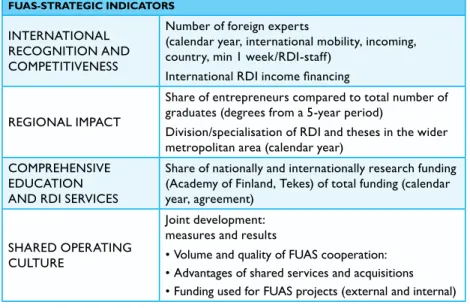
The FUAS strategy defines critical success factors and strategic indicators (Ta-ble 3), by which the fruitfulness and influence of activity are systematically assessed from a perspective of RDI services, among other things. Other FUAS RDI indicators are presented in paragraph Quality Management.
Table 3. RDI-related strategic indicators.
FUAS-STRATEgIC InDICAToRS
INTERNATIONAL RECOGNITION AND COMPETITIVENESS
Number of foreign experts
(calendar year, international mobility, incoming, country, min 1 week/RDI-staff)
International RDI income financing REGIONAL IMPACT
Share of entrepreneurs compared to total number of graduates (degrees from a 5-year period)
Division/specialisation of RDI and theses in the wider metropolitan area (calendar year)
COMPREHENSIVE EDUCATION AND RDI SERVICES
Share of nationally and internationally research funding (Academy of Finland, Tekes) of total funding (calendar year, agreement)
SHARED OPERATING CULTURE
Joint development: measures and results
• Volume and quality of FUAS cooperation: • Advantages of shared services and acquisitions • Funding used for FUAS projects (external and internal)
Chapter Three
FUAS RDI structures and resources
According to the FUAS strategy, FUAS significantly fortifies international, practical RDI, which also generates new, internationally competitive content for education. FUAS is an engine for renewing the foundations of the innova-tion system in the wider metropolitan area, emphasising the joining of forc-es in the merging of rforc-esearch, innovation and practical development. The RDI of FUAS is closely linked to EU-level R&D programmes, increasing and diver-sifying the funding sources. The RDI of FUAS is established on international consortia, which serve as the framework for implementing multidisciplinary joint projects that cover the entire innovation chain and are connected to au-thentic development environments. The RDI profile of FUAS is established on the production of partial services for global challenges.
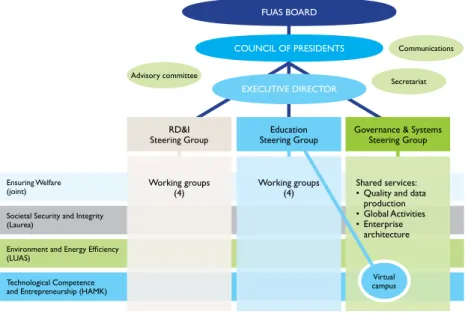
The FUAS agreement defines the key principles of the activity and guidance of a FUAS university, as well as the power of decision of jointly agreed bodies and the basis of that power. The FUAS structure and steering system is described in Figure 2. A development manager has been appointed for joint functions like RDI (from 1 May 2013).
Figure 2. The management system of FUAS as of 10/2013.
Fuas BoaRd CounCiL oF PResidents exeCutiVe diReCtoR advisory committee Rd&i steering group ensuring Welfare (joint)
societal security and integrity (Laurea)
Environment and Energy Efficiency (Luas)
technological Competence and entrepreneurship (hamk)
education
steering group governance & systems steering group
secretariat Communications
Working groups
(4) Working groups (4) shared services:• Quality and data production • global activities • enterprise architecture Virtual campus
The Rectors Collegium decides on the strategic policies of all joint functions as part of the operational and financial planning of FUAS. FUAS has thee stra-tegic steering groups (RDI, Educational Responsibilities, and Governance and Systems), the key function of which is the execute FUAS strategic policies and develop activity in strategic sub-areas.
The job of the RD&I steering group is to execute the FUAS RDI-related strate-gic policies:
• International-level practical RDI
• Reform of the basic structures of the innovation system • The diversification of sources of funding
• International consortia, joint multidisciplinary projects in au-thentic development environments
• the profile of RDI: the production of solutions for global chal-lenges
• The strengthening of RDI services in the Metropolitan Area. In addition, the RD&I steering group guides the activity of the RDI focus area groups, agrees on the common operating methods of member universities within the framework of its powers, sets the tasks and objectives of the devel-opment manager and acts as a steering group for /her work, decides on pro-jects to be implemented, work groups and the activity of those work groups in relation to strategic objectives and, if necessary, makes proposals to the Rec-tors Collegium.
The function of the RDI development manager is
• to support the activity of the steering group in the development of the RDI sub-area
• to be responsible for the preparation of development measures and proposals in co-operation with the chairperson of the steer-ing group
• to act as project manager in projects agreed on by the steering group
• to participate in the activity of the extended secretariat, and to ensure that decisions and possible commissions made in the Rec-tors Collegium and FUAS board proceed in the development of the RDI sub-area
The RDI development manager reports on her activities to the chairperson of the RDI steering group, to the expertise area director in charge of RDI at LUAS and her immediate subordinates and to the FUAS secretariat.
In addition to FUAS bodies, RDI development work also utilises the bodies and structures of each member university, as well as their best practices. RDI re-sources by FUAS UASs are presented in Table 4.
Table 4. RDI resources at FUAS UASs in 2012.
HAMK LUAS LAUREA
Personnel man-years 120 73.9 111.4 Doctors, PhD 55 32 44.9 Licenciate, Lic 44 14 27
Development work is carried out as jointly agreed development projects: the development of learning and innovation environments as part of innovation clusters and regional innovation ecosystems, and the design and integration of a common service structure for RDI activity and entrepreneurship.
RDI in practice
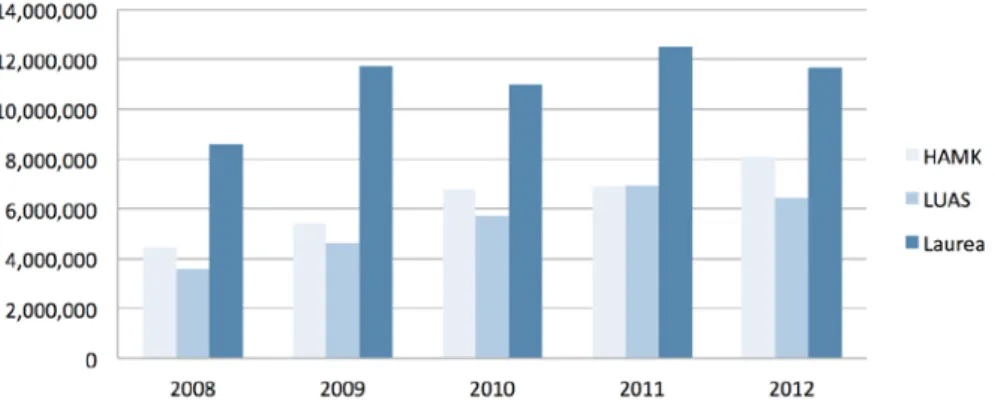
The integration of RDI into pedagogy has been and will be strongly linked through students and teachers in all four FUAS focus areas. Environmental impact is also highlighted in these focus areas to promote entrepreneurship. A total RDI volume in 2008 – 2012 in FUAS UASs is presented in Figure 3.
The R&D projects among the FUAS consortium have been divided between four focus areas as shown below. The project budgets for the focus areas were €5.6 million in technology competence and entrepreneurship, €3.5 million in en-suring welfare, €1.8 million in environment and bioenergy and €1.6 million in societal security and integrity in 2012. When adding pedagogical projects of €0.6 million, the total budget was €13 million in 2012. All FUAS higher ed-ucation institutes have a strong tendency to integrate all RDI work done into education performed by students and supervised by lecturers. The total turn-over used in integration will more than double the sum used in only the pro-jects here mentioned.
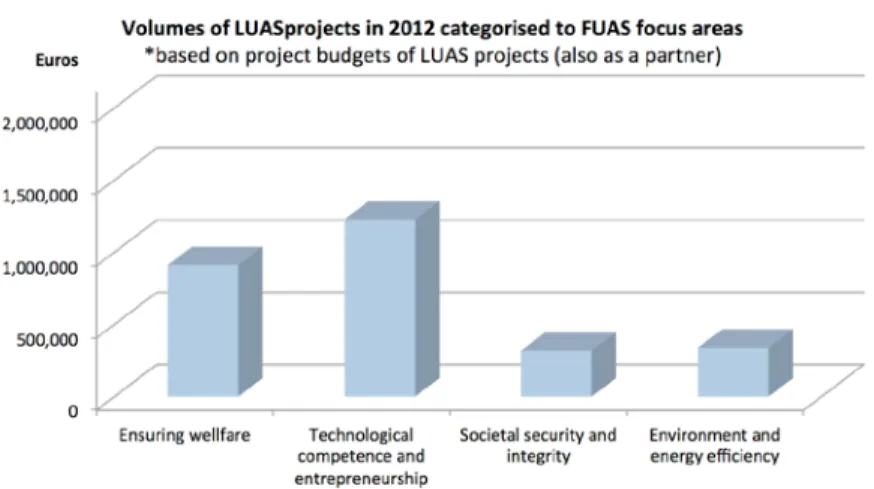
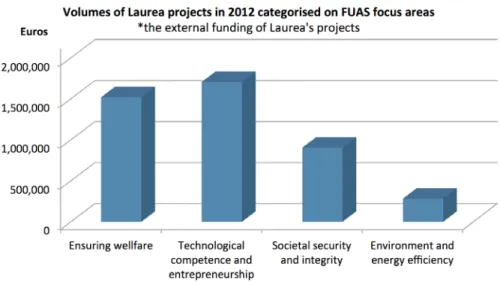
The volumes of FUAS RDI projects categorised in FUAS focus areas at the FUAS institutions HAMK, LUAS and Laurea in 2012 are presented below in Figures 4 – 6.
Figure 4. Volumes (€) of HAMK RDI projects in 2012.
Figure 6. Volumes (€) of Laurea RDI projects in 2012.
Ensuring welfare
The ensuring welfare focus area has some special themes. The ageing of the population concentrates on finding new ways of prolonging working life and improving the welfare of elderly people after working life, with efforts to help them live at home as long as possible. The research and development projects aim to improve the quality of life and enhance the independent living not only of elderly people but also of disabled and injured people. The eHealth services are developed in R&D projects focusing on strengthening self-care capabilities, monitoring and assessing vital functions, supporting networking and offer-ing information channels. Productivity focuses on workoffer-ing abilities and ser-vice entrepreneurship on enhancing business growth, and helping new start-ups and SMEs to carry on.
The aim of maintaining welfare is to build national and transnational net-works, and open new possibilities in an also international market for a bet-ter life through cooperation with different areas. The aim is to generate R&D projects, which are easy to integrate into education systems in the concept of FUAS. The more intense cooperation will create the prerequisites for more ad-vanced projects also in the international world in cooperation with teachers and students.
Technological Competence and Entrepreneurship
Technological competence and entrepreneurship emphasises three main themes. Digitalisation concentrates on online services, e-learning & e-work-ing and the virtual campus. The development of international business op-erations is the second highlight and the third is diverse application of design like industrial and service designs.
The aim of technological competence and the entrepreneurship focus group is to integrate the abovementioned methods into real life to promote entre-preneurial activity and technical information transfer for common use to sup-port society, the environment and welfare, so that the borders between focus groups are not sharp and cooperation between the groups is intensive. The technological competence and entrepreneurship focus team has in the past worked for several years in the framework of FUAS before FUAS existed. The work was incoherent before and now it is being concentrated more in cer-tain topics to make the emphasis deeper and more practical. The freedom of new ideas and smaller development needs have also been saved.
The technological competence and entrepreneurship focus has the vision of promoting collaborative projects integrated into teachers’ and students’ learn-ing, helping to understand the specific needs of different fields and to com-municate and understand different cultures. The aim is to gain better skills to develop the region.
Societal Security and Integrity
Societal security and integrity emphasises four different main themes, namely water and food, the built environment, the security of energy supply and cri-sis management. Societal security and integrity focuses on elderly people and their security as part of the security of the living environment. Food chain safety and water safety are also the main focuses, also concentrating on the measurement possibilities to increase safety. All the projects will be integrat-ed into the integrat-education of students and teachers.
Environment and Energy Efficiency
This focus area aims at developing solutions to two of the major challeng-es chosen by FUAS, namely global warming and dwindling energy supplichalleng-es as well as water and food. Environment and energy efficiency has three main themes, Metropolitan rural areas, environmental technology and environ-mental business operations.
“Metropolitan rural areas” focuses on three specific themes: bio-economy and bio-energy, smart transport and healthy food. “Environmental technology” focuses both on waste streams and water management but also on the devel-opment of clean technology solutions (for example Green – ICT) aiming at more material- and energy-efficient production and services. One common theme is the managing of storm waters, which combines both bio-based and technology knowledge. Another important theme is energy efficiency which connects not only bio-economy and renewable energy technology but also ur-ban and rural planning. “Environmental business operations” is part of the commercialisation of technology solutions, the developing of a low-carbon economy and responsible business.
Examples of FUAS RDI projects
The FUAS RR Team selected some projects (Appendix 5) as examples to show their methodology used, objectives, results, achievements and output in 2012. Some project themes (like Africa in Connect) have collected together similar projects with looking from different angles at the problems to be solved. The participation of students in the projects has been great, but there are also some projects where no student participated. These projects have been important to strongly impact the region, and also in these projects lecturers have been able to learn useful things for student assignments.
An important fact is that, among single projects, several belong to a long pro-ject chain (like ALDIGA, a propro-ject chain since 2001), which indicates that the work has been interesting and useful to working life, and industry and mu-nicipalities have been keen to join them as partners and also to partly finance them.