Department of Mathematics and Computer Science
More information about
TU/e, admission and enrollment Education and Student Service Center tel. +31 (0)40 247 4747
e-mail: [email protected]
www.tue.nl/graduateprograms
Designer’s program
Software Technology
Following your Master’s graduation, you can continue on to the Software Technology (ST) Designer’s program within the Computer Science graduate program.
High-tech industry needs experienced designers able to design complex new products and processes. A Master’s degree can give you the requisite theoretical knowledge but it does not provide a lot of practical experience. A Designer’s program gives you that practical experience, which boosts your market value for industry. You graduate with a Professional Doctorate in Engineering (PDEng) degree.
The Software Technology program begins with a 15-month series of short courses and workshops and short industrial design projects. This is followed by a major in-company design assignment of nine months.
The development of software for advanced systems covers a wide range of different aspects. The Software Technology program devotes a lot of attention to the project-based design and development of software for resource-constrained, software-intensive systems such as real-time embedded systems.
- Study possibilities: Full-time
- Degree: Professional Doctorate in Engineering - Language: English
- Times of entry: Once a year (around October 1) - Duration: 2 years
- www.tue.nl/graduateprograms/cs
The Technological Designer’s programs are coordinated in the 3TU.School for Technological Design, Stan Ackermans Institute. The institute represents the three universities of technology in the Netherlands and was established in mid-2006.
PhD programs
A PhD study at TU/e typically takes four years. During this period you receive scientific training and, most importantly, you perform research under the guidance of and in collaboration with your supervisor(s). The research areas covered by the sub-department are Algorithms and Visualization, Information Systems, Model-Driven Software Engineering, and Security and Embedded Networked Systems. In each of these areas we have internationally recognized research groups. In the Netherlands, PhD students are (fixed-term) university employees. This means you get a salary, and benefit from all the facilities offered by the department. Successful completion of the PhD program results in a PhD degree, which provides a solid basis for a career in academia or in an industrial research lab.
- Study possibilities: Full-time - Degree: PhD
- Language: English
- Times of entry: All year round - Duration: 4 years
- www.tue.nl/graduateprograms/cs
About TU/e:
- Best Dutch university in Times World University Rankings 2010 - 8500 students, PhD’s and PDEng’s
- Open and friendly atmosphere
- Personal contact with lecturers and staff - More than 70 nationalities present
- English spoken everywhere in the Netherlands
- Brainport Eindhoven: the world’s most intelligent community 2011 - TU/e students in high demand among employers
More information about the graduate program Prof.dr. Mark de Berg tel. +31 (0)40 247 2150 e-mail: [email protected] www.tue.nl/graduateprograms/cs
Where innovation starts
Computer Science Graduate Program
Program Guide 2014–2015
Computer Science Graduate Program
Program Guide 2014–2015
Business Information Systems Computer Science and Engineering Embedded Systems
Information Security Technology EIT Service Design and Engineering EIT Embedded Systems
Editor: dr. M.A. Westenberg Version: 1.1 (2014-07-21)
Contents
I
General Information
7
1 Studying in the Computer Science Graduate Program 9
1.1 Structure of the master programs . . . 10
1.2 Lecture and interim examination periods . . . 10
1.3 Course and exam registration . . . 10
1.4 Examination and titles . . . 11
1.5 Admissions . . . 11
1.5.1 General admissions requirements . . . 11
1.5.2 Admissions with deficiencies . . . 11
1.5.3 Foreign students . . . 11
1.5.4 Polytechnic graduates (HBO) . . . 12
1.5.5 Admissions procedure . . . 12
1.6 Studying abroad . . . 12
1.7 Honors program. . . 12
1.8 Internal quality assurance . . . 13
1.9 Study advisor . . . 13
1.9.1 Making an appointment with the study advisor . . . 14
1.10 After graduation . . . 14
1.10.1 Software Technology PDEng degree program. . . 14
1.10.2 PhD programs. . . 15
2 Pre-master programs 17 2.1 Computer Science and Engineering . . . 17
2.2 Business Information Systems . . . 17
2.3 Information Security Technology . . . 18
2.4 Embedded Systems . . . 18
2.5 Information sources . . . 19
II
Master Programs
21
3 Computer Science and Engineering 23 3.1 Admission . . . 233.2 Learning outcomes . . . 23
3.3 Curriculum 2014 . . . 24
3.3.1 Data Science stream . . . 24
3.3.2 Software Science stream . . . 25
4 Contents
3.3.3 Web Science stream. . . 27
3.3.4 Systems Science stream . . . 28
3.3.5 Free stream . . . 29
3.3.6 Stream contact persons. . . 29
3.3.7 Free electives . . . 29
3.3.8 Internship . . . 31
3.3.9 Admission to seminars, capita selecta, master project . . . 31
3.4 Curriculum generation 2013 and before . . . 32
3.4.1 Core program . . . 32
3.4.2 Electives . . . 33
3.4.3 Specializations . . . 33
3.4.4 Internship . . . 33
3.4.5 Admission to seminars, capita selecta, master project . . . 34
3.5 Approval of study program . . . 34
3.6 Final project . . . 34
3.6.1 Admission . . . 34
3.6.2 Planning . . . 35
3.6.3 Assessment . . . 35
3.6.4 Checklist . . . 35
3.7 Double degree program CSE and SEC . . . 35
4 Information Security Technology 37 4.1 Admission . . . 37
4.2 Learning outcomes . . . 38
4.3 Curriculum . . . 38
4.3.1 Core program . . . 39
4.3.2 Electives . . . 39
4.3.3 Admission to seminars, capita selecta, master project . . . 39
4.4 Approval of study program . . . 40
4.5 Final project . . . 40
4.5.1 Admission . . . 40
4.5.2 Planning . . . 40
4.5.3 Assessment . . . 41
4.5.4 Checklist . . . 41
5 Business Information Systems 43 5.1 Admission . . . 43
5.2 Learning outcomes . . . 43
5.3 Curriculum . . . 44
5.3.1 Core and stream program . . . 44
5.3.2 Electives . . . 46
5.3.3 Homologation units . . . 48
5.3.4 Internship . . . 48
5.3.5 Admission to seminars, capita selecta, master project . . . 49
5.4 Approval of study program . . . 49
5.5 Final project . . . 49
Contents 5
5.5.2 Planning . . . 50
5.5.3 Assessment . . . 50
5.5.4 Checklist . . . 50
5.6 Double degree program BIS and SEC . . . 50
6 Embedded Systems 53 6.1 Admission . . . 53 6.2 Learning outcomes . . . 54 6.3 Curriculum . . . 54 6.3.1 Core program . . . 55 6.3.2 Electives . . . 56
6.3.3 Internship or multi-disciplinary design project . . . 58
6.3.4 Admission to seminars, capita selecta, master project . . . 58
6.4 Approval of study program . . . 59
6.5 Final project . . . 59 6.5.1 Admission . . . 59 6.5.2 Planning . . . 59 6.5.3 Assessment . . . 60 6.5.4 Checklist . . . 60 7 Research groups 61 7.1 Research groups in the CS department . . . 61
7.1.1 Algorithms . . . 61
7.1.2 Architecture of Information Systems . . . 62
7.1.3 Web engineering . . . 63
7.1.4 Formal System Analysis . . . 64
7.1.5 System Architecture and Networking . . . 65
7.1.6 Software Engineering and Technology . . . 66
7.1.7 Visualization . . . 67
7.1.8 Security . . . 67
7.2 Research groups in the IE&IS department relevant for BIS. . . 68
7.2.1 Information Systems (IE&IS-IS) . . . 68
7.2.2 Operations, Planning, Accounting, and Control (IE&IS-OPAC) . . . . 69
7.3 Research groups in the EE department relevant for ES . . . 69
7.3.1 Electronic systems . . . 69
8 EIT Tracks 71 8.1 Service Design and Engineering . . . 72
8.1.1 Goals . . . 72
8.1.2 Entry point program . . . 73
8.1.3 Exit point program . . . 74
8.2 Embedded Systems . . . 74
8.2.1 Goals . . . 75
8.2.2 Entry point program . . . 76
6 Contents
III
Organization and regulations
79
9 Academic administration 81
9.1 Academic administration of the department. . . 81
9.1.1 Department Board of Mathematics and Computer Science . . . 81
9.1.2 Study-program Director . . . 82
9.1.3 Study-program Committee . . . 82
9.1.4 Examinations Committee . . . 83
9.1.5 Department Council . . . 83
9.1.6 CS Division and professors . . . 83
9.1.7 Department Office . . . 83
9.1.8 Student Council. . . 84
9.2 Facilities . . . 84
9.2.1 Buildings . . . 84
9.2.2 Lecture rooms, halls and other instruction facilities . . . 85
9.2.3 Library services . . . 85
9.2.4 Sale of study materials . . . 85
9.2.5 Computer Services Office . . . 85
9.2.6 Conditions for computer use . . . 86
9.3 Study association GEWIS . . . 86
9.4 Information resources . . . 86
A Teaching and Examination Regulations 89 A.1 CSE . . . 89
A.2 BIS . . . 89
A.3 ES . . . 89
Part I
General Information
1
Studying in the Computer Science
Graduate Program
The Department of Mathematics and Computer Science (W&I) at the Eindhoven Univer-sity of Technology (TU/e) offers undergraduate (Bachelor of Science), graduate (Master of Science) and postgraduate (PhD, PDEng) courses in Computer Science and Applied Math-ematics.
The Computer Science Division (CS) focuses on Specification and Verification, Algo-rithms and Visualization, Software and Systems Engineering, Information Systems, and Security. The CS Division offers its graduate and postgraduate courses in the Computer Science Graduate Program. There are four master programs, one of which is a specializa-tion within the master program CSE:
Computer Science and Engineering (CSE). This master program has a special track:
In-formation Security Technology (IST), an interdisciplinary variant in cooperation with the Mathematics Division of the TU/e, the Radboud University Nijmegen, and the University of Twente.
Business Information Systems (BIS), an interdisciplinary master program in
coopera-tion with the Department of Industrial Engineering and Innovacoopera-tion Sciences (IE&IS).
Embedded Systems (ES), an interdisciplinary master program in cooperation with the
Department of Electrical Engineering (E). The two postgraduate programs are:
Software Technology, a Master of Technological Design (PDEng) program, The PhD program.
The CS Division also contributes to the Computer Science specialization of the master program Science Education and Communication (SEC), offered by the Eindhoven School of Education (ESoE), seehttp://www.tue.nl/esoe. Graduates in the CS specialization from the program are entitled to teach computer science at Dutch high schools. Gradu-ates from one of the above mentioned master programs will also be admitted to the
10 Studying in the Computer Science Graduate Program
program and are offered a one-year program. Since 2009, double-degree programs are of-fered for CSE & SEC (see Section 3.7), as well as for BIS & SEC (see Section 5.6), which comprise 150 credits.
1.1 Structure of the master programs
All programs comprise two years of study or 120 credit points (ects); a credit point is equiv-alent to 28 hours of study and homework for an average student. Most courses are stan-dardized to 5 credit points per course.
The two years of course work and practical training are divided into three parts, consist-ing of:
1. Mandatory core courses to create a sufficient layer of theory and general or program-related knowledge.
2. Elective courses to prepare for the specialization.
3. Master project and thesis to be spent on a specialist topic of theoretical or practical nature. This part presents the opportunity to show your independent engineering and academic skills in research and design.
1.2 Lecture and interim examination periods
Each study year is divided into two semesters (September January and February July). Each semester consists of two quarters, each consisting of eight weeks of lectures followed by an examination period of two weeks. For details see the agendas and calendars athttp: //owinfo.tue.nl/. Quarter Period 1 September 1, 2014 – November 9, 2014 2 November 10, 2014 – February 1, 2015 3 February 2, 2015 – April 19, 2015 4 April 20, 2015 – July 5, 2015 interim August 10, 2015 – August 15, 2015
1.3 Course and exam registration
Participation in a course is possible only if you have registered for the course via OASE. In the first quarter, the registration deadline is set at the end of the first lecture week. In the remaining quarters, this deadline is in the week before the lectures start. During the registration period, and in the first two lecture weeks, it is possible to withdraw from the course via OASE yourself. Outside this period, you should contact the lecturer if you wish to withdraw.
Studying in the Computer Science Graduate Program 11
have to register for each exam separately via OASE (http://education.tue.nl/) be-fore the set deadlines. Note that if you are not registered for an exam, you cannot take part in it.
1.4 Examination and titles
There is only one examination at the end of the program, in which the examination commit-tee verifies and judges the final course results and the final master project grade. Comple-tion of the program will lead to the title: Master of Science (MSc) with addiComple-tion of the name of the program. Graduates are also entitled to use the Dutch title of ingenieur (ir).
1.5 Admissions
General and specific master program requirements are applicable to admissions. The spe-cific requirements may be higher in terms of knowledge prerequisites, but may also pro-vide more possibilities for entry for students from other related areas of specialization. The specific requirements for admission to each of the master programs are described in the corresponding chapters.
1.5.1 General admissions requirements
To be eligible for admission to any of the master programs, a Bachelor of Science degree is required. This degree must be of an equivalent academic level and approximate scientific content as the corresponding Dutch BSc degrees. In addition, sufficient proficiency in the English language is required.
1.5.2 Admissions with deficiencies
For admitted students from other universities, it may be necessary to repair deficiencies due to differences in programs. The admission committee will point out those so-called homologation courses to the students directly or via the study advisor.
Students coming from other disciplines at the three Dutch technical universities may be admissible after they followed a deficiency program of up to 30 credits. The disciplines in question are mentioned in the “3TU-doorstroommatrix”, the corresponding deficiency program is constructed on an individual basis.
1.5.3 Foreign students
The applications of students with a foreign university BSc degree will be evaluated by the admissions committee, taking into account both the academic level of the degree and the subjects studied by the applicant. In some special cases, relevant work experience may also be considered. The level of the degree is determined by the NUFFIC (www.nuffic.nl).
12 Studying in the Computer Science Graduate Program
1.5.4 Polytechnic graduates (HBO)
Students who have completed a polytechnic program may be eligible to participate in the pre-master programs. Completion of the pre-master program gives access to the corre-sponding master program. In Chapter 2further details about admission for HBO students and the premaster program can be found.
1.5.5 Admissions procedure
The procedure to be followed depends on your particular situation. Detailed information on the application procedure can be found on the site of the Education and Student Service Center of the TU/e, http://www.tue.nl/en/education/. Foreign students must be
aware that the admissions procedure, including visa application and other formalities, may take a while.
1.6 Studying abroad
In case a student wants to study abroad as part of the program, several options are available for students with a Dutch Bachelor diploma:
Take subjects at a foreign university Do an internship abroad
Do the graduation project abroad
Consult the study advisor for programmatic issues. For organizational issues, the interna-tional affairs coordinator provides assistance. The contact person is E. van den Hurk bc., Room MF 3.068,[email protected].
You need to deal with the organizational aspects yourself. The Education and Stu-dent Service desk has a handy checklist; it can be found on http://w3.tue.nl/en/
services/stu/. Information on scholarships can also be found athttp://www.beursopener. nl/.
1.7 Honors program
The Honors program is aimed at excellent students from one of the Master programs of-fered by the Computer Science sub-department: Business Information Systems, Computer Science and Engineering, Information Security Technology, and Embedded Systems.
The goal of the program is to give these students the opportunity to participate in and contribute to the research being done at the department. Concretely, the Honors program consists of:
Two projects for 6 ects each, one in semester 1B of the Master program and one in
semester 2A. These projects can be research-oriented or design-oriented and are done in different research groups in the department. The exact contents of the projects is determined by the supervisor of the research group where the project is done, in con-sultation with the student. The expected outcome of the project is a paper (published as a technical report of the department, and possibly also elsewhere).
Studying in the Computer Science Graduate Program 13
Beside the projects, the student participates in other activities of the research group
(for example in research seminars) and is encouraged to participate in activities orga-nized by one of the national Dutch research schools (ASCI, IPA, or SIKS). The latter activities are typically short courses or conferences.
Note that the Honors program is done on top of the regular Master program, that is, the 12 ects do not count towards the 120 credits you need to accumulate for your Master pro-gram. Students who successfully complete the Honors program will receive a certificate upon graduation.
Participating in the Honors program is useful if you are interested in taking a PhD later on, since it allows you to experience what its like to do research in two different areas. But above all, the Honors program is challenging and fun.
The program is aimed at motivated and excellent students (among the top 10% of the Master students in the department) who had excellent grades in their Bachelor programs and scored high grades during the first semester of the Master program (average at least 8). For admission to the honors program, an application procedure applies. Detailed in-structions for application and the deadline will be announced by e-mail to all students in February of each year.
More information about the honors program can be obtained from the honors program coordinator prof.dr. Paul De Bra, [email protected].
1.8 Internal quality assurance
After each semester the individual courses as well as the program are evaluated by the ed-ucational management and the study program committee. Based on this evaluation follow-up actions for improvement are defined if necessary. Input for the evaluation sessions are statistical data on the examination results, and the aggregated results from the semester questionnaires for students. It is of vital importance that students cooperate in this respect since only questionnaires with a sufficient number of respondents are taken into considera-tion. Apart from that, the examinations committee periodically carries out an investigation, in particular on the quality of the graduation projects and the quality of (partial) interim examinations.
The opinion of students on the quality of their graduation project and process is gathered by means of a graduation questionnaire, which is filled in after the assessment of the grad-uation project. These are collected and aggregated once a year. The results are discussed both in the study program committee and examinations committee.
1.9 Study advisor
The master study advisor for all programs is dr. Peter Veltkamp.
Office: MF 3.066
E-mail: [email protected]
Phone: 040 247 2763
Consulting hours: Monday, Tuesday and Thursday from 17:00 to 18:00 (or later if neces-sary) based on appointments (see below). Walk-in hour without ap-pointment is often possible on Thursdays from 12.30 to 13.30, except
14 Studying in the Computer Science Graduate Program
when the study advisor is not in office then (check with the Study Pro-gram Secretariat)
1.9.1 Making an appointment with the study advisor
The preferred way of making an appointment is by an e-mail to the Study Program [email protected] least one working day before you want to come. Alternatively, you can call either (040-)2475630 or (040-)2474501, but then make sure your name gets across correctly. You can choose the day (see above) and the length of the time slot (15 minutes or 30 minutes, see below). Please also indicate a topic for the appointment, so the secretaries can assess whether you need a 15- or 30-minute slot.
You will then receive a meeting request with an exact time. Please decline if the time does not suit, otherwise accept. If you are unable to come to a set appointment, please inform the secretariat as soon as possible (phone, e-mail, decline the appointment), so that the time slot can be given to someone else.
15 minute slot: For approval of a graduation plan. Please ensure that the form is filled out completely, that you have collected all required signatures, that you have a separate problem description, and that your individual study program has been approved already.
30 minute slot: For all other cases.
In case you are not able to visit the study advisor during his consulting hours, you can make an appointment for a meeting at another time.
1.10 After graduation
As an MSc graduate from the Computer Science Graduate Program, you are optimally pre-pared for a broad range of ICT-related jobs. However, you might consider to qualify your-self further for special jobs like system or software architect or for an academic career. In the latter case, the department of Mathematics and Computer Science offers the following opportunities.
1.10.1 Software Technology PDEng degree program
The Professional Doctorate in Engineering (PDEng) degree program in Software Technology is provided in the context of the 3TU School for Technological Design, the Stan Ackermans Institute.
It is an accredited and challenging two-year doctorate-level engineering degree program during which its trainees focus on strengthening their technical and non-technical compe-tences related to the effective and efficient design and development of software-intensive systems, such as real-time embedded systems, in an industrial setting. The emphasis is on large-scale project-based design and development of this kind of software.
The various parts of the PDEng degree program aid to develop the capability of individ-uals to work within a professional context. It advocates a scientific research based approach to solving problems, a systematic way of collecting evidence and a critical, reflective, and independent mind for the analysis and interpretation of evidence.
Studying in the Computer Science Graduate Program 15
It adds an additional dimension to a full MSc. program by extending it and integrating it with new elements. The emphasis is on developing and strengthening (exercising) the com-petencies necessary for finding technical solutions. For finding such solutions, an effective collaboration with representatives of different domains is inevitable, and this is practiced during the program. During the program, the PDEng trainees focus on systems architecting and designing software for software-intensive systems in multiple application domains for the High Tech Industry.
After successfully completing all requirements, trainees are awarded a Professional Doc-torate in Engineering degree. More information can be found on: http://wwwooti.win. tue.nl/
1.10.2 PhD programs
When pursuing an academic career, the first step is to obtain a doctorate. A PhD program is an individual four year program, dedicated to sharpen your research skills. You are typ-ically hired on a specific research project and become part of the scientific staff of the re-search group in which the project takes place. Your main task is to perform rere-search under the guidance of and in collaboration with the supervisor(s) appointed by the Department. At the end of the four-year period, a PhD thesis is written on the research results. You do not only perform research, but also receive scientific training and training related to profes-sional skills and personal development.
More information about PhD programs can be found on: http://www.tue.nl/en/ education/tue-graduate-school/taking-a-phd/
2
Pre-master programs
2.1 Computer Science and Engineering
The pre-master program for a student with a completed polytechnic program in computer science consists of the following units:
Quarter Code Unit ECTS
1 2DL10 Premaster calculus and probability 5
1 or 2 2IT60 Logic and set theory 5
2 2ID50 Datamodeling and databases 5
2 or 4 2IT70 Automata and process theory 5
2 2IV60 Computer graphics 5
1-2 or 3-4 9ST14 Academic skills in English 1 4
Students taking the pre-master program are required to include some units of the bachelor program “Technische Informatica” as homologation units in the elective part of the master program:
Quarter Code Unit ECTS
3 2IL50 Data structures 5
4 2IC60 Computer networks and security 5
2.2 Business Information Systems
The pre-master program consists of the following units:Quarter Code Unit ECTS
1 2DL10 Premaster calculus and probability 5
1-2 or 3-4 9ST14 Academic skills in Engish 4
1 or 2 2IT60 Logic and set theory 5
2 2ID50 Datamodeling and databases 5
1 2IP90 Programming 5
2 or 4 2IT70 Automata and process theory 5
18 Pre-master programs
Students taking the pre-master program are required to include some units of the bachelor program “Technische Informatica” as homologation units in the elective part of the master program:
Quarter Code Unit ECTS
1 or 3 2IIC0 or 2IIC7 Business information systems 5
2 2DI60 Stochastic operations research 5
2.3 Information Security Technology
The pre-master program for a student with a completed polytechnic program in computer science consists of the following units:
Quarter Code Unit ECTS
1 2DL10 Premaster calculus and probability 5
1 or 2 2IT60 Logic and set theory 5
2 2ID50 Datamodeling and databases 5
2 or 4 2IT70 Automata and process theory 5
2 2IV60 Computer graphics 5
1-2 or 3-4 9ST14 Academic skills in English 1 4
Students taking the pre-master program are required to include some units of the bachelor program “Technische Informatica” as homologation units in the elective part of the master program:
Quarter Code Unit ECTS
1 2IT50 Discrete structures 5
3 2IL50 Data structures 5
4 2IC60 Computer networks and security 5
2.4 Embedded Systems
The pre-master program consists of the following units:
Quarter Code Unit ECTS
1 2WBB0 Calculus 5
1 5DD17 Circuit analysis 3
1 or 2 2IT60 Logic and set theory 5
1-2 5HH30 Digital signal processing 3
2 or 4 2IT70 Automata and process theory 5
2 or 4 2DL07 Statistics A 3
1-2 or 3-4 9ST14 Academic skills in English 4
Students taking the pre-master program are required to include some units of the bachelor program “Technische Informatica” as homologation units in the elective part of the master program:
Quarter Code Unit ECTS
3 2IL50 Data structures 5
2 5HH00 Electronics for embedded systems 3
1 2INC0 Operating systems 5
Pre-master programs 19
2.5 Information sources
Study advisor: dr. C.J. (Roel) Bloo, MF 3.067, phone 040 247 4496
Coordinator: ms. E. (Elisabeth) Melby, e-mail:[email protected], MF 3.094, phone 040 247 5150
Part II
Master Programs
3
Computer Science and Engineering
The Master program in Computer Science and Engineering (CSE) gives a broad view of computer science from both a scientific and an engineering perspective, and provides ample opportunities for specialization. The program offers four different streams: Data Science, Software Science, Systems Science, and Web Science. Each stream has a core program of five courses, and a large list of stream electives from which you can choose. There is also ample room in the program to choose electives from outside your stream.
3.1 Admission
A Bachelor degree in Computer Science obtained at a Dutch university provides direct ad-mission to the CSE program. Students with a different degree and from foreign universities have to apply for admission via the admission committee. Dutch HBO graduates have to take a pre-master program before they can be admitted, seeSection 2.1.
The admission procedure is described inSection 1.5, and the requirements are listed in the Teaching and Examination Regulations (seeAppendix A.1).
3.2 Learning outcomes
A graduate from the master programis qualified to degree level in the domain of science, engineering and technology; is competent in the relevant domain-specific discipline, namely computer science and
engineering;
is capable of acquiring knowledge independently;
approaches computer-science problems in a thorough and scientifically founded
man-ner;
is capable of critical thinking, can reason logically and form opinions; has design skills, presentation skills, and communication skills;
24 Computer Science and Engineering
has insight into the role of computer science in industry, society, and science;
and, in addition to a recognizable domain-specific profile, possesses a sufficiently
broad basis to be able to work in an interdisciplinary and multidisciplinary context. In addition to these general learning outcomes, CSE graduates should also be experts in the subarea of computer science that they specialize in.
3.3 Curriculum 2014
The Master program Computer Science and Engineering is a two-year program of 120 ECTS in total. The academic year is subdivided into two semesters, the fall semester starting in September, and the spring semester starting in February. It is possible to enter the program in either semester; however, starting in September is preferred. The program is full time.
The CSE curriculum is structured instreams, which provide an organized set of courses in particular subject areas within computer science. The streams provide guidance for the directions in which you can specialize, and ensure that you choose a comprehensive and coherent set of courses. The streams are:
Data science Software science Web science Systems science
Each stream has the same structure, as summarized in the following table.
Units ECTS Mandatory courses 25 Stream electives 25 Free electives 35 Seminar 5 Master project 30
Each stream has a number of mandatory courses, and a selected set of elective courses from which at least 25 credit points should be chosen. There is great flexibility in defining the remaining part of your individual study program from all courses that are offered by the computer science department (35 credit points). To prepare for the master project, you take a seminar course from one of the eight computer science research groups. In the following sections, more details for each of the streams are given.
3.3.1 Data Science stream
Recent technological and societal changes have led to an explosion of digitally available data. Exploiting the available data to its fullest extent, in order to improve decision mak-ing, increase productivity, and deepen our understanding of scientific questions, is one of today’s key challenges. Data science is an emerging area that aims to address this challenge, and computer science is one of its key areas. The CSE stream Data Science focuses on the computer-science aspects of this area. You learn how to develop effective and efficient meth-ods to analyze data and turn it into meaningful information, which can then be presented (visually) to data users. As a graduate of the Data Science stream, you
Computer Science and Engineering 25
have expertise in a variety of approaches to analyze data
understand the pros and cons of these approaches and apply them in the appropriate
situations
can perform research and develop novel methods and techniques in one of the
computer-science areas relevant to data computer-science The following table lists the mandatory courses.
Quarter Code Unit ECTS Exam
Mandatory courses 60
1 2IL45 Advanced algorithms 5 a
1 2ID26 Web information retrieval and data mining 5 w+a
2 2IV35 Visualization 5 a
3 2DI70 Statistical learning theory 5 ?
4 2II66 Advanced process mining 5 w+a
2 or 4 Seminar1 5 a
2IM91 Master project2 30 a
Stream electives3 25
1 2IN28 Grid and cloud computing 5 a
1 2IV55 Interactive virtual environments 5 a
2 2II36 Web-based interactive systems 5 w+a
2 2II75 Business process simulation 5 a
2 2IS27 Principles of data protection 5 w+a
3 1BM56 Business intelligence 5 w+a
3 2IL76 Algorithms for geographic data 5 a
3 2IV06 Visual computing project 5 a
3-4 2DD23 Time-series analysis & forecasting 5 a+o
3-4 5P480 Knowledge systems and applications 4 o
4 0EM02 Survey design & statistical analysis 3 a
4 2ID35 Database technology 5 w+a
4 5N520 Statistical bioinformatics 2 w
Free electives 35
1Seminars can be taken from the fourth quarter of your study program onwards. This means that
if you enroll in September, you cannot take the seminars in quarter 2 in your first year, but that you have to wait until you have entered the second year. Similarly, if you enroll in February, the seminars in quarter 4 can only be followed in your second year.
2You can only start the master project if your individual study program has been approved by the
Examinations Committee, and if all homologation units (if any) have been completed successfully, see alsoSection 3.6.
3You have to choose at least 25 credit points from this list
3.3.2 Software Science stream
Innovative software systems are the driving force behind many exciting developments in society, industry, and science. However, designing software systems that function correctly, efficiently and securely, is far from easy. The CSE stream Software Science focuses on the formal techniques and technology you need for this. You learn model-driven engineering techniques to increase the quality of computer programs. As a graduate of the stream
Soft-26 Computer Science and Engineering
ware Science, you
have in-depth knowledge of techniques needed to model and design efficient and
re-liable software
understand the strengths and weaknesses of these techniques and can apply them in
the appropriate situation, taking limitations of cost, time, and other resources into account
can analyze existing software systems and understand the fundamental issues
in-volved in software maintenance
The following table lists the mandatory courses.
Quarter Code Unit ECTS Exam
Mandatory courses 60
1 2IL45 Advanced algorithms 5 a
1 2IS15 Generic language technology 5 w+a
1 2IW26 System validation 5 w+a
3 2IS55 Software evolution 5 a
4 2ID35 Database technology 5 w+a
2 or 4 Seminar1 5 a
2IM91 Master project2 30 a
Stream electives3 25
1 2ID26 Web information retrieval and data mining 5 w+a
1 2II45 Architecture of distributed systems 5 w+a
1 2II65 Metamodeling and interoperability 5 w+a
1 2II70 Constraint programming 5 a
1 2IN28 Grid and cloud computing 5 a
2 2IF85 Program verification techniques 5 w+a
2 2IL55 Geometric algorithms 5 a
2 2IW15 Automated reasoning 5 w+a
3 2IN26 Real-time systems 5 w+a
3 2IW55 Algorithms for model checking 5 w+a
4 2IF45 Process algebra 5 w+a
4 2IN35 VLSI programming 5 a
4 2IP45 Software project management 5 a
4 2IW02 Real-time software development 5 a
Free electives 35
1Seminars can be taken from the fourth quarter of your study program onwards. This means that
if you enroll in September, you cannot take the seminars in quarter 2 in your first year, but that you have to wait until you have entered the second year. Similarly, if you enroll in February, the seminars in quarter 4 can only be followed in your second year.
2You can only start the master project if your individual study program has been approved by the
Examinations Committee, and if all homologation units (if any) have been completed successfully, see alsoSection 3.6.
Computer Science and Engineering 27
3.3.3 Web Science stream
Over the past decade the use of web-based systems has exploded. Buying clothes, books, and DVDs, booking hotels, checking the weather forecast, contacting your friends: all of this is done on the internet nowadays, and novel web-based applications are developed every day. The CSE stream Web Science focuses on the technology behind these developments. In the stream you learn techniques needed to design intelligent and reliable web-based sys-tems and to analyze the use of such syssys-tems. As a graduate of the Web Science stream you
have knowledge of the principles and technologies that drive the Web
have the skills to design effective based systems, and to analyze existing
web-based systems and their use
can design intelligent information services using semantic-web technology or
machine-learning techniques
have insight into privacy and security issues related to web-based systems.
The following table lists the mandatory courses.
Quarter Code Unit ECTS Exam
Mandatory courses 60
1 2ID26 Web information retrieval and data mining 5 w+a
1 2II45 Architecture of distributed systems 5 w+a
2 2II36 Web-based interactive systems 5 w+a
2 2IS27 Principles of data protection 5 w+a
4 2ID35 Database technology 5 w+a
2 or 4 Seminar1 5 a
2IM91 Master project2 30 a
Stream electives3 25
1 2IC35 Physical aspects of digital security 5 w
1 2ID56 Adaptive web-based systems 5 a
1 2IL45 Advanced algorithms 5 a
1 2IN28 Grid and cloud computing 5 a
1 2IV55 Interactive virtual environments 5 a
1–2 2IF17 Hacker’s hut 6 a
2 2IV35 Visualization 5 a
3 2II55 Business process management systems 5 w+a
4 0EM02 Survey design & statistical analysis 3 a
4 0EM51 Infonomics 3 a
4 2II66 Advanced process mining 5 w+a
Free electives 35
1Seminars can be taken from the fourth quarter of your study program onwards. This means that
if you enroll in September, you cannot take the seminars in quarter 2 in your first year, but that you have to wait until you have entered the second year. Similarly, if you enroll in February, the seminars in quarter 4 can only be followed in your second year.
2You can only start the master project if your individual study program has been approved by the
Examinations Committee, and if all homologation units (if any) have been completed successfully, see alsoSection 3.6.
28 Computer Science and Engineering
3.3.4 Systems Science stream
Modern systems are defined by software. Trends include cloud platforms, consisting of large connected server farms, and Cyber Physical Systems, with a tight integration of phys-ical system, control, communication and computation. In the CSE stream Systems Science you study these new technologies and the process to develop them. Protocols, interfaces and algorithms need to be designed to improve (energy) efficiency and automation. Larger systems are never built from scratch anymore, but composed from existing building blocks. An understanding of the essential structures and behaviors of a system - the architecture, laid down in models - is therefore essential. Models are further used to validate and moni-tor required qualities (reliability, robustness, safety, security and privacy), and to drive the implementation. Experimentation and online methods (like self-monitoring) are essential ingredients. As a student graduating in the stream Systems Science you
are familiar with the architectures and architectural principles of large-scale software
systems
understand the role of models in model-driven systems engineering, and can develop
and use corresponding techniques to design systems with required qualities
are capable to perform research on processes and tools, as well as on new emerging
technologies.
The following table lists the mandatory courses.
Quarter Code Unit ECTS Exam
Mandatory courses 60
1 2II45 Architecture of distributed systems 5 w+a
1 2IW26 System validation 5 w+a
2 2IW15 Automated reasoning 5 w+a
3 2IN26 Real-time systems 5 w+a
3–4 2IF02 Verification of security protocols 6 w+a
2 or 4 Seminar1 5 a
2IM91 Master project2 30 a
Stream electives3 25
1 2II70 Constraint programming 5 a
1 2IL45 Advanced algorithms 5 a
1 2IN28 Grid and cloud computing 5 a
1 2IS15 Generic language technology 5 w+a
1-2 5KK73 Embedded computer architecture 5 o
2 2IN27 Quantitative evaluation of embedded systems 5 w+a
2 2IS27 Principles of data protection 5 w+a
2 2IV35 Visualization 5 a
3 2IF65 Proving with computer assistance 5 w+a
3 2IS55 Software evolution 5 a
3 2IW55 Algorithms for model checking 5 w+a
3-4 5KK80 Multiprocessors 5 a+o
4 2IF45 Process algebra 5 w+a
4 2IN35 VLSI programming 5 a
4 5KK60 Systems on silicon 5 w+a
Computer Science and Engineering 29
1Seminars can be taken from the fourth quarter of your study program onwards. This means that
if you enroll in September, you cannot take the seminars in quarter 2 in your first year, but that you have to wait until you have entered the second year. Similarly, if you enroll in February, the seminars in quarter 4 can only be followed in your second year.
2You can only start the master project if your individual study program has been approved by the
Examinations Committee, and if all homologation units (if any) have been completed successfully, see alsoSection 3.6.
3You have to choose at least 25 credit points from this list
3.3.5 Free stream
The streams have been set up such that they provide a structured set of courses related to important topics in computer science. If you feel that none of the streams appeal to you, there is the possibility to take the Free stream. However, you have to ask permission to the Examinations Committee, and motivate why you cannot set up a desired individual study program that falls within one of the streams.
The Free stream is identical to the curriculum of CSE for generations 2013 and before, seeSection 3.4.
3.3.6 Stream contact persons
Each of the streams has a contact person, with whom you can talk about the specialization area, choosing stream electives or other courses, and other stream-related topics. For general study advice, you should consult the study advisor, seeSection 1.9.
The stream contact persons are:
prof. Jack van Wijk (data science)
dr. Alexander Serebrenik (software science and free stream) dr. Natasha Stash (web science)
prof. Jan Friso Groote (systems science)
3.3.7 Free electives
This section provides a list of courses than can be chosen in the free electives space in the curriculum. The list applies to all streams. To compose a balanced program, you should consult the contact person for your stream (see Section 3.3.6) or the contact person of the research group in which you want to do a master project (seeSection 3.4.3).
Some courses may be prescribed as homologation courses (up to 18 credits) to make up for deficiencies in former education. Other courses may only be selected after approval by the Examinations Committee in advance (please consult the master study advisor). In some cases an internship of 15 credits may be part of the electives, seeSection 3.3.8.
Quarter Code Unit ECTS Exam
1 2IC35 Physical aspects of digital security 5 w
1 2ID26 Web information retrieval and data mining 5 w+a
1 2ID56 Adaptive web-based systems 5 a
1 2II45 Architecture of distributed systems 5 w+a
1 2II65 Metamodeling and interoperability 5 w+a
30 Computer Science and Engineering continued from previous page
Quarter Code Unit ECTS Exam
1 2II70 Constraint programming 5 a
1 2IL45 Advanced algorithms 5 a
1 2IN28 Grid and cloud computing 5 a
1 2IS15 Generic language technology 5 w+a
1 2IV55 Interactive virtual environments 5 a
1 2IW26 System validation 5 w+a
1–2 2IF17 Hacker’s hut 6 a
1–2 9ST14 Academic skills in English 11 4 w+o
2 2IF85 Program verification techniques 5 w+a
2 2II36 Web-based interactive systems 5 w+a
2 2II75 Business process simulation 5 a
2 2IL55 Geometric algorithms 5 a
2 2IN27 Quantitative evaluation of embedded systems 5 w+a
2 2IS27 Principles of data protection 5 w+a
2 2IV35 Visualization 5 a
2 2IW15 Automated reasoning 5 w+a
3 2IF65 Proving with computer assistance 5 w+a
3 2II55 Business process management systems 5 w+a
3 2IL76 Algorithms for geographic data 5 a
3 2IN26 Real-time systems 5 w+a
3 2IS55 Software evolution 5 a
3 2IV06 Visual computing project 5 a
3 2IW04 Knowledge based control systems 5 w+a
3 2IW55 Algorithms for model checking 5 w+a
3–4 2IF02 Verification of security protocols 6 w+a
3–4 2WO08 Graphs and algorithms 6 w
3–4 9ST14 Academic skills in English 11 4 w+o
4 2ID35 Database technology 5 w+a
4 2IF45 Process algebra 5 w+a
4 2II66 Advanced process mining 5 w+a
4 2IN35 VLSI programming 5 a
4 2IP45 Software project management 5 a
4 2IV15 Simulation in computer graphics 5 a
4 2IW02 Real-time software development 5 a
4 2WO07 Approximation algorithms 3 a
Courses at Utrecht University2
1 2IUU1 Intelligent agents 7.5 w
2 2IUU2 Multi-agent systems 7.5 w+a
2 2IUU3 Computer animation 7.5 a
2 2IUU4 Computer vision 7.5 w+a
4 2IUU5 Games and agents 7.5 a
Seminars3
2 2II96 Seminar architecture of information systems 5 a
2 2ID96 Seminar web engineering 5 a
2 2IN95 Seminar systems architecture and networking 5 a
2 2IS95 Seminar software engineering and technology 5 a
2 2IV95 Seminar visualization 5 a
3–4 2IF03 Seminar information security technology 6 a
Computer Science and Engineering 31 continued from previous page
Quarter Code Unit ECTS Exam
4 2IF96 Seminar formal system analysis 5 a
4 2IL95 Seminar algorithms 5 a
Capita selecta courses/internship4
2IF98 Capita selecta formal system analysis 5 a
2IS99 Capita selecta software engineering and technology 5 a
2IC99 Capita selecta security 5 a
2IL99 Capita selecta algorithms 5 a
2IN99 Capita selecta systems architecture and networking 5 a
2IV99 Capita selecta visualization 5 a
2ID98 Capita selecta web engineering 5 a
2II99 Capita selecta architecture of information systems 5 a
2IM02 Internship5 15 a
1For foreign students, and for students who have completed a polytechnic (HBO) programme of
computer science.
2Enrollment (“neveninschrijving”) at Utrecht University is required to follow these courses. Note
that all teaching activities take place in Utrecht.
3Seminars can be taken from the fourth quarter of your study program onwards. This means that
if you enroll in September, you cannot take the seminars in quarter 2 in your first year, but that you have to wait until you have entered the second year. Similarly, if you enroll in February, the seminars in quarter 4 can only be followed in your second year.
4Capita selecta can only be taken with permission of the responsible lecturer.
5The internship can be followed only after having obtained permission of the internship
coordina-tor.
3.3.8 Internship
Since the master project can already be performed in an industrial environment, it is usually advised to spend the rest of the study program on regular courses. In some cases, however, an internship may be a valuable addition to the program, provided that it enhances prac-tical experience, provides deepening of knowledge, and contributes to the specialization. An internship takes 15 credit points as part of the electives, and can be followed only by permission of the internship coordinator. The internship is not open to IST-students. Re-quests for internships accompanied by convincing arguments explaining the reasons why the intended internship has a clear added value to the study program are to be sent to the internship coordinator dr. J.P. Veltkamp.
3.3.9 Admission to seminars, capita selecta, master project
Capita selecta courses are occasional educational elements, often with a research flavor. They may be experimental courses, a lecture series given by a visitor, or a special individual assignment as a preparation on future research. The capita selecta can be followed only by permission of the responsible lecturer. Students do not have a “right” to do these courses, but they may be granted the possibility.
The seminars, capita selecta, and master project are only open to students that are fully admitted. This means that they are not available for students that do not yet have their BSc diploma or students that did not yet complete the premaster. Other students that have deficiencies (e.g. uncompleted homologation courses) cannot start the master project.
32 Computer Science and Engineering year 1 year 2 seminar core course core course core course core course core course
master’s thesis project
quarter 1 quarter 2 quarter 3 quarter 4
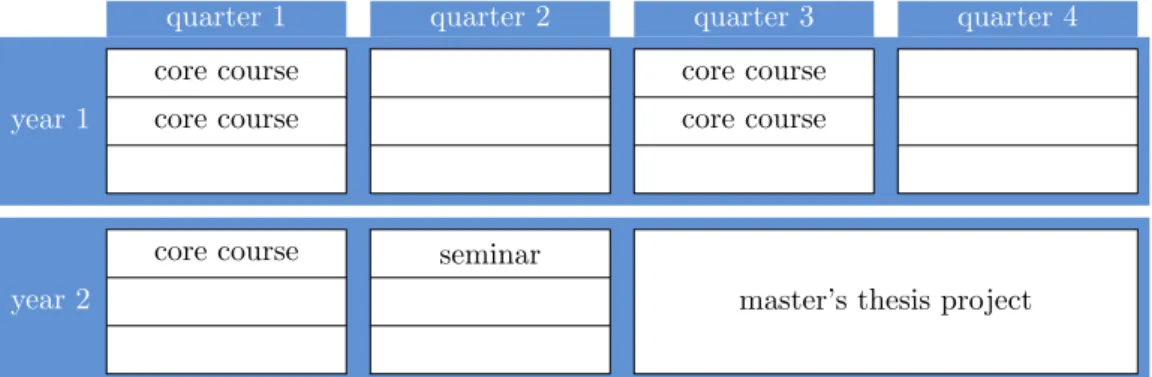
Figure 3.1: Global CSE study program for generations 2013 and before. The white slots indicate electives.
3.4 Curriculum generation 2013 and before
The global contents of the program is as follows:Study component Credits
Core program 25
Electives 60
Research seminar 5 (or 6)
Master project1 30
1The individual study program has to be approvedbeforeyou can start the master project, see
Sec-tion3.5for details. Note also that you cannot start the master project if you still have uncompleted homologation units.
A global view of the study program is shown in Fig.3.1.
3.4.1 Core program
The core courses provide you with a sound theoretical basis. This mandatory part of the Master program consists of a choice of five courses from each of the specialization areas. Each research group offers a core course. Additionally, you should follow a research sem-inar in your specialization (see Chapter 7) to prepare for your master project. Each of the eight computer science research groups offers a seminar, in which typical topics for that particular field of research are addressed.
Quarter Code Unit ECTS Exam
Core courses
1 2IL45 Advanced algorithms 5 a
1 2IS15 Generic language technology 5 w+a
1 2IW26 System validation 5 w+a
2 2IV35 Visualization 5 a
3 2II55 Business process management systems 5 w+a
3 2IN26 Real-time systems 5 w+a
3–4 2IF02 Verification of security protocols 6 w+a
4 2ID35 Database technology 5 w+a
Computer Science and Engineering 33 continued from previous page
Quarter Code Unit ECTS Exam
Seminars1
2 2II96 Seminar architecture of information systems 5 a
2 2ID96 Seminar web engineering 5 a
2 2IN95 Seminar systems architecture and networking 5 a 2 2IS95 Seminar software engineering and technology 5 a
2 2IV95 Seminar visualization 5 a
3–4 2IF03 Seminar information security technology 6 a
4 2IF96 Seminar formal system analysis 5 a
4 2IL95 Seminar algorithms 5 a
1Seminars can be taken from the fourth quarter of your study program onwards. This means that
if you enroll in September, you cannot take the seminars in quarter 2 in your first year, but that you have to wait until you have entered the second year. Similarly, if you enroll in February, the seminars in quarter 4 can only be followed in your second year.
3.4.2 Electives
The elective part of the curriculum amounts to 60 credits. You can choose freely from the list provided inSection 3.3.7. To compose a balanced program, you should consult the contact person of the specialization of your interest (seeSection 3.4.3).
Some courses may be prescribed as homologation courses (up to 18 credits) to make up for deficiencies in former education. Other courses may only be selected after approval by the Examinations Committee in advance (please consult the master study advisor). In some cases an internship of 15 credits may be part of the electives, seeSection 3.3.8.
3.4.3 Specializations
The CS division has eight research groups (see details and the names of contact persons in Chapter 7), each offering specialization courses in addition to their core course.
After taking some courses, you will probably have a more clear picture of the academic direction you want to pursue in your studies. If not, you may want to talk to several staff members or the study advisor. In the specialization for your subject, there are people that you may want to be involved with for your final master project. In order to compose a well-balanced program that provides adequate prerequisites for the this project, it is advisable to first choose and consult a project supervisor in the specialization of your interest before choosing elective courses.
As a rule of thumb, you should start your search for a supervisor and the construction of your individual program not later than at the end of your first year.
3.4.4 Internship
Since the master project can already be performed in an industrial environment, it is usually advised to spend the rest of the study program on regular courses. In some cases, however, an internship may be a valuable addition to the program, provided that it enhances prac-tical experience, provides deepening of knowledge, and contributes to the specialization. An internship takes 15 credit points as part of the electives, and can be followed only by
34 Computer Science and Engineering
permission of the internship coordinator. The internship is not open to IST-students. Re-quests for internships accompanied by convincing arguments explaining the reasons why the intended internship has a clear added value to the study program are to be sent to the internship coordinator dr. J.P. Veltkamp.
3.4.5 Admission to seminars, capita selecta, master project
Capita selecta courses are occasional educational elements, often with a research flavor. They may be experimental courses, a lecture series given by a visitor, or a special individual assignment as a preparation on future research. The capita selecta can be followed only by permission of the responsible lecturer. Students do not have a “right” to do these courses, but they may be granted the possibility.
The seminars, capita selecta, and master project are only open to students that are fully admitted. This means that they are not available for students that do not yet have their BSc diploma or students that did not yet complete the premaster. Other students that have deficiencies (e.g. uncompleted homologation courses) cannot start the master project.
3.5 Approval of study program
The Examinations Committee must approve your program consisting of the mandatory courses and your choice of the electives. In order to obtain this approval you construct a program, possibly with the help of the study advisor, fill out the program form, have it signed by yourself and the supervisor of your choice and hand it in at the student adminis-tration office (MF 3.068).
3.6 Final project
The final project of 30 credit points can be completed in any of the research groups in the CS-division, as long as a CS staff member is supervising it.
The start of your master project is marked by submitting a completed graduation plan containing the necessary information on the project (name, place, period, supervisor, and so on), and stating the fact that you have completed your curricular part of the program (see Section 3.5). The form must be accompanied by a project description and signed by you, your supervisor, the head of the relevant specialization and the study advisor.
3.6.1 Admission
During the master project, you should be able to spend full time and concentration on your project. In practice, however, it turns out to be rather difficult to plan curricular activities and, especially, their success. Therefore, we leave room for at most two courses of in total at most ten credit points to be finished during the master project period. Courses that are to be taken as homologation units have to be passed before you can start the master project. Also, be aware that you are not allowed to finish your project before you completed all your courses.
Computer Science and Engineering 35
3.6.2 Planning
Together with your supervisor, you decide on a description of your topic and a global plan-ning. You also arrange the supervision method, including how often you and your supervi-sor will meet to discuss progress. The project is concluded with a thesis and a presentation followed by a defense.
In general, the master project has to be finished within 6 months from the start. An extension to 9 months is possible. In exceptional cases, and only if it is clear that the project can be finished, the exam committee may allow for an additional 3 months period. It is important to note that the project must be finished within 1 year (when working full time) to prevent cancellation of the project, and having to start a new project with a different supervisor. Thegraduation regulationscan be found on the website.
3.6.3 Assessment
Your final project is graded by an assessment committee. The committee usually consists of your supervisor, a staff member from your specialization area, and a staff member from one of the other CS research groups. The supervisor is responsible for forming this committee at least one month before graduation.
The assessment committee takes the following criteria into account:
Report: Structure, completeness, correctness, readability, argumentation.
Graduation presentation: Structure, contents, clarity, contact with audience.
Defense: Argumentation, demonstration of knowledge, competency in dis-cerning main aspects from details of the project.
Execution of the project: Level of independence, planning, organization, handling dead-lines and setbacks, level of own contribution.
Not all criteria are equally important. The assessment committee decides the relative impor-tance of each criterion to arrive at a final grade. The motivation for the grade is documented in an assessment report, see thewebsite.
3.6.4 Checklist
The graduation checklist (Appendix B) summarizes all the steps required from having your study program approved to the graduation ceremony.
3.7 Double degree program CSE and SEC
The qualification to teach computer science to senior secondary school pupils is coupled to the 3TU program Science Education and Communication (SEC). This program encompasses 120 credits. In Eindhoven it is offered by the Eindhoven School of Education (ESoE). In the Education track of the SEC program, a student specializes in one of four disciplines: maths, physics, chemistry or computer science. Please note that the SEC program is completely lectured in Dutch!
BSc graduates in computer science are directly admitted to the SEC-program. So are MSc graduates from a computer science oriented program; their SEC-program is reduced to 60 credits because of exemptions. For this last category an even shorter route is available by taking the double degree program, which amounts up to 150 credits. Enrollment is required
36 Computer Science and Engineering
for both master programs (one main enrollment and a second enrollment). Certificates will be granted after completion of the whole program.
Details about the curriculum are available at the ESoE website:http://www.tue.nl/ esoe/.
4
Information Security Technology
A Master of Science in Information Security Technology (IST) is an academic expert in the area of digital communication in general, and in information security technology in partic-ular. Information security technology protects data that are stored, transmitted, accessed, or modified against all kinds of threats. This can vary from unauthorized access to malicious manipulations. Information security technology is essential for secure communication and data protection in many situations.
The IST program is a joint master program between three Dutch universities: Eindhoven University of Technology (TU/e), Radboud University Nijmegen (RU), and University of Twente (UT). These three universities have joint their forces with respect to security educa-tion in theKerckhoffs Institute.
Each of the mandatory and special elective courses is taught at only one of these three universities. This implies that students have to travel to other sites for part of their educa-tion. The program is set up in such a way that averaged over the two years of their master’s studies students will have to travel one day per week to another university.
A Master of Science in Information Security Technology can become involved in crypto-graphic primitives, security protocols, data storage, communication, or information security management. Additionally, he or she can act as internal or external consultant, regarding the security of information systems and networks, or regarding the security policy of an organization. A Master of Science in Information Security Technology can enter a job in the following institutions: research laboratories and academic institutes (both for theoretical and applied work); applied R&D in industry; the financial world; governmental agencies; consultancy agencies (all with respect to security in the area of information systems and relevant policymaking).
4.1 Admission
A Bachelor degree in Computer Science obtained at a Dutch university provides direct ad-mission to the CSE program. Students with a different degree and from foreign universities have to apply for admission via the admission committee. Dutch HBO graduates have to take a pre-master program before they can be admitted, seeSection 2.3.
38 Information Security Technology
The admission procedure is described inSection 1.5, and the requirements are listed in the Teaching and Examination Regulations (seeAppendix A.1).
4.2 Learning outcomes
The goal of the program is to transform Bachelors in Computer Science and Mathematics into academic experts in the area of digital communication in general and in information security in particular. Alumni will be able to function as researcher or as system developer in university or society. They will be well aware of the state-of-the-art in information secu-rity technology at the master level. They will be able to analyze complex secusecu-rity situations and to reduce them to solvable problems.
A graduate from the master program
is qualified to degree level in the domain of science, engineering and technology; is competent in the relevant domain-specific discipline, namely computer science and
engineering;
is capable of acquiring knowledge independently;
approaches computer-science problems in a thorough and scientifically founded
man-ner;
is capable of critical thinking, can reason logically and form opinions; has design skills, presentation skills, and communication skills;
has insight into the role of computer science in industry, society, and science;
and, in addition to a recognizable domain-specific profile, possesses a sufficiently
broad basis to be able to work in an interdisciplinary and multidisciplinary context. In addition to these general learning outcomes, a graduate from IST
has a broad view of information security;
should be able to evaluate existing and newly designed security systems;
should be able to list relevant security requirements in an application and to select the
right techniques to address these issues;
is an expert in at least one subarea of information security;
can contribute to discussions about the role of information security in our society; has experience in the process of specifying, designing, and realization of an
applica-tion in which security plays an important role.
4.3 Curriculum
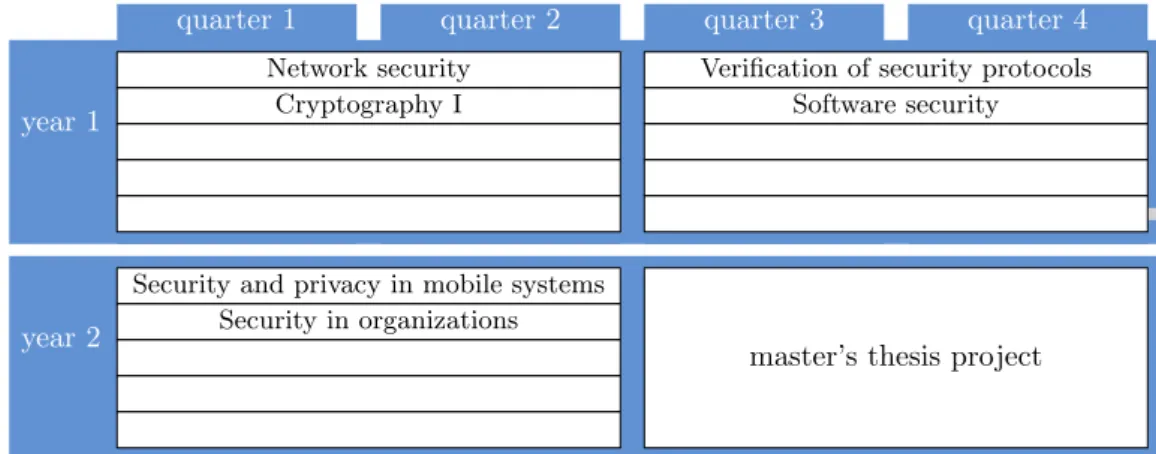
The Master track Information Security Technology is a two-year program of 120 ECTS in total. The academic year is subdivided into two semesters, the fall semester starting in September, and the spring semester starting in February. It is only possible to enter the program September. The program is full time. The curriculum contains both computer science courses and mathematics courses, and consists of a mandatory core program and elective courses. See Fig.4.1for a global view of the program.
Information Security Technology 39
year 1 year 2
master’s thesis project
quarter 1 quarter 2 quarter 3 quarter 4
Network security Cryptography I
Verification of security protocols Software security
Security and privacy in mobile systems Security in organizations
Figure 4.1: Global IST study program. The white slots indicate electives.
4.3.1 Core program
The mandatory part of the program contains the following courses:
Quarter Code Unit ECTS Exam Location
First year
1-2 2IF08 Network security 6 w+a Twente
1-2 2WC12 Cryptography 1 6 w Eindhoven
3-4 2IF02 Verification of security protocols 6 w+a Eindhoven
3-4 2IF06 Software security 6 w Nijmegen
Second year
1-2 2IF19 Security and privacy in mobile systems 6 a Twente
1-2 2IF07 Security in organizations 6 w+a Nijmegen
3-4 2IM91/ 2H016 Master project * 30
*) In case the master project is done within the Mathematics Division the code is 2H016.
All mandatory courses are offered as tele-lectures, so it is not strictly necessary to travel to the other locations.
4.3.2 Electives
The list below contains the preferred electives for the IST program. It is also possible to choose electives from the CSE program (seeSection 3.3.7); an internship (2IM02) is not pos-sible however. At least threecourses must be chosen from the following list of preferred electives:
Quarter Code Unit ECTS Exam Location
First year
1-2 2IF09 Biometric recognition 6 a Twente
1-2 2IF18 Cyber crime Science 6 a Twente
1-2 2IF17 Hacker’s hut 6 a Eindhoven
3-4 2IF03 Seminar information security technology 6 a Eindhoven
3-4 2IF13 Privacy seminar 6 a Nijmegen
3-4 2WC13 Cryptography 2 6 a Eindhoven
Second year
1-2 2IF12 Law in cyberspace 6 w+a Nijmegen
1-2 2IF14 Hardware and operating system security 6 a Nijmegen
1-2 2IF15 Secure data management 6 a Twente
4.3.3 Admission to seminars, capita selecta, master project
Capita selecta courses are occasional educational elements, often with a research flavor. They may be experimental courses, a lecture series given by a visitor, or a special individual assignment as a preparation on future research. The capita selecta can be followed only by permission of the responsible lecturer. Students do not have a “right” to do these courses, but they may be granted the possibility.