
LEARNER-CENTRED APPROACHES FOR CURRICULUM IMPLEMENTATION IN SECONDARY SCHOOLS: Teachers' perceptions and challenges
24
0
0
Full text
(2) the recent times, evidence exists that show that LCA was introduced in secondary schools and teachers' colleges in 2000 (Massawe, 2007). Subsequently, there has been review of Tanzania's secondary education curriculum in the past so as to incorporate learner centred approaches in the teaching and learning processes and teacher training programmes (see for example TIE, 2005; Education Sector Development Programme, 1999-2009; Education and Training Policy, 1995; Secondary Education Development Plan, 2004 -2009; Development Vision, 2025).. Introduction of LCA in secondary schools aimed at preparing students to be able to cope with the growing globalization and to make them competent enough for various job opportunities (Massawe, 2007; Temu, 2003). In addition, the revised curriculum was expected to be student-friendly in terms of content and methods, producing competent, creative and innovative students (Temu, 2003). According to Massawe (2007:6) LCA should make students participate more in lessons by being involved in different tasks. During LCA, a teacher facilitates learning process by. creating a conducive environment in which learning can occur and involve learners actively in learning activities. Students are expected to assume increasing responsibility for specific content determination and acquisition (Osaki, 2001; Kerry& Wilding, 2004; Mushi, 2004).The position of students during LCA is that of a critical thinker, a researcher, a person who analyses and critiques what is presented and finally constructs his or her own meaning. Several studies have explored about acceptability and use of LCA among primary school teachers (Ogondiek, 2005), in Vocational Education Training Authority (VETA) (Mdima, 2005) and in the new diploma teachers ' curriculum (Msonde, 2006). Limited studies have investigated about the challenges encountered by secondary school teachers when implementing curriculum using LCA. The focus of the study reported in this paper was to investigate secondary school teachers' perceptions about LCA and challenges that they encounter when implementing curriculum using LCA.. PURPOSE OF THE STUDY The main objective of the study was to investigate challenges of implementing curriculum using LCA in O-level secondary school classrooms. The following main research question guided the study: What are teachers ' perceptions and challenges of using LCA for implementation of curriculum in secondary schools? The main research question was addressed by answering the following sub-research questions: 1. What are teachers' perceptions about LCA 2.
(3) 2. What teaching approaches do teachers usually use to implement curriculum in classrooms? 3. What challenges do teachers encounter when implementing curriculum using LCA in classrooms? The investigation was necessary because considerable efforts have taken place in Tanzania to achieve among others, effective use of LCA to implement curriculum in secondary schools. Such efforts include SEDP, which was geared towards improving access, equity and quality as well as capacity building. LITERATURE REVIEW Learner-centred approaches for curriculum implementation LCA is heavily advocated by cognitive learning theorists, social learning theorists, humanistic learning theorists and transformative learning theorists. Educationists like Rousseau, Froebel, Dalton, Montessori, Piaget and others form a suitable example (Khursheed ,2002). In this approach, teacher 's role is to create a conducive environment in which learning can occur. Students are actively involved in learning activities and are expected to assume increasing responsibility for specific content determination and acquisition (Osaki, 2001; Kerry & wilding, 2004; Mushi, 2004). Above all, LCA puts more emphasis on the good relationships between a teacher and students and between students and their interaction with the environment. A teacher should be facilitated and supported to prepare teaching materials and techniques that stimulate participatory learning (Khursheed, 2002). The following are some of the major characteristics of LCA (Le Francois, 1999; Osaki, 2001; Weimer, 2002; Khursheed, 2002; Mushi, 2004): x The teacher does the learning task less, learners do more. These tasks are such as problem solving, discussions, drawing, dramatizing, role-playing etc. x The teacher does less talking to promote discovering, learners do more discovering on their own and give feedback, leading to more understanding. Discovery is achieved through discussions, reading books, doing experiments, making observations, doing interviews with people, participating in group work etc. x The teacher does more designing work for learners to do; learners do all the designed 3.
(4) work effectively and in the time scheduled. x The work to be done by teachers is preparing quizzes, assignments, instruments for experiments, and providing books for reading, things for the learners to observe, topics for debates, drawing equipments, drama, games, songs, and sports materials and so on. x The teacher simply guides his /her learners to do more role-playing so that she /he can facilitate each individual. Here the teacher just demonstrates how to write, study, read, dramatize, calculate, take notes, answer questions, solve social problems, do economic activities, and contribute to group discussions or debates and so on. x The teacher works more at understanding each child, so that every learner does more work of self-understanding. x The teacher seeks to identify a learner 's talents and problems so that she /he can facilitate every individual in accordance with his or her uniqueness and make the learner aware of his /her talents and problems and how to promote the talents and solve the problems. x The teacher works hard at a condusive climate for learning, which learners use for effective learning. This can be done by the teacher making sure that his /her classroom is full of learning resources, being strict on language policy, establishing subject clubs, leaving time for independent learning, closely supervising the work and so on. x The teacher uses more feedback and learners submit their work to the teacher on time. Here the teacher should be democratic, tolerant of mistakes, be good listener and reader of learners' feedback and so on. Therefore, learners are transformed from being passive learners to active ones. In this approach learning is viewed as a process of communication that encourages participation. x The learner is helped to discover the subject of learning in an environment that is free from the indoctrination of the teacher or the stress of examinations. LCA treats each child as a unique individual whose needs, interests, abilities and problems are catered for. Studies indicate that the greatest challenge of using LCA is that teachers have weak knowledge base, they lack confidence and creativity and a strong theoretical foundation to support LCA 4.
(5) use (Mhando & Basiliane, 2004). According to Mhando and Basiliane, teachers place a lot of dependence on texts instead of using resources from the environment to facilitate learning of students. Teaching and learning resources Since the world is now rapidly changing due to the newly invented Information and communications technology (ICT) what is greatly needed in teaching and learning, Osaki (2002) argues, is the need to educate and train science and mathematics teachers to use effective strategies in teaching to make science exciting and enjoyable. ICT as a medium for teaching and learning is seen as a potential means of improving curriculum design, incorporating the use of computers. Furthermore, Tilya (2003) described a project using Microcomputer Based Laboratory (MBL) in science education in Tanzania. This promotes activity-based teaching. A computer is connected to the internet to access a Teaching Enhanced Independent Learning (TEIL) program. Via the internet, students can research and browse books and journals online, thus increasing the availability of learning materials (Kitta and Tilya, 2010). However, it may be fair to argue that most teachers in Tanzania have little knowledge and skills in using ICT-based teaching and learning, which now has a major role in the world .Tilya,(1997), and Gast ,et al(2004), in their studies revealed that the majority of teachers were and are still computer illiterate. Therefore, complete integration of a computer literacy course into the existing subjects would make the course meaningful for both teachers and students (Tilya, 2003).Enhancing the Learning and teaching in secondary schools using ICT, will enable teachers and students to become more competent (Tilya and Voogt, 2002).As the world evolves into a post-industrial, technology-based society, our educational system must also change to keep pace. Today, the teaching of lessons is information-based, which involves analyzing and storing existing information and such teaching relies heavily on computers, media and other technology. The question as to whether secondary school teachers have access to and use ICT in teaching is needed to be answered through the researcher consulting the teachers. Other. teaching. and. learning. materials 5. include. teacher. guides. (Nihuka,2004)..
(6) Environment-oriented biology lesson materials have been developed to support teachers in implementing learner-centered lessons on the environment in secondary schools. According to Nihuka (2004), teacher guides seemed quite effective in promoting classroom interactions during biology lessons. The materials, which were written to address the problem of lack of textbooks in secondary schools, have the lessons organized in such a way that they emphasize the activities that students can do while learning about science. A similar approach is reflected in chemistry materials (Ottevanger 2001), physics materials (see Tilya 2003) and in TEAMS materials (TEAMS project, 2000). Bio Quest Curriculum materials (as explained in Nihuka, 2004) is another kind of material that can be used to promote an interactive, open-ended environment for learning about biological concepts, through a philosophy based on problem posing, problem solving and peer publication and review (3P 'sphilosophy).Using this kind of guide in the lesson, students get actively involved in their own learning and it opens up avenues for further exploration. Library services in teaching and learning play a major role in equipping students with a rich source of learning materials. Studies by Lance (1994), Lonsdale (2003) and Matheews (2005) show that school library services play a significant role in the process of teaching and learning and enhance students' performance. School libraries help students to develop their intellectual ability. They are critical for students ' achievement. Across the world, different scholars have shown that students in schools with good school libraries learn more, get good grades, and score higher in standardized tests than their peers in schools without libraries.(Panda,1992). For instance, equipping teacher students with information literacy skills enhances their ability to access and use information efficiently for teaching and learning. A study conducted in America by Crow (2006) shows that the school library can help children to become lifelong learners. Another study by Lance (2004) shows that when a library is served by professionals and has a good collection it tends to attract more people to use it. Unlike the study by Nawe (1989) in Tanzania which shows that most schools do not have librarians .They are served by teachers who are not only unqualified as librarians but also have other school responsibilities and so they cannot manage the library properly. Another study by Mwashiga (2005) in Tanzania revealed that most of the school libraries are still understaffed. Furthermore, Barman and Mayer (1994) reported on the inadequate coverage of concepts in textbooks in the 6.
(7) United States of America (USA). This is also true in Tanzania as most textbooks in schools are from America and Europe. Field visits can also be used to promote learner centred approach because field visits provide students with the opportunity to explore and learn lessons in the environment (e.g. National parks, Museums, etc), which is different from the traditional classroom approach, as demonstrated by Nihuka (2004). Challenges of implementing curriculum using LCA The process of curriculum change is important for understanding changes in education. Several. scholars such as Marsh and Willis (1995) and Chediel (2004) have cautioned that. change process is not quite so linear and that the phase is overlapping. According to Fullan (1992), adoption takes one step closer in that it refers to the phase that leads up to and includes the decision to proceed with a new curriculum direction .The adoption phase can generate meaning or confusion, commitment or alienation or simply ignorance on part of participants and others to be affected by the change (Marsh and Willis, 1995; Chediel, 2004). At this important stage, Rogers, (1995)set five stages to be followed in introducing new innovation starting with awareness, interest, evaluation ,trial and then ,adoption. Thus, implementation of a new pedagogy depends on teachers' understanding of the adoption process and their role in relation to the given curriculum change. Furthermore, the new pedagogy was introduced without the proper orientation of tutors (Wangeleja, 2003; Mtana et al; 2004).Thus tutors were half-baked in implementing curriculum in teachers colleges. This appears as fidelity implementation as discussed by various scholars Rogers and Fullan, 1992; Marsh and Willis, 1995; Rogers, 1995). The Ministry of Education and Vocational Training (MOEVT) is responsible for making decisions concerning the curriculum .For instance; regarding the selection of the content, TIE does this work on behalf of the MOEVT without the involvement of tutors and other stakeholders. Ownership of change is associated with the so-called bottom up initiative after the top-down models of the 1960's and 1970's (Rudluck; 1988).As a result, curriculum change becomes highly school-based. However according to Gordon (cited in Rudluck, 1988), complex structures of 7.
(8) control hinder such bottom-up initiatives As a result, teachers may just dangle like puppets from the strings of someone else 's invention .On the other hand, curriculum development initiatives at the central level and the implementation outcomes at the school system are inconsistency. That is why the reason Goodlad (1990) argues that top-down curriculum innovations have led to have differences in adopting curriculum change. According to Hargreaves (1989), the movement towards school-centred change offers the most attractive alternative. Similarly Marsh (1977) argued that top-down legislative changes could cause confusion and stress that may lead to the rejection of new policies. In that regard, teachers need to be involved in the process of curriculum change (Msonde, 2006). It is argued that the principle of working with students and not just preaching to them may well be vital to the task of securing effective curriculum development in any particular school (Meena, 2004; Maro, 2004). It is sensible that curriculum research should treat teachers with seriousness and get a sense of the classroom and school world as they see it. Ignoring teachers can lead to several problems, as by indicated by Hargreaves (1989:30), when he says: For without that understanding, it is likely that curriculum development will be misconceived for want of knowing how teachers will interpret, transform or resist them at the classroom level. But the difficulty with all this is that while the existing qualities of teachers thinking are received much more warmly by school-centre pragmatists than their more traditional academic counterparts, there is a strong tendency for theory to be applied and developed only to those things which teachers already value to be of practical issue. LCA in Tanzania was introduced into the education of new teachers' education in 2004 and started to be used in secondary schools in 2005.Various scholars and researchers have shown some opportunities and challenges in implementing LCA (participatory methods).Teacher trainees' and tutors' conceptions have shown that the traditional approach has more advantages than LCA because students ' confidence is built (Mtana et al., 2004).Contrary to what they believe, biology tutors in teachers ' colleges have been observed not to be applying the learner-centred approach in teaching and learning but rather they are still using transmittal methods at the expenses of participatory methods (Maro, 2004). Although the new teacher education curriculum intended to improve the quality of education, many challenges can be put forward in that regard for successful implementation in real 8.
(9) classroom instruction. First, the initiation of new curriculum was too abrupt to allow for sufficient orientation of teachers or tutors, (Wangeleja; 2003).Likewise teachers ' involvement in the whole process of curriculum change is imperative for effective implementation. In addition, Meena (2004) argued that the teacher education curriculum reform used mainly the top down approach and teachers were not fully involved. Research has show that if stakeholders are not involved fully in a certain innovation, its implementation would likely lead to failure (Marsh and Willis, 1995).Teachers involvement is important in the initiation and adoption of any change. (Msonde, 2006). Second, there is not enough time to implement LCA in secondary schools. Meena,( 2004) argues that participatory methods in the teaching-learning process are by nature time consuming. Third, the new syllabi for teacher education are overloaded (MOEC,1997).It is a question as to how tutors managed to accomplish the introduced overloaded diploma syllabi using participatory methods ,which are basically time consuming and. produce effective. secondary school diploma teachers. Mdima (2005) added that failure to use participatory methods is linked to the overloaded syllabus. Teachers still lack the skills and enabling conditions for the use of participatory methods, which can speed up the teaching and learning process, but only if the syllabi are well planned in accordance with the situation and teachers are skilled enough in the use of LCA. Fourth, teaching methods require students' participation in the entire teaching and learning process to encourage. independent learning (Gibbs,1995;Lea et al,2003).The process is. enhanced by the availability of appropriate and sufficient teaching -learning resources for exposing teachers trainees to different sources of knowledge, to build their skills and competence. (Caffarella, 1994) It is doubtful whether teacher colleges, primary and secondary schools have sufficient teaching and learning resources to suit participatory, interactive and transformative pedagogy orientations. If teaching-learning resources are scarce, then one wonders how teacher trainees, primary and secondary school student can develop effective and independent learning, especially in large classes. School libraries lack local textbooks for reference that reflect the Tanzanian context for both teachers and students to update their experience. (Nihuka, 2004).Teachers' instructional strategies in the process of teaching involve 9.
(10) planning the teaching methods, and instructional objectives, application of the planned lesson overall evaluation Mariam, 2008). Fifth, the research study wanted to know whether LCA is relevant to countries like Tanzania nowadays. O 'Sullivan (2003) described learner-centred learning as a western approach to learning which may not necessarily transfer to developing countries such as Tanzania, where there are limited resources and a different learning culture. It can be equally hard at times to see how the approach can be economical in large classes associated with high enrolment in secondary schools under SEDP. Though, LCA is the approach ephasised to be used in secondary schools nowadays but f for effective teaching and learning process, both traditional and modern approaches should be integrated. Moreover, a comprehensive study was conducted in 2004, by the University of Glasgow, on the use of student centred learning with full-time undergraduate students. In the study, it was found out that student-centred learning was very prevalent in the later years of degree studies, and they believed that its effectiveness depends on class sizes, and the resources needed to implement it, as well as students' familiarity with the term. To know whether the LCA is relevant to Tanzania now was the question to be answered through the researcher interviewing and discussing with the teachers who are the victims of this approach. METHODOLOGY Research design The study reported in this dissertation used a holistic case study design. According to Yin (2003) a holistic case design increases generality of the findings case study research design. A case study is an in depth comprehensive study of a situation or a phenomena (Yin, 2003). Case study design helps in understanding the present status of a situation or phenomena (Krisnaswami and Ranganathan, 2006; Yin, 2003). It also helps to secure a wealth of information about the unit of the study, which may provide clues and ideas for further research. It provides an opportunity for the intensive analysis of many specific details that are overlooked by other methods.. The case study was used because the researcher was unable to survey secondary schools all over the country due to time constraints. So the information gathered may be a representation of the rest of the government schools in the country. 10.
(11) Sample and sampling techniques The study involved the following four schools from Ilala District in Dar es Salaam Region: Azania, Jangwani, Kibasila, Kisutu and Zanaki. Systematic sampling technique was used to select the schools. The selection was done by considering old ordinary government secondary schools in Dar es Salaam. The schools were selected from a list of 40 old ordinary government secondary schools in Dar es Salaam which were arranged alphabetically. Table 3.1 shows that teachers from the studied secondary schools were diploma holders and graduates from various colleges and universities. This indicates that they have sufficient qualifications and most of them have experience of more than two years of teaching in secondary schools.. 11.
(12) Table3.1. Teachers background characteristics Qualification School Azania Jangwani Kisutu Zanaki. No. of teachers 10 10 10 10. Diploma. Degree. 2 1 4 5. 6 9 6 5. Teaching experience (in years) Less than 2 More than 2 2 1. 8 9 10 10. Instruments These are tools for collecting information or data for the study. The study employed questionnaires, interviews and classroom observations, because case study research employs all kinds of data collection methods. The questionnaires had five parts, the first part collected data about teachers' understanding of LCA. The second part intended to know how the stakeholders manage to use LCA in overcrowded classes. The third part focused on the challenges the stakeholders face when implementing LCA in their teaching and learning activities. The fourth and fifth parts intended to know the attributes needed for successful implementation of LCA. Interviews with mostly open- ended questions were used to gather information from the teachers, and a total of eight (8) teachers were interviewed, two (2) teachers from each school. The interview was used to gather information on teachers ' understanding of LCA, the challenges faced by teachers in implementing LCA, and what should be done to resolve the problems. The interview was also used to know whether the teachers have received any training in LCA. Classroom observations were carried out to ascertain whether or not LCA is implemented in the classroom and the kind of learning and teaching resources that are used by teachers to implement LCA in the classroom. Eight lessons by eight teachers were observed to see how they physically implement LCA in the real situation. The lesson Observation Guide was used to observe the techniques used by teachers in teaching and learning. In each observed lesson, the researcher sat at the back of the classrooms and recorded what was taking place during lesson introduction, lesson development and conclusion. Areas focused during observation were the involvement of learners in the lesson, the teaching methods used, the textbooks used, and the use of teaching and learning materials. Evidence of improvisation was also observed and noted, 12.
(13) as well as time management, lesson evaluation, and the manner in which teachers handled undisciplined behaviour such as making a noise and coming late. Data analysis Two kinds of data analysis were used in analyzing the findings of this study. Observation and interview data were analyzed using the data reduction technique, where by themes were identified and presented accordingly. Where necessary, tables showing frequencies were presented. The data were carefully organized in such a way that they were reduced to omit bulkiness without losing the meaning. Interview data were used to answer questions 1, 4 and 5.Data from observations were used to answer questions no.2, 3 and 4 which together with the interview described what was observed during the lessons. Questionnaire data were analyzed using the Microsoft Excel program, which facilitated the grouping and presentation of data in tables, frequencies and percentages as per research questions 1, 3, 4 and 5. FINDINGS Teachers' perceptions about LCA Table 4.1 presents teachers perceptions about LCA in percentages and percentages. Findings indicate that majority of teachers in every school have positive perceptions about LCA (e.g. Azania: 70% - 80%; Jangwani: 60% - 80%; Kisutu: 60% - 90%; Zanaki: 50% - 82.5%). They feel that in LCA teachers do less talking and learners do more and that teacher's task is to facilitate students learning.. Table4.1. Teachers' perceptions about LCA Items I am the centre of teaching and learning process. Frequencies & Percentages N=40 Jangwani Kisutu Zanaki (n=10 (n=10) (n=10) 6(60) 7(70) 6(60). Azania (n=10) 4(40) 13. Overall 23(57.5).
(14) I do less talking and learners do more I like to use LCA in my teaching As a teacher my task is to facilitate students learning I do diagnosis to identify learner talents and problems I do more work of creating conducive climate for learning. 7(70). 6(60). 7(70). 8(80). 28(70). 8(80) 7(70). 8(80) 6(60). 8(80) 3(30). 9(90) 6(60). 33(82.5) 22(55). 7(70). 8(80). 7(70). 4(40). 26(65). 7(70). 1(10). 6(60). 6(60). 20(50). Specifically, in all schools except Azania (40%), teachers perceive LCA as putting the teacher at the centre of teaching and learning process (60% - 70%). With an exception of Zanaki (40%), teachers in other schools perceive LCA as demanding teachers to do diagnosis to identify learners ' talents and problems (70% - 80%). Also, with an exception of Jangwani (10%), teachers in other schools perceive LCA as making teachers do more work of creating conducive climate for learning (50% - 70%). In overall, majority of teachers across schools have positive perceptions about LCA (overall percentages between 50% - 82.5%) and they generally like to use LCA in their teaching (80% - 90%). Teaching approaches As perceived by teachers Teachers ' responses from interviews showed that they use different approaches in their teaching. Specifically, seven (7) teachers pointed out that they use group discussion in their teaching and provide group assignments to students. The following quotation from one of the teachers from Azania secondary school confirms what was expressed by majority of teachers in other schools: I prefer teaching by organizing group discussion and give my students group assignments at the end of the lesson. But sometimes I feel it is difficult to measure each student's level of understanding because sometimes only a few do the tasks and the rest do not concentrate. Only 2 out of 8 teachers who were interviewed indicated that they provide their students with individual assignments. Five (5) other teachers out of 8 indicated that they do not provide their students with individual assignments. According to the teachers individual assignments are not preferred because of the large student size in the class, approximately 70 in a stream which makes making of 14.
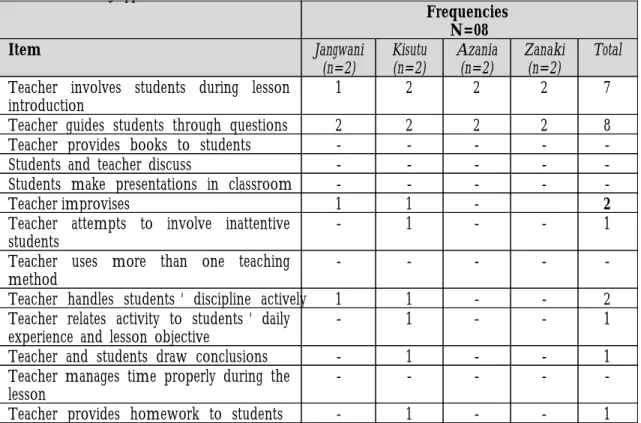
(15) scripts for the whole class very difficult. Coupled with the number of streams that a teacher will teach, individual assignment becomes even more difficult to handle as shown by the following statement made by one of the teachers from Azania: I have 70 students in one stream and I teach a total of 3 streams with a total of 210 students and so it is very difficult for me to mark each student's work individually. Six (6) out of eight (8) teachers pointed out that they used different teaching approaches such as asking students questions at the introduction and at lesson evaluation. According to the teachers, the approach is preferred because it is the simplest method to use as indicated in the following utterance: I prefer asking questions to students during lesson introduction because the approach favors fast learners by way of involving them during the lesson more than slow learners who are often left behind without talking, because they dare not try out things in the classroom. The following utterance by another teacher from Jangwani secondary school indicates that she even uses jig-saw method in her teaching: I usually employ suitable methodology in a large class. For example I use the jig-saw method where I provide different questions to be discussed in different groups called home groups. Later each member from each group form foreign groups where they share what they have been discussing and after discussion these foreign groups all return to their home groups and share all that they have learnt in the foreign groups, which helps to share different issues in a short timeµ. As observed in classroom Findings from classroom observations are presented in Table 4.2. Findings indicate that only seven (7) out of 8 teachers were observed to involve students. during lesson introduction.. Almost all teachers across schools guide students to learn by means of asking them questions 15.
(16) and helping them to answer the questions. Table 4.2. Teaching approaches as observed in classroom Item Teacher involves students during lesson introduction Teacher guides students through questions Teacher provides books to students Students and teacher discuss Students make presentations in classroom Teacher improvises Teacher attempts to involve inattentive students Teacher uses more than one teaching method Teacher handles students ' discipline actively Teacher relates activity to students ' daily experience and lesson objective Teacher and students draw conclusions Teacher manages time properly during the lesson Teacher provides homework to students. Jangwani (n=2) 1. Frequencies N=08 Kisutu Azania Zanaki (n=2) (n=2) (n=2) 2 2 2. Total 7. 2 1 -. 2 1 1. 2 -. 2 -. 8 2 1. -. -. -. -. -. 1 -. 1 1. -. -. 2 1. -. 1 -. -. -. 1 -. -. 1. -. -. 1. However, majority of the teachers were observed using chalk and talk as dominant teaching approach in all schools. It was also observed that one of the teachers was teaching weathering using lecture method which involved talking from the beginning of the lesson to the end and writing notes during lesson development without any relevant teaching aid to illustrate the explanations. No group discussions were observed and majority of teachers could not relate their lessons to students' daily experiences.. Challenges of implementing LCA in classrooms Table 4.3 presents challenges which constrain the use of LCA to implement curriculum in schools. Findings indicate that large class size is a critical challenge to majority of teachers in using LCA to implement curriculum (90%). Result from interviews also supported those 16.
(17) from questionnaires. Majority of the teachers indicated that most of classes have 70 students as opposed to the normal teacher-student ratio of 1: 45 which is a big obstacle for me because there are too many students in a class which is impossible to teach them effectively through LCA. Table4.3. Challenges which constrain teachers in using LCA to implement curriculum. Item Large class size which hinder active involvement of students LCA consumes time Lack of financial support from school Unavailability of internet in the school Lack of computers in the school. Azania (n=10) 90. Percentage (%) N=40 Jangwani Kisutu (n=10) (n=10) 90 90. Zanaki (n=10) 90. Overall 90. 90 20 80 90. 90 30 80 70. 80 20 90 89. 90 17.5 80 90. 10 00 90 90. Overloaded syllabus was another challenge pointed out by majority of teachers in the schools. According to the teachers, overloaded syllabus hinders the application of LCA in schools because the content is bulky to be covered in a year, hence teachers feel they are under pressure to finish the syllabus rather than think about LCA. Also, majority of teachers except those from Kisutu (10%) reported that LCA consumes time (80% - 90%). Same result was also reported by majority of teachers during interviews. According to the teachers, LCA requires interactions with students so a lot of time is consumed during its implementation and most teachers fear of not covering their syllabi, which is why they shift to teacher centred approaches. Another challenge identified by most of teachers at interview is library. According to the teachers the books in library are inadequate and the library space is not proportional to the number of students in schools. Based on interview results, teachers across schools added lack of teaching and learning materials in the school library as a chronic challenge as evidenced in one of the utterances which seemed common to most teachers: Only I as the English teacher have a personal copy for some of the texts in literature which I use for teaching but learners have none. For example, in the Death Factory reading the school has 10 copies and the class has more than 50 learners, making the book student ratio of 1:5 instead of 1:1and so I have to ask students to photocopy the texts but this is still a problem as not all students can afford to 17.
(18) photocopy the texts and so can not get a real picture of the book and its content. I do not even have a teacher's guide book on how to go about the learner-centred approach. Majority of teachers pointed lack of internet (80% - 90%) and computer (70% - 90%) facilities in the schools as among the challenges of using LCA in their teaching. Teachers indicated that access to computers and internet is limited in schools as evidenced in a statement by one of the teachers from Jangwani secondary school: Computers are available in this school, but are not working, only 7 work but are not connected to the internet because the school has failed to pay the bill and so neither students nor teachers can access up-to-date materials. Lack of regular in-service training on how to use LCA effectively was also mentioned as another critical challenge as pointed out by one of the teachers from Jangwani: I have never been trained on LCA .Only one Biology teacher has been trained in our school so that he trains us, but we are 115 teachers teaching different subjects, which makes it impracticable because each subject has a different teaching approach, and so it is difficult for a Biology teacher to train an art teacher since the teaching approaches differ. DISCUSSION AND CONCLUSIONS The study reported in this paper investigated perceptions of secondary school teachers about LCA and challenges that constrain them from using LCA to implement curriculum in schools. The study has established that generally, teachers have positive perceptions about using in curriculum implementation. They perceive LCA as putting teachers at the centre of the teaching and learning process, demanding teachers to identify students' experiences and talents during lessons and making teachers do more work of creating conducive environment for students to learn. Generally, teachers like to use LCA in their teaching and as perceive by the majority of teachers in the study, they do use LCA in terms asking students questions during lesson introduction, employ jig-saw and allow students to discuss in groups during lessons. However, inconsistent to what teachers perceive classroom observations of the actual teaching revealed that generally chalk and talk is the dominant approach for teaching by most teachers. 18.
(19) Several challenges prevent teachers from using LCA in curriculum implementation in schools. Foremost, large class size of over 70 students in a class is a critical challenge that makes teachers uncomfortable to use LCA in their teaching. As a result most teachers avoid providing assignments to individual students because it means more work for teachers during marking. This affects effective assessment of students ' learning and subsequently their academic outcomes. Another challenge is existence of overloaded syllabi which make it difficulty for teachers to complete by are more after completing syllabus even at the expense of effective learning. Also, teachers feel that LCA is demanding in terms of time for lesson preparation and execution in classroom. As such chalk and talk is the cheapest option for them. Lack of relevant teaching and learning materials such as books in the school library and lack of enough space are also critical challenges for effective use of LCA by teachers in schools. In this case students and teachers do not have reliable access to teaching and learning resources from within school library which makes application of LCA difficult. Limited access to computers and internet is also a challenge that makes the use of LCA in schools difficult. Studies show that computer and internet have potential in enhancing active involvement of students in the learning process. Lack of regular in-service training for teachers on the use of LCA in classrooms is another challenge. School-based in-service arrangements which are cheaper may be the best options in this respect. It is recommended that unless deliberate efforts are made by relevant stakeholders (such as teachers, heads of departments, headmistresses / masters, education officers at district, region and at the level of Ministry), the use of LCA by teachers in secondary schools will remain a nightmare. REFERENCES Ball, S.J. (1990). Politics and Policy-Making in Education.London: Routledge. Bennaars, G.A.,Otiende,J.E., & Boisvert, R.(1993).Theory and Practice of 19.
(20) Education.East African Education Publishers Ltd. Borg,W.R.,Gall,M.D.,&Gall,J.P.(1996).Educational Research: An Introduction. NewYork: Longman Publishers. Bredo, E. (1995).The social construction of learning.In Phye (Ed.).Handbook of academic learning:Construction of knowledge(pg4):SanDiego,Academic press. . Bruner, J. S. (1963). The Process of Education.USA: Oxford University Press. Cohen, L., & Manion, L. (2007). Research Methods in Education. Routledge: London and NewYork. Cuban, L. (1992). Curriculum Stability and Change. In P,Jackson (Ed), Handbook of Research on Curriculum(pg 56-56). New York: Macmillan Press. Chediel, M. (2004). Pedagogy Reforms in Tanzania:Learning From Experience. In Mtana, N, Hojlund;G, and Mhando,Teaching and Learning in Primary Education in Tanzania, Dar es Salaam:Ecoprint. Edwards, A (2001). Meeting Individual Learner Needs:Power, Subject, Subjection In C.Paechter, M.Preedy,D.Scott, and J.Soler, ( Eds,) Knowledge, Power,and Learning.(pg 67-78) London: SAGE. Fullan, M.(2001). The new Meaning of Educational Change. London: ASSELL. Goodlad, J. (1979). Curriculum Inquiry: The Study of Curriculum Practice. New York: Mc Graw-Hill. Goodlad, J. (1984). A Place Called School. New York: Mc Graw Hill. Goodson, I. (1991). On Understanding Curriculum: The Alienation of Curriculum Theory. London: Falmer Press. Harding, D. (2001). Strengthening Teaching and Learning. World Bank Institute: Harvard University. Huberman, A.M. (1973). Understanding Change in Education. An Introduction. Paris: UNESCO Press. 20.
(21) Ishumi,A. & Nyirenda. (2003). Philosophy of Education. Dar es Salaam: Dar es Salaam University Press. Keya,S.O.,Makau,B.F.,& Omari,I.M.(1989). Guidelines for the Formation of Research Project Proposals.Nairobi: Oxford University Press. Kitta, S. (2004). Enhancing Mathematics Teachers Pedagogical Content Knowledge and Skills in Tanzania.Enschede:Print Parterners. Kitta,S., & Tilya,F.(2010).The status of learner -centred learning andassesment in Tanzania in the context of the competence-based curriculum.Papers in Education and Development,29,77-90. Krishnaswami,O.R,, & Ranganatham,M.(2006).Methodology of Research in Social Sciences.Mumbai,Delh,Nagpur,Bangalore,Hyderabad:HimalayaPublishing House. Kombo,D.K.,&Tromp,D.L.A.(2006).Proposal and thesis writing.An Introduction,.Nairobi:Paulines Publications Africa. Kursheed, E. A. (2002). Learning through Learner Centered Approach.Retrieved on 10th February 2010 from world wide web http://www.apn.org/ed/lcp.html. Lance,K.C.(1994).What Research Tells Us About the Importance of School Libraries:White House Conference on School Libraries-USA. Retrieved on 8th May 2011 from the World Wide Web http/www.imls.gov/news/events/ whitehouse-cashtm/klc. Le Francois, G.R. (1999). Psychology for Teaching. Beltmont:Words Worth. Lea, S.J.D. Stephenson, &J, Troy (2003). Higher Education Students Attitudes to Student Centred Learning:Beyond Educational Bulmia.Studies in Higher Education,No.28,vol,3. Lonsdale, M. (2003).Impact of School Libraries on Student Achievement:A Review of Research Mellabourne:Australian Council for Education Research.Retrieved 21.
(22) on 15th may 2010 from the world wide web. Marsh,C. and Willis, G.(1995). Curriculum: Alternative Approaches, On going Issues. Columbia:Ohio Merrill. Massawe,J.E.(2007). TIE. Government Report (Taasisi ya Elimu Tanzania,Mabadiliko Yaliyotokea Katika Mtaala wa Elimu Ulioanza Kutumika mwaka 2005).Dar es Salaam:Tanzania Institute of Education. Meena,W.(2004). Shifting From Teaching to Learning: Teachers Educators' Conception of Curriculum Change in Mtana,N,Mhando,E,and Hojlund,G (Eds) Teaching and Learning in Primary Education in Tanzania, Dar es Salaam:MOEC. Mdima, A.D. (2005). Acceptability and the Use of LCA Among School Teachers. Masters of Arts in education Dissertation.University of Dar es Salaam,Tanzania. Mhando,E.and Mrimi,B.(2004). Opening Windows Opportunity for Collaborative Learning and Research in Mtana, N, Hojhund, G, Mhando E.Teaching and Learning in Primary Education In Tanzania.Dar es Sallaam:Ecoprint. Mwashiga,C.G.(2005). Assessment of the Role and Current Status of Libraries in Selected Military Secondary Schools in Tanzania Mainland and Zanzibar. Prospects and Constraint. Masters of Arts in Education Dissertation.University of Dar es Salaam, Tanzania. Nawe, J. (1989). Evaluation of Library Services in Secondary Schools and Teachers Training Colleges in Tanzania.Report Dar es Sallaam University. Niemi, H.(1995).Active Learning by Teachers :In Active Learning for Students and Teachers. Manuscript OECD: CERI. Nihuka, K.A. (2004). The use of Teacher Guide Materials (TGM) in the teaching on Environment Lesson. Masters of Science in Education Dissertation. University of Dar es Salaam, Tanzania. 22.
(23) Ndunguru,S.(1984). Educational Essays for Teachers,. Dar es Salaam: National Printing Co.Limited. Osaki, K.M. and Agu, A.O.(1999). A study of Classroom Interaction in Primary Schools in the United Republic of Tanzania. Dar es Salaam: UNICEF. Osaki, (2000).Curriculum and QualityIn J. C. J. Galabawa, F. E. M. Senkoro and A. F. L. Lwaitama, (Eds), The Quality of Education in Tanzania: Issues and Experience. Dar es Salaam, Institute of Kiswahili Research University of Dar es Salaam. O' Sullivan, M. (2003). The Reconceptualisation of Learner- Centered Approaches: A Namibian Case study International Journal of Educational Development Press. Panda, B. D. (1992).The Growth of Academic Library System. New Delhi:Anmol Publications. Piaget, J. (1970). Science of Education and the Psychology of the Child.New York: Rogers, E.M. (1995). Diffusion of Innovations. New York: The Free Press. Ruddluck, J. (1988).The Ownership of Change as a Basic for Teachers Professional LearningIn J. Calder head(Ed.) Teachers Proffesional Learning London: Farmer. Sotto, E. (2003). When Teaching Becomes Learning: A Theory and Practice of Teaching.Great Britain: The Bath Press. Straus, S. A. & Corbin, (1990). Basics of Quantitative Research Grounded Theory Procedures and Techniques. Newburg Park, C A: Sage Publication, Inc. TIE, (2005). The United Republic of Tanzania.Dar es Salaam:Curriculum Development. TIE, (2008).The United Republic of Tanzania. Secondary Education Curriculum For Tanzania Mainland, Curriculum Document.Dar es Salaam: MOEC. Temu,E.B (2003). Teacher Education by Open and Distance Learning: Experiences and 23.
(24) Lessons of the 1970s and Prospects of MOEC'S Current Teacher Education and Professional Development Initiatives. HURIA Journal of the OUT,5,1-4 United Republic of Tanzania,(1995). Education and Training Policy. Dar es Salaam:MOEC. University of Glasgow,(2004).Student Centered Learning. Retrieved on 27thAugust 2009 at http://www.gla.ac.uk/otherdepts/TLS/Project/Reports. Wangeleja, M.(2003).Innovations in the New Teacher Education Curriculum.. The Tanzania Educational Journal, .21:22-29. Weimer, M.(2002).´ Learner Centered Approach. Five Keys to Practice.µRetrieved on 10th February 2010 from World wide web.htt// www.apn.org/ed/lcp.html. Yin, R.K.(2000) .Case Study Research: Design and Methods. London: Inc. Sage Publish. 24.
(25)
Figure
Related documents
Assistive technologies are defined as any commercially acquired, modified, manufactured, or personalized object, device or system that is used to support a person with
92 Computation of Income from International transaction having regard to arm’s length price 92A Meaning of Associated Enterprise 92B Meaning of International transaction 92C
Primers were designed based on genomic sequence data, and the products from multiple overlapping RT-PCRs allowed the verification and construction of the 3,099-bp coding sequence
The findings of our study, demonstrated that association analysis of complex traits in rice with a relatively small number of markers is an efficient method that
The present study was conducted to optimize in vitro callus induction and regeneration of cannabis using cotyledon and epicotyl explants on culture media containing
The predictions of the two DMST formulations are compared with VAWT power measurements obtained at Princeton’s High Reynolds number Test Facility, over a range of tip speed
Head with scattered erect setae; clypeus with four setae, labrum symmetri- cal, deeply emarginated anteriorly, with four setae; mandibles with one seta; stipes with no setae;
