Review Article
Surgical options in inguinal hernia: Which is
Surgical options in inguinal hernia: Which is
Surgical options in inguinal hernia: Which is
Surgical options in inguinal hernia: Which is
Surgical options in inguinal hernia: Which is
the best
the best
the best
the best
the best
Prosanta Kumar Bhattacharjee
Department of Surgery, I.P.G.M.E & R/S.S.K.M Hospital, Kolkata, West Bengal, India
F o r c o r r e s p o n d e n c e :
Prosanta Kumar Bhattacharjee, Flat No. 10-C, 9- Mandeville Gardens, Kolkata - 700 019, India. E-mail: [email protected]
ABSTRACT
Background: Inguinal hernia repair in men is one of the most common operations in general surgery. Techniques of surgical repair include open suture, open mesh and laparoscopic techniques. Successful hernia surgery is a series of minimums, specifically minimum risk of surgery and anesthesia, minimum tissue trauma, confinement, complications, cost, disability and recurrence. The most effective surgical treatment is unknown. Materials and Methods: A systemic review of relevant articles on surgical repair of inguinal hernia from National Library of Medicine’s Pubmed database along with other available literatures, helped in this review. Conclusion: The recurrence rate from open suture repair may be unacceptably high and postoperative pain and disability is frequent. While the recurrence rate is substantially low with the use of synthetic mesh by both open and laparoscopic method persistent groin pain was a problem though less common following laparoscopic mesh placement. However, laparoscopic repair carry the drawback of a long learning curve (mainly due to unfamiliarity with the pre-peritoneal anatomy), use of general anesthesia, more operative time, cost and some serious though infrequent complications. Having virtually no advantage for adult patients, in the modern day practice open suture repair of inguinal hernia has literally been consigned to the pages of history. It is only recommendable in the repairs of pediatric hernias. The results of mesh repair, both open and laparoscopic are encouraging.
Key words: Hernioplasty, herniorrhaphy, inguinal hernia, laparoscopic repair How to cite this article:
Bhattacharjee PK. Surgical options in inguinal hernia: Which is the best. Indian J Surg 2006;68:191-200.
INTRODUCTION physical activities. The standard principles of inguinal
hernia repair remained unchanged for decades and in The earliest record of inguinal hernia dates back fact, suture repair is still used in around 10 to 15% of to 1500 BC.[1] In the middle ages, results of inguinal hernia repairs.[5]
attempted repairs were poor. In the last decades
of the 19th century along with the rapid The modern age of hernia repair began about 45 years
advancement of the knowledge of anatomy, ago with the introduction of monofilament knitted
surgical asepsis and anesthesia there was polyethylene mesh[6] to reinforce a previous sutured
refinements in the techniques of hernia repair repair.[7] The introduction of polypropylene mesh (PPM)
as well.[2,3] as a synthetic biomaterial for hernia surgery soon
followed.[8] Most hernia repairs performed today
The early techniques relied on sutures to close involves the placement of some synthetic biomaterial.
the hernial defect.[4] Conventional open The most revolutionary developments occurred over the
herniorrhaphy is associated with high last 15 years with the development of laparoscopic
recurrence rate and slower return to unrestricted surgery and its subsequent application in groin hernia repair.[9] Refinements in minimally invasive hernial
repair techniques, along with evolving medical Paper Received: September, 2005. Paper Accepted: July, 2006. technologies have changed the present day scenario Source of Support: Nil. Conflict of Interest: None declared.
Hernia repair is the most common elective procedure in general surgery.[10] Annually over 700,000 inguinal
herniorrhaphies are performed in the United States,[11]
100,000 in France[12] and 80,000 in UK.[13] A high failure
rate delayed return to normal activities and lastly a high overall cost involved will not only adversely affect the individual patients but will also have a negative impact on the society at large, in view of the re-operations, sick leave and the associated economic burden. Thus, a modest improvement in the surgical outcome has a significant impact on the surgical practice.
With a better understanding of the anatomy and physiology of the inguinal area and knowledge of the most effective currently available techniques and materials, we are close to the ultimate goal of zero recurrence. However, the choice of repair remains controversial[14] and no consensus has been reached
regarding the surgical approach showing good cost effective clinical results.[15]
This review article will briefly discuss the various surgical techniques, ranging from the sutured techniques, the use of various prosthetic materials and the novel approach of laparoscopic repair, to help us chose the best form of repair for an individual.
OPEN SUTURE REPAIR
Eduardo Bassini, the father of modern day hernia surgery, in 1887 with his pioneering work brought about radical changes in the concept of hernia repair.[16]
Bassini’s repair included high dissection and ligation of the peritoneal sac followed by division of the transversalis fascia. The split fascia was reconstructed along with the transversus aponeurosis and internal oblique (three layers) down to the inguinal ligament with interrupted sutures. Finally, the external oblique aponeurosis was closed of the over the cord.
Somehow his triple layer repair was corrupted over the years and he did not get due credit for his attention to the posterior inguinal wall,[17] a concept so commonly
accepted in procedures of today.
Before Bassini’s aggressive approach of “radical cure of the inguinal hernia”, (the title of his presentations at the Italian Surgical Society in 1887) the results of hernial surgery were very poor. Recurrence ranged from 30 to 40% in the1st postoperative year, to 100% within 4 years. Bassini recorded only eight recurrences out of 206 repairs during 3-year period.[16]
Other modifications of primary pure tissue repair by anterior approach were subsequently described by surgeons like Halsted, Tanner (relaxing incision to reduce suture line tension) and later by McVay (Cooper ligament
repair) and these remained the mainstay of hernia surgery for decades. In 1948, Moloney introduced the nylon darn technique and it gained wide acceptance. The important drawback of pure tissue repair is the high failure rate and delayed return to normal activities stemming from the tension on the repair.
In the “modified” or “North American” Bassini repair the posterior wall was not opened and sutures approximated the transversus arch and the inguinal ligament. The undue tension created resulted in recurrences.
E. E. Shouldice in the second half of the 20th century
revitalized Bassini’s original technique of herniorrhaphy.[18] Under local anesthesia, he performed
a double layer repair of fascia transversalis followed by approximation of the conjoined tendon, iliopubic tract and inguinal ligament as third and fourth layers with non-absorbable sutures (originally stainless steel wire). Repaired flaps of external oblique aponeurosis finally cover the later. The experience at the Shouldice Clinic, which later became a hospital devoted exclusively to the repair of abdominal wall hernias, was excellent with recurrence rate of <1%. Surgeons here operate independently only after assisting in at least 100 cases and surgery on obese patients deferred until a targeted weight is reached. Shouldice repair remained the gold standard of hernia repair for the last 4 decades and has produced the best and most enduring results of any other pure tissue repair.
Porrero et al[19] conducted a recent prospective study on
Shouldice repair on 775 patients. Average age of the patients was 52 years and 93% were males. They used local anaesthesia in 83% and regional anaesthesia in 13% of cases. 93% of the patients tolerated local anaesthesia well. The average duration of surgery was 57.5 (40-75) minutes. The most significant postoperative complications were urinary retention (8%), headache (7%) and ecchymosis (6%). While 20% of the interventions were on an outdoor basis, 76% of the patients were discharged within 1 day. Average absence from work was 20 days. Recurrence rate at 7 years was 2%.
Another recent randomized trial with Shouldice repair by Fleming et al[20] suggested a median operation time of
56 minutes, only 48% of the patients discharged from the hospital within 24 hours, rate of complications was 36%, median time taken to return to normal activities was 5 weeks and recurrence at 1 year was 4.3%. Many other innovative surgeons have tried to improve the outcome of primary tissue repair. Annandale[3] first
described the posterior approach to groin hernia repair. Cheatle[21] revitalized the issue of posterior preperitoneal
approach. Henry[22] began using it for femoral hernia
Harkins effectively adapted the posterior preperitoneal approach for the repair of all types of groin hernias.[23]
They employed only sutures for repair of type I, II and IIIC hernias.
Since the work of Bassini, not less than 81 operative techniques for inguinal hernia repair have been described. Such proliferation of techniques is the typical result of poor outcome. Recurrence rate of non-mesh suture repair of inguinal hernia vary between 0.2 and 33 percent.[15] Recurrence following Shouldice repair is
in general less, the best reports are from Shouldice Clinic.
OPEN MESH REPAIR
Different materials were tried in hernia surgery from native tissues like strips of external oblique aponeurosis, fascia lata grafts from thigh and even skin from the edges of the incision to metal and silk.
The concept of hernia repair underwent a sea change with the introduction of monofilament knitted polyethylene plastic mesh (Marlex®) in 1958[6] and later
in 1962 of knitted, malleable PPM[8] (Prolene® mesh,
Ethicon, Somerville, NJ, USA). American surgeon Francis Usher fabricated and developed both the materials. His innovations paved the way for advances we accept without question today. PPM remains most popular both in open and laparoscopic surgery. However, the first popular nonmetallic mesh was a machine knitted polyester polymer called Dacron (Mersilene®, Ethicon, Somerville, NJ, USA).
In 1976, Gore by refining the technique of expanding polytetrafluroethylene developed the expanded PTFE or e-PTFE (Gore-Tex®, WL Gore and Associates, Flagstaff,
AZ, USA) as a sheet. Its first use in hernia repair was in 1983.
Recently some of the prosthetic biomaterials have been combined together to form various composite mesh in an attempt to minimize the undesirable side effects. Composix® (CR Bard, Somerville, NJ, USA) mesh is a
combination of polypropylene with a thin coat of e-PTFE on one side used mainly in incisional hernia repair. The floppy, conformable Vypro® (Ethicon, Somerville, NJ,
USA) mesh is another innovation in similar direction. It is light, large pore multifilamentous mesh composed of 50% polyglactin 910 (absorbable) and 50% polypropylene. Ingrowths of fibrous tissue and collagen provide strength to the repair.
A recent randomized trial compared standard polypropylene and lightweight composite mesh, following its subaponeurotic placement, to evaluate whether patient noticed any difference after operation. There was no difference with respect to early and late
complications. Use of composite mesh was associated with significantly less pain on exercise after 6 months and fewer patients reported the feeling of a foreign body after repair with it.[24]
The ideal prosthetic material, which is free of any problems and achieves the goals of both the patient and the surgeon, is yet to be developed. The choice of material requires some degree of compromise.[25] An ideal
prosthetic mesh, as proposed by Cumberland[26] and
Scales[27] should be chemically inert, non-carcinogenic,
capable of resisting mechanical strain and resist bursting by the maximum forces created by the intra-abdominal pressure. It should be easy to handle and fabricate as per requirement. It should allow tissue ingrowth within it resulting in normal pattern of tissue healing and repair without inciting adhesion formation if placed intra-abdominally. The tissue fluids should not physically modify it or incite inflammatory, foreign body or allergic reaction and it should resist infection. It must conform easily to the abdominal/inguinal wall and be seen-through for accurate placement over the defect. Finally, it should not be too costly.
A perfect prosthesis in addition to fulfilling the Cumberland and Scales criteria should be impregnated with antibiotic material to resist infection, allow fibrous tissue ingrowths on one side for proper fixation and anti-adhesive properties on the other to avoid adhesions to the abdominal viscera and finally should respond like autologus tissue in vivo.
DIFFERENT TENSION-FREE (MESH) REPAIRS
Every type of tension free repair requires a mesh. Placement is either by open anterior, open posterior approach or by laparoscopic means.
Giant prosthetic reinforcement of the visceral sac (GPRVS)
Initially mesh prosthesis reinforced previous sutured repair. In 1975, René Stoppa used a large Dacron prosthesis for the repair of groin hernias by the posterior pre-peritoneal approach via a low midline incision.[28]
The entire peritoneal bag was wrapped with the mesh without suture fixation in a tension less manner. Expanding intraabdominal pressure held the graft in place just like the pressure of water in a bathtub holds the drain stopper in place (an application of Pascal’s hydrostatic principle). GPRVS is the “ultimate weapon” to repair recurrent hernia.[29] Stoppa was the first to
demonstrate that permanent repair of the groin hernias do not require closure of the abdominal wall defect per se in presence of extensive reinforcement of fascia transversalis. Wantz[25] in 1989 furthered the works on
GPRVS by using Dacron mesh for unilateral hernia repair. The mesh was draped between the peritoneum and the
myopectineal orifice. The minimal access surgeons later utilized this concept of tension free repair.
Lichtenstein onlay patch repair
Is an example of open anterior tension free repair.[30]
This is the most frequently performed hernia repair worldwide. In this tension free mesh hernioplasty a 12 x 7 cm piece of polypropylene mesh (tailored as per requirement) butresses the weak inguinal floor. The onlay graft is fixed by interrupted sutures to the transversus arch superiorly, inguinal ligament inferiorly and pubic tubercle medially. At the level of the cord, the mesh is slit creating two tails. These tails are crossed and overlapped, effectively creating a neo-ring ring. The technique is simple, rapid, less painful and effective for primary hernia repair. The prime factor behind most herniorrhaphy failures is suturing together under tension of structures that are not normally in apposition. By Lichtenstein mesh hernioplasty, repair without suture line tension and distortion of anatomy is practicable. A survey with 72 non-expert surgeons who performed more than 16,000 Lichtenstein repair[31] showed a
recurrence rate of <0.5% and wound infection rate of 0.6%. Unlike Shouldice repair, Lichtenstein repair do not need a steep learning curve to obtain acceptable results in the hands on general surgeons.
Patch and plug repair
A preformed plug of polypropylene mesh (Atrium®
self-forming plug, Pre Fix® plug) is placed within the internal
ring (for indirect hernia) or into the direct hernial defect and sutured to the ring of the fascial opening. An onlay patch of the same material placed over the inguinal floor and around the spermatic cord lateral to the internal ring either free or sutured. This form of repair is ideally suited for small tight defects. It is pertinent to mention that the first attempt of this technique used a plug or cigarette made of mesh in the hernial defect and then the patch. The use of cigarette plug was eliminated because of the complications related to it. Later Rutkow modified the technique of the plug and patch repair. Gilbert’s sutureless repair[32] of inguinal hernia with an
umbrella plug along with an onlay patch was an attempt in similar direction.
Kugel patch®
(Surgical Sense, Inc., Arlington, Texas) is an oval, flat piece of PPM with a “memory recoil ring” at the periphery, which allows it to flatten out in the preperitoneal space, to cover the entire inguinal floor. A single suture fixes it and it stays in place by the intra-abdominal pressure.
The PROLENE® polypropylene hernia system
(Ethicon, Somerville, NJ, USA) is a bilayer, three in one, patch device. It consists of a round disc (underlay patch)
placed in the preperitoneal space of Bogros and an oblong shaped onlay component which needs to be placed over the inguinal floor. The internal ring accommodates a cylindrical connector joining these two components, producing the plug effect. It is useful in the repair of both direct and indirect inguinal hernias. The bilayered repair with PHS gives dual benefits of Lichtenstein repair (placement of the oblong onlay patch on the inguinal floor) and those of the laparoscopic approach (the round inlay component in the preperitoneal space).
The results of a recent Indian trial with PHS,[33]
conducted on 47 patients (mostly males) with the mean age of 55.8 years, having primary inguinal hernias (58% direct) was encouraging. The mean follow up period of this study was 6.24 months. The mean duration of operation was 35 minutes. Mean postoperative stay was 3.5 days. There were no postoperative complications except for transient neuralgia complained of by four patients, which resolved within one week. However, in spite of its favorable results the high cost of the PHS as compared to the conventional PPM is a definite deterrent to its wide spread use.
Latest randomized trial[34] comparing PHS, mesh plug
repair and Lichtenstein method of open inguinal hernia repair on 334 patients did not show any clinically significant difference in the postoperative pain and quality of life between the three types of mesh hernia repair.
OPEN SUTURE VERSUS OPEN MESH REPAIR Individual trials generally do not provide sufficiently precise estimates. The least biased evaluations come from randomized control trials. Systematic reviews[14,15,35]
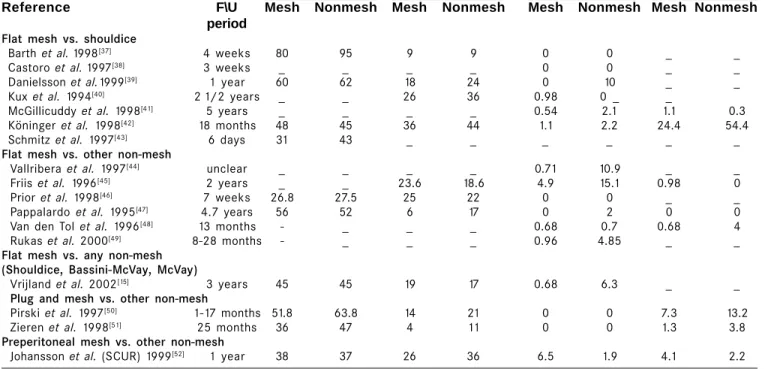
of published data from some such recent randomized trials on groin hernia repairs by open mesh (Lichtenstein, plug and mesh and preperitoneal mesh) with open non-mesh (Shouldice and other suture repairs), with special references to duration of operation, time to return to normal activities, hernia recurrence and persistent groin pain are summarized in Table 1. Seventeen comparative studies were included (Shouldice versus flat mesh 7, flat mesh versus other non-mesh 6, flat mesh versus any non-mesh 1, plug and mesh versus other non-mesh 2 and preperitoneal mesh versus other non-mesh 1). Lichtenstein repair and Shouldice repair were the most common mesh and non-mesh repair respectively. All studies were restricted to elective groin hernia repair. Eleven included primary hernias only, 3 primary and recurrent hernias while 3 studies did not note details. The studies ranged in size from 64 to 672 patients. The mean or median duration of follow up ranged from 6 days to 3 years. The mean or median duration of operation was shorter in the mesh group in six trials while the reverse was true in three. It was equal in one and unclear or not specified in seven. Postoperative
Table 1: Summary of different randomized control trials comparing open suture with open mesh repair Average duration Average time No. of Persistent
of operation taken to return recurrences (%) pain (minutes) to normal
activities (days)
Reference F\U Mesh Nonmesh Mesh Nonmesh Mesh Nonmesh Mesh Nonmesh period
Flat mesh vs. shouldice
Barth et al. 1998[37] 4 weeks 80 95 9 9 0 0 _ _
Castoro et al. 1997[38] 3 weeks _ _ _ _ 0 0 _ _
Danielsson et al.1999[39] 1 year 60 62 18 24 0 10 _ _
Kux et al. 1994[40] 2 1/2 years _ _ 26 36 0.98 0 _ _
McGillicuddy et al. 1998[41] 5 years _ _ _ _ 0.54 2.1 1.1 0.3
Köninger et al. 1998[42] 18 months 48 45 36 44 1.1 2.2 24.4 54.4
Schmitz et al. 1997[43] 6 days 31 43 _ _ _ _ _ _
Flat mesh vs. other non-mesh
Vallribera et al. 1997[44] unclear _ _ _ _ 0.71 10.9 _ _
Friis et al. 1996[45] 2 years _ _ 23.6 18.6 4.9 15.1 0.98 0
Prior et al. 1998[46] 7 weeks 26.8 27.5 25 22 0 0 _ _
Pappalardo et al. 1995[47] 4.7 years 56 52 6 17 0 2 0 0
Van den Tol et al. 1996[48] 13 months - _ _ _ 0.68 0.7 0.68 4
Rukas et al. 2000[49] 8-28 months - _ _ _ 0.96 4.85 _ _
Flat mesh vs. any non-mesh (Shouldice, Bassini-McVay, McVay)
Vrijland et al. 2002[15] 3 years 45 45 19 17 0.68 6.3 _ _
Plug and mesh vs. other non-mesh
Pirski et al. 1997[50] 1-17 months 51.8 63.8 14 21 0 0 7.3 13.2
Zieren et al. 1998[51] 25 months 36 47 4 11 0 0 1.3 3.8
Preperitoneal mesh vs. other non-mesh
Johansson et al. (SCUR) 1999[52] 1 year 38 37 26 36 6.5 1.9 4.1 2.2
SCUR: Scandinavian clinics united research
complications were uncommon and those reported were not potentially serious. Hematomas and infections occur with similar frequency following mesh and non-mesh repairs. Two studies reported higher rates of seromas in the mesh group. Following mesh repair, chances of groin hernia recurrence reduced by around 50% and the reduction appears to increase over time.[35] Length of
hospital stay and incidence of persistent groin pain were
both less following mesh repair.[35] Some common
reasons for not using mesh is the concern about the mesh infection, possibility of groin pain and the extra cost of the mesh. The later is especially relevant for a country like ours. However, these fears are apparently unfounded. The chances of mesh infection are minimal in elective cases, the mesh reduces rather than increases persistent pain and the extra costs of the mesh repair are offset by the savings associated with the reduced risk of recurrence over 1 to 4 years (the time depending on the local costs or charges of repeat surgery).[35] Nation
wide surveys of surgical practice reveal that open mesh technique has become the procedure of choice for primary inguinal hernia repair.[36]
LAPAROSCOPIC HERNIA REPAIR Ger in 1982[9] was the first to attempt minimal access
groin hernia repair by closing the opening of an indirect inguinal hernial sac by Michel clips. Bogojavlensky in 1989 modified the technique[53] by intra-corporeal suture
of the deep ring after plugging a PPM into the sac. Toy and Smoot in 1991[54] described a technique of intra
peritoneal onlay mesh (IPOM) placement, where an intra-abdominal piece of polypropylene or e-PTFE was stapled over the myopectineal orifice without dissection of the peritoneum. The IPOM had some major drawbacks like possibility of bowel adhesions and migration of the mesh. These initial attempts of laparoscopic repair did not meet with encouraging results.[54,55] Ever since the
early attempts by Ger, refinements of technique and innovations have changed the concept of hernia surgery forever and in spite of the longer learning curve and being more challenging than laparoscopic cholecystectomy or open herniorrhaphy,[56,57] it became
an increasingly popular procedure though controversies abound.[58]
The present day techniques of laparoscopic hernia repair evolved from Stoppa’s concept of pre-peritoneal reinforcement of fascia transversalis over the myopectineal orifice with its multiple openings by a prosthetic mesh.[29] In the early 1990’s Arregui and
Doin[59,60] described the trans-abdominal pre-peritoneal
repair (TAPP), where the abdominal cavity is first entered, peritoneum over the posterior wall of the inguinal canal is incised to enter into the avascular preperitoneal plane which is adequately dissected to place a large (15 x 10 cm) mesh over the hernial orifices. After fixation of the mesh, the peritoneum is
�
�
�
�
carefully sutured or stapled. 14% of the recurrences after open repair[61] have been attributed to missed
additional direct or femoral hernia. TAPP approach has the advantage identifying them during the first operation itself.
Around the same time Phillips and McKernan[62,63]
described the totally extra-peritoneal (TEP) technique of endoscopic hernioplasty where the peritoneal cavity is not breached and the entire dissection is performed bluntly in the extra-peritoneal space with a balloon device or the tip of the laparoscope itself. An advanced knowledge of the posterior anatomy of the inguinal region is imperative. Once the dissection is complete, a 15 x 10 cm mesh is stapled in place over the myopectineal orifice. The TEP method minimizes the potential for injury to the intra-abdominal organs while eliminating the exposure of the bowel to the prosthetic biomaterial. Experienced laparoscopists have increasingly favored it[56] and it appears to be the most
common endoscopic repair today.[62]
In both these repairs, the mesh in direct contact with the fascia of the transversalis muscle in the pre-peritoneal space, allows tissue ingrowths leading to the fixation of the mesh (as opposed to being in contact to the peritoneum as in IPOM repair where it is prone to migrate).
In a randomized study Fleming et al[20] had compared
TEP (n=116) repair with Shouldice technique (n=115) on 200 patients. The comparative results are as follows (figures in brackets are those of Shouldice repair): median duration of operation 70 minutes (56 minutes), first day discharge 68% (48%), return to normal life style within 1 month 77% (49%), rate of complications 16% (36%), recurrence within 1 year of follow up 2 (5). TEP repair costs 40% more than Shouldice repair.
A recent randomized study[64] on 123 patients comparing
Lichtenstein repair (n=62) with TEP repair (n=61) concluded that there was no significant difference between the two groups in terms of postoperative pain, in hospital stay, resumption of normal activities and complications. TEP repair took 16 minutes longer and it was more expensive. The authors opined that for primary inguinal hernia repair Lichtenstein technique is preferable and TEP repair in recurrent and bilateral hernias. With gradual decrease in operating time, use of reusable instruments and reduction in the hospital stay, (many are performing it as an out patient procedure) laparoscopic repair is likely to become more cost effective. Heikkinen et al[65] on the other hand opined
that the total costs for working patients would be lower with laparoscopic repair if the cost of lost workdays were factored into the overall expenses. A recent meta analysis of randomized trials comparing open with laparoscopic repair reported fewer complications
following laparoscopic repair but all serious visceral and vascular complications were from this group.[66] The EU
Hernia Trialists Collaboration found 4.7 serious injuries per 1000 procedures, especially of bladder and vessels.[14]
Laparoscopic repair is particularly appealing procedures for bilateral and recurrent hernias.[67]
In a prospective randomized study,[68] TAPP and TEP
repairs were compared and found to give equally good results. TAPP is an easier procedure to learn and is less expensive than TEP repair done with balloon dissectors and their ports; however, the reverse is true if no balloon dissectors and staples are used during TEP repair. Though TEP repair has a longer learning curve, Kald[69]
et al concluded that it should be the preferred method,
since intra-abdominal injury and postoperative adhesions and postoperative pain occurred more often in the TAPP group. On the contrary, a recent study on over 8000 patients[70] has shown TAPP procedure can
be performed without any serious morbidity. A large multi-center study[71] comparing recurrences following
TAPP and TEP repairs concluded, after a mean follow-up period of 13 months, the recurrence rates to be 0.7% and 0.4% respectively; another concluded that there was no significant difference.[72]
Certain guidelines prescribed by the UK National Institute of Clinical Excellence[73] on laparoscopic hernia
repair are as follows:
For primary inguinal hernia repair, open (mesh) should be the preferred.
For recurrent and bilateral inguinal hernia repair, laparoscopic surgery should be preferred.
TEP should be the preferred choice for laparoscopic repair.
Laparoscopic inguinal hernia repair should be done in units manned by trained laparoscopic surgeons who regularly undertake these procedures.
Laparoscopic repair versus open tension-free (mesh) repair
Systematic reviews[35,74] of published data from some
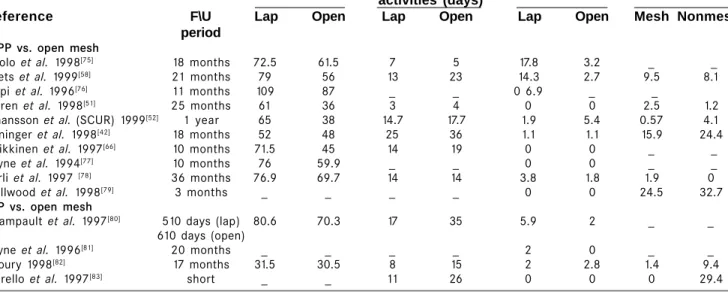
recent randomized trials on elective groin hernia repairs done either by open mesh or by laparoscopic technique (TAPP and TEP), with special references to duration of operation, time to return to normal activities, hernia recurrence and persistent groin pain are summarized in Table 2. Fourteen comparative studies were included (TAPP Versus open mesh 10 and TEP versus open mesh 4). Three included primary hernias only, one recurrent hernia only and eight primary and recurrent hernias while two studies did not note details. The studies ranged in size from 38 to 613 patients. The mean or median duration of follow up ranged from a short period to 3 years. The mean or median duration of operation was shorter in all the open mesh groups; however, data was not available on three trials. The laparoscopic groups returned to activities more quickly in 12 trials, in one
Table 2: Summary of different randomized control trials comparing open mesh with laparoscopic repair Average duration Average time No. of Persistent
of operation taken to return recurrences (%) pain (minutes) to normal
activities (days)
Reference F\U Lap Open Lap Open Lap Open Mesh Nonmesh
period TAPP vs. open mesh
Aitolo et al. 1998[75] 18 months 72.5 61.5 7 5 17.8 3.2 _ _
Beets et al. 1999[58] 21 months 79 56 13 23 14.3 2.7 9.5 8.1
Filipi et al. 1996[76] 11 months 109 87 _ _ 0 6.9 _ _
Zieren et al. 1998[51] 25 months 61 36 3 4 0 0 2.5 1.2
Johansson et al. (SCUR) 1999[52] 1 year 65 38 14.7 17.7 1.9 5.4 0.57 4.1
Köninger et al. 1998[42] 18 months 52 48 25 36 1.1 1.1 15.9 24.4
Heikkinen et al. 1997[66] 10 months 71.5 45 14 19 0 0 _ _
Payne et al. 1994[77] 10 months 76 59.9 _ _ 0 0 _ _
Sarli et al. 1997 [78] 36 months 76.9 69.7 14 14 3.8 1.8 1.9 0
Wellwood et al. 1998[79] 3 months _ _ _ _ 0 0 24.5 32.7
TEP vs. open mesh
Champault et al. 1997[80] 510 days (lap) 80.6 70.3 17 35 5.9 2 _ _
610 days (open)
Payne et al. 1996[81] 20 months _ _ _ _ 2 0 _ _
Khoury 1998[82] 17 months 31.5 30.5 8 15 2 2.8 1.4 9.4
Merello et al. 1997[83] short _ _ 11 26 0 0 0 29.4
SCUR: Scandinavian clinics united research
trial reverse was true and at similar times in one. No significant difference in recurrence rates (short-term) between laparoscopic mesh and open mesh method was detected (there is little data on long-term recurrences); recurrence rate of more than 10% were noted when performed by surgeons with an experience of less than 250 laparoscopic repairs.[84] Postoperative complications
were uncommon and of varying reported prevalence though, intra-operative life threatening complications were more in laparoscopic group.[84] The incidence of
hematoma formation was less after laparoscopic repair, but the risk of seroma formation was higher. The incidence of chronic groin pain was less in comparison to open repair.
NEW METHOD OF INGUINAL HERNIA REPAIR
Desarda[85] from Pune, India has described a new
technique of pure tissue repair for any type of inguinal hernia without a mesh, based on the concept of constructing a strong and physiologically dynamic posterior wall to the inguinal canal with the help of the external oblique muscle and its aponeurosis. It has been developed because mesh is not easily available in rural or remote parts of many countries. After excision of the sac, a strip of the external oblique aponeurosis is partially separated from its medial leaf, keeping its continuity intact at either end. This undetached strip of external oblique aponeurosis is sutured to the inguinal ligament below and the muscular arch above, behind the cord, to form a new posterior wall. This strip is put under tension by muscular contraction and works as a shield to prevent recurrence. Thus the external oblique muscle
gives additional strength to the weakened internal oblique and transverse abdominis muscles. Results were quite encouraging. Average hospital stay of 2-3 days and patients returned to work within 1-2 weeks. Out of 400 patients (followed up for more than10 years) there was only one recurrence. These results are comparable with operations performed with mesh. The operation is simple to perform, does not require mesh or extensive dissection and has produced excellent results. It may therefore be good alternative to mesh or other open or laparoscopic repairs.[85]
CONCLUSION
An ideal hernia repair should be durable, produce low level of morbidity, allow rapid return to work or recreational pursuits and should be cost effective. The use of prosthetic mesh has emerged superior and the procedure of choice; it reduces recurrences by around 50%, regardless the method of placement and the incidence of both early and late persistent pain. The quality of life indicators for hernia repair as assessed by the postoperative pain and return to work strongly favors tension-free and laparoscopic approaches.[86]
Evidence-based practice indicates no advantage of non-mesh approach for patients above 18 years of age.
If mesh is a better choice, then which is the best way of placing it (open or laparoscopic)? The place of laparoscopic inguinal hernia repair is a subject of intense debate and its routine use is controversial.[87] The
short-term benefits of laparoscopic repair in short-terms of less postoperative pain, marginal advantage in reducing time off work[86] and its obvious advantages in recurrent and
bilateral hernias are established. Recurrence rate are similar to that of open mesh repairs. However, even without the use of balloon dissectors, staples for fixation and disposable instruments, laparoscopy is associated with greater anesthetic (general anesthesia is usually necessary) and recovery room inputs and hence is not cost effective when compared to an open mesh under local anesthesia: a pertinent factor for a country like ours. In addition, the long learning curve of laparoscopic repair also deters many surgeons.
Thus, there is no “best” form of hernia repair; it is to be tailored according to the nature of hernia, patient characteristic and the preference of the surgeon and the patient. It would be only apt to end with the words of Sir John Bruce of Edinburgh:[88] “The final words on
hernia repair will probably never be written”. REFERENCES
1. Ebbell B (transl.). The Ebers Papyrus. The Greatest Egyptian
Medical Document. London: H. Milford and Oxford University Press, 1937:17:123.
2. Marcy HO. A new use of carbiolized catgut Ligatures. Boston
Med Surg J 1871;85:315.
3. Annandale T. A case in which a reducible oblique and direct
inguinal and femoral hernia existed on the same side and were successfully treated by operation. Edinburhg Med J 1876;21:1087-91.
4. Read RC. The centenary of Bassini’s contribution to inguinal
herniorrhaphy. Am J Surg 1987;153:324-6.
5. Liem MS, van der Graaf Y, van Steensel CJ, Boelhouwer RU,
Clevers GJ, Meijer WS et al. Comparison of conventional anterior surgery and laparoscopic surgery for inguinal hernia repair. N Engl J Med 1997;336:1541-7.
6. Usher FC, Fries JG, Ochsner JL, Tuttle LL Jr. Marlex mesh: a
new plastic mesh for replacing tissue defects: II Experimental studies. AMA Arch Surg 1959;78:138-45.
7. Schockett E. Routine rapid preperitoneal Marlex mesh
buttressing in the repair of all inguinal hernias. Contemp Surg 1985;26:22-7.
8. Usher FC. Hernia repair with knitted polypropylene mesh.
Surg Gynaecol Obstet 1963;117:239.
9. Ger R. The management of certain abdominal herniae by
intra-abdominal closure of the neck of the sac. Ann R Coll Surg Engl 1982;64:342-4.
10. Rutkow IM, Robbins AW. Demographic, classificatory, and socioeconomic aspects of hernia repair in the United States. Surg Clin North Am 1993;73:413-26.
11. Schumpelick V, Treutner KH, Arlt G. Inguinal hernia repair in adults. Lancet 1994;344:375-9.
12. Levard H, Boudet MJ, Hennet H, Hay JN. Inguinal hernia repair: a prospective multicentre trial on 1706 hernias. Br J Surg 1996;83(suppl)2:72.
13. Kingsnorth AN, Gray MR, Nott DM. Prospective randomized trial comparing the Shouldice a. technique and placation darn for inguinal hernia. Br J Surg 1992;79:1068-70. 14. EU Hernia Trialists Collaboration. Mesh compared with
non-mesh methods of open groin hernia repair: systematic review of randomized controlled trials. Br J Surg 2000;87:854-9. 15. Vrijland WW, van den Tol MP, Luijendijk RW, Hop WCJ,
Busschbach JJV, de Lange DCD et al. Randomized clinical trial of non-mesh versus mesh repair of primary inguinal hernia. Br J Surg 2002;89:293-97.
16. Bassini E. Nuovo metodo per la cura ridicule dell’ernia
inguinale. Arch F Klin Chir 1890;40:429-76.
17. Nyhus LM. Evolution of hernia repair: a salute to Professor Piero Pietri. Hernia 2002;5:196-99.
18. Shouldice EE. The treatment of Hernia. Ontario Med Rev 1953;20:670-84.
19. Porrero JL, Hidalgo M, Sanjuanbenito A, Sanchez- Cabezudo C. The Shouldice herniorrhaphy in the treatment of inguinal hernias: a prospective study on 775 patients. Hernia 2004;8:60 3.
20. Fleming WR, Elliott TB, Jones RM, Hardy KJ. Randomized clinical trial comparing totally extraperitoneal inguinal hernia repair with the Shouldice technique. Br J Surg 2001;88:118 38.
21. Cheatle GL. An operation for the radical cure of inguinal and femoral hernia. Br Med J 1920;2:68.
22. Henry AK. Operation for femoral hernia by midline extraperitoneal approach: With a preliminary note of the use of this, route for reducible inguinal hernia. Lancet 1936;1: 531-3.
23. Nyhus LM, Condon RE, Harkins HN. Clinical experiences with preperitoneal hernia repair for all types of hernia of the groin. Am J Surg 1960;100:234-44.
24. Port S, Weiss B, Willer M, Neufang T, Lorenz D. Randomized clinical trial of lightweight composite mesh for Lichtenstein inguinal hernia repair. Br J Surg 2004;91:44-8.
25. Wantz GE. Prosthetics: Their Complications and Management, Part I. In: Bendavid R (ed). Prosthesis in Abdominal Wall Hernias. Austin,Tex: RG Landes Co. 1994;326-9.
26. Cumberland O. Ueber die Verschliessung von Bauchwunden und Brustpforten durch Versenkte Siberdrahtnetze. Zentralbl Chir 1900;27:257.
27. Scales JT. Discussions on metals and synthetic materials in relation to soft tissues: tissue reaction to synthetic materials. Proc R Soc Med 1953;46:647.
28. Stoppa R, Petit J, Henry X. Unsutured Dacron prosthesis in groin hernias. Int Surg 1975;60:411-2.
29. Stoppa RE, Rives JL, Warlaumont CR, Palot JP, Verhaeghe PJ, Delattre JF. The use of Dacron in the repair of hernias of the groin. Surg Clin North Am 1993;73:571-81.
30. Lichtenstein IL, Shulman AG. Ambulatory (outpatient) hernia surgery including a new concept: introducing tension free repair. Int Surg 1986;11:1-4.
31. Shulman AG, Amid PK, Lichtenstein IL. A survey of non expert surgeons using open tension free mesh patch repair for primary inguinal hernias. Int Surg 1995;80:35-6. 32. Gilbert AI. Inguinal hernia repair: biomaterials and sutureless
repair. Perspect Gen Surg 1991;2:113-29.
33. Chandiramani VA, Katara AN, Pandya SM, Nair NS. Prolene hernia system in the tension free repair of primary inguinal hernias. Indian J Surg 2003;65:488-91.
34. Nienhuijs SW, van Oort I, Keemers-Gels ME, Strobbe LJ, Rosman C. Randomized trial comparing the Prolene Hernia System, mesh plug repair, and Lichtenstein method of open inguinal hernia repair. Br J Surg 2005;92:33-8.
35. The EU Hernia Trialists Collaboration. Repair of groin hernia with synthetic mesh- meta analysis of randomized controlled trials. Ann Surg 2002;235:322-32.
36. Bay-Nielsen M, Kehlet H, Strand L, Malmstrom J, Andersen FH, Wara P et al. Quality assessment of 26,304 herniorraphies. Lancet 2001;358:1124-8.
37. Barth RJ Jr, Burchard KW, Tosteson A, Sutton JE Jr, Colacchio TA, Henriques HF et al. Short term outcome after mesh or Shouldice herniorrhaphy: a randomized prospective study. Surgery1998;123:121-6.
38. CastoroC, Polo P, Pignataro M, Sorrentino P, Spreafico G, Baccaglini U et al. Shouldice versus Lichtenstein technique of inguinal hernia repair: preliminary results of multicentric randomized prospective trial. Br J Surg 1996;83(Suppl. 2): 72(Abstract).
39. Danielsson P, Isacson S, Hansen MV. Randomized study of preliminary report. Surg Laparosc Endosc 1992:2:53-8.
Lichtenstein compared with Shouldice inguinal hernia repair 60. Dion YM, Morin J. Laparoscopic inguinal herniorrhaphy. Can
by surgeons in training. Eur J Surg 1999;165:49-53. J Surg 1992;35:209-12.
40. Kux M, Fuchsjager N, FeichterA. Lichtenstein- Patch versus 61. Flex E, Michas C, Gonzalez H. Laparpscopic hernioplasty: why
Shouldice Technique in primary inguinal hernia at high risk it works. Surg Endoscv1997;11:36-40.
of recurrence (German). Chirurg 1994;65:59-62. 62. Phillips EH, Carroll BJ, Fallas MJ. Laparoscopic preperitoneal
41. McGillicuddy JE. Prospective randomized comparison of the inguinal hernia repair without peritoneal incision: technique
Shouldice and Lichtenstein hernia repair procedures. Arch and early clinical results. Surg Endosc 1993;7:159-62.
Surg 1998;133:974-8. 63. McKernan BJ, Laws HL. Laparoscopic preperitoneal prosthetic
42. Koninger JS, Oster M, Butters M. Management of inguinal repair of inguinal hernias. Surg Rounds 1992;7:579-610.
hernia: a comparison of current methods (German). Chirurg 64. Gokalp A, Inal M, Maralcan G, Baskonus I. A prospective
1998;69:1340-4. randomized study of Lichtenstein open tension-free versus
43. Schmitz R, Treckmann J, Shah S, Schneider K. The tension laparoscopic totally extra-peritoneal techniques for inguinal
free technique in open inguinal hernia repair. A prospective hernia repair. Acta Chir Belg 2003;103:502-6.
randomized study concerning postoperative pain (German). 65. Heikkinen T, Haukipuro K, Leppala J, Hulkko A. Total costs
Chirurg 1997;68:259-63. of laparoscopic and Lichtenstein inguinal hernia repairs: a
44. Vallribera F, Oms LM, Giménez M, Anguilar F, Sala-Pedrós J. randomized prospective study. Surg Laparosc Endosc
Groin hernia repair: comparison of three open techniques. Br 1997;7:1-5.
J Surg 1997;84 (Suppl 2):85-6 (Abstract). 66. Memon MA, Cooper NJ, Memon B, Memon MI, Abrams KR.
45. Friis E, Lindahl F. The tension free hernioplasty in a Meta-analysis of randomized clinical trials comparing open
randomized trial. Am J Surg 1996;172:315-9. and laparoscopic inguinal hernia repair. Br J Surg 2003;90:
46. Prior MJ, Williams EV, Shukla HS, Phillips S, Vig S, Lewis M. 1479-92.
Prospective randomized controlled trial comparing 67. Memon MA, Feliu X, Sallent EF, Camps J, Fitzgibbons RJ Jr.
Lichtenstein with modified Bassini repair of inguinal hernia. Laparoscopic repair of recurrent hernias. Surg Endosc 1999;
J R Coll Surg Edinb 1998;43:82-6. 13:807-10.
47. Pappalardo G, Guadalaxara A, Illomei G, Frattaroli FM, Trifero 68. Cohen RV, Alvarez G, Roll S, Garcia ME, Kawahara N, Schiavon
M. The Bassini techniques versus Tension free repair. A CA et al. Transabdominal or totally extraperitoneal laparoscopic
prospective randomized trial. Chirurgia 1995;8:293-5. hernia repair? Surg Laparosc Endosc 1998;8:264- 8.
48. van den Tol MP, Lange DCD, Luijendijk RW, Rottier AB, van 69. Kald A, Anderberg B, Smedh K, Karlsson M. Transperitoneal
Geldere D, Vegt PA et al. Conventional vs open “tension free” or totally extraperitoneal approach in laparoscopic hernia repair:
hernioplasty: preliminary results of a prospective multicenter results of 491 consecutive herniorrhaphies. Surg Laparosc
randomized trial. Br J Surg 1996;83(Suppl 2):75 (Abstract). Endosc 1997;7:86- 9.
49. Rukus R, Strupas K, Rukiene A. The comparison of 70. Bittner R, Schmedt CG, Schwartz J, Kraft K, Leibl BJ.
Lichtenstein and Bassini repairs of inguinal hernia. Hernia in Laparoscopic transperitoneal procedure for routine repair of
the 21st century. Toronto: 2000. groin hernia. Br J Surg 2002;89:1062-6.
50. Pirski MI, Gacyk W, Witowski P, Kostro J, Kot J. Mesh-plug 71. Tetik C, Arregui ME, Dulucq JL, Fitzgibbons RJ, Franklin ME,
ooperation for treating inguinal hernia. Randomized studies McKernan JB et al. Complications and recurrences associated
(Polish). Wiad Lek 1997;50 (Suppl): 391-5. with laparoscopic repair of groin hernias. A multi-institutional
51. Zieren J, Zieren HU, Jacobi CA, Wenger FA, Muller JM. retrospective analysis. Surg Endosc 1994;8:1316- 23.
Prospective randomized study comparing laparoscopic and 72. Fitzgibbons RJ Jr, Camps J, Cornet DA, Nguyen NX, Litke BS,
open tension free inguinal hernia repair with Shouldice’s Anniball R et al. Laparoscopic inguinal herniorrhaphy: Results
operation. Am J Surg 1998;175:330-3. of a multicenter trial. Ann Surg 1995;221:3-13.
52. Johansson B, Hallerback B, Glise H, Anesten B, Smedberg S, 73. National Institute of Clinical Excellence. Guidelines on the use
Roman J. Laparoscopic mesh versus open pre-peritoneal mesh of laparoscopic surgery for inguinal hernia. NICE: London, 2001.
versus conventional technique for inguinal hernia repair: a 74. EU Hernia Trialists Collaboration. Laparoscopic compared with
randomized multicenter trial (SCUR Hernia Repair Study). open methods of groin hernia repair: systematic review of
Ann Surg 1999;230:225-31. randomized controlled trials. Br J Surg 2000;87:860-67.
53. Bogojavalensky S. Laparoscopic treatment of inguinal and 75. Aitola P, Airo I, Matikainen M. Laparoscopic versus open
pre-femoral hernia (video presentation). 18th Annual Meeting of peritoneal inguinal hernia repair: a prospective randomized
the American Association of Gynecological Laparoscopists. trial. Ann Chir Gynaecol 1998;87:22-5.
Washington, DC, 1989. 76. Filipi CJ, Gaston-Johansson F, McBride PJ, Murayama K,
54. Toy FK, Smoot RT Jr. Laparoscopic hernioplasty update. J Gerhardt J, Cornet DA et al. An assessment of pain and return
Laparoendosc Surg (United States) 1992;2:197-205. to normal activity. Laparoscopic herniorrhaphy vs. open
55. Corbitt JD Jr. Laparoscopic Herniorrhaphy: A pre-peritoneal tension free Lichtenstein repair. Surg Endosc 1996;10:983-6.
tension-free approach. Surg Endosc 1993;7:550-5. 77. Payne JH Jr, Grininger LM, Izawa MT, Podoll EF, Lindahl PJ,
56. Aeberhard P, Klaiber C, Meyenberg A, Osterwalder A, Tschudi Balfour J. Laparoscopic or open inguinal herniorrhaphy? A
J. Prospective audit of laparoscopic totally extra peritoneal randomized prospective trial. Arch Surg 1994;129:973-9.
inguinal hernia repair: a multicenter study of the Swiss 78. Sarli L, Pietra N, Choua O, Costi R, Thenasseril B, Giunta A.
Association for Laparoscopic and Thoracoscopic Surgery Prospective randomized comparative study of Laparoscopic
(SALTC). Surg Endosc 1999;13:1115-20. hernioplasty and Lichtenstein tension free hernioplasty. Acta
57. Beets GL, Dirksen CD, Go PM, Geisler FE, Baeten CG, Kootstra Biomed Ateneo Parmense 1997;68:5-10.
G. Open or laparoscopic pre-peritoneal mesh repair for 79. Wellwood J, Sculpher MJ, Stoker D, Nicholls GJ, Geddes C,
recurrent inguinal hernia? A randomized controlled trial. Surg Whitehead A et al. Randomized controlled trial of laparoscopic
Endosc 1999;13:323-7. versus open mesh repair of inguinal hernia: outcome and
58. Velanovich V. Laparoscopic versus open surgery: a preliminary cost. BMJ 1998;317:103-10.
comparison of quality-of-life outcomes. Surg Endosc 80. Champault GG, Rizk N, Catheline JM, Turner R, Boutelier P.
2000;14:16-21. Inguinal hernia repair; totally pre-peritoneal laparoscopic
59. Arregui ME, Davis CJ, Yucel O, Nagan RF. Laparoscopic mesh approach versus Stoppa operation: randomized trial of 100
81. Payne J, Izawa M, Glen P. Laparoscopic or tension free inguinal Dunlop D, Gibbs J et al. Open mesh versus laparoscopic mesh
hernia repair? A cost benefit analysis of 200 prospective repair of inguinal hernia. N Engl J Med 2004; 350: 1819-27.
randomized patients. In: SAGES. Philadelphia, Pennsylvania 85. Desarda MP. New method of inguinal hernia repair: a new
1996. solution. ANZ J Surg 2001;71:241-4.
82. Khoury N. A randomized prospective controlled trial of 86. Neumayer L, Jonasson O, Fitzgibbons R, Henderson W, Gibbs
laparoscopic extra-peritoneal hernia repair and mesh-plug J, Carrico CJ: Tension-free inguinal hernia repair: The design
hernioplasty: a study of 315 cases. J Laparoendosc Adv Surg of a trial to compare open and laparoscopic surgical techniques.
Tech 1998;8:367-72. J Am Coll Surg 2003;196:743-52.
83. Merello J, Guerra GA, Madriz J, Guerra GG. Laparoscopic TEP 87. Beattie DK, Foley RJ, Callam MJ. Future of laparoscopic inguinal
versus open Lichtenstein hernia repair. Randomized trial. Surg hernia surgery. Br J Surg 2000;87:1727-28.
Endosc 1997;11:545 (Abstract). 88. Bruce J. Foreword. In: Nyhus LM, Harkins HN (editors).
84. Neumayer L, Giobbie-Hurder A, Jonasson O, Fitzgibbons R Jr, Hernia. 1st ed. Philadelphia: Lippincott; 1964.
Author Help: Online Submission of the Manuscripts
Articles can be submitted online from http://www.journalonweb.com. For online submission articles should be prepared in two files (first page file and article file). Images should be submitted separately.
1) First Page File:
Prepare the title page, covering letter, acknowledgement, etc., using a word processor program. All information which can reveal your identity should be here. Use text/rtf/doc/pdf files. Do not zip the files.
2) Article file:
The main text of the article, beginning from Abstract till References (including tables) should be in this file. Do not include any information (such as acknowledgement, your names in page headers, etc.) in this file. Use text/rtf/doc/pdf files. Do not zip the files. Limit the file size to 400 kb. Do not incorporate images in the file. If file size is large, graphs can be submitted as images separately without incorporating them in the article file to reduce the size of the file.
3) Images:
Submit good quality colour images. Each image should be less than 100 kb in size. Size of the image can be reduced by decreasing the actual height and width of the images (keep up to about 3 inches) or by reducing the quality of image. All image formats (jpeg, tiff, gif, bmp, png, eps, etc.) are acceptable; jpeg is most suitable. The image quality should be good enough to judge the scientific value of the image.
Always retain a good quality, high resolution image for print purpose. This high resolution image should be sent to the editorial office at the time of sending a revised article.
4) Legends: