A Dynamic Operating System for Sensor Nodes
Chih-Chieh Han, Ram Kumar, Roy Shea, Eddie Kohler and Mani Srivastava
University of California, Los Angeles
{
simonhan, roy, kohler
}
@cs.ucla.edu,
{
ram, mbs
}
@ucla.edu
A
BSTRACTSensor network nodes exhibit characteristics of both em-bedded systems and general-purpose systems. They must use little energy and be robust to environmental condi-tions, while also providing common services that make it easy to write applications. In TinyOS, the current state of the art in sensor node operating systems, reusable components implement common services, but each node runs a single statically-linked system image, making it hard to run multiple applications or incrementally up-date applications. We present SOS, a new operating sys-tem for mote-class sensor nodes that takes a more namic point on the design spectrum. SOS consists of dy-namically-loaded modules and a common kernel, which implements messaging, dynamic memory, and module loading and unloading, among other services. Modules are not processes: they are scheduled cooperatively and there is no memory protection. Nevertheless, the system protects against common module bugs using techniques such as typed entry points, watchdog timers, and primi-tive resource garbage collection. Individual modules can be added and removed with minimal system interruption. We describe SOS’s design and implementation, discuss tradeoffs, and compare it with TinyOS and with the Mat´e virtual machine. Our evaluation shows that despite the dynamic nature of SOS and its higher-level kernel inter-face, its long term total usage nearly identical to that of systems such as Mat`e and TinyOS.
1 I
NTRODUCTIONWireless sensor nodes—networked systems containing small, often battery-powered embedded computers—can densely sample phenomena that were previously diffi-cult or costly to observe. Sensor nodes can be located far from networked infrastructure and easy human ac-cessibility, anywhere from the forest canopy [13] to the backs of zebras [12]. Due to the difficulty and expense of maintaining such distant nodes, wireless sensor net-works are expected to be both autonomous and long-lived, surviving environmental hardships while conserv-ing energy as much as possible. Sensor network applica-tions will change in the field as well; data returned from the network can influence followup experiment design, and long-lived networks will necessarily be retasked dur-ing their lifetimes.
All of this argues for a general-purpose sensor network
operating system that cleanly supports dynamic applica-tion changes. But sensor nodes are embedded systems as well as general-purpose systems, introducing a tension between resource and energy constraints and the layers of indirection required to support true general-purpose operating systems. TinyOS [15], the state-of-the-art sen-sor operating system, tends to prioritize embedded sys-tem constraints over general-purpose OS functionality. TinyOS consists of a rich collection of software com-ponents written in the NesC language [8], ranging from low-level parts of the network stack to application-level routing logic. Components are not divided into “kernel” and “user” modes, and there is no memory protection, although some interrupt concurrency bugs are caught by the NesC compiler. A TinyOS system image is statically linked at compile time, facilitating resource usage anal-ysis and code optimization such as inlining. However, code updates become more expensive, since a whole sys-tem image must be distributed [10].
This paper shows that sensor network operating sys-tems can achieve dynamic and general-purpose OS se-mantics without significant energy or performance sacri-fices. Our operating system, SOS, consists of a common kernel and dynamic application modules, which can be loaded or unloaded at run time. Modules send messages and communicate with the kernel via a system jump ta-ble, but can also register function entry points for other modules to call. SOS, like TinyOS, has no memory pro-tection, but the system nevertheless protects against com-mon bugs. For example, function entry points are marked with types using compressed strings; this lets the system detect typing errors that might otherwise crash the sys-tem, such as when a module expecting a new version of an interface is loaded on a node that only provides the old. SOS uses dynamic memory both in the kernel and in application modules, easing programing complexity and increasing temporal memory reuse. Priority scheduling is used to move processing out of interrupt context and provide improved performance for time-critical tasks.
We evaluate SOS using both microbenchmarks and the application-level Surge benchmark, a well-known multi-hop data acquisition program. Comparisons of Surge versions running on SOS, TinyOS, and Mat´e Bombilla virtual machine [14] show comparable CPU utilization and radio usage; SOS’s functionality comes with only a minor energy cost compared to TinyOS. Evaluation of code distribution mechanisms in the same three
sys-tems shows that SOS provides significant energy savings over TinyOS, and more expressivity than Mat´e Bombilla. However, analytical comparisons of the total energy con-sumed by the three systems over an extended period of time reveals that general operating costs dwarf the above differences, resulting in nearly identical total energy con-sumption on the three systems.
The rest of the paper is structured as follows. Section 2 describes other systems that have influenced the SOS de-sign. A detailed look at the SOS architecture is presented in Section 3, including key differences between SOS and TinyOS. A brief walk through of an SOS application is presented in Section 4. An in-depth evaluation of SOS, including comparisons to TinyOS and Mat´e Bombilla, is presented in Section 5. Section 6 closes with ending re-marks and directions for future work.
2 R
ELATEDW
ORKSOS uses ideas from a spectrum of systems research in both general purpose operating system methods and em-bedded systems techniques.
2.1 Traditional Operating Systems
SOS provides basic hardware abstractions in a core ker-nel, upon which modules are loaded to provide both higher level functionality. This is similar to microkernel abstractions explored by the Mach [19] operating sys-tem and the Exokernel [6]. Mach modularizes low layer kernel services to allow easy customization of the sys-tem. The Exokernel uses a minimal hardware abstraction layer upon which custom user level operating environ-ments can be created. SOS also uses a small kernel that provides interfaces to the underlying hardware at a level lower than Mach and higher than the Exeokernel.
SOS’s typed communication protocols were inspired partially by SPIN [2], which makes kernel extensions safe through the use of type safe languages.
2.2 Sensor Network Operating Systems
TinyOS [9] is the de facto standard operating system for sensor nodes. TinyOS is written using the NesC lan-guage [8] and provides an event driven operating envi-ronment. It uses a component model for designing sen-sor network applications. At compile time, a component binding configuration is parsed, elements are statically bound and then compiled to make a binary image that is programmed into the flash memory on a sensor node. TinyOS’s static binding facilitates compile time checks. Like TinyOS, SOS is event driven and uses a component model, but SOS components can be installed and modi-fied after a system has been deployed.
Our experiences working with TinyOS helped to mo-tivate the development and design decisions of SOS.
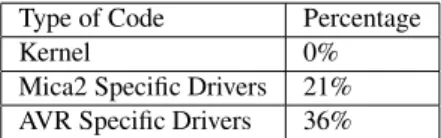
As described in section 5.1, approximately 21% of the Mica2 specific driver code and 36% of the AVR specific code included in the current SOS distribution is ported directly from TinyOS.
The need for flexible systems has inspired virtual ma-chines (VM), mobile agents, and interpreters, for sensor nodes. One such system is Mat´e [14]. Mat´e implements a simple VM architecture that allows developers to build custom VMs on top of TinyOS and is distributed with Bombilla, which demonstrates a VM implementation of the Surge protocol. Sensorware [3] and Agilla [7] are de-signed to enable mobile agent abstractions in sensor net-works. Unfortunately, these approaches can have signif-icant computational overhead, and the retasking of the network is limited by the expressibility of the underly-ing VM or agent system. SOS occupies a middle ground with more flexibility and less CPU overhead than VMs, but also higher mote reprogramming cost.
MANTIS [1] implements a lightweight subset of the POSIX threads API targeted to run on embedded sen-sor nodes. By adopting an event driven architecture, SOS is able to support a comparable amount of concurrency without the context switching overhead of MANTIS.
2.3 Dynamic Code
Traditional solutions to reprogrammable systems target resource rich devices. Loadable modules in Linux share many properties with SOS, but benefit from running on systems that can support complex symbol linking at run time. Impala [17] approaches the devices SOS targets by implementing dynamic insertion of code on devices similar to PDAs. At any given time, Impala middleware chooses a single application to run based on the state of application specific and global node state, allowing Im-pala to execute an application that is the best fit to current conditions. In contrast to this, SOS both expects and sup-ports multiple modules executing and interacting on top of the SOS kernel at the same time. An operating sys-tem for 8-bit devices developed at the same time as SOS and supporting modular dynamic code updates is Con-tiki [5]. ConCon-tiki uses runtime relocation to to update bi-naries loaded onto a node, as opposed to the completely position independent code used by SOS. This results a different low layer design choices in Contiki and SOS.
XNP [4] is a mechanism that enables over the air re-programming of the sensor nodes running TinyOS. With XNP a new image for the node is stored into an exter-nal flash memory, then read into program memory, and finally the node is rebooted. SOS module updates cannot replace the SOS kernel, but improve on XNP’s energy usage by using modular updates rather than full binary system images, not forcing a node to reboot after up-dates, and installing updates directly into program mem-ory without expensive external flash access.
Low overhead solutions using differential patching are proposed in [20] and [11]. In these schemes a binary dif-ferential update between the original system image and the new image is created. A simple language is used to encode this update in a compressed form that is then dis-tributed through the network and used to construct a new system image on deployed nodes. This technique can be used at the component level in SOS and, since changes to the SOS kernel or modules will be more localized than in tightly coupled systems, result in smaller differentials. MOAP [22] and Deluge [10] are two protocols that hove been used to distribute new system images to all nodes in a sensor network. SOS currently includes a publish-subscribe scheme that is similar to MOAP for distributing modules within a deployed sensor network. Depending on the user’s needs SOS can use MOAP, Del-uge, or any other code distribution protocol. SOS is not limited to running the same set of modules or same base kernel on all nodes in a network, and will benefit from different types of distribution protocols including those supporting point-to-point or point-to-region transfer of data.
3 S
YSTEMA
RCHITECTUREIn addition to the traditional techniques used in embed-ded system design, the SOS kernel features dynamically linked modules, flexible priority scheduling, and a sim-ple dynamic memory subsystem. These kernel services help support changes after deployment, and provide a higher level API freeing programmers from managing underlying services or reimplementing popular abstrac-tions. Most sensor network application and protocol de-velopment occurs in modules that sit above the kernel. The minimal meaningful sensor network application us-ing SOS consists of a simple sensus-ing module and routus-ing protocol module on top of the kernel.
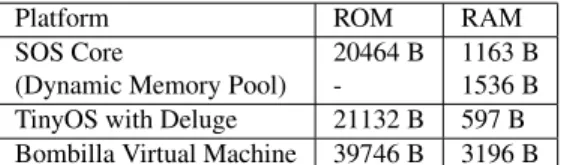
Table 1 presents memory footprints of the core SOS kernel, TinyOS with Deluge, and Mat´e Bombilla virtual machine. All three of these configurations include a base operating environment with the ability to distribute and update the programs running on sensor nodes. SOS na-tively supports simple module distribution and the ability to add and remove modules at run time. TinyOS is able to distribute system images and reflash nodes using Del-uge. The Mat´e Bombilla VM natively supports the trans-fer and execution of new programs using the Trickle [16] protocol. SOS is able to provide common kernel services to external modules in a footprint comparable to TinyOS running Deluge and a space smaller than the Mat´e Bom-billa VM. Note that RAM usage in SOS is broken into two parts: RAM used by the core kernel and RAM re-served for the dynamic memory subsystem.
The following discussion takes a closer look at the key architectural decisions in SOS and examines them
Platform ROM RAM
SOS Core 20464 B 1163 B
(Dynamic Memory Pool) - 1536 B
TinyOS with Deluge 21132 B 597 B Bombilla Virtual Machine 39746 B 3196 B
Table 1—Memory footprint for base operating system with ability to
distribute and update node programs compiled for the Mica2 Motes.
Figure 1—Module Interactions
in light of the commonly used TinyOS.
3.1 Modules
Modules are position independent binaries that imple-ment a specific task or function, comparable in function-ality to TinyOS components. Most development occurs at the module layer, including development of drivers, protocols, and application components. Modification to the SOS kernel is only required when low layer hardware or resource management capabilities must be changed. An application in SOS is composed of one or more in-teracting modules. Self contained position independent modules use clean messaging and function interfaces to maintain modularity through development and into deployment. The primary challenge in developing SOS was maintaining modularity and safety without incurring high overhead due to the loose coupling of modules. An additional challenge that emerged during development, described in more detail in section 3.1.4, was maintain-ing consistency in a dynamically changmaintain-ing system.
3.1.1 Module Structure
SOS maintains a modular structure after distribution by implementing modules with well defined and generalized points of entry and exit. Flow of execution enters a mod-ule from one of two entry mechanisms: messages deliv-ered from the scheduler and calls to functions registdeliv-ered by the module for external use. This is illustrated in fig-ure 1.
Message handling in modules is implemented using a module specific handler function. The handler function
Communication Method Clock Cycles Post Message Referencing Internal Data 271
Post Message Referencing External Buffer 252 Dispatch Message from Scheduler 310 Call to Function Registered by a Module 21
Call Using System Jump Table 12
Direct Function Call 4
Table 2—Cycles needed for different types of communication to and
from modules in SOS when running on an Atmel AVR microcontroller. The delay for direct function calls within the kernel is listed as a base-line reference.
takes as parameters the message being delivered and the state of the module. All module message handlers should implement handler functions for theinitandfinal mes-sages produced by the kernel during module insertion and removal, respectively. Theinitmessage handler sets the module’s initial state including initial periodic timers, function registration, and function subscription. Thefinal message handler releases all node resources including timers, memory, and registered functions. Module mes-sage handlers also process module specific mesmes-sages in-cluding handling of timer triggers, sensor readings, and incoming data messages from other modules or nodes. Messages in SOS are asynchronous and behave some-what like TinyOS tasks; the main SOS scheduling loop takes a message from a priority queue and delivers the message to the message handler of the destination ule. Inter-module direct function calls are used for mod-ule specific operations that need to run synchronously. These direct function calls are made possible through a function registration and subscription scheme described in section 3.1.2. Module state is stored in a block of RAM external to the module. Modules are relocatable in mem-ory since: program state is managed by the SOS kernel, the location of inter-module functions is exposed through a registration process, and the message handler function for any module is always located an a consistent offset in the binary.
3.1.2 Module Interaction
Interactions with modules occur via messages, direct calls to functions registered by a module, and ker * sys-tem calls into the SOS kernel. The overhead for each of these types of interactions is presented in table 2. Mes-saging, detailed in section 3.2, provides asynchronous communication to a module and enables scheduling by breaking up chains of execution into scheduled subparts. Messaging is flexible, but slow, so SOS provides direct calls to functions registered by modules, which bypass the scheduler to provide low latency communication to modules.
Function registration and subscription is the mecha-nism that SOS uses to provide direct inter-module com-munication and upcalls from the kernel to modules.
Function Registration Action Clock Cycles
Register a Function 267
Deregister a Function 230
Get a Function Handle 124
Call to Function Registered by a Module 21
Table 4—Cycles needed for the function registration mechanism in
SOS when running on an Atmel AVR microcontroller.
Figure 2—Jump Table Layout and Linking in SOS.
When explicitly registering functions with the SOS ker-nel, a module informs the kernel where in its binary im-age the function is implemented. The registration is done through a system callker register fndescribed in table 3 with overheads detailed in table 4. A function control block (FCB) used to store key information about the reg-istered function is created by the SOS kernel and indexed by the tuple{module ID, function ID}.
The FCB includes a valid flag, a subscriber reference count, and prototype information. The stored prototype information encodes both basic type information and wh-ether a parameter contains dynamic memory that needs to undergo a change of ownership. For example, the pro-totype{’c’, ’x’, ’v’, ’1’} indicates a function that re-turns a signed character (’c’) and requires one parame-ter (’1’). That parameparame-ter is a poinparame-ter to dynamically al-located memory (’x’). When a registered function is re-moved, this prototype information is used by kernel stub functions described in section 3.1.4.
The callker get handledescribed in table 3 is used to subscribe to a function. The module ID and function ID are used as a tuple to locate the FCB of interest, and type information is checked to provide an additional level of safety. If the lookup succeeds, the kernel returns a pointer to the function pointer of the subscribed function. The subscriber should always access the subscribed function by dereferencing this pointer. This extra level of indirec-tion allows the SOS kernel to easily replace the imple-mentation of a function with a newer version by chang-ing the function pointer in the FCB, without needchang-ing to update subscriber modules.
Prototype Description
int8 t ker register fn(sos pid t pid, uint8 t fid, Register function ’func’ with type ’prototype’ as being char *prototype, fn ptr t func) supplied by ’pid’ and having function ID ’fid’. fn ptr t* ker get handle(sos pid t req pid, Subscribe to the function ’fid’ provided by uint8 t req fid, char *prototype) module ’pid’ that has type ’prototype’.
Table 3—Function Registration and Subscription API
Modules access kernel functions using a jump table. This helps modules remain loosely coupled to the kernel, rather than dependent on specific SOS kernel versions. Figure 2 shows how the jump table is setup in memory and accessed by a module. This technique also allows the kernel to be upgraded without requiring SOS modules to be recompiled, assuming the structure of the jump table remains unchanged, and allows the same module to run in a deployment of heterogeneous SOS kernels.
3.1.3 Module Insertion and Removal
Loading modules on running nodes is made possible by the module structure described above and a minimal amount of metadata carried in the the binary image of a module.
Module insertion is initiated by a distribution protocol listening for advertisements of new modules in the net-work. When the distribution protocol hears an advertise-ment for a module, it checks if the module is an updated version of a module already installed on the node, or if the node is interested in the module and has free program memory for the module. If either of the above two con-ditions are true, the distribution protocol begins to down-load the module and immediately examines the metadata in the header of the packet. The metadata contains the unique identity for the module, the size of the memory required to store the local state of the module, and sion information used to differentiate a new module ver-sion. Module insertion is immediately aborted should the SOS kernel find that it is unable to allocate memory for the local state of the module.
A linker script is used to place the handler function for a module at a known offset in the binary during com-pilation, allowing easy linking during module insertion. During module insertion a kernel data structure indexed by the unique module ID included in the metadata is cre-ated and used to store the absolute address of the han-dler, a pointer to the dynamic memory holding the mod-ule state, and the identity of the modmod-ule. Finally the SOS kernel invokes the handler of the module by scheduling aninitmessage for the module.
The distribution protocol used to advertise and propa-gate module images through the network is independent of the SOS kernel. SOS currently uses a publish sub-scribe protocol similar to MOAP.
Module removal is initiated by the kernel dispatching afinalmessage. This message provides a module a final
opportunity to gracefully release any resources it is hold-ing and inform dependent modules of its removal. After thefinalmessage the kernel performs garbage collection by releasing dynamically allocated memory, timers, sen-sor drivers, and other resources owned by the module. As described in section 3.1.4, FCBs are used to maintain system integrity after module removal.
3.1.4 Potential Failure Modes
The ability to add, modify, and remove modules from a running sensor node introduces a number of potential failure modes not seen in static systems. It is important to provide a system that is robust to these potential fail-ures. While still an area of active work, SOS does pro-vide some mechanisms to minimize the impact of poten-tial failure modes that can result from dynamic system changes. These mechanisms set a global error variable to help inform modules when errors occur, allowing a mod-ule to handle the error as it sees fit.
Two potential modes of failure are attempting to de-liver a scheduled message to a module that does not exist on the node, and delivering a message to a handler that is unable to handle the message. In the first case, SOS sim-ply drops the message addressed to a nonexistent mod-ule and frees dynamically allocated memory that would normally undergo ownership transfer. The latter case is solved by the individual modules, which can choose cus-tom policies for what to do with messages that they are unable to handle. Most modules simply drop these mes-sages, return an error code, and instruct the kernel to col-lect dynamically allocated memory in the message that would have undergone a change of ownership.
More interesting failure modes emerge as a result of intermodule dependencies resulting from direct func-tion calls between modules, including: no correct im-plementation of a function exists, an imim-plementation of a function is removed, an implementation of a function changes, or multiple implementations of a single func-tion exist.
A module’s subscription request is successful if there exists a FCB that is tagged as valid and has the same module ID, function ID and prototype as that in the sub-scription. Otherwise the subscription request fails and the module is free to handle this dependency failure as it wishes. Actions currently taken by various SOS mod-ules include aborting module insertion, scheduling a later attempt to subscribe to the function, and continuing to
execute with reduced functionality.
A subscription to a function can become invalid should the provider module be removed. When the supplier of a function is removed from the system, SOS checks if any other modules have registered to use the function. If the registration count is zero then the FCB is sim-ply removed from the system. If the registration count is greater than zero, a control flag for the FCB is marked as being invalid to prevent new modules from subscrib-ing and the implementation of the function is redirected to a system stub function. The system stub function per-forms expected memory deallocations as encoded in the function prototype and sets a global error variable that the subscriber can use to further understand the problem. Problems can arise after a module has subscribed to a function if the implementation of the function changes due to updates to the provider module. Similar to when a module is removed, functions provided by a module are marked invalid during an update. When the updated module finishes installing, it registers new versions of the provided functions. SOS assumes that a function regis-tration with the same supplier module ID, function ID, and prototype of an already existent FCB is an update to the function implementation, so the existent FCB is updated and the control flag is returned to being valid. This automatically redirects subscribers to the new im-plementation of the function. Changes to the prototype of a provided function are detected when the new imple-mentation of the function is registered by the supplying module. This results in the old FCB remaining invalid with old subscribers redirected to a system stub and a new FCB with the same supplier module ID and func-tion ID but different prototype informafunc-tion being created. New subscribers with the new prototype information are linked to the new FCB, while any attempts to subscribe to the function with the old prototype fail.
It is important to note that when SOS prevents an er-ror in the situations described above, it typically returns an error to the calling module. The programmer of the module is responsible for catching these errors and han-dling them as they see fit. Providing less intrusive protec-tion mechanisms is a fascinating and challenging prob-lem that continues to be worked on as SOS matures.
3.2 Message Scheduling
SOS uses cooperative scheduling to share the processor between multiple lines of execution by queuing messages for later execution.
TinyOS uses a streamlined scheduling loop to pop function pointers off of a FIFO message queue. This cre-ates a system with a very lean scheduling loop. SOS in-stead implements priority queues, which can provide re-sponsive servicing of interrupts without operating in an interrupt context and more general support for passing
parameters to components. To avoid tightly integrated modules that carefully manage shared buffers, a result of the inability to pass parameters through the messag-ing mechanism, messagmessag-ing in SOS is designed to handle the passing of parameters. To mitigate memory leaks and simplify accounting, SOS provides a mechanism for re-questing changes in data ownership when dynamically allocated memory is passed between modules. These de-sign goals result in SOS choosing a more expressive scheduling mechanism at the cost of a more expensive scheduling loop. The API for messaging is SOS is shown in figure 5.
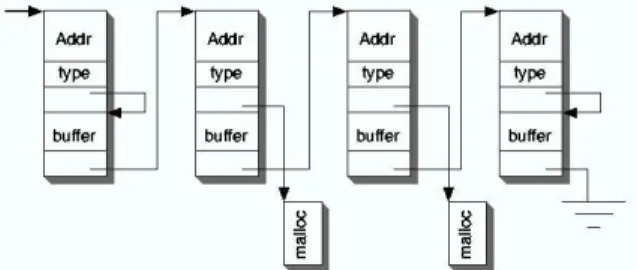
Figure 3—Memory Layout of An SOS Message Queue
Figure 3 provides an overview of how message head-ers are structured and queued. Message headhead-ers within a queue of a given priority form a simple linked list. The information included in message headers includes com-plete source and destination information, allowing SOS to directly insert incoming network messages into the messaging queue. Messages carry a pointer to a data pay-load used to transfer simple parameters and more com-plex data between modules. The SOS header provides an optimized solution to this common case of passing a few bytes of data between modules by including a small buffer in the message header that the data payload can be redirected to, without having to allocate a separate piece of memory (similar to the mbuf design). SOS message headers also include a series of flags to describe the prior-ity of the message, identify incoming and outgoing radio messages, and describe how the SOS kernel should man-age dynamic memory. These flags allow easy implemen-tation of memory ownership transfer for a buffer moving through a stack of components, and freeing of memory on completion of a scheduled message.
SOS uses the high priority queue for time critical mes-sages from ADC interrupts and a limited subset of timers needed by delay intolerant tasks. Priority queues have al-lowed SOS to minimize processing in interrupt contexts by writing interrupt handlers that quickly construct and schedule a high priority message and then drop out of the interrupt context. This reduces potential concurrency er-rors that can result from running in an interrupt context. Examples of such an errors include corruption of shared buffers that may be in use outside of the interrupt con-text, and stale interrupts resulting from operating with
Prototype Description
int8 t post short(sos pid t did, sos pid t sid, Place a message on the queue to call function ‘type’ in uint8 t type, uint8 t byte, uint16 t word, uint8 t flag) module ‘did’ with data ‘byte’ and ‘word’.
int8 t post long(sos pid t did, sos pid t sid, Place a message on the queue to call function ‘type’ uint8 t type, uint8 t len, void *data, uint8 t flag) in module ‘did’ with *data pointing to the data.
Table 5—Messaging API
Prototype Description Cycles
void *ker malloc(uint16 t Allocate memory 69 size, sos pid t id)
void ker free(void* ptr) Free memory 85 int8 t ker change own(void Change ownership 43 *ptr, sos pid t id)
sos pid t Validate memory 1175
ker check memory() (after a crash)
Table 6—Cycles needed for dynamic memory tasks in SOS when
run-ning on an Atmel AVR microcontroller.
interrupts disabled.
3.3 Dynamic Memory
Due to reliability concerns and resource constraints, em-bedded operating systems for sensor nodes do not always support dynamic memory. Unfortunately, static memory allocation results in fixed length queues sized for worst case scenarios and complex program semantics for com-mon tasks, such as passing a data buffer down a protocol stack. Dynamic memory in SOS addresses these prob-lems. It also eliminates the need to resolve during mod-ule insertion what would otherwise be static references to module state.
SOS uses dynamic memory with a collection of book-keeping annotations to provide a solution that is efficient and easy to debug. Dynamic memory in SOS uses simple best fit fixed-block memory allocation with three base block sizes. Most SOS memory allocations, including message headers, fit into the smallest block size. Larger block sizes are available for the few applications that need to move large continuous blocks of memory, such as module insertion. A linked list of free blocks for each block size provides constant time memory allocation and deallocation, reducing the overhead of using dynamic memory. Failed memory allocation returns a null pointer. Queues and data structures in SOS dynamically grow and shrink at run time. The dynamic use and release of memory in SOS creates a system with effective temporal memory reuse and an ability to dynamically tune mem-ory usage to specific environments and conditions. Self imposed hard memory usage limits prevent programing errors that could otherwise result in a module allocating all of the dynamic memory on a node.
Common memory functions and their clock cycle overheads are presented in table 6. All allocated mem-ory is owned by some module on the node. This value is set during allocation and used by SOS to implement
basic garbage collection and watch for suspect memory usage. Modules can transfer memory ownership to reflect data movement. Dynamic memory blocks are annotated with a small amount of data that is used to detect basic sequential memory overruns. These features are used for post-crash memory analysis1to identify suspect memory
owners, such as a module owning a great deal of sys-tem memory or overflowed memory blocks. SOS also supports the use of a hardware watchdog timer used to force a soft boot of an unresponsive node and triggering the same post-crash memory analysis. Finally, memory block annotations enable garbage collection on module unload.
3.4 Miscellaneous
The SOS kernel includes a sensor API that helps to man-age the interaction between sensor drivers and the mod-ules that use them. This leads to more efficient usage of a node’s ADC and sensing resources. Other standard system resources include timer multiplexing, UART li-braries, and hardware management of the I2C bus.
The loosely coupled design used in SOS has resulted in a platform that is very portable. SOS currently has sup-port for the Mica2 and MicaZ motes from Crossbow, and the XYZ Node from Yale. The most difficult portion of a port tends to be the techniques for writing to program memory while the SOS core is executing.
Limitations on module development result from the loose coupling of modules. An example of this is a 4KB size limitation for AVR module binaries, since relative jumps used in position independent code on the AVR ar-chitecture can only jump up to 4KB. Moreover, modules cannot refer to any global variables of the SOS kernel, as their locations of may not be available at compilation time.
4 P
ROGRAMMINGSOS A
PPLICATIONSFigure 4 contains a source code listing of the Sam-ple Send module of the Surge application2. The program
uses a singleswitchstructure to implement the message handler for the Sample Send module. Using the standard C programing language reduces the learning curve of SOS while taking advantage of the many compilers, velopment environments, debuggers, and other tools de-signed for C. C also provides efficient execution needed to operate on resource limited 8-bit microcontrollers.
01 int8_t module(void *state, Message *msg) { 02 surge_state_t *s = (surge_state_t*)state; 03 switch (msg->type){
04 //! System Message - Initialize module 05 case MSG_INIT: { 06 char prototype[4] = {’C’, ’v’, ’v’, ’0’}; 07 ker_timer_start(SURGE_MOD_PID, SURGE_TIMER_TID, 08 TIMER_REPEAT, INITIAL_TIMER_RATE); 09 s->get_hdr_size = (func_u8_t*)ker_get_handle 10 (TREE_ROUTING_PID, MOD_GET_HDR_SIZE, 11 prototype); 12 break; 13 }
14 //! System Message - Timer Timeout 15 case MSG_TIMER_TIMEOUT: {
16 MsgParam *param = (MsgParam*) (msg->data); 17 if (param->byte == SURGE_TIMER_TID) { 18 if (ker_sensor_get_data(SURGE_MOD_PID, PHOTO) 19 != SOS_OK) 20 return -EFAIL; 21 } 22 break; 23 }
24 //! System Message - Sensor Data Ready 25 case MSG_DATA_READY: {
26 //! Message Parameters
27 MsgParam* param = (MsgParam*) (msg->data); 28 uint8_t hdr_size;
29 uint8_t *pkt;
30 hdr_size = (*(s->get_hdr_size))(); 31 if (hdr_size < 0) return -EINVAL; 32 pkt = (uint8_t*)ker_malloc
33 (hdr_size + sizeof(SurgeMsg), SURGE_MOD_PID); 34 s->smsg = (SurgeMsg*)(pkt + hdr_size); 35 if (s->smsg == NULL) return -EINVAL; 36 s->smsg->reading = param->word; 37 post_long(TREE_ROUTING_PID, SURGE_MOD_PID, 38 MSG_SEND_PACKET, length, (void*)pkt, 39 SOS_MSG_DYM_MANAGED);
40 break; 41 }
42 //! System Message - Evict Module 43 case MSG_FINAL: { 44 ker_timer_stop(SURGE_MOD_PID, SURGE_TIMER_TID); 45 ker_release_handle(s->get_hdr_size); 46 break; 47 } 48 default: 49 return -EINVAL; 40 } 51 return SOS_OK; 52 }
Figure 4—Surge Source Code
Line 2 shows the conversion of the generic state stored in and passed from the SOS kernel into the module’s in-ternal representation. As noted in section 3.1.1, the SOS kernel always stores a module’s state to allow modules to be easily inserted at runtime.
An example of the init message handler appears on lines 5-13. These show the module requesting a peri-odic timer from the system and subscribing to the MOD-GET HDR SIZE function supplied by the tree routing module. This function pointer is used on line 30 to find the size of the header needed by the underlying routing layer. By using this function, changes to the underlying routing layer that modify the header size do not break the application. Lines 43-47 show thefinalmessage handler releasing the resources it had allocated: the kernel timer and the subscribed function. If these resources had not been explicitly released, the garbage collector in the SOS kernel would have soon released them. Good programing style is observed on lines 31 and 35 where potential er-rors are caught by the module and handled.
5 E
VALUATIONOur initial performance hypothesis was that SOS would perform at roughly the same level as TinyOS in terms of latency and energy usage, despite the greater level
of functionality SOS provides (and the overhead neces-sary to support that functionality). We also hypothesized that SOS module insertion would be far less expensive in terms of energy than the comparable solution in TinyOS with Deluge. This section tests these hypotheses using a prototypical multihop tree builder and data collector called Surge. A baseline evaluation of the operating sys-tems is also performed.
Benchmarking shows that application level perfor-mance of a Surge-like application on SOS is compara-ble to Surge on TinyOS and to Bombilla, an instantiation of the Mat´e virtual machine specifically for the Surge application. Initial testing of CPU active time in base-line evaluations of SOS and TinyOS showed a significant discrepancy between the two systems, motivating an in depth search into the causes of overhead in SOS. This search revealed simple optimizations that can be applied to improve both systems and bring their baseline perfor-mance to almost the same level. The process of remotely updating an application’s functionality in SOS is more energy efficient than updates using Deluge in TinyOS, but less efficient than updates using Bombilla. While our hypotheses that SOS can more efficiently install updates than TinyOS with Deluge proves true, further analysis shows that this difference does not significantly impact the total energy usage over time and that the three sys-tems have nearly identical energy profiles over long time scales. From these results, we argue that SOS effectively provides a flexible solution for sensor networking with energy usage functionally equivalent to other state of the art systems.
5.1 Methodology
We first describe the workings of the Surge application. Surge nodes periodically sample the light sensor and send that value to the base station over multi-hop wire-less links. The route to the base station is determined by setting up a spanning tree; every node in the tree main-tains only the address of its parent. Data generated at a node is always forwarded to the parent in the spanning tree. Surge nodes choose as their parent the neighbor with the least hop count to the base station and, in the event of a tie, the best estimated link quality. The es-timate of the link quality is performed by periodically broadcasting beacon packets containing neighborhood information.
The Surge application in SOS is implemented with three modules: Sample Send, Tree Routing and Photo-Sensor. For SOS, a blank SOS kernel was deployed on all motes. The Sample Send, Tree Routing and Photo-Sensor modules were injected into the network and re-motely installed on all the nodes. For TinyOS, the nodes were deployed with the Deluge GoldenImage. The Surge application was injected into the network using the
Del-Type of Code Percentage
Kernel 0%
Mica2 Specific Drivers 21% AVR Specific Drivers 36%
Table 7—Approximate number of lines of code (including comments)
used from TinyOS in different parts of SOS.
uge protocol and remotely installed on all the nodes. For Mat´e, the Bombilla VM was installed on all the nodes. Bombilla VM implements the tree routing protocol na-tively and provides a high-level opcode, Send, for trans-ferring data from the node to the base station via a span-ning tree. Bytecode for periodically sampling and send-ing the data to the base station was injected into the net-work and installed on all relevant nodes.
In all versions of Surge, the routing protocol parame-ters were set as follows: sensor sampling happens every 8 seconds, parents are selected and route updates broad-cast every 5 seconds, and link quality estimates are calcu-lated every 25 seconds. Therefore, upon bootup, a node will have to wait at least 25 seconds before it performs the first link quality estimate. Since the parent is selected based on link quality, the expected latency for a node to discover its first parent in the network is at least 25 sec-onds.
The experiments in section 5.2 use the setup de-scribed above to examine application level performance of Surge. Section 5.3 examines the base SOS kernel and a simple TinyOS application to find the base CPU active time in the two operating systems when no application is present. The section continues with an examination of how the Surge application effects CPU active time. Sec-tion 5.4 finishes with a numerical examinaSec-tion of the up-date overhead in SOS, TinyOS and Mat´e. In an attempt to isolate operating system specific overhead, the anal-ysis in section 5.4 does not use Deluge or the module distribution protocol currently used in SOS.
SOS reuses some of the TinyOS driver code for its Mica2 target and AVR support. Table 7 shows the ap-proximate percentage of code reused from TinyOS in SOS. For these experiments SOS uses nearly direct ports of the TinyOS CC1000 radio stack, sensor drivers, and applications. This helps to isolate performance differ-ences to within the kernel and module framework of SOS.
5.2 Macro Benchmarks
We first measure the time needed to form a routing tree and then measure the number of packets delivered from each node to the base station in a duration of 40 minutes. These tests act as a macro benchmark to help verify that Surge is running correctly on the three test platforms. Since all three systems are executing the same applica-tion and the CPU is not being heavily loaded, we
ex-pect differences in application performance to be small enough to be lost in the noise, as in fact they are.
For this experiment, Mica2 motes are deployed in a linear topology, regularly spaced at a distance of 4 feet from each other. The transmit power of the radio is set to -25dBm, the lowest possible transmit power, which results in a range of approximately 4 feet for our indoor laboratory environment.
Figure 5 shows the average time it took for a node to discover its first parent, averaged over 5 experiments. All three systems achieve latencies quite close to 25 seconds, the minimum latency possible given the Surge configura-tion parameters. The differences between the three sys-tems are mainly due to their different boot routines. The source of the jitter results from the computation of the parent being done in a context which is often interrupted by packet reception.
Figure 5 also shows the average time it takes to de-liver the first packet from a node to the base station. Since all three systems implement a queue for sending packets to the radio, the sources of per-hop latency are queue service time, wireless medium access delay, and packet transmission time. Queue service time depends upon the amount of traffic at the node, but the only vari-ation between the three systems is due to the differences in the protocols for code dissemination given the other-wise lightly loaded network. The medium access delay depends on the MAC protocol, but this is nearly identi-cal in the three systems [18]. Finally, packet transmission time depends upon the packet size being transmitted; this is different by a handful of bytes in the three systems, causing a propagation delay on the order of 62.4µs per bit [21]. The latency of packet delivery at every hop is almost identical in the three systems. The small varia-tions that can be observed are introduced mainly due to the randomness of the channel access delay.
Finally, figure 5 shows the packet delivery ratio for the three systems when the network was deployed for 40 minutes. As expected, the application level performance of the three systems was nearly identical. The slight dif-ferences are due to the fluctuating wireless link quality and the different overheads introduced by the code up-date protocols.
These results verify our hypothesis that the application level performance of a typical sensor network applica-tion running at a low duty cycle in SOS is comparable to other systems such as TinyOS and Mat´e. The overheads introduced in SOS for supporting run time dynamic link-ing and message passlink-ing do not affect application perfor-mance.
5.3 CPU Overhead
We proceed by measuring CPU active time on the SOS and TinyOS operating systems without any application
1 2 3 0 5 10 15 20 25
30 Tree Formation Latency
Hop Count Latency (Sec) Ideal TinyOS SOS Mate’
(a) Surge Tree Formation Latency
1 2 3 0 10 20 30 40 50 60 70 80 90 100 Hop Count Delay (Milli−seconds)
Surge App: Delay Measurement TinyOS
SOS Mate’
(b) Surge Forwarding Delay
Hop 1 Hop 2 Hop 3
0 10 20 30 40 50 60 70 80 90
100 Surge Packet Delivery Ratio
Trace over 40 minutes (300 Pkts per node)
Packet Delivery Percentage
TinyOS SOS Mate’
(c) Surge Packet Delivery Ratio
Figure 5—Macro Benchmark Comparison of Surge Application
activity to examine the base overhead in the two systems. Bombilla is not examined in these base measurements since the virtual machine is specific to the Surge appli-cation. The evaluation is finished by examining the CPU active time when running Surge on each of SOS, TinyOS, and Mat´e. In all three systems, the source code is instru-mented to raise a GPIO pin in the microcontroller when the CPU is performing any active operation (executing a task or interrupt). A high speed data logger is used to cap-ture the waveform generated by the GPIO pin and mea-sure the active duration. All experiments are run for 10 intervals of 60 seconds using the same Mica2 motes. We expect both systems to have nearly identical base over-heads since the SOS kernel should be nearly as efficient as the base TinyOS kernel.
To examine the base overhead in SOS we installed a blank SOS kernel onto a single mote and measured CPU active time to be 7.40%±0.02%. In contrast to this,
run-ning the closest TinyOS equivalent, TOSBase, resulted in a CPU active time of 4.76%±0.01%. This active time
discrepancy came as a great surprise and prompted an evaluation into the cause of overhead in SOS.
Detailed profiling using the Avrora [23] simulator re-vealed that the overhead in SOS may be related to the SPI interrupt used to monitor the radio for incoming data. The SPI interrupt is triggered every 418µs in both SOS and TinyOS when the radio is not in a low power mode, as is the case in the above experiments. Micro-benchmarking showed that the SPI interrupt handler in SOS and TinyOS are almost identical. However upon exit from the SPI interrupt, control is transferred to the scheduler that checks for pending tasks. On a lightly loaded system the common case is to perform this check and go to sleep, since the scheduling queue is usually empty. Further micro-benchmarking revealed that in the common case of empty scheduling queues, the SOS scheduling loop takes 76 cycles compared to 25 cycles in TinyOS. This additional overhead acquired every 418µs
accounts for the discrepancy in performance between SOS and TinyOS.
The SOS scheduling loop was then optimized to better handle this common case reducing the CPU active time to 4.52%±0.02%and resulted in SOS outperforming TinyOS. For a fair comparison we modified the TinyOS scheduling loop and post operation 3 to use a similar
scheduling mechanism, reducing the TinyOS CPU active time to 4.20%±0.02%. This difference is small enough
that it can be accounted for by two additional push and pop instruction pairs in the SOS SPI handler that are in-troduced due to the slight modifications to the radio stack implementation.
The above active times are summarized in table 8. Of the most interest are the last two entries, which show that when both scheduling loops are optimized the base op-eration overhead of SOS and TinyOS are within a few percent, as expected.
Having verified that the base operating systems have very similar overheads, we continue by examining the CPU active time when Surge is run on SOS, TinyOS and Mat´e. Versions of both SOS and TinyOS with optimized schedulers are used for all three tests and Mat´e Bom-billa runs on top of the optimized TinyOS core. Surge is loaded onto two nodes, and the active time is again mea-sured by instrumenting the code to activate a GPIO pin when active and monitoring this pin with a high speed data logger. The experiment results are shown in Table 9. This comparison shows that this low duty cycle applica-tion has less effect on the base performance of SOS than for TinyOS. The cause of this larger increase for TinyOS is not yet fully understood. One hypothesis is that the ini-tial baseline measurement between SOS and TinyOS do not accurately reflect the same base functionality.
5.4 Code Updates
We now present an evaluation of the energy needed for propagation and installation of the Surge application. We
OS Version Percent Active Time SOS Unoptimized 7.40%±0.02% TinyOS Unoptimized 4.76%±0.01% SOS Optimized 4.52%±0.02% TinyOS Optimized 4.20%±0.02%
Table 8—CPU Active Time on Base
Op-erating System
OS Version Percent Active Time
SOS 4.64%±0.08%
Optimized
TinyOS 4.58±0.02% Optimized
Mat´e Bom. 5.13±0.02%
Table 9—CPU Active Time With
Surge
SOS Module Name Code Size Sample Send 568 bytes Tree Routing 2242 bytes Photo Sensor 372 bytes
Energy (mJ) 2312.68
Latency (s) 46.6
Table 10—SOS Surge Remote Installation
begin by looking at installing Surge onto a completely blank node over a single hop in SOS. Surge on SOS con-sists of three modules: Sample send, Tree routing, and Photo Sensor. Table 10 shows the size of the binary mod-ules and overall energy consumption and the latency of the propagation and installation process. The energy con-sumption was measured by instrumenting the power sup-ply to the Mica2 to sample the current consumed by the node.
We continue with an analytical analysis of the energy costs of performing similar code updates in our three benchmark systems—SOS, TinyOS with Deluge [10], and Mat´e Bombilla VM with Trickle [16]. It is impor-tant to separate operating system-related energy and la-tency effects from those of the code distribution proto-col. Overall latency and energy consumption is mainly due to the time and energy spent in transmitting the up-dated code and storing and writing the received code to the program memory.
Communication energy depends upon the number of packets that need to be transferred in order to propagate the program image into the network; this number, in turn, is closely tied to the dissemination protocol. However, the number of application update bytes required to be transferred to update a node depends only on the archi-tecture of the operating system. Therefore, to eliminate the differences introduced due to the different dissemi-nation protocols used by SOS, TinyOS, and Bombilla, we consider the energy and latency of communication and the update process to be directly proportional to the number of application update bytes that need to be trans-ferred and written to the program memory. The design of the actual distribution protocol used is orthogonal to the operating system design and SOS could use any of the existing code propagation approaches [22, 16]; it cur-rently uses a custom publish/subscribe protocol similar to MOAP [22].
5.4.1 Updating low level functionality
To test updating low level functionality, we numerically evaluate the overhead of installing a new magnetometer sensor driver into a network of motes running the Surge application. The SOS operating system requires the dis-tribution of a new magnetometer module, whose binary is 1316 bytes. The module is written into the program
System Code Size Write Cost Write Energy (Bytes) (mJ/page) (mJ)
SOS 1316 0.31 1.86
TinyOS 30988 1.34 164.02
Mat´e VM N/A N/A N/A
Table 11—Magnetometer Driver Update
System Code Size Write Cost Write Energy (Bytes) (mJ/page) (mJ)
SOS 566 0.31 0.93
TinyOS 31006 1.34 164.02
Mat´e VM 17 0 0
Table 12—Surge Application Update
memory, one 256-byte page of the flash memory at a time. The cost of writing a page to the flash memory was measured to be 0.31 mJ, and 6 pages need to be written so the total energy consumption of writing the magne-tometer driver module is 1.86 mJ.
TinyOS with the Deluge distribution protocol requires the transfer of a new Surge application image with the new magnetometer driver. The total size of the Surge application with the new magnetometer driver is 30988 bytes. The new application image is first stored in ex-ternal flash memory until it is completely received. The cost of writing and reading one page of the external flash is 1.03 mJ [21]. Thereafter, the new image is copied from the external flash to the internal flash memory. This makes the total cost of installing a page of code into the program memory 1.34 mJ, and the total energy consump-tion for writing the updated Surge applicaconsump-tion 164.02 mJ. Lastly, the Mat´e Bombilla VM does not support any mechanism for updating low level functionality such as the magnetometer driver. These results are summarized in table 11.
5.4.2 Updating application functionality
We examine updates to applications by numerically eval-uating the overhead of updating the functionality of the Surge application. The modified Surge application samples periodically, but transmits the value to a base station only if it exceeds a threshold. The SOS oper-ating system requires the distribution of a new Sam-ple Send module with the updated functionality. As be-fore, TinyOS/Deluge requires the transfer of a new Surge application image with the modified functionality. How-ever, the Mat´e Bombilla VM requires just a bytecode
up-date. The total size of the bytecode was only 17 bytes, and since it is installed in the SRAM, it has no extra cost over the running cost of the CPU. The results of an analy-sis similar to that in section 5.4.1 is presented in table 12. SOS offers more flexibility than Mat´e; operations such as driver updates not already encoded in Mat´e’s high-level bytecode cannot be accomplished. However, Mat´e’s code updates are an order of magnitude less expensive than SOS’s. TinyOS with Deluge picks the extreme end of the flexibility/cost trade off curve by offering the greatest update flexibility at the highest cost of code date. With a Deluge like mechanism, it is possible to up-grade the core kernel components, which is not possible using only modules in SOS; but in SOS and Mat´e, the state in the node is preserved after code update while it is lost in TinyOS due to a complete reboot of the system. The above analysis does not consider how differential updates described in section 2.3 could impact static and dynamic systems. There is potential for differential up-dates to significantly decrease the amount of data that needs to be transmitted to a node for both systems. It is also unclear how efficiently a differential update, which may require reconstructing the system image in external flash, can be implemented. Differential updates are an area of research that both SOS and TinyOS could benefit from in the future.
5.4.3 Analytical analysis of update energy usage
The previous evaluation of CPU utilization and update costs in SOS, TinyOS, and Mat´e prompts asking how significant those factors are in the total mote energy ex-penditure over time. Application energy usage on a mote can be divided up into two primary sources: the energy used to install or update the application, and the power used during application execution multiplied by applica-tion execuapplica-tion time. An interesting point of comparison is to find the time, if any, when the total energy usage of two systems running the same application becomes equal. Starting with an update to a node, the total energy consumption of the node is found using:
Etotal=Eupdate+Paverage×Tlive (1) Paverage denotes the power consumption of the mote av-eraged over application execution duration and the sleep duration (due to duty cycling).Tlive is the time that the node has been alive since it was updated.Eupdate is the energy used to update or install the application.
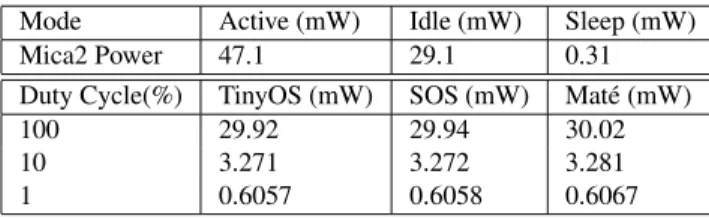
The average power consumption during application execution depends upon the active time of the applica-tion, duty cycle of operaapplica-tion, and the power consump-tion of the hardware platform in various power modes. The Mica2 power consumption in various modes was ob-tained from [21] and is summarized in table 13. We first
Mode Active (mW) Idle (mW) Sleep (mW)
Mica2 Power 47.1 29.1 0.31
Duty Cycle(%) TinyOS (mW) SOS (mW) Mat´e (mW)
100 29.92 29.94 30.02
10 3.271 3.272 3.281
1 0.6057 0.6058 0.6067
Table 13—Average Power Consumption of Mica2 Executing Surge
computePawake, the average power consumption of the Surge application assuming a 100% duty cycle i.e. the system is operating continuously without sleep:
Pawake=Pactive× Tactive
Tactive+Tidle+Pidle×
Tidle Tactive+Tidle
Table 9 provides the ratio Tactive
Tactive+Tidle, which can be used
to find Tidle
Tactive+Tidle. When the system is operated at lower
duty cycles, the average power consumption is given by: Paverage=Pawake×DutyCycle+Psleep×(1−DutyCycle)
Table 13 summarizes the average power consumption of the Surge application at various duty cycles.
Now we compute the energy used during the Surge application installation,Eupdate, which is the sum of the energy consumed in receiving the application over the radio and subsequently storing it on the platform. For the Mica2 Mote, the energy to receive a byte is 0.02 mJ/byte-[21]. Using table 12 we can compute the energy required to update the Surge application on SOS assuming that communications energy has a one to one correlation with application bytes transmitted:
Eupdate(SOS) =0.02 mJ
byte×566bytes+0.93mJ=12.25mJ Similar computations can also be performed for TinyOS and Mat´e using the numbers in table 12.
Using the numbers computed thus far, it is possible to understand the total energy consumption of a system, Etotal, as a function of the elapsed timeTlive. From equa-tion 1, it can be seen that energy consumpequa-tion is linear with the slope being equal toPaveragewith an initial off-set equal toEupdate. The average power consumption for each of the three systems examined is very similar and results in nearly identical total energy usage over time, despite the initially significantly different update costs. For example, by solving the linear equations for the 10% duty cycle, it is easy to see that TinyOS becomes more energy efficient than SOS after about 9 days. Similarly, for a 10% duty cycle, SOS becomes more energy effi-cient than Mat´e after about 22 minutes. But looking at the absolute difference in energy consumed after 30 days at a 10% duty cylcle, SOS has consumes less than 2 J more energy than TinyOS and Mat´e is only about 23 J beyond SOS. This analysis reveals that, contrary to our
initial intuition, differences in both CPU utilization and update costs are not significant in the total energy con-sumption of the node over time.
Note that this analysis is only for a single application, Surge, running under a given set of conditions. Differ-ent applications and evolving hardware technology will change the results of the above analysis. Applications with very high CPU utilization can magnify the effects of different CPU utilization onPaverageresulting in total energy variances of 5% to 10% on current mote hard-ware. Similarly, improvements to duty cycling that re-duce node idle time can magnify the effects of CPU uti-lization onPaverage. Hardware innovations that reduce pe-ripheral energy usage, especially when the CPU is idle, will also lead to a noticeable discrepancy in total energy consumption. Only as the above improvements to sys-tems are made, leading to more energy efficient execu-tion environments, will energy savings from efficient up-dates become significant.
5.5 Discussion
This analysis examines energy usage, which provides a quantifiable comparison of these systems. This section also shows that these differences are not significant when taking into account average power consumption resulting from the different power modes of current mote technol-ogy. Choosing between operating systems for these sys-tems should be driven more by the features provided by the underlying system, such as flexibility of online up-dates in SOS or full system static analysis in TinyOS, rather than total system energy consumption. As soft-ware and hardsoft-ware technologies advance, the effects of differing CPU utilization and update costs between tems will play a more significant role in choosing a sys-tem.
The results of the experiments performed in this sec-tion validate the following claims about SOS. First, the architectural features presented in section 3 position SOS at a middle ground between TinyOS and Mat´e in terms of flexibility. Second, the application level performance of the SOS kernel is comparable to TinyOS and Mat´e for common sensor network applications that do not stress the CPU. Third, code updates in SOS consume less en-ergy than similar updates in TinyOS, and more enen-ergy than similar updates in Mat´e. Fourth, despite different update costs and CPU active times, the total energy usage in SOS is nearly identical to that in TinyOS and Mat´e.
6 C
ONCLUSIONSOS is motivated by the value of maintaining mod-ularity through application development and into sys-tem deployment, and of creating higher-level kernel interfaces that support general-purpose OS semantics. The architecture of SOS reflects these motivations. The
kernel’s message passing mechanism and support for dynamically allocated memory make it possible for independently-created binary modules to interact. To im-prove the performance of the system and to provide a simple programming interface, SOS also lets modules interact through function calls. The dynamic nature of SOS limits static safety analysis, so SOS provides mech-anisms for run-time type checking of function calls to preserve system integrity. Moreover, the SOS kernel per-forms primitive garbage collection of dynamic memory to improve robustness. Fine grain energy usage of SOS, TinyOS and the Mat´e Bombilla virtual machine are de-pendent on the frequency of updates and stressing of the CPU required for a specific deployment. However, analy-sis of overall energy consumed by each of the three sys-tems at various duty cycles shows nearly identical en-ergy usage for extended deployments. Thus, to choose between SOS and another system, it is important for velopers to consider the benefits of static or dynamic de-ployments independently of energy usage.
SOS is a young project under active development and several research challenges remain. One critical chal-lenge confronting SOS is to develop techniques that pro-tect the system against incorrect module operation and help facilitate system consistency. The stub function sys-tem, typed entry points, and memory tracking protect against common bugs, but in the absence of any form of memory protection it remains possible for a module to corrupt data structures of the kernel and other mod-ules. Techniques to provide better module isolation in memory and identify modules that damage the kernel are currently being explored. The operation of SOS is based on the notion of co-operative scheduling, but an incorrectly composed module can utilize all of the CPU. We are exploring more effective watchdog mechanisms to diagnose this behavior and take corrective actions. Since binary modules are distributed by resource con-strained nodes over a wireless ad-hoc network, SOS mo-tivates more research in energy efficient protocols for bi-nary code dissemination. Finally, SOS stands to benefit greatly from new techniques and optimizations that spe-cialize in improving system performance and resource utilization for modular systems.
By combining a kernel that provides commonly used base services with loosely-coupled dynamic modules that interact to form applications, SOS provides a more general purpose sensor network operating system and supports efficient changes to the software on deployed nodes.
We use the SOS operating system in our research and in the classroom, and support users at other sites. The system is freely downloadable; code and documentation are available at:
A
CKNOWLEDGEMENTSWe gratefully acknowledge the anonymous reviewers and our shepherd, David Culler. Thanks goes out the XYZ developers and other users of SOS who have pro-vided feedback and help to make better system. This ma-terial is based on research funded in part by ONR through the AINS program and from the Center for Embedded Network Sensing.
R
EFERENCES[1] ABRACH, H., BHATTI, S., CARLSON, J., DAI, H., ROSE, J., SHETH, A., SHUCKER, B., DENG, J., ANDHAN, R.
Man-tis: system support for multimodal networks of in-situ sensors. In Proceedings of the 2nd ACM international conference on Wireless sensor networks and applications(2003), ACM Press, pp. 50–59.
[2] BERSHAD, B. N., SAVAGE, S., PARDYAK, P., SIRER, E. G., FI -UCZYNSKI, M., BECKER, D., EGGERS, S.,ANDCHAMBERS,
C. Extensibility, safety and performance in the SPIN operat-ing system. In15th Symposium on Operating Systems Principles
(Copper Mountain, Colorado, 1995), pp. 267–284.
[3] BOULIS, A., HAN, C.-C.,ANDSRIVASTAVA, M. B. Design and implementation of a framework for efficient and programmable sensor networks. InProceedings of the First International Con-ference on Mobile Systems, Applications, and Services(2003), ACM Press, pp. 187–200.
[4] CROSSBOWTECHNOLOGY, INC. Mote In-Network Program-ming User Reference, 2003.
[5] DUNKELS, A., GRONVALL¨ , B.,ANDVOIGT, T. Contiki - a
lightweight and flexible operating system for tiny networked sen-sors. InProceedings of the First IEEE Workshop on Embedded Networked Sensors(2004).
[6] ENGLER, D. R., KAASHOEK, M. F.,ANDO’TOOLE, J. Exok-ernel: An operating system architecture for application-level re-source management. InSymposium on Operating Systems Prin-ciples(1995), pp. 251–266.
[7] FOK, C., ROMAN, G.-C.,ANDLU, C. Rapid development and flexible deployment of adaptive wireless sensor network appli-cations. Tech. Rep. WUCSE-04-59, Washington University, De-partment of Computer Science and Engineering, St. Louis, 2004. [8] GAY, D., LEVIS, P.,VONBEHREN, R., WELSH, M., BREWER, E.,ANDCULLER, D. The nesc language: A holistic approach to networked embedded systems. InProceedings of Programming Language Design and Implementation(2003).
[9] HILL, J., SZEWCZYK, R., WOO, A., HOLLAR, S., CULLER, D.,AND PISTER, K. System architecture directions for
net-worked sensors. InProceedings of the ninth international con-ference on Architectural support for programming languages and operating systems(2000), ACM Press, pp. 93–104.
[10] HUI, J. W.,ANDCULLER, D. The dynamic behavior of a data dissemination protocol for network programming at scale. In
Proceedings of the second international conference on Embed-ded networked sensor systems(2004), ACM Press.
[11] JEONG, J.,ANDCULLER, D. Incremental network programming for wireless sensors. InProceedings of the First IEEE Communi-cations Society Conference on Sensor and Ad Hoc Communica-tions and Networks IEEE SECON(2004).
[12] JUANG, P., OKI, H., WANG, Y., MARTONOSI, M., PEH, L.-S.,
ANDRUBENSTEIN, D. Energy-efficient computing for wildlife tracking: Design tradeoffs and early experiences with ZebraNet. InProc. 10th International Conference on Architectural Support
for Programming Languages and Operating Systems (ASPLOS-X)(San Jose, California, Oct. 2002).
[13] KAISER, W., POTTIE, G., SRIVASTAVA, M., SUKHATME, G. S., VILLASENOR, J.,ANDESTRIN, D. Networked Infome-chanical Systems (NIMS) for ambient intelligence.
[14] LEVIS, P.,ANDCULLER, D. Mate: A tiny virtual machine for sensor networks. InInternational Conference on Architectural Support for Programming Languages and Operating Systems, San Jose, CA, USA(Oct. 2002).
[15] LEVIS, P., MADDEN, S., GAY, D., POLASTRE, J., SZEWCZYK, R., WOO, A., BREWER, E.,ANDCULLER, D. The emergence of networking abstractions and techniques in tinyos. In Proceed-ings of the First Symposium on Networked Systems Design and Implementation(2004), USENIX Association, pp. 1–14. [16] LEVIS, P., PATEL, N., CULLER, D.,ANDSHENKER, S. Trickle:
A self-regulating algorithm for code propagation and mainte-nance in wireless sensor networks. InProceedings of the First Symposium on Networked Systems Design and Implementation
(2004), USENIX Association, pp. 15–28.
[17] LIU, T.,ANDMARTONOSI, M. Impala: a middleware system for managing autonomic, parallel sensor systems. InProceedings of the ninth ACM SIGPLAN symposium on Principles and practice of parallel programming(2003), ACM Press, pp. 107–118. [18] POLASTRE, J., HILL, J.,ANDCULLER, D. Versatile low power
media access for wireless sensor networks. InSecond ACM Con-ference on Embedded Networked Sensor Systems(2004). [19] RASHID, R., JULIN, D., ORR, D., SANZI, R., BARON, R.,
FORIN, A., GOLUB, D.,ANDJONES, M. B. Mach: a system
software kernel. InProceedings of the 1989 IEEE International Conference, COMPCON(San Francisco, CA, USA, 1989), IEEE Comput. Soc. Press, pp. 176–178.
[20] REIJERS, N.,ANDLANGENDOEN, K. Efficient code distribu-tion in wireless sensor networks. InProceedings of the 2nd ACM international conference on Wireless sensor networks and appli-cations(2003), ACM Press, pp. 60–67.
[21] SHNAYDER, V., HEMPSTEAD, M., RONG CHEN, B., AND
MATTWELSH, H. Powertossim: Efficient power simulation for tinyos applications. InSensor Networks. In Proc. of ACM SenSys 2003.(2003).
[22] STATHOPOULOS, T., HEIDEMANN, J.,ANDESTRIN, D. A re-mote code update mechanism for wireless sensor networks. Tech. Rep. CENS-TR-30, University of California, Los Angeles, Cen-ter for Embedded Networked Computing, November 2003. [23] TITZER, B. L., PALSBERG, J.,ANDLEE, D. K. Avrora:
Scal-able sensor network simulation with precise timing. InFourth International Conference on Information Processing in Sensor Networks(2005).
N
OTES1Soft reboot of many microcontrollers, including the Atmel AVR,
preserves on chip memory.
2This source code is trimmed for clarity. Complete source code can
be downloaded separately.
3Patch is being submitted to the TinyOS developers should they
wish to optimize for the case of a lightly loaded radio that is not in a low power mode.