Deep Q-Learning for Chunk-based Caching in
Data Processing Networks
Yimeng Wang
∗, Yongbo Li
∗, Tian Lan
∗, and Vaneet Aggarwal
† ∗George Washington University,
†Purdue University
Abstract—A Data Processing Network (DPN) streams massive volumes of data collected and stored by the network to multiple processing units to compute desired results in a timely fashion. Due to ever-increasing traffic, distributed cache nodes can be deployed to store hot data and rapidly deliver them for consumption. However, prior work on caching policies has pri-marily focused on the potential gains in network performance, e.g., cache hit ratio and download latency, while neglecting the impact of cache on data processing and consumption.
In this paper, we propose a novel framework, DeepChunk, which leverages deep Q-learning for chunk-based caching in DPN. We show that cache policies must be optimized for both network performance during data delivery and processing efficiency during data consumption. Specifically, DeepChunk utilizes a model-free approach by jointly learning limited network, data streaming, and processing statistics at runtime and making cache update decisions under the guidance of powerful deep Q-learning. It enables a joint optimization of multiple objectives including chunk hit ratio, processing stall time, and object download time while being self-adaptive under the time-varying workload and network conditions. We build a prototype implementation of DeepChunk with Ceph, a popular distributed object storage system. Our extensive experiments and evaluation demonstrate significant improvement, i.e., 43% in total reward and39%in processing stall time, over a number of baseline caching policies.
I. INTRODUCTION
Data collection, streaming, and processing are essential tasks for modern networks due to the rapid development in areas such as Internet of Things, sensor networks, online data analytics and edge computing [1], [2], [3]. In such applications, massive volumes of data collected (and stored) by the network need to be streamed to multiple processing units to compute desired results in a timely fashion. Due to ever-increasing traffic in Data Processing Networks (DPN), [4], [5], [6], they often enhance the performance by caching data in nodes close to computing units and rapidly delivering those data for consumption.
The design of caching policies, however, is primarily focused on the potential gains in network performance, e.g., cache hit ratio and download latency, while neglecting the impact of data processing and consumption. These include the Least Frequently Used [7] and Most Popular Object [8] strategies that achieve a high cache hit ratio, and the Least Recently Used (LRU), qLRU, and kLRU [9] strategies that use request recency for cache update. Yet, for data processing networks, a data stream is simultaneously being fetched and consumed on the fly. Existing caching policies
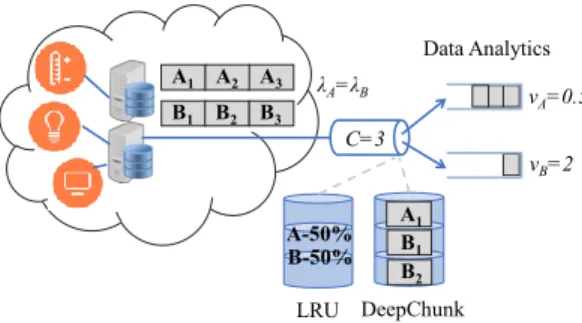
A1 A2 A3 B1 B2 vA=0.5 vB=2 B3 λA=λB A1 B1 B2 A-50% B-50% C=3 LRU DeepChunk Data Analytics
Fig. 1. An illustrative example of DeepChunk approach for data processing.
only considering network performance during data delivery fall short on addressing end-to-end tuple processing time [2], which depends on both data delivery and consumption. In practice, when available network bandwidth cannot fully sustain all data processing needs [1], [2], stalls during data processing become inevitable. As a result, the design of caching policies should be made aware of data consumption needs, to mitigate processing stalls and fulfill the timely online processing requirements.
In this paper, we propose a novel framework, DeepChunk, which leverages deep Q-learning [10] for chunk-based caching in DPN. Our key idea is that cache policies must be optimized for both (i) network performance during data delivery and (ii) processing efficiency during data consump-tion. Since the classical hit ratio does not account for partial files in the cache, we use the notion ofchunk hit ratio that accounts for the existence of partial files in the cache. The necessity of taking data processing into account in caching can be illustrated via a simple example in Figure 1. Two data objects, A and B (each consisting of 3 chunks), are recorded on network edge and fetched by different data processing units through a link that has a capacity of 1 chunk per second and is equipped with a cache of size C= 3 chunks. Under a file-based policy, it is easy to see that if A is cached, the processing of B stalls for a total of 2 seconds (i.e., 1 second waiting time for the first chunk and 1/2 second idle time before processing each subsequent chunks), and similarly the processing of A stalls for 1 second if B is cached. However, if guided by an optimized, chunk-based caching policy, the cache node stores 1 and 2 chunks for objectives A and B respectively, we can achieve not only the same chunk hit ratio (i.e., 50%), but also the minimum end-to-end tuple processing
Allerton Park and Retreat Center
time with stall-free data processing. Thus, to fulfill the real-time data processing requirements, it is necessary to consider both network performance and data processing objectives.
A fundamental problem in our chunk-based cache system is the cache update policy, which entails two types of deci-sions at chunk level – how many chunks of a data object to admit (cache admission) and which chunks to evict from the cache (cache eviction), if it is already full – with the objective of jointly optimizing average chunk hit ratio, processing stall time, and object download time in DPN. This optimization may be solvable if we can accurately model the correlation between the objective values and underlying variables, e.g., request arrival patterns, data popularity distributions and network conditions. However, this is very challenging and has not yet been well studied in the context of data processing networks, which represent a fairly complicated multi-point to multi-point system with the dynamics of data streaming and processing (from multiple data objects) closely-coupled and jointly impacting the design objectives.
Hence, DeepChunk aims to develop a model-free ap-proach by jointly learning data streaming, processing, and network statistics and making decisions under the guidance of powerful deep Q-learning [10]. We believe the approach is especially promising for chunk-based cache in data pro-cessing networks because: (i) it does not rely on precise and mathematically solvable models, hard to obtain in practical DPN, (ii) it is capable of supporting an enormously large state space, and (iii) it is self-adaptive to the dynamic environment, e.g., evolving data popularity/arrivals and time-varying network conditions. In particular, the state space in DeepChunk’s Q-learning include data popularity distribution, cache states, request arrival statistics, network conditions and current request information, while its reward captures chunk hit ratio, processing stall time, and object download time. The output action determines DeepChunk’s cache update policy, and the resulting reward is further fed-back to the neural network for learning.
We build a prototype implementation of DeepChunk with Ceph [11], a popular distributed object storage system. Ceph’s cache node is modified to implement a learning engine and a chunk-based cache module. Upon a request arrival, the cache module immediately streams all cached chunks and request the remaining chunks from the Ceph storage cluster, where all data objects are stored. At the mean time, the learning engine guides the cache updates, and obtains the updated reward for the training purpose. To evaluate DeepChunk, we generate data popularities from Zipf distribution and utilize Linux TC traffic control [12] to set up different network configurations. We run extensive experiments to compare DeepChunk with a number of base-lines including No-Cache, LRU, kLRU, gLRU. DeepChunk achieves up to43%reward improvements compared with the baselines, and in all scenarios, it has the ability to balance different design objects, illuminating an interesting tradeoff between chunk hit ratio, processing stall time, and object
download time.
The main contributions of this paper are as follows: • We propose DeepChunk for chunk-based caching in
DPN with the objective of jointly optimizing both data processing and network performance.
• DeepChunk leverages a model-free approach by jointly learning limited statistics on the fly and making cache update decisions under the guidance of powerful Q-learning.
• We build a prototype of DeepChunk using Ceph and compare its performance with a number of baseline caching policies. Significant improvement, i.e., 43% in total reward and 39% in processing stall time, is observed.
Related work. LRU-based caching mechanisms have been widely studied [13]. One of the key issue in LRU based caching strategy is that a large file arrival can evict multiple small files [14]. In order to have better performance with realistic file sizes, multiple approaches have been proposed, see [14], [15] and the references therein. Caching has been applied in many applications including radio-access network [16], mobile 5G networks [17], web applications [18], BigData applications [19], distributed storage [20], [21], and video delivery [22], [23]. In this paper, we propose a chunk-based caching framework that leverages deep Q-learning [10]. Q-Q-learning has been applied to address network optimization tasks such as traffic engineering [24], video bitrate control [25], LTE femtocell configuration [26], ride-sharing [27], and cell outage management [28].
II. PROPOSEDDEEPCHUNKFRAMEWORK
We assume that there are N data objects to be streamed and processed by different processing units. Each objecti∈ {1,2, ..., N} is partitioned into Fi identical-sized chunks. A cache node is located in close proximity to the processing units and can store up toCdata chunks. We consider a time-slotted system model, in which each time bin contains exactly one request arrival. At a given time bint, letCi(t)denote the number of chunks of data objectistored in the cache node, satisfying0≤Ci(t)≤Fi. The cache size constraint requires
PN
i=1Ci(t)≤Cfor any time bint. For the proposed caching strategy, in steady state the above cache size constraint will hold with equality since we will not waste any cache capacity in the steady state.
Our chunk-based caching policy is formulated as follows. In time bin t, when data objectiis requested, Ci(t)chunks stored in the cache are directly streamed to the processing unit, which then immediately begin data processing. At the same time, the remaining Fi−Ci(t) requested chunks will be delivered from the data source and through the network. When the complete data object i is not yet in the cache, i.e.,Ci(t)< Fi, Ec additional chunks of object i satisfying
0≤Ec ≤Fi−Ci(t) will be added to the cache. Thus, the number of object-i chunks in cache increases fromCi(t)to
these Ci(t+ 1) chunks of object i are moved to the head of line in the cache since they become most-recently-used. It is easy to see that to mitigate processing stall, we should always place the first Ci(t+ 1) chunks of objecti in cache and stream them to jump-start data processing. Finally, when the cache is already full, to make space for the added chunks, an equivalent number of chunks must be removed from the cache. In DeepChunk, we adopt a policy similar to least-recently-used and remove a necessary number of chunks from the tail of the cache line.
Our goal is to design a cache policy to optimize both network performance and data processing objectives. Leth(t) be the chunk hit ratio in time bin t (defined formally later in this section), Td(t) the average object download time, and Ts(t) the average processing stall time. Specifically, DeepChunk aims to optimize the following objective in steady state (for sufficiently large τ) over feasible cache policies P : max P 1 τ τ X t=1 α1h(t)−α2Ts(t)−α3Td(t), (1) whereα1, α2, α3are non-negative weights assigned to chunk hit ratio, processing stall time, and object download time, respectively. In practice, we can adjust these weights to achieve different tradeoffs between the network performance and data processing objectives [29]. We use Reinforcement Learning (RL) to solve the above optimization, and for each network state, to determine the optimal cache replacement, i.e., the number of chunks Ec to replace. We note that existing caching policies typically rely on constant cache replacement strategies, e.g.,Ec=Fi for the LRU policy and
Ec= 1 for the gLRU policy [15], thus lacking the ability to adapt cache replacement on the fly with respect to dynamics in DPN.
Next, we derive different network performance and data processing metrics that will be computed from limited run-time statistics on the fly and leveraged by the RL agent to optimize DeepChunk.
Chunk hit ratio. We note that for object-based cache systems, a “hit” occurs if the requested data object is found in the cache. Thus, the hit ratio equals to the probability that the requested data object is stored in the cache. For chunk-based caching considered in this paper, we define a similar chunk hit ratioto quantify the performance of the proposed caching policy. Specifically, we denotehi=Ci/Fi as the chunk hit ratio of data object i, which is the percentage of object-i
chunks that are stored in the cache and can be directly used to serve a request. This notion of chunk hit ratio generalizes the existing object-based definition, which is binary –hi= 0 for a cache miss andhi = 1for a cache hit – and cannot be used to evaluate chunk-based caching systems. Finally, the overall chunk hit ratio is simply the average of chunk hit ratio of individual data objects weighted by request arrival rates λi, i.e., (Piλihi)/(Piλi).
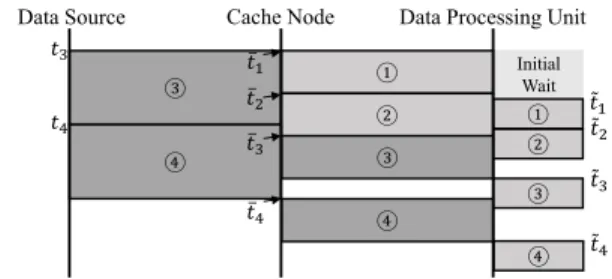
Initial Wait Data Source Cache Node Data Processing Unit
③ ① ② ④ ③ ④ 𝑡3 𝑡4 ҧ𝑡 3 ҧ𝑡 4 ① ǁ𝑡1 ② ③ ④ ǁ𝑡 2 ǁ𝑡 3 ǁ𝑡 4 ҧ𝑡 2 ҧ𝑡 1
Fig. 2. Calculation of process stall time.
Process stall time.The stall time of streamed data is defined as a leaking bucket problem in prior work [30], and a calculation methodology based on download time and play time is introduced. In our DPN caching model, the process stall time can be treated as a two-stage leaking bucket problem, in which an additional cache layer affects the stall time as well.
Figure 2 shows the calculation method of the process stall time. We denotetk,¯tk, and˜tkas the time when thekth chunk starts being sent/processed at the data source, cache node, and data processing unit respectively. By using the similar method in [30], we recursively obtain the time when the last chunk starts being processed ˜tk, and the process stall time can be calculated by
Ts= (˜tFi−
Fi−1
νi
−tini)+, (2)
whereνi andtinidenote the data processing speed of file i, and the initial wait time (or startup delay).
Object download time. The download time of each data chunkkcan be found through¯tk, which is the time to starting streaming chunkkfrom the cache node to the processing unit and is already given in the above analysis of processing stall time. Thus the download time Td of data object i that is equivalent to the arrival time of last chunkFi can be derived directly from¯tFi as follows:
Td= ¯tFi+
1
r1
, (3)
where r1 denotes the download speed from cache node to the data processing unit.
III. REINFORCEMENTLEARNING A. Deep Q-Learning
To make caching decisions in different system states, we utilize deep Q-learning to dynamically generate optimized values.
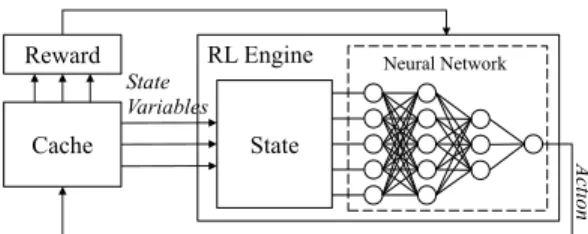
Figure 3 illustrates how deep Q-learning is solving our cache decision problem. At each time bint, the cache node monitors the current states(t)of the system. When a request
q(t)is observed at the cache node, the RL Engine feeds the current states(t)into a neural network to generate an action
a(t). Further, according to the states(t)and the actiona(t), the state will be pushed to the next states(t+ 1). When the next request arrives, the reward r(t) of the previous action
Cache RL Engine Action State Variables State
Reward Neural Network
Fig. 3. Reinforcement learning mechanism of DeepChunk decision making.
a(t) can be observed, further fed back to train the neural network.
To dynamically improve the reward, Q-values for each state-action pair are maintained to represent the potential reward of decisions. The Q-values are updated by the imme-diate reward, and an expected optimal future reward which is discounted by a factorγ,(0≤γ≤1):
Q(s(t), a(t)) =r(t) +γmax
a Q(s(t+ 1), a). (4) To maintain a large system state space, an artificial neural network is utilized. At time t, the detected state s(t) are sent into the neural network as the input. After the process in hidden layers, the Q-values for all possible actions are observed at the output layer. The decision making policy follows the Epsilon Greedy scheme: with probability , the agent will choose the action that results in the highest Q-value, otherwise, select a random action with equal probabil-ity. Thereduces linearly from1to0.1over iterations, thus the agent starts with an aggressive exploring behavior, then tends to utilize the learned experience over time.
After the action is selected, according to the corresponding rewardr(t), the Q-value is updated with a learning rateβ:
(5)
Q0(s(t), a(t))←(1−β)Q(s(t), a(t)) +β[r(t) +γmax
a Q(s(t+ 1), a)]. Similar to, the learning rate β is also reduced linearly. B. Reward, States, and Actions
To use deep Q-learning for decision making, we define the three crucial elements - state, action and reward - as follows:
1) Reward: We consider both data processing and network performance to be optimized as the reward. As mentioned in Section II, chunk hit ratio, processing stall time and object download timeare defined as the reward variables. We apply three weight factorsα1,α2andα3to adjust the importances of the three reward variables. Thus, the immediate reward is defined as:
r=α1h−α2Ts−α3Td. (6) Note that when the algorithm is running, all three objec-tives –h,Ts,Td – can be measured from the cache node or the data processing units, while Equations (2) and (3) can be
utilized to pre-train the neural network from zero knowledge, to improve the speed of convergence.
2) States: The state variables should reflect the system status, further affect the reward feedback of different actions. We measure the system state in our caching model as a five-tuple:(−→p ,−→n ,−→c ,−→o , f).
Specifically, −→p denotes the popularity distribution over all objects. In practical networks, the popularity of objects are changing over time. In order to adapt to the latest popu-larities, instead of using a static distribution, we maintain a sliding window to monitor popularities of all objects during the pastnrequests.
wp= [f(t−n+ 1), f(t−n+ 2), ..., f(t)]. (7) Similarly, the network condition history −→n is computed through another sliding window to track the time-varying bandwidth of wireless channel:
wn= [b(t−n+ 1), b(t−n+ 2), ..., b(t)], (8) The currently cached chunks for all objects are denoted by −→c. These state variables are utilized to determine how data chunks in the cache are updated, in order to optimize the re-ward. Theorderof requested objects is expressed by an array −→o. In our DeepChunk policy, we make decisions to replace the least-recently-used object chunks by new chunks. This state variable will indicate chunks from which object/objects will be removed when making decisions. Finally, f denotes the currently requested object. As we designed, only this object will be cached in the same time iteration. Decisions will result in differentc[f]in the next time bin.
All the elements in this four-tuple can be obtained at the cache node when a request arrives. For cache decision, the four-tuple is pushed into the input layer of the neural network.
3) Actions: Current RL applications can have a large state space, but it is not well scalable with action. So, we define an unsophisticated action to fit our problem to this feature. The actiona(t)representsthe number of chunks of the requested objectf to be added to the cache. When the action is made,
Ec additional chunks of objectf will be stored in the cache storage. When the cache storage is full, chunks from the LRU objects will be removed.
IV. IMPLEMENTATION
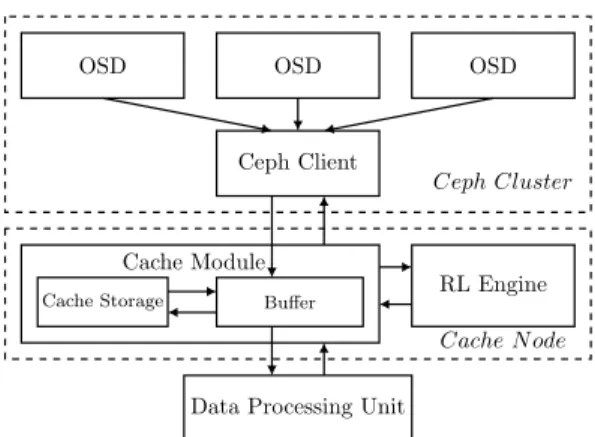
In this section, we will describe the prototype implemen-tation details. In specific, we will discuss the DPN setup in terms of the following aspects: data source, cache node, data processing unit, and the links between nodes. The system diagram is depicted in Figure 4.
When initiated, the Tornado servers in the Ceph client and the cache module, and the state listener in the RL Engine are activated. The data processing unit generates a random integer following Zipf distribution and decides which object to be requested according to the Zipf seed. Then a request of the object is sent to the cache module.
OSD OSD OSD
Ceph Client
Ceph Cluster
Cache Module
RL Engine Cache Storage Buffer
Cache N ode
Data Processing Unit
Fig. 4. Implemented DPN diagram.
The cache module maintains awareness of cache status real-timely. Once the new request is detected, it is able to build up the system state by cache storage status (cached chunks of all objects), updated request history, and the currently requested object. We denote this state as s(t) for clearer demonstration. s(t) is further pushed to the RL Engine via a UDP message. Then, the action listener is activated.
The RL Engine captures state message by the state listener and makes an actiona(t)based on previously trained neural network. The RL Engine then sendsa(t)to the cache module through a UDP message and starts to listen for the reward.
The cache module obtains the action message a(t), and begins the data flushing process. It first reads all cached chunks of the requested object to its buffer, then sends a request for the missing chunks from its Tornado client to the server in Ceph cluster.
At the Ceph cluster, the chunks stored in Ceph OSDs are fetched as the response data. When sending the response, the Tornado server will flush the chunks into the network interface one by one to achieve a streaming feature.
The cache module starts two threads simultaneously. The fetching thread pushes the fetched bytes into the buffer. It is also responsible to write a part of the chunks into files according to a(t), and further store them into the cache storage. The flushing thread keeps flushing the existing bytes in the buffer to the network interface. When the buffer is empty, it waits for the fetching thread until another chunk is ready in the buffer. After all chunks are fetched and flushed, the connection finishes. Then, the reward listener enters standby mode.
The data processing unit receives the data stream. A timer will measure the download time from the moment when the request is sent, to the moment when the connection is finished. By subtracting the preset initial wait time and processing time, it obtains the processing stall time. A UDP message carrying stall time and download time is reported to the cache module.
The reward value is calculated at the cache module. Note that three terms: chunk hit ratio, processing stall time, and
total delay. The chunk hit ratio is obtained from the cache status which can be found ins(t). Further, the rewardr(t−1) is sent to the RL Engine.
At the RL Engine, r(t) is utilized to train the neural network. In our deep Q-Learning algorithm, the reward
r(t−1) is correlated with the previous state and action,
s(t−1)anda(t−1). After the whole process is complete, the data processing unit loops.
V. EVALUATION
In this section, we present our evaluation results based on the experimental setup described in the last section.
We fully implement the prototype. We utilize the Linux TC traffic control feature [12] to throttle the bandwidth between the user client and the cache node to 5MB/s, while the link between the cache node and the cloud server node is 1MB/s. The tested files consist of multiple chunks, where each chunk is 1MB. Further, the processing speed of the files is divided into two groups – 1 MB/s and 3 MB/s – to represent different data processing applications. We gener-ate file popularities using Zipf’s distribution [31] with the parameter z = 1. We sort the files by their sizes as the popularity ranks. In general, the file sizes and the popularities are dependent on each other. We consider both positive and negative correlation between the file size and the popularity. In positive correlation, larger file sizes have higher popularity and the reverse holds for negative correlation. The popularity numbers are taken as the arrival rates of the requests at the user client.
Based to the range of the reward variables, we set α1,
α2, and α3 in (6) as 10, 10, and 1, respectively. Under this reward setting, increasing the hit ratio of an object by 10%, decreasing the processing stall time by 1 second, and decreasing the total download time by 2 seconds are considered the same amount of contribution.
A. Baseline Caching Policies
We compare the proposed DeepChunk policy with four baseline strategies, as described below.
No Cache: This caching policy does not store anything in the cache.
LRU: The LRU caching policy [32] moves the requested file to the head of the cache, if already in the cache. If it is not in the cache, the file is added to the head of the cache and the files are removed from the tail to make space for the incoming file. Due to different file sizes, multiple files can be evicted to make space of a large incoming file.
kLRU: Instead of caching every missed request, kLRU [33], [9] deployskvirtual LRU caches ahead of the physical LRU cache to achieve a selective caching scheme. The virtual caches cache only file pointers instead of the data. A virtual/physical cache will store the pointer/data only if there is a hit in the LRU cache ahead of it, and replace the object following the LRU policy. In our experiments, two kLRU policies are tested. kLRU-1 and kLRU-2 policies apply 1 and 2 virtual caches ahead of their physical cache, respectively.
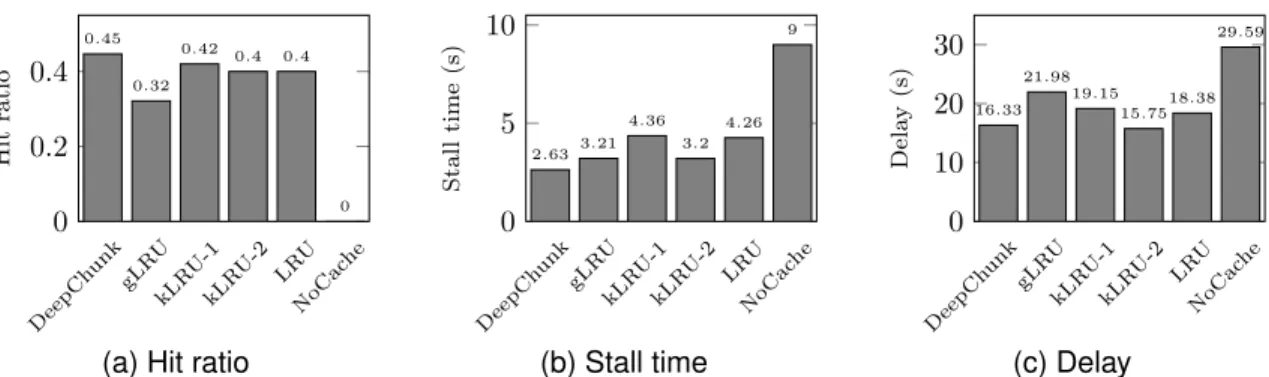
DeepCh unk gLR U kLR U-1 kLR U-2 LRU NoCac he 0 0.2 0.4 0.45 0.32 0.42 0.4 0.4 0 Hit ratio
(a) Hit ratio
DeepCh unk gLR U kLR U-1 kLR U-2 LRU NoCac he 0 5 10 2.63 3.21 4.36 3.2 4.26 9 Stall time (s) (b) Stall time DeepCh unk gLR U kLR U-1 kLR U-2 LRU NoCac he 0 10 20 30 16.33 21.98 19.15 15.75 18.38 29.59 Dela y (s) (c) Delay
Fig. 5. Reward breakdown for different policies. Cache capability is 80 chunks, file popularity and size are positively correlated.
gLRU: Distinct from the previous policies, the generalized LRU [15] extends the LRU caching algorithm from file-level to a chunk-level algorithm. Upon a request arrival, if the requested file is not completely in the cache, one additional chunk of that file will be stored. When the cache storage is full, one chunk of the LRU object will be replaced. Further, all chunks of the requested file will be moved to the head of the cache (in order, such that the earlier chunks are towards the head so that they are evicted later).
B. Evaluation Results
TABLE I
REWARD SUMMARY FOR POLICIES IN DIFFERENT POPULARITY AND CACHE SIZE SETTINGS.
Policy
Reward
Positive correlation, Negative correlation, cache size = 80 cache size = 40
DeepChunk -38.1650385015 -9.4738189784 gLRU -50.824600919 -12.6091608098 kLRU-1 -58.5616000914 -9.8270152744 kLRU-2 -43.7540371966 -15.4748794595 LRU -56.9513351377 -16.6214642859 No cache -119.5670992208 -27.7861073589
As seen in Table I, DeepChunk policy improves the total reward by 12.77 - 34.83% from other caching algorithms. The chunk-level gLRU policy has16.16%lower reward than kLRU-2, which indicates that without optimizing the chunk cache decision, chunk-level policies do not always gain a better performance than file-level schemes in a data streaming scenario.
Figure 5 shows the reward breakdown when popularities and file sizes are positively correlated, and the cache size is set to 80 chunks. From the figure, we observe that our DeepChunk policy outperforms all other policies in terms of both the chunk hit ratio and the processing stall time. As compared to the file-level policies, our improvements are up to11.71%and39.70%, respectively. Since the reward weight of response delay is set low, DeepChunk policy has a slightly higher delay than kLRU-2 while being better in the other two metrics. As compared with the other chunk-level policy gLRU, DeepChunk is better for all three reward factors. We note that one of the down-sides of gLRU is that it takes a long time to fill the cache since only one chunk is added for each request. This startup phase is alleviated in other schemes,
−200 −150 −100 −50 0 Rew ard 0 0.1 0.2 0.3 0.4 0.5 0.6 0.7 0 20 40 Hit ratio Time Reward Stall time Download time
Fig. 6. Reinforcement learning mechanism of DeepChunk decision making.
File 1 File 2 File 3 File 4 File 5 0 5 10 15 Stall Time (s) DeepChunk LRU
(a) Stall time
File 1 File 2 File 3 File 4 File 5 0 0.1 0.2 0.3 Hit Ratio DeepChunk LRU (b) Hit ratio Fig. 7. Reward breakdown for different files.
including ours, which helps provide improved gains as the system evolves or when the popularities of contents change. This phase makes the rewards of the gLRU conservative, while this issue is alleviated with the proposed DeepChunk policy.
Figure 6 describes the importance of cache chunk decision optimization. We run the DeepChunk policy at the cache node with an empty cache storage, while a file with 40 chunks is repeatedly requested. As the time evolves, the chunk hit ratio of individual requests will grow from 0 to 1 linearly. The x-axis in the figure is marked by the chunk hit ratio of the request. As it grows, the download time decreases linearly. However, with the chunk hit ratio at 0.4 (iteration 10), the stall time hits 0 which is its minimum. Thus at this state, caching more chunks of this file will no longer gain rewards from the stall time, which has a heavy weight. The reward curve shows the same information, the growth slows down
after the 10th iteration. Since DeepChunk is a state-aware policy, it tends to cache fewer chunks to save cache space for other files when the stall time can no longer be improved. We extract the reward variables for individual files while running the experiments. In Figure 7, we compare the average stall time and chunk hit ratio for each file when different caching policies are applied. According to Figure 7 (a), the five files shown experience similar stall time under the DeepChunk policy. The standard deviation is 0.268, that is lower than LRU’s standard deviation which is 2.189. As depicted in Figure 7 (b), although chunk hit ratio is not the largest weighted term in the reward function, DeepChunk still has a lower standard deviation (0.074) as compared to LRU (0.104). We can conclude that under the DeepChunk policy, more space is saved to reduce the overall stall time among all files.
VI. CONCLUSION
We propose DeepChunk to leverage powerful Q-learning to make chunk-based cache update decisions on the fly in Data Processing Networks, and to jointly optimize both net-work performance and data processing objectives, including the chunk hit ratio, processing stall time, and object download time. Our prototype using Ceph demonstrates significant improvement, i.e.,43%in total reward and39%in processing stall time, over a number of baseline caching policies, as well as DeepChunk’s ability to adapt to time-varying workload and network conditions. As a future research, we plan to incorporate other metrics such as the Age of Information into DeepChunk and investigate the performance of DeepChunk in a setting with network of caches.
REFERENCES
[1] M. D. de Assunc¸˜ao, A. D. S. Veith, and R. Buyya, “Distributed data stream processing and edge computing: A survey on resource elasticity and future directions,”J. Network and Computer Applications, vol. 103, pp. 1–17, 2018.
[2] T. Li, Z. Xu, J. Tang, and Y. Wang, “Model-free control for distributed stream data processing using deep reinforcement learning,”CoRR, vol. abs/1803.01016, 2018.
[3] A. Elgabli, V. Aggarwal, S. Hao, F. Qian, and S. Sen, “Lbp: Robust rate adaptation algorithm for svc video streaming,”IEEE/ACM Trans-actions on Networking, vol. 26, no. 4, pp. 1633–1645, 2018. [4] D. Jiang, B. C. Ooi, L. Shi, and S. Wu, “The performance of
mapreduce: An in-depth study,”Proceedings of the VLDB Endowment, vol. 3.
[5] N. Alliance, “5g white paper,”Next generation mobile networks, white paper, pp. 1–125, 2015.
[6] Youtube help. https://support.google.com/youtube/answer/1722171. [7] Y. Kim and I. Yeom, “Performance analysis of in-network caching
for content-centric networking,”Comput. Netw., vol. 57, no. 13, pp. 2465–2482, Sep. 2013.
[8] D. K. Krishnappa, S. Khemmarat, L. Gao, and M. Zink, “On the feasi-bility of prefetching and caching for online tv services: a measurement study on hulu,” in International Conference on Passive and Active Network Measurement. Springer, 2011, pp. 72–80.
[9] D. Shasha and T. Johnson, “2q: A low overhead high performance buffer management replacement algoritm,” inVLDB, 1994, pp. 439– 450.
[10] V. Mnih, K. Kavukcuoglu, D. Silver, A. Graves, I. Antonoglou, D. Wierstra, and M. Riedmiller, “Playing atari with deep reinforcement learning,”arXiv preprint arXiv:1312.5602, 2013.
[11] Ceph. https://ceph.com/.
[12] B. Hubertet al., “Linux advanced routing & traffic control howto,” Netherlabs BV, vol. 1, 2002.
[13] H. Che, Y. Tung, and Z. Wang, “Hierarchical web caching systems: Modeling, design and experimental results,”IEEE Journal on Selected Areas in Communications, vol. 20, no. 7, pp. 1305–1314, 2002. [14] D. S. Berger, R. K. Sitaraman, and M. Harchol-Balter, “Adaptsize:
Orchestrating the hot object memory cache in a content delivery network.” inNSDI, 2017, pp. 483–498.
[15] E. Friedlander and V. Aggarwal, “Generalization of lru cache replace-ment policy with applications to video streaming,”ACM Transactions on Modeling and Performance Evaluation of Computing Systems (TOMPECS), vol. 4, no. 3, p. 18, 2019.
[16] H. Ahlehagh and S. Dey, “Hierarchical video caching in wireless cloud: Approaches and algorithms,” in ICC 2012. IEEE, 2012, pp. 7082– 7087.
[17] E. Bas¸tu˘g, M. Bennis, and M. Debbah, “Living on the edge: The role of proactive caching in 5g wireless networks,” arXiv preprint arXiv:1405.5974, 2014.
[18] S. Sivasubramanian, G. Pierre, M. Van Steen, and G. Alonso, “Analysis of caching and replication strategies for web applications,” IEEE Internet Computing, vol. 11, no. 1, 2007.
[19] Y. Zhao, J. Wu, and C. Liu, “Dache: A data aware caching for big-data applications using the mapreduce framework,” Tsinghua science and technology, vol. 19, no. 1, pp. 39–50, 2014.
[20] V. Aggarwal, Y.-F. R. Chen, T. Lan, and Y. Xiang, “Sprout: A functional caching approach to minimize service latency in erasure-coded storage,”IEEE/ACM Transactions on Networking, vol. 25, no. 6, pp. 3683–3694, 2017.
[21] T. Luo, V. Aggarwal, and B. Peleato, “Coded caching with distributed storage,”IEEE Transactions on Information Theory, pp. 1–1, 2019. [22] A. Al-Abbasi, V. Aggarwal, T. Lan, Y. Xiang, M.-R. Ra, and Y.-F.
Chen, “Fasttrack: Minimizing stalls for cdn-based over-the-top video streaming systems,”IEEE Transactions on Cloud Computing, 2019. [23] A. O. Al-Abbasi, V. Aggarwal, and M.-R. Ra, “Multi-tier caching
anal-ysis in cdn-based over-the-top video streaming systems,”IEEE/ACM Transactions on Networking (TON), vol. 27, no. 2, pp. 835–847, 2019. [24] Z. Xu, J. Tang, J. Meng, W. Zhang, Y. Wang, C. H. Liu, and D. Yang, “Experience-driven networking: A deep reinforcement learning based approach,”arXiv preprint arXiv:1801.05757, 2018.
[25] H. Mao, R. Netravali, and M. Alizadeh, “Neural adaptive video streaming with pensieve,” inSIGCOMM. ACM, 2017, pp. 197–210. [26] G. Alnwaimi, S. Vahid, and K. Moessner, “Dynamic heterogeneous learning games for opportunistic access in lte-based macro/femtocell deployments,” IEEE Transactions on Wireless Communications, vol. 14, no. 4, pp. 2294–2308, 2015.
[27] A. O. Al-Abbasi, A. Ghosh, and V. Aggarwal, “Deeppool: Distributed model-free algorithm for ride-sharing using deep reinforcement learn-ing,”IEEE Transactions on Intelligent Transportation Systems, pp. 1– 14, 2019.
[28] O. Onireti, A. Zoha, J. Moysen, A. Imran, L. Giupponi, M. A. Imran, and A. Abu-Dayya, “A cell outage management framework for dense heterogeneous networks,”IEEE Transactions on Vehicular Technology, vol. 65, no. 4, pp. 2097–2113, 2016.
[29] Y. Wang, Y. Li, and T. Lan, “Capitalizing on the promise of ad prefetching in real-world mobile systems,” in2017 IEEE 14th Inter-national Conference on Mobile Ad Hoc and Sensor Systems (MASS). IEEE, 2017, pp. 162–170.
[30] A. Ghosh, V. Aggarwal, and F. Qian, “A rate adaptation algo-rithm for tile-based 360-degree video streaming,” arXiv preprint arXiv:1704.08215, 2017.
[31] L. A. Adamic and B. A. Huberman, “Zipf’s law and the internet.” Glottometrics, vol. 3, no. 1, pp. 143–150, 2002.
[32] A. V. Aho, P. J. Denning, and J. D. Ullman, “Principles of optimal page replacement,”JACM, vol. 18, no. 1, pp. 80–93, 1971.
[33] M. Garetto, E. Leonardi, and V. Martina, “A unified approach to the performance analysis of caching systems,” ACM TOMPECS, vol. 1, no. 3, p. 12, 2016.