University of Huddersfield Repository
Ibrahim, OlaThe Implications of Applying Total Quality Management (TQM) On E-Learning in Egypt. “Suggested E-Learning Service Quality Model”
Original Citation
Ibrahim, Ola (2015) The Implications of Applying Total Quality Management (TQM) On E-Learning in Egypt. “Suggested E-E-Learning Service Quality Model”. Doctoral thesis, University of Huddersfield.
This version is available at http://eprints.hud.ac.uk/26437/
The University Repository is a digital collection of the research output of the University, available on Open Access. Copyright and Moral Rights for the items on this site are retained by the individual author and/or other copyright owners. Users may access full items free of charge; copies of full text items generally can be reproduced, displayed or performed and given to third parties in any format or medium for personal research or study, educational or not-for-profit purposes without prior permission or charge, provided:
• The authors, title and full bibliographic details is credited in any copy; • A hyperlink and/or URL is included for the original metadata page; and • The content is not changed in any way.
For more information, including our policy and submission procedure, please contact the Repository Team at: [email protected].
1
University of Huddersfield
The Implications of Applying Total Quality Management (TQM)
On E-Learning in Egypt
“Suggested E-Learning Service Quality Model”
A Thesis submitted in partial fulfilment of the requirements Of the Doctorate Degree of Philosophy in Quality Management
School of Business September 2015
Ola Abdel Moneim Moustafa Mohamed Ibrahim
Supervisor: Dr. R. Rollins Co-supervisor: Dr. G.Worsdale
2
Abstract
Egypt is seeking to accelerate comprehensive and sustainable development and to achieve higher growth rates for the interest of all classes and categories of society. According to what was published in 1/7/2013 by the public association for adult education AEA at the information and decision support centre in Egypt; 14.9% of population in age between 15 and 35 years old are illiterate. Here, we have to ask:" How a society where 14.9% of its young working power is illiterate can execute the mentioned adopted strategy of development?!"The Egyptian young working power is poor educated due to the bad education system ranking 131 out of 144 in the world. There is a need for a good High Educational system, affordable to those who does not have the opportunity to leave there jobs, from where they gain to live, in order to have a good education to improve their social life, and help them being part of the required development. Making benefit from the technological revolution and the excitement and passion of using it, can give the chance to offer an E-learning service through which a human development could be achieved. Then, strategies could be well adopted to improve society. In Organizations; Total Quality Management (TQM) has become most widely used management acronym and is considered as the buzz word in the management practices, keeping an eye on details. TQM is mainly concerned with continuous improvement in all work, from high level strategic planning and decision-making, to detailed execution of work elements on the shop floor. On the other hand, Enterprises find ways to set themselves apart in the hyper-competitive global marketplace by applying e-service. E-Service may provide the greatest return on investment (ROI) and sets the foundation for adding and integrating other E-Business functionality in the future. Customers can achieve the service through web page without a need to any help or support at any time. E-service and Total quality management (TQM) seek for same goals, but from different perspectives. Now, what if an organisation offers an E-service while applying Total quality management (TQM)? Hoping to achieve a good affordable High educational E-learning system, it was decided to study “The Implications of applying TQM on E-Learning in Egypt”. This is for the great impact of the learning quality on the education as main national issue in Egypt. E-Learning was implemented in the near past few years, through limited programs in national Universities, and the Egyptian E-learning University established in 2009. The Quality management were also taken as essential of management in the higher educational institutes there. This research take a track to suggest Total Quality management Model to improve E-learning service offered in one of the Higher Educational Institutes in Egypt. The suggested e-learning Model emphasize that the eight elements of TQM were engaged in the Baldrige criteria framework. Quality Function Deployment (QFD) the main tool of evaluation of all the processes. The Idea of this model is to use Quality function Deployment (QFD) to translate and plan the‖ voice of the customer‖ into the quality characteristique of the service before enter the market. QFD analyse the client‘s requirements,define how each requirement will be satisfied by the service,organize the needs,illustrate the relationship between the requirement of the customer in the market and the needs to fullfil them. The result will be transmitted to the leadership Management,who will deploy the quality ,and apply the eight Total Quality Management Principles going through the seven categories of the Baldrige Criteria. The result of all the model phases shall affect the learner through the afforded high quality E-learning service. The high qualified personnel educated through the high quality E-learning system, will affect the social culture and environment from where comes the ―voice of cutomer‖, to be analyzed through the QFD, to the leadership management, and the improvement cycle continue.The suggested E-learning service Quality Model represents required emerged recognised set of procedures for validation of quality framework.
3
Copyright Statement
i. The author of this thesis (including any appendices and/or schedules to this thesis) owns any copyright in it (the ―Copyright‖) and she has given The University of Huddersfield the right to use such copyright for any administrative, promotional, educational and /or teaching purposes.
ii. Copies of this thesis, either in full or in extracts, may be made only in accordance with the regulations of the University Library. Details of these regulations may be obtained from the Librarian. This page must form part of any such copies made. iii. The ownership of any patents, designs, trademarks and any and all other intellectual
property rights except for the copyright (the ―Intellectual Property Rights‖) and any reproductions of copyright works, for example graphs and tables (―Reproductions‖), which may be described in this thesis, may not be owned by the author and may be owned by third parties. Such Intellectual Property Rights and Reproductions cannot and must not be made available for use without the prior written permission of the owner(s) of the relevant Intellectual Property Rights and / or Reproductions.
4
Dedication
To the soul of my beloved mother, who started this trip with me, but couldn‘t stand to the end. She always wanted to see me achieving my goals; I wish she can see me from heaven.
To my dear father who always waited for my success, and to my beautiful daughters who are always taking me as a role model.
5
Acknowledgments
First, I want to thank GOD for his blessings, and for giving me wonderful family whose love, encouragement and support have been my source of inspiration. I am eternally grateful to all of them for the sacrifices that drive me to this important occasion.
I would like to express my heart- felt thanks to my supervisors, “Prof. Ralph Rollins‖ and ―Prof. Graham Worsdale‖, whose insights and invaluable advice have helped me arrive at this important milestone.
Also, I express my deepest gratitude to all the staff of the Arab Academy for Science , Technology and Maritime Transport, Specially Prof. “Ismail Abdel Ghaffar Ismail Farag”, the president of the AASTMT, for the zealous support throughout the duration of this study.
And I can‘t forget to express my sincere recognition for all my colleagues and professors who gave me the support till this precious moment in which I achieve my first step in a new track.
6
Table of Contents
Items Titles Pages
Chapter One
Overview
1.1 Introduction 16
1.1.1 Personal Background to the study 17
1.1.2 Researcher Interest in TQM and E-learning 17
1.2 Research problem 18
1.3 Field of Study 18
1.3.1 Social field 18
1.3.2 Educational field 20
1.3.2.1 Higher Education in Egypt 20
1.3.2.2 Total Quality Management in Egypt 22
1.3.2.3 Culture in High Education in Egypt with reference to both public and private Universities 23 1.4 Research objectives 24 1.5 Research questions 24 1.6 Hypothesis 25 1.7 Research methods 26 1.8 Plan of study 27
1.8.1 Quality function deployment 29
1.8.2 The rationale for the study 30
1.9 Research structure 31
1.10 References and sources 31
Chapter Two
Literature Review
2.1 Introduction 32
2.2 E-learning quality 33
2.3 Higher education and E-learning 42
2.4 Total Quality Management(TQM) and continuous improvement 45
2.5 E-learning and quality circle 50
7
Items Titles Pages
2.5.2 Distance learning 51
2.5.3 E-learning system quality 54
2.5.4 A quality circle 56
2.5.4.1 Learning stages versus quality circle 56
2.5.4.2 The different objectives of the quality circle 57
2.5.5 E-learning in higher education in Egypt 58
2.5.5.1 National E- learning Centre 59
2.5.5.2 Enabling E-learning in Higher education 60
2.5.5.3 Improving Faculties of Education 61
2.5.5.4 Exposing Students to Advanced ICT Tools 61
2.5.5.5 Enhancing ICT Infrastructure in Higher Education 61
2.5.5.6 Track Events 62
2.5.5.7 Egyptian E-learning University (EELU) 62
2.5.5.8 Other Relevant Initiatives 62
2.6 Perspectives of E- learning Quality from 2004 to 2012 64
2.7 E-learning Benchmark And Quality function deployment role 74 2.7.1 Benchmarking E- learning and Chinese standard system 74
2.7.2 Quality function deployment role 77
2.7.3 Between learning system technology architecture and quality function deployment. 80 2.8 Summary 81 Chapter Three Research methodology 3.1 Introduction 82 3.2 Philosophies 82 3.3 Approaches 93 3.4 Strategies 95 3.5 Choices 99 3.6 Time horizons 100
8
Items Titles Pages
3.8 Chosen Approach and alternative research strategies 104
Chapter Four
E-Learning in Egypt
4.1 Introduction 117
4.2 Pilot Survey 117
4.3 Experience of offering Online course at University of Nottingham (UoN) 119
4.4 Case study 121
4.4.1 Overview 121
4.4.2 Population 122
4.4.2.1 Distribution of Students in Campuses and Branches 123
4.4.2.2 Distribution of Students in Colleges 123
4.4.2.3 Use of E-learning in Colleges 125
4.4.2.3.1 Variation of number of students in College of Business Administration- Heliopolis
125 4.4.2.3.2 Faculty members at the College of Business Administration-Heliopolis 127
4.4.3 Data Collection Method 128
4.4.4 Questionnaires
129
4.4.4.1 Questionnaire Design 129
4.4.4.2 Validity 130
4.4.4.3 Reliability 131
4.5 Case Selection and Sampling 132
4.6 Statistical Tools 133
4.7 Instructors Satisfaction from e- learning before Improvement 134 4-8 Student Satisfaction from Online Courses before Improvement 138 4-8-1 Student Satisfaction on Learner Contents before Improvement 139 4-8-1-1 Analysis of qualitative data of Contents before Improvement 139 4-8-1-2 Analysis of Quantitative data of Contents before Improvement 141
Chapter Four E-Learning in Egypt
4.8.2 Student Satisfaction on Learner – Instructor before Improvement 144 4.8.2.1 Analysis of qualitative data of Learner Instructor before Improvement 144 4.8.2.2 Analysis of Quantitative data of Learner Instructor before Improvement 145
9
Items Titles Pages
4.8.3 Student Satisfaction on Learner – Learner before Improvement 149 4.8.4 Student Satisfaction on Learner – Technology before Improvement 150 4.8.5 Student Satisfaction on General Satisfaction before Improvement 153
4.9 Summary 154
Chapter Five
Suggested Model for E-learning Quality
service
5.1 Introduction 155
5.2 The elements of quality 156
5.3 Baldrige criteria framework 156
5.4 Quality Function deployment system 158
5.5 The suggested E-learning Model 169
5.5.1 General explanation of the E-learning process Model 172
5.6 Cost of the suggested model 172
5.6.1 Pricing educational programs 172
5.6.2 Cost of online program 175
5.7 Implementation of the suggested E-learning process 176
5.7.1 Instructors Satisfaction from e- learning after Improvement 180 5.7.2 Students Satisfaction from Online Courses after Improvement 186 5.7.2.1 Student Satisfaction on Learner Contents after Improvement 188 5.7.2.1.1 Analysis of qualitative data of Contents after Improvement 188 5.7.2.1.2 Analysis of Quantitative data of Contents after Improvement 189 5.7.3 Students Satisfaction on Learner – Instructor after Improvement 193 5.7.3.1 Analysis of qualitative data of Learner Instructor after Improvement 193 5.7.3.2 Analysis of Quantitative data of Learner Instructor after Improvement 194 5.7.4 Students Satisfaction on Learner – Learner after Improvement 198
5.7.5 Students Satisfaction on Learner Technology after Improvement
199
5.7.6 Students Satisfaction on General Satisfaction after Improvement 203
10
Items Titles Pages
Chapter six Conclusions and Recommendations
6.1Introduction 206
6.2 Achievement of research objectives 206
6.3 Research approach results 207
6.4 Summary of the work done, Emphasising the contributionto knowledge 211
6.5 The lessons learned from this experience 212
6.6 Lessons from undertaking research 212
6.7 The possible limitation of the work 212
6.8 Recommendations 212
6.9 Future areas of research 213
References References 213
Appendix A A pilot Survey 220
Appendix B E- Learning Pivot table of a pilot survey about Applying TQM and E- Learning in Egypt
222
Appendix C Questionnaires Evaluation of Instructors for work at E-Learning Program 226 Appendix D Questionnaires to measure Students Satisfaction from online courses 231
Appendix E Quality Management System Manual for E-Learning program 241
List of Figures
Items Titles Pages
(Figure 1-1) Suggested theoretical model of TQM implementation and overall High Educational Institute performance
26
(Figure 2-1) Baldrige Leadership flow 47
(Figure 2-2) Baldrige Model 48
(Figure 2-3) Principles of TQM 50
(Figure 2-4) E- Learning 3P Model 53
(Figure 2-5) Learning and Teaching issues in 53
(Figure 2-6) Virtual learning environment 55
(Figure 2-7) E-learning Stages versus Quality circle 56
11
(Figure 2-9) challenges meet Higher Education in Egypt 58
(Figure 2-10) 8 Egyptian higher education institutions had computer labs and Internet access in 2008 60 (Figure 2-11) A graph of the number of electronic courses produced for the Undergraduate and
postgraduate stages
63
(Figure 2-12) Learning Technology Systems Architecture from IEEE 76
(Figure 2-13) House of Quality 77
(Figure 2-14) Non-functional Requirements Representation scheme to Architecture 79 (Figure 2-15) merge between Learning system technology architecture and QFD 80
(Figure 3-1) The implementation cycle of the suggested model 113
(Figure 4-1) Respondents‘ ratings of their online learning experience 120
(Figure 4-2) Number of students that would take UoN course taught entirely online 121
(Figure 4-3) Announcement of E-learning system at AASTMT in 2009 122
(Figure 4-4) Variation in number of students at the College of Business Administration in Heliopolis the first semester in four years
126 (Figure 4-5) Variation in number of students at the College of Business Administration in Heliopolis the
second semester in four years
126
(Figure 4-6) four sources of error in social survey research 129
(Figure 5-1) TQM Key Elements 156
(Figure 5-2) Baldrige Criteria 157
(Figure 5-3) Baldrige core categories 158
(Figure 5-4) Quality Lever 160
(Figure 5-5) QFD Technique 160
(Figure 5-6) series of matrices of House of Quality 161
(Figure 5-7) Kano Model 163
(Figure 5-8) The Suggested E-learning Model 170
(Figure 5-9)
The suggested E-learning Process
171 (Figure 5-10) Graph of competitive analysis using the House of Quality to benchmark the instructor‘s
evaluation
178
(Figure 5-11) Graph of competitive analysis using the House of Quality to benchmark the students satisfaction
179
(Figure 5-12) Graph of competitive analysis using the House of Quality to benchmark the instructor‘s evaluation after improvement
181
(Figure 5-13) Graph of competitive analysis using the House of Quality to benchmark the students satisfaction after improvement
12
List of Tables
Items Titles Pages
(Table 1-1) The main dimensions of E-learning service quality 28
(Table 4-1) Results of Pilot Survey 118
Table (4.2) Distribution of students among AASTMT Campuses and Branches 123 Table (4-3) Number of students in colleges by semester from 2010 till 2014 123
Table (4-4) Number of students in each college by semester 124
Table (4-5) Distribution of students at South Valley Campus in colleges by semester 125 Table (4-6) Distribution of Faculty Members in Cairo Campus in colleges 127
Table (4-7) Cronbach‘s alpha for constructs of the two questionnaires 132
Table (4-8) Satisfaction of instructors work at e- learning program before Improvement 135 Table (4-9) 1 Sample-T for instructors satisfaction for current work at e- learning program 136
Table (4-10) 1 Sample-T for elements of instructor's satisfaction 137
Table (4-11) perceived student satisfaction for qualitative data of Learner Contents from Online Courses before Improvement
140
Table (4-12) Results of 1 Sample-P test for perceived student satisfaction for qualitative data of Learne Contents from Online Courses before Improvement
141
Table (4-13) Overall student‘s satisfaction from content of e- learning program before improvement
141
Table (4-14) 1 Sample-T for Student's perceived answers and their expectations at e- learning program 142
Table (4-15) 1 Sample-T for elements of student‘s satisfaction 143
Table (4-16) Perceived answers for students to evaluation of instructor before improvement 144 Table (4-17) Results of 1 Sample-P test for Evaluation of learner-instructor dimension before
improvement
145
Table (4-18) Overall Student‘s satisfaction from Instructors in online program before improvement 146 Table (4-19) 1 Sample-T for Overall student‘s satisfaction from e- learning program before improvem 147 Table (4-20) 1 Sample-T for elements of elements of student's satisfaction for Learner Instructor from
Online Courses before Improvement
147
Table (4-21) Perceived answers for students to evaluation objectives of Learner – Learner in online program before improvement
13
Table (4-22) Results of 1 Sample-P test for Evaluation objectives of Learner – Learner in online program before improvement
150
Table (4-23) Overall student‘s satisfaction from technology at e- learning program before improvement
151
Table (4-24) 1 Sample-T for Overall student‘s satisfaction from technology at e- learning program befo improvement
152
Table (4-25) 1 Sample-T for comparison between the answers of students for all statements of Learner Instructor and their expectations
152
Table (4-26) Perceived answers for Student Satisfaction on dimension General Satisfaction from Online Courses
153
Table (4-27) Results of 1 Sample-P test for Evaluation objectives of perceived student satisfaction for qualitative data of General Satisfaction from Online Courses before Improvement
154
Table (5-1) ―What List‖ 162
Table (5-2) House of quality with suppositious customer input and importance weightings 164
Table (5-3) ―HOW?‖ List 165
Table (5-4) Relation matrix 166
Table (5-5) Benchmarking 167
Table (5-6) Weight of the relationship symbols. 167
Table (5-7) Importance level 168
Table (5-8) Correlation matrix 169
Table (5-9) Estimated fixed cost of online program 175
Table (5-10) Estimated variable cost of online program 176
Table (5-11) House of Quality Summary – Instructors evaluation for the work at E-learning program.
179
Table (5-12) House of Quality Summary – Students Satisfaction from online course 180
Table (5-13) Answers of instructor's Satisfaction after improvement 182
Table (5-14) 1 Sample-T for Overall instructors satisfaction 184
Table (5-15) 1 Sample-T for elements of instructor's satisfaction 185
Table (5-16) Answers for 1st part of 1st dimension of Student's Satisfaction (learner Contents) after improvement
188
Table (5-17) Results of 1 Sample-P test for Evaluation objectives of Student's Satisfaction (learner Contents) after improvement
14
Table (5-18) Answers for 2nd part of 1st dimension of Student's Satisfaction (learner Contents) after improvement
190
Table (5-19) 1 Sample-T for Overall of Student's Satisfaction (learner Contents) after improvement 191 Table (5-20) 1 Sample-T for elements of student‘s satisfaction from content of online program after
improvement
192
Table (5-21) Answers for 1st part of 2nd dimension of Student's Satisfaction (Learner Instructor) after improvement
193
Table (5-22) Results of 1 Sample-P test for Evaluation objectives of perceived student satisfaction for Learner Instructor from Online Courses after Improvement
194
Table (5-23) Answers for 2nd part of 2nd dimension of Student's Satisfaction (Learner Instructor) after improvement
195
Table (5-24) 1 Sample-T for Overall Student's Satisfaction (Learner Instructor) after improvement 196 Table (5-25) 1 Sample-T for elements of perceived student satisfaction for Quantitative data of Learner
Instructor from Online Courses after Improvement
197
Table (5-26) Answers 3rd dimension of Student's Satisfaction (Learner – Learner) after improvement 198 Table (5-27) Results of 1 Sample-P test for Evaluation objectives of Student's Satisfaction (Learner –
Learner) after improvement
199
Table (5-28) Answers fourth dimension of Student's Satisfaction (Learner Technology) after improvement
200
Table (5-29) 1 Sample-T for Overall Student's Satisfaction (Learner Technology) at e- learning program after improvement
201
Table (5-30) 1 Sample-T for elements of student's perceived satisfaction and their expectations on the dimension Learner Technology after improvement
202
Table (5-31) Answers fifth dimension of Student's Satisfaction (General Satisfaction) after improvement 203 Table (5-32) (1 P Test) for fifth dimension (General Satisfaction) after Improvement 204
15
List of Publications
# Title of Publication Media of Publication
1 E- Learning and Quality Circle
International Journal of Scientific and Research
Publications, Volume 3, Issue 2, February 2013 1 ISSN 2250-3153 www.ijsrp.org
2
E-learning benchmark and quality function deployment role
Comprehensive Research Journal of Management and Business Studies (CRJMBS) Vol. 1(1) pp. 0013-017 October, 2013
Available online
http://crjournals.org/CRJMBS/Index.htm
Copyright © 2013 Comprehensive Research Journals 3 Total Quality Management (TQM) as addressed by
Researchers
International Journal of Scientific and Research
Publications, Volume 3, Issue 10, October 2013 1 ISSN 2250-3153
4 Suggested Model for E-learning Quality service
Journal of Business Management & Social Sciences Research (JBM&SSR) ISSN No: 2319-5614 Volume 4, No.1, January 2015
© 2012 The Author © Blue Ocean Research Journals 2012
www.borjournals.com Open Access Journals Blue Ocean Research Journals
16
Chapter one
Overview
1.1
Introduction
Total Quality Management is a description of the culture, attitude and organisation of a company or association, that attempts to provide customers with products and services that satisfy their needs (Dahlgaard,Kristinsen and Gopal K. Kanji, 1998). It is a management approach created in the 1950‘s, and has gradually turn out to be more popular since the early 1980‘s (Blackmon, 2005). It becomes the most widely used management acronym, and considered as the buzz word in the management practices. Its culture requires quality in all aspects of operations, with processes being done right the first time, and defects and waste eradicated from operations (Ha shmi, 2010). Total Quality Management is a method by which management and employees can become involved in the continuous improvement of the production of goods and services (Faisal Talib,Zillur Rahman, M. N Qureshi, 2010). It has been well accepted by managers and quality practitioners as a change management quality approach (Arumugam et al., 2009). It plays a vital role in the development of management practices (P rajogo and Sohal, 2003; Hoang et al., 2006). Many researchers asserted TQM as an approach to improve effectiveness, flexibility, and competitiveness of a business to meet customers‘ requirements (Oa kland, 1993), as the source of sustainable competitive advantage for business organisations (Terziovski, 2006), as a source of attaining excellence, creating a right first-time attitude, acquiring efficient business solutions, delighting customers and suppliers etc. (Mohanty and Behera, 1996) and above all as a source of enhancing organisational performance through continuous improvement in organisation‘s activities (Claver-Cortes et al., 2008; Teh et al., 2009). It has been well accepted by managers as the source of sustainable competitive advantage for business organisations (Dahlgaa rd,Kristinsen and Gopal K. Kanji, 1998). Now, with the great rapid improvement of information technology, in a world where many E-business applications are fast becoming commodities, enterprises find ways to set themselves apart in the hyper-competitive global marketplace by applying E-service (Alex Douglas,LindsyMuir and Karon Meehan, 2003). It is in this new arena that real customer loyalty is created (Alex Douglas,LindsyMuir and Karon Meehan, 2003). For many companies, E-service may provide the greatest return on investment (ROI), and sets the foundation for adding and integrating other E-business functionality in the future (Jinli, Establishing Quality Assurance Systems for, 2009).
17
In an E- service solution, Customer entry into service organization is achieved by means of a service web page creating a new level of support, level zero (Manual, 2003). Through the service web page the customer can transact service related issues in a ―self-serve‖ manner. Customer self-service offers a true 24x7 support structure for service transactions and problem resolution. Customer self-service functions include a number of the traditional service functions that are straight forward and efficient; meanwhile The Total Quality Management Process is the attention and control that must be given to all features of a product or service to ensure total customer satisfaction, in addition to the obvious characteristics; such as form, fit, function, and reliability (Baklizi, 2007). The Total Quality Management Process involves maintainability, storability, appearance, ease of application, end use of a product or service, efforts to accomplish error–free documentation and systems, and countless other aspects contributing to the overall value to the internal operations or the external customers (Alex Douglas,LindsyMuir and Karon Meehan, 2003)
1.1.1 Personal Background to the study.
Being the first employee hired at the Cairo Campus of the Arab Academy for Science, Technology and Maritime Transport (AASTMT), made the researcher in the Market of the High Education in Egypt since 1998. She could know the rules followed in Egypt, and how this business is working; its strengths, weaknesses, and opportunities.
1.1.2 Researcher Interest in TQM and E-learning.
TQM was applied at the Arab Academy for Science, Technology and Maritime Transport (AASTMT) since 1996, when the Productivity and Quality Institute has been established. The researcher was the first to work in applying the ISO 9001 requirement in High educational system offered at Cairo Campus. Also, she was from the few employees using the internet and e-mails to correspond with different departments‘ managers to accomplish the work, since she was responsible for managing all the educational and managerial affairs in Cairo Campus during the period from 1998 to 2004. The easiness in using the online correspondence convinced her that E-learning is the promotion of the Higher education system.
18
1.2
Research Problem:-
Between the Total quality Management and the E-service applications, common goals arise. Both seek for improving customer satisfaction, and productivity, through decreasing costs (Faisal Talib,Zillur Rahman, M. N Qureshi, 2010). But, what are the implications of applying Total Quality Management (TQM) on E- service? This is the aim of this research. E- Service is an umbrella term for services on the Internet. It includes E-commerce transaction services for handling online orders, application hosting by application service providers (ASPs) and any processing capability that is obtainable on the Web (Kavous Ardalan and Marist College, 2010). It also includes the ―E-learning‖ service which considered automation perspective of E- services. In this perspective, the E-service shall be labeled as ―online‖ if the processes under the E-service are fully automated (electronically enabled) and require no manual interaction; or, ―partially online‖ if the service requires manual / offline interaction (whether from the service provider or from the end customer) at some point within one or more of the E-services processes (strategy, 2000). E- Learning service becomes a promotion to the next level of education. And it is the education level who improves societies. Therefore, the core of this research is ―The implications of applying Total Quality Management on E-learning in Egypt”.
1.3
Field of study
1.3.1 Social FieldTo conduct a research we should chose a field where results can make difference, and achieve development (Blackmon, 2005). The most communities in need to development are the developing countries. According to the World Bank and IMF-UNDP reports, the human development rank of Egypt, remains low compared to many developing countries, due to the high population rate there. The thing which corrodes efforts made to improve various aspects of human development over the last three decades. Development gains in Egypt vanished, and country's limited resources were put under pressure to provide public health and education for an increasing population. The World Bank and IMF-UNDP published many reports about the human development (HDR). In 1990, the HDR focused on development of the people for the people and by the people. In 1996, the HDR focuses on the theme of poverty, where it concluded that 23% of Egyptians lived below the poverty line. The 1998/99 HDR focuses on education from human development lens. Then, in 2000/01 it was focused on the theme of globalization. It looked at Egypt's position in technology and information-led globalization, human capital issues and environment and
19
sustainable development. The 2002/3 and 2004 focused on the decentralization, and the last Human development report in 2005 proposed to policy makers a new pro-poor growth social contract and a vision for Egypt until 2015. This last report explores alternative scenarios that give numerical and time bound targets to meet the basic requirements and aspirations for Egypt's less privileged for a better life. It proposes and calculates the cost of pro-poor quality education for all, pro-poor health insurance for all, a target social insurance programme, and an integrated package of income transfers and service access for families in extreme poverty (George kossaifi and Halla Shafey, 2006).
A report published in 2008 by the information and decision support centre in Egypt, where it was claimed that Egypt is seeking to accelerate comprehensive and sustainable development and to achieve higher growth rates for the interest of all classes and categories of society. Egypt will adopt a comprehensive strategy for development, focusing on the following:
a- Liberating Egyptian economy, to comply with market mechanisms.
b- Enabling individuals to invest and work and encouraging initiatives and innovations. c- Developing and organizing human resources administration to maximize returns of development.
d- Attracting and employing investments for building the capabilities of material economy. Achieving development and providing job opportunities.
e- Considering the social aspect of transformation and assisting marginal and poor people by society.
f- Ensuring justice and equality for all citizens and providing equal opportunities to all people (making, 2008)
And according to what was published in 1/7/2013 by the public association for adult education AEA at the information and decision support centre in Egypt; (AEA, 2013) 14.9% of population in age between 15 and 35 years old are illiterate. Here, we have to ask:" How a society where 14.9% of its young working power is illiterate can execute the mentioned adopted strategy of development?!"
When thinking about all the previous given data, arise the Idea of having an easy access way of high quality learning, affordable to those who does not have the opportunity to leave there jobs, from where they gain to live, in order to have a good education to improve their social life. Making benefit from the technological revolution and the
20
excitement and passion of using it, can give the chance to offer an E-learning service through which a human development could be achieved. Then, strategies could be well adopted to improve society.
The importance of E-learning in Egypt comes from the fact that, the e-Learning initiative will primarily upgrade the local corporate culture and support the private sector driven economy. It will enhance workforce performance through high quality, practical, state of the art e-Learning and human resources development activities in accordance with the government and business communities evolving needs. It can provide Women Empowerment.
Therefore, the field of this research has been chosen through one of the National Target in Egypt as a Developing Country. This field is ‗The High Educational Institutes in Egypt‘, where the e-service were implemented in the near past few years and the Quality management were also taken as essential of management in these institutes. Thus, our research is mainly meant by “The Implications of applying TQM on E-Learning in Egypt”. This is for the great impact of the E- learning quality on the education as main national issue in Egypt.
1.3.2 Educational Field:- 1.3.2.1 Higher education in Egypt
According to what was published by the National Tempus Office (office, 2014) the higher education system in Egypt is made up of 18 public universities with more than 2.4 million students, 12 public non-university institutions, and 15 private (profit-making) universities providing technical and professional training. Of the 12 non-university institutions, 8 are two year upper secondary-level technical institutes (MTI), and four- or five year higher education-level technical institutes. Those are joined by 115 private (profit making) institutes giving the same type of education. There is more than 63.000 teaching staff in the Egyptian higher education system.
Non-university education is offered by industrial, commercial, and technical institutes that provide two-year courses leading to diplomas in accountancy, secretarial work, insurance, computer or health sciences and electronics. Technical education schools provide five-year courses leading to advanced technical education diplomas in commercial, industrial, and agricultural fields (George kossaifi and Halla Shafey, 2006).
21
According to Era watch Country report 2011 about Egypt. There are three bodies for the governance and control of higher education in Egypt: the Ministry of Higher Education, the Supreme Council of Universities (SCU), and the Central Administration of Al-Azhar Institutes. The Ministry of Higher Education has jurisdiction over higher education through the supervision and coordination of all post-secondary education, planning, policy formulation, and quality control. It also oversees teacher training for basic education. The Supreme Council of Universities, founded in 1950, formulates the overall policy of university education and scientific research in universities and determines the number of students to be admitted to each faculty in each university.
Supervision and administration of the Al-Azhar higher education system is the responsibility of the Central Administration of Al-Azhar Institutes. The latter is a department of the Supreme Council of Al-Azhar, responsible for the development of the general policy and planning for the propagation of Islamic culture and the Arabic language throughout the Al-Azhar higher education system (AEA, 2013).
Since 2002, Tempus programme (Trans European Mobility Programme for University Studies). Includes FAQ, applicant information, events and other ... has played an important role in Egypt, with most of the Egyptian Universities participating in a total of 64 Tempus projects (52 JEPs and 12 SCMs). The subject areas were: Urban and Regional Planning, Microfinance, Health Care, Open and Distance Learning, European Studies, Engineering and Technology, Electrical Engineering, Chemistry, Bio-Chemistry, Cultural Heritage, Pharmacy, Translation and Interpreting, Management and Business, Information Technologies, Interdisciplinary Studies, Mechanical Engineering, Medicine and Surgery, Tourism and Leisure, Physical Education, and Biology. (office, 2014)
Tempus has had a strong impact on the Higher Education System in Egypt. The programme was very timely to accompany the implementation of the Higher Education Enhancement Strategy that was introduced in 2000 and revised twice, in 2002 and 2004. The main objectives of this strategy were in line with the objectives of Tempus (modernization of curricula, Introduction of Quality Assurance in Higher Education, etc.).
Although the direct impact of Tempus projects on the Egyptian Higher Education system is not directly visible, the program‘s long term involvement in the country and the introduction of competitiveness in Higher Education have been the main direct outcomes.
22
One of the main elements of impact of Tempus in Egypt is the introduction of quality education through partnerships with EU member states in different disciplines, with more than 170 IMG grants awarded to staff members from Egypt. Such a mechanism was one of the most demanded in the country, and shows the interest of Egyptian staff members in retraining and building bridges for cooperation. Many JEP projects introduced new concepts and programmes in the education system and were considered as self-sustainable success stories for the modernization of Higher Education in Egypt. (office, 2014)
1.3.2.2 Total Quality Management in Egypt:-
Total Quality Management is only applied as a general management process required by the Council of High Education in Egypt in order to accredit the overall offered education by the Institute. Established in 2007 by a Presidential Decree, the National Authority for Quality Assurance and Accreditation in Education (NAQAAE) is the accrediting body for all Egyptian educational institutions (higher education, pre-university and Al-Azhar education). NAQAAE main goal is to support Egyptian educational institutes by fostering their quality assurance practices. National Quality Institute in Egypt established 2012 to Introduce Training and qualifying programs in addition to consultation, certification to individuals on all levels in Quality, Environment, Safety, Standards assessment and the activities related to these fields. Provide consultancy services, academic and technical studies to all sectors. Assess Service Providers for training centres in fields of qualifying, training, consultation, conformity assessment and all the activities related to it according to set indicators in this respect. Carry out Studies and research in different fields of quality. Proposing, and developing methods of motivation to adopt the quality standards and criteria and to comprehend with rules and regulations for ethical practices in industry and trade. Coordinate and cooperate in exchanging expertise with Ministries, Organizations, Universities, and National and International bodies, signing mutual agreements, protocols for cooperation and aiding decision for individuals, production and service units in quality field. Cooperate with Institutes, Universities Educational organization nationally and internationally in the field of studies, research, certification and professional Diplomas in the field of quality. Sponsor public associations and organizations working in different fields of quality and encourage the establishment of public unions, conformity assessment and standards users union according to international criteria to ensure spreading awareness to support national & international trade. Join membership of similar institutes, associations and organizations regionally and internationally interested in the field of
23
quality including twinning with similar institutes. Hold Seminars, Conferences and publish printouts, professional periodicals in the field of quality to expose the community to the latest knowledge and the new results of scientific studies and research nationally, regionally and internationally. Design Work Plans for development and continuous improvement in quality requirements and criteria which complies with the international new aspects. Design work programs supporting the capabilities of production and service units in the field of Quality. Monitor and follow up indicators for implementation of quality programs, activities and compliance assessment for production and service units. Follow up the binding of implementing ideas ownership in the field of quality and increase the awareness for the importance of quality and its implementation. It awards Professional Certification, for those working in the field of quality, and conformity assessment.
(Eldesouki)
1.3.2.3 Culture in High Education in Egypt with reference to both public and private Universities.
Inji Mounib, a Consultant of Crisis Management and Public Relations. Claimed in her article in dailynewsegypt.com published the 8 of March 2014, that it all started with the illusion of so-called ―Public Education‖. Late President Nasser got this ultimate dream of making higher education available and for free just for everyone. Consequently, each and every citizen obtained the right to join university and get enrolled in one of its different faculties only based on his academic records at the end of secondary school. From the age of the primary school, the dream of the university, previously restricted and only for privileged and genius ones, became a real opportunity just for everyone. Unlike most developed countries and even unlike the common rule prior the 1950s of last century, the academic degree became a must-have within the Egyptian society and a sign of social respectful status. Your academic records dictate your moves and choices and not your desires, talents and aspirations. You wish to be an accountant; you turn to become a doctor with your high records in Thanaweya Amma (Egyptian Baccalaureate). You will neither realize your dream, nor manage to cope with your planned future imposed on you by law. The fact remains that higher education is not a must-have; it all depends on the choices the individual makes for his life and future. This dilemma resulted into a total dramatic social chaos. From one side, the large number joining, annually, the higher education universities and institutions led to a quasi loss of credibility and incapacity to invest in quality. The quality of the public universities is dramatically falling, giving birth to the increase of -private universities and colleges that are not necessarily offering good or better education.
24
However, they are offering another opportunity for higher education and, most importantly, opening a new horizon for outstanding well-rewarded business opportunities. Nothing wrong with the model, yet, the devil is in details. The crisis lies in the implementation not in the concept itself and the objectives behind it. It is not always comprehensive; it is still emerging, mostly underdeveloped, subjective and very individual. Subject to the full command of the P&L indicators, education, which is supposed to carry on human interests and pure abstract seeds turned into a business opportunity with an owner on the top seeking the lowest costs, the highest return and judging quality his own way. (Mounib, 2014)
1.4
Research Objectives
The objectives of this research can be summarized as follows:-
1- To evaluate the relationship between total quality management and E-Learning. 2- To evaluate the E-learning as an E-service provided in High Educational Institutes
in Egypt.
3. To analyse the implications of applying TQM on E-learning in High Educational Institutes in Egypt
By analysing the implications of applying TQM on E-learning in High Educational Institutes in Egypt, Universities can move in parallel in developing E-Learning while applying the TQM of such newly developed services on the internet. We can have an overview about how to go forward for improving E-learning service, which will lead us to how to expand the market, to have more satisfied customers and increase the profitability. Using Total quality management techniques such as Quality function deployment, the eight total Quality Management principles, and the seven Baldrige criteria for business excellence, will offer a recognized set of procedures for validation of quality framework of E-learning, which enable universities to expand their market share by providing high quality more satisfactory E-learning service. The most important of all is offering a high quality E-learning service, following the quality standards in each related process, can give an opportunity to have a new educational system affordable to all people who do not have the chance to get a good formal education, especially in the developing countries like Egypt. This can have a great impact in improving the society in developing countries.
1.5 Research Questions
Based on the research objectives, the extensive literature review, seven research questions have been proposed. They are listed as follows:
25
Question 2: What is overall business performance within TQM?
Question 3: What are the effects of TQM implementation on overall E- Learning service performance?
Question 4: To what extent TQM is applied in High Educational Institutes in Egypt? Question 5: To what extent the E-learning service is applied in High Educational Institutes in Egypt?
Question 6: What kind of TQM implementation model should be developed in order to guide High Educational Institute in implementing TQM in E- Learning service?
Question 7: How can this TQM implementation model be demonstrated in practice?
1.6
Hypothesis
Based on the empirical research findings, the following hypotheses were proposed: 1) TQM implementation has a positive effect on staff member‘s satisfaction.
2) TQM implementation has a positive effect on E-learning service quality. 3) TQM implementation has a positive effect on Students satisfaction.
4) TQM implementation has a positive effect on strategic Educational Institute performance.
5) Staff satisfaction has a positive effect on E- Learning service quality. 6) Staff satisfaction has a positive effect on Student satisfaction.
7) Staff satisfaction has a positive effect on strategic Educational Institute performance 8) E-Learning service quality has a positive effect on student satisfaction.
9) E- Learning service quality has a positive effect on strategic Educational Institute performance.
10) Student satisfaction has a positive effect on strategic Educational Institute performance.
26
1.7
Research methods
One of the fundamental building blocks of TQM is performance measurement, which is recognised as an important factor by some researchers many years ago (Phusavat, Anussornnitisarn, Helo, & Dwight, 2009). This factor includes financial and non-financial indicators (Wilson, Hagarty, & Gauthier, 2003). According to Phusavat et al. (2009), performance measurement can be considered as a significant factor in failure and success of each quality effort of the organization. Seven research questions and ten hypotheses were proposed to re-validate the TQM practices. The adoption of a theoretical model on TQM and E- Learning service High Education Institute performance would help managers, decision makers, and practitioners of TQM in better understanding of the TQM implications and to focus on the identified practices affecting E- Learning service.
Seven research questions and ten hypotheses were proposed to re-validate the TQM practices. The adoption of a theoretical model on TQM and E- Learning service High Education Institute performance would help managers, decision makers, and practitioners of TQM in better understanding of the TQM implications and to focus on the identified practices affecting E- Learning service. According to what is mentioned, and based on the above hypotheses, a theoretical model of TQM implementation and overall business performance was suggested in the figure below. The links between TQM implementation, staff satisfaction, E- Learning service quality, student satisfaction, and strategic High
(Figure 1-1) Suggested theoretical model of TQM implementation and overall High Educational Institute performance
Staff members Satisfaction Student Satisfaction Strategic Management performance E-Learning Service Quality TQM Implementation H1 H2 H3 H4 H5 H6 H7 H8 H9 H10
27
Educational Institute performance are incorporated in one single model. In these hypotheses, TQM implementation is an independent variable and staff satisfaction, E- learning service quality, student satisfaction, and strategic High Educational Institute performance are dependent variables. (David, 2011)
The literature review is conducted to identify what TQM is and what overall High Educational Institute performance is. Through the literature review, we could answer the first three questions of this research: - what are TQM, The overall business performance within TQM, and the effects of TQM implementation on overall E-learning service performance. We could answer the fourth and fifth research Questions through the results of a Pilot Survey: - To what extent TQM is applied in High Educational Institutes in Egypt, and to what extent the E-learning service is applied in High Educational Institutes in Egypt?
In this research a new model of management is developed (see Figure 5-8 in chapter five). The voice of customers is the main source of information supplies, to help in offering a new high quality E- learning service. A combination of total quality management tools is used to work in harmony to form the new suggested model which will always provide a continuous improvement. A case study is used to provide a practical example of using this model in practice.
The research strategies adopted in this study can be characterised as approaches of quantitative (a questionnaire survey) and qualitative investigations (a literature review, structured interviews, and a case study). The research method chosen for this research is the empirical method. It is based on certain hypothesis testing through field experience to see the impact of the independent variable (TQM) to the dependent variable (E- Learning Service). The results of empirical research have significant honesty and trust that outweighs other researches.
1.8
Plan of the study
In this research we survey the implications of quality on E- Learning Service in High Educational Institute in Egypt.
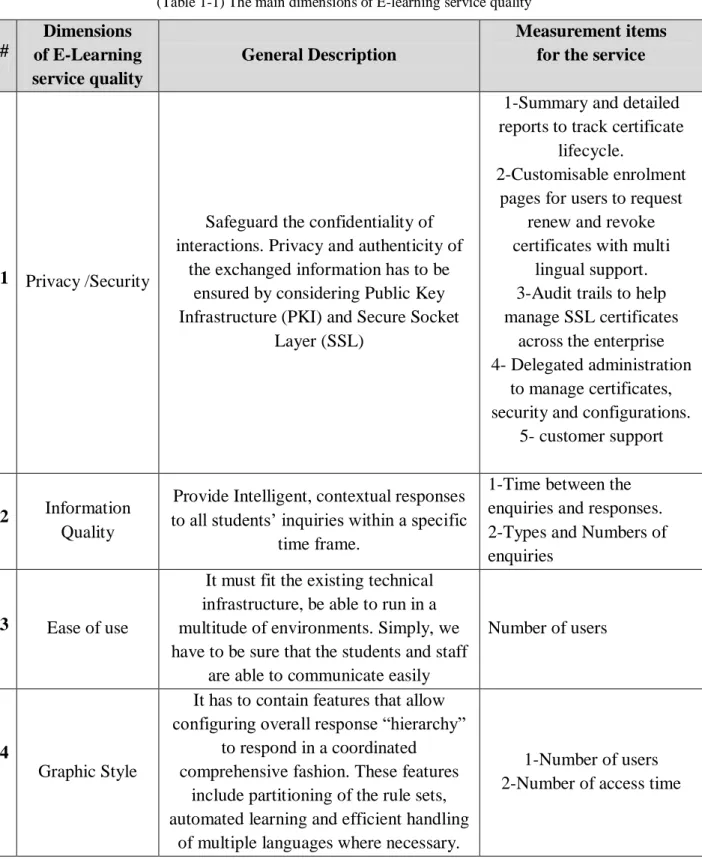
First: - by analysing it‘s associated measurements items: The main dimensions of E- Learning service quality. (Alex Douglas,LindsyMuir and Karon Meehan, 2003)
1. Privacy / Security (protection of personal information, risk of fraud and financial loss)
28
2. Information quality (the suitability of the information to the student‘s purpose) 3. Ease of use (Effort of the end-user in using the website)
4. Graphic style (Presentation of graphics and text on the website)
5. Fulfilment (to how extent the website is reliable and responsive. The extent to which the site‘ s promises about knowledge delivery are fulfilled)
This can be clearer in the following Table:-
(Table 1-1) The main dimensions of E-learning service quality
# Dimensions of E-Learning service quality General Description Measurement items for the service
1 Privacy /Security
Safeguard the confidentiality of interactions. Privacy and authenticity of
the exchanged information has to be ensured by considering Public Key Infrastructure (PKI) and Secure Socket
Layer (SSL)
1-Summary and detailed reports to track certificate
lifecycle.
2-Customisable enrolment pages for users to request
renew and revoke certificates with multi
lingual support. 3-Audit trails to help manage SSL certificates
across the enterprise 4- Delegated administration
to manage certificates, security and configurations.
5- customer support
2 Information Quality
Provide Intelligent, contextual responses to all students‘ inquiries within a specific
time frame.
1-Time between the enquiries and responses. 2-Types and Numbers of enquiries
3 Ease of use
It must fit the existing technical infrastructure, be able to run in a multitude of environments. Simply, we have to be sure that the students and staff
are able to communicate easily
Number of users
4
Graphic Style
It has to contain features that allow configuring overall response ―hierarchy‖
to respond in a coordinated comprehensive fashion. These features
include partitioning of the rule sets, automated learning and efficient handling
of multiple languages where necessary.
1-Number of users 2-Number of access time
29 # Dimensions of E-Learning service quality General Description Measurement items for the service
5 Reliability
It has to provide quick answers not only quick responses
Recognising the best student‘s need instantly and give it preferential
treatment.
1-Number of users 2-Number of access time
6 Responsiveness Respond with the necessary information to formulate an intelligent response.
1-Number of users 2-Number of access time
3-Time between the enquiries and responses. 4-Types and Numbers of
enquiries
Second: - Using Quality Techniques and tools to examine E-Learning Service quality. Because we need to identify the implications, then the deployment should be measured. Therefore, Quality function deployment is the chosen tool to be used in examining E-Learning service quality. (Press, 2001)
1.8.1 Quality Function Deployment (QFD) is:- 1. Understanding Customer Requirements.
2. Quality Systems thinking, psychology and knowledge 3. Maximising positive quality that adds value
4. Comprehensive Quality System for customer Satisfaction 5. Strategy to stay ahead of the game
In order to use Quality Function Deployment (QFD) we have to:- 1- Identify the e-service type.
2- Identify the internal and the external customers 3- Collect the internal and external customers voices 4- Document Customers requirement
5- Build a house of Quality to assess the needs of customers from the offered e-service.
In this research, based on the proposed hypotheses, a theoretical model of TQM implementation and overall performance was suggested above in (Fig. 1) .The Links between TQM implementation, Staff members satisfaction, E- Learning service Quality, Student Satisfaction, and Strategic management performance are incorporated in one single
30
model. TQM implementation is independent variable. E- Learning service quality, staff member‘s satisfaction, student satisfaction and strategic management performance are dependent variables. By using Quality Function Deployment (QFD) tool, we measure the implication of TQM implementation on each dependent variable. Then, by analysing the measurements we get, we conclude the implication of applying TQM on E- Learning service.
In order to do what is mentioned above, Interviews take place with board of director, Staff members and students. This has the target of examining the overall performance of the service. Thematic analysis used to analyse the result of these interviews. Also, Questionnaires are distributed to measure the staff members (internal customers) and students (external customers) satisfaction. The outcome of these questionnaires is analysed and transformed to quantitative data (percentages) by which we can measure the quality of service by referring to internal and external customers‘ satisfaction. The collected Data will be used in constructing a House of quality from which we can have a general view between the offered service specifications and student requirements and expectations. At the end we can know what should be developed or improved, and then according to what we get, we put our recommendations. A comparative study is made between the questionnaire results got from the Higher education Institute in Egypt, where the E-learning service is offered and the results of questionnaires of online course offered at a higher educational institute in UK. In order to validate the proposed E-learning Management suggested Model, it was applied in one of the High educations institutes in Egypt, and the customer‘s satisfaction is measured after applying the model.
As mentioned before, the field where this research is conducted has been chosen through one of the National Target in Egypt as a Developing Country. This field is ‗The High Educational Institutes in Egypt‘, where the e-service were implemented in the near past few years and the Quality management were also taken as essential of management in these institutes.
1.8.2 The rationale for the study.
According to the literature review, it was found that e-learning is the promotion of the traditional educational system. But, it c causes serious concern to governments about safety of national system. Also, there is a need for:-
1- A good affordable high educational system to improve the Egyptian society. 2- A recognised set of procedures for validation of quality framework,
31
The suggested E-learning service Quality Model can provide a complete organised management system. It can eliminate serious concerns to the governments, and Quality Assurance agencies, about the safety of national system, legitimacy of the providers, and fake providers.
1.9 Research Structure
Chapter One: - provides an overview of the research. It covers the context of the problem, statement of the research problem, the research aim, objectives, and planning of the research.
Chapter Two: - reviews the literature dealing with the nature of Total Quality Management-. Specific attention is directed to reviewing existing models and theories with regard to E-service. The objective of this chapter is to create a theoretical foundation upon which the research will be based.
Chapter Three: - discusses the research design and the selection of the research method, techniques for data gathering and the procedure to be followed to arrive at trustworthy and confirmable results. The study‘s research methodology is chosen with consideration for the study‘s main research questions and the constraints and limitations of the study site. Alternative research methods are considered and reasons provided for non-selection. Taken together, Chapters Two and Three provide the methodological justification for the research study and its methods.
Chapter Four: - deals with the presentation of data and preliminary findings. Chapter Five: - deals with the analysis of data and interpretation of results
Chapter Six: - concludes by summarizing the study. It draws conclusions and makes recommendations for practice of effective knowledge transfer across cultures. The study also suggests pointers for future research.
1.10 References and sources:- 1- Observations 2- Interviews 3- Questionnaire 4- Books 5- Periodicals 6- Internet
32
Chapter (2)
Literature Review
2.1
Introduction
(Wa shington, D.C.) – Egypt's education system is the largest in the Middle East, but also one of the worst performing in the world, ranking 131st out of 144 countries in the World Economic Forum's latest report on global competitiveness. As computers and internet access become more available and affordable, private sector innovators are trying to address Egypt‘s educational shortcomings by offering free online educational platforms intended to augment the Egyptian school curriculum. But despite the progress that has been made, questions remain about the viability of information and communications technology (ICT) to bring about effective and equitable development in the education sector. (Murr, 2015)
In a Middle East Institute (MEI) event held February 20, ―Ahmed El Alfi‖ of Sawari Ventures and Nafham Education, ―Sherif Kamel‖ of the American University in Cairo, and ―Simon Thacker‖of the World Bank‘s Education Global Practice, emphasized the importance of investing in online education initiatives and encouraged greater partnership between the public and private sectors. With a rapidly growing population, a high unemployment rate, and an internet penetration rate of only 50%, Egyptian society faces many challenges in improving the quality of education for its young population. (Murr, 2015)
Most students appreciate the flexibility of training schedule and employers enjoy a deep cost advantage by avoiding travel time and expenses, e-learning does require the learner to effectively manage his/her own time. There is a self –motivation and personal tenacity needed in order to succeed (Hoda Abdel Hafez, Sherif Kamel, 2015)
To study the implications of applying Total Quality management (TQM) on E- learning in High educational institutes in Egypt, as a sample of E-service offered. The following literature review has been made to gain some knowledge about the common factors of the field of study.
In this chapter; E-learning quality and Higher education and e-learning were illustrated. Then, through various readings, a paper titled Total Quality management (TQM) and
33
Continuous Improvement As Addressed by Researchers, published -IJSRP, Volume 3, Issue 10, October 2013 Edition, analyse some work produced in the field of Total Quality Management (TQM), to prove that, all targets and aims are achieved by relying on the same base and principles. Also, to study the criteria of each of Higher Education, E-learning, and Quality, in order to find a relationship to indicate a route to go through for improve of E-Learning programme in Higher Education, a paper titled "E- Learning and Quality Circle" has been published in IJSRP Volume 3 Issue 2 Februar y 2013 edition. Then, to find relations between the role of benchmarking in evaluation of E- learning and Virtual Education, and the role of quality function deployment in planning and designing the route to continuous improvement; to maintain high quality of service, a paper titled "E-learning benchmark and quality function deployment role", published - Compr. Res. J. Manage. Bus. Std. October 2013 1(1): 013-017
2.2 E-learning Quality
In a Study about Fuzzy Evaluation of E-learning Teaching Quality by (He Yongqiang & Wang Jianxin, n.d.) Stated that at present, E-learning develops rapidly; in order to ensure teaching quality, it should establish a scientific and traditional evaluation system of teaching quality. Aiming at multifactor and fuzzy evaluation factor for teaching quality and using the data of questionnaire, it has established fuzzy evaluation index system and mathematical model for E-learning teaching quality; it supplies reference to establish and development of learning. From the evaluation result, it can be found that learners in E-learning centre think that factors of bad teaching quality mainly focus on weakness of fundamental facilities and multimedia equipment construction, indefiniteness of learning quality assurance policy, imperfection of teachers management, low participation of teachers and learners, the courseware‘s designing, transmission and maintain need to be improved. Therefore, if improves E-learning teaching quality, it should increase input on weak links, so that the E-learning can be developed healthily while ensuring teaching quality. Learners‘ evaluation of E-learning teaching quality is rational and uncertainty, even to some extent, it is ambiguity. Fuzzy evaluation of E-learning teaching quality can make the result more clear and qualification and overcome deviation of subjective evaluation. The learners‘ recognition of teaching quality can be acquired correctly in accordance with the evaluation result. At the same time, according to the evaluation result, E-learning centre can find reasons for low teaching quality and make corresponding solution, so to promote the development of E-learning continually.