EFFICIENT HANDLING OF MULTILINGUAL LANGUAGE MODELS
Christian F¨ugen, Sebastian St¨uker, Hagen Soltau, Florian Metze
Interactive Systems Labs
University of Karlsruhe
Am Fasanengarten 5
76131 Karlsruhe, Germany
Tanja Schultz
Interactive Systems Labs
Carnegie Mellon University
School of Computer Science
Pittsburgh, PA 15221, USA
ABSTRACT
In this paper we introduce techniques for building a multi-lingual speech recognizer. More specifically, we present a new language model method that allows for the combina-tion of several monolingual into one multilingual language model. Furthermore, we extend our techniques to the con-cept of grammars. All linguistic knowledge sources share one common interface to the search engine. As a conse-quence, new language model types can be easily integrated into our Ibis decoder. Based on a multilingual acoustic model we compare multilingual statistical n-gram language mod-els with multilingual grammars. Results are given in terms of recognition performance as well as resource requirements. They show that (a) n-gram LMs can be easily combined at the meta level without major loss in performance, (b) gram-mars are very suitable to model multilinguality, (c) language switches can be significantly reduced by using the intro-duced techniques, (d) the resource overhead for handling multiple languages in one language model is acceptable, and (e) language identification can be done implicitly dur-ing decoddur-ing.
1. INTRODUCTION
The increasing interest in multilingual mobile devices has generated a need for small footprint engines and speech recognition systems which can not only handle input from many languages, but also can switch seamlessly between those languages. The problems associated with building a multilingual speech recognizer are closely related to the multi-domain case. A solution to the first problem might also solve the second as shown by Hazen et. al [1] for a FST-based recognizer. As of today, the majority of speech rec-ognizers only processes one language (and one domain) at a time. Recently, many groups have investigated the potential of multilingual acoustic models, but only little research has been done on handling language models for multiple lan-guages [2, 3] or combining both multilingual acoustic and language models, into one single system [4, 5].
Over the years, the Interactive Systems Labs have been involved in various multilingual and cross-cultural projects and has gained significant experience in building human-human interfaces for speech translation and multilingual speech applications, as well as human-machine interfaces in many different languages. As a consequence, our work is mo-tivated by the strong need for a truly multilingual speech recognizer that is flexible enough for use with various ap-plications. The work presented here focuses on a speech engine that simultaneously serves such diverse applications as the human-robot interface of the SFB project1, the inter-face to an intelligent room in the FAME project2, and our mobile linguistic tourist assistant, LingWear.
In the SFB project, a very flexible human-machine in-terface is required that allows to seamlessly switch between several languages and domains. Our interface, combined with a dialogue manager, allows those switches, and, to-gether with grammar based speech recognition, the dialogue manager even manipulates the grammar at the rule level to achieve a better recognition performance on user responses. In the FAME project the interface is required to handle ver-bal interactions in different languages and multiple domains but also to implicitly identify the language during decod-ing. Our mobile linguistic tourist assistant LingWear [6] not only requires a flexible multilingual speech interface, but has strict limitations on available computing and memory resources. As a consequence, we use semantic grammars to model the linguistic system knowledge. Furthermore, since LingWear also integrates speech-to-speech translation it is necessary to share as much knowledge between the differ-ent input languages as possible.
In order to meet the above described requirements, we introduce a new language modeling method, multilingual
Meta-LM, that allows the user to easily combine several
monolingual language models into one multilingual LM. Furthermore, we extend the research in multilingual lan-1Sonderforschungsbereich SFB, No. 588, “Humanoide Roboter
-Lernende und kooperierende multimodale Roboter”
2FAME (Facilitating Agent for Multicultural Exchange) and is funded
guage modeling to the concept of grammars, which often prove to be superior to statistical language models on small domains. We apply the Meta-LM approach to monolingual n-gram language models and compare it to our multilingual grammars in terms of recognition performance and resource requirements.
Since we combine the multilingual language models with our multilingual acoustic model [7], we can build a truly multilingual speech recognizer that allows seamless switch-ing between languages (and domains).
2. LANGUAGE MODELING IN THE IBIS DECODER
The Ibis decoder [8] was developed at the University of Karlsruhe as part of our Janus Recognition Toolkit (JRTk). Besides several other advantages such as smaller memory usage and higher recognition speed, Ibis allows us to decode along context free grammars in addition to the classical sta-tistical n-gram language models. In the following sections, we describe our common language model interface to the single pass search engine and some features of our context free grammar implementation.
2.1. LM Interface and Vocabulary Mapper
The common language model interface abstracts from dif-ferent linguistic knowledge sources, such as phrase language models, grammars or interpolated linguistic knowledge sources. It makes it easy to attach new language model types and consists mainly of three functions, which are usually called by the search engine:
lks.createLCT () creates the initial linguistic context, which consists usually only of the begin of a sentence, lks.scoreArray (LCT) gives back the array of scores for
all language model words given a specific linguistic context,
lks.extendLCT (LCT, LVX) extends a given linguistic con-text by a given language model word to form a new linguistic context,
In the case of a grammar, a linguistic context (LCT) is equal to a grammar state or, in the case of an n-gram lan-guage model, to the n-gram history of lengthn−1. The term LVX refers to the language model vocabulary index. A vocabulary mapper is used to map search vocabulary3words to language model words. In the standard case of an n-gram language model, each search vocabulary word is stripped of its variant information and directly mapped to the language 3The search vocabulary is not necessarily identical to the
pronuncia-tion lexicon, e.g. two items in the search vocabulary can rely on the same pronunciation.
model word with the same spelling. The mapping has to be surjective, which means that all search words unknown by the LM are mapped to a special unknown LM word.
2.2. Context Free Grammars
Using grammars instead of n-gram language models is espe-cially an advantage in small domains, where less domain de-pendent training data is available for n-gram language mod-els. Rather than compiling one finite state graph out of all the terminals given by the grammars, we use a more dy-namic approach, where several rule based finite state graphs consisting of terminals and non-terminals, are linked to-gether by their non-terminal symbols. During decoding, a rule stack gives us the ability to enter and leave the linked finite state graphs. This kind of network organization has usually a smaller memory footprint and results in higher flexibility for using grammars in speech recognition in com-bination with a dialogue management system. Furthermore, it enables us to work with real context free grammars.
Several domain dependent sub-grammars can be acti-vated/deactivated and loaded at run time. The activation/de-activation mechanism goes all the way to the rule level, giv-ing the dialogue management system the full control over the speech recognizer. Furthermore, it is also allowed to pe-nalize grammars or rules by giving them a penalty factor. Another feature is that grammars can be expanded on the fly by new rules or terminals without restarting the recog-nizer. Even new words can be added to the grammar and the search network on the fly. In most cases we work with non-statistical grammars, i.e. each transition to the next word has the same language model score.
To cope with spontaneous non-verbal speech events and non-human noises, we are using the mechanism of filler words in the decoder, which can potentially occur between any two terminals. Instead of asking the language model for their score, a predefined filler penalty is applied.
3. MULTILINGUAL LANGUAGE MODELING The goal of multilingual language modeling is to be able to recognize utterances from multiple languages with the use of a single recognition engine. This not only requires a multilingual language model, but also a multilingual acous-tic model. We studied the latter problem already extensively [7] and will apply our results in this paper.
Experiments in multilingual n-gram language modeling have been performed in [2, 3, 4, 5] and can be divided by the degree to which language switching is allowed. [4] merged the corpora of two languages to calculate one combined trigram language model, thus allowing language switching at any time. They introduced a penalty factor to control language switches, but could not regain full performance
compared to the monolingual case. [2] built a four-lingual language model that allows language switching through a common backoff-node which was implemented as a pause model, i.e. language switching is possible by inserting a pause. [3] calculated n-grams on two monolingual corpora and introduced one common begin and sentence-end symbol, therefore language switching is possible at the sentence level. With this setup, they could achieve good re-sults if the amount of text was the same for both languages.
3.1. Multilingual N-gram LMs
3.1.1. Previous Work
In [5], we compared three approaches to multilingual n-gram language modeling. In the first, we concatenated two language tagged training corpora, and calculated a language model on the new corpus as introduced by [4]. This ap-proach fails when the sizes of the training corpora are highly unbalanced, like in our case, where the English corpus was about 218 times larger than the German one. On average, German n-grams were assigned a smaller probability than English n-grams, and, therefore, German words were often incorrectly recognized as English ones. In our second ap-proach we interpolated between two monolingual language models using constant weights. Because of the unbalanced corpora, less n-grams for a specific n were seen for German compared to English. So most of the n-grams probabilities in the German language model were higher than most of the n-gram probabilities in the English model. Now English words were often incorrectly recognized as German ones because the German n-gram probabilities dominated the En-glish. In order to overcome these problems, we balanced the probability distribution functions of the two languages by assigning similar probabilities to two n-grams obtained from different corpora if they had a similar frequency rank with respect to the rest of the n-grams obtained from the respective corpus. This third approach showed the best per-formance, but the multilingual recognition results were still relatively poor compared to the monolingual case [5].
3.1.2. Combining Monolingual LMs at a Meta Level
In our task, language switching takes place only at utter-ance boundaries. It is, therefore, desirable to suppress the language switching within an utterance. However, the meth-ods for multilingual language models from [5] still allow language switching after every word. Furthermore, those methods require complex manipulations of the counts of the individual language models before merging them. Also, through this process of balancing the probability distribu-tions, the relations of the n-grams within a language are changed. Though the ranking of the n-grams in terms of fre-quency remains the same, the distance between the n-grams
changes. The information that is captured in the shape of the probability distribution over the n-grams of a language is possibly corrupted. We therefore implemented a new ap-proach for the Ibis language model interface that allows to easily combine two monolingual language models and ef-fectively prevents language switching within an utterance. To do so we introduced a meta layer between the monolin-gual language models and the decoder and call it
multilin-gual Meta-LM.
The idea behind our Meta-LM is to prevent language switches by allowing expansions of a given LCT by words taken from the same language as the LCT only. So in this case, an LCT not only represents the n-gram history, but also information about the languages that the words in the history come from. The extension of an LCT by an un-wanted word gets the worst possible score. If the language of the LCT is not yet decided, because it only consists of words from all languages, the score is interpolated from all monolingual language models.
Since the n-gram language models for different languages give probabilities that differ in magnitude for reasons de-scribed above, our multilingual language model allows the application of different weights to the scores from the indi-vidual monolingual language models. Though we applied our Meta-LM so far only to n-gram language models, it is possible to use any type of language model, e.g. interpo-lated language models or grammars.
3.2. Multilingual Grammars
To handle multilingual grammars we make use of the mech-anism of having several different grammars in parallel, as described in section 2.1. When asking for the next scores given a linguistic context the grammar itself ensures, that language switching is not permissible by giving the worst possible score to unwanted words.
The multilingual grammar, together with its language dependent sub-grammars, appears as one linguistic knowl-edge source – a grammar set – to the decoder. Therefore, the language model vocabulary is built over all grammars in the set. When mapping the different multilingual search vo-cabularies to the language model indices, one has a choice of two mapping methods:
• Language dependent search vocabulary words can be mapped to the appropriate language dependent lan-guage model word. Therefore, all lanlan-guage model words with the same orthographic representation have to be tagged with a language id.
• Language model words with the same orthographic representation and semantic meaning can be shared across the languages, which means, in our case, that e.g. a street name shares the same LVX in all lan-guages.
The second method has a major advantage over the first one, especially in the case that speakers of one language are familiar with the other language. The method allows the decoding of a word with the pronunciation of another language, e.g. a street name, without switching the language model and without destroying the semantic meaning of the word.
3.3. Multi-domain and context language modeling Though our research in this work focuses on multilingual speech recognition, the techniques to combine monolingual grammars and language models can be easily transfered to multi-domain speech recognition. In this case one decodes different domains using one decoding engine and one com-mon acoustic model but separate domain specific language models. This approach has several benefits. First, it is very easy to implement if the domain-dependent language mod-els already exist. Second, the construction of several do-mains becomes decoupled from each other and is therefore easier to separately optimize and maintain. Third, by avoid-ing to combine the trainavoid-ing material of different domains, there is no chance for contamination.
In the LingWear project we use this approach to per-form speech translation in the medical domain in addition to speech recognition in the navigation domain. For SFB and FAME we use a multi-domain approach based on gram-mars using the activation/deactivation feature as mentioned in 2.2. We make use of this feature not only on the higher level of complete domains, but allow the dialogue manager to control the speech recognizer depending on single com-munication contexts by activation/deactivation or weighting of specific rules.
4. EXPERIMENTS AND RESULTS
In order to show the differences in recognition performance and resource requirements of the different approaches for multilingual language modeling, we applied them to the navigation domain of the LingWear mobile tourist assis-tant. Throughout the experiments, we use one multilingual acoustic model trained in the languages German and En-glish. The performance of the multilingual acoustic in com-bination with monolingual grammars and n-gram language models serves as a baseline.
4.1. Multilingual Acoustic
For our experiments we used the multilingual acoustic de-scribed in [5]. 5000 context dependent tri-phone models were trained on 60 hours of spontaneous German (GSST) and 40 hours of spontaneous English (ESST) Verbmobil-II speech data, as well as 15h of English Broadcast News (BN). Every acoustic unit was modeled by a mixture of 30
Language Speakers Utterances Duration
German 11 457 17’
English 9 363 14’
Total 20 820 31’
Table 1. Overview of the test set
German English vocabulary size 2.574 2.029 LM corpus size 9.167 260.914 grammar rules 132 198 grammar nodes 1.357 1.408 grammar arcs 2.061 1.357
Table 2. Size of the vocabularies, grammars and LM train-ing corpora
Gaussians. The input vector is a combination of 13 Mel-frequency scaled cepstral coefficients (MFCC) at the time of the current frame and seven MFCC vectors to the left and right. A linear discriminant analysis (LDA) reduced the dimension of the input vector to 40.
Incorporated into this system are techniques such as in-cremental vocal tract length normalization, cepstral mean normalization, and feature space adaptation. The models were trained in a language independent way using a tech-nique called MLtag [7]. In MLtag, the training material for phonemes is shared in a knowledge-based way with the help of the alphabet of the International Phonetic Association. Previous research has shown that it is best to preserve the language information of a phoneme so that the algorithm for clustering the context dependent models can ask for the language of a phoneme and decide whether it wants to share the parameters of poly-phones from different languages or not [7].
4.2. Data
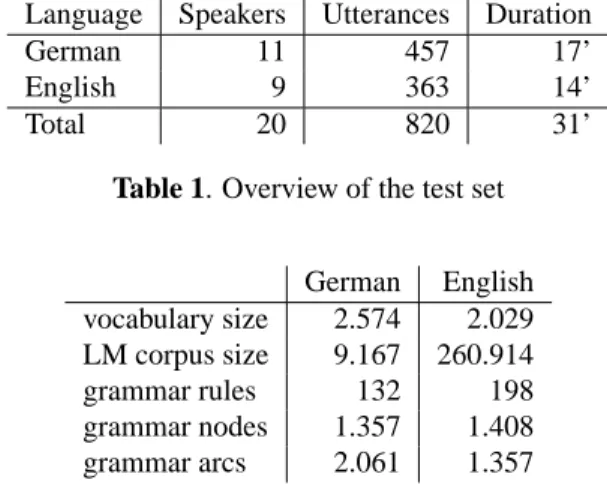
German and English test data were collected from native speakers using a laptop and a close-talking microphone. It contains spontaneous speech queries to LingWear while tour-ing the city of Karlsruhe. The queries mainly included re-quests for directions and informations, whereby informa-tions about streets, hotels, restaurants, sights and other places of interest were stored in the database. The users also asked for recommendations. Table 1 gives an overview.
Table 2 shows the sizes of the vocabularies used for rec-ognizing the two languages and the size of the two language model training corpora, together with the grammar sizes. While the vocabularies and grammars are roughly equal in size, the amount of available language model training ma-terial differs substantially. The English training corpus is
approximately 28 times as big as the German one. Not all queries of the test set were covered by the n-gram LMs and grammars.
4.3. Baselines
Using the multilingual acoustic, we decoded the English and German test set separately with the help of monolingual n-gram language models as well as monolingual grammars. The results can be seen in the first two rows of table 3. For all experiments we used the same beam settings during de-coding. When optimizing the language model parameters for the single languages, one can see, that there is only a small difference between the languages.
When comparing the monolingual numbers of the En-glish grammar with the EnEn-glish n-gram LM an increase in WER by 14.7%, but a decrease in SER by 7% is seen. In German, there is a gain of 9.4% in WER and also a large gain of 9.4% in the SER. It is also noticed that the WERs and SERs for the grammars in English and German are ly-ing in the same range, which means that both test sets are of equal difficulty. The difference between the results of En-glish and German in the case of the n-gram LM can only be explained by the fact that the English LM training material outweighs the German material by a factor of 28.
When comparing the real time factors between the n-gram LMs and the n-grammars, it can be seen that the n- gram-mar is roughly twice as fast as the n-gram LM. The n-gram LM loses more in the case of German due to the poor cover-age of the LM. Thus, decoding along context free grammars in such restricted domains gives a large advantage over the standard n-gram approach.
4.4. Simple Merging of N-gram LM Training Corpora In analogy to the first experiment in [5] mentioned above, we simply concatenated the two language tagged LM train-ing corpora. We then trained a new n-gram model on this corpus and call it the multilingual Mix-LM. The results in ta-ble 3 show that the performance on English stays the same. However, on the German test set, the WER increases severely by 17%, the SER increases by 3.3%. As mentioned above, and also observed by [5], the difference between the WERs can only be explained by the large difference of the LM training corpora sizes. This explanation is also validated by the LID, which is in the case of German the worst observed error rate, while on English it is almost as good as the Meta-LM.
The run time behavior of the system is, as expected, slower than the monolingual systems, due to the larger search space. The system is faster than the Meta-LM system, how-ever, because of the missing meta layer, which produces some additional overhead.
4.5. Multilingual Grammar and N-gram LM
4.5.1. Multilingual n-gram Meta-LM
In German, both the WER and the SER increases slightly by 1.8% compared to the monolingual case. Therefore, the Meta-LM outperforms the mixed one. However, in English the WER falls short of the monolingual and mixed LM re-sults. It increases by 14%. However, the SER only increases by 1.7%.
The increase in WER is due to the high amount of lan-guage switches, the highest in English among all presented methods. Even though the number of switches roughly equals that of the mixed LM, a language switch in the Meta-LM causes more word errors than for the mixed LM, since the Meta-LM always recognizes a whole utterance in the wrong language in the case of a language switch. One reason for the switches seems to be, that German noises at the be-ginning of a sentence get a higher LM score than the En-glish ones due to the imbalance of the LM training corpora. Since all noises share the same acoustic independent of their language but are seen as language dependent words in the language model, German noises are preferred over English, therefore pruning away English hypotheses at the beginning of the search.
The Meta-LM shows the slowest runtime behavior of all examined methods, because of the extra meta layer in-troduced above the monolingual LMs. But the loss in speed is still acceptable when compared to the ease of use of the Meta-LM.
4.5.2. Multilingual Grammar
The results of the experiments of the multilingual grammar show that measured over both languages, the grammar ap-proach outperforms the n-gram LM apap-proaches. Compared to the monolingual grammar baseline, the overall WER in-creases only by 4% and the SERs are nearly equal. In the case of English the decrease in the SER is a result of the search vocabulary to language model vocabulary mapping. Mainly street names, like ‘Kaiserstrasse’, and other points of interest with a German orthography are replaced by their German pronunciation variant. This was not counted as a language switch, because the semantic meaning of the sen-tence was not changed. Examples other than street names include ‘okay’, ‘in’ or the noise models. It can also be seen, that the balance in WERs and SERs between both languages is not changed by using the multilingual approach, because our non-statistical grammars do not have to cope with un-balanced training corpora sizes. Due to the larger search space when using the multilingual grammars, the RTFs in-crease by nearly 28%, but are still twice as small as com-pared to the multilingual n-gram LM approaches.
Meta-English German
Language Type WER SER LID RTF WER SER LID RTF monolingual n-gram 21.7% 47.4% – 0.70 26.5% 54.4% – 1.29 monolingual grammar 24.9% 44.1% – 0.48 24.0% 42.2% – 0.48 multilingual n-gram Mix-LM 21.6% 46.8% 5.51% 1.00 31.0% 56.2% 10.28% 1.38 multilingual n-gram Meta-LM 24.8% 48.2% 6.06% 1.24 27.0% 55.4% 0.22% 1.51 multilingual grammar 25.9% 43.2% 3.58% 0.67 25.0% 42.7% 1.75% 0.61
Table 3. Performance and resource usage of both systems. SER is the sentence error rate. LID (language identification error rate) is the percentage of sentences with language switches. The real-time factor (RTF) was computed on a Laptop with a 1.13GHz Pentium III Mobile Processor.
LM, the grammar also had to cope with language switches, which leads to completely incorrect sentences, and, there-fore, has a high influence on the WER. One third of the failed language identifications in English was produced by one speaker in the test set.
Again, without losing too much in word accuracy, de-coding is nearly twice as fast compared to the n-gram LM approaches. Also the SER is much lower which makes it easier for the dialogue manager in LingWear to understand the user queries. Furthermore, when using grammars it is not necessary to use a separate parser for the language pro-cessing because the parse tree of the recognizer can be given directly to the dialogue manager.
5. SUMMARY AND FUTURE WORK
In this paper, we investigated techniques for building a tilingual speech interface. We extended the research in mul-tilingual language modeling to the concept of grammars and also introduced a new language modeling method that al-lows to combine several monolingual into one multilingual LM. Our results proved that multilingual grammars can be used to efficiently decode the two languages English and German within a single system. On our LingWear task, we improved the runtime behavior while facing only a minor loss in performance compared to the monolingual systems. We also showed that n-gram LMs can be combined at a meta level thereby preserving language specific information cap-tured in the individual LMs. The resulting system is easier to maintain, allows decoupled optimization, and implicitly identifies the spoken language during decoding.
In the future we plan to improve the handling of spon-taneous speech effects in the multilingual LM and to inte-grate the mapping between search vocabulary and language model words currently used by the multilingual grammars into the n-gram Meta-LMs. Furthermore we will investigate the combination of n-gram LMs and grammars to benefit from the advantages of both approaches.
6. ACKNOWLEDGMENT
We would like to thank Victoria MacLaren for her help in collecting, transcribing the data, and editing the paper.
This work was partly carried out within the FAME (Fa-cilitating Agent for Multicultural Exchange) projet that is funded by the European Commission as IST-2000-28323, and also within the Sonderforschungsbereich (SFB), No. 588 (Humanoide Roboter - Lernende und kooperierende mul-timodale Roboter) which is supported by the German re-search foundation (DFG).
7. REFERENCES
[1] Timothy J. Hazen, I.Lee Hetherington, and Alex Park, “FST-Based Recognition Techniques for Lingual and Multi-Domain Spontaneous Speech,” in Proceedings of the Eu-rospeech 2001, Aalborg, Denmark, September 2001. [2] Stefan Harbeck, Elmar N¨oth, and Heinrich Niemann,
“Mul-tilingual Speech Recognition,” in Proceedings of the 2nd SQEL Workshop on Multi-Lingual Information Retrieval Di-alogs, Pilzen, Czech Republic, 1997.
[3] Fulian Weng, H. Bratt, L. Neumeyer, and A. Stolke, “A Study of Multilingual Speech Recognition,” in Proceedings of the Eurospeech, Rhodes, Greece, September 1997.
[4] Thomas Ward, S. Roukos, C. Neti, M. Epstein, and S. Dhara-nipragada, “Towards Speech Understanding across Multiple Languages,” in Proceedings of the ICSLP, Sydney, Australia, November 1998.
[5] Zhirong Wang, Umut Topkara, Tanja Schultz, and Alex Waibel, “Towards Universal Speech Recognition,” in Pro-ceedings of the ICMI, Pittsburgh, 2002.
[6] Christian F¨ugen, Martin Westphal, Mike Schneider, Tanja Schultz, and Alex Waibel, “LingWear: A Mobile Tourist In-formation System,” in Proceedings of the Human Language Technology Meeting (HLT-2000), San Diego, USA, March 2000.
[7] Tanja Schultz and Alex Waibel, “Language Independent and Language Adaptive Acoustic Modeling for Speech Recogni-tion,” Speech Communication, vol. 35, August 2001. [8] Hagen Soltau, Florian Metze, Christian F¨ugen, and Alex
Waibel, “A One Pass-Decoder Based on Polymorphic Lin-guistic Context Assignment,” in Proceedings of the ASRU, Madonna di Campiglio Trento, Italy, December 2001.