B
ERTRAM: Improved Word Embeddings Have Big Impact on
Contextualized Model Performance
Timo Schick Sulzer GmbH Munich, Germany [email protected]
Hinrich Sch ¨utze
Center for Information and Language Processing LMU Munich, Germany
Abstract
Pretraining deep language models has led to large performance gains in NLP. Despite this success, Schick and Sch¨utze(2020) recently showed that these models struggle to under-stand rare words. For static word embeddings, this problem has been addressed by separately learning representations for rare words. In this work, we transfer this idea to pretrained language models: We introduce BERTRAM, a powerful architecture based on BERT that is capable of inferring high-quality embeddings for rare words that are suitable as input rep-resentations for deep language models. This is achieved by enabling the surface form and con-texts of a word to interact with each other in a deep architecture. Integrating BERTRAMinto BERT leads to large performance increases due to improved representations of rare and medium frequency words on both a rare word probing task and three downstream tasks.1
1 Introduction
As word embedding algorithms (e.g.Mikolov et al.,
2013) are known to struggle with rare words, sev-eral techniques for improving their representations have been proposed. These approaches exploit ei-ther the contexts in which rare words occur ( Lazari-dou et al.,2017;Herbelot and Baroni,2017; Kho-dak et al., 2018;Liu et al.,2019a), their surface-form (Luong et al.,2013;Bojanowski et al.,2017;
Pinter et al.,2017), or both (Schick and Sch¨utze,
2019a,b;Hautte et al.,2019). However, all of this prior work is designed for and evaluated on uncon-textualizedword embeddings.
Contextualized representations obtained from pretrained deep language models (e.g.Peters et al.,
2018;Radford et al.,2018;Devlin et al.,2019;Liu et al.,2019b) already handle rare words implicitly
1Our implementation of B
ERTRAMis publicly available at
https://github.com/timoschick/bertram.
using methods such as byte-pair encoding ( Sen-nrich et al., 2016), WordPiece embeddings (Wu et al.,2016) and character-level CNNs (Baevski et al., 2019). Nevertheless, Schick and Sch¨utze
(2020) recently showed that BERT’s (Devlin et al.,
2019) performance on a rare word probing task can be significantly improved by explicitly learning rep-resentations of rare words using Attentive Mimick-ing (AM) (Schick and Sch¨utze,2019a). However, AM is limited in two important respects:
• For processing contexts, it uses a simple bag-of-words model, making poor use of the avail-able information.
• It combines form and context in a shallow fashion, preventing both input signals from interacting in a complex manner.
These limitations apply not only to AM, but to all previous work on obtaining representations for rare words by leveraging form and context. While using bag-of-words models is a reasonable choice for static embeddings, which are often themselves bag-of-words (e.g.Mikolov et al.,2013;Bojanowski et al.,2017), it stands to reason that they are not the best choice to generate input representations for position-aware, deep language models.
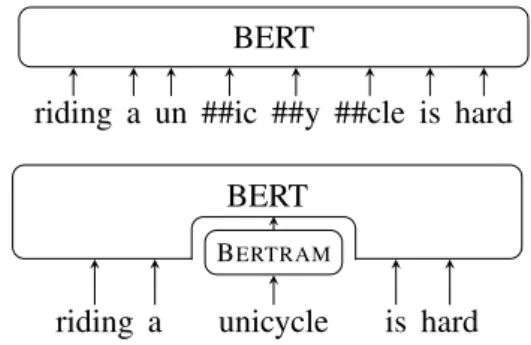
To overcome these limitations, we introduce BERTRAM (BERT for Attentive Mimicking), a novel architecture for learning rare word representa-tions that combines a pretrained BERT model with AM. As shown in Figure1, the learned rare word representations can then be used as an improved input representation for another BERT model. By giving BERTRAMaccess to both surface form and contexts starting at the lowest layer, a deep integra-tion of both input signals becomes possible.
Assessing the effectiveness of methods like BERTRAMin a contextualized setting is challeng-ing: While most previous work on rare words was
evaluated on datasets explicitly focusing on rare words (e.g Luong et al., 2013; Herbelot and Ba-roni,2017;Khodak et al.,2018;Liu et al.,2019a), these datasets are tailored to uncontextualized em-beddings and thus not suitable for evaluating our model. Furthermore, rare words are not well repre-sented in commonly used downstream task datasets. We therefore introducerarification, a procedure to automatically convert evaluation datasets into ones for which rare words are guaranteed to be impor-tant. This is achieved by replacing task-relevant frequent words with rare synonyms obtained using semantic resources such as WordNet (Miller,1995). We rarify three common text (or text pair) classifica-tion datasets: MNLI (Williams et al.,2018), AG’s News (Zhang et al.,2015) and DBPedia (Lehmann et al., 2015). BERTRAM outperforms previous work on four English datasets by a large margin: on the three rarified datasets and on WNLaMPro (Schick and Sch¨utze,2020).
In summary, our contributions are as follows:
• We introduce BERTRAM, a model that
inte-grates BERT into Attentive Mimicking, en-abling a deep integration of surface-form and contexts and much better representations for rare words.
• We devise rarification, a method that trans-forms evaluation datasets into ones for which rare words are guaranteed to be important.
• We show that adding BERTRAM to BERT
achieves a new state-of-the-art on WNLaM-Pro (Schick and Sch¨utze,2020) and beats all baselines on rarified AG’s News, MNLI and DBPedia, resulting in an absolute improve-ment of up to 25% over BERT.
2 Related Work
Surface-form information (e.g., morphemes, char-acters or charactern-grams) is commonly used to improve word representations. For static word em-beddings, this information can either be injected into a given embedding space (Luong et al.,2013;
Pinter et al.,2017), or a model can directly be given access to it during training (Bojanowski et al.,2017;
Salle and Villavicencio,2018;Piktus et al.,2019). In the area of contextualized representations, many architectures employ subword segmentation meth-ods (e.g.Radford et al.,2018;Devlin et al.,2019;
Yang et al.,2019;Liu et al., 2019b). Others use
riding a un ##ic ##y ##cle is hard BERT a riding is hard BERT BERTRAM BERTRAM unicycle
Figure 1: Top: Standard use of BERT. Bottom: Our proposal; first BERTRAMlearns an embedding for “uni-cycle” that replaces the WordPiece sequence. BERT is then run on this improved input representation.
convolutional neural networks to directly access character-level information (Kim et al.,2016; Pe-ters et al.,2018;Baevski et al.,2019).
Complementary to surface form, another useful source of information for understanding rare words are the contexts in which they occur (Lazaridou et al.,2017;Herbelot and Baroni,2017;Khodak et al.,2018).Schick and Sch¨utze(2019a,b) show that combining form and context leads to signifi-cantly better results than using just one of the two. While all of these methods are bag-of-words mod-els,Liu et al.(2019a) recently proposed an architec-ture based oncontext2vec(Melamud et al.,2016). However, in contrast to our work, they (i) do not incorporate surface-form information and (ii) do not directly access the hidden states of context2vec, but instead simply use its output distribution.
Several datasets focus on rare words, e.g., Stan-ford Rare Word (Luong et al.,2013), Definitional Nonce (Herbelot and Baroni,2017), and Contex-tual Rare Word (Khodak et al., 2018). However, unlike our rarified datasets, they are only suitable for evaluatinguncontextualized word representa-tions. Rarification is related to adversarial example generation (e.g.Ebrahimi et al.,2018), which ma-nipulates the input to change a model’s prediction. We use a similar mechanism to determine which words in a given sentence are most important and replace them with rare synonyms.
3 Model
3.1 Form-Context Model
We first review the basis for our new model, the form-context model (FCM) (Schick and Sch¨utze,
2019b). Given a set ofd-dimensional high-quality embeddings for frequent words, FCM induces em-beddings for rare words that are appropriate for
the given embedding space. This is done as fol-lows: Given a wordwand a contextC in which it occurs, asurface-form embeddingvform(w,C)∈Rd
is obtained by averaging over embeddings of all charactern-grams inw; then-gram embeddings are learned during training. Similarly, a context embeddingvcontext
(w,C) ∈R
dis obtained by averaging
over the embeddings of all words in C. Finally, both embeddings are combined using a gate
g(vform(w,C), v(contextw,C)) =σ(x>[vform(w,C);v(contextw,C)] +y)
with parametersx ∈ R2d, y ∈ Randσ denoting
the sigmoid function, allowing the model to decide how to weight surface-form and context. The final representation ofwis then a weighted combination of form and context embeddings:
v(w,C)=α·(Avcontext(w,C) +b) + (1−α)·v(formw,C)
whereα =g(v(formw,C), v(contextw,C))andA ∈Rd×d, b∈ Rdare parameters learned during training.
The context part of FCM is able to capture the broad topic of rare words, but since it is a bag-of-words model, it is not capable of obtaining a more concrete or detailed understanding (seeSchick and Sch¨utze,2019b). Furthermore, the simple gating mechanism results in only a shallow combination of form and context. That is, the model is not able to combine form and context until the very last step: While it can learn to weight form and context components, the two embeddings (form and context) do not share any information and thus do not influence each other.
3.2 BERTRAM
To overcome these limitations, we introduce BERTRAM, a model that combines a pretrained BERT language model (Devlin et al.,2019) with Attentive Mimicking (Schick and Sch¨utze,2019a). We denote withetthe (uncontextualized, i.e.,
first-layer) embedding assigned to a (wordpiece) token
tby BERT. Given a sequence of such uncontextu-alized embeddingse=e1, . . . , en, we denote by
hj(e)the contextualized representation of thej-th
token at the final layer when the model is givene
as input.
Given a wordwand a contextCin which it oc-curs, lett=t1, . . . , tmbe the sequence obtained
fromC by (i) replacingwwith a[MASK]token and (ii) tokenization (matching BERT’s vocabu-lary); furthermore, letidenote the index for which
ti=[MASK]. We experiment with three variants
of BERTRAM: BERTRAM-SHALLOW, BERTRAM
-REPLACEand BERTRAM-ADD.2
SHALLOW. Perhaps the simplest approach for
obtaining a context embedding fromCusing BERT is to define
v(contextw,C) =hi(et1, . . . , etm).
This approach aligns well with BERT’s pretrain-ing objective of predictpretrain-ing likely substitutes for
[MASK]tokens from their contexts. The context
embeddingvcontext
(w,C) is then combined with its form counterpart as in FCM.
While this achieves our first goal of using a more sophisticated context model that goes beyond bag-of-words, it still only combines form and context in a shallow fashion.
REPLACE. Before computing the context
embed-ding, we replace the uncontextualized embedding of the[MASK]token with the word’s surface-form embedding:
vcontext(w,C) =hi(et1, ... , eti−1, v
form
(w,C), eti+1, ... , etm).
Our rationale for this is as follows: During regular BERT pretraining, words chosen for prediction are replaced with [MASK] tokens only 80% of the time and kept unchanged 10% of the time. Thus, standard pretrained BERT should be able to make use of form embeddings presented this way as they provide a strong signal with regards to how the “correct” embedding ofwmay look like.
ADD. Before computing the context embedding, we prepad the input with the surface-form embed-ding ofw, followed by a colon (e:):3
v(contextw,C) =hi+2(v(formw,C), e:, et1, . . . , etm).
The intuition behind this third variant is that lex-ical definitions and explanations of a wordware occasionally prefixed by “w:” (e.g., in some on-line dictionaries). We assume that BERT has seen many definitional sentences of this kind during pre-training and is thus able to leverage surface-form information aboutwpresented this way.
For both REPLACEand ADD, surface-form
in-formation is directly and deeply integrated into the
2
We refer to these three BERTRAMconfigurations simply asSHALLOW,REPLACEandADD.
3We experimented with other prefixes, but found that this variant is best capable of recoveringwat the masked position.
hSiwas wash . . . leshSi
vform(w,C1)
e[CLS] e: eother e[MASK] esuch eas etrousers . . .
: other [MASK] such as trousers . . .
BERT A· +b v(w,C1) BERTRAM . . . BERTRAM v(w,C1) . . . v(w,Cm) (w, C1) . . . (w, Cm) Attentive Mimicking v(w,C)
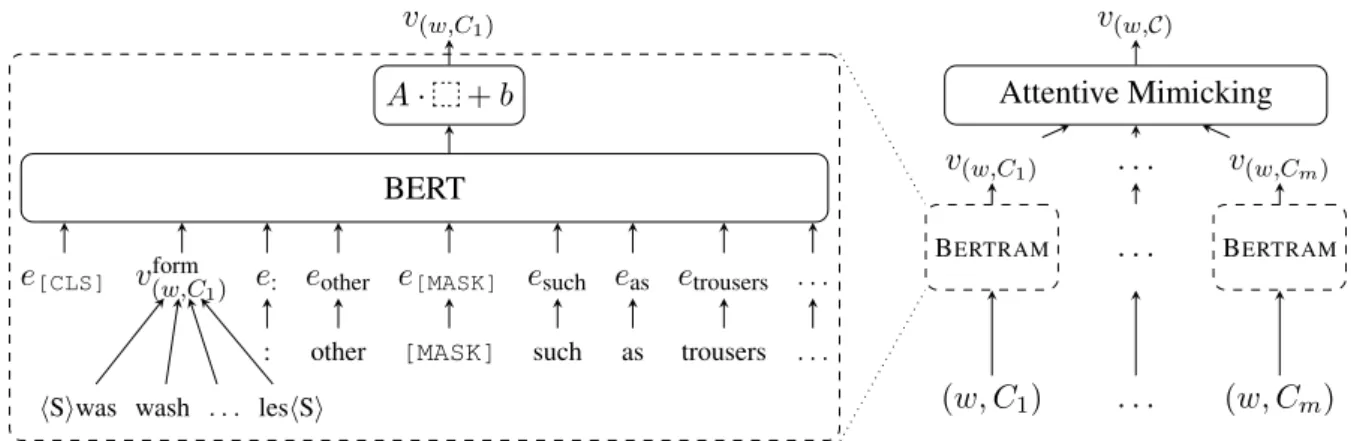
Figure 2: Schematic representation of BERTRAM-ADDprocessing the input wordw=“washables” given a single contextC1=“other washables such as trousers. . .” (left) and given multiple contextsC={C1, . . . , Cm}(right)
computation of the context embedding; thus, we do not require any gating mechanism and directly setv(w,C)=A·vcontext(w,C) +b. Figure2(left) shows how a single context is processed usingADD.
To exploit multiple contexts of a word if avail-able, we follow the approach ofSchick and Sch¨utze
(2019a) and add an AM layer on top of our model; see Figure 2 (right). Given a set of contexts
C = {C1, . . . , Cm} and the corresponding
em-beddingsv(w,C1), . . . , v(w,Cm), AM applies a
self-attention mechanism to all embeddings, allowing the model to distinguish informative from uninfor-mative contexts. The final embeddingv(w,C)is then a weighted combination of all embeddings:
v(w,C) =
Xm
i=1ρi·v(w,Ci)
where the self-attention layer determines the weights ρi subject to Pmi=1ρi = 1. For further
details, seeSchick and Sch¨utze(2019a). 3.3 Training
Like previous work, we usemimicking(Pinter et al.,
2017) as a training objective. That is, given a fre-quent wordwwith known embeddingewand a set
of corresponding contextsC, BERTRAMis trained to minimizekew−v(w,C)k2.
Training BERTRAM end-to-end is costly: the cost of processing a single training instance(w,C) withC={C1, . . . , Cm}is the same as processing
an entire batch ofmexamples in standard BERT. Therefore, we resort to the following three-stage training process:
1. We train only the context part, minimizing
kew −A ·(Pim=1ρi ·v(contextw,C i)) +bk
2 where
ρi is the weight assigned to each contextCi
through the AM layer. Regardless of the se-lected BERTRAMvariant, the context embed-ding is always obtained usingSHALLOWin this stage. Furthermore, only A, b and all parameters of the AM layer are optimized. 2. We train only the form part (i.e., only then
-gram embeddings); our loss for a single exam-ple(w,C)iskew−v(formw,C)k2. Training in this
stage is completely detached from the under-lying BERT model.
3. In the third stage, we combine the pretrained form-only and context-only models and train all parameters. The first two stages are only run once and then used for all three BERTRAM
variants because context and form are trained in isolation. The third stage must be run for each variant separately.
We freeze all of BERT’s parameters during training as we – somewhat surprisingly – found that this slightly improves the model’s performance while speeding up training. For ADD, we additionally found it helpful to freeze the form part in the third training stage. Importantly, for the first two stages of our training procedure, we do not have to back-propagate through BERT to obtain all required gra-dients, drastically increasing the training speed. 4 Dataset Rarification
The ideal dataset for measuring the quality of rare word representations would be one for which the accuracy of a model with no understanding of rare words is 0% whereas the accuracy of a model that perfectly understands rare words is 100%. Unfortu-nately, existing datasets do not satisfy this
desidera-tum, not least because rare words – by their nature – occur rarely.
This does not mean that rare words are not im-portant: As we shift our focus in NLP from words and sentences as the main unit of processing to larger units like paragraphs and documents, rare words will occur in a high proportion of such larger “evaluation units”. Rare words are also clearly a hallmark of human language competence, which should be the ultimate goal of NLP. Our work is part of a trend that sees a need for evaluation tasks in NLP that are more ambitious than what we have now.4
To create more challenging datasets, we use rar-ification, a procedure that automatically transforms existing text classification datasets in such a way that rare words become important. We require a pretrained language model M as a baseline, an arbitrary text classification datasetDcontaining la-beled instances(x, y)and asubstitution dictionary
S, mapping each wordwto a set of rare synonyms
S(w). Given these ingredients, our procedure con-sists of three steps: (i) splitting the dataset into a train set and a set of test candidates, (ii) training the baseline model on the train set and (iii) modifying a subset of the test candidates to generate the final test set.
Dataset Splitting. We partitionDinto a training setDtrainand a set oftest candidates,Dcand.Dcand
contains all instances(x, y) ∈ Dsuch that for at least one wordwinx,S(w)6=∅– subject to the constraint that the training set contains at least one third of the entire data.
Baseline Training. We finetuneMonDtrain. Let (x, y) ∈ Dtrain where x = w1, . . . , wn is a
se-quence of words. We deviate from the finetuning procedure ofDevlin et al.(2019) in three respects:
• We randomly replace 5% of all words inx
with a[MASK]token. This allows the model to cope with missing or unknown words, a prerequisite for our final test set generation.
• As an alternative to overwriting the language model’s uncontextualized embeddings for rare words, we also want to allow models toaddan alternative representation during test time, in
4Cf. (Bowman,2019): “If we want to be able to establish fair benchmarks that encourage future progress toward robust, human-like language understanding, we’ll need to get better at creating clean, challenging, and realistic test datasets.”
which case we simply separate both represen-tations by a slash (cf.§5.3). To accustom the language model to this duplication of words, we replace each wordwiwith “wi/wi” with
a probability of 10%. To make sure that the model does not simply learn to always focus on the first instance during training, we ran-domly mask each of the two repetitions with probability 25%.
• We do not finetune the model’s embedding layer. We found that this does not hurt per-formance, an observation in line with recent findings ofLee et al.(2019).
Test Set Generation. Letp(y|x)be the proba-bility that the finetuned modelMassigns to classy
given inputx, andM(x) = arg maxy∈Yp(y |x) be the model’s prediction for inputxwhereY de-notes the set of all labels. For generating our test set, we only consider candidates that are classified correctlyby the baseline model, i.e., candidates (x, y) ∈ Dcand withM(x) = y. For each such entry, letx=w1, . . . , wnand letxwi=tbe the
se-quence obtained fromxby replacingwiwitht. We
compute
wi= arg min wj:S(wj)6=∅
p(y|xwj=[MASK]),
i.e., we select the wordwiwhose masking pushes
the model’s prediction the farthest away from the correct label. If removing this word al-ready changes the model’s prediction – that is,
M(xwi=[MASK]) 6= y –, we select a random rare
synonymwˆi ∈ S(wi)and add(xwi= ˆwi, y)to the
test set. Otherwise, we repeat the above procedure; if the label still has not changed after masking up to 5words, we discard the candidate. Each instance (xwi1= ˆwi1,...,wik= ˆwik, y)of the resulting test set has
the following properties:
• If eachwijis replaced by[MASK], the entry
is classified incorrectly byM. In other words, understanding the wordswijis necessary for
Mto determine the correct label.
• If the model’s internal representation of each ˆ
wijis sufficiently similar to its representation
ofwij, the entry is classified correctly byM.
That is, if the model is able to understand the rare words wˆij and to identify them as
synonyms ofwij, it will predict the correct
Model RARE MEDIUM
BERT (base) 0.112 0.234
+ AM (Schick and Sch¨utze,2020) 0.251 0.267 + BERTRAM-SHALLOW 0.250 0.246 + BERTRAM-REPLACE 0.155 0.216 + BERTRAM-ADD 0.269 0.367 BERT (large) 0.143 0.264 RoBERTa (large) 0.270 0.275 + BERTRAM-ADD 0.306 0.323
Table 1: MRR on WNLaMPro test for baseline mod-els and various BERTRAMconfigurations. Best results per base model are underlined, results that do not dif-fer significantly from the best results in a paired t-test (p <0.05) are bold.
Note that the test set is closely coupled to the baseline modelM because we select the words to be replaced based onM’s predictions. Importantly, however, the model is never queried with any rare synonym during test set generation, so its repre-sentations of rare words arenottaken into account for creating the test set. Thus, while the test set is not suitable for comparingM with an entirely different modelM0, it allows us to compare various strategies for representing rare words in the embed-ding space ofM. Definitional Nonce (Herbelot and Baroni,2017) is subject to a similar constraint: it is tied to a specific (uncontextualized) embedding space based on Word2Vec (Mikolov et al.,2013). 5 Evaluation
5.1 Setup
For our evaluation of BERTRAM, we follow the ex-perimental setup ofSchick and Sch¨utze(2020). We experiment with integrating BERTRAMboth into BERTbase and RoBERTalarge (Liu et al., 2019b). Throughout our experiments, when BERTRAMis
used to provide input representations for one of the two models, we use the same model as BERTRAM’s underlying language model. Further training speci-fications can be found in AppendixA.
While BERT was trained on BookCorpus (Zhu et al.,2015) and a large Wikipedia dump, we fol-low previous work and train BERTRAMonly on the much smaller Westbury Wikipedia Corpus (WWC) (Shaoul and Westbury,2010); this of course gives BERT a clear advantage over BERTRAM. This ad-vantage is even more pronounced when comparing BERTRAMwith RoBERTa, which is trained on a corpus that is an order of magnitude larger than the original BERT corpus. We try to at least partially
Task Entry
MNLI i think i will go finish up my laundry
wash-ables.
AG’s [. . . ] stake will improvemeliorate syman-tec’s consulting contacts [. . . ]
DBPedia yukijiro hotaru [. . . ] is a japanesenipponese
actorhistrion.
MNLI a smart person is oftenofttimes correct in their answersansers.
MNLI the southwest has a lot of farming and vineyards vineries that make excellent
fantabulousmerlot.
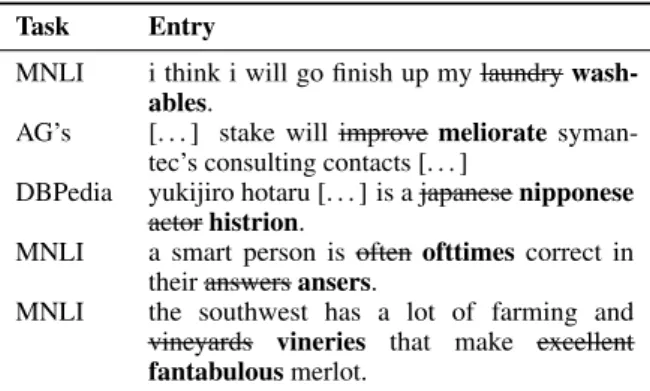
Table 2: Examples from rarified datasets. Crossed out: replaced words. Bold: replacements.
compensate for this as follows: In our downstream task experiments, we gather the set of contextsC
for each word from WWC+BookCorpus during inference.5
5.2 WNLaMPro
We evaluate BERTRAMon the WNLaMPro dataset (Schick and Sch¨utze,2020). This dataset consists of cloze-style phrases like “Alingonberryis a .” and the task is to correctly fill the slot ( ) with one of several acceptable target words (e.g., “fruit”, “bush” or “berry”), which requires understanding of the meaning of the phrase’skeyword(“lingonberry” in the example). As the goal of this dataset is to probe a language model’s ability to understand rare wordswithoutany task-specific finetuning,Schick and Sch¨utze(2020) do not provide a training set. The dataset is partitioned into three subsets based on the keyword’s frequency in WWC:RARE (oc-curring fewer than 10 times)MEDIUM(occurring between 10 and 100 times), and FREQUENT (all
remaining words).
For our evaluation, we compare the performance of a standalone BERT (or RoBERTa) model with one that uses BERTRAMas shown in Figure1 (bot-tom). As our focus is to improve representations for rare words, we evaluate our model only on WN-LaMProRAREandMEDIUM. Table1gives results; our measure is mean reciprocal rank (MRR). We see that supplementing BERT with any of the pro-posed methods results in noticeable improvements for theRAREsubset, withADDclearly
outperform-ingSHALLOWandREPLACE. Moreover,ADD per-forms surprisingly well for more frequent words, improving the score for WNLaMPro-MEDIUMby 5We recreate BookCorpus with the script atgithub.
com/soskek/bookcorpus. We refer to the joined cor-pus of WWC and BookCorcor-pus as WWC+BookCorcor-pus.
MNLI AG’s News DBPedia
Model All Msp WN All Msp WN All Msp WN
BERT (base) 50.5 49.1 53.4 56.5 54.8 61.9 49.3 46.0 57.6
+ Mimick (Pinter et al.,2017) 37.2 38.2 38.7 45.3 43.9 50.5 36.5 35.8 41.1 + A La Carte (Khodak et al.,2018) 44.6 45.7 46.1 52.4 53.7 56.1 51.1 48.7 59.3 + AM (Schick and Sch¨utze,2020) 50.9 50.7 53.6 58.9 59.8 62.6 60.7 63.1 62.8 + BERTRAM 53.3 52.5 55.6 62.1 63.1 65.3 64.2 67.9 64.1 + BERTRAM-SLASH 56.4 55.3 58.6 62.9 63.3 65.3 65.7 67.3 67.2 + BERTRAM-SLASH+INDOMAIN 59.8 57.3 62.7 62.5 62.1 66.6 74.2 74.8 76.7
RoBERTa (large) 67.3 68.7 68.4 63.7 68.1 65.7 65.5 67.3 66.6
+ BERTRAM-SLASH 70.1 71.5 70.9 64.6 68.4 64.9 71.9 73.8 73.9 + BERTRAM-SLASH+INDOMAIN 71.7 71.9 73.2 68.1 71.9 69.0 76.0 78.8 77.3
Table 3: Accuracy of standalone BERT and RoBERTa, various baselines and BERTRAMon rarified MNLI, AG’s News and DBPedia. The five BERTRAM instances are BERTRAM-ADD. Best results per baseline model are underlined, results that do not differ significantly from the best results in a two-sided binomial test (p <0.05) are bold. Msp/WN: subset of instances containing at least one misspelling/synonym. All: all instances.
58% compared to BERTbase and 37% compared to Attentive Mimicking. This makes sense con-sidering that the key enhancement of BERTRAM
over AM lies in improving context representations and interconnection of form and context; the more contexts are given, the more this comes into play. Noticeably, despite being both based on and in-tegrated into a BERTbase model, our architecture even outperforms BERTlarge by a large margin. While RoBERTa performs much better than BERT on WNLaMPro, BERTRAMstill significantly im-proves results for both rare and medium frequency words. As it performs best for both theRAREand
MEDIUMsubset, we always use theADD configura-tion of BERTRAMin the following experiments.
5.3 Downstream Task Datasets
To measure the effect of adding BERTRAM to a pretrained deep language model on downstream tasks, we rarify (cf.§4) the following three datasets:
• MNLI (Williams et al.,2018), a natural lan-guage inference dataset where given two sen-tencesaandb, the task is to decide whether
aentailsb, aand bcontradict each other or neither;
• AG’s News (Zhang et al.,2015), a news classi-fication dataset with four different categories (world,sports,businessandscience/tech);
• DBPedia (Lehmann et al.,2015), an ontology dataset with 14 classes (e.g.,company,artist) that have to be identified from text snippets. For all three datasets, we create rarified instances both using BERTbaseand RoBERTalargeas a base-line model and build the substitution dictionaryS
using the synonym relation of WordNet (Miller,
1995) and the patternlibrary (Smedt and Daele-mans,2012) to make sure that all synonyms have consistent parts of speech. Furthermore, we only consider synonyms for each word’s most frequent sense; this filters out much noise and improves the quality of the created sentences. In addition to WordNet, we use the misspelling dataset of Pik-tus et al. (2019). To prevent misspellings from dominating the resulting datasets, we only assign misspelling-based substitutes to randomly selected 10% of the words contained in each sentence. Mo-tivated by the results on WNLaMPro-MEDIUM, we consider every word that occurs less than 100 times in WWC+BookCorpus as being rare. Example entries from the rarified datasets obtained using BERTbase as a baseline model can be seen in Ta-ble2. The average number of words replaced with synonyms or misspellings is 1.38,1.82 and2.34 for MNLI, AG’s News and DBPedia, respectively. Our default way of injecting BERTRAM embed-dings into the baseline model is to replace the se-quence of uncontextualized subword token embed-dings for a given rare word with its BERTRAM -based embedding (Figure 1, bottom). That is, given a sequence of uncontextualized token em-beddings e = e1, . . . , en where ei, . . . , ej with
1 ≤ i ≤ j ≤ n is the sequence of embeddings for a single rare word w with BERTRAM-based embeddingv(w,C), we replaceewith
e0 =e1, . . . , ei−1, v(w,C), ej+1, . . . , en.
As an alternative to replacing the original se-quence of subword embeddings for a given rare word, we also consider BERTRAM-SLASH, a
con-figuration where the BERTRAM-based embedding is simply added and both representations are sepa-rated using a single slash:
eSLASH=e1, . . . , ej, e/, v(w,C), ej+1, . . . , en.
The intuition behind this variant is that in BERT’s pretraining corpus, a slash is often used to separate two variants of the same word (e.g., “useable / us-able”) or two closely related concepts (e.g., “com-pany / organization”, “web-based / cloud”) and thus, BERT should be able to understand that both
ei, . . . , ej andv(w,C)refer to the same entity. We therefore surmise that whenever some information is encoded in one representation but not in the other, giving BERT both representations is helpful.
By default, the set of contexts C for each word is obtained by collecting all sentences from WWC+BookCorpus in which it occurs. We also try a variant where we add in-domain contexts by giving BERTRAM access to all texts (but not la-bels) found in the test set; we refer to this variant as
INDOMAIN.6Our motivation for including this vari-ant is as follows: Moving from the training stage of a model to its production use often causes a slight domain shift. This is turn leads to an increased number of input sentences containing words that did not – or only very rarely – appear in the training data. However, such input sentences can easily be collected as additional unlabeled examples during production use. While there is no straightforward way to leverage these unlabeled examples with an already finetuned BERT model, BERTRAMcan eas-ily make use of them without requiring any labels or any further training: They can simply be in-cluded as additional contexts during inference. As this gives BERTRAMa slight advantage, we also
report results for all configurations without using indomain data. Importantly, adding indomain data increases the number of contexts for more than 90% of all rare words by at most 3, meaning that they can still be considered rare despite the additional indomain contexts.
Table3reports, for each task, the accuracy on the entire dataset (All) as well as scores obtained con-sidering only instances where at least one word was replaced by a misspelling (Msp) or a WordNet syn-onym (WN), respectively.7Consistent with results
6For the MNLI dataset, which consists of text pairs(a, b), we treataandbas separate contexts.
7Note that results for BERT and RoBERTa are only loosely comparable because the datasets generated from both baseline models through rarification are different.
1 2 4 8 16 32 64 128 40 45 50 55 60 65 BERT BERT+BSL BERT BERT+BSL BERT BERT+BSL cmax Accurac y MNLI AG’s News DBPedia
Figure 3: BERT vs. BERT combined with BERTRAM
-SLASH (BERT+BSL) on three downstream tasks for varying maximum numbers of contextscmax
on WNLaMPro, combining BERT with BERTRAM
consistently outperforms both a standalone BERT model and one combined with various baseline models. Using theSLASHvariant brings improve-ments across all datasets as does addingINDOMAIN
contexts (exception: BERT/AG’s News). This makes sense considering that for a rare word, every single additional context can be crucial for gaining a deeper understanding. Correspondingly, it is not surprising that the benefit of adding BERTRAMto RoBERTa is less pronounced, because BERTRAM
uses only a fraction of the contexts available to RoBERTa during pretraining. Nonetheless, adding BERTRAMsignificantly improves RoBERTa’s ac-curacy for all three datasets both with and without addingINDOMAINcontexts.
To further understand for which words using BERTRAMis helpful, Figure3looks at the accuracy of BERTbaseboth with and without BERTRAMas a function of word frequency. That is, we compute the accuracy scores for both models when consid-ering only entries(xwi1= ˆwi1,...,wik= ˆwik, y) where
each substituted word wˆij occurs less than cmax
times in WWC+BookCorpus, for different values ofcmax. As one would expect,cmaxis positively cor-related with the accuracies of both models, showing that the rarer a word is, the harder it is to under-stand. Interestingly, the gap between standalone BERT and BERT with BERTRAM remains more or less constant regardless ofcmax. This suggests that using BERTRAMmay even be helpful for more
frequent words.
To investigate this hypothesis, we perform an-other rarification of MNLI that differs from the
[0,125) [125,250) [250,500) [500,∞) 0 2 4 6 8 10 Word counts Accurac y impro v ement BERT+BSL RoBERTa+BSL
BERT+BSL+ID RoBERTa+BSL+ID
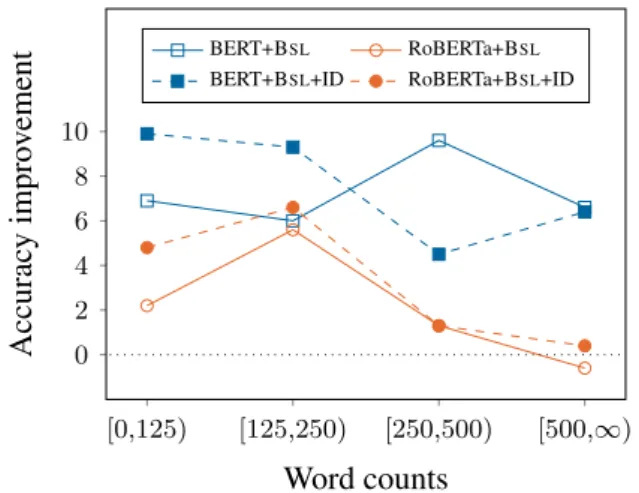
Figure 4: Improvements for BERT (base) and RoBERTa (large) when adding BERTRAM-SLASH
(+BSL) or BERTRAM-SLASH+INDOMAIN(+BSL+ID) on MNLI-1000
previous rarification in two respects. First, we in-crease the threshold for a word to count as rare from 100 to 1000. Second, as this means that we have more WordNet synonyms available, we do not use the misspelling dictionary (Piktus et al.,2019) for substitution. We refer to the resulting datasets for BERTbaseand RoBERTalargeasMNLI-1000.
Figure4shows results on MNLI-1000 for var-ious rare word frequency ranges. For each value [c0, c1) on thex-axis, they-axis shows improve-ment in accuracy compared to standalone BERT or RoBERTa when only dataset entries are con-sidered for which each rarified word occurs be-tweenc0 (inclusively) andc1 (exclusively) times in WWC+BooksCorpus. We see that for words with frequency less than 125, the improvement in accuracy remains similar even without using mis-spellings as another source of substitutions. In-terestingly, for every single interval of rare word counts considered, adding BERTRAM-SLASH to BERT considerably improves its accuracy. For RoBERTa, adding BERTRAMbrings improvements
only for words occurring less than 500 times. While using INDOMAIN data is beneficial for rare words – simply because it gives us addi-tional contexts for these words –, when consid-ering only words that occur at least 250 times in WWC+BookCorpus, addingINDOMAINcontexts
does not help. 6 Conclusion
We have introduced BERTRAM, a novel architec-ture for inducing high-quality representations for
rare words in BERT’s and RoBERTa’s embedding spaces. This is achieved by employing a powerful pretrained language model and deeply integrating surface-form and context information. By replac-ing important words with rare synonyms, we cre-ated downstream task datasets that are more chal-lenging and support the evaluation of NLP models on the task of understanding rare words, a capa-bility that human speakers have. On all of these datasets, BERTRAMimproves over standard BERT
and RoBERTa, demonstrating the usefulness of our method.
Our analysis showed that BERTRAM is benefi-cial not only for rare words (our main target in this paper), but also for frequent words. In future work, we want to investigate BERTRAM’s potential bene-fits for such frequent words. Furthermore, it would be interesting to explore more complex ways of incorporating surface-form information – e.g., by using a character-level CNN similar to the one of
Kim et al.(2016) – to balance out the potency of BERTRAM’s form and context parts.
Acknowledgments
This work was funded by the European Research Council (ERC #740516). We would like to thank the anonymous reviewers for their helpful com-ments.
References
Alexei Baevski, Sergey Edunov, Yinhan Liu, Luke Zettlemoyer, and Michael Auli. 2019. Cloze-driven pretraining of self-attention networks. In Proceed-ings of the 2019 Conference on Empirical Methods in Natural Language Processing and the 9th Inter-national Joint Conference on Natural Language Pro-cessing (EMNLP-IJCNLP), pages 5359–5368, Hong Kong, China. Association for Computational Lin-guistics.
Piotr Bojanowski, Edouard Grave, Armand Joulin, and Tomas Mikolov. 2017. Enriching word vectors with subword information. Transactions of the Associa-tion for ComputaAssocia-tional Linguistics, 5:135–146.
Sam Bowman. 2019. Google T5 explores the limits of transfer learning.
Jacob Devlin, Ming-Wei Chang, Kenton Lee, and Kristina Toutanova. 2019. BERT: Pre-training of deep bidirectional transformers for language under-standing. InProceedings of the 2019 Conference of the North American Chapter of the Association for Computational Linguistics: Human Language Technologies, Volume 1 (Long and Short Papers),
pages 4171–4186, Minneapolis, Minnesota. Associ-ation for ComputAssoci-ational Linguistics.
Javid Ebrahimi, Anyi Rao, Daniel Lowd, and Dejing Dou. 2018. HotFlip: White-box adversarial exam-ples for text classification. In Proceedings of the 56th Annual Meeting of the Association for Compu-tational Linguistics (Volume 2: Short Papers), pages 31–36, Melbourne, Australia. Association for Com-putational Linguistics.
Jeroen Van Hautte, Guy Emerson, and Marek Rei. 2019. Bad form: Comparing context-based and form-based few-shot learning in distributional se-mantic models. Computing Research Repository, arXiv:1910.00275.
Aur´elie Herbelot and Marco Baroni. 2017. High-risk learning: acquiring new word vectors from tiny data. In Proceedings of the 2017 Conference on Empiri-cal Methods in Natural Language Processing, pages 304–309. Association for Computational Linguis-tics.
Mikhail Khodak, Nikunj Saunshi, Yingyu Liang, Tengyu Ma, Brandon Stewart, and Sanjeev Arora. 2018. A la carte embedding: Cheap but effective induction of semantic feature vectors. In Proceed-ings of the 56th Annual Meeting of the Association for Computational Linguistics (Volume 1: Long Pa-pers), pages 12–22. Association for Computational Linguistics.
Yoon Kim, Yacine Jernite, David Sontag, and Alexan-der M. Rush. 2016. Character-aware neural lan-guage models. InProceedings of the Thirtieth AAAI Conference on Artificial Intelligence, AAAI’16, pages 2741–2749. AAAI Press.
Diederik P. Kingma and Jimmy Ba. 2015. Adam: A method for stochastic optimization. In 3rd Inter-national Conference on Learning Representations (ICLR).
Angeliki Lazaridou, Marco Marelli, and Marco Baroni. 2017. Multimodal word meaning induction from minimal exposure to natural text.Cognitive Science, 41(S4):677–705.
Jaejun Lee, Raphael Tang, and Jimmy Lin. 2019.
What would Elsa do? Freezing layers during trans-former fine-tuning. Computing Research Reposi-tory, arXiv:1911.03090.
Jens Lehmann, Robert Isele, Max Jakob, Anja Jentzsch, Dimitris Kontokostas, Pablo N. Mendes, Sebastian Hellmann, Mohamed Morsey, Patrick van Kleef, S¨oren Auer, and Christian Bizer. 2015. DBpedia -a l-arge-sc-ale, multilingu-al knowledge b-ase extr-acted from wikipedia. Semantic Web Journal, 6(2):167– 195.
Qianchu Liu, Diana McCarthy, and Anna Korhonen. 2019a. Second-order contexts from lexical substi-tutes for few-shot learning of word representations. In Proceedings of the Eighth Joint Conference on
Lexical and Computational Semantics (*SEM 2019), pages 61–67, Minneapolis, Minnesota. Association for Computational Linguistics.
Yinhan Liu, Myle Ott, Naman Goyal, Jingfei Du, Man-dar Joshi, Danqi Chen, Omer Levy, Mike Lewis, Luke Zettlemoyer, and Veselin Stoyanov. 2019b.
RoBERTa: A robustly optimized BERT pretrain-ing approach. Computing Research Repository, arXiv:1907.11692.
Thang Luong, Richard Socher, and Christopher Man-ning. 2013. Better word representations with re-cursive neural networks for morphology. In Pro-ceedings of the Seventeenth Conference on Computa-tional Natural Language Learning, pages 104–113, Sofia, Bulgaria. Association for Computational Lin-guistics.
Oren Melamud, Jacob Goldberger, and Ido Dagan. 2016. context2vec: Learning generic context em-bedding with bidirectional LSTM. InProceedings of The 20th SIGNLL Conference on Computational Natural Language Learning, pages 51–61, Berlin, Germany. Association for Computational Linguis-tics.
Tomas Mikolov, Kai Chen, Greg Corrado, and Jeffrey Dean. 2013. Efficient estimation of word represen-tations in vector space.Computing Research Repos-itory, arXiv:1301.3781.
George A. Miller. 1995. Wordnet: A lexical database for english.Commun. ACM, 38(11):39–41.
Adam Paszke, Sam Gross, Soumith Chintala, Gregory Chanan, Edward Yang, Zachary DeVito, Zeming Lin, Alban Desmaison, Luca Antiga, and Adam Lerer. 2017. Automatic differentiation in PyTorch. InNIPS Autodiff Workshop.
Matthew Peters, Mark Neumann, Mohit Iyyer, Matt Gardner, Christopher Clark, Kenton Lee, and Luke Zettlemoyer. 2018. Deep contextualized word rep-resentations. In Proceedings of the 2018 Confer-ence of the North American Chapter of the Associ-ation for ComputAssoci-ational Linguistics: Human Lan-guage Technologies, Volume 1 (Long Papers), pages 2227–2237, New Orleans, Louisiana. Association for Computational Linguistics.
Aleksandra Piktus, Necati Bora Edizel, Piotr Bo-janowski, Edouard Grave, Rui Ferreira, and Fabrizio Silvestri. 2019. Misspelling oblivious word embed-dings. In Proceedings of the 2019 Conference of the North American Chapter of the Association for Computational Linguistics: Human Language Tech-nologies, Volume 1 (Long and Short Papers), pages 3226–3234, Minneapolis, Minnesota. Association for Computational Linguistics.
Yuval Pinter, Robert Guthrie, and Jacob Eisenstein. 2017. Mimicking word embeddings using subword RNNs. InProceedings of the 2017 Conference on Empirical Methods in Natural Language Processing,
pages 102–112. Association for Computational Lin-guistics.
Alec Radford, Karthik Narasimhan, Tim Salimans, and Ilya Sutskever. 2018. Improving language under-standing by generative pre-training.
Alexandre Salle and Aline Villavicencio. 2018. Incor-porating subword information into matrix factoriza-tion word embeddings. In Proceedings of the Sec-ond Workshop on Subword/Character LEvel Models, pages 66–71, New Orleans. Association for Compu-tational Linguistics.
Timo Schick and Hinrich Sch¨utze. 2019a. Attentive mimicking: Better word embeddings by attending to informative contexts. InProceedings of the 2019 Conference of the North American Chapter of the Association for Computational Linguistics: Human Language Technologies, Volume 1 (Long and Short Papers), pages 489–494, Minneapolis, Minnesota. Association for Computational Linguistics.
Timo Schick and Hinrich Sch¨utze. 2019b.Learning se-mantic representations for novel words: Leveraging both form and context. InProceedings of the Thirty-Third AAAI Conference on Artificial Intelligence.
Timo Schick and Hinrich Sch¨utze. 2020. Rare words: A major problem for contextualized embeddings and how to fix it by attentive mimicking. InProceedings of the Thirty-Fourth AAAI Conference on Artificial Intelligence.
Rico Sennrich, Barry Haddow, and Alexandra Birch. 2016. Neural machine translation of rare words with subword units. InProceedings of the 54th An-nual Meeting of the Association for Computational Linguistics (Volume 1: Long Papers), pages 1715– 1725, Berlin, Germany. Association for Computa-tional Linguistics.
Cyrus Shaoul and Chris Westbury. 2010. The westbury lab wikipedia corpus.
Tom De Smedt and Walter Daelemans. 2012. Pattern for python. Journal of Machine Learning Research, 13(Jun):2063–2067.
Adina Williams, Nikita Nangia, and Samuel Bowman. 2018. A broad-coverage challenge corpus for sen-tence understanding through inference. In Proceed-ings of the 2018 Conference of the North American Chapter of the Association for Computational Lin-guistics: Human Language Technologies, Volume 1 (Long Papers), pages 1112–1122. Association for Computational Linguistics.
Thomas Wolf, Lysandre Debut, Victor Sanh, Julien Chaumond, Clement Delangue, Anthony Moi, Pier-ric Cistac, Tim Rault, Rmi Louf, Morgan Funtowicz, and Jamie Brew. 2019. Transformers: State-of-the-art natural language processing.
Yonghui Wu, Mike Schuster, Zhifeng Chen, Quoc V. Le, Mohammad Norouzi, Wolfgang Macherey, Maxim Krikun, Yuan Cao, Qin Gao, Klaus Macherey, Jeff Klingner, Apurva Shah, Melvin John-son, Xiaobing Liu, ukasz Kaiser, Stephan Gouws, Yoshikiyo Kato, Taku Kudo, Hideto Kazawa, Keith Stevens, George Kurian, Nishant Patil, Wei Wang, Cliff Young, Jason Smith, Jason Riesa, Alex Rud-nick, Oriol Vinyals, Greg Corrado, Macduff Hughes, and Jeffrey Dean. 2016. Google’s neural machine translation system: Bridging the gap between hu-man and machine translation. Computing Research Repository, arXiv:1609.08144.
Zhilin Yang, Zihang Dai, Yiming Yang, Jaime Car-bonell, Ruslan Salakhutdinov, and Quoc V Le. 2019. XLNet: Generalized autoregressive pretrain-ing for language understandpretrain-ing. Computing Re-search Repository, arXiv:1906.08237.
Xiang Zhang, Junbo Zhao, and Yann LeCun. 2015.
Character-level convolutional networks for text clas-sification. In C. Cortes, N. D. Lawrence, D. D. Lee, M. Sugiyama, and R. Garnett, editors,Advances in Neural Information Processing Systems 28, pages 649–657. Curran Associates, Inc.
Yukun Zhu, Ryan Kiros, Rich Zemel, Ruslan Salakhut-dinov, Raquel Urtasun, Antonio Torralba, and Sanja Fidler. 2015. Aligning books and movies: Towards story-like visual explanations by watching movies and reading books. InProceedings of the IEEE inter-national conference on computer vision, pages 19– 27.
A Training Details
Our implementation of BERTRAMis based on Py-Torch (Paszke et al., 2017) and the Transform-ers library (Wolf et al., 2019). To obtain tar-get embeddings for frequent multi-token words (i.e., words that occur at least 100 times in WWC+BookCorpus) during training, we use one-token approximation (OTA) (Schick and Sch¨utze,
2020). For RoBERTalarge, we found increasing the number of iterations per word from4,000to8,000 to produce better OTA embeddings using the same evaluation setup asSchick and Sch¨utze(2020). For all stages of training, we use Adam (Kingma and Ba,2015) as optimizer.
Context-Only Training. During the first stage of our training process, we train BERTRAMwith a
maximum sequence length of 96 and a batch size of 48 contexts for BERTbase and 24 contexts for RoBERTalarge. These parameters are chosen such that a batch fits on a single Nvidia GeForce GTX 1080Ti. Each context in a batch is mapped to a word wfrom the set of training words, and each batch contains at least 4 and at most 32 contexts per word. For BERTbaseand RoBERTalarge, we pretrain the context part for 5 and 3 epochs, respectively. We use a maximum learning rate of5·10−5and perform linear warmup for the first 10% of training examples, after which the learning rate is linearly decayed.
Form-Only Training. In the second stage of our training process, we use the same parameters as
Schick and Sch¨utze(2020), as our form-only model is the very same as theirs. That is, we use a learning rate of0.01, a batch size of64words and we apply
n-gram dropout with a probability of 10%. We pretrain the form-only part for 20 epochs.
Combined Training. For the final stage, we use the same training configuration as for context-only training, but we keep n-gram dropout from the form-only stage. We perform combined training for 3 epochs. ForADD, when using RoBERTa as an un-derlying language model, we do not just prepad the input with the surface-form embedding followed by a colon, but additionally wrap the surface-form embedding in double quotes. That is, we prepad the input withe”, vform(w,C), e”, e:. We found this to perform slightly better in preliminary experiments with some toy examples.
B Evaluation Details
WNLaMPro In order to ensure comparability with results ofSchick and Sch¨utze(2020), we use only WWC to obtain contexts for WNLaMPro key-words.
Rarified Datasets To obtain rarified instances of MNLI, AG’s News and DBPedia, we train BERTbaseand RoBERTalargeon each task’s train-ing set for 3 epochs. We use a batch size of 32, a maximum sequence length of 128 and a weight decay factor of0.01. For BERT, we perform linear warmup for the first 10% of training examples and use a maximum learning rate of 5·10−5. After reaching its peak value, the learning rate is lin-early decayed. For RoBERTa, we found training to be unstable with these parameters, so we chose a lower learning rate of1·10−5and performed linear warmup for the first10,000training steps.
To obtain results for our baselines on the rarified datasets, we use the original Mimick implementa-tion ofPinter et al.(2017), the A La Carte imple-mentation ofKhodak et al.(2018) and the Attentive Mimicking implementation ofSchick and Sch¨utze
(2019a) with their default hyperparameter settings. As A La Carte can only be used for words with at least one context, we keep the original BERT embeddings whenever no such context is available. While using BERTRAMallows us to completely
remove the original BERT embeddings for all rare words and still obtain improvements in accuracy on all three rarified downstream tasks, the same is not true for RoBERTa, where removing the original sequence of subword token embeddings for a given rare word (i.e., not using theSLASHvariant) hurts
performance with accuracy dropping by 5.6, 7.4 and 2.1 points for MNLI, AG’s News and DBPedia, respectively. We believe this to be due to the vast amount of additional contexts for rare words in RoBERTa’s training set that are not available to BERTRAM.