
Model Order Reduction by Routh Stability
Array with Stability Equation Method for SISO
and MIMO Systems
D. K. Sambariya
∗,
A. S. Rajawat
Department of Electrical Engineering, Rajasthan Technical University, Kota, 324010, India
Copyright c⃝2016 by authors, all rights reserved. Authors agree that this article remains permanently
open access under the terms of the Creative Commons Attribution License 4.0 International License
Abstract
In this paper, the technique applicable to reduce a high-order system to a low-order system is presented. The methods used are Routh stability array (RSA) method and stability equation (SE) method to get the reduced model of systems. The application of the techniques is examined over SISO linear time invariant systems and extended to MIMO systems. The step response performance of the reduced models gets compared to the original system as well as reduced models in literature in terms of rise-time, settling-time, peak-time and peak of the system. The comparative study reveals that the performances of the reduced models using proposed RSA and SE methods are encouraging as compared to that of with reduced models in literature.Keywords
Linear Time Invariant (LTI), Model Order Reduction (MOR), Single-Input Single-output (SISO) System, Multi-input Multi-output (MIMO), Routh Stability Array (RSA) Method, Stability Equa-tion (SE) Method, High-order System (HOS)1
Introduction
Nowadays, system becomes very complicated, tedious & costly by increases the use of some external control-ling devices and the calculation, complexity, cost be-comes major factor and also creates a problem for an-alyst or programmer to solve those high-order system (HOS) problems [1, 2]. The dynamic stable systems with least cost, minimum complexity, better character-istics, ease in operation, and low time computation re-quirements are known as the most economical system. Several techniques have been considered for reduction of high-order LTI models into the lower-order models to re-duced system complexity, cost-effectiveness as compared to the original system [3].
All the control system and power system networks de-fined in MATLAB using a block diagram in SIMULINK portion may represent a higher-order transfer function for that system [4]. This transfer function for the sim-plicity or for ease of operation must be reduced to a lower-order transfer function using a reduction tech-nique prevalent in literature such as Routh approxima-tion [5], Pade approximaapproxima-tion [6], Routh-Pade method [7, 8], Stability equation method [9, 10, 11, 12], Dif-ferentiation method [2, 3, 4, 13], Routh Stability array method [10, 14], pole clustering [15], integral square er-ror method [1] and/or based on soft computing tech-niques such as genetic algorithm (GA) [16, 17], parti-cle swarm optimization (PSO) [18, 19], bat algorithm (BA)[1] and Harmony search algorithm [7] etc.
In Routh approximation, the reciprocals of the co-efficients for both numerator and denominator polyno-mial’s alpha (for denominator) and beta (for numera-tor) tables. The reduced order model is determined and reconsidered for reciprocal of their coefficients to calcu-late final decreased model using Routh approximation method [20]. In differentiation method, the first re-ciprocal coefficients are determined for both numerator and denominator polynomials until the desired reduced model is obtained [4]. The application of model order reduction techniques have been considered for reduction of single-machine infinite-bus (SMIB) power system in [21, 20, 10, 22, 23].
In this paper, a mixed technique is used for deduc-tion of the high-order problem to lower order model 2nd or 3rd order system. The reduction topologies are considered in order to make the hybrid technique. These are Routh Stability Array (RSA) [27], and Sta-bility Equation methods are considered. The numera-tor of the system is reduced using RSA method, while the denominator is reduced using SE method. As an example, four problems are considered with three on single-input single-output (SISO) and one on multi-input multi-output (MIMO) systems.
The rest of paper is arranged within fix sections. Problem formulation in shows in section 2. Detailed description of RSA-MOR described in section 3. De-scription of stability equation method explained in sec-tion 4. All four examples on SISO and MIMO systems are explained in section 5. It includes the comparative study of the reduced systems in literature and that of with proposed methods. Finally the paper is concluded in section 6 followed by references.
2
Problem formulation
Let annthhigh-order transfer functionG(s) given
be-low in Eq. 1.
G(s) =
n∑−1
i=0
aisi
n ∑ i=0
bisi
(1)
where,
• G(s); indicates anthhigh-order system,
• ai&bi; indicates scalar constants of original
trans-fer function
This high order transfer function is reduced by RSA-MOR method ofrthorder represented as in Eq. 2.
R(s) =
r∑−1
j=0
cjsj
r ∑
j=0
djsj
(2)
where,
• R(s); indicates a rth reduced order system,
• cj &dj; indicates scalar constants of reduced order
system
This reduced model having maximum properties of orig-inal functionG(s) for same type of inputs.
3
Routh Stability Array
This method uses the generation of Routh array by us-ing coefficients of givennth high-order polynomial of a
problem. First, two rows indicate generated rows, hav-ing the coefficients of original HOS. After that all the rows known as computed rows derived from previous
Table 1. Generating Rows
a0 a1 a2 a3 · · ·
b0 b1 b2 b3 · · ·
Table 2. Computing Rows
c0 c1 c2 c3 · · ·
d0 d1 d2 d3 · · ·
two rows [4]. First row of generated rows indicates 1st,
3rd, 5th, ... order coefficients and second rows indicate
2nd, 4th, 6th,...order coefficients. Consider an nth order polynomial HOS P(s) is given below as in Eq. 3
P(s) =a0sn+b0s(n−1)+a1s(n−2)+b1s(n−3)+· · · (3)
Routh Array method is popular for determining the sta-bility of high order polynomial system.
Above given Table 1, which indicates generated rows easily understandable by Eq. 3, whereas Table 2 indi-cates computed rows explained below by mathematical procedure used in Eq. 4.
c0=b0a1b−a0b1
0 c1=
b0a2−a0b2
b0
d0= c0b1c−b0c1
0 d1=
c0b2−b0c2
c0
(4)
wherea0,a1,· · · andb0,b1,· · · etc. are the coefficients
of generated rows of original system andd0,d1,· · · and
c0,c1,· · · are the coefficients of computed rows derived
from just previous two rows.
3.1
Reduction methodology
Let the high-order transfer function for a SISO system is shown as in Eq. 5.
G(s) =b11s
m+b
21s(m−1)+b12s(m−2)+b22s(m−3)+· · ·
a11sn+a21s(n−1)+a12s(n−2)+a22s(n−3)+· · ·
(5) where,
• G(s), indicates HOS transfer function, • n, indicates order of denominator of HOS, • m, indicates order of numerator of HOS
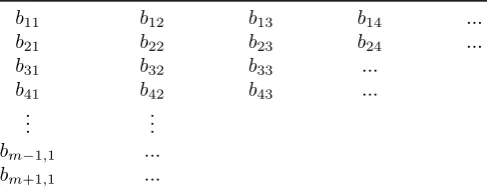
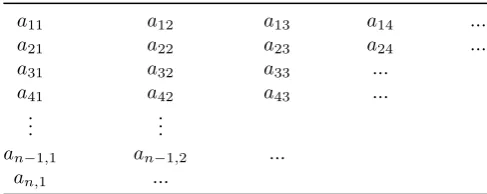
[image:2.595.297.541.726.820.2]The table for numerator and denominator are derived according to Eq. 5 and is mentioned in Table 3 and Table 4.
Table 3. Routh stability array for numerator
b11 b12 b13 b14 ...
b21 b22 b23 b24 ...
b31 b32 b33 ...
b41 b42 b43 ...
..
. ...
bm−1,1 ...
Table 4. Routh stability array for denominator
a11 a12 a13 a14 ...
a21 a22 a23 a24 ...
a31 a32 a33 ...
a41 a42 a43 ...
..
. ...
an−1,1 an−1,2 ...
an,1 ...
The computed rows can be calculated by using follow-ing algorithm given as in Eq. 6.
cij =ci−2,j+2−
ci−2,1.ci−1,j+1
ci−1,1
(6) It holds for i ≥3 and i ≤ n−21+3. In RSA method, if the first two rows known then the reduced model can be calculated by applying algorithm formula for computed rows. The transfer function forn−1 reduced system can be calculate by second generated row and first computed rows as in Eq. 7.
Gn−1(s) =
b21s(m−1)+b31s(m−2)+b22s(m−3)+· · ·
a21s(m−1)+a31s(m−2)+a22s(m−3)+· · ·
(7) The reduced model of required order as 2nd, 3rd, · · ·,
etc. by applying this general formula applied which is given as in Eq. 8.
Rk(s) =
bm+2−k,0s(k−1)+bm+3−k,1s(k−2)+· · ·
an+1−k,1sk+an+2−k,1s(k−1)+· · ·
(8)
4
Stability equation method
In this method, a general phenomenon is used to con-struct reduced model of 2nd or 3rd order from given in
high order system. Stability equation method is based on elimination of high order terms in each step. Let consider a transfer function havingnthorder high order polynomial function which is given below in Eq. 9.
G(s) =bms
m+b
(m−1)s(m−1)+...+b1s+b0
ansn+a(n−1)s(n−1)+...+a1s+a0
(9)
G(s) =N(s)
D(s) (10)
where, n≥m. In Eq. 10, N(s) and D(s) are the nu-merator, denominator part respectively. Each numera-tor and denominanumera-tor portion divided into two parts as even and another is odd. The numerator can be repre-sented in even and odd terms asN(s) =Ne(s) +No(s)
and the denominator can be represented as D(s) = De(s) +Do(s). Therefore, theG(s) can be written as in
Eq. 11.
G(s) = Ne(s) +N0(s) De(s) +Do(s)
(11) The even and odd terms of the polynomial are written as in Eq. 12 and Eq. 13. where,
Ne(s) = m ∑
i=0,2,4
bisi (12)
No(s) = m ∑
i=1,3,5
bisi (13)
These two equations are known as stability equation of N(s) andD(s). In this method, we reduce a high order polynomial system by successively discarding the least significant factors from N(s) as well as D(s). In each step some unwanted or least significant terms are elim-inated which can be understood by using mathematical explanation given below from Eq. 14 - 23.
D(s) =De(s)+Do(s) (14)
The expression for even and odd parts of the denomina-tor can be written as in Eq. 15 and Eq. 16.
De(s) =ao+ a2s2+ a4s4+· · · (15)
Do(s) =a1+ a3s3+ a5s5+· · · (16)
These may be written as
De(s) =ao k1
∏
i=1
(1 + s
2
zi2
) (17)
Do(s) =a1s k2
∏
i=1
(1 + s
2
pi2
) (18)
Wherek1andk2are integer parts ofn/2 and (n−2)/2,
respectively andz12< p12< z22< p22by discarding the
factors with larger magnitude of zi andpi, the reduced
stability equations of desired orderr become as Der(s) =ao
r1
∏
i=1
(1 + s
2
zi2
) (19)
Dor(s) =a1 r2
∏
i=1
(1 + s
2
pi2
) (20)
where, r1 and r2 are the integer parts of r/2 and (r−
1)/2, respectively. The reduced denominator of formed as
Dr(s) =Der(s) + Dor(s) (21)
The numerator is reduced similarly and we obtain Nr(s) =Ner(s) + Nor(s) (22)
The reduced orderR(s) is given by R(s) = Ner(s) +Nor(s)
Dor(s) +Der(s)
(23)
5
Illustrative Examples
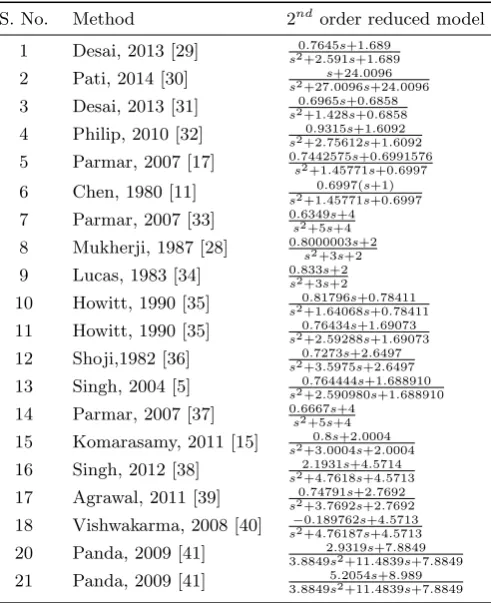
Table 5. Reduced models in literature for system in Example-1 [28]
S. No. Method 2ndorder reduced model
1 Desai, 2013 [29] 0.7645s+1.689
s2+2.591s+1.689
2 Pati, 2014 [30] s2+27s.+240096.0096s+24.0096
3 Desai, 2013 [31] s20+1.6965.428s+0s+0.6858.6858
4 Philip, 2010 [32] s2+20.9315.75612s+1s+1.6092.6092
5 Parmar, 2007 [17] 0.7442575s+0.6991576
s2+1.45771s+0.6997
6 Chen, 1980 [11] s2+10..457716997(ss+1)+0.6997
7 Parmar, 2007 [33] 0.6349s+4
s2+5s+4
8 Mukherji, 1987 [28] 0.8000003s2+3s+2s+2
9 Lucas, 1983 [34] 0s.2833+3ss+2+2
10 Howitt, 1990 [35] s20+1.81796.64068s+0s+0.78411.78411
11 Howitt, 1990 [35] 0.76434s+1.69073
s2+2.59288s+1.69073
12 Shoji,1982 [36] 0.7273s+2.6497
s2+3.5975s+2.6497
13 Singh, 2004 [5] 0.764444s+1.688910
s2+2.590980s+1.688910
14 Parmar, 2007 [37] 0.6667s+4
s2+5s+4
15 Komarasamy, 2011 [15] s2+30..80004s+2s.0004+2.0004
16 Singh, 2012 [38] s22+4.1931.7618s+4s+4.5714.5713
17 Agrawal, 2011 [39] s20+3.74791.7692s+2s+2.7692.7692
18 Vishwakarma, 2008 [40] −0.189762s+4.5713
s2+4.76187s+4.5713
20 Panda, 2009 [41] 2.9319s+7.8849
3.8849s2+11.4839s+7.8849
21 Panda, 2009 [41] 5.2054s+8.989
[image:4.595.43.289.122.424.2]3.8849s2+11.4839s+7.8849
Table 6. Denominator array using Routh stability array method
s4 1 35 24
s3 10 50 0
s2 30 24
s1 42 0
s0 24
5.1
Example-1
A fourth order SISO system is considered as presented in Eq. 24 [28].
G4(s) =
s3+ 7s2+ 24s+ 24
s4+ 10s3+ 35s2+ 50s+ 24 (24)
5.1.1 ROM in literature
The authors have screened the literature for second order reduced models using different techniques of the system. The reduced models reported in literature are summarized in Table 5.
5.1.2 Proposed RSA based ROM
The RSA method applied on given problem shown in Eq. 24, on the basis of Routh stability array for both denominator in Table 6 and numerator in Table 7 com-puted terms gives the result as shown in Eq. 25.
R2(s) =
20.57143s+ 24
[image:4.595.41.289.457.517.2]30s2+ 42s+ 24 (25)
Table 7. Numerator array using Routh stability array method
s3 1 24
s2 7 24
s1 20.57143 0
s0 24
5.1.3 Proposed hybrid RSA and SE based ROM
The prposed method includes use of Routh stabil-ity array method for numerator and stabilstabil-ity equation method determine the reduced order model. The RSA is used for reduced numerator and SE for reduced de-nominator. The numerator using RSA is given by Eq. 26 and the denominator using stability equation method is shown in Eq. 27. The reduced second order reduced model is given as in Eq. 28.
Nr(s) = 20.57143s+ 24 (26)
Dr(s) = 35s2+ 50s+ 24 (27)
R2(s) =
Nr(S)
Dr(S)
= 20.57143s+ 24
35s2+ 50s+ 24 (28)
5.1.4 Results and discussion
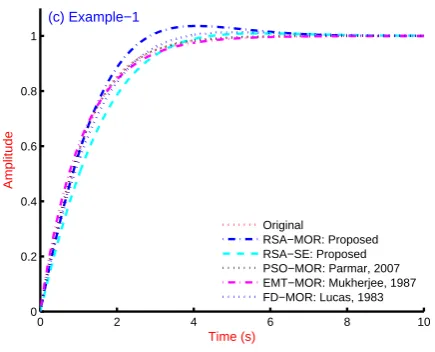
The step response of the original system (as in Eq. 24, reduced order model in literature (as in Table 5) and that of with proposed (as in Eq. 25 and Eq. 28) are compared in terms of rise-time, settling-time, peak-time and peak as enlisted in Table 8. The step response of these systems are compared in Fig. 1 Fig. 7.
0 2 4 6 8 10
0 0.2 0.4 0.6 0.8 1
Time (s)
Amplitude
(a) Example−1
Original
RSA−MOR: Proposed RSA−SE: Proposed GA−MOR: Desai, 2013 Conv−MOR: Pati, 2014 BBBC−MOR: Desai, 2013
Figure 1. Step response of original system [28], Proposed ROM using RSA (Eq. 25), Proposed ROM using RSA and SE (Eq. 28), MOR in literature such as GA-MOR [29], Conv-MOR [30] and BBBC-MOR [31]
[image:4.595.307.526.497.667.2]Table 8. Comapartive analysis of step response of original system, methods used in literature and proposed models for Example- I
Method Rise Settling Peak Peak
Time (s) Time (s) Time (s)
Original 2.2602 3.9307 6.9770 0.9991
Proposed RSA 1.9266 5.5869 4.0468 1.0359
Proposed RSA-SE 2.5389 3.7673 5.7285 1.0089
Desai, 2013 [29] 2.2616 3.8443 9.6778 1.0000
Pati, 2014 [30] 2.3875 4.2478 8.4934 0.9996
Desai, 2013 [31] 2.2716 3.3278 5.1430 1.0132
Philip, 2010 [32] 2.5288 4.5538 9.9334 0.9998
Parmar, 2007 [17] 2.1889 3.2202 4.9662 1.0122
Chen, 1980 [11] 2.3010 3.4111 5.2541 1.0107
Parmar, 2007 [33] 2.2694 4.0271 7.8163 0.9995
Mukherji, 1987 [28] 2.3413 4.0916 7.8163 0.9995
Lucas, 1983 [34] 2.3199 4.0643 7.8163 0.9995
Howitt, 1990 [35] 2.2550 3.5767 5.8832 1.0030
Howitt, 1990 [35] 2.2617 3.8449 9.6708 1.0000
Shoji,1982 [36] 2.2626 3.9618 7.5639 0.9995
Singh, 2004 [5] 2.2617 3.8446 9.6779 1.0000
Parmar, 2007 [37] 2.2645 4.0177 7.8163 0.9996
Komarasamy, 2011 [15] 2.3413 4.0915 7.8163 0.9995
Singh, 2012 [38] 1.3117 2.5404 4.3566 0.9983
Agrawal, 2011 [39] 2.2991 4.0453 7.8163 0.9995
Vishwakarma, 2008 [40] 1.8370 3.3411 5.7019 0.9991
Panda, 2009 [41] 2.2687 3.9175 7.2078 0.9994
Panda, 2009 [41] 1.9442 3.5022 6.7240 1.1393
0 2 4 6 8 10
0 0.2 0.4 0.6 0.8 1
Time (s)
Amplitude
(b) Example−1
Original
RSA−MOR: Proposed RSA−SE: Proposed BBBC−MOR: Philip, 2010 GA−MOR: Parmar, 2007 SE−MOR: Chen, 1980
Figure 2. Step response of original system [28], Proposed ROM using RSA (Eq. 25), Proposed ROM using RSA and SE (Eq. 28), MOR in literature such as BBBC-MOR [32], GA-MOR [17] and SE-MOR [11]
stability equation based SE-MOR [11], particle swarm optimization based PSO-MOR [18, 42], error minimiza-tion based EMT-MOR [28], factor division based FD-MOR [34, 37], integral square minimization based ISE-MOR [35, 5], iterative algorithm based Iter-ISE-MOR [36], PC-MOR [15, 38, 40], and clustering based Clus-MOR [39].
It could be easy to say that the proposed hybrid method based reduced order model is reflecting early settling to steady state as compared to original system and the RSA based reduced model. The peak value at-tained by the hybrid method based reduced model is
0 2 4 6 8 10
0 0.2 0.4 0.6 0.8 1
Time (s)
Amplitude
(c) Example−1
Original
RSA−MOR: Proposed RSA−SE: Proposed PSO−MOR: Parmar, 2007 EMT−MOR: Mukherjee, 1987 FD−MOR: Lucas, 1983
Figure 3. Step response of original system [28], Proposed ROM using RSA (Eq. 25), Proposed ROM using RSA and SE (Eq. 28), MOR in literature such as PSO-MOR [18], EMT-MOR [28] and FD-MOR [34]
lesser as compared to RSA and Original, as well.
5.2
Example-2
Considering another 4th order system as reported in [43] and presented in Eq. 29.
G4(s) =
4.269s3+ 5.10s2+ 3.9672s+ 0.9567
4.39992s4+ 9.0635s3+ 8.021s2+ 5.362s+ 1
[image:5.595.323.541.428.604.2]0 2 4 6 8 10 0
0.2 0.4 0.6 0.8 1
Time (s)
Amplitude
(d) Example−1
Original
[image:6.595.58.273.102.278.2]RSA−MOR: Proposed RSA−SE: Proposed ISE−MOR: Howitt, 1990 ISE−MOR: Howitt, 1990 Iter−MOR: Shoji, 1982
Figure 4. Step response of original system [28], Proposed ROM using RSA (Eq. 25), Proposed ROM using RSA and SE (Eq. 28), MOR in literature such as ISE-MOR [35], ISE-MOR [35] and Iter-MOR [36]
0 2 4 6 8 10
0 0.2 0.4 0.6 0.8 1
Time (s)
Amplitude
(e) Example−1
Original
RSA−MOR: Proposed RSA−SE: Proposed ISE−MOR: Singh, 2004 FD−MOR: Parmar, 2007 PC−MOR: Komarasamy,2011
Figure 5. Step response of original system [28], Proposed ROM using RSA (Eq. 25), Proposed ROM using RSA and SE (Eq. 28), MOR in literature such as ISE-MOR [5], FD-MOR [37] and PC-MOR [15]
5.2.1 ROM in literature
The 4th order original model of Eq. 29 is solved by different researchers using different techniques of reduc-tion, are summarized in Table 9.
5.2.2 Proposed RSA based MOR
The Routh stability array method is used to derive the 2nd order reduced model of the original system. To
limit the size of paper, the steps of RSA technique are skipped and the reduced model is presented in Eq. 30.
R2(s) =
3.166386s+ 0.9567
5.417991s2+ 3.689147s+ 1 (30)
5.2.3 Proposed hybrid RSA-SE based MOR
In this method, the numerator of reduced model is solved by RSA as in Eq. 30, while the denominator is
0 2 4 6 8 10
0 0.2 0.4 0.6 0.8 1
Time (s)
Amplitude
(f) Example−1
Original
[image:6.595.308.529.107.279.2]RSA−MOR: Proposed RSA−SE: Proposed PC−MOR: Singh, 2012 Clus−MOR: Agarwal, 2011 CP−MOR: Vishwakarma, 2008
Figure 6. Step response of original system [28], Proposed ROM using RSA (Eq. 25), Proposed ROM using RSA and SE (Eq. 28), MOR in literature such as PC-MOR [38], Clus-MOR [39] and CP-MOR [40]
0 2 4 6 8 10
0 0.2 0.4 0.6 0.8 1
Time (s)
Amplitude
(g) Example−1
Original
RSA−MOR: Proposed RSA−SE: Proposed PSO−MOR: Panda, 2009 GA−MOR: Panda, 2009
Figure 7. Step response of original system [28], Proposed ROM using RSA (Eq. 25), Proposed ROM using RSA and SE (Eq. 28), MOR in literature such as PSO-MOR [41] and GA-MOR [41]
solved using SE method. The 2nd order reduced model
is presented in Eq. 31. R2(s) =
3.166386s+ 0.9567
8.021s2+ 5.362s+ 500 (31)
5.2.4 Results and discussion
The original system of 4thorder is reduced as in
pre-vious sections. The step response of the original system of 4thorder as in [43] and the reduced 2ndorder model
in literature [45, 44] are compared with the proposed method based reduced models. The step response com-parison is shown in Fig. 8, and the respective step re-sponse information in terms of rise time, settling time, peak time and peak are enlisted in Table 10.
[image:6.595.56.273.352.523.2] [image:6.595.308.526.352.523.2]Table 10. Comapartive analysis of step response of original system, methods used in literature and proposed models for Example-2
Method Rise Settling Peak Peak
Time (s) Time (s) Time (s)
Original [43] 1.5621 9.0437 2.8939 0.9737
RSA-MOR: Proposed 2.1766 11.7025 5.3930 1.0882
RSA-SE: Proposed 4.5437 6.9973 11.4570 0.9650
ABC: Bansal, 2012 [44] 1.5768 2.8456 5.3816 0.9568
Pade: Bansal, 2012 [44] 3.1301 9.8472 18.6056 0.9543
Routh: Bansal, 2012 [44] 2.9087 4.3721 7.5517 0.9741
Aguirre, 1993 [45] 27.2242 48.8617 86.0420 0.4955
Table 9. The 2ndorder reduced models in literature for
Example-2
S. No. Method 2ndorder reduced model
1 ABC: Bansal,2012 [44] 0.2034s+8.9994
s2+7.9249s+9.4008
2 Pade: Bansal,2012 [44] s21+2.869.663s+0s+0.5585.5838
3 Routh: Bansal,2012 [44] s02.+06267.847s+0s+0.1511.158
4 Aguirre, 1993 [45] s20+1.2211.9531s+0s+0.0702.1415
0 5 10 15 20
0 0.2 0.4 0.6 0.8 1
Time (s)
Amplitude
Example−2
Original
RSA−MOR: Proposed RSA−SE: Proposed ABC−MOR: Bansal, 2012 Pade−MOR: Bansal, 2012 RA−MOR: Bansal, 2012 Aguirre, 1993
Figure 8. Step response of original system [43], Proposed ROM using RSA, Proposed ROM using RSA and SE, MOR in litera-ture such as ABC-MOR [44], Pade-MOR [44], RA-MOR [44] and Aguirre-MOR [45]
5.3
Example-3
Considering another 5th order system as presented in
Eq. 32 [46].
G(s) = 10s
4+ 82s3+ 264s2+ 396s+ 156
2s5+ 21s4+ 84s3+ 173s2+ 148s+ 40 (32)
5.3.1 ROM in literature
The 5th order original model of Eq. 32 is solved by
different researchers using different techniques of reduc-tion, are summarized in Table 11.
5.3.2 Proposed RSA based MOR
The Routh stability array method is used to derive the 2ndorder reduced model of the original system [46].
To limit the size of paper, the steps of RSA technique
are skipped and the reduced model is presented in Eq. 33.
R2(s) =
336.6974s+ 156
128.1566s2+ 123.1151s+ 40 (33)
5.3.3 Proposed hybrid RSA-SE based MOR
In this method, the numerator of reduced model is solved by RSA as in Eq. 33, while the denominator is solved using SE method. The 2ndorder reduced model
is presented in Eq. 34. R2(s) =
336.6974s+ 156
173s2+ 148s+ 40 (34)
5.3.4 Results and discussion
The 5th order problem as in [46], the reduced mod-els in literature as shown in Table 11, and the proposed MOR using RSA and hybrid RSA-SE are compared sub-jected to step response. The step response comparison is shown in Fig. 9 and the step response information is compared in Table 12. It is found that the proposed method is able to retain original characteristics of the system even with 2nd order reduced model. The rise
time with RSA is 2.3065 seconds while that of with orig-inal is 2.7457 seconds. The peak time with RSA and RSA-SE are 5.3515 seconds and 7.8459 seconds, respec-tively and reported as lower as compared to 10.4393 sec-onds with original system. It is again found the RSA-SE method based reduced order is able to quickly settle to steady state with minimum peak as compared to RSA model and the original system.
5.4
Example-4
Considering the 6th order multi-input multi-output
(MIMO) system as presented in [37, 17]. It is two-input two-output system shown in following Eq. 35.
G(s) =
[ 2(s+5) (s+1)(s+10)
(s+4) (s+2)(s+5) (s+10)
(s+1)(s+20)
(s+6) (s+2)(s+3)
]
(35)
The common denominator of Eq. 35 is represented by D(s) and presented in Eq. 36.
D(s) =s6+41s5+571s4+3491s3+10060s2+13100s+6000 (36) The numerator polynomials are mentioned in Eq. 37 -40.
[image:7.595.62.289.275.547.2]Table 11. The 2ndorder reduced models in literature for Example-3
S. No. Method 2ndorder reduced model
1 PSO-MOR: Panda, 2009 [46] 347.0245s+225.6039
135.6805s2+166.3810s+57.8472
2 Conv.-MOR: Panda, 2009 [46] 369s+156
239.5s2+148s+40
3 DE-MOR: Yadav, 2011 [47] 369s+156
93.5606s2+151.1163s+39.890
4 Hwang,1996 [48] 2.487s+3.9
[image:8.595.41.539.223.332.2]0.4951s2+1.838s+1
Table 12. Step response information original system, proposed reduced models and the reduced models in literature for example-3
Method Rise Settling Peak Peak
Time (s) Time (s) Time (s)
Original [46] 2.7457 5.4346 10.4393 3.8944
RSA: Proposed 2.3065 8.5242 5.3515 4.0888
RSA-SE: Proposed 3.4069 4.9892 7.8459 3.9643
PSO: Panda, 2009 [46] 2.9001 4.6323 7.7002 3.9120
Conv: Panda, 2009 [46] 3.3484 12.4151 7.3006 4.1744
DE: Yadav, 2011 [47] 3.3494 8.0352 17.1344 3.9070
Hwang,1996 [48] 2.9337 5.4490 9.4668 3.8945
0 5 10 15 20
0 0.5 1 1.5 2 2.5 3 3.5 4 4.5
Time (s)
Amplitude
Example−3
Original
RSA−MOR: Proposed RSA−SE: Proposed PSO−MOR: Panda, 2009 Conv−MOR: Panda, 2009 DE−MOR: Yadav, 2011 Iter−MOR: Hwang, 1996
Figure 9. Step response of original system [46], Proposed ROM using RSA, Proposed ROM using RSA and SE, MOR in litera-ture such as PSO-MOR [46], Conv.-MOR [46], DE-MOR [47] and Hwang-MOR [48]
N12(s) =s5+38s4+459s3+2182s2+4160s+2400 (38)
N21(s) =s5+30s4+331s3+1650s2+3700s+3000 (39)
N22(s) =s5+42s4+601s3+3660s2+9100s+6000 (40)
Therefore, the original four transfer functions are repre-sented byGij =Nij/Dij. These transfer functions are
associated to 2-inputs and 2-outputs.
5.4.1 ROM in literature
The above original denominator of the 6thorder sys-tem as shown in Eq. 36 is subjected to reduce its 2nd order reduced polynomial. Similarly, the four numera-tor polynomials as shown in Eq. 37 - 40, are subjected to reduce to 2nd order transfer function. These are
re-duced by different researchers using different techniques and are summarized in Table 13.
5.4.2 Proposed RSA based MOR
The 6th order original model of Eq. 35 is solved by
Routh stability array method for denominator as well as for four-numerators. The 2ndorder reduced model is
shown in Eq. 41 and the associated four-numerators are shown in Eq. 42.
Dr(s) = 7448.008s2+ 10443.55s+ 6000 (41)
Nr11(s) = 6121.824s+ 6000
Nr12(s) = 3559.712s+ 2400
Nr21(s) = 2942.176s+ 3000
Nr22(s) = 7904.117s+ 6000
(42)
5.4.3 Proposed hybrid RSA- SE based MOR
The original systems denominator is reduced using stability equation method while the four numerators are reduced using Routh stability array method as in Eq. 42. The reduced 2nd order polynomials are shown in Eq. 43 and the transfer functions are shown in Eq. 44.
Dr(s) = 10060s2+ 13100s+ 6000 (43)
Gr11(s) = 100606121s2.+13100824s+6000s+6000
Gr12(s) = 100603559s2.+13100712s+2400s+6000
Gr21(s) = 100602942s2.+13100176s+3000s+6000
Gr11(s) = 100607904s2.+13100117s+6000s+6000
(44)
5.4.4 Results and discussion
In this section, the system with inputs and two-outputs is considered. It results to four transfer func-tions. These transfer functions are denoted by Gij(s)
and to be analysized separately. The comparative re-sponse of original system, reduced models in literature and the proposed models asG11(s),G12(s),G21(s) and
[image:8.595.55.270.361.536.2]Table 13. The 2ndorder reduced models in literature for Example-4
S. No. Method Reduced order model
1 Parmar, 2007 [37]
Dr(s) =s2+ 13.6666s+ 8.4707
r11(s) = 6.0429s+ 8.4707
r12(s) = 3.9419s+ 3.3883
r21(s) = 2.8097s+ 4.2354
r22(s) = 8.0195s+ 8.4707
2 Parmar, 2007 [17]
Dr(s) =s2+ 1.34952s+ 0.6181 r11(s) = 0.8503087s+ 0.6171331
r12(s) = 0.4617562s+ 0.2466069
r21(s) = 0.4093304s+ 0.3086095
r22(s) = 0.9976611s+ 0.6171125
3 Komarasamy, 2011 [15]
Dr(s) =s2+ 4.0847s+ 3.0847
r11(s) = 1.30487s+ 3.0847
r12(s) = 1.0786s+ 1.23388
r21(s) = 0.5771s+ 1.54235
r22(s) = 2.0282s+ 3.0847
4 Vishwakarma, 2009 [49]
Dr(s) =s2+ 4.3374s+ 3.65079 r11(s) = 1.18156s+ 3.65079
r12(s) = 1.04664s+ 1.46031
r21(s) = 0.49819s+ 1.82539
r22(s) = 1.6911s+ 3.65079
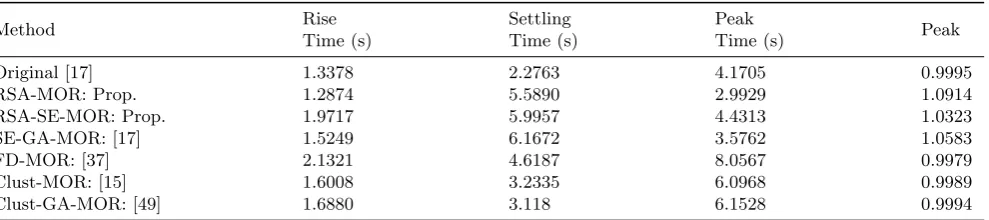
the response data is compared in Table 14 Table 17. The response due to proposed models and that of with original systems are as quite similar in terms of rise time, settling time, peak time and peak. It is also compara-tive to the systems reduced in literature using different control techniques as presented in [37, 17, 15, 49].
0 5 10 15
0 0.2 0.4 0.6 0.8 1
Time (s)
Amplitude
(a) R11(s): Example−4
Original
[image:9.595.69.286.527.700.2]RSA−MOR: Proposed RSA−SE: Proposed SE−GA−MOR: Parmar, 2007 FD−MOR: Parmar, 2007 Clus−MOR: Komarasamy, 2011 Clus−GA−MOR: Vishwakarma, 2009
Figure 10. Step response for G11(s) of original system [17],
Proposed ROM using RSA, Proposed ROM using RSA and SE, MOR in literature such as [17, 37, 15, 49]
The rise time associated to 2nd order reduced model using proposed RSA is 1.6712 seconds, which is lower as compared to original G11(s) and its reduced
mod-els in literature. Similarly, for G21(s) and G22(s); the
rise time is again lower as 1.7286 and 1.2874 seconds respectively and found to be lesser as compared to
orig-0 5 10 15
0 0.05 0.1 0.15 0.2 0.25 0.3 0.35 0.4 0.45 0.5
Time (s)
Amplitude
(b) R12(s): Example−4
Original
RSA−MOR: Proposed RSA−SE: Proposed SE−GA−MOR: Parmar, 2007 FD−MOR: Parmar, 2007 Clus−MOR: Komarasamy, 2011 Clus−GA−MOR: Vishwakarma, 2009
Figure 11. Step response forG12(s) of original system [17],
Proposed ROM using RSA, Proposed ROM using RSA and SE, MOR in literature such as [17, 37, 15, 49]
inal and reduced models in literature. It is again estab-lished while considering the multivariable system that the model with RSA-SE is able to quickly settle as com-pared to RSA-MOR and original system.
6
Conclusion
Table 14. Comparative analysis of step response of original system, methods used in literature and proposed method of system of Example -4 forG11(s)
Method Rise Settling Peak Peak
Time (s) Time (s) Time (s)
Original [17] 2.1254 3.7944 8.5950 0.9998
RSA-MOR: Prop. 1.6712 5.5839 3.5915 1.0502
RSA-SE-MOR: Prop. 2.4575 3.5435 5.3982 1.0161
SE-GA-MOR: [17] 1.8627 5.8176 4.1982 1.0312
FD-MOR: [37] 2.6393 5.1309 9.4531 0.9988
Clust-MOR: [15] 2.0639 3.7543 7.2917 0.9994
[image:10.595.46.538.326.436.2]Clust-GA-MOR: [49] 1.9093 3.4067 6.8396 0.9996
Table 15. Comparative analysis of step response of original system, methods used in literature and proposed method of system of Example -4 forG12(s)
Method Rise Settling Peak Peak
Time (s) Time (s) Time (s)
Original [17] 1.0216 1.8653 3.6459 0.3998
RSA-MOR: Prop. 1.1152 5.5910 2.6936 0.4495
RSA-SE-MOR: Prop. 1.7248 6.2178 3.9479 0.4193
SE-GA-MOR: [17] 1.2438 6.3842 3.0320 0.4394
FD-MOR: [37] 1.4314 3.9153 9.1852 0.3997
Clust-MOR: [15] 0.9931 2.2690 7.8058 0.4000
Clust-GA-MOR: [49] 1.0691 2.3330 3.9246 0.3987
Table 16. Comparative analysis of step response of original system, methods used in literature and proposed method of system of Example -4 forG21(s)
Method Rise Settling Peak Peak
Time (s) Time (s) Time (s)
Original [17] 2.1808 3.8582 8.8500 0.4999
RSA-MOR: Prop. 1.7286 5.5829 3.7412 0.5232
RSA-SE-MOR: Prop. 2.5221 3.6481 5.5593 0.5074
SE-GA-MOR: [17] 1.9439 5.6955 4.3537 0.5135
FD-MOR: [37] 2.7284 5.2215 8.7117 0.4990
Clust-MOR: [15] 2.1342 3.8353 8.3409 0.4999
Clust-GA-MOR: [49] 1.9702 3.4836 6.8396 0.4998
Table 17. Comparative analysis of step response of original system, methods used in literature and proposed method of system of Example -4 forG21(s)
Method Rise Settling Peak Peak
Time (s) Time (s) Time (s)
Original [17] 1.3378 2.2763 4.1705 0.9995
RSA-MOR: Prop. 1.2874 5.5890 2.9929 1.0914
RSA-SE-MOR: Prop. 1.9717 5.9957 4.4313 1.0323
SE-GA-MOR: [17] 1.5249 6.1672 3.5762 1.0583
FD-MOR: [37] 2.1321 4.6187 8.0567 0.9979
Clust-MOR: [15] 1.6008 3.2335 6.0968 0.9989
[image:10.595.44.542.510.619.2] [image:10.595.46.541.693.803.2]0 5 10 15 0
0.1 0.2 0.3 0.4 0.5
Time (s)
Amplitude
(c) R21(s): Example−4
Original
[image:11.595.70.289.104.279.2]RSA−MOR: Proposed RSA−SE: Proposed SE−GA−MOR: Parmar, 2007 FD−MOR: Parmar, 2007 Clus−MOR: Komarasamy, 2011 Clus−GA−MOR: Vishwakarma, 2009
Figure 12. Step response for G21(s) of original system [17],
Proposed ROM using RSA, Proposed ROM using RSA and SE, MOR in literature such as [17, 37, 15, 49]
0 5 10 15
0 0.2 0.4 0.6 0.8 1
Time (s)
Amplitude
(d) R22(s): Example−4
Original
RSA−MOR: Proposed RSA−SE: Proposed SE−GA−MOR: Parmar, 2007 FD−MOR: Parmar, 2007 Clus−MOR: Komarasamy, 2011 Clus−GA−MOR: Vishwakarma, 2009
Figure 13. Step response for G22(s) of original system [17],
Proposed ROM using RSA, Proposed ROM using RSA and SE, MOR in literature such as [17, 37, 15, 49]
array (RSA) method and (ii) the combination of RSA and stability equation (SE) method. The systems re-duced order models in literature are considered to com-pare the response due to proposed RSA based model and proposed RSA-SE based model. The original sys-tems, the respective reduced models of the systems and proposed reduced order models are subjected to step re-sponse and its information in terms of rise time, settling time, peak time and peak. The graphical and statistical comparative analysis have been carried out and found to be satisfactory response as compared to original system and reduced models in literature.
REFERENCES
[1] D. K. Sambariya and H. Manohar, “Model order reduc-tion by integral squared error minimizareduc-tion using bat algorithm,” inIEEE Proceedings of 2015 RAECS UIET Panjab University Chandigarh21−22ndDecember 2015, 2015, pp. 1–7.
[2] D. K. Sambariya and H. Manohar, “Preservation
of stability for reduced order model of large scale systems using differentiation method,” British Journal of Mathematics & Computer Science, vol. 13, no. 6, pp. 1–17, 2016. [Online]. Available: http://dx.doi.org/10. 9734/BJMCS/2016/23082
[3] H. Manohar and D. K. Sambariya, “Model order reduc-tion of mimo system using differentiareduc-tion method,” in
IEEE Proceeding of 10th International Conference on
Intelligent Systems and Control (ISCO 2016), vol. 2, 2016, pp. 347–351.
[4] D. K. Sambariya and H. Manohar, “Model order re-duction by differentiation equation method using with routh array method,” inIEEE Proceeding of10th Inter-national Conference on Intelligent Systems and Control (ISCO 2016), vol. 2, 2016, pp. 341–346.
[5] V. Singh, D. Chandra, and H. Kar, “Optimal routh approximants through integral squared error minimi-sation: computer-aided approach,” IEE Proceedings -Control Theory and Applications, vol. 151, no. 1, pp. 53–58, Jan 2004. [Online]. Available: http://dx.doi. org/10.1049/ip-cta:20040007
[6] I. El-Nahas, N. Sinha, and R. Alden, “Pade and routh approximation in the time domain,” in Decision and Control, 1983. The 22nd IEEE Conference on, Dec 1983, pp. 243–246. [Online]. Available: http://dx.doi. org/10.1109/CDC.1983.269837
[7] H. N. Soloklo and M. M. Farsangi, “Multiobjective weighted sum approach model reduction by routh-pade
approximation using harmony search,” Turk J Elec
Eng & Comp Sci, vol. 21, no. 0, pp. 2283 – 2293, 2013. [Online]. Available: http//dx.doi.org/10.3906/ elk-1112-31
[8] V. Singh, “Obtaining routh-pade approximants using the luus-jaakola algorithm,” IEE Proceedings - Control Theory and Applications, vol. 152, no. 2, pp. 129–132, March 2005. [Online]. Available: http://dx.doi.org/10. 1049/ip-cta:20041305
[9] D. K. Sambariya and G. Arvind, “High order diminution of LTI system using stability equation method,”British Journal of Mathematics & Computer Science, vol. 13, no. 5, pp. 1–15, 2016. [Online]. Available: http://dx. doi.org/10.9734/BJMCS/2016/23243
[10] D. K. Sambariya and R. Prasad, “Routh stability ar-ray method based reduced model of single machine infi-nite bus with power system stabilizer,” inInternational Conference on Emerging Trends in Electrical, Commu-nication and Information Technologies (ICECIT-2012), 2012, pp. 27–34.
[11] T. C. Chen, C. Y. Chang, and K. W. Han,
“Model reduction using the stability-equation method and the continued-fraction method,” International Journal of Control, vol. 32, no. 1, pp. 81–94, 1980. [Online]. Available: http://dx.doi.org/10.1080/ 00207178008922845
[12] D. K. Sambariya and G. Arvind, “Reduced order mod-elling of SMIB power system using stability equation
method and firefly algorithm,” in 6th IEEE
Inter-national Conference on Power Systems, (ICPS-2016), 2016, pp. 1–6.
[13] D. K. Sambariya and R. Prasad, “Differentiation
[image:11.595.69.287.339.513.2]International Journal of Applied Engineering Research,
vol. 7, no. 11, pp. 2116 – 2120, 2012.
[On-line]. Available: http://gimt.edu.in/clientFiles/FILE REPO/2012/NOV/24/1353741189722/202.pdf.
[14] D. K. Sambariya and A. S. Rajawat, “Application of routh stability array method to reduce MIMO SMIB power system,” in6th IEEE International Conference on Power Systems, (ICPS-2016), 2016, pp. 1–6.
[15] R. Komarasamy, N. Albhonso, and G. Gurusamy, “Order reduction of linear systems with an improved pole clustering,” Journal of Vibration and Control, vol. 18, no. 12, p. 18761885, 2011. [Online]. Available: http://dx.doi.org/10.1177/1077546311426592
[16] H. N. Soloklo, O. Nali, and M. M. Farsangi, “Model re-duction by hermite polynomials and genetic algorithm,”
Journal of mathematics and computer science, vol. 9, no. 0, pp. 188–202, 2014.
[17] G. Parmar, S. Mukherjee, and R. Prasad, “Order re-duction of linear dynamic systems using stability equa-tion method and ga,” International Journal of Com-puter, Information, and Systems Science, and Engineer-ing, vol. 1, no. 2, pp. 26–32, 2007.
[18] G. Parmar, S. Mukherjee, and R. Prasad, “Reduced order modeling of linear dynamic systems using parti-cle swarm optimized eigen spectrum analysis,” Interna-tional Journal of ComputaInterna-tional and Mathematical Sci-ence, vol. 1, no. 1, pp. 45–52, 2007.
[19] A. Sikander and R. Prasad, “Soft computing approach for model order reduction of linear time invariant systems,” Circuits, Systems, and Signal Processing, vol. 34, no. 11, pp. 3471–3487, 2015. [Online]. Available: http://dx.doi.org/10.1007/s00034-015-0018-4
[20] D. K. Sambariya and R. Prasad, “Routh approximation based stable reduced model of single machine infinite bus system with power system stabilizer,” in DRDO-CSIR Sponsered: IX Control Instrumentation System Conference (CISCON - 2012), 2012, pp. 85–93.
[21] D. K. Sambariya and R. Prasad, “Stable reduced model of a single machine infinite bus power system with power system stabilizer,” inInternational Conference on Advances in Technology and Engineering (ICATE’13), Jan 2013, pp. 1–10. [Online]. Available: http://dx.doi. org/10.1109/ICAdTE.2013.6524762
[22] D. K. Sambariya and R. Prasad, “Stability equation method based stable reduced model of single machine infinite bus system with power system stabilizer,” In-ternational Journal of Electronic and Electrical Engi-neering, vol. 5, no. 2, pp. 101–106, 2012.
[23] D. K. Sambariya and R. Prasad, “Stable reduced model of a single machine infinite bus power system,” in
17th National Power Systems Conference (NPSC-2012), 2012, pp. 541–548.
[24] D. K. Sambariya and O. Sharma, “Model order
reduction using routh approximation and cuckoo search algorithm,”Journal of Automation and Control, vol. 4, no. 1, pp. 1–9, 2016. [Online]. Available: http://pubs. sciepub.com/automation/4/1/1
[25] D. K. Sambariya and G. Arvind, “Reduced order model of single machine infinite bus power system using stability equation method and self-adaptive bat algo-rithm,”Universal Journal of Control and Automation, vol. 4, no. 1, pp. 1–7, 2016. [Online]. Available: http:// dx.doi.org/10.13189/ujca.2016.040101
[26] D. K. Sambariya and A. S. Rajawat, “Model order reduction of lti system using routh stability array method,” inIEEE proceedings on International Confer-ence on Computing, Communication and Automation (ICCCA-2016), 2016, pp. 1–6.
[27] V. Krishnamurthy and V. Seshadri, “Model reduction using the routh stability criterion,”Automatic Control, IEEE Transactions on, vol. 23, no. 4, pp. 729–731, Aug 1978. [Online]. Available: http://dx.doi.org/10.1109/ TAC.1978.1101805
[28] S. Mukherjee and R. Mishra, “Order reduction of linear systems using an error minimization technique,”
Journal of the Franklin Institute, vol. 323, no. 1, pp. 23 – 32, 1987. [Online]. Available: http://www.sciencedirect. com/science/article/pii/0016003287900378
[29] S. R. Desai and R. Prasad, “Implementation of
order reduction on tms320c54x processor using genetic
algorithm,” in Emerging Research Areas and 2013
International Conference on Microelectronics, Commu-nications and Renewable Energy (AICERA/ICMiCR), 2013, pp. 1–6. [Online]. Available: http://dx.doi.org/ 10.1109/AICERA-ICMiCR.2013.6576027
[30] A. Pati, A. Kumar, and D. Chandra, “Suboptimal control using model order reduction,”Chinese Journal of Engineering, vol. 2014, p. 5, 2014. [Online]. Available: http://dx.doi.org/10.1155/2014/797581
[31] S. R. Desai and R. Prasad, “A new approach to order reduction using stability equation and big bang big crunch optimization,” Systems Science & Control Engineering, vol. 1, no. 1, pp. 20–27, 2013. [Online]. Available: http://dx.doi.org/10.1080/21642583.2013. 804463
[32] B. Philip and J. Pal, “An evolutionary computation
based approach for reduced order modelling of
linear systems,” in IEEE International Conference on Computational Intelligence and Computing Research (ICCIC ’10), 2010, pp. 1–8. [Online]. Available: http:// dx.doi.org/10.1109/iccic.2010.5705729
[33] G. Parmar, S. Mukherjee, and R. Prasad, “Reduced order modeling of linear dynamic systems using parti-cle swarm optimized eigen spectrum analysis,” Interna-tional Journal of ComputaInterna-tional and Mathematical Sci-ence, vol. 1, no. 1, pp. 45–52, 2007.
[34] T. Lucas, “Factor division: a useful algorithm in model reduction,” IEE Proceedings D - Control Theory and Applications, vol. 130, no. 6, pp. 362–364, November 1983. [Online]. Available: http://dx.doi.org/10.1049/ ip-d.1983.0060
[35] G. D. Howitt and R. Luus, “Model reduction by minimization of integral square error performance indices,” Journal of the Franklin Institute, vol. 327, no. 3, pp. 343 – 357, 1990. [Online]. Avail-able: http://www.sciencedirect.com/science/article/ pii/001600329090001Y
[36] F. Shoji, “Comments on simplification of large linear systems using a step iterative method: A two-step projection algorithm,” Journal of the Franklin Institute, vol. 313, no. 5, pp. 267 – 271, 1982. [Online]. Available: http://www.sciencedirect.com/ science/article/pii/0016003282900023
vol. 31, no. 11, pp. 2542 – 2552, 2007. [Online]. Avail-able: http://www.sciencedirect.com/science/article/ pii/S0307904X06002411
[38] V. P. Singh, P. Chaubey, and D. Chandra, “Model order reduction of continuous time systems using pole clustering and chebyshev polynomials,” in Students Conference on Engineering and Systems (SCES-12), 2012, pp. 1–4. [Online]. Available: http://dx.doi.org/ 10.1109/sces.2012.6199028
[39] S. K. Agrawal, D. Chandra, and I. A. Khan, “Order reduction of linear system using clustering, integral square minimization and dominant pole technique,”
International Journal of Engineering and Technology, vol. 3, no. 1, pp. 64–67, 2011. [Online]. Available: http://dx.doi.org/10.7763/IJET.2011.V3.201
[40] C. B. Vishwakarma and R. Prasad, “Clustering method for reducing order of linear system using pade approx-imation,” IETE Journal of Research, vol. 54, no. 5, pp. 326–330, 2008. [Online]. Available: http://www. tandfonline.com/doi/abs/10.4103/0377-2063.48531
[41] S. Panda, J. S. Yadav, N. P. Patidar, and C. Ardil, “Evo-lutionary techniques for model order reduction of large scale linear systems,” International Journal of Applied Science, Engineering and Technology, vol. 5, no. 1, pp. 22–28, 2009.
[42] S. Panda, S. K. Tomar, R. Prasad, and C. Ardil, “Re-duction of linear time-invariant systems using routh-approximation and pso,”International Journal of Elec-trical, Robotics, Electronics and Communications Engi-neering, vol. 3, no. 9, pp. 20–27, 2009.
[43] L. A. Aguirre, “The least squares pad method for model reduction,” International Journal of Systems Science, vol. 23, no. 10, pp. 1559–1570, 1992. [Online]. Available: http://dx.doi.org/10.1080/00207729208949408
[44] J. Bansal, H. Sharma, and K. Arya, “Model order reduction of single input single output systems us-ing artificial bee colony optimization algorithm,” in
Nature Inspired Cooperative Strategies for Optimiza-tion (NICSO 2011), ser. Studies in Computational Intelligence, D. Pelta, N. Krasnogor, D. Dumitrescu, C. Chira, and R. Lung, Eds. Springer Berlin Heidel-berg, 2011, vol. 387, pp. 85–100. [Online]. Available: http://dx.doi.org/10.1007/978-3-642-24094-2 6
[45] L. Aguirre, “Validation of reduced-order models for closed loop applications,” in Control Applications, 1993., Second IEEE Conference on, Sep 1993, pp. 605–610 vol.2. [Online]. Available: http://dx.doi.org/ 10.1109/CCA.1993.348337
[46] S. Panda, S. K. Tomar, R. Prasad, and C. Ardil, “Model reduction of linear systems by conventional and evolu-tionary techniques,”International Journal of Electrical, Robotics, Electronics and Communications Engineering, vol. 3, no. 11, pp. 29–34, 2009.
[47] J. S. Yadav, N. P. Patidar, J. Singhai, S. Panda, and C. Ardil, “A combined conventional and differential evo-lution method for model order reduction,”International Journal of Electrical, Robotics, Electronics and Commu-nications Engineering, vol. 5, no. 9, pp. 68–75, 2011.
[48] C. Hwang and J.-H. Hwang, “A new two-step iterative method for optimal reduction of linear siso systems,”
Journal of the Franklin Institute, vol. 333, no. 5, pp. 631–645, 1996.
![Figure 7. Step response of original system [28], Proposed ROMusing RSA (Eq. 25), Proposed ROM using RSA and SE (Eq](https://thumb-us.123doks.com/thumbv2/123dok_us/8756386.892976/6.595.308.529.107.279/figure-step-response-original-proposed-romusing-proposed-using.webp)
![Figure 8. Step response of original system [43], Proposed ROMusing RSA, Proposed ROM using RSA and SE, MOR in litera-ture such as ABC-MOR [44], Pade-MOR [44], RA-MOR [44] andAguirre-MOR [45]](https://thumb-us.123doks.com/thumbv2/123dok_us/8756386.892976/7.595.56.554.113.223/figure-response-original-proposed-romusing-proposed-litera-andaguirre.webp)

![Figure 10.Step response for G11(s) of original system [17],Proposed ROM using RSA, Proposed ROM using RSA and SE,MOR in literature such as [17, 37, 15, 49]](https://thumb-us.123doks.com/thumbv2/123dok_us/8756386.892976/9.595.69.286.527.700/figure-response-original-proposed-using-proposed-using-literature.webp)
![Figure 12.Step response for G21(s) of original system [17],Proposed ROM using RSA, Proposed ROM using RSA and SE,MOR in literature such as [17, 37, 15, 49]](https://thumb-us.123doks.com/thumbv2/123dok_us/8756386.892976/11.595.69.287.339.513/figure-response-original-proposed-using-proposed-using-literature.webp)
