Development and Analysis of Verb Frame
Lexicon for Hindi
Rafiya Begum
*, Dipti Misra Sharma
Language Technology and Research Center, India
Copyright©2017 by authors, all rights reserved. Authors agree that this article remains permanently open access under the terms of the Creative Commons Attribution License 4.0 International License
Abstract
A verb frame (VF) captures various syntactic distributions where a verb can be expected to occur in a language. The argument structure of Hindi verbs (for various senses) is captured in the verb frames (VFs). The Hindi verbs were also classified based on their argument structure. The main objective of this work is to create a linguistic resource of Hindi verb frames which would: (i)Help the annotators in the annotation of the dependency relations for various verbs; (ii)Prove to be useful in parsing and for other Natural Language Processing (NLP) applications; (iii)Be helpful for scholars interested in the linguistic study of the Hindi verbs. In this study of Hindi verbs, the verb argument relations are captured using the dependency relations from Paninian Grammatical Framework (PGF). Analysis of Hindi verbs is the focus of this study since it gives us a good understanding of syntactic and semantic behaviour of verbs which is required for dependency annotation and for parsing. [1]. The preliminary work on this study was published as “Developing Verb Frames for Hindi” [1] in Language Resources and Evaluation Conference (LREC), 2008.Keywords
Hindi Verbs, Verb Frames, Linguistic Resources, Paninian Grammatical Framework, karaka Relations, Verb Classification1. Introduction
Verbs play a major role in interpreting the sentence meaning. Since verbs are important, the study of verb argument structure and their syntactic behaviour provides the necessary knowledge base for intelligent NLP applications. In this work, Hindi verbs were analyzed and then verb frames (capture the argument structure of the verbs) were created for these verbs. Verb frames were created following Paninian Grammatical Framework (PGF) where a verb plays a critical role in the analysis of a sentence. Hindi verbs were also classified based on their VFs.
The justification for following PGF is as follows: Indian Languages (ILs) are morphologically rich and have a
relatively flexible word order [2,3]. There is a debate in the literature whether the notions subject and object can at all be defined for ILs [4]. Behavioral properties are the only criteria based on which one can confidently identify grammatical functions in Hindi [5]; Marking semantic properties such as thematic roles as dependency relations is problematic too. Thematic roles are abstract notions and require higher semantic features which are difficult to formulate and to extract. Therefore, a grammatical model which can account for most of the linguistic phenomena in ILs and would also work well for computational purposes is required. Panini's grammar [3], offers a theoretical model which works well for morphologically rich languages and offers a level of analysis which being syntactic-semantic in nature provides us a good combination of syntactic and semantic features for processing natural language. Since Hindi is an Indian language (IL) and has relatively free word order [6,3], dependency grammar formalism is very well suited for it. In such languages, because of their rich morphology, there is more freedom in word order for expressing syntactic functions [7,8]. Thus, for this work, computational model of Panini's Grammar has been chosen.
Paninian Grammar (PG) is a dependency based grammar [9,10]. Dependency grammar formalisms have emerged from the work of Tesnière [7]. The basic elements in the Dependency Grammar (DG) are: (i)head word, and (ii)its dependent. Syntactic annotation in the dependency framework has two types of inter-related decisions: attachment and labeling [11,12,13,14,15]. If one word attaches with another then it indicates that there is a syntactic relationship between the head word and the dependent word. There is a parent-child relationship between head word (parent) and the dependent word (child). The relations will tell the type of the attachment. For example, if the noun is the subject of the verb then the attachment of a dependent noun with the head verb will be marked as relation subject [16].
action specified by the verb.
Paninian Grammar is followed for creating verb frames since it provides a karaka based analysis framework for a sentence where karakas are the roles of different participants directly involved in the action denoted by the verb. The relations between noun constituents and the verb are called karaka relations which are dependency relations. The karaka relations are syntactico-semantic in nature, i.e., they have both syntactic and semantic information [3]. There are six basic karakas, namely; karta (k1, agent) ‘doer of the action’, karma (k2, theme) ‘one who undergoes the action’, karana (k3, instrument) ‘instrument in accomplishing the action’, sampradana (k4, recipient) ‘reciever of the action’, apadana (k5, source) ‘fixed point of departure’, and adhikarana (k7, location) ‘location in place/time/other’. Thus, information about a verb’s syntactic and semantic behaviour plays an important role both in dependency annotation as well as while parsing. Therefore, studying Hindi verbs and their nature formed a crucial part of the current study. Thus, the motivation for developing verb frames is: (1)To create a linguistic resource which gives a classification of Hindi verbs; (2)It is helpful for the annotators in deciding various dependency relations for a given verb in the corpus; (3)It is also helpful in preparing demands (arguments) for the Hindi parser [17,18]; and (4)It forms a basis for linguistic analysis.
The focus of this work has been on identifying a verb’s argument structure as it is crucial for parsing and other NLP applications. Verb frames for Hindi provide us the arguments that a particular verb can take for a particular sense, i.e., they show mandatory and desirable (not mandatory and not optional; but required) arguments for a verb. In verb frames, arguments are annotated using karaka relations and other dependency relations (Other than karaka relations; these were introduced since karaka relations were not sufficient). Many formal theories of grammar talk about the distinction between constituents that are arguments and those that are adjuncts: Arguments are something that lexical heads have [19]. Complements/Arguments are obligatory and Adjuncts are always optional [20]. Adjuncts are not considered in this work as they are optional. Some of the arguments are considered as ‘desirable’ which means that these arguments are required to fulfill the meaning of the verb and they don’t have the compulsion to be present on the surface level of the sentence.
This paper is organized as follows: Section 2 discusses Related Work which talks about resources related to verb argument structure created for English; Section 3 gives a brief overview of the Paninian Grammar and the motivation for following it; Section 4, 5 and 6 talk about verb frames, methodology followed in creating VFs and results related to it, respectively; Section 7 discusses about the comparison between Paninian Dependency Annotation and Propbank Annotation; Section 8 gives the Classification of Hindi verbs based on their frames; Section 9 gives the Conclusion along with the Future Work.
2. Related Work
Some of the well-known linguistic resources related to the verb argument structure created for English, are discussed briefly in this section.
Beth Levin’s work on verb classes [21] shows correlations between the semantic and syntactic behavior of the English verbs. The verb behavior can be used to get an insight into linguistically relevant aspects of the verb meaning [22]: (1) If the members of a set of verbs S share some meaning component M, then the members of S can be expected to exhibit the same syntactic behavior(s) and (2) if the members of a set of verbs S exhibit the same syntactic behavior(s), then the members of S can be expected to share some meaning component(s).
VerbNet (VN) [23,24] is a hierarchical, domain-independent; broad-coverage online verb lexicon which extends Levin’s verb classes [21] and provides the syntactic and semantic information for English verbs. It is mapped to other language resources such as Wordnet [25,26], FrameNet, and PropBank. Each Verb class in VN is described by thematic roles, selectional restrictions on the arguments, and syntactic frames [21].
PropBank (PB) [27] is a corpus, annotated with verbal propositions and their arguments. It has recently been extensively used for the semantic role labeling task (CoNLL shared task 2004-051 and 2008-2009). PB adds a layer of semantic annotation atop the syntactic structures. PB represents the verb argument relations by Arg0, Arg1, Arg2, etc., depending on the valency of the verb [28]. Each set of argument labels and their definitions is called a frameset. For example, the frameset of the verb dance contains Arg0: dancer,Arg1: dance and Arg2: partner as essential roles. It also has non-essential roles such as Argm-loc: location and Argm-tmp: time.
FrameNet (FN) [29] is an on-line lexical resource for English, based on frame semantics and supported by corpus evidence. FN groups words according to the conceptual structures, i.e., frames that underlie them [29]. It has three major components [29]: (1) Lexicon; (2) Frame Database contains descriptions of each frame's basic conceptual structure, and provides names and descriptions for the elements participating in such structures; (3) Annotated Example Sentences are marked to exemplify the semantic and morpho-syntactic properties of the lexical items. Each frame contains various participants, i.e., core (core arguments) and non-core (adjuncts or peripheral roles) elements which are considered as semantic roles. For example, core elements of the frame Getting-up are person/animal getting up from sleep and place of sleeping; non-core elements are time, purpose, etc.
All these resources talk about the verb argument structure of the English verbs. They provide syntactic and semantic information, and correlation between them. These resources are also mapped to each other to make individual resources
1 http://www.lsi.upc.edu/~srlconll/
richer. In this work of creating verb frames for Hindi, the verb argument structure is captured using karaka relations which capture both syntactic and semantic information of the verbs. A mapping is done between karaka relations, theta roles and Propbank annotation. It is also mentioned if an argument is mandatory or non-mandatory for a particular verb.
All these resources for English have been extensively used for various NLP applications in English and have proved to be very useful in improving the state of the art for many of these applications. This paper shows the work on Hindi language and presents the study on Hindi verbs which have been analyzed within the Paninian Grammatical Framework. It is believed that this resource of verb frames proves to be helpful for various NLP tasks in Hindi.
3. Paninian Grammar
The main problem that the Paninian approach addresses is to identify syntactico-semantic relations in a sentence. Thus the motivation for following the Paninian approach is: a)The framework is motivated by Sanskrit language which is an inflectionally rich language and focuses on the role of case markers such as post-positions and verbal inflections [3]; b)Is better suited for handling Indian languages, which have a relatively free word order and richer morphology (similar to Sanskrit); c)The model, not only offers a mechanism for SYNTACTIC analysis, but also incorporates the SEMANTIC information (dependency analysis), i.e., it provides the level of syntactico-semantic interface for parsing.
In Paninian based approach, the verb is taken as the root of the tree and its argument structure is considered as its children [3]. The labels on the edges between a parent-child pair show the relation-type between them [17]. Two levels of analysis are followed in Paninian framework: (1) Syntactico-semantic relations (karaka relations): (i) Direct participants of the action denoted by a verb (karaka); (ii)Other relations: purpose, genitive, reason etc; (2)Relation markers (vibhaktis or Hindi postposition/case markers).
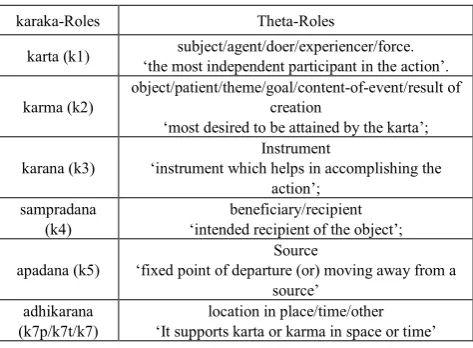
[image:3.595.314.551.90.264.2]The elements of the semantic model within the Paninian framework [3] are explained as follows: A verbal root (dhaatu) indicates an action comprising of (i)an activity (vyaapaara) and, (ii)a result (phala). Activity consists of actions performed by various participants or karakas involved in the action. Result is the condition or state reached when the action is complete [3]. Thus every action involves an activity and a result. Ashraya or locus of the activity is karta and among all the participants in the action, karta is swatantra ‘independent’, i.e., it is the most independent karaka. Ashraya or the locus of the result is called karma (k2). The rough mapping of all karaka roles with its theta roles is given below in table 1:
Table 1. Rough Mapping of karaka-Roles with Theta-Roles karaka-Roles Theta-Roles
karta (k1) ‘the most independent participant in the action’. subject/agent/doer/experiencer/force.
karma (k2) object/patient/theme/goal/content-of-event/result of creation ‘most desired to be attained by the karta’; karana (k3) ‘instrument which helps in accomplishing the Instrument
action’; sampradana
(k4) ‘intended recipient of the object’; beneficiary/recipient apadana (k5) ‘fixed point of departure (or) moving away from a Source
source’ adhikarana
(k7p/k7t/k7) ‘It supports karta or karma in space or time’ location in place/time/other In Paninian grammar, Hindi postposition/case markers are referred to as vibhaktis (Hindi postpositions) which are relation markers. A vibhakti denotes case markings on the nouns and the TAM (tense, aspect and modality) of the verbs. Vibhaktis play a key role in indicating semantic relationships. They act as syntactic cues in a sentence and help in identifying the appropriate karakas [30]. In example 1, ne vibhakti indicates karta (doer), se vibhakti indicates karana (instrument), and 0 (zero) vibhakti indicates karma (theme).
After discussing PG, a detailed discussion of the verb frames and the procedure followed in creating the VFs is provided in the sections given below.
4. Verb Frames for Hindi
The senses of the verb aa in the above examples 2 and 3 is ‘come’ and ‘know’ respectively. In example 2, the verb aa having the sense ‘come’takes the following arguments: karta, and goal. In example 3, the verb aa with the sense ‘know’ takes the following arguments: anubhavkarta, and karta. It can be noticed here that there is a difference in the set of dependency relations of the arguments taken by the verb aa having two different senses in the above two examples. Therefore, with the change in the sense of the verb there is also change in the frame of the verb, but this is not always the case, i.e., frames can be same for different senses of a verb.
Multiple frames, mentioned in the second basis, means that a verb can take a different set of dependency relations for the same sense of a verb. For example, the verb bheja with the sense ‘send’ has two different frames:
In the above Hindi example sentences 4 and 5, the verb bheja has the same sense, i.e., ‘send’. In example 4, the verb bheja is taking the following arguments: karta, karma, and goal. In example 5, the verb bheja ‘send’ is taking the following arguments: karta, sampradana, and karma. Here, it can be noticed that there is a difference in the set of dependency relations of the arguments taken by verb bheja ‘send’ in the examples 4 and 5. This shows that the same sense of a verb can take multiple frames. There exists a finer distinction in the sense of bheja in examples 4 and 5, i.e., in example 4, it is an individual (bachche ‘children’) who is being sent so the verb bheja becomes a causative verb here. Whereas in example 5, it is an object (saMdesh
‘message’) that is being sent so the verb bheja becomes a ditransitive verb here. Such a finer distinction in the senses of bheja given in the examples 4 and 5 is not captured. Even Hindi Wordnet2 (HWN) [31] considers the above senses of bheja as a single sense. Also, the type of causative type that exists in example 4 is lexical causative. The base verb root of the lexical causative bheja ‘send’ is jaa ‘go’. The causative structure is as follows:
jaa ‘go’ (base verb root) bheja ‘send’ (first causal) bhijavaa ‘to cause to send’ (second causal).
Since, lexical causatives are very rare in Hindi, the causative nature of the verb is ignored here. Both these usages are ditransitive which take different participants here; hence there is a change in the frame.
In the verb frames, along with the mandatory arguments of a verb, other arguments are also captured which are mostly not present on the surface level of the sentence but are implicit. For example, the verb kaaT having the sense ‘cut’ takes two mandatory arguments, i.e., karta and karma in the example 7 given below. It also takes the instrument argument that is used in the action of cutting. So the instrument is considered as a desirable argument which is not strictly required to be present in the sentence. For example, chaakuu ‘knife’ is the instrument used in the action of kaaT ‘cut’, so it becomes the desirable argument. The dependency relation of the chaakuu is karana (k3). Ex-7 raam ne chaakuu se seba kaaTaa
ram Erg. knife with apple cut ‘Ram cut an apple with a knife.’
5. Materials and Methods
Hindi verbs were taken from a corpus and studied. Its distribution was taken from the corpus. For doing this, the following resources were used: (1) Levin’s verb classes [21]; (2) A Hindi corpus3 (Raw and Dependency annotated); (3) Hindi Wordnet (HWN) [31]; and (4) Sahay’s verb classes [32].
Verb frames (VFs) were created for 300 verbs which are simple verbs (non-complex verbs: combination of noun and verb) and these verbs were selected from a raw Hindi Corpus (75,000 sentences) on the following basis: complex nature, showing interesting patterns, focus of study in literature.
Given a verb, first of all its senses were taken from the corpus. Then for each sense, example sentences were taken from the corpus. VFs were created for different senses of a verb. VFs mainly contain the dependency relations of the mandatory and desirable (Desirable arguments are required by the semantics of the verb but they are weak compared to obligatory ones, in a sense that one can omit them without breaking down the communication. They can generally be
2 Developed by the wordnet team at IIT Bombay, http://www.cfilt.iitb.ac.in/webhwn
3 We use the CIIL (Central Institute for Indian languages) corpus.
extracted out of the context; e.g. He cuts the apple vs. He cuts the apple with a knife. Note that this is very different from obligatory arguments and optional arguments) arguments taken by a verb. For each sense of a verb, multiple frames were created if there were any. All the vibhaktis (Hindi postpositions/case markers) taken by the arguments of a particular verb sense were merged together within the VF. While doing this, the TAM (tense, aspect and modality) was kept constant in all the sentences as the change in TAM causes change in vibhakti too. Theta roles are also marked as additional information to make the resource richer. POS categories of the verb arguments are also included.
5.1. Verb Frame File
The corpus was consulted to get the syntactic distribution in which the verbs occur and the Hindi Wordnet (HWN) was referred to get the required sense information. Verb frames are defined in terms of dependency relations, i.e., karaka relations [2] and other dependency relations. The following information is given for each verb in its verb frame file: (1) Description of the verb, and (2) Verb Frame.
The two types of information above are provided in a data file which is referred as VF file. In the VF file there is a table which is actually a verb frame but the verb frame file of a verb itself is referred as a verb frame of that verb.
5.1.1. Description of the Verb
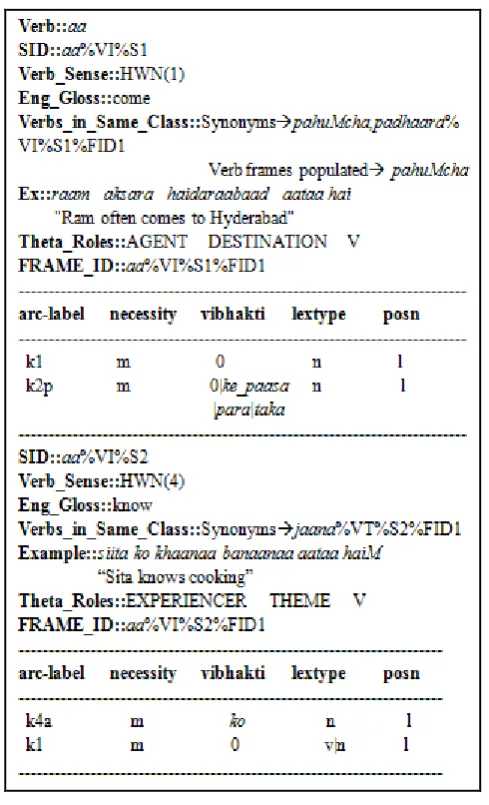
For each verb, a verb frame file is created and it contains the following description for each verb sense: (1) Verb name, (2) Sense-id (SID), (3)HWN sense-id (optional), (4)English gloss, (5)Synonyms, (6)Example sentence, (7)Theta roles, (8)Frame-id, and (9)Verb frame (given in a table). Given below is an example of a VF file in figure 1 (Basically ‘verb frame file’ is used to refer to the file that has been created for entering the data of each verb. But mostly the term ‘verb frame’ is used insteadof verb frame file) including the verb frame for verb aa ‘come’.
Given below is the frame file of the verb aa having two senses. Here, first sense is discussed and then the second sense. In the below VF file, the first field is the name of the verb, i.e., aa ‘come’. Sense-id (SID) is a unique id given to each sense of the verb and here it is represented as aa%VI%S1. In SID, the following information is captured: (1) verb, (2) verb type, and (3) sense number; all three separated by a percentage symbol. In SID, VI is the verb type which means verb intransitive and S1 means sense-1. Here, 4 types of verbs are used: VI Intransitive Verb; VT Transitive Verb; VDT Ditransitive Verb; and VCAUS Causative Verb. Here the sense of the verb aa matches with the first sense given in HWN hence, it is represented as HWN (1) in the frame file. The sense numbers in HWN are not fixed, they keep changing hence this information is not considered.
Theta_Roles field gives the theta roles (taken from Verbnet) of the verb arguments. It is believed that such a mapping is going to help in making the transition from the dependency level (karaka level (syntactico-semantic) as well as non-karaka) to thematic level (semantic) easier. It helps in making certain generalizations.
FRAME_ID field gives a unique-id to the verb frame of a verb for a particular sense. FRAME_ID is a combination of verb sense-id and frame number. Here, Frame-id aa%VI%S1%FID1 is made up of the sense-id, aa%VI%S1 and verb frame number, FID1 both separated by a percentage sign. A verb will have a unique sense-id and within that sense it will have unique frame-id because a verb can have multiple senses and each sense can have multiple verb frames, i.e., syntactic distributions. So sense-id helps us in identifying the sense of the verb and frame-id helps us in identifying the verb frame of that particular sense of a given verb. If a verb takes two frames for the same sense then they are represented as: (i)verb%VI%S1%FID1 and (ii)verb%VI%S1%FID2 where frame-ids FID1 and FID2 denote that there are two frames, belonging to the same sense S1.
Figure 1. Verb Frame for Verb aa ‘come’
Populating a VF for a verb, means that instead of creating a separate VF file for that verb, it is just listed in another VF file with which it matches in sense. By doing this it is getting conveyed that this populated verb has the same VF (dependency relations) as the verb in whose VF file it has been listed. The process of populating VFs lessens the effort of creating more VF files.
There can be differences in VFs between populated verb (pahuMcha ‘reach’) and the main verb (aa ‘come’). They might have same dependency relations but may differ in vibhaktis, POS categories, no. of VFs, etc.
5.1.2. Verb Frame (table in the Verb Frame File)
The actual VFis the table given in the verb frame file.VF contains the verb argument information of the verb. A VF shows the following information: (1)dependency relations; (2)necessity of the argument, i.e., whether an argument is mandatory (m) or desirable (d); (3)vibhakti (Hindi postpositions/case markers taken by the arguments); (4)lexical category of the arguments, i.e., noun, verb and adjective, etc., represented by n, v, and adj respectively;
(5)position of the argument with respect to the verb, i.e., left or right represented by l and r respectively.
In Fig. 1, the dependency relations for verb aa ‘come’ is given under the arc-label field. The arguments of the verb aa is raam ‘Ram’ and haidaraabaad ‘Hyderabad’, and their karaka relations are karta (k1) and Goal (k2p) respectively. These two arguments are mandatory to accomplish the semantics of the verb aa hence, their necessity information is mandatory which is represented as m. raam (k1) takes 0 vibhakti and haidaraabaad(k2p) can take either 0, ke_paasa ‘near’, taka ‘till’ vibhakti. There is par ‘on’ vibhakti which is not taken by haidaraabaad but taken by other nouns that can replace haidaraabaad. So basically, all the vibhaktis taken by different nouns for the Goal karaka relation of the verb aa are merged here. The vibhaktis are merged using an ‘or’ operator, represented as a pipe ‘|’ (see Fig. 1). Here, it is getting conveyed that the relation goal (k2p) takes all these vibhaktis but the lexical item may change.
Present imperfect TAM, i.e., taa_hai is taken here. A VF is different from another VF for a verb with the same sense, when the set of dependency relations marked on the verb arguments are different. An argument of a verb can take various vibhaktis (postpositions) like the haidaraabaad (k2p) argument of the verb aa ‘come’. In case of verbs having the same sense, the arguments of these verbs may sometimes take different vibhaktis, additional vibhaktis, or less vibhaktis than the arguments of the verb with which it is matching in sense.
The lexical category of both the arguments (raam ‘Ram’ and haidaraabaad ‘Hyderabad’) of the verb aa ‘come’ is noun (n) and this is mentioned under the lex-type field. There is one more information about the arguments in the verb frame and that is about the position of the argument in relation to the verb, i.e., to which side of the verb does the argument occurs. Both the arguments (raam ‘Ram’ and haidaraabaad ‘Hyderabad’) of the verb aa ‘come’ occur to the left of the verb so they are marked as left represented by l. This information is mentioned in the verb frame under the posn field which means position. The information of posn (position) in the verb frame is not required from the point of view of a lexical resource (was required for the parser purpose). As the parser is rule-based, one needs some heuristics in order to reduce the possible search space to find various arguments of a verb. Thus, the notion of 'most frequent' position helps in this sense. If the position field is made part of the parser implicit strategy then this makes the rules hard-coded whereas it is required to make sure that such parser behaviour is externalized, therefore the position field was introduced.
The frames are developed based on simple present tense and indicating habitual acts taking it as the default TAM. In fact, dependency relations and the vibhaktis (Hindi postpositions/case markers) in the frame reflect the behaviour of the verb when it occurs in simple present (‘-taa hai’ in Hindi, eg. khaa-taa hai ‘eats’). This is done to bring in consistency while forming the various frames, as in Hindi, the vibhakti of an argument changes with the change in the TAM (tense, aspect and modality) information of the verb. These changes in the vibhaktis are not syntactic alternations but are transformations due to the change in the default TAM.
After discussing the first sense, the discussion about the second sense of the verb aa is given below. As mentioned above, the two senses of the verb aa, i.e., ‘come’ and ‘know’ are given in Fig. 1. Each of these senses has one verb frame each. All the senses of a verb are present in single verb frame file. For each sense, a sense id is provided along with the English gloss. For the first sense of the verb aa, the sense id (SID) is aa%VI%S1 and for the second sense, the sense-id (SID) is aa%VI%S2.The Eng_Gloss of the first sense of the verb aa is ‘come’ and the second senseis ‘know’. The verb jaana ‘know’ matches with the second sense of the verb aa ‘know’. The verb entry for the verb jaana exists as it can be seen that the FRAME_ID for the verb jaana, i.e.,
jaana%VT%S2%FID1 is mentioned under the field
Verbs_in_Same_Class of the second sense of the verb aa ‘know’. Different senses of a verb match with different senses of other verbs. The first sense of the verb aa ‘come’ (aa%VI%S1) matches with the first sense of the verb padhaara ‘arrive’ (padhaara%VI%S1). Both the first sense of the verbs aa ‘come’, and padhaara ‘arrive’ have single frame which match with each other. So both these verbs match in sense as well as frames, i.e., aa%VI%S1%FID1 and padhaara%VI%S1%FID1 match with each other. In case of second sense of the verb aa ‘know’ (aa%VI%S2), the verb jaana ‘know’ (jaana%VT%S2) matches with it (aa%VI%S2). In case of the verb frame file jaana which is a transitive verb, the sense ‘know’ is the second sense of the verb jaana (jaana%VT%S2) which is matching with the second sense of the verb aa ‘know’ (aa%VI%S2). Here it can be seen that though the second sense of the verbs aa ‘know’ and jaana ‘know’ is same but they are different types of verbs, i.e., aa ‘know’ is an intransitive verb (VI) whereas jaana ‘know’ is a transitive verb (VT). The difference in their verb type is making an effect on their frames also. Though they differ in frames, still the verb jaana ‘know’ (jaana%VT%S2) has been listed under the Verbs_in_Same_Class field of the verb aa ‘know’ (aa%VI%S2) as they have same senses and a note has been made clearly saying that they don’t match in frames. This gives us a generalization that though semantically they are same: (1) they differ in their verb types; (2) they differ in their frames, i.e., they take a different set of dependency relations (karaka relations (syntactico-semantic) and other dependency relations).
In the Example field of sense-2, there are two sentences separated by an ‘or’ operator represented by pipe (‘|’). These two examples differ in the lexical category of k1 (karta). Here k1 can have either verb (v) or noun (n) as its lexical category. In one example banaanaa ‘cooking’ is k1 and it is a verbal noun as it is a noun derived from a verb. So banaanaa ‘cooking’ is just marked as a verb (v) and no additional information of it being a verbal noun is marked. In the other example, silaaii-ka.Daaii ‘stitching’ is k1 and its lexical category is noun (n). So this information that k1 can take either verb (v) or noun (n) as its lexical category will be shown in the verb frame as v|n. Here the lexical categories are merged by an ‘or’ operator represented by pipe (‘|’). Generally merging process is done in verb frames for vibhakti and lexical category as arguments of a verb can take multiple vibhaktis in different situations and their lexical category also varies sometimes.
The FRAME_ID of the verb frame of the first sense and second sense is aa%VI%S1%FID1 and aa%VI%S2%FID1 respectively. aa%VI%S1%FID1 means that it is the verb frame-1 of the first sense of the verb aa ‘come’ and aa%VI%S2%FID1means that it is the verb frame-1 of the second sense of the verb aa ‘know’. The arguments of the verb aa having the sense ‘know’ are siitaa ‘Sita’, and
banaanaa/silaaii-ka.Dhaaii ‘cooking/stitching’ are anubhavakarta (k4a) and karta (k1) respectively. The necessity of siitaa (k4a, experiencer) and banaanaa/silaaii-ka.Dhaaii (k1)is mandatory i.e., m. siitaa (k4a) takes ko vibhakti and banaanaa/silaaii-ka.Dhaaii(k1) takes 0 vibhakti. As mentioned above, lexical category of siitaa (k4a) is noun, i.e., n and the lexical category of banaanaa/silaaii-ka.Dhaaii (k1) is verb/noun (v/n). The structure also has thematic role information. The first sense of the verb aa ‘come’, takes agent and destination theta roles for raam ‘Ram’ and haidaraabaad ‘Hyderabad’ respectively. The second sense of the verb aa ‘know’, takes experiencer
and theme theta roles for siitaa ‘Sita’ and banaanaa ‘cooking’/silaaii-ka.Daaii ‘stitching’ respectively.
5.2. Some Examples of Hindi Verb Frames
In this section, the following verb frames are discussed: (1)a verb having two frames for a single sense, (2)verb taking a desirable argument, (3)verbs matching in sense as well as number of frames, and (4)causative verb’s representation in verb frames.
5.2.1. Verb Frame of Verb laad ‘load’ Having Two Frames for one Sense
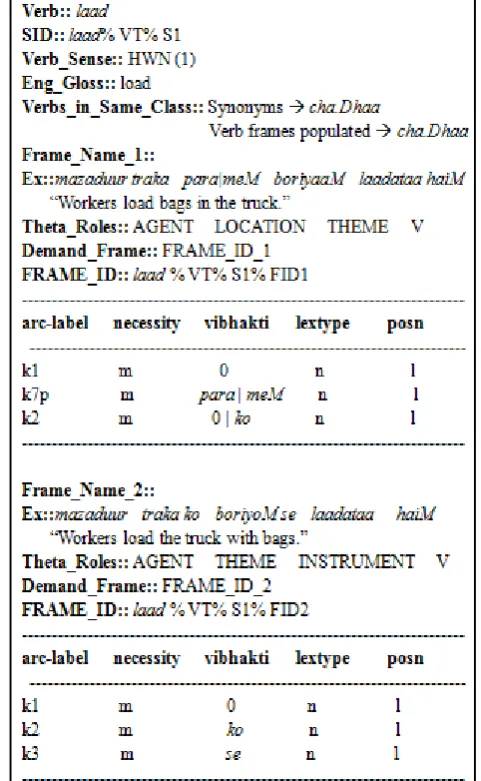
[image:8.595.183.424.239.630.2]As mentioned earlier, each verb can have multiple senses and for each sense of the verb there can be a number of possible verb frames. A frame is different from another frame for a verb when the argument relations are different. Only few verbs have more than one frame for its one particular sense. An example of a verb having more than one frame for a particular sense is given in Fig. 2. Here the verb is laadhaving the sense ‘load’. Its SID is laad%VT%S1. For this particular sense of verb laad ‘load’, there are two verb frames. The FRAME_IDs of the first and second verb frames
are laad%VT%S1%FID1 and laad%VT%S1%FID2
respectively. Here it can be seen that for the same sense S1 there are two frames FID1 and FID2. The arguments of the verb laad ‘load’ in the first frame are mazaduur‘servants’, traka‘truck’, and boriyaaM‘bags’. The karaka relations of mazaduur‘servants’, traka ‘truck’, and boriyaaM‘bags’are karta (k1), deshadhikaran(k7p, place of action) and karma (k2) respectively. The necessity of mazaduur (k1), traka (k7p), and boriyaaM (k2) is mandatory, i.e., m. mazaduur (k1) takes 0 vibhakti, traka (k7p) takes either para ‘on’or meM ‘in’ vibhakti and boriyaaM (k2) takes either 0 or kovibhakti. The arguments traka (k7p), and boriyaaM (k2) are taking more than one vibhakti so here these vibhaktis of traka (k7p), and boriyaaM (k2) are merged, i.e., para|meM, and 0|ko respectively. The lexical category of all the arguments is nouni.e., n.
Here the second frame is different from the first frame because the dependency relations are different. As it is a second frame, the number of the verb frame will be Frame_Name_2. The arguments of the verb laad ‘load’ in the second frame are mazaduur‘servants’, traka‘truck’, and boriyoM ‘bags’. The karaka relations of mazaduur ‘servants’, traka‘truck’ and boriyoM ‘bags’are karta (k1), karma (k2) and karana (k3) respectively. The necessity of mazaduur(k1), traka(k2) and boriyoM(k3) is mandatory i.e., m. mazaduur (k1) takes 0 vibhakti, traka (k2) takes ko vibhakti, and boriyoM (k3) takes se ‘with’ vibhakti. The lexical category of all the arguments is noun i.e., n. Verbs_in_Same_Class field lists a verb, i.e., cha.DZaa ‘load’ which has same sense as the verb laad ‘load’. There is no verb frame file for the verb cha.DZaa ‘load’ as it can be seen that there is no frame id (FRAME_ID) mentioned for the verb cha.DZaa. In case of verb frames, cha.DZaa ‘load’ has only one verb frame which matches with the first frame of the verb laad ‘load’. Verb laad has two frames for this particular sense of ‘load’ whereas the verb cha.DZaa has only one frame for the sense of ‘load’. This information is also provided in the verb frame file of the verb laad ‘ load’ that; (i)there is a difference between the number of frames of verbs laad and cha.DZaa, and (ii)the single frame of the verb cha.DZaa matches with the first frame of the verb laad. 5.2.2. Verb Taking a Desirable Argument
One of the important features in verb frames is the feature necessity. The necessity of the arguments is divided into 2 categories: (1) mandatory, and (2) desirable. An argument which is mandatory is compulsory to be present in the sentence as it is obligatory to fulfil the meaning of the verb, without which the meaning of the verb is incomplete. A desirable argument is also required to fulfil the meaning of the verb but it is not compulsory for the desirable argument to be present in the sentence. Even if the desirable argument is absent on the surface level, the meaning is conveyed implicitly from the context. The meaning of the verb will be still complete in its absence. Mandatory arguments are considered as strong arguments and desirable arguments as weak arguments. Desirable arguments are weak in the sense they can be dropped when compared to mandatory. The expectation level in case of mandatory arguments is very high whereas the expectation level in desirable arguments is very low. An example of desirable argument is given below: Ex-8 raam ne chaakuu se (k3) seba kaaTaa ram Erg. knife with apple cut ‘Ram cut an apple with a knife.’
Ex-9 raam ne seba kaaTaa ram Erg. apple cut ‘Ram cut an apple.’
In example 8, chaakuu se ‘with the knife’ is a desirable argument as it can be dropped and still the meaning can be retrieved from the context. Example 9, is a perfect example of the sentence without the desirable argument chaakuu se‘with the knife’ and the desirable argument can be identified even if it is not present in the sentence.
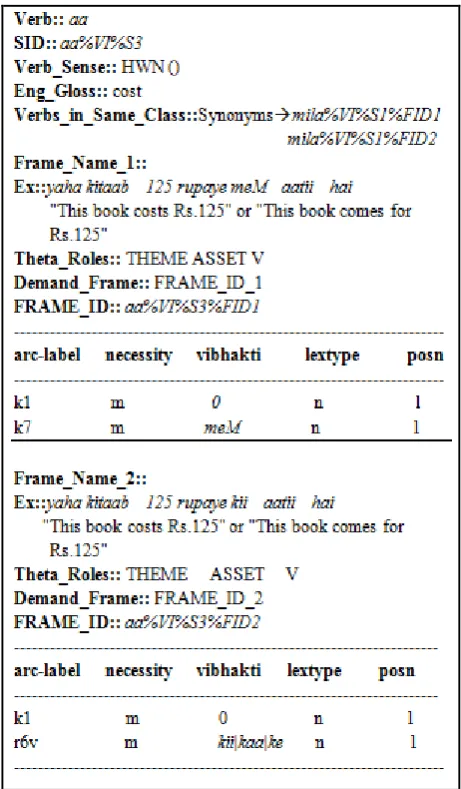
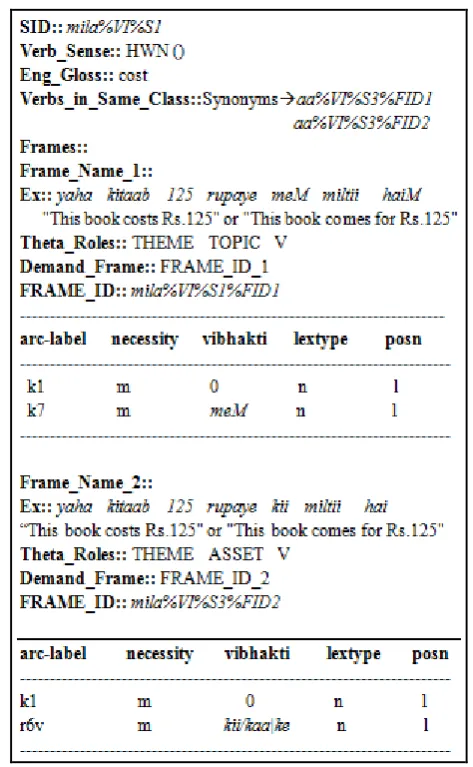
5.2.3. Verbs Matching in Sense as well as Number of Frames Below given figures 3 and 4 are the verb frames of the verbs aa ‘cost’ and mila ‘get’ respectively. These two verbs match in sense and also have the same number of frames. They both have two frames.
The two frames mila%VI%S1%FID1 and mila%VI%S1%FID2belonging to the first sense ‘get’ of the verb mila, match with the two frames, i.e., aa%VI%S3%FID1 and aa%VI%S3%FID2 belonging to the third sense ‘cost’ of the verb aa. In the Fig. 3, it can be seen that the two frame ids of mila ‘get’ (mila%VI%S1%FID1 and mila%VI%S1%FID2) are listed in the Verbs_in_Same_class field of the verb entry aa ‘cost’. The two verb frame ids of mila ‘get’ (mila%VI%S1%FID1 -
mila%VI%S1%FID2) listed in the field
Figure 4. Verb Frame of Verb mila ‘cost’ Having Two Frames for One Sense
In Fig. 1, it can be seen that the verb aa ‘come’ and the verb belonging to its class (which have the same sense as the verb aa), i.e., padhaara ‘arrive’ vary in vibhakti in case of goal (k2p) dependency relation (see figure 1). The verb padhaara takes less vibhaktis for goal (k2p) than the verb aa whereas the verb pahu.Ncha ‘reach’ which also belongs to the class of verb aa has same no. of vibhaktis as the verb aa for goal (k2p). The verb aa and pahuMcha take 0, ke_paas, ‘near’, par ‘on’, and taka ‘till’ vibhaktis whereas the verb padhaara takes 0, ke_paas ‘near’, par ‘on’ vibhaktis. taka vibhakti is not taken by the goal (k2p) argument of the padhaara verb. In the example 10 given below, it can be noticed that goal (k2p) with taka vibhakti for the verb padhaara is ungrammatical. This information about the differences between vibhaktis among the verbs having same sense is provided in the respective verb frame files. These differences allow us to come up with generalizations and also classify the verbs based on these features.
Ex-10 *raam hydaraabaad taka (k2p) padhaare ram hyderabad till arrived ‘Ram arrived till Hyderabad.’
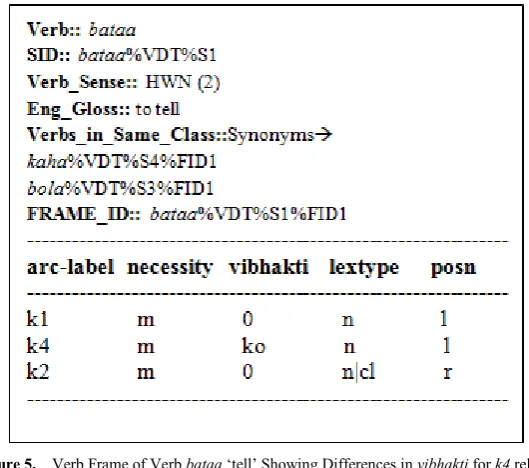
In the above instance, there is difference in vibhaktis, i.e., the verb (padhaara ‘arrive’) listed in the class has less vibhaktis than the main verb (aa ‘come’). There is another instance where the verb listed in the class has more vibhaktis than the main verb frame file. In the verb frame of bataa ‘tell’, the relation k4 (sampradana) takes only ko vibhakti whereas the verbs that belong to the bataa class, i.e., kaha ‘say’ and bola ‘tell’ which have the same sense as the verb bataa take an additional vibhakti se other than ko. See the examples 11 and 12 given below:
Ex-11 raam (k1) siitaa ko/*se (k4) sab (k2) ram sita Dat./ everything bataataa hai
tell.Impf. be.Pres.
‘Ram tells everything to Sita.’
Ex-12 raam (k1) siitaa ko/se (k4) sab (k2) ram sita Dat./with everything boltaa/kehtaa hai
tell/say.Impf. be.Pres.
‘Ram tells/says everything to Sita.’
[image:11.595.185.422.75.459.2]are represented in the verb frame.
There are also cases where main verb and the verb having the same sense as the main verb, take totally different vibhaktis for a particular dependency relation. The main verb chaaha ‘love’ takes ko vibhakti with karma (k2) whereas the verb prema kar ‘love’ which belongs to the chaaha class takes se vibhakti with karma (k2) relation. The verb pasaMd kar ‘like’ which also belongs to the chaaha class takes ko vibhakti as the verb chaaha. See the examples 13 and 14 given below:
Ex-13raam (k1)siitaa ko(k2)chaahtaa/pasaMd_kartaa ram sita Dat. love.Impf./ like do.Impf hai
be.Pres.
‘Ram loves/likes Sita.’
Ex-14raam (k1) siitaa se (k2) prem kartaa hai ram sita with love. do.Impf. be.Pres ‘Ram loves Sita.’
Below given figure 6 shows how the examples 13 and 14 are represented in the verb frame.
Figure 5. Verb Frame of Verb bataa ‘tell’ Showing Differences in vibhakti for k4 relation
[image:12.595.170.435.227.461.2] [image:12.595.169.432.471.669.2]There are cases where the verbs are similar in senses (main verb and the verbs belonging to its class) but there are some variations between them. The variations are as follows: (1) Differ in frames, for example, verb frames of jaana ‘know’ and aa ‘know’ as mentioned in the Fig. 1. Verb aa ‘know’ takes k4a+k1 relations. It takes ko vibhakti with k4a and 0 vibhakti with k1. Verb jaana ‘know’ (which belongs to the verb class aa) takes different frame, i.e., different karaka relations, k1+k2. Both the relations take 0 vibhaktis; (2)All the frames don’t match, i.e., only one frame matches and the other doesn’t, e.g., the verb cha.Dhaa ‘load’ (which belongs to the verb class laad) matches with the first frame of laad ‘load’ and doesn’t match with the second frame of the verb laad as mentioned in the Fig. 2. Verb laad ‘load’ takes two frames for the same sense. One is k1+k7p+k2 where k1 takes 0 vibhakti, k7p takes either par or meM vibhakti, and k2 takes either 0 or ko vibhakti. The second frame is k1+k2+k3 where k1 takes 0 vibhakti, k2 takes ko vibhakti, and k3 takes se vibhakti. The verb cha.Dhaa ‘load’ which has the same sense as laad ‘load’ has only one frame, i.e., the first frame k1+k7p+k2 of the verb laad ‘load’ and it doesn’t have the second frame k1+k2+k3 of the verb laad ‘load’; (3)All the frames match, i.e., the two frames of the verb aa ‘cost’ (which belongs to the verb class mila) matches with the two frames of the verb mila get, obtain’ as mentioned in the Fig. 3 and 4. The two frames of mila are k1+k7 (k1 takes 0 vibhakti and k7 takes meM vibhakti) and k1+r6v (k1 takes 0 vibhakti and r6v takes kii/kaa/ke vibhakti). The verb aa ‘cost’ also takes same two frames as mila; (4)Less vibhaktis, for example, aa ‘come’ and padhaara ‘arrive’. padhaara ‘arrive’ (which belongs to the verb class aa) takes less vibhaktis in comparison to aa ‘come’ for the dependency relation goal (k2p); (5)More vibhaktis, for example, bataa ‘tell’ and kaha/bola ‘say/tell’. Verbs kaha/bola ‘say/tell’ (which belongs to the verb class baat) take more vibhaktis in comparison to the verb bataa ‘tell’ for sampradana (k4) karaka relation; (6)Totally different vibhaktis, for example, prem kar ‘love’ (which belongs to the verb class chaaha) takes totally a different vibhakti in comparison to the verbs chaaha ‘love’ and pasand kar ‘love’. prem kar ‘love’ takes se vibhakti for k2 relation whereas the verbs chaaha ‘love’ and pasand kar ‘love’ take ko vibhakti for the karma (k2) karaka relation.
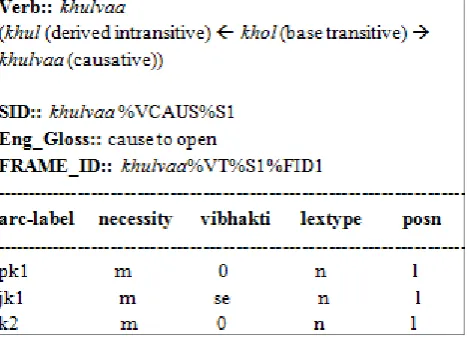
5.2.4. Causative Verbs Representation in Verb Frames. Causatives in Hindi are realized through a morphological process. In Hindi, a base verb root changes to a causative verb when affixed by either an ‘-aa’ or a ‘-vaa’ suffix. The causativization process of the causative verb khulvaa ‘cause to open’ is given below:
In the above causativization process, khol ‘open’ is taken as the base verb which is a transitive verb. Here, other than morphology, the semantics of the verbs is also taken into consideration. Here khul ‘open’ and khulvaa ‘cause to open’ are derived from the base verb khol ‘open’. khulvaa ‘cause to open’is a causative verb which is derived from the base verb by adding suffix ‘-vaa’ to it. khul ‘open’ is a derived intransitive form which is derived from the base verb khol ‘open’. The agent of the base verb khol ‘open’ is not realized on the surface level of the derived intransitive verb khul ‘open’ though it is implied semantically. Here there is both forward and backward derivation. From base verb khol to the causative verb khulvaa it is a forward derivation which means there is an increment of one argument from base verb to the causative verb. From base verb khol to the derived intransitive khul it is a backward derivation which means there is a reduction of one argument from base verb to the derived intransitive verb [33,34]. Example sentences (15, 16 and 17) of causatives are given below: [35].
Ex-15 darvaazaa (k1) khultaa hai door open.Impf. be.Pres. ‘The door opens.’
Ex-16 raam (k1) darvaazaa (k2) kholtaa hai ram door open.Impf. be.Pres. ‘Ram opens the door.’
Ex-17 maiM (pk1) raam se (jk1) darvaazaa (k2) I ram by door
khulvaataa huuM open.Caus.Impf. be.Pres. ‘I cause Ram to open the door.’
Below given is the verb frame file (figure 7) for the causative verb khulvaa. The causative derivation process is given in the verb frame file of the causative verb khulvaa. The verb frame files of khul and khol can be referred to get an idea of alternations since these verbs are related to the causative verb in the process of causativization.
[image:13.595.318.552.548.718.2]6. Results
The frequencies and percentage of the 300 verbs were extracted from the pilot Hindi dependency Treebank (HyDT) (2230 sentences) [30] whose coverage is 67.47%. The statistics related to the verb frames discussed above are given below in table 2.
It is clear that the entire structure of the verb frame discussed (refer table 2) is very rich. As of now it is planned to exploit the frames and the verb classes in parsing. They can also be used for various other applications which require a knowledge base, for example, word sense disambiguation, Machine translation, etc.
These verb frames are used in Hindi Parser [17,18]. The Output of the Parser is given below for the following examples:
Ex-18 vaha ghar meM aataa hai he home in comes is ‘He comes inside the home.’ Ex-19 raam seba khaataa hai
ram apple eats is ‘Ram eats apple.’
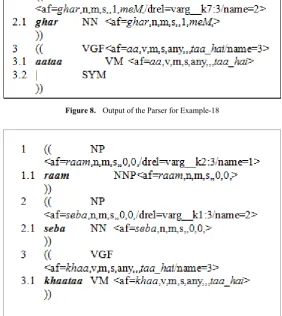
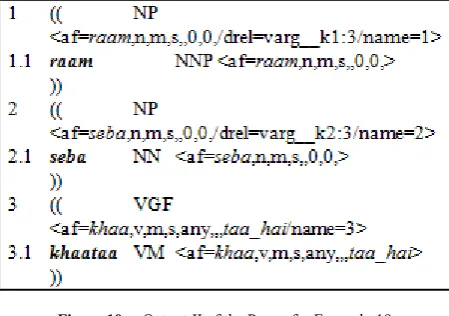
The output of the parser for example 18 is given below in Fig. 8. There will be 2 parse outputs for example 19. They will then go through a ranking process which will rank the parses. The two outputs are given in the Fig. 9 and 10 respectively:
Figure 8. Output of the Parser for Example-18
[image:14.595.164.448.274.443.2] [image:14.595.162.445.344.661.2]Table 2. Verb Frames and their Statistics
Type of the Count and Count Description
Case-1= Total no. of verbs for which verb frames (verb
entry) were created is: 300 Here the verbs are counted by just taking its single sense, i.e., the additional senses of the verbs are excluded out of the count. Case-2= Total no. of verbs for which verb frames were
created based on their multiple senses is: 486
Here additional senses of the above 300 verbs are included, i.e., each sense of all the 300 verbs has been counted. (The single sense count is 300 + the count of additional senses is 186= 486 )
Case-3= Highest sense count for a verb: 11 Verb nikala ‘leave’ has 11 senses. Case-4= Total no. of additional verbs that were populated in
the existing verb frames of certain verbs is: 180 Here the populated verbs are counted by just taking its single sense, i.e., the additional senses of the populated verbs are excluded out of the count. Case-5= Total no. of additional verbs that were populated
based on their multiple senses in the existing verb frames of certain verbs is: 279
Here additional senses of the populated verbs are included, i.e., each sense of all the populated verbs has been counted.
Case-6 (Case1+Case4)= Total no. of verbs for which verb frames (verb frame file) were created + Total no. of additional verbs that were populated in the existing verb frames of certain verbs are: 480
Here the verbs are counted by just taking their single sense, i.e., the additional senses of the verbs are excluded out of the count in both the categories (Both the categories mean verbs for which verb frames are created and the populated verbs). Case-7 (Case2+Case5)= Total no. of verbs for which verb
frames were created based on their multiple senses + Total no. of additional verbs that were populated based on their multiple senses in the existing verb frames of certain verbs are: 765 (In other words, total no. of verbs in the verb frames is:)
[image:15.595.65.290.362.520.2]Here additional senses of the verbs are included, i.e., each sense of all the verbs belonging to both the categories (Both the categories means verbs for which verb frames were created and the populated verbs) has been counted
Figure 10. Output-II of the Parser for Example-19
Example 19 has two outputs because raam ‘Ram’ and seba ‘apple’ have 0 (zero) vibhakti. In such a situation, two outputs will be generated as both k1 (karta) and k2 (karma) take 0 (zero) vibhakti. In output-I (figure 9), raam is k2 (karma) and seba is k1 (karta), and in output-II (figure 10), raam is k1 (karta) and seba is k2 (karma).
The verb frames developed have been used in Constraint based parser. Constraint based parsing using integer programming [36,18,37] has been successfully tested for Indian languages [38,39]. The parser uses the syntactic cues available in a sentence and forms constraint graphs (CG) on the basis of the generalizations available. It uses these notions as basic demand frames, i.e., verb frames and transformation frames [3] to build the constraint graphs. It translates the constraint graphs into an integer programming (IP) problem. The solutions to the problem provide the possible parses for the sentence. The initial results have shown that the parser gives comparable results with the state-of-the-art data driven Hindi parsers. The performance
is not directly comparable as the dependency tagset used for the constraint-based parser is coarse-grained, while the data-driven uses fine-grained. On average, however, the data-driven parser will do better than the constraint-based parser. The small lexicon (linguistic demands of various heads) has a negative impact on parser performance. The efficiency will automatically increase with the increase in the coverage of this lexicon [36,18,37].
7. Comparison of Dependency
Annotation with Propbank
Annotation
In this work, the Propbank annotation and dependency annotation done on the Hindi data is compared to get a mapping between them. This mapping will help in analysing the relation between dependency annotation and propbank annotation.
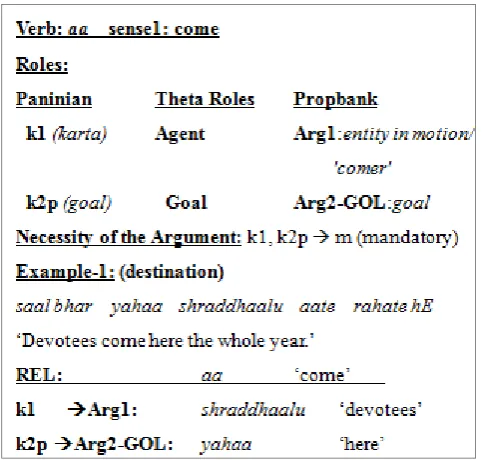
argument; (6)The mapping between the roles in these three frameworks (Paninian, Theta roles, Propbank roles); (7)An example sentence (with an English gloss) in which the karaka relations and Propbank roles are annotated. Example sentences were taken from the corpus or from Hindi WordNet; (8)If the verb had more than one sense, each sense was separately represented with all the information mentioned above in (1) to (7). A sample verb entry is provided below in the figure-11:
Figure 11. Frameset for Hindi verb aa “come”
In the above figure, frameset for Hindi verb aa “come‟ is given. The argument relations are given in three frame works i.e., karaka relations, Theta roles, and Propbank. According to the example sentence given, it has the following roles, i.e. k1 (karta), k2p (Goal), and k7t (kaladhikaran - time location) in karaka relations; Agent, Goal, and Time in Theta roles and; Arg1:entity in motion/‘comer’, Arg2-GOL:goal and ArgM-TMP:temporal in Propbank respectively. k1 (shraddhaalu “devotees”) and k2p (yahaa “here”) are mandatory; k7t (saal bhar ‟year long”) is optional.
In the comparative study of Hindi verbs in both dependency annotation and Propbank annotation, it is found that karta maps with both Arg0 and Arg1 whereas karma maps with Arg1. In PropBank, Arg0 and Arg1 are understood as framework-independent labels. They are closely linked with Dowty’s Proto-roles [40]. Arg0 correlates with the agent, causer, or experiencer, even if it is realized as the subject of an active construction or as the object of an adjunct (by phrase) of the corresponding passive. In this case, Arg0 and Arg1 are very much like k1 and k2 in Hyderabad Dependency Treebank (HyDT) [36]. k1 and k2 are annotated based on their semantic roles and not their grammatical relation. HyDT treats the sentences given below in a similar manner, whereas PropBank does not:
Ex- (20) The boy opened the door.
Ex- (21) The door opened.
In HyDT, the boy (Ex-20) and the door (Ex-21) are annotated as k1, whereas in PropBank, the boy (Ex-20) is annotated as Arg0 and the door (Ex-21) as Arg1. In example 21, the door is not a primary causer as the verb is unaccusative for Propbank. In HyDT, the concept of unaccusativity is not taken into consideration. This is a significant differentiation that has to be considered when doing the mapping. Hence, k1 is ambiguous, i.e., it maps to Arg0 as well as ARG1. In HyDT, Experiencer subjects are annotated as k4a (anubhavkarta) whereas in PropBank, experience subjects don’t have a separate label and are marked as ARG0. Therefore, k4a maps to ARG0 [41].
In Hindi, necessary arguments are dropped frequently and it can be retrieved from the previous discourse. In HyDT, all the dropped arguments are not represented but some of the empty categories like ellipsis, gapping, and empty conjunctions, etc. [42]. Hence, to provide total representations of predicate argument structures involving dropped arguments, Hindi PropBank does semantic role annotation and also empty argument insertion [43].
Table 3. Mapping between karaka roles, Theta roles, and Propbank roles
karaka Propbank Theta-Role Verb Sense
k1(karta)
Arg1:entity in motion / 'comer'
Agent
Aa sense1: come
Arg0:agent, doer Kara sense1: do Arg0:Taker Le sense1: take
Arg0:buyer Le sense2: buy
Arg0:creator Banaa sense1: make Arg0:believer Maan sense1:believe Arg0:reacher pahu.Ncha sense1: reach
Arg0:giver de sense1:give
Arg0:entity leaving Cho.Da sense1:leave Arg0:entity doing the dropping Cho.Da sense2:drop
k5 (apadaan)
Argm: direction or location or extent)
Source
Baha sense1: flow
Arg2-SOU:entity taken from, orprepositional complement of arg1 Le sense1: take
Arg2-SOU:seller Le sense2: buy
Arg2-SOU:thing/place exited from nikala sense2:emerge
k2 (karma)
Arg1:thing done
Theme
Kara sense1: do Arg1:thing taken Le sense1: take Arg1: thing bought Le sense2: buy
Arg1:belief maan sense1:believe Arg1: entity respected Maan sense2: respect Arg1:thing given de sense1:give
Arg1:place left Cho.Da sense1:leave Arg1:Logical subject, patient,
thing falling Cho.Da sense2:drop
k4 (sampradan)
Arg2:entity given to Beneficiary de sense1: give Arg2:Hearer Recipient bataa Kaha sense1:tell
After the creation of verb frames for Hindi, the Hindi verbs were classified based on their argument structure given in the verb frames. The classification of Hindi verbs is discussed in the section given below.
8. Hindi Verb Classification
This section presents the approach followed for the classification of Hindi verbs. Hindi verbs have been classified based on similar verb frames, i.e., based on same argument structure. In other words, the verbs have been classified based on the dependency relations taken by the verbs. These dependency relations are syntactico-semantic in nature. They include mostly karaka relations and also some other dependency relations. Verb frames of Hindi verbs are same when they have same set of dependency relations. Other information in the verb frame (table in the verb frame file) such as necessity, vibhakti, lexical category, etc., may vary but dependencyrelations should be the same. The basis of classification was more syntactico-semantic than either totally syntactic or totally semantic.
[image:17.595.56.547.91.407.2]In the whole process of creating verb frames, 49 unique verb frames (unique set of dependency relations) were developed and the verbs were classified based on these verb frames. The verbs which take these 49 unique verb frames are grouped and this group of verbs is listed under each unique verb frame. Table 4 given below shows all the 49 unique verb frames (dependency relations):
Table 4. Unique Verb Frames (dependency relations)
Frames Frames Frames
k1+ k2p+verb k1+rh+k7+verb k4a+k1+k1s+ verb k4a+k1+verb k1+k2+k2g+verb pk1+jk1+k2+ verb k4a+k7p+verb k1+k7t+verb pk1+ jk1+k7p+verb
k1+k2+verb k1+ras+verb pk1+ jk1+k3+verb vmod(sequential)+k1
+k2+verb k1+rt+verb pk1+ jk1+verb k1+k7+verb k1+rt+k2+verb pk1+ jk1+k5+verb k1+r6v+verb k1+k2+k7+verb pk1+jk1+k4+k2+ verb k1+k7p+verb k1+k5+k7+ verb pk1+jk1+k2+k5+ verb k1+k5+verb k1+k2+k7p+verb pk1+ jk1+ k2p+verb k1+vmod(simultaneo
us)+verb k1+k2p+k2+verb k1+k1u+verb k1+vmod(reason)+
verb k1+k2p+k7t+verb k1+k1u+k1s+ verb k1+verb k1+k7t+k5+verb pk1+mk1+jk1+ verb k7p+k7t+k1+verb k1+rt+k5+k2+verb pk1+mk1+jk1+k2+verb
k1+k2+k5+verb k7+ k7p+k1+verb k1+rd+verb k1+k5+k7p+k2+ verb k1+rd+k2+verb k1+ k2+k3 +verb k1+k1s+verb k1+k2+k4+verb
k1+rh+verb k1+k2+k2s+verb
[image:17.595.312.553.433.722.2]that are classified under each unique verb frame share certain semantics. So, within the verb frame classification the verbs are grouped under a semantic class and these classes are closer to Levin’s semantic classes. The verbs within the main class were sub-classified based on similar vibhaktis and other information (necessity, lextype) in the verb frame. Section given below describes the classification process (In the frames given below, for the ease of understanding, the complete format of sense-id and frame-ids of the verbs are not provided. Only sense number of the verb is mentioned. Those verbs which don’t have sense and frame ids are the populated verbs).
8.1. Verb Frame: k1+k2+k4+verb
The below listed verbs take the ‘k1+k2+k4+verb’ verb frame:
(1)bataa1, (2)bola3, (3)kaha4, (4)bataa4, (5)bataa6, (6)bola4, (7)kaha3, (8)sunaa, (9)bataa3, (10)bataa2, (11)bheja1, (12)bola2, (13)kaha1, (14)pahuMchaa2, (15)Daala2, (16)lauTaa1, (17)vaapasa_kara, (18)parosa1, (19)de1, (20)sauMpa1, (22)Cho.Da, (23)baa.NTa1, (24)likha
Out of the above listed verbs, some verbs are ‘Verbs of Communication’ and some are ‘Give verbs’. The verbs that share the semantics of ‘Communication’ and ‘Give’ are listed under these semantic classes:
Verbs of Communication: (1)bataa1, (2)bataa2, (3)bataa3, (4)bataa4, (5)bataa6, (6)bola3, (7)bola4, (8)bola2, (9)kaha4, (10)kaha3, (11)kaha1, (12)sunaa, (13)likha
Give verbs: (1)lauTaa1, (2)vaapasa_kara, (3)parosa1, (4)de1, (5)baa.NTa1
In ‘verbs of communication’ semantic class there are 5 senses of bataa verb, 3 senses of bola verb, and 3 senses of kaha verb.
Verbs that take ‘k1+k2+k4+verb’ verb frame, are sub-divided based on the vibhaktis and other information (necessity, lextype) given in the verb frame (tabular form). Main classification of the verbs is based on dependency relations and the sub-classification is based on vibhaktis and other information given in the verb frame (tabular form). There are 8 sub-classes of verbs based on this sub-division. Below given are the sub-classes of the ‘k1+ k2+k4+verb’ verb frame:
I. Frame for the following verbs is given below:(1)bataa1 arc-label Necessity vibhakti lextype Posn
k1 M 0 n l
k4 M ko n l
k2 M 0 n|cl r
II. Frame for the following verbs is given below: (1)bola3, (2)kaha4
arc-label Necessity vibhakti lextype Posn
k1 M 0 n l
k4 M ko|se n l
k2 M 0 cl|n r
III. Frame for the following verbs is given below:(1)bataa4,
(2)bataa6, (3)bola4, (4)kaha3, (5)sunaa, (6)bheja1, (7)Daala2, (9)lauTaa1, (10)vaapasa_kara, (11)parosa1, (12)de1 (de%VDT%S1%FID1), (13)sauMpa1, (14)likha, (15)baa.NTa1
arc-label Necessity vibhakti lextype Posn
k1 M 0 n l
k4 M ko n l
k2 M 0 n l
IV. Frame for the following verbs is given below:(1)bataa3 arc-label necessity vibhakti lextype Posn
k1 M 0 n l
k4 M ko n l
k2 M 0 cl l
V. Frame for the following verbs is given below:(1)bataa2 arc-label necessity vibhakti lextype Posn
k1 M 0 n l
k4 M ko n l
k2 M ke_baare_meM n l
VI. Frame for the following verbs is given below:(1)bola2, (2)kaha1
arc-label Necessity vibhakti lextype Posn
k1 M 0 n l
k4 M ko n l
k2 M ko|ke_liye n l
VII. Frame for the following verbs is given below: (1)pahuMchaa2
arc-label necessity vibhakti lextype posn
k1 M 0 n l
k4 M 0|ko n l
k2 M taka n l
In the above verb frame, i.e., k1 + k2 + k4 + verb, all the verbs that take this verb frame, are listed under it. Certain verbs listed in the verb class have semantic similarities such as verbs of Communication and Give verbs. Then the verbs were sub-divided based on similar vibhaktis and other information given in the verb frame (tabular form).
Within the verb frame classification, the verbs that share certain semantics are grouped under a semantic class and these classes are closer to Levin’s semantic classes. Semantic similarities are not found among the verbs of most of the verb frames. Table 5 shows some of the verb frames which contain semantic classes and also shows the Levin’s semantic classes to which our semantic classes are closer to (refer table 5).