Researching decision support : what do we
need to know?
Rooke, J, Koskela, LJ, Siriwardena, ML, Ruikar, K, Kagioglou, M, Sexton, MG,
McDermott, P and Aouad, GF
Title Researching decision support : what do we need to know?
Authors Rooke, J, Koskela, LJ, Siriwardena, ML, Ruikar, K, Kagioglou, M, Sexton, MG, McDermott, P and Aouad, GF
Type Conference or Workshop Item
URL This version is available at: http://usir.salford.ac.uk/20727/ Published Date 2006
USIR is a digital collection of the research output of the University of Salford. Where copyright permits, full text material held in the repository is made freely available online and can be read, downloaded and copied for noncommercial private study or research purposes. Please check the manuscript for any further copyright restrictions.
TO KNOW
?
JOHN ROOKE, LAURI KOSKELA, MOHAN SIRIWARDENA, KIRTI RUIKAR,
MICHAIL KAGIOGLOU, MARTIN SEXTON, PETER MCDERMOTT, GHASSAN
AOUAD
kim33rep001jr022006 DecisionSupport.doc
ISSUEDATE: 2ND OCTOBER 2006
R
EFERENCETHE PAPERAS:
R
OOKE, J., K
OSKELA, L., S
IRIWARDENA, M., R
UIKAR, K.,
K
AGIOGLOU, M., S
EXTON, M., M
CD
ERMOTT, P. & A
OUAD, G.
(2006) 'R
ESEARCHINGD
ECISIONS
UPPORT:
WHATDOWE NEEDTO KNOW?' S
YMPOSIUMONS
USTAINABILITYANDV
ALUET
HROUGHC
ONSTRUCTIONP
ROCUREMENT, CIB W092, D
IGITALW
ORLDR
ESEARCHINGDECISIONSUPPORT: W
HATDOWENEED TOKNOW?
John Rooke, Lauri Koskela, Mohan Siriwardena, Kirti Ruikar, Mike Kagioglou, Martin Sexton, Peter McDermott, Ghassan Aouad.
Salford Centre for Research and Innovation (SCRI) in the Built and Human Environment
The University of Salford 4th Floor, Maxwell Building Salford M5 4WT
Abstract: The EPSRC funded KIM Grand Challenge project to investigate the use of Knowledge and Information Management techniques in the context of the emerging product-service paradigm in engineering is introduced. The paper focuses on the topic addressed by Task 3.3 of this project, decision support. An outline is offered of an approach to decision support which combines the Unique Adequacy (UA) requirement of methods with Transformation-Flow-Value (TFV) theory. UA requires that reports are [1] grounded in a detailed inside knowledge of the topic and [2] are theory neutral. TFV theory emphasises the importance of flows in the analysis of production. It is suggested that these two approaches may be usefully combined to facilitate: [1] the design of through life decision support; and [2] the creation of the through-life community of practice which makes possible the sharing of information across the whole product-service life cycle.
1. The Aim of the Research
This paper outlines an intended contribution to Task 3.3 of the EPSRC funded ‘Grand Challenge’ project, Immortal Information and Through-Life Knowledge Management (KIM). KIM involves eleven UK universities, including eight EPSRC funded Innovative Manufacturing Research Centres and spans a number of industries including aerospace and construction. Its aim is to address a perceived shift among engineering companies towards a product-service paradigm and to explore the implications of this for knowledge management. Thus, the project seeks to identify approaches to information and knowledge management that are appropriate to the through-life support of products. The four Work Packages (WPs) and eleven Tasks into which the project is organised address the evaluation, input, storage, access and use of information and knowledge over extended periods of time and across a diversity of organizational, occupational and other knowledge communities. The four Work Packages address, respectively: [WP1] recording design knowledge in a manner which is sustainable throughout the product-service life-cycle; [WP2] the operational systems and knowledge communities in which knowledge is accessed and used; [WP3] the nature and use of knowledge. WP4 is concerned with the co-ordination of the other three.
The primary aim of T3.3 is to increase the understanding of decision-making processes and the various methods available to support them within the context of product-service projects. This will facilitate the achievement of a second aim, to provide suggestions for the improvement of decision support systems and related practice. In order to achieve these aims, this contribution aims to answer three questions:
1. How do we create the conditions in which information will be available for decisions, useful and clearly understood at all points in the life cycle?
2. How can we provide a common conceptual basis for an understanding at all stages of the product-service life-cycle, such that the right data is assembled, saved and made available in a clearly understandable form to potential users?
3. Can such a conceptual basis be used also to underpin decisions that facilitate the integration of key systems and interests in the through life product/service and the resolution of potential conflicts?
These will be addressed using an innovative and evolving approach which combines a descriptive research methodology with a generic theory for the development of production improvement solutions. Finally, the contribution aims to integrate with other Universities' initiatives within the project, in a process of collaboration that should ultimately span the whole of the Grand Challenge project.
2. Finding a focus
• In order to make this more manageable, we propose to concentrate on four central phases: design; procurement; construction; and maintenance and operations.
• As a starting point, we intend to talk to facilities managers as key informants on the process of maintenance and operation.
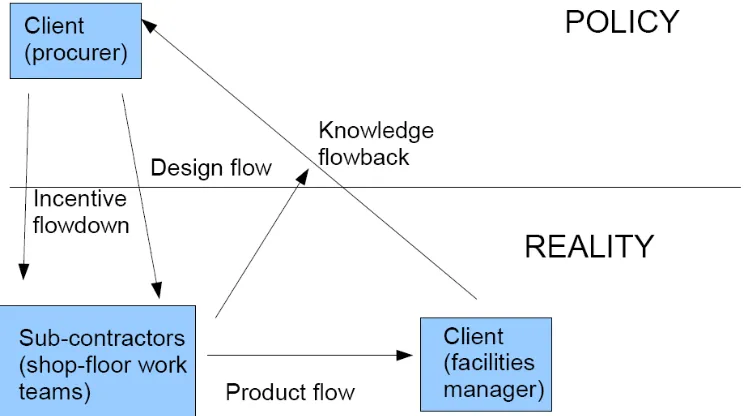
• Using Ohno's 'five why's' (Womack, Jones, & Roos 1990) we will attempt to trace knowledge management problems in this phase back to construction, design and procurement phases.
• We will also investigate the decisions made by sub-contractors (shop-floor teams) again tracing KM problems back up the incentive and design flows but also tracing decisions forward for their consequences, in the light of what we have learned from facilities managers.
[image:6.595.93.466.477.685.2]This procedure is organised through the dichotomy of intended policy and operational reality. The mechanisms necessary for effective knowledge management being flowdown of policy to reality and feedback from reality to policy (see Figure 1).
3. Understanding decisions
The second task is to clearly understand the decision making processes that we have identified. We suggest that such an understanding depends upon us conducting our research to meet the unique adequacy (UA) requirement of methods (Garfinkel 2002; Garfinkel & Wieder 1992). Research conducted to this standard has been shown to be useful in supporting the design of IT applications (Rooke & Seymour 2005) and holds out the promise of innovative approaches to the design of such applications (Button & Dourish 1996; Dourish & Button 1998). The UA requirement has two forms, both of which “are founded on the principle that the activities and procedures of persons in a setting can best be accounted for in terms of the understandings that those persons have of that setting” (Rooke, Seymour & Fellows 2004:656).
In brief, the two forms of the UA requirement stipulate that:
1. the research achieves a detailed inside knowledge of the research topic;
2. the research report is theory-neutral.
The strong requirement concerns the reporting of research. It demands that the methods of analysis used to describe a process should be derived directly from that process. This assumes that the methods that participants use in the process of making a decision are sufficient to the purpose of producing an account of that decision. This assumption has a particular piquancy with regard to decisions, where 'the decision' might be nothing more than a gloss used to account for an indeterminate phenomenon which is invoked retrospectively to excuse or justify a particular course of action. However, it is proposed as a standard for the description of any social setting, that is to say, any phenomenon which is composed of (and by) conscious beings who are able to produce an account of their own activities. It is proposed that methods of analysis which are alien to the analysed setting (thus introducing a theoretical spin to the description) must involve some distortion. Although the strong requirement was originally proposed as a criterion for ethnomethodology, we suggest that its theory neutrality gives it too a far wider application. Unlike findings that are theoretically constructed, UA findings are available for to a diversity of different theoretical and practical purposes.
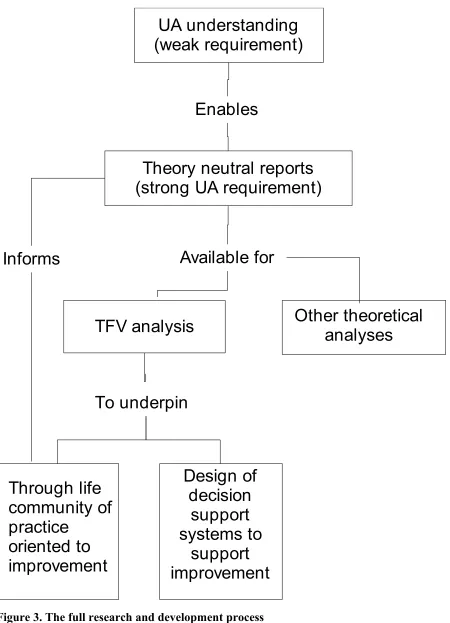
UA reports have at least two possible applications in whole life decision support: [1] to inform the design of decision support systems; [2] to promote common understanding between knowledge communities at different stages of the life cycle. However, UA reports are purely descriptive in intent. They do not in themselves offer solutions to practical problems of production, service or knowledge managment.
4. Communities of Practice
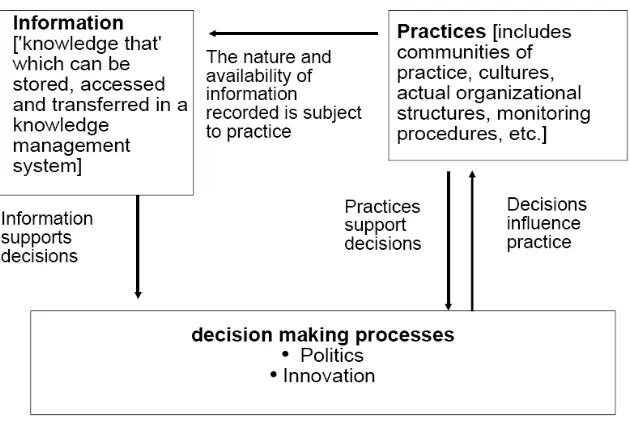
The notion of communities of practice (Lave & Wenger 1991) draws attention to the situated and social nature of knowledge. Ryle's distinction between 'knowing that' and 'knowing how' is again relevant here and is illustrated in Figure 2 in terms of information and practices.
support? How is the task of bringing together relevant information, requirements and viewpoints in a decision-making context to be achieved? Button & Sharrock (2002) have shed some light on these questions, demonstrating the high level of specification of an actually existing decision making process that can be achieved through observation of the UA requirement of methods.
However, it will be necessary to build some kind of community of practice across the product-service life-cycle, if adequate decision support is to be achieved. UA descriptions can go some way towards this, by illustrating particular stages of the process for the benefit of decision makers at other stages in the process.
[image:9.595.96.411.421.634.2]This is unlikely to be sufficient in itself for the development of a community of practice. We propose that a vital contribution will be the introduction of generic production theory concepts intended to inform and develop practice. If these can be shown to offer local improvements at each stage of the product-service process, then this will create the necessary interest in adopting them.
5. TFV production theory as a common conceptual basis
It is implicit in the concept of community of practice that a shared understanding is a pre-requisite of sharing information; thus, a set of shared ideas is necessary in order to create a community of practice that can facilitate decision support across the product/service life-cycle. Our second research question addresses this necessity; how can we provide a common conceptual basis for an understanding at all stages of the product-service life-cycle, such that the right data is assembled, saved and made available in a clearly understandable form to potential users? Such a conceptual basis would underpin both appropriate practices for recording and sharing information and a shared understanding of data thus preserved and distributed.
We propose Koskela’s (2000) Transformation-Flow-Value (TFV) theory as a possible source of concepts for such a shared understanding. While traditional production theory is based on an analytic decomposition in which production is seen as a transformation of materials, recent innovations (Quality Management, JIT, Business Process Re-engineering etc.) see production as a flow (of materials and other things) or in terms of the generation of value.
TVF theory provides an account of the importance of the concept of flow in developing new approaches to improving production. Lean construction, as embodied in the work of the European Group for Lean Construction, the International Group for Lean Construction, and the Lean Construction Institute, is an adaptation, development and implementation of the lessons of the Toyota production system in the construction industry. Lean construction's main innovatory tool, the Last Planner System (Ballard & Howell 1998) is a prime example of the practical application of the flow concept. A crucial issue is the tension between short & long term thinking which is itself implied in the distinction between product and service paradigms. There is a growing body of evidence of the effective application of lean principles on construction projects (for instance, Thomassen, Sander, Barnes, Nielsen, 2003, Versteeg 2006).
life cycle, which in turn will underpin an immortal community of practice. Some ideas which initially suggest themselves as useful in this way are:
1. The understanding of the product/service life-cycle as a product flow;
2. The understanding of the product/service life-cycle as the generation of value in the context of a customer-supplier relationship;
3. The methodology of the Toyota product development process;
4. The importance of achieving incentive flow-down from procurers to shop-floor teams;
5. The development of standards which underpin flexibility.
In offering generic concepts that underlie practical improvement initiatives and tools, TFV goes beyond promoting understanding in throughout the product-service life-cycle to encouraging shared thought processes between different occupational groups and life-cycle stages.
6. Conclusion, developing a community of practice to improve the product-service process
The approach to through-life decision support outlined in this paper combines thorough empiricism with tested theory.
The UA requirement offers a standard for empirical research that has proven efficacious in IT design. It has been suggested here that research to this standard can also be used to promote common understanding across the life-cycle.
KM systems towards the development of KM systems which support improvement of the whole construction product/service process.
The use of a production theory that has been successfully implemented in practice favours the creation of a through-life community of practice that does not merely promote common understanding and interests but is enabled to promote improvement across the whole product-service process.
UA understanding
(weak requirement)
Theory neutral reports
(strong UA requirement)
TFV analysis
Enables
Available for
To underpin
Through life
community of
practice
oriented to
improvement
Design of
decision
support
systems to
support
improvement
Other theoretical
analyses
[image:13.595.89.539.63.686.2]Informs
7. References
Ballard, G. & Howell, G. (1998) ‘Shielding Production: Essential Step in Production Control’, Journal of Construction Engineering and Management, 124(1):11-17.
Button, G. and Dourish, P. (1996) 'Technomethodology: Paradoxes and Possibilities,' in Proceedings of the ACM Conference on Human Factors in Computing Systems CHI'96 (Vancouver, BC), 19-26. New York: ACM. http://www.ics.uci.edu/ %7Ejpd/publications/1996/chi96-technomethodology.pdf
Button, G. & Sharrock, W. W. (2002) Operating the Production Calculus: Ordering a Production System in the Print Industry. In British Journal of Sociology, 53(2):275-290.
Davenport, T.H. and Prusak, L. (1997). Working Knowledge: How Organisations Manage What They Know. Harvard Business School Press, Boston, MA.
Dourish, P. & Button, G. (1998) ‘On “Technomthodology”: Foundational Relationships between Ethnomethodology and System Design’, in Human-Computer Interaction,13(4 ):395-432.
Garfinkel, H. (2002) Ethnomethodology’s Program: Working out Durkheim’s Aphorism, Rowman & Littleford, Lanham.
Garfinkel, H. & Wieder, D. L. (1992) 'Two Incommensurable, Asymmetrically Alternate Technologies of Social Analysis', in G. Watson & R. M. Seiler (eds.), Text in Context, Sage, London, pp. 175-206.
Koskela, L. (2000). An exploration towards a production theory and its application to construction, VTT Technical Research Centre of Finland, VTT Publication 408.
Lave, J. & Wenger, E. (1991) Situated learning: legitimate peripheral participation, Cambridge University Press.
Rooke, J. & Seymour, D. (2005) ‘Studies of Work: Achieving Hybrid Disciplines in IT Design and Management Studies’, Human Studies 28(2):205-221. http://www.ingentaconnect.com/content/klu/huma/2005/00000028/00000002/00004192
Rooke, J., Seymour, D. & Fellows, R. (2004) ‘Planning for Claims; An Ethnography of Industry Culture’, in Construction Management and Economics,22:655-662.
Ryle, G. (1963) The Concept of Mind, Penguin, Harmondsworth.
Thomassen, M. A., Sander, D., Barnes, K. A. & Nielsen, A. (2003) Experience and results from implementing lean construction in a large Danish contracting firm, Proceedings of the 11th Annual Conference on Lean Construction, Virginia Tech, Blacksburg, July 22nd - 24th.
Versteeg, D. (2006) The lean experience of Heembouw, presentation at EGLC3: European Group for Lean Construction, Delft, 22nd - 23rd May. http://www.obom.org/DOWNLOADS2/Dennis%27Slides.pdf