International Journal of Emerging Technology and Advanced Engineering
Website: www.ijetae.com (ISSN 2250-2459,ISO 9001:2008 Certified Journal, Volume 3, Issue 5, May 2013)
Multiprocessor Based Architecture for Controlled Switching of
Circuit Breaker
Ashish Maheshwari
1, Sunil Singla
2, Suraj Pardeshi
31, 2
EIE Department, Thapar University Patiala - India
3CG Global R&D Centre, Crompton Greaves Ltd; Mumbai - India
Abstract— Circuit Breaker is one of the most critical
elements of power industry. Controlled Switching of grid voltage and grid current is the best solution to prevent the high inrush current and over voltages. This paper describes the Controlled Switching of Circuit Breaker by using multi-processor based architecture. With this architecture early detection of most of major fault is feasible; it is also possible to monitor most of the critical parts, which affects the contacts of circuit breaker, with single system. The developed system also includes features such as oscillographic data storage, real time fault analysis, event information and Alarm. The design of multiprocessor hardware architecture to achieve the point on wave switching has also been described in this paper.
Keywords- Circuit Breaker, Controlled Switching,
Compensation, Processor, Switching Transients.
I. INTRODUCTION
Random closing and opening operations in many circuit breaker applications generate severe voltage and current switching transients. While transients occur in main circuit, these cause induced transients in control and auxiliary circuits and low voltage systems. Such switching transients are also associated with a variety of dielectric and mechanical stresses on the EHV equipment and may cause gradual or immediate damage. Induced transients may lead to disturbances in substation control and protection systems, personal computers / processors or telecommunications.
Energizing shunt reactors shunt capacitors and power transformers may cause high over-voltage, under-voltage or high in-rush currents. De-energizing capacitive loads, harmonic filters and shunt reactors result in restrikes. Re-ignition may occur, resulting in steep voltage surges. The magnitude of transient depends upon the instant on the voltage waveform where opening or closing of breaker contacts occur. In an uncontrolled situation, sooner or later switching is bound to occur at the worst possible points-on-wave. Conventional methods used to limit the magnitude of these switching transients like Pre-insertion resistors, Damping Reactors, Arrestors or upgrading the insulation are inefficient, unreliable or expensive and do not address the root problem.
Sooner or Later, uncontrolled switching is bound to occur at the worst possible points on wave. [1]
II. MULTIPROCESSOR ARCHITECTURE
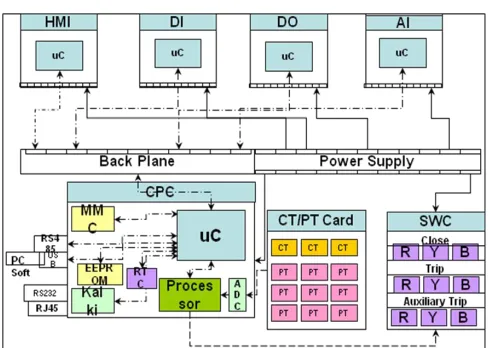
The system comprises of various modular units such as digital input, digital output, analog input, switching, power supply, display unit and central processing unit. All the units describe above are modular in nature and are hot-swappable. Each module performs individual tasks which acquire, analyse, control and sent to the central processing card. For Inter-communication within the module differential bus is used as shown in Figure 1.
Each module contains 16-bit microcontroller and various signal conditioning circuits as shown in figure 2. Every card has its own microcontroller dsPIC33Fxx which prevents the central processing card from overloading by the inputs as all the data is first processed by their own controller and then the information is sent to the central processing card. One of the advantages of using multi-processor architecture is that each controller is performing a low level task, time stamping and the necessary signal conditioning part for the input channels. Operating temperature of each module is from -20°C to +60°C.
International Journal of Emerging Technology and Advanced Engineering
Website: www.ijetae.com (ISSN 2250-2459,ISO 9001:2008 Certified Journal, Volume 3, Issue 5, May 2013)
[image:2.612.49.296.120.311.2]554
Fig. 1Block Diagram of Multiprocessor based Architecture for Controlled Switching of Circuit Breaker
Fig. 2 Internal Block Diagram of Multiprocessor Architecture
III. MODULES
A. Digital Input Card
Digital input card (DIC) is used to acquire various digital inputs from contactors/actuators like status of air pressure, close command, open command, auxiliary switch position feedback, and auto-reclosure. Digital input card have 16 digital inputs in one module. It is designed to work within the operating input range of 20Vdc to 220Vdc.
B. Digital Output Card
Digital output card (DOC) is used to provide on/off commands to various relays within the system. It is designed to simultaneously trigger at most of the ten relays within the module.
DO card gives the alarms like temporary over voltage, inrush current, contactor failure, operation failure, sensor failure, breaker opening, and breaker closing of RYB phase.
C. Analog Input Card
Analog input card (AIC) has 16 isolated channels. This card is used to take the input from various analog sensors such as SF6 pressure sensor, temperature sensor, air pressure transducers. The analog signals are converted to 4mA to 20mA current signal and digitized by controller. Controller sends the digitized signals to CPC card on CAN bus.
D. Switching Card
Switching card (SWC) will amplify the power of switching pulse for closing and opening of main contact and auxiliary contact of the circuit Breaker. It has two analog channels to condition dc voltages from main and auxiliary batteries. The conditioned analog signals are digitized by controller and sent to cpc card on CAN bus.
E. Display Card
Display card is used to show the monitoring parameter of the circuit breaker like grid voltage, grid current, breaker status, various events and oscillogram of R, Y, and B phase. Factory settings can also be done by the user using the display card.
F. Current Transformer / Voltage Transformer (CT/PT) Card
In this card measurement of grid voltage and grid current are done by taking proper ratio of current and voltage in software configuration. In this there are two types of CT/PT one is for metering called metering CT/PT and another is for protection called protection CT/PT.
G. Power Supply Card
Power supply card (PSC) provides 12Vdc @5A to all the cards. Power supply card has the input range 60Vdc to 270Vdc.
H. Central processing Card
[image:2.612.48.292.339.513.2]International Journal of Emerging Technology and Advanced Engineering
[image:3.612.50.297.135.270.2]Website: www.ijetae.com (ISSN 2250-2459,ISO 9001:2008 Certified Journal, Volume 3, Issue 5, May 2013)
Fig. 3 Block Diagram of Central Processing Card
While dual port RAM CY7C026V is used for shared memory. Both the processors communicate with each other by dual port RAM. All the data from each card is captured by TMS320F2812 processor and is converted into data packets before sending to the ARM processor at regular interval. ARM processor has one Ethernet port which is dedicated to serve for IEC61850 protocol.
A high speed USB host is also connected to the TMS320F2812 processor for data downloading and configuration of the device. TMS320F2812 processor also has EEPROM interfaced to store the faults and events information. CPC executes the various algorithms such as opening, closing, pre-arcing, re-ignition etc. CPC captures the data from various cards and send it to the display card and various communication interfaces.
IV. FUNCTIONAL OPERATION OF SYSTEM
Following tasks are performed by the system to monitoring and controlling the critical parts of the Circuit Breaker.
1) Acquire: In this task the data from all the sensors mounted on critical parts of the Circuit Breaker through analog input card and CT/PT card.
2) Analyse: All the data received by input cards is then analysed by the central processing card. All the parameters are to be sent to LCD for display and all the inputs by the operator are received and manipulated to perform the desired action. The data captured by the acquire task is then analyse by various algorithms for controlled switching of the circuit breaker.
3) Control: After analysis of data by central processing card it is sent to digital output card and switching card to perform the control actions by relays and Power MOSFETS / TRANSISTOR.
4) Store: The controller also keeps the historic data for computation purposes to understand the proper functionality of open and close operation of the circuit breaker.
5) Oscillograph and Events: In this 10 numbers of oscillograph (R Y B phase grid voltage and grid current) and 32 numbers of events can store in flash memory. 6) Communication: All the processed data is sent to the SCADA through IEC 61850 Protocol.
7) Adaptive Control: The main function of the adaptive control is to make a prediction of the circuit breaker time, execute the operation, monitor or record the actual circuit breaker operation time and use this value to correct the next operation.
V. HARDWARE ARCHITECTURE
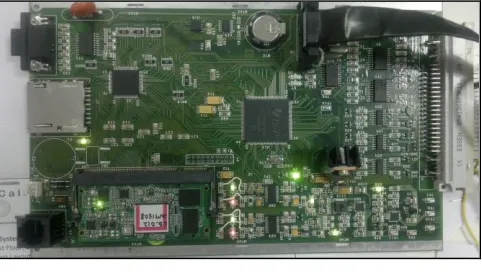
The system contains multiple microprocessors which are independent to each other but communicate through RS485 and CAN bus through backplane. All the cards are attached with the single backplane. Backplane consists of CAN & RS 485 Bus and 12 volt supply to power up the cards. The use of differential bus helps to overcome from EMI-EMC problems. dual port SRAM is used within the CPC card. The advantage of using dual port SRAM is that the both the microprocessor can exchange the data within a latent time period and data transfer can be increased. The central processor card which is shown in figure 4 acts as a master card for all the other cards in the system. CPC card request all the slave cards in a round robin fashion and capture the actual data from the slave cards. In case any one of the slave card does not respond then the master card will start communication on the second bus and if the second bus also does not respond then the master card will reset the slave card. If the slave card still does not respond then the master card will declare the card as fail.
Fig. 4 Central Processing Card
VI. SOFTWARE ARCHITECTURE
[image:3.612.326.567.507.644.2]International Journal of Emerging Technology and Advanced Engineering
Website: www.ijetae.com (ISSN 2250-2459,ISO 9001:2008 Certified Journal, Volume 3, Issue 5, May 2013)
556 There exists intelligent software in each card that captures the data from the inputs and converts it in digital form. Other aspect such as filtering and fault protection is provided in each card by both the hardware and the software. The main card communicates with the slave card either through the dual RS485 bus or the CAN bus. Dual bus provides the redundancy and the necessary speed for the inter-card communication.
Firstly, the software requests to all the cards for capturing data at an interval of one second. Health monitoring and data is captured by various frames.
VII. PRINCIPLE OF CONTROLLED SWITCHING
[image:4.612.324.569.185.311.2]There are several important circuit breaker applications where random closing instant may lead to severe voltage switching transients and random opening instant may lead to severe current switching transients, as in circuit breaker closing take the voltage reference and opening take the current reference. [2] The switching transients occur in main circuits, but may also induced transients in control and auxiliary circuits. The switching transients that occur during the switching of capacitive and inductive loads result in thermal and dielectric stress on the connected equipment in the system, the intensity of the switching transients during switching operations depends on the phase position at the point of switching. A circuit breaker without controlled switching switches the three phases at approximately the same instant, as a result of the arbitrary switching instant and the phase shift of the three phases with respect to each other; a tendency for random phase positions arises. [3]
Fig. 4 Principle of Controlled Switching [3]
The figure 4 shows how much time the system will take to optimize the switching.
Controlled Switching is a method for eliminating transients via time controlled switching operations. Closing or Opening commands to the CB are delayed in such a way that making or contact separation will occur at optimum time instant related to phase angle as shown in Figure 5. Controlled switching allows an individual optimum switching instant to be set for each switching pole. The switching transients there by reduced to a minimum. For single pole operation, each switching pole receives an individual switching command from the control unit.
[image:4.612.50.296.497.549.2]Successful controlled switching reduces the mechanical and electromagnetic stresses endured during normal switching operations by reducing the inrush currents upon closing and re-ignition currents during opening. [4]
Fig. 5 Block Diagram or Controlled Switching for energizing a capacitor bank [3]
This paper also describes the various compensation techniques used in Circuit Breaker for achieving the closing and opening instant at a particular target.
VIII. TIMING PARAMETERS IN CIRCUIT BREAKER [2]
A. Opening Time
The opening time is the interval of time from energizing of the opening release (e.g. opening coil) for a circuit breaker being in closed position and the instant when the (arcing) contacts have separated in all poles.
B. Closing Time
The closing time is the interval of time from energizing of the closing release (e.g. closing coil) for a circuit breaker being in open position and the instant when the (arcing) contacts touch in all poles.
[image:4.612.324.567.540.660.2]International Journal of Emerging Technology and Advanced Engineering
Website: www.ijetae.com (ISSN 2250-2459,ISO 9001:2008 Certified Journal, Volume 3, Issue 5, May 2013)
Tf: Time to detect zero reference voltage.
Tv: Waiting time due to variation in air pressure, coil
voltage and frequency.
Tm: Mechanical delay for circuit breaker
C. Rated Break Time
The rated (maximum) break time (interrupting time) is the time interval between energizing the trip circuit and when the arc is extinguished in all poles. The break time is expressed in ms or cycles (20 ms = 1 cycle at 50 Hz). In IEC, the break-time is based on the results of the terminal fault test duties with symmetrical current. Compensation is made for single phase testing and for reduced control voltages.
D. Dead Time
The dead time (during auto-reclosing) is the interval of time between final arc extinction in all poles in the opening operation and the first re-establishment of current in any pole in the subsequent closing operation. IEC and ANSI/IEEE specify a dead time of 300 ms.
E. Arcing Time
Interval of time between the instant of the first initiation of an arc and the instant of final arc extinction in all poles.
F. Pre - Arcing Time
Interval of time between the initiation of current flow in the first pole during a closing operation and the instant when the contacts touch in all poles for three-phase conditions and the instant when the contacts touch in the arcing pole for single phase conditions.
G. Reclosing Time
The reclosing time is the interval of time between the energizing of the opening release (e.g. opening coil) and the instant when the contacts touch in all poles during a reclosing cycle. If the differences in operating times (closing and opening time respectively) between poles are small and can be neglected, the following formula can be applied:
Reclosing time = Opening time + Arcing time + Dead time +Pre-arcing time
H. Close - Open Time
The close-open time is the interval of time between the instant of contact touch in the first pole during a closing operation and the instant when the (arcing) contacts have separated in all poles during the following opening operation. The opening release (e.g. opening coil) shall have been energized at the instant when the contacts touch during closing.
I. Open - Close Time
The open-close time (during auto-reclosing) is the interval of time between the instant of contact separation in all poles and the instant when the contacts touch in the first pole in the subsequent closing operation. If the differences in operating times (closing and opening time respectively) between poles are small and can be neglected, the following formula can be applied:
Open-Close time = Arcing time + Dead time + Pre-arcing time
J. Make Time
Interval time between energizing the closing circuit and the circuit breaker being in the open position and the instant when the current begins to flow in the first pole.
K. Make - Break Time
The make-break time is the interval of time between the initiation of current flow in the first pole during a closing operation and the end of the arcing time during the subsequent opening operation. The make-break time is based on an operation where the opening release (e.g. opening coil) shall have been energized at the instant when the contacts touch during closing. If the differences in operating times (closing and opening time respectively) between poles are small and can be neglected, the following formula can be applied:
Make-break time = Pre-arcing time + Close-open time + Arcing time
IX. TESTING PROCEDURE AND COMPENSATION FOR
CIRCUIT BREAKER
International Journal of Emerging Technology and Advanced Engineering
Website: www.ijetae.com (ISSN 2250-2459,ISO 9001:2008 Certified Journal, Volume 3, Issue 5, May 2013)
558
1. Coil Voltage Variation Compensation:
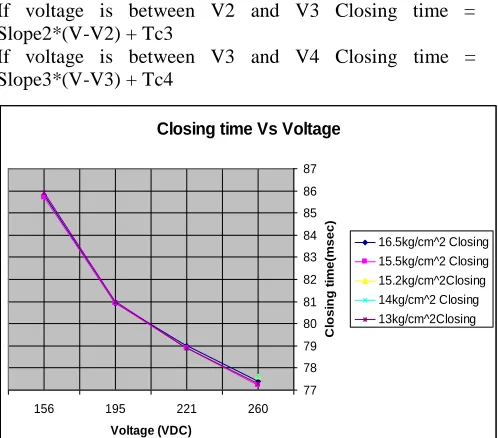
In Coil Voltage Variation Compensation the coil voltage is varied The 4 points of “closing and opening times” are set during circuit breaker commissioning for R, Y and B phases. These timings will be according to the standard values of coil voltage and air pressure from the circuit breaker’s specification. “closing and opening times” will vary with line frequency also. If any of these 3 parameter changes, the corresponding waiting time is compensated in actual mechanical time. Following graph (figure 9) shows the close and open time against coil voltage variation for one pole with in accuracy of 1.0 mSec. [5]
Algorithm for closing Time calculation:
Read 4 points of Closing time Tc1, Tc2, Tc3, Tc4 and corresponding DC voltage V1, V2, V3, V4 entered from HMI. Calculate 3 slopes as per following equation and store them in a memory.
Slope1 = (Tc1-Tc2) / (V2-V1) Slope2= (Tc2-Tc3) / (V3-V2) Slope3 = (Tc3-Tc4) / (V4-V3) Read the Station Supply V
If voltage is between V1 and V2 Closing time = Slope1*(V-V1) + Tc2
If voltage is between V2 and V3 Closing time = Slope2*(V-V2) + Tc3
If voltage is between V3 and V4 Closing time = Slope3*(V-V3) + Tc4
Closing time Vs Voltage
[image:6.612.322.572.131.450.2]77 78 79 80 81 82 83 84 85 86 87 260 221 195 156 Voltage (VDC) C lo s in g t im e (m s e c ) 16.5kg/cm^2 Closing 15.5kg/cm^2 Closing 15.2kg/cm^2Closing 14kg/cm^2 Closing 13kg/cm^2Closing
Fig. 9 Closing time Vs Voltage Graph
Algorithm for opening /tripping Time calculation:
Read 4 points of closing time To1, To2, To3, To4 and corresponding DC voltage V1, 2, V3, V4 entered from HMI.
Calculate 3 slopes as per following equation and store them in a memory
Slope1 = (To1-To2) / (V2-V1) Slope2= (To2-To3) / (V3-V2) Slope3 = (Tco-To4) / (V4-V3) Read the Station Supply V
If voltage is between V1 and V2 Opening time = Slope1*(V-V1) + To2
If voltage is between V2 and V3 Opening time = Slope2*(V-V2) + To3
If voltage is between V3 and V4 Opening time = Slope3*(V-V3) + To4
Tripping time Vs Voltage
17 18 19 20 21 22 23 260 221 195 156 Voltage(VDC) T ri p p in g t im e (m s e c ) 16.5kg/cm^2 Tripping 15.5kg/cm^2 Tripping 15.2kg/cm^2Tripping 14kg/cm^2Tripping 13kg/cm^2Tripping
Fig. 10 Tripping Time Vs Voltage Graph
2.Air Pressure Variation Compensation:
The closing and opening time is changed with respect to changes in air pressure. The variation of close and open time with respect to air pressure is compensated in the POWS. The following compensation curves (Figure 9 & 10) are implemented with-in 1.0 ms accuracy. For Calculating opening time at actual Air pressure(Ap) read tripping time(Tp1) at Air pressure(Ap1) and tripping time(Tp2) at Air pressure(Ap2) from HMI entered value then calculate tripping time(Tp) . [6]
3.SF6 Gas Pressure Variation Compensation:
SF6 gas is the ideal media for the arc interruption and dielectric strength. This compensation comes in action during the closing operation; at close time SF6 gas rated pressure is 7 Kg/cm². [6]
4.Idle Time Compensation:
[image:6.612.50.299.413.632.2]International Journal of Emerging Technology and Advanced Engineering
Website: www.ijetae.com (ISSN 2250-2459,ISO 9001:2008 Certified Journal, Volume 3, Issue 5, May 2013)
For some circuit breaker technology, an operation will be “quicker” if the previous operation was only a short while before compared to a “longer” time if the circuit breaker was idle for a long period. For this compensation to be effective, SynchroTeq calculates the time between “now” and when the last operation was done. Of course, this values continuously increments each seconds but is being reset to zero after the completion of each operation. [7]
X. ACKNOWLEDGEMENT
The authors gratefully acknowledge the financial support of CG Global R&D Centre, Crompton Greaves Ltd in support of this work. In addition grateful acknowledgement is made to the contributions of Upendra Kambli, Rohit Kumar Arora, Neelabh Trivedi, Mayank Shukla, and Jitendra Panchal for giving their support in development and testing of the work described in this paper.
XI. CONCLUSION
In this paper a solution for point-on-wave controlled switching of circuit breakers are described. The operation of circuit breaker is operated on capacitive and inductive loads as well as unloaded transformers and transmission lines. The system automatically adjusts the circuit breaker operation according to the supply voltage, ambient temperature, drive mechanism pressure, etc.
Furthermore, coil voltage variation compensation and idle time compensation are described to perform an automatic adjustment of the next operation, based on the learning of the past history of the circuit breaker performance. The paper also highlights the importance of the compensation for opening / closing times. Some errors may be generated by the deviation of the operation time due to an insufficient compensation especially due to pause time. Thus the multiprocessor based system described in the paper can compensate the closing / opening time and eliminates control error for different types of Load.
REFERENCES
[1] Controlled switching technologies, state-of-the-art, Ito, H.;
Transmission and Distribution Conference and Exhibition 2002: Asia Pacific. IEEE/PES, Volume: 2, Publication Year: 2002 , Page(s): 1455 - 1460 vol.2
[2] Catalogue publication 1HSM 9543 22-01 en. 2006. Controlled
Switching, Buyer’s Guide, Application Guide. Edition 2. 2006-09, http://www.abb.com.
[3] Tsudata, H. 2002. “Controlled Switching System for Capacitor Bank
and Transformer Switching”. In ElectricalEngineering. 2125-2130.
[4] CIGRE WG13.07, “Controlled Switching of HVAC Circuit
Breakers: Guide for Application”, Part 1: ELECTRA No.183, pp.43-73, Part 2: ELECTRA No.185, pp.37–57, 1999
[5] R.D. Garzon, High voltage circuit breakers, Marcel Dekker, Inc.,
New York – Basel, 2002.
[6] Condition monitoring of SF6 circuit breakers. by U. Akesson etal.,
CIGRE 1992 Session, Paper 13-104, 8 pages.
[7] H. Ito “Controlled Switching Technologies, State-of-the-Art”,
![Fig. 5 Block Diagram or Controlled Switching for energizing a capacitor bank [3]](https://thumb-us.123doks.com/thumbv2/123dok_us/8730030.886520/4.612.50.296.497.549/fig-block-diagram-controlled-switching-energizing-capacitor-bank.webp)