International Journal of Emerging Technology and Advanced Engineering
Website: www.ijetae.com (ISSN 2250-2459, Volume 2, Issue 3, March 2012)290
Image Segmentation using Graphical Models: A Survey
Ashish Kumar
1, Prof. Uday Pratap Singh
21M.Tech (CSE), LNCT Bhopal 2
Prof. Uday Pratap Singh, LNCT Bhopal
Abstract- This paper presents a survey of image segmentation techniques using Graphical Models. Image Segmentation is a technique that partitioned the digital image into multiple unique regions or sets of homogeneous pixels is called image segmentation. Segmentation should stop as object of interest in an application is isolated. The ultimate goal is to make the image more simplified and that to get more meaningful to analyze. In this paper, several segmentation techniques using graphical models like PGM, Bayesian Networks Unified Graphical Models etc., are taken from the literature are reviewed. In this paper, the main aim is to understand the Graphical Model based approaches for image segmentation.
Keywords:
- Bayesian Networks (BN), Chain Graph (CG),
Image Segmentation, Probabilistic Graphical Model (PGM), Unified Graphical Model (UGM).
I.
I
NTRODUCTIONThe process of partitioning a digital image into multiple regions or sets of homogeneous pixels is called image segmentation. Actually, partitions are different objects in image which have the same texture or colour. The result of image segmentation is a set of regions that collectively cover the entire image, or a set of contours extracted from the image. All the pixels in a region are similar with respect to some characteristics or computed property, such as colour, intensity, or texture. Adjacent regions are
significantly different with respect to the same
characteristics. This technique has a variety of applications including computer vision, image analysis, medical image processing, remote sensing and geographical information system. Image segmentation is based on two basic properties, first intensity values involving discontinuity that refers to sudden or abrupt changes in intensity as edges and second similarity that refers to partitioning a digital image into regions according to some pre-defined likeness criterion. Segmentation is a process which partitioned image into multiple unique regions, where region is set of pixels. If I is set of all image pixels, then by applying segmentation we get different-different unique regions like { R1,R2, R3,…,Rn } which when combined formed the
image „I‟.
Much progress has been made in the image segmentation field so far. As a result of the progress, computer vision is able to segment increasingly more complex images. Image segmentation, however, is still far from being resolved.
II.
G
RAPHICALM
ODELSMany methods have been proposed and a dense literature is available for extracting information from an image and to partition it into different regions. Probabilistic Graphical Models (PGMs) [1], [2], [3], [4], [5] are very powerful models for extracting features from the image.
There are two basic types of graphical models: the undirected graphical model and the directed acyclic graphical model. The undirected graphical model can represent noncasual relationships among the random variables. The Markov Random Field (MRF) [1] is a type of well-studied undirected graphical model. MRF models have been widely used for image segmentation. They incorporate the spatial relationships among neighbouring labels as a Markovian prior. This prior can encourage the adjacent pixels to be classified into the same group. As an extension to MRFs, the Conditional Random Field (CRF) [2] is another type of undirected graphical model that has become increasingly popular.
International Journal of Emerging Technology and Advanced Engineering
Website: www.ijetae.com (ISSN 2250-2459, Volume 2, Issue 3, March 2012)291
The existing graphical models for image segmentation are directed, undirected which can effectively capture one type of image relationship and often fail to capture the complex image relationships of different types, and combination of both directed (i.e., the BN model) and undirected (i.e., the CRF Model).
III.
G
RAPHICALM
ODELB
ASEDM
ETHODOLOGIESF
ORI
MAGES
EGMENTATIONIn this section we present a survey of various image segmentation techniques using Graphical models clustering recently proposed in the literature.
Lei Zhang, Zhi Zeng, and Qiang Ji [9] proposed a method to extend the Chain Graph (CG) model to with more general topology and the associated methods for learning and inference.CG is a hybrid Probabilistic Graphical Model (PGM) which Contains both directed and undirected links. Its representation is powerful enough to capture heterogeneous relationships among image entities.
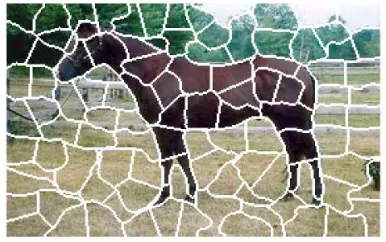
For CG they first oversegment the image into
superpixels and find out different heterogeneous
relationships among image entities (superpixels, vertices or junctions, edges, regions etc.) They construct the CG model with parameterization of links with derived Joint Probability Distribution (JPD). They represent these links by either potential function or conditional probabilities.
They first create a Directed Master Graph then create undirected sub-graphs for some terms in the JPD of Directed Master Graph. They segment the image into two parts foreground and background. Finally applying the probabilistic inference in the foreground to find out Most Probable Explanation (MPE).
Li Zhang and Qiang Ji [10] have proposed a Bayesian Network (BN) Model for Both Automatic (Unsupervised) and Interactive (Supervised) image segmentation.
They Constructed a Multilayer BN from the oversegmentation of an image, which find object boundaries according to the measurements of regions, edges and vertices formed in the oversegmentation of the image and model the relationships among the superpixel regions, edge segment, vertices, angles and their measurements.
For Automatic Image Segmentation after the
construction of BN model and belief propagation segmented image is produced. For Interactive Image Segmentation if segmentation results are not satisfactory then by the human intervention active input selection are again carried out for segmentation.
Kittipat Kampa, Duangmanee Putthividhya and Jose C. Principe [11] design a probabilistic unsupervised framework called Irregular Tree Structure Bayesian Network (ITSBN).
The ITSBN is made according to the similarity of image regions in an input image. ITSBN is a Directed acyclic graph (DAG) with two disjoint sets of random variables hidden and observed. The original image is oversegmented in multiscale hierarchical manner then they extracted features from the input image corresponding to each superpixel. According to these superpixels ITSBN is built for each level. After applying the learning and inference algorithms the segmented image is produced.
Fei Liu, Dongxiang Xu, Chun Yuan and William Kerwin [12] combined the BN and MRF (Markov Random Field) to form an image segmentation approach. The BN generates a probability map for each pixel in the image and then MRF prior is incorporated to produce the segmentation.
It is a supervised image segmentation method. First each pixel will be individually assigned a probability value to be each given class. According to such probability map, BN provides a mechanism to convert the problem from feature space to image domain.
Second they consider the prior knowledge on the image model and the spatial relationships between pixels, they used MRF based model to generate the segmentation.
Costas Panagiotakis, Ilias Grinias, and Georgios Tziritas [13] proposed a framework for image segmentation which uses feature extraction and clustering in the feature space followed by flooding and region merging techniques in the spatial domain, based on the computed features of classes. A new block-based unsupervised clustering method is introduced which ensures spatial coherence using an efficient hierarchical tree equipartition algorithm. They divide the image into different-different blocks based on the feature description computation. The image is partitioned using minimum spanning tree relationship and mallows distance. Then they apply K-centroid clustering algorithm and Bhattacharya distance and compute the posteriori distributions and distances and perform initial labelling. Priority multiclass flooding algorithm is applied and in the end regions are merged so that segmented image is produced.
International Journal of Emerging Technology and Advanced Engineering
Website: www.ijetae.com (ISSN 2250-2459, Volume 2, Issue 3, March 2012)292
Given a user input seed path, they use minimum path spanning tree graph search to find the most likely object boundaries. They also encode a statistical similarity measure between the adjacent regions of an edge into its a priori probability therefore implicitly integrating region information.
In the early study [15] they use the similar BN model for both automatic and interactive segmentation .Their approach can find multiple non-overlapping closed contours before any given user‟s intervention. The intervention will serve as an evidence to help select a single closed contour that covers the object of interest.
Lei Zhang, and Qiang Ji [16] develop a unified graphical model in which they combined directed graphical model and undirected graphical model. The combination allows capturing more complex and heterogeneous relationships among image entities. The unified model is more expressive and more powerful. But it only used for automatic segmentation not for interactive segmentation. They first propose to employ Conditional Random Field (CRF) to model the spatial relationships among image superpixel regions and their measurements. They introduce a multilayer Bayesian Network (BN) to model the causal dependencies that naturally exist among different image entities, including image regions, edges, and vertices. The CRF model and the BN model are then systematically and seamlessly combined through the theories of Factor Graph to form a unified probabilistic graphical model that captures the complex relationships among different image entities. Using the unified graphical model, image segmentation can be performed through a principled probabilistic inference.
IV. RESULT AND DISCUSSION
In Probabilistic Image Modeling with an Extended Chain Graph for Human Activity Recognition and Image Segmentation [10] they proposed a model called Chain Graph which is a hybrid probabilistic graphical model (PGM) capable of modeling heterogeneous relationships among random variables. They apply it to two challenging image and video analysis tasks: human activity recognition and image segmentation. Extended CG models are constructed to capture useful heterogeneous relationships among multiple entities for solving these problems. In [10] experiments show that the CG Models outperform conventional undirected PGMs or directed PGMs. It demonstrates the applicability of the proposed CG model to different image and video analysis problems as well as its potential benefits over standard directed or undirected
PGMs in improving classification and recognition performance.
In [11] they propose a model-based segmentation approach based on BN. The model is to be able to perform fully automatic image segmentation, comparable to or outperforming several other existing related methods. In addition, they further extend it to be used for interactive image segmentation. This model improves the overall segmentation accuracy and reduces the total user‟s involvement. Their experimental results demonstrate the promising capability of the proposed BN model for both automatic image segmentation and effective interactive image segmentation.
In [12] They presents a novel probabilistic unsupervised image segmentation framework called Irregular Tree-Structured Bayesian Networks (ITSBN).By integrating non-parametric density estimation technique with the traditional precision-recall framework, the method is more robust to boundary inconsistency due to human subjects. They experimentally show the improvement of ITSBN over the baseline method which motivates us to further investigate models of similar type.
In [13] Based on BN and MRF theory, they presented a supervised image segmentation framework. Applying this framework to the vivo plaque segmentation problem by combining multi-contrast intensity and morphology information demonstrates that reliable, automated, in vivo segmentation of carotid plaque components is possible and quantitatively comparable to manual results. They Combine the morphological information with intensity to make the final decision proves to increase the accuracy of the segmentation result.
In [14] they proposed an unsupervised feature classification method and a new image segmentation framework. The framework involves feature extraction and clustering in the feature space, followed by region growing and merging in the spatial domain. The second strong point of our approach consists on establishing topological constraints. We have adopted a Bayesian framework for attributing a height per pixel and per label.
The merging criterion which is used in the method is sufficiently robust as compared to the others.
International Journal of Emerging Technology and Advanced Engineering
Website: www.ijetae.com (ISSN 2250-2459, Volume 2, Issue 3, March 2012)293
use of this approach allows user to interact with the belief network to quickly define object boundaries in a general class of images.
In [16] they present a new image segmentation framework based on a unified probabilistic graphical model. The unified model can systematically capture the complex and heterogeneous relationships among different image entities and combine the captured relationships with various image measurements to perform effective image segmentation.
[image:4.612.348.541.389.510.2]The experiments results in [16] shows that the method has good time complexity than the other methods. Experiments in [16] also show that the framework achieved very good accuracy in segmentation of an image when compared to other existing methods.
Table 1: The Typical Time Required for Segmenting a Normal Size Image
Method Normal Image Size Segmentation Time
ITSBN 300 × 200 2 min/image
UGM 320 × 213 Less than 30 seconds
PMCFA 214 × 320 13.2 seconds
MPST 128 × 128 Approx. 1 second.
V. CONCLUSION
Segmentation is an important step in advance image analysis and computer vision and therefore is an on-going research area.
In this paper various image segmentation schemes based on graphical models like Chain Graphs, PGMs, Unified graphical models, BN and ITSBN are studied and their
performance is evaluated. Several new models for segmenting color images were also analyzed.
We conclude that graphical models used for image segmentations have some basic techniques to oversegment the image into superpixels and based on the superpixels they find different-different regions connected to each other. There are many vertices and edges between the regions. Then they find relationships between them and on the basis of these relationships they apply different-different methods for segmenting the image.
There are many methods for image segmentation and all produced satisfactory results, but there is not a single method which can be applied in any area or which is a standard for image segmentation. Many methods are available to use according to the problems. Because each method has its own advantages and disadvantages to be use in different-different problem areas. This is also possible that a method producing very good results for particular problem may not produce even satisfactory results for some different type of problems.
Fig.1- Superpixels in an Image separated by white lines.
References
[1]. S.Z. Li, “Markov Random Field Modeling in Image Analysis,”
Springer, ISBN. ,2001.
[2]. J. Lafferty, A. McCallum, and F. Pereira, “Conditional Random
Fields: Probabilistic Models for Segmenting and Labeling Sequence
Data,” Proc. Int’l Conf.Machine Learning, pp. 282-289 2001.
[3]. S.L. Lauritzen, “Graphical Models,” Oxford Univ. Press, ISBN.
,1996.
[4]. F.V. Jensen, Bayesian Networks and Decision Graphs.
Springer-Verlag, 2001.
[5]. S.Z. Li, “Markov random field modeling in computer vision,”
Springer-Verlag New York, Inc. Secaucus, NJ, USA, 1995.
[6]. C.M. Bishop, “Pattern Recognition and Machine Learning”,Springer, 2006.
[7]. F.V. Jensen, “Bayesian Networks and decision Graph”,
Springer-Verlag, 2001.
[8]. J. Peral, “Probabilistic Reasoning in Intelligent System: Network of
Plausible Inference. Morgan-KaufmannPublishers”, 1998.
[9]. Lei Zhang, Zhi Zeng, and Qiang Ji“Probabilistic Image Modeling
With an Extended Chain Graph for Human Activity Recognition and Image Segmentation”, IEEE Transaction on
International Journal of Emerging Technology and Advanced Engineering
Website: www.ijetae.com (ISSN 2250-2459, Volume 2, Issue 3, March 2012)294
[10].Lei Zhang and Qiang Ji, “A Bayesian Network Model for Automatic and Interactive Image Segmentation”, IEEE Transaction on Image
Processing, VOL. 20, NO. 9, September 2011.
[11].Kittipat, Kampa, Duangmanee Putthividhya and Jose C. Principe, “Irregular Tree-Structured Bayesian Network for Image Segmentation.”, IEEE International Workshop on Machine Learning
for Signal Processing September 18-21, 2011.
[12].F. Liu, D. Xu, C. Yuan, and W. Kerwin, “Image segmentation based
on Bayesian network-Markov random field model and its application
on in vivo plaque composition,” in Int. Symp. Biomed. Imag.,2006,
pp. 141 –144.
[13].Costas Panagiotakis, Ilias Grinias, and Georgeios Tziritas “Natural
Image Segmentaion Based on Tree Equipartition, Bayesian Flooding and Region Merging”, IEEE Transactions on Image Processing,Vol.
20, No. 8, August 2011.
[14]. E. N. Mortensen and J. Jia, “Real-time semi-automatic segmentation using a Bayesian network,” inProc. IEEE Conf. Compute Vis.
PatternRecognit., 2006, pp. 1007–1014.
[15].E. Mortensen and J. Jia, “A Bayesian network framework for real-time object selection,” in Workshop Percept. Org. Comput vis,2004,
p.44.
[16].L. Zhang and Qiang Ji, “Image Segmentation with a Unified Graphical Model,”IEEE Transactions Pattern Anal. Mach. Intell.,
vol. 32, no. 8, pp. 1406–1425, August 2010.