Published in IET Communications Received on 24th May 2013 Revised on 18th September 2013 Accepted on 12th October 2013 doi: 10.1049/iet-com.2013.0443
ISSN 1751-8628
Adaptive differential amplitude pulse-position
modulation technique for optical wireless
communication channels based on fuzzy logic
Mohammad Faiz Liew Abdullah
1, Siaw Wee Bong
21
Department of Communication Engineering, Faculty of Electrical and Electronic Engineering, University Tun Hussein Onn, Batu Pahat, Malaysia
2
Department of Electrical Engineering, Polytechnic Kuching, Kuching, Sarawak, Malaysia E-mail: [email protected]
Abstract:Optical wireless communication has the potential for extremely high data rates of up to tens of Gb/s. In this study, a hybrid modulation technique named adaptive differential amplitude pulse-position modulation (DAPPM) is proposed to improve channel immunity by utilising optimised modulation to channel. The unit transmission rate, channel capacity, peak-to-average power ratio, bandwidth requirement and power requirement of the DAPPM were determined and compared with other modulation schemes such as on–off key, pulse-amplitude modulation, pulse-position modulation (PPM), differential PPM and multilevel digital pulse interval modulation. The simulation results show that DAPPM gives better bandwidth and power efficiency depending on the number of amplitude level (A) and the maximum length (L) of a symbol. In addition, the fuzzy logic module is developed to assist the adaptation process of DAPPM. Mamdani fuzzy logic method is used in which the decisions made by the system will be approaching to what would be decided by the user in the real world.
1 Introduction
Optical wireless communication has emerged as a viable technology for next generation indoor and outdoor broadband wireless applications. The applications range from short-range wireless communication links providing network access to portable computers, to last-mile links bridging gaps between end users and existing fibre optic communications backbones, and even laser communications in outer-space links [1]. Indoor optical wireless communication is also called wireless infrared communication, whereas outdoor optical wireless communication is commonly known as free space optical (FSO) communication [2].
The modern era of indoor wireless optical communications was using the diffuse emissions in the infrared band for indoor communications [3]. Since that time, much work has been done in characterising indoor channels, designing receiver and transmitter optics and electronics and developing the channel topologies as well in the area of communications system design.
An optical wireless communication system is an attractive alternative to radio, primarily because of a virtually unlimited, unregulated bandwidth. It has the advantage of requiring low-cost and low power consumption components [4]. On the other hand, the channel can be severely interfered with background noise: shot noise induced by the background ambient light and the interference induced by artificial light sources [5]. In comparison, however, directed line-of-sight
IR systems had the potential to achieve a data rate of a few gigabits per second and higher.
Therefore, in optical communication applications, there are always tradeoffs between system performance and costs. Thus, there is a pressing need to design a modulation technique for the real time situation. As mentioned earlier, the optical wireless channel was limited by channel constraints such as the maximum allowable optical power and available bandwidth. Modulation schemes well suited to the conventional channel may not necessarily perform well for the optical wireless channel, therefore, adaptive modulation technique for pulse-position modulation (PPM), pulse-amplitude modulation (PAM) and pulse amplitude position amplitude (PAPM) using fuzzy logic has been proposed which showed substantial improvements for channel impaired by ISI and ambient background noise [5–8]. The optical wireless channel can be easily affected by channel uncertainty. For example, distance between transmitter and receiver, distance from ambient light source or optical propagation path changes can result in bit error rate (BER) variation. Besides that, the BER not only will be affected by noise and transmitted signal power but also by the system modulation level and modulation state. Therefore adaptive differential amplitude PPM (DAPPM) using fuzzy logic for optical wireless communication channels is proposed to solve this problem.
adaptive differential amplitude pulse-position modulation (DAPPM) is proposed in this paper, which combined the DPPM and PAM as shown in Fig.1.
The working principle of DAPPM for optical wireless communication channel is analysed, and compared with other modulation schemes such as OOK, PAM, PPM, DPPM and multilevel DPIM (MDPIM). The analysis and comparison comprise of, the unit transmission rate, channel capacity, peak-to-average power ratio (PAPR) and normalised power and bandwidth required.
2.1 Unit information transmission rate
Unit information transmission rate (γ) can be expressed asγ=
R/B(bits per second per Hz), whereRis the transmission rate,
Bis the signal bandwidth,tis the pulse duration,rpis the duty ratio and T is the slot width. Thus, the unit information transmission rate for OOK (γOOK) is γOOK= (1/t). For the
single pulse PPM, the time slot width of PPM is
TPPM=2 M·t
rp (1)
The unit information transmitting rates of PPM and DPPM are expressed as
gPPM=M ·rp
2M (2)
gDPPM=2·M ·rp
2M+3 (3)
The time slot length of the MDPIM modulation is notfixed, therefore, it required a statistical average to calculate the width of the code block, therefore, the time slot width and
unit transmission rate are
TMDPIM= 2 M−1+
3 2
t
rp (4)
gMDPIM=2·M ·rp
2M−1+3 (5)
Finally, for DAPPM modulation, time slot width and unit transmission rate are
TDAPPM= 2
M−1+A
2A
t
rp (6)
gDAPPM=2·M·A·rp
2M−1+A (7)
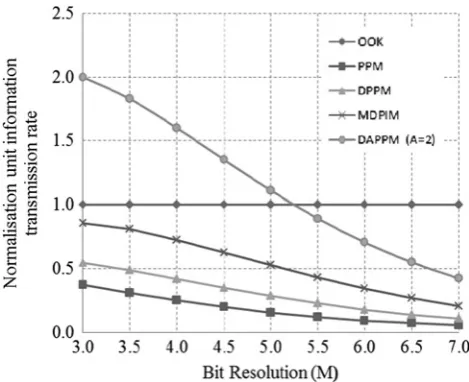
As shown in Fig. 2, the unit transmission rate of DAPPM (A= 2) is the highest, whereas PPM is the lowest. The transmission rate for DPPM and MDPIM falls between the curves for DAPPM and PPM. When the bit resolution (M) increases, the unit transmission rate of OOK remains the same, whereas PPM, DPPM, MDPIM and DAPPM (A= 2) will decrease.
2.2 Channel capacity performance
The channel capacity is the highest rate in bits per channel use at which, information can be sent with arbitrarily low probability of error, and it is an important performance parameter for the FSO communication system. If the time slot width is t, the channel capacity of OOK isCOOK= 1/t,
therefore, the channel capacity of PPM, DPPM, MDPIM
Fig. 1 Waveforms of (A = 2, L = 2)
[image:2.595.314.549.54.245.2] [image:2.595.116.486.688.766.2]and DAPPM can be expressed as follows
CPPM= M
2Mt= M
2MCOOK (8)
CDPPM = 2M
2M+3
t= 2M
2M+3
COOK (9)
CMDPIM= 2M
2M−1+3
t= 2M
2M−1+3
COOK (10)
CDAPPM=
2MA
2M−1+A
t= 2MA
2M−1+A
COOK (11)
The normalised channel capacity requirement for each modulation scheme is plotted in Fig. 3 against M for comparison. If M increases to more than or is equal to 2, the normalised channel capacity for PPM, DPPM, MDPIM and DAPPM will decrease, whereas OOK will remain at
‘1’. It is clear that DAPPM has the highest transmission capacity and that PPM has the lowest. The transmission capacity for DPPM and MDPIM falls between the curves for DAPPM (A= 2) and PPM.
2.3 PAPR analysis
The PAPR is analysed based on the equation as follows
PAPRPPM=2M (12)
PAPRDPPM=2
M+
1
2 (13)
PAPRDPPM=2
M+A
(A+1) (14)
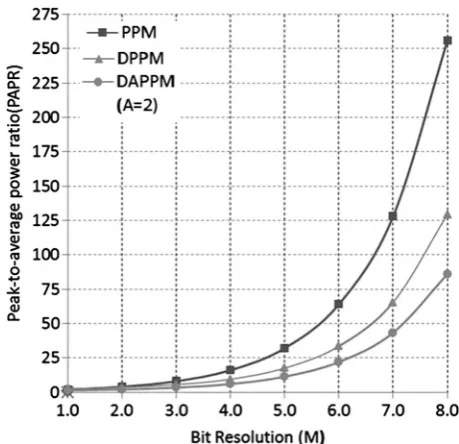
The PAPR for PPM, DPPM and DAPPM against the bit resolution (M) is shown in Fig. 4. It is clear that DAPPM provided the lowest PAPR compared with PPM and DPPM.
2.4 Normalised power and bandwidth requirement
The normalised optical power against bandwidth requirement for OOK, PAM, PPM, DPPM, PAPM and DAPPM is shown in Fig.5. Each point for PAM, PPM, DAPPM and DAPPM represents the maximum lengthL= {2, 4, 8, 16 and 32}.
The performance of the modulation schemes for optical wireless communication channel analysis shows that, OOK is the simplest scheme, therefore, it does not require symbol synchronisation and the minimum bandwidth requirements, but power utilisation ratio is too low. PPM improved the power utilisation ratio but bandwidth availability ratio is low. The use of PPM having a very low duty cycle decreases the average power requirement at the cost of an increased bandwidth. DPPM always achieves higher power efficiency and lower hardware complexity than PPM. These make DPPM a favourable candidate to replace PPM in many applications. MDPIM requires no symbol synchronisation and symbols length is not fixed, therefore, when sending afixed bit packet, its transmitting time is not a constant.
The analysis suggest that using the DAPPM modulation techniques, will provide more advantages over OOK, PAM, PPM, DPPM and MDPIM. DAPPM will give better bandwidth and power efficiency depending on the number of amplitude level (A) and the maximum length (L) of a symbol. In addition to this, DAPPM also provides higher transmission capacity and lower PAPR.
Fig. 3 DAPPM requirement of channel capacity comparison
Fig. 4 DAPPM of PAPR comparison
[image:3.595.315.545.54.276.2] [image:3.595.51.279.54.233.2] [image:3.595.311.549.587.750.2]3.1 BER degradation to modulation level
System A was created for the modulator based on the feedback from the optical wireless communication channel. This system was Mamdani type fuzzy inferences model, where the output of the membership function will be applied to centroid calculation. In this system, the three rules can be set as follows
1. If BER degradation is LOW then required modulation level change is ZERO.
2. If BER degradation is MEDIUM then required modulation level change MINOR.
3. If BER degradation is HIGH then required modulation level change LARGE.
Surface viewer for BER degradation to modulation level is plotted in Fig.6.
3.2 BER degradation and variation rate to modulation level
The fuzzy system rules can be expressed as the following, with this system name‘adaptive DAPPM System B’.
1. If BER degradation is LOW, then LEVELS change is ZERO.
2. If BER degradation is MEDIUM or RATE of variation is SLOW, then LEVELS change is MINOR.
3. If BER degradation is MEDIUM and RATE of variation is FAST, then LEVELS change is LARGE.
Fig. 6 Surface viewer for BER degradation to modulation level
[image:4.595.310.548.53.288.2] [image:4.595.125.466.492.759.2]4. If BER degradation is HIGH or RATE of variation is FAST, then LEVELS change is MINOR.
5. If BER degradation is HIGH and RATE of variation is FAST, then LEVELS change is MINOR.
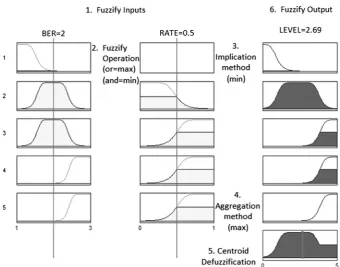
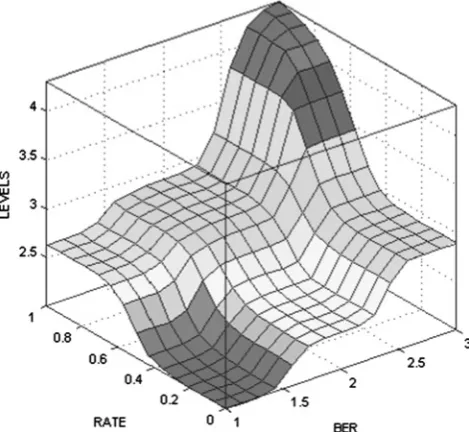
This system has two inputs (BER and rate), and one output (levels). A complete setting of the fuzzy sets, membership function and rules and the rule viewer for System B is shown in Fig.7. If set BER is equal to 2 and rate is 0.5 as sample inputs, the required level change is 2.69. The mapping from ‘BER’ and ‘RATE’ to ‘MODULATION LEVELS’ accordingly is plotted in Fig. 8. The surface viewer is equipped with drop-down menus X (input), Y
(input) andZ(output).
3.3 BER level and variation rate to modulation state
The BER is affected by noise, transmitted signal power, modulation level and also modulation state. An FIS was set up to solve this problem and named System C. BER level and rate are set as the input fuzzy set, whereas the amplitude level (A) and the differential pulse position change will set the value (L) as the outputs fuzzy sets.
The rules for System C can be expressed as follows:
1. If BER level is OK, then modulation state is NO_CHANGE.
2. IF BER level is LOW, then amplitude level (A) is change FAST.
3. IF BER level is HIGH, then differential pulse position (L) is change FAST.
4. If BER level is OK and rate is NEGATIVE, then amplitude level (A) is change SLOW.
5. If BER level is OK and rate is POSITIVE, then amplitude level (A) is change SLOW.
The five steps for the fuzzy inference process setting is fuzzify the inputs, apply the fuzzy operation, apply the implication method, apply the aggregation method and apply the centroid defuzzification. The surface of amplitude level (A) against the BER level and change rate is shown in
Fig. 9, whereas the differential pulse position (L) against the BER level and change rate is shown in Fig.10.
The fuzzy control method was incorporated with the developed adaptive DAPPM as a viable control process for optical wireless communication channel. The simulation result demonstrated that, fuzzy logic is able to provide powerful control functionality for BER, variation rate and modulation level. Therefore through incorporation with the proposed DAPPM, communication systems can provide
flexible and efficient adaptations for improving the communication system.
4 Conclusions
This paper introduced an adaptive DAPPM for high speed optical wireless communication channels based on fuzzy logic. DAPPM provides several advantages when the simulation results are compared between DAPPM with OOK, PPM, PAM, DPPM and MDPIM on unit transmission rate, channel capacity, PAPR, bandwidth and power required. According to the results, DAPPM requires less bandwidth when the number of amplitude levels is Fig. 8 Three-dimensional curve of surface viewer for System B
Fig. 9 Surface of amplitude level (A) against the BER level and change rate
[image:5.595.311.550.54.235.2] [image:5.595.47.282.57.273.2] [image:5.595.311.550.291.472.2]diffuse infrared radiation’. Proc. IEEE, 1979, pp. 1474–1486 4 Tanaka, Y.:‘A study on optical wireless communication systems and
their applications’, Ph.D. dissertation, Graduate School, Univ. Keio, 2002
5 Yu, Z.: ‘Adaptive modulation schemes for optical wireless communication systems’, Ph.D. dissertation, School of Eng., Univ. Warwick, 2010
6 Yu, Z., Green, R.J., Leeson, M.S., Sun, S.:‘Tunable pulse amplitude and position modulation technique for reliable optical wireless communication channels’,J. Commun., 2007,2, pp. 22–28
7 Yu, Z., Green, R.J., Leeson, M.S.: ‘Multiple pulse amplitude and position modulation for the optical wireless channel’. Proc. Tenth Anniversary Int. Conf. on Transparent Optical Networks, 2008, pp. 193–196
8 Zeng, Y., Green, R.J., Leeson, M.S.: ‘Fuzzy logic control based modulation optimization for the indoor optical wireless channel’. Proc. 12th Int. Conf. on Transparent Optical Networks (ICTON), 2010, pp. 1–4
9 Ghassemlooy, Z., Hayes, A.R., Seed, N.L., Kaluarachchi, E.D.:‘Digital pulse interval modulation for optical communications’, IEEE Trans. Commun. Mag., 1998,36, pp. 95–99
10 Ghassemlooy, Z., Popoola, W.O., Rajbhandari, S., Amiri, M., Hashemi, S.: ‘A synopsis of modulation techniques for wireless infrared communication’. Proc. IEEE ICTON Mediterranean Winter Conf., 2007, pp. 1–6
Trans. Wirel. Commun., 2006,5, (1), pp. 176–185
17 Baldo, N., ZorzH, M.:‘Cognitive network access using fuzzy decision making’. Proc. 2007 IEEE Communications Int. Conf., pp. 6504–6510 18 Bashyal, S., Venayagamoorthy, G.K.:‘Real-time collaborative routing algorithm for wireless sensor network longevity’. IEEE Int. Symp. on Intelligent Control, September 2008, pp. 414–419
19 Baldo, N., Zorzi, M.:‘Cognitive network access using fuzzy decision making’,IEEE Trans. Wirel. Commun., 2009,8, (7), pp. 3523–3535 20 Qayyum, H., Sohail, S., Shah, G.A., Khanum, A.:‘A fuzzy decision
maker for wireless sensor network in ubiquitous network environment’. Proc. 2009 IEEE Advanced Information Networking and Applications Workshops Int. Conf., pp. 359–364
21 Zeng, H., Qiu, J., Shen, X., Dai, G., Liu, P., Le, S.:‘Fuzzy control of LED tunnel lighting and energy conservation’,IEEE Trans. Tsinghua Sci. Technol., 2011,16, (6), pp. 576–582
22 Phaiboon, S., Phokharatkul, P., Somkuarnpanit, S.:‘Muti-layer fuzzy logic sets for mobile path loss in forests’. Proc. 2006 IEEE TENCON Region 10 Conf., pp. 1–4
23 Cheng-Zen, Y., Chih-Chun, C., Chun-Ta, L.:‘On scatternet formation in bluetooth networks using fuzzy logic’. Proc. 2007 IEEE Wireless Communications and Networking Conf., pp. 3141–3146