BIROn - Birkbeck Institutional Research Online
Leslie, Esther and Jackson, M. (2018) Milk’s arrays. Studies in the Maternal
10 (1), p. 8. ISSN 1759-0434.
Downloaded from:
Usage Guidelines:
Please refer to usage guidelines at or alternatively
Article
How to Cite:
Leslie, E and Jackson, M. 2018. Milk’s Arrays. Studies in the
Maternal, 9(1): X, pp. 1–23, DOI: https://doi.org/10.16995/sim.260
Published:
XX Month 201X
Peer Review:
This article has been peer reviewed through the double-blind process of Studies in the Maternal, which is a journal published by the Open Library of Humanities.
Copyright:
© 2018 The Author(s). This is an open-access article distributed under the terms of the Creative Commons Attribution 4.0 International License (CC-BY 4.0), which permits unrestricted use, distri-bution, and reproduction in any medium, provided the original author and source are credited. See http://creativecommons.org/licenses/by/4.0/.
Open Access:
Studies in the Maternal is a peer-reviewed open access journal.
Digital Preservation:
The Open Library of Humanities and all its journals are digitally preserved in the CLOCKSS scholarly archive service.
The Open Library of Humanities is an open access non-profit publisher
of scholarly articles and monographs.
Esther Leslie and Melanie Jackson ‘Milk’s Arrays’ (2018). Studies in the Maternal, 9(1): X, DOI: https://doi.org/10.16995/sim.260
Studies in the Maternal
ARTICLE
Milk’s Arrays
Esther Leslie and Melanie Jackson
Hidden in Plain Sight
In milk, all contradictions can be contained. Out of milk arises all imagination – but not an expansive one for those who imagine milk to be white and only white and so without hope. Hidden in milk, beneath and inside that whiteness, is a multitude, another world or worlds, invisible things and knowledge. Milk fans out widely, from reason to imagination. Any understanding of a phenomenon, this one of milk, is achieved through a synthesis of the ‘whole’ entity. This entirety of the thing includes all that is magical, dreamlike, absurd and incredible, as well as all that is real and lucid. In milk, there is blackness and whiteness and all that might be found in its spectrum of all possible and impossible colours.
[image:3.595.125.469.229.449.2]Milk is white. Milk is every colour, and so milk has also been black, black in the mind’s eye. As Paul Celan put it in his poem from 1944 titled ‘Death Fugue’: ‘Black
Leslie and Jackson: Milk’s Arrays 2
milk of morning we drink you at dusktime, we drink you at noontime and dawntime we drink you at night, we drink and drink.’ Celan’s black milk is a perversity and a necessity. It is other to itself, wholly defamiliarised, a horror that must be imbibed without respite. For Elif Şafak, Black Milk, the title of her book on motherhood and writing, is a reference to postpartum depression and it ‘shows that mother’s milk is not always as white and spotless as society likes to think it is’. Out of that negativity, though, she claims, comes something generative: ‘out of that black milk I was able to develop some sort of ink’.1 Like Cixous, she might say: ‘I’m brimming over. My
breasts are overflowing! Milk. Ink. Nursing time. And me? I’m hungry too. The milky taste of ink!’2
There is another world of black milk, as Marcus Wood calls it; the milk of the Black slave mother, milk that flowed from the breasts of the Mammy and the Mãe
1 Caroline Baum, ‘Breaking down the boundaries’, The Sydney Morning Herald, 17 March 2010,
<https://www.smh.com.au/entertainment/books/breaking-down-the-boundaries-20100316-qcfd. html> [accessed May 16 May 2018].
[image:4.595.126.470.141.391.2]Leslie and Jackson: Milk’s Arrays 3
Preta into the mouths of white infants for four centuries in Brazil and North America, while their own children were compelled to go hungry or had to be fed on dirty water and animal milk.3
Beastly Practices
The producing body of the milk giver is no simple entity. It is monstrous. It refuses. It takes on other shapes. For example, humans have engaged and imagined other milk suppliers, which take on the figure of nonhuman caregivers. In myth, a nanny goat called Amalthea – tender goddess – was said, in some accounts, to have nursed the baby Zeus. Her horn, the cornu copeia, or horn of plenty, is said to have been donated to the caregiving Nymphs who had facilitated the transfer, in gratitude for their pro-vision of honey, as well as milk. Other versions of the myth of Zeus have him suckled by a sow, fed ambrosia by a dove and nectar by an eagle.
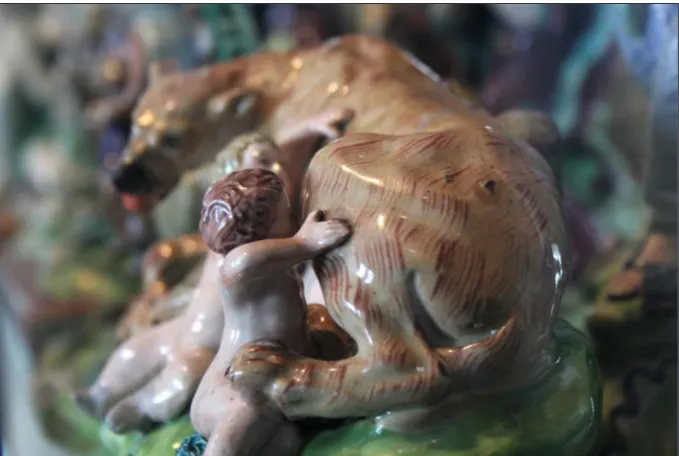
A she-wolf fed Romulus and Remus, the abandoned twin offspring of Mars and Rhea, whose story recounts the founding of Rome and the Roman Kingdom. Goats often let the Gods and heroes of Antiquity suckle: Dionysus; Asklepios, God of medi-cine, and Aegisthus, killer of Agamemnon. Telephus, the son of Heracles and Auge, while exposed on Mount Parthenion, was said to have been suckled by a deer as por-trayed on the 1 st century CE fresco at Herculaneum – his name is perhaps derived from a dug and a doe.4 The altar of the Pergamon transposes this milk provider to a
lion. Aeolus and Beotus, the sons of Melanippe, were exposed by King Desmotis, but saved by a suckling cow before becoming heroes. Hippothoon was twice exposed and twice fed by a mare, while the abandoned Miletus was suckled by she-wolves under Apollo’s command. The grandfather of Habis, King of Tartessos, exposed his grandchild five times in different environments and every time Habis was breastfed by animals – pigs, hind and doe. Cyrus I of Persia was said in some accounts to have been nursed by a wild dog. With this milk came characteristics, transfers of personal-ity, qualities that marked out these babies as chosen ones.
3 Wood, Marcus, Black Milk: Imagining Slavery in the Visual Cultures of Brazil and America (Oxford:
Oxford University Press, 2013).
Leslie and Jackson: Milk’s Arrays 4
Brigid, a Celtic Goddess or a Saint – the patron saint of Ireland and protector of dairymaids, cattle, midwives, Irish nuns and new-born babies – mingles with milk in many ways and her milk is miraculous. Some say her mother was a milkmaid and Brigid was born out of a milk pail, or at least doused in warm new milk, or lemlacht, on the threshold of the home, at sunrise, as her mother returned from milking. As an infant, she drank only the milk of a white cow with red ears, a faery cow, and when she grew up, she in turn gave away the animals’ milk so freely, dispensing butter to the poor from a dairy that endlessly replenished itself. Brigid’s milk was as freely given as the cows that gave their milk to her. Brigid could also turn water into milk or beer. Her festival on 1 st February is named Imbolc, but its etymology is obscure – perhaps it stems from the Old Irish meaning ‘in the belly’, and may be a reference to the pregnancy of ewes, or to the Old Irish for cleansing oneself, or to a proto-Indo-European root that means both milk and cleansing.
Between myth and rumour, Wild Peter, who appeared in North Germany in 1724, was covered with thick hair, said to have grown as a result of him suckling from a bear – he imbibed with the milk his nursing mother’s characteristics.5 Carl Linnaeus
[image:6.595.128.468.140.368.2]Leslie and Jackson: Milk’s Arrays 5
shared this belief in the transfer of characteristics through milk – he professed that to suckle from a lioness would confer courage. In Egypt, donkeys were not favoured as wet nurses, for it was believed that a donkey’s milk transmitted the animal’s char-acteristic stupidity and obstinacy. The Hindu laws of Manu and the teachings of the J ewish Torah restrict milk from one-hoofed animals. But the Talmud ascribes brav-ery, strength and endurance to the goat, and the milk of a white goat is especially beneficial. The Hottentots were said to tie babies to the stomach of a goat to nurse.
[image:7.595.129.468.139.510.2]Enlightenment (Chicago: University of Chicago Press, 2002), pp. 22–25.
Leslie and Jackson: Milk’s Arrays 6
[image:8.595.165.431.139.502.2]Others believed that goats were libidinous beasts, and some recommended donkeys as wet nurses instead, since the donkey represented morality. Hippocrates, Galen, Aretaeus and Alexander of Tralles all recommended the milk of asses, considering it to be the best antidote against poisons and disease. Galen had it brought directly to an ill patient’s bedside, as he believed that, as with semen, air would contaminate it. The warmth of milk in the teat was deemed to contain its invigorating spirit, a belief that persisted in science into the eighteenth century and in folklore beyond. The practice of cross-species feeding extended into the modern age. In 1816, the German
Leslie and Jackson: Milk’s Arrays 7
physician Conrad Zwierlein published The Goat as the Best and Most Agreeable Wet Nurse, a treatise that recommended wet nursing by goats. This treatise was dedicated to vain and coquettish women, who would not feed their babies, and sick and weak ones, who could not.
[image:9.595.128.469.139.422.2]While the animal aspects of breastfeeding were acknowledged in the pre-mod-ern period, such that images of interspecies nutrition were available without concpre-mod-ern or horror, the modern period introduces a series of separations and divisions of class and status. Attendant on this is a philosophy of Humanism dependent on hierar-chies of beasts and humans, as well as a pyramidal structure within humankind, which renders these other hierarchies problematic. The very act of breastfeeding, of women feeding babies, begins to appear as an animal act, suitable only for those who live amongst animals and are themselves considered more animal-like. Why would a woman of status wish to turn herself into a Milchkuh? At other times, and on other
Leslie and Jackson: Milk’s Arrays 8
women’s breasts, animals like puppies, kittens, piglets and monkeys have fed, to toughen up the nipples and improve the milk flow, to relieve engorgement, and to prevent conception. In the case of Mary Wollstonecraft on her deathbed, puppies sucked milk that was thought to be tainted out of her breasts, to divert poison milk from the lips of the newly born.
Abandoned syphilitic children suckled from mercury-infused goats and other creatures. Teats, not nipples, were for their mouths. Today’s plastic bottles have teats rather than nipples too, linking these artificial feeding mechanisms to cross-species wet nursing, which has now become, for the most part, an alien practice.
Posh Totty
In eighteenth century Europe, breastfeeding was unfashionable amongst the aristoc-racy and rising middle classes. Ladies believed it would ruin their figures, spoil their health and interrupt the endless rounds of card games, social visiting and theatre trips. For royal brides, or others bound by duty to issue as many heirs as possible, breastfeeding was discouraged in case it made future pregnancies less likely. Aris-tocratic nipples were considered ‘vestigial’, as male nipples were – as if they had evolved to transcend their use in base, more animal-like acts. Later research, by con-trast, has found that nipples are as fundamental to human life as limbs, ears, and all other shared organs. They precede in utero sexual differentiation and appear on the bodies of all mammals.
Leslie and Jackson: Milk’s Arrays 9
In the tenth edition of System Naturae from 1758, Linnaeus attributed humans to a class of animals defined by the capacity of the female of the spe-cies to suckle: mammals. This designation as ‘mammalia’ underlined the role of feeding from the mammaries and replaced a previous term from Aristotle, according to which many creatures were classified: quadrupeds. For Linnaeus, breastfeeding was a natural law, and wet nursing – and bottle-feeding – an unnatural vice.
William Cadogan was another influential advocate of breastfeeding and his ‘Essay upon Nursing and the Management of Children from their Birth to Three Years of Age’, from 1749, admonished those mothers who refused to feed their own babies, passing them out to wet nurses or using artificial means. He was a physician to the Foundling Hospital in London and considered that his own observations of infants, as one of the ‘Men of Sense’, qualified him to speak on the best course of nutrition. Indeed, his hospital, run by enlightened physicians, would allow the world to emerge out of the darkness of female custom:
The Foundling Hospital may be of more Use to the World, than was perhaps at first imagin’d by the Promoters of it; it will be a Means not only of prevent-ing the Murder of many, but of savprevent-ing more, by introducprevent-ing a more reason-able and more natural Method of Nursing. In my Opinion, this Business has been too long fatally left to the Management of Women, who cannot be supposed to have proper Knowledge to fit them for such a Task, notwith-standing they look upon it to be their own Province.6
Cadogan understood the ‘Lower Class of Mankind’ to be confined by their pov-erty, their ‘Want of Superfluity’ within the ‘Limits of Nature’. It is the rich who suffocate their young under a ‘Load of Finery’ and stuff them with dainties until they are sick.
Aristocratic beauty queens in pre-revolutionary France were also dairy queens – if milk flowed not from their breasts, it streamed from the architectural follies, the
Leslie and Jackson: Milk’s Arrays 10
only architectures they were allowed to commission. The devoted women played together at Versailles and elsewhere with faux-peasant fashions and pleasure dairies. As the country whirled into revolution, Marie-Antoinette – known as Madame Deficit – copied another queen of France, Catherine de Medici, who, childless and unpopu-lar, had the first of her pleasure dairies built at Fontainebleu. Marie-Antoinette’s was at Rambouillet, and here she and her bosom friends could play at being milkmaids and consume milk products from a sixty-five piece Sèvres porcelain service. One of its forms was the ‘breast cup’, flesh-coloured, tipped by a pert nipple in pink. It was handleless and designed to be cupped in the hands. Rumoured – falsely – to be cast from Marie-Antoinette’s own breast, it became a symbol of her suspect lascivious-ness. She also had the peasants’ wooden dairy churns and buckets copied in perfect porcelain mimesis.
Other aristocratic women indulged in the craze of the pleasure dairy. One was Madame de Pompadour, who, ensconced in the court, became a bosom friend of the king. As a courtesan of King Louis XV, she was known more unkindly as a royal whore. For pleasure, she sponsored pastoral festivals and set up model work-ing dairies for royal entertainments. She was responsible for designwork-ing porcelain drinking vessels for milk, such as the trembleuses, made by Sèvres too. Rather than being associated with the fertile, health-sustaining properties of milk, she was frigid and sickly. To cure her various ills, she consumed vast quantities of milk. Her face was covered by a white mask of makeup made of milk to disguise her blemishes. It was said that she suffered from fleurs blanches, white flowers, used as a slang term for a disease known as leucorrhoea, derived from the white discharge visible in menstrual blood.
Leslie and Jackson: Milk’s Arrays 11
[image:13.595.184.412.138.375.2]Figure 7: Nipple-cup known as the Breast bowl: Jatte-téton, dite bol sein, 1788, Sèvres Porcelain Manufactory, Musée National de la Céramique, Sèvres, France (Photo: M. Beck-Coppola).
[image:13.595.194.403.429.671.2]Leslie and Jackson: Milk’s Arrays 12
Republican Milk
The image of the prim mother of the Republic, the stabilising force after the French Revolution who dispenses mercy and enlightenment from her breasts, is one nega-tion of the aristocratic women whose heads fell. The French draughtsman Honoré Daumier made several images of women nursing. In 1848, he entered a sketch into a state-sponsored competition. The aim was to define the painted face of the Republic for a picture replacing the portrait of the old king at the Hotel de ville. Daumier‘s sketch, The Republic Nourishes and Instructs Her Children, is of a classically dressed woman in white robes, seated inside a space with two children feeding from her exposed breasts, while a third reads at her feet. It is almost a direct transposition of Delacroix’s Liberty at the Barricades, with the armed defenders of the Republic depicted as (atypically older) suckling children. In Daumier’s sketch, Liberty is now tethered to a chair, flag rolled up at her side. The image suggests that it is the duty of women to nurture the citizens of the state. No longer bare breasted and in the throes of revolutionary struggle, they now have reproductive duties. Captured in this official art – to be enlarged to more than four metres square – are instruments of the state, milk-laden breasts, which have become metaphorical.
It is no coincidence that, in the new Republic, actual women were no longer able to institute feeding networks, and informal networks of wet nursing became illegal.
Formulaic
Leslie and Jackson: Milk’s Arrays 13
necessary ingredients for healthy life, for milk alone, and the mechanism by which milk is secreted, ‘were designed, and made what they are, by the great Creator of the universe’: ‘In milk, therefore, we should expect to find a model of what an alimen-tary substance ought to be—a kind of prototype, as it were, of nutritious materials in general’.7 Industry and the market came rapidly to deliver this ever-so natural and
simultaneously divine substance to the masses, in ever newer and improved versions. In the nineteenth century, animal milk – cow’s milk – comes to the fore as a substitute for mother’s milk for the mass population. There was apparently a happy coincidence between the superior taste of cow’s milk and its profitability. Cow’s milk more easily presents a predictable and constantly manageable flow that can be
[image:15.595.189.407.137.445.2]7 William Prout, Chemistry, meteorology, and the function of digestion, considered with reference to natu-ral theology (Philadelphia, Carey, Lea & Blanchard, 1836), p. 234.
Leslie and Jackson: Milk’s Arrays 14
subjected to technical analysis and commodification, and thereby incorporated into the necessary systems of economy and policy that are emergent. The imperative of ‘purifying’ milk became a driving principle of the modern era and it is in milk that public health battles occur. Nowhere was bacteria pursued more aggressively than in milk – which nurtures when drunk directly from the body, and has a tendency to poi-son when removed from it – the milky environment perfect as it is for nurturing all scales of life, including those not congruent with human life. In milk, a battle against disease, against microbes, took place. Louis Pasteur fought microbes in milk in the laboratory, as part of a war that seemed to parallel the one being fought by Napoleon in Russian territories and elsewhere. Healthy people are needed to defend the coun-try, and so the twin sciences that emanate from the dairy – that of Pasteurisation and vaccination, as developed by Edward Jenner from cows against smallpox – develop industrially and are incorporated into effective public health policies. Hygiene is the result of this laboratory work – with Pasteurised milk becoming more widely avail-able from the 1890s – and it makes possible the mass deaths of millions of healthy men in the muddy, rat-infested trenches of the First World War; for had the war on the microbes not been won, then the war in the trenches could not have proceeded. Even in the heat of battle, the war on microbes kept alive so many bodies where before so many had succumbed, so that they might, subsequently, die in excessive numbers on the battlefield.
Leslie and Jackson: Milk’s Arrays 15
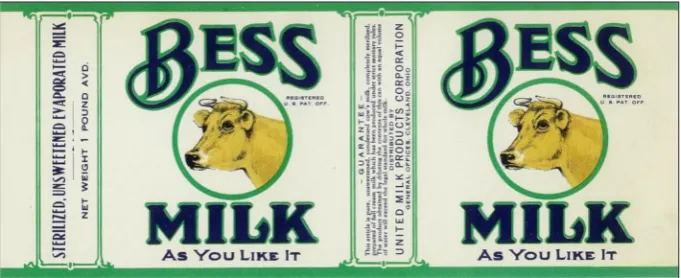
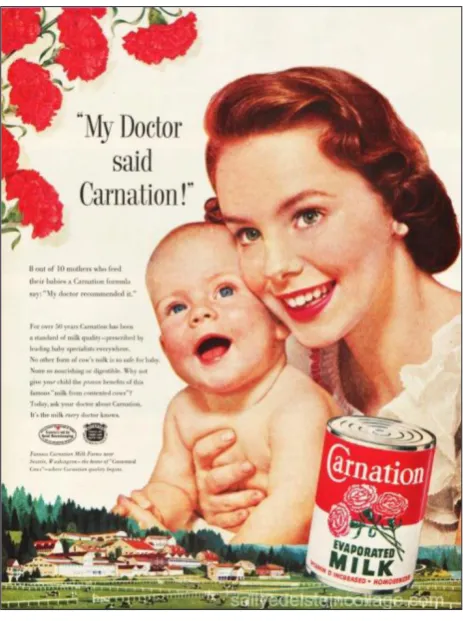
In the 1910s, evaporated milk began to be widely commercially available at low prices. Milk corporations funded clinical studies that suggested that babies who were fed on evaporated milk formula thrived better than breastfed babies, when their weight gain was compared. In North America particularly, some paediatricians pro-moted the view that bottle-feeding was as good as breastfeeding, based on progres-sive weight gain. The monitoring of growth then became a benchmark justifying the charts and weighing clinics. As infant welfare and health surveillance grew, there was a notional standard established on the basis of readings from these formula-fed babies. In today’s climate, there may be more concerns that these weight gains and formulae contribute to diabetes and obesity in later life – and now feeding ‘success’ is as likely to be measured in achieving cerebral milestones. In the rapidly growing Asian markets, breast milk substitutes make unsubstantiated claims that the addition of vitamins will increase height, weight and intelligence. A mother from Vietnam, who spends nearly all of her income on formula milk from a German manufacturer, observed that: ‘Most people here look for the weight and the height … We always see chubby children on formula packages and on TV. We all want that.’8
Most of the medical profession adhered for some time to the idea that bottle feeding was better than breastfeeding. It was regularised. It overcame problems associated with rationing. It fed into the same atmosphere of ‘salvation through
8 Milking It: How milk formula companies are putting profits before science, Changing Markets
[image:17.595.128.469.141.280.2]Foun-dation, 31 October 2017, <https://changingmarkets.org/wp-content/uploads/2017/10/Milking-it-Final-report-CM.pdf> [Accessed 16 May 2018].
Leslie and Jackson: Milk’s Arrays 16
technology’ that fuelled the Space Race and the ‘white heat’ of technology of the post war period. This knowledge was taken forward aggressively in projects of exporting Western infant products to be imbibed by colonised bodies. Rationalisation of milk supply allows the penetration of exchange relations into new markets.9
Milk Is Not Enough
Breastfeeding is not just about the provision of milk. It is also not just about intimate bonds. Like the act of reproduction, lactation is the enactment of a splitting, of a for-mation of self and part-self that is to become other. It disrupts the dominant motif of the bounded body, of sovereign individuality. Milk is a bridge between bodies: an emission from one and incorporation into another. This can be evidenced in the
[image:18.595.182.414.139.450.2]9 Thuy Linh Nyugen, Nyugen, Thuy Linh, Childbirth, Maternity and Medical Pluralism in French Colonial Vietnam 1880–1945 (Rochester: Rochester University Press, 2016).
Leslie and Jackson: Milk’s Arrays 17
tively recent proliferation of the brelfie, the breast-feeding selfie – at once an image of self and not-self, of bodies joined in the transmission of milk.10 Brelfies are part of
the phenomenon of narcissistic self-imaging triggered by the confluence of the cam-era and the Internet in the smartphone. They are also an act of conscious image mak-ing. These images of breastfeeding are not metaphorical, idealised or pornographic, but normalising, various and self-authored. Maternal nursing, as a bodily practice located at the breast, challenges notions of the rational, autonomous individual. Lac-tational embodiment fits conceptually within the frameworks proposed by Elizabeth Grosz, who argued that ‘women’s corporeality is inscribed as a mode of seepage’.11
The maternal subject, Julia Kristeva reminds us, is ‘the place of a splitting’12 –
simul-taneously the self and not the self; and the act of breastfeeding materialises this con-ceptual framing. In this light, the breastfeeding selfie can be understood as a site of both rupture and bridging, an evocation of a simultaneously split and dual subject.
Perhaps the site of giving milk, of the mother splitting herself, causes social anxi-eties. This anxiety is mobilised to validate the social separation of the breastfeed-ing woman from the public environment, whether through shame or through lack of paid maternity leave, which produces the need for the technological fix of the breast pump. Sometimes the breastfeeding woman is directed to separate herself and her baby from the rest of the world, by taking up a position in the toilets. Breast pumps are now designed so that women can continue to be optimally productive while using them – expected to work at the computer whilst lactating, even whilst away from home on business in hotels, or while exercising. As milk is known bet-ter through the smartness of our technologies and analytical abilities, its essence is extracted and negated, as the messy body is constituted negatively as a source or ves-sel. Optimisation is not conceived of as an emotional and embodied issue, but a ques-tion of the quality of the fluid, a nutriques-tional source for the brains of the intelligent,
10 Boon, Sonja and Beth Pentney, ‘Virtual lactivism: Breastfeeding Selfies and the Performance of
Moth-erhood’, International Journal of Communication, 9 (2015), 1759–1772.
11 Elizabeth Grosz, Volatile Bodies: Toward a Corporeal Feminism (Bloomington, Indiana: Indiana
Univer-sity Press, 1994), p. 203.
12 Julia Kristeva, Desire in Language: A Semiotic Approach to Literature and Art (Columbia: Columbia
Leslie and Jackson: Milk’s Arrays 18
adaptable workforce of the future, extracted remotely from the newly-freed bodies of a female workforce that need not leave its desks to do the work of reproduction.
Luce Irigaray wrote in 1981, ‘All Western culture rests on the murder of the mother’.13 Lacan identified the mirror stage as an archetypal moment in the
develop-ment of an individual’s sense of self, through which an infant comes to perceive itself as a coherent whole by identifying with the reflection in a mirror. This feat of trium-phant self-integration lends the individual, Lacan suggests, the thrusting ‘impres-siveness of statues’. It is the process which ‘constitutes the ego’ with the ‘attributes of permanence, identity, and substantiality’. Irigaray noticed that this mythic develop-mental moment never actually involves a mirror. The identity of the child – who in Lacan’s account is always imagined as male – is not actually formed in relation to an impassive reflecting object, but rather, in relation to an active reflecting person. And to her mind, it was far from incidental that this person-being-depicted-as-a-mirror is most usually a woman. That is, this mirror-person is a mother. We are a culture that despises vulnerability, dependency and welfare, and this erasure of the maternal, or her turning into a mere reflection, finds a parallel in the abhorrence of the ‘bovine’,
[image:20.595.128.470.139.353.2]Leslie and Jackson: Milk’s Arrays 19
the compliant, and the exploited. Contempt for interspecies dependency renders the co-dependent human relationship invisible.
Milk Sops
Ours is a social climate that oscillates between a political economy of nostalgia, and paranoia about a techno-utopian euphoria and exaltation in the face of extinctions. Extreme transhumanist fantasies of jettisoning the body altogether and uploading consciousness onto new improved substrates permeates this climate in a further repression of the long-promulgated Cartesian mind-body split.
Redundant Stock
Milk – like skin – is fully abstractable from its source. The body is no longer required, in industrial processes that remain still on the fringes of the economy. In effect, the cow’s body is no longer needed once the genetic sequence has been obtained, though the marketing speaks rather idealistically of cows being released to roam free. Producing milk or leather is visualised more as a harvesting of data. In contem-porary dairy industrial farming, the cow’s body is discardable in any case. It becomes the location of a series of processes to be ‘optimised’ – utilising a language that per-vades the industry, where ‘yield’ must be increased by manipulating the cows’ feed, medication, living conditions, and genetics.
The application of artificial breeding techniques to improve livestock is now routine in the dairy industry. Given the advances in embryo transfer technology from the 1970s onwards and the development of sexed semen identification in the 1990s, the dairy industry became enmeshed in dairy genetics. Companies specialis-ing in cattle genetics provide catalogues containspecialis-ing an almost limitless assortment of semen from sires at all pricing points for a worldwide marketplace. There is no longer a need to have live bulls at the dairy. Instead a phial or ‘straw’ of frozen sperm arrives.
Leslie and Jackson: Milk’s Arrays 20
development programs. Humans that do not eat large amounts of meat and dairy, for example, may not be considered ‘optimal’ eaters.
Dairy is the industry that pioneered the application of big data, assisting milk’s accelerated abstractions into chemical components, economic actions and bodily manipulations. It has provided a model for other industries to generate their algo-rithmic futures. Big data has been implemented in dairy farming more than in any other industry, and – combined with the financialisation of species and individual worth – pioneered in the field of animal science through quantitative analysis.
Can we identify domesticated animals as trapped – albeit over time and space, intergenerationally? Is the fully roboticised milk production line a transformed rep-resentation of its maker, the hunter, and the prey animal, its victim, and of their mutual relationship? Capitalism depends not just upon the exploitation of labour and knowledge, but the expropriation of land and its resources, and the co-option of bodies and body parts as bioreactors. Is the in-vitro mammary gland, which oper-ates as a bioreactor, a form of entrapment? Is the new science of cellular agricul-ture a form of entrapment? The depletion of species and environmental loss of the present is identified as an acceleration of the burden of human entrapment in dependent relationships, rather than a consequence of the human entrapment of and instrumentalisation of nature, first through industrialisation and then through technoscience, which still seeks to offer positivist solutions for degradation, as it simultaneously quickens it. Like many experimental cellular farming technologies,
[image:22.595.131.467.140.266.2]Leslie and Jackson: Milk’s Arrays 21
technoscience is offered as a foil to try to combat the spectre of collapse and destruc-tion, by utilising a frenzy of growth and regeneration. What to think of a distinctly vampiric, indeed, masculine obsession, posed by the renewed interest by venture capitalists in parabiosis, the transfusion of young blood into old people’s veins?
Reproduction is never left alone. Reproduction and the sustenance of life are endlessly augmented. But there is one very present, tangible way in which repro-duction and life sustenance is affected today. Over 1000 UK midwives are from EU countries and their future is now uncertain, in a context in which there is already a national shortage of around 35,000 midwives. In August 2017, a charity, Fertility Network UK, collated evidence that there were restrictions being imposed on access to NHS-funded IVF in some areas of England: ‘England pioneered IVF approaching 40 years ago, but that achievement is meaningless if only those who can afford to pay for IVF benefit from it’.14
This is a climate with disdain for dependency, the flesh, and vulnerability. It cor-roborates a neoliberal market-driven economy that draws on pseudoscientific fan-tasies of genetic and geopolitical advantage. In an age of the surveillance state and corporate data extraction, to be bodiless seems to represent emancipatory freedoms. It is an arena for unrestrained depravity, of ungendered, unracialised, unembodied, multiple selfhood. Likewise, for those who want to disavow their flesh, and hive-mind their intelligence onto some more robust substrate, singularity seems like an attractive proposition. But what we really know is, within our lifetimes at the very least, to be without a body is quite simply to be dead. There is no more present, effi-cient and fast-acting way for a state to perpetrate ultraviolence on the bodies of its citizens, than the removal of a public health service.
Milky Abyss
Milk is a liquid latent with the power of annihilation as well as the capacity to pro-vide life. Its shapings are driven by the attempt to wrestle control of supply, to entrap the milk-giver, to take its milk from it and to remake that milk as something else, as
14 See ‘NHS access to IVF being cut in England’, BBC News, 7 August 2017, <http://www.bbc.co.uk/
Leslie and Jackson: Milk’s Arrays 22
anything else, even as something so different to itself, it barely registers as milk at all. We are far from milk being just milk, however nutritious and feeding it is supposed to be. The force of history, the bio-medicalisation of the body, the intervention of politics into the very start of life: all that is clear. Milk’s components have now been more closely identified: casein, whey, lactose. Each of these has multiple uses. Milk is still mobilised as a cipher of nature, as rendered in the work of lactivists: militant advocates of the normalisation of breastfeeding.15 It is, though, a highly technical,
technologised fluid, and one of the most technologized fluids on the planet. Milk’s capacity is to be extendable, to issue in various ways.
Competing Interests
[[COMPETING INTEREST STATEMENT TO BE PROVIDED]]
References
Apollodorus. 1921. The Library, with an English Translation by Sir James George Frazer, F.B.A., F.R.S. in 2 Volumes (Cambridge, MA: Harvard University Press; London: William Heinemann Ltd.).
Baum, Caroline. 2010. ‘Breaking down the boundaries’. The Sydney Morning Herald, 17 March 2010. <https://www.smh.com.au/entertainment/books/breaking-down-the-boundaries-20100316-qcfd.html> [accessed May 16 May 2018].
Boon, Sonja and Pentney, Beth. 2015. ‘Virtual lactivism: Breastfeeding Selfies and the Performance of Motherhood’. International Journal of Communication, 9: 1759–1772.
Cadogan, William. 1749. An Essay Upon Nursing, and the Management of Children: From Their Birth to Three Years of Age. By a Physician (London: J. Roberts).
Cixous, Hélène. 1991. Coming to Writing and Other Essays (Harvard: Harvard University Press).
Douthwaite, Julia V. 2002. The Wild Girl, Natural Man, and the Monster: Dangerous Experiments in the Age of Enlightenment (Chicago: University of Chicago Press). DOI: https://doi.org/10.7208/chicago/9780226160573.001.0001
Leslie and Jackson: Milk’s Arrays 23
Faircloth, Charlotte. 2013. Militant Lactivism?: Attachment Parenting and Intensive Motherhood in the UK and France (Berghahn Books).
Grosz, Elizabeth. 1994. Volatile Bodies: Toward a Corporeal Feminism (Bloomington, Indiana: Indiana University Press).
Irigaray, Luce. 1981. Le Corps À Corps Avec La Mère (Editions de la pleine lune).
Kristeva, Julia. 1980. Desire in Language: A Semiotic Approach to Literature and Art (Columbia: Columbia University Press).
Milking It: How milk formula companies are putting profits before science. Chang-ing Markets Foundation, 31 October 2017 <https://changChang-ingmarkets.org/wp- <https://changingmarkets.org/wp-content/uploads/2017/10/Milking-it-Final-report-CM.pdf> [Accessed 16 May 2018].
‘NHS access to IVF being cut in England’. BBC News, 7 August 2017 <http://www. bbc.co.uk/news/health-40848097> [accessed 16 May 2018].
Nyugen, Thuy Linh. 2016. Childbirth, Maternity and Medical Pluralism in French Colonial Vietnam 1880–1945 (Rochester: Rochester University Press).
Prout, William. 1836. Chemistry, meteorology, and the function of digestion, consid-ered with reference to natural theology (Philadelphia, Carey, Lea & Blanchard).
Wood, Marcus. 2013. Black Milk: Imagining Slavery in the Visual Cultures of Brazil and America (Oxford: Oxford University Press). DOI: https://doi.org/10.1093/ acprof:oso/9780199274574.001.0001
How to cite this article: Leslie, E and Jackson, M. 2018. Milk’s Arrays. Studies in the Maternal, 9(1): X, pp. 1–23, DOI: https://doi.org/10.16995/sim.260
Published: XX Month 201X
Copyright: © 2018 The Author(s). This is an open-access article distributed under the terms of the Creative Commons Attribution 4.0 International License (CC-BY 4.0), which permits unrestricted use, distribution, and reproduction in any medium, provided the original author and source are credited. See http://creativecommons.org/licenses/by/4.0/.
OPEN ACCESS Studies in the Maternal is a peer-reviewed open access
Typesetting queries
1. The journal has a policy to include a competing interest statement in all published articles, to
ensure transparency. Please could you provide a competing interest statement, or confirm that all authors of this article have no competing interests. Further information is available here: http://www.mamsie.bbk.ac.uk/about/competinginterests/
2. Figures 1 to 13 are not cited within the text. Please advise where they should be cited.