IJPSR (2019), Volume 10, Issue 6 (Research Article)
Received on 26 September 2018; received in revised form, 04 December 2018; accepted, 29 December 2018; published 01 June 2019
FORMULATION AND EVALUATION OF LOSARTAN POTASSIUM COMPRESSION COATED TABLETS BY OKRA GUM AS A BINDER
S. Chatterjee and R. Mazumder *
Department of Pharmaceutics, Calcutta Institute of Pharmaceutical Technology and Allied Health Sciences, Howrah - 711316, West Bengal, India.
ABSTRACT: The purpose of the present study was to formulate Losartan potassium compression-coated tablets using okra gum as a binder along with synthetic hydrophilic polymers like various grades of Hydroxypropyl methylcellulose (HPMC) and compare the different parameters. The effect of different concentration of okra is to be used in the formulations with varying concentration of the polymers, elucidating the effect of type of polymers and its concentration on release pattern of the drug from the compression-coated tablets. Okra gum was extracted by using acetone. After subsequent evaluation of the gum and the preformulation studies of the drug, fast disintegrating core tablets were prepared. Okra gum was used as binder in varied concentrations (3%, 4% & 5%) and three different grades of Hydroxypropyl methylcellulose (HPMC) were used in 30%, 60% & 90% concentrations to prepare compression coated tablets. Characterization was done, and the drug release pattern was compared among the batches. Preformulation studies like differential scanning calorimeter (DSC), Fourier transform infrared spectroscopy (FTIR) showed that there was no significant interaction between the drug and the polymers. The characterization of the new polymer okra showed that it has swelling properties, and in spite of being a hydrophilic polymer, it can be successfully used in sustained release formulations. Drug release was retarded successfully, which followed zero order reaction, and the best fit model was Korsemeyer Peppas model. This study provides an insight into the usage of okra gum as a rate retardant polymer, which can be successfully used as a binder in compression of tablets.
INTRODUCTION: Drug delivery technologies, 1 modify drug release profile, absorption, distribution, and elimination for the benefit of improving product efficacy and safety, as well as patient convenience and compliance. Drug release is from diffusion, swelling, degradation, and affinity-based mechanisms 2.
QUICK RESPONSE CODE
DOI:
10.13040/IJPSR.0975-8232.10(6).2917-22
The article can be accessed online on
www.ijpsr.com
DOI link: http://dx.doi.org/10.13040/IJPSR.0975-8232.10(6).2917-22
Many drugs, peptides, and proteins, antibody, vaccine, and gene-based, in general, may not be delivered using these routes because they might be susceptible to enzymatic degradation or cannot be absorbed into the systemic circulation efficiently due to molecular size and charge issues to be therapeutically effective.
To achieve or maintain the concentration of administered drug within the therapeutically effective range needed or medication, it is often ready to administer conventional dosage forms several times a day. To prevent fluctuation of drug level in the body, fabrication of sustained release dosage is taken into consideration, which is
Keywords:
Compression coated tablet, Hydrophilic polymer, Okra, Binder
Correspondence to Author: Rana Mazumder
Assistant Professor,
Department of Pharmaceutics, Calcutta Institute of Pharmaceutical Technology and Allied Health Sciences, Howrah - 711316, West Bengal, India.
associated with physicochemical parameters and pharmacokinetic behavior of drugs, route of administration, disease state to be treated and most important placement of the drug in the dosage form that will provide the desired temporal and spatial delivery pattern for the drug, where the drug is released over a period of time in a controlled manner from a formulation. A compression coated tablet 3 can be formulated to deliver an accurate dosage to a specific site, which is usually taken orally. The finished product is a tablet within a tablet. Coatings are applied to achieve the superior aesthetic property of a dosage form and modify release characteristics. Coating with solvents are generally time-consuming, unstable for heat labile drug and hydrolyzes degradable drug and the polluted environment too. Therefore, the non-solvent coating is introduced as an alternative to overcome these problems. Compression coating 4 is the absolute dry coating without solvent and heat use. Losartan Potassium 5 is an antihypertensive, used as a model drug here, and Okra gum 6 has been extracted from Abelmoschus esculentus. It is used in the preparation of the tablets as a binder, along with hydrophilic polymers like HPMC. Then the dissolution studies are conducted, and the percentage of drug release is calculated, and the drug release rate is studied. Despite using different grades of hydrophilic polymers, a hydrophilic natural gum is chosen to evaluate its efficacy as a binder and its coherence in producing sustained-release tablets. The dosage form must ensure its novelty in prolonging the drug dissolution rates, giving a long-term therapeutic effect that is far more superior as compared to the conventional dosage forms of Losartan potassium, having a half-life of almost 2 h.
MATERIALS AND METHODS: Losartan
potassium was obtained as a gift sample from Caplet India Pvt. Ltd., Kolkata, West Bengal, India. Hydroxypropyl methylcellulose (HPMC) 5cps, 15cps, 50cps, Talc, Magnesium stearate were purchased from Merck Specialties Private Limited. New Delhi, India. Microcrystalline cellulose, Sodium starch glycolate, and Lactose were
purchased from Loba chemicals Private Ltd., Mumbai, Maharashtra, India. Fresh unripe Ladies fingers were procured from local areas of Kolkata, West Bengal, India.
Extraction of Okra Gum: Fresh unripe pods of Okra (Ladies Finger) were obtained from the local market. The pods were cut into very thin slices longitudinally, and the seeds were removed and then soaked in the distilled water for 24 h, the swollen slices were then squeezed through muslin bags to obtain an aqueous extract. To the aqueous extract, twice the volume of alcohol was added to precipitate the mucilage. The mucilage was further washed with thrice the volume of acetone. The mucilage was separated, and acetone was removed by vacuum filtration. A part of the mucilage was kept aside, and a part was subjected to solar drying
7
. Various characterizations were carried out like organoleptic characters 8, the presence of carbohydrates, pH, swelling index, 9, 10, etc. Micromeritic studies were also carried out 11.
Preformulation Studies of the Drug:
Preformulation studies 12 for both the drug and Okra gum were carried out, like the preparation of calibration curve, determination of melting point, drug solubility studies. For checking the drug-polymer interaction DSC and FTIR tests were done, and the results showed that there was no significant interaction between them.
Preparation of Core Tablets and Compression Coated Tablets: The below-mentioned formulation Table 1-2 shows the number of ingredients used for the preparation of tablets. Sodium Starch glycolate was used as a super-disintegrant. Core tablets were prepared by direct compression method. Compression coated tablets 13 were prepared by wet granulation method, where the Okra mucilage was used as a binder. Three grades of Hydroxypropyl methylcellulose (HPMC) were used- 5cps, 15cps & 50cps. Nine batches were prepared. Before the compression of the tablets, micromeritic properties of the granules were evaluated.
TABLE 1: FORMULATION CHART OF CORE TABLETS
Drug (in mg) Sodium Starch
Glycolate
Talc Magnesium stearate MCC (in mg) The total weight (in
mg)
TABLE 2: FORMULATION OF COMPRESSION COATED TABLETS
Formulation code
Weight of core tablets (mg)
Okra mucilage
HPMC 5cps
HPMC 15cps
HPMC 50cps
Mag stearate (mg)
Talc (mg)
Lactose (mg)
Total weight (mg)
F1 200 3% 30% - - 2% 2% q.s 500
F2 200 4% 60% - - 2% 2% q.s 500
F3 200 5% 90% - - 2% 2% q.s 500
F4 200 3% - 30% - 2% 2% q.s 500
F5 200 4% - 60% - 2% 2% q.s 500
F6 200 5% - 90% - 2% 2% q.s 500
F7 200 3% - - 30% 2% 2% q.s 500
F8 200 4% - - 60% 2% 2% q.s 500
F9 200 5% - - 90% 2% 2% q.s 500
Evaluation of Compression Coated Tablets: The hardness and friability 14 of the tablets were calculated using the Monsanto Hardness Tester and Roche’s Friabilator. Thickness and diameter 15
were calculated by using Vernier Callipers. Weight variation test was done according to the official method. Percentage of drug content 16 in the tablets was also determined.
Release Studies:Dissolution studies 17 were carried out for all the formulation in USP paddle method (Apparatus 2) using Phosphate buffer pH 6.8, and pH 1.2 (0.1N) HCl solution in the dissolution medium (900 ml) at 50 rpm and 37 ± 0.5 ºC. Samples were periodically withdrawn at suitable time intervals and volume replaced with equivalent amounts of plain dissolution medium. The samples were analyzed spectrophotometrically at 250 nm. In-vitro Release Kinetics: Drug release kinetics 18 were fitted to the kinetic model including the zero order [Equation 1], first order [Equation 2], Higuchi matrix [Equation 3], and Korsmeyer-Peppas [Equation4] release equations to find the equation with the best fit.
R=k0t Log UR = k1t / 2.303
R=kh√t R=kkptn*
Where R and UR are the released and unreleased percentages respectively, at the time [t]; k0, k1, kh, kkp are the rate constants of zero order, first order, Higuchi matrix, and Korsmeyer-Peppas respectively. Different ‘n’ values of the Korsmeyer-Peppas equation indicate the different mechanism of drug release. If the ‘n’ value is around 0.5 then Fickian diffusion is apparent, if the ‘n’ value ranges from 0.5 to 1.0 which represents anomalous diffusion transport and if the ‘n’ value reaches 1 and above, then case II and super case II
transport are indicated which shows that the release
19
is following zero order kinetics.
Surface Topography (SEM): The samples for the SEM analysis were prepared by sprinkling the tablets on one side of an adhesive stub. Then the tablets were coated with gold (20Å) before microscopy. Finally, the morphology and size of the tablets are observed with the scanning electron microscope.
RESULTS AND DISCUSSION:
Infrared Absorption Spectra: The Fourier transform infrared spectroscopy (FTIR) spectra analysis of Okra gum, Losartan potassium, and the physical mixtures show that there was no significant interaction between the drug and the polymers. It is depicted in the following Fig. 1-2.
FIG. 1: FOURIER TRANSFORM INFRARED SPECTROSCOPY (FTIR) SPECTRA OF THE DRUG (LOSARTAN POTASSIUM)
FIG. 2: FOURIER TRANSFORM INFRARED SPECTROSCOPY (FTIR) SPECTRA OF LOSARTAN POTASSIUM AND POLYMERS (OKRA GUM, HPMC 5CPS, HPMC15CPS AND HPMC 50CPS)
[image:3.612.316.565.433.706.2]Differential Scanning Calorimetry: The DSC thermogram analysis of Okra gum, Losartan potassium, and the physical mixtures shows that there was no significant interaction between drug and polymers, as shown in Fig. 3-4.
FIG. 3:DIFFERENTIAL SCANNING CALORIMETRY (DSC) OF LOSARTAN POTASSIUM
FIG. 4: DIFFERENTIAL SCANNING CALORIMETRY (DSC)
THERMOGRAM OF LOSARTAN POTASSIUM AND
POLYMERS (OKRA GUM, HPMC 5CPS, HPMC 15CPS, AND HPMC 50 CPS)
Physico-Chemical Properties of Compression Coated Tablets of Losartan Potassium: The thickness (mm), weight variation (%), Hardness (kg/cm2) Friability (%) and content uniformity (%) were calculated, and the results are tabulated in
Table 3.
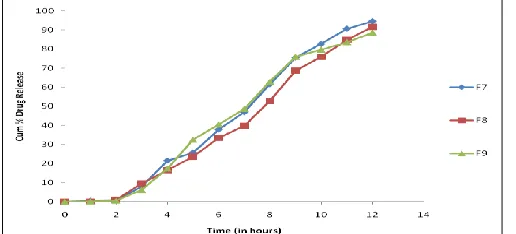
In-vitro Drug Release Studies: It includes the dissolution of the compression coated type tablet formulations study of all of the formulations by fitting the data obtained from dissolution study.
The in-vitro release was carried out up to 12 h for all the formulations which shown in following Fig. 5-7.
Drug Release Kinetics: From the release kinetics and mechanism data Table 4, it was found that all the formulations have followed the zero-order kinetics, as depicted from the regression values, ranging from 0954 to 0.979 as its value is nearer to ‘1’.
The rate of drug release follows zero order kinetics, and numerical data is fitted into Korsmeyer-Peppas model, where the value of n reaches above 1, so the mechanism of drug release was followed by non-fickian (super case II) transport for tablet formulation.
TABLE 3: PHYSICOCHEMICAL PROPERTIES OF COMPRESSION COATED TABLETS OF LOSARTAN POTASSIUM
Formulation code Thickness (± S.D) (cm)
Hardness (± S.D) (kg/cm2)
Friability (± S.D) (%)
Weight variation (± S.D) (%)
Percentage content (± S.D) (%)
F1 0.574 ± 0.054 6.73 ± 0.16 0.45 ± 0.01 ±2 99.79 ± 0.36
F2 0.596 ± 0.070 6.79 ± 0.28 0.35 ± 0.07 ±1 99.96 ± 0.23
F3 0.579 ± 0.83 6.79 ± 0.20 0.39 ± 0.08 ±2 99.95 ± 0.51
F4 0.592 ± 0.53 6.77 ± 0.28 0.43 ± 0.02 ±1 99.74 ± 0.56
F5 0.563 ± 0.44 6.85 ± 0.28 0.32 ± 0.09 ±2 98.87 ± 0.382
F6 0.582 ± 0.13 6.77 ± 0.16 0.39 ± 0.03 ±1 99.34 ± 0.12
F7 0.582 ± 0.044 6.74 ± 0.17 0.44 ± 0.02 ±1 99.67 ± 0.31
F8 0.576 ± 0.070 6.83 ± 0.28 0.35 ± 0.08 ±1 99.02 ± 0.14
F9 0.581 ± 0.10 6.81 ± 0.33 0.37 ± 0.01 ±1 99.97 ± 0.332
Values are represented as mean ± SD (n=3)
FIG. 5: CUMULATIVE DRUG RELEASE STUDY OF FIG. 6: CUMULATIVE DRUG RELEASE STUDY OF
[image:4.612.49.300.132.253.2] [image:4.612.48.569.460.732.2]FIG. 7: CUMULATIVE DRUG RELEASE STUDY OF FORMULATION F7, F8, AND F9
TABLE 4: DRUG RELEASE KINETICS OF COMPRESSION COATED TABLETS
Formulations Zero-order First order Higuchi Model Korsmeyer-Peppas Model
R2 K0 R2 K1 R2 kh R2 kkp
F1 0.969 8.701 0.865 -0.086 0.819 30.90 0.958 2.449
F2 0.969 9.340 0.883 -0.105 0.835 33.50 0.953 2.422
F3 0.979 8.298 0.934 -0.076 0.866 30.16 0.925 2.092
F4 0.969 9.263 0.808 -0.113 0.819 32.91 0.953 2.343
F5 0.954 9.426 0.838 -0.109 0.792 33.20 0.964 2.422
F6 0.973 8.846 0.831 -0.094 0.824 31.44 0.959 2.532
F7 0.973 9.058 0.859 -0.100 0.829 32.31 0.942 2.242
F8 0.970 8.455 0.849 -0.082 0.814 29.94 0.950 2.545
F9 0.970 8.690 0.925 -0.082 0.843 31.29 0.937 2.559
Surface Topography (SEM): Scanning electron (SEM) microscopy was used to observe the surface morphology of compression coated tablet of
Losartan Potassium before and after dissolution study described by the following Fig. 8-9.
FIG. 8: SEM OF LOSARTAN POTASSIUM COMPRESSION FIG. 9: SEM OF LOSARTAN POTASSIUM COMPRESSION COATED TABLET BEFORE DISSOLUTION AT X200 COATED TABLET AFTER DISSOLUTION AT X200
CONCLUSION: The present study shows that the compression coated tablets of Losartan potassium, prepared by using a natural polymer, i.e., Okra gum and other hydrophilic polymers like HPMC in various concentrations were able to retard the drug release and in spite of being hydrophilic in nature, they can prolong the therapeutic effect up to 12 h, establishing its cognizance over similar dosage forms. By compression coating, delay in drug dissolution is further aided. Solventless coating eradicates the hazards of using coating materials and types of equipment, yet manifests to be advantageous. The presence of super disintegrant
ACKNOWLEDGEMENT: Authors wish to give thanks to Calcutta Institute of Pharmaceutical Technology and A.H.S. Howrah, West Bengal, India, authority for constant support and given research laboratory to carry out this project work and Jadavpur University, Kolkata, West Bengal, India, where the sample analysis was done.
CONFLICT OF INTEREST: The authors
validate that the contents of this article have no conflict of interests.
REFERENCES:
1. Khar SP and Vyas RK: Targeted & Controlled Drug Delivery Novel Carrier System. CBS Publishers, New Delhi, Edition 1, 2002; 1(1): 134-80.
2. Frank. DW, Gray JE and Weaver RN: Cyclodextrin nephrosis in the rat. Am J Pathol 1976; 83: 367-82. 3. Senthilnathan B, Pavithra R, Sangeetha M and
Ravichandran V: Formulation and Evaluation of Chrono-pharmaceutical Drug Delivery System. International Journal of PharmTech Research 2014; 6(3): 1124-1130. 4. Soravoot R: Aus, 2010; Bangkok, Thailand, 1-134. 5. Boersma C, Atthobari J, Gansevoort RT, de Jong-Van den
Berg LT, De Jong PE, De Zeeuw D, Annemans LJ and Postma MJ: Pharmacoeconomics of angiotensin II antagonists in type 2 diabetic patients with nephropathy: implications for decision making. Pharmacoeconomics 2006; 24 (6): 523-35.
6. Jain N: A Review on: Abelmoschus esculentus. Pharmacacia 2012; 1: 1-8.
7. Nasipuri RN, Igwilo CI and Brown SA: Mucilage from
Abelmoschus exculentus fruits-a potential pharmaceutical
raw material. Part II-emulsyly properties. Journal of Pharmaceutical Research Development 1997; 2: 27-34. 8. Lala PK: Practical Pharmacognosy. Lina Guha, Calcutta,
1981: 135.
9. Indian Pharmacopoeia, FDA, Maharashtra, Mumbai 1996; 1.
10. Kulkarni GT, Gowthamarajan K, Rao B and Suresh B: Evaluation of binding properties of selected natural mucilages. Journal of Scientific and Industrial Research 2002; 61: 529-32.
11. Malviya R, Srivastava P, Bansal M and Sharma PK: Preparation and evaluation of Curcubita maxima pulp, Powder. International Journal of Pharmaceutical Sciences 2010; 2(1): 395-99.
12. McIntyre M, Caffe SE, Michalak RA and Reid JL: Losartan, an orally active angiotensin (AT1) receptor antagonist: a review of its efficacy and safety in essential hypertension. Pharmacol Therapy 1997; 74(2): 181‐94. 13. Ketousetuo K: Drug delivery system based on
chronobiology, A review. Journal of Controlled Released 2010; 147(3): 314-25.
14. Aulton ME: Pharmaceutics: The science of Dosage Form Design. Churchill Livingstone, Edition 2, Vol. 2: 134. 15. Drug information for Losartan potassium from Indian
Pharmacopoeia 2010; 2: 1607-08.
16. Bhanja S, Ellaiah P, Mohanty C, Murthy KVR, Panigrahi B and Padhy SK: Design and in vitro evaluation of mucoadhesive buccal tablets of perindopril Prepared by sintering technique. Asian Journal of Pharmaceutical Clinical Research 2010; 3(4): 4-10.
17. Higuchi T: Mechanism of sustained action medication, Theoretical analysis of rate release of solid drugs dispersed in solid matrices. Journal of Pharmaceutical Sciences 1963; 52: 1145-49.
18. Cottrell IW, Kang KS and Kovaca P: In Handbook of Water Soluble Gums and Resins (R, L. Davidson, ed.), McGraw Hill, Kingsport Press, New York 1980: 24-29.
All © 2013 are reserved by International Journal of Pharmaceutical Sciences and Research. This Journal licensed under a Creative Commons Attribution-NonCommercial-ShareAlike 3.0 Unported License.
This article can be downloaded to Android OS based mobile. Scan QR Code using Code/Bar Scanner from your mobile. (Scanners are available on Google Play store)
How to cite this article: