BIROn - Birkbeck Institutional Research Online
Thackeray, L.A. and Eatough, Virginia (2015) "Well the Future, that is
Difficult": a hermeneutic phenomenological analysis exploring the maternal
experience of parenting a young adult with a developmental disability.
Journal of Applied Research in Intellectual Disabilities 28 (4), pp. 265-275.
ISSN 1360-2322.
Downloaded from:
Usage Guidelines:
Please refer to usage guidelines at or alternatively
1
‘Well the future, that is difficult’: An Interpretative
phenomenological analysis exploring the maternal experience of
2
Mothers of young adults with Dev. Disabilities-IPA
Background: The predominant focus of extant literature exploring maternal experience of developmental disability is stress,
adaptation, efficacy of interventions and the burden of care. Most
studies involve mothers of children, with scant attention given to
what life is like later in the life course. This study qualitatively
explores the experience of mothers of young adults (aged 19-28
years).
Materials and methods: Semi-structured interviews conducted with six women aged 48 to 60 years were transcribed and analysed using
interpretative phenomenological analysis.
Results: Three themes illustrate how mothers are confronted with their adult children’s continuing need for support and how a lack of
trust in social care creates anxiety about the future, increasing
awareness of mortality.
Conclusion: Vulnerability represents a useful concept for understanding these findings theoretically. Galvin and Todres’
(2013) conceptual framework for the humanisation of care provides
the opportunity to prioritise the needs of individuals by highlighting
dimensions of existence which confer meaning.
3 Introduction
The predominant focus of extant literature exploring maternal
experience of developmental disability is stress, adaptation, efficacy
of interventions and the burden of care. Researchers have largely
studied mothers of children as opposed to mothers of young adults
who continue to require considerable parental involvement; as a
result there is a gap in our understanding of what life is like later in
the life course. Normative development generally entails young
adults gradually assuming independence (Arnett, 2007) whereas the
commitment made by mothers of adults with disabilities often
exceeds the typical maternal experience in terms of intensity,
complexity, and its temporal unfolding (Burkhard, 2013). Jennings
(1987) referred to this cohort as ‘perpetual parents’, a group who, in
contravention of the typical life span trajectory, continue to be
intimately involved in ensuring offspring’s needs are met.
In a longitudinal study Seltzer, Floyd, Song, Greenberg and Hong
(2011) found that 57% of parents of individuals with intellectual and
developmental disabilities had co-residing adult children compared
to 16% of the comparison sample while Pedrovska (2009)
demonstrated poorer well-being for parents, particularly mothers,
when adult children continue to live at home. This may relate to the
fact that planning for the future of adult children with intellectual
4
attributed to the complexity of the process given the multiple
variables influencing each family’s situation.
Magill-Evans, Darrah and Galambos. (2011) employed mixed
methods in a longitudinal study investigating the parental journey of
21 mothers of young adults with cerebral palsy. Qualitative analysis
found that 15 mothers reported challenges to physical and/or
emotional health in response to parenting demands. However the
majority also believed their experience had positively influenced
their views of themselves, disability and life in general. Smith et al.
(2010) conducted a diary study of the daily experiences of 96
mothers who co-resided with their offspring (aged 17 to 53 years)
with Autistic Spectrum Disorders. The results of their statistical
analysis reveals a complex picture of the maternal experience
characterised by both positive and negative aspects. Although
mothers in the experimental group experienced more stressful
events than the control there was no difference in terms of the
number of days on which they had positive interactions or
participated in volunteer work. This finding garners further support
from Burkhard (2013) who adopted a phenomenological approach
to explore the lived experience of 11 mothers caring for adolescents
or young adults (aged 14 to 22 years) with severe cerebral palsy.
Thematic analysis identified the experience had had a profound
impact on participants’ lives which were comprised of sorrows, joys
5
Green (2007) employed mixed methods collecting survey and
interview data. She argued that the tendency to focus on the
emotional burden of having a child with a disability as opposed to
examining the impact of society’s negative attitudes towards
disability and the impact of inadequate support has failed to
recognise parental experience of benefits. She claimed that the
majority of research has emphasised Subjective Burden (emotional
distress), failing to fully acknowledge the Objective Burden
(socio-structural constraints) as well as any benefits. Post hoc analysis of
survey and interview data found participants’ lives to be more
emotionally complex than existing findings suggest. Green believes
the results demonstrate the need for more nuanced research
examining the burden of care-giving as well as an exploration of the
benefits mothers derive from a lifetime of loving and living with
their children with disabilities.
It is apparent that there is a gap in our understanding of what it is
like to be the mother of a young adult with a developmental
disability. The broad aim of the study is to explore this phenomenon
using a qualitative method, Interpretative Phenomenological
Analysis (IPA). IPA provides the opportunity to focus on how
mothers experience and ascribe meaning to parenting these young
adult and begin to address an existing gap by providing a rich,
nuanced and contextual account. In this paper we focus on one
aspect of the overall findings which was particularly salient for the
participants, namely maternal conceptions of adult children’s future
6
explicate this from the mothers’ unique frame of reference and to
discuss the implications for all interested parties including service
providers.
Materials and methods
Methodology
IPA is an interpretative phenomenological method with a
commitment to examining how people make sense of their
experiences (Smith, Flowers and Larkin, 2009). IPA typically employs
small participant groups who share experience of a particular
phenomenon and aims to elucidate shared patterns of meaning.
Fundamentally phenomenology aims to study ‘human experience
carefully and systematically and to express insights arising out of
such study in language that does justice to these experiences’
(Halling, 2008, p.3). IPA acknowledges that analysis is an
interpretative endeavour and that researchers can never fully put
their pre-suppositions out of play. We are interpreting beings and
Smith et al. (2009) invoke a ‘double hermeneutic’ whereby the
researcher is attempting to make sense of the participant making
sense of different aspects of their experience, for example mothers’
understanding of their response to adult children’s vulnerability .
IPA’s idiographic commitment means that researchers privilege the
experience of individuals in the context of their lives necessitating
7 Participants
Six white British women, aged 45 to 60 years (see below) were
interviewed by the first author. Criteria for inclusion stipulated that
each was the mother of a young adult, aged 19 to 28 years, with a
diagnosis of a developmental disability. All but one, who is in a
long-term relationship, remains married to the father of their children.
Participants had at least one other typically developing adult child.
Ethical approval was granted by the Ethics Committee of the
Department of Psychological Sciences, Birkbeck, University of
London. The women were given pseudonyms.
A pilot interview was carried out with a mother known to the first
author. The resultant data was not included in this study. The
participant provided contact details for a mother she had met
through a support group and an interview was arranged. Thereafter
snowball sampling was employed allowing for recruitment of a
homogenous sample in order to represent a particular perspective
as opposed to a population (Smith et al., 2009). Below are vignettes
for the participants whose data is reported here:
Mary and Megan: Mary is 48 years old and has been married to
John, 49 years old, for 30 years. Mary works for social services and
John is a business manager. They live in a small village in the south
of England and recently bought and adapted a large detached house
to provide separate accommodation for their daughter Megan and a
8
and currently receives 24 hour care. Megan’s sisters, Helen 28 years
old and Maddy 25 years old, have left home.
Anna and Henry: Anna is 58 years old and has been married to Mark, 49 years old, for 22 years. They live in a small town in the
south of England. Anna retired from social work two years ago and
Mark is an engineer. Their son Henry has autism, is 22 years old and
lives at home. Henry recently finished college and is awaiting
assignment to a part-time job. Anna has a daughter from her first
marriage. Phoebe is 28 years old and has left home.
Jan and Livvy: Jan and her husband Jeff are 60 years old and the couple are both retired business consultants. They have been
married for 32 years and have three daughters. Livvy is 28 years old
and has low- functioning autism. She lives in a residential care home
in the same London borough as her parents. Rachel, 29 years old,
and Lucy, 26 years old, are both married and have their own homes.
Data collection
Participants were interviewed in their own homes with interviews
lasting between 1 hour and 2 hours and 49 minutes. Interviews took
place between June and October of 2012. IPA advocates the use of
semi-structured interviews, asking open-ended questions as a
means of accessing an individual’s sense-making in relation to a
given phenomenon. Questions included ‘Just start by telling me
about Henry?’, ’Tell me about a typical day?’, ‘Tell me about your
9
Henry’s mum?’, ‘What are the most challenging things?’, ‘How does
the experience compare to parenting your other child/children?’,
‘What have you learnt from the experience that you wouldn’t
otherwise have known?’ and ‘How do you see the future?’ The
interview schedule acted as a framework allowing the researcher to
seek clarification where necessary, providing the opportunity to
explore facets of experience introduced by participants. Interviews
were recorded on a digital recorder and transcribed verbatim.
Analysis
In line with IPA’s idiographic focus each transcript was analysed
individually. The process started with the first researcher reading
each interview while concurrently listening to the recording. This
facilitated immersion in the data such that the participant became
the focus of analysis. During a second exploratory reading, initial
notes were made and anything of interest recorded. Next analysis
moved to a more abstract and conceptual level. Conceptual coding
is more interpretative and demands a shift in focus. This involves
moving beyond narrative and descriptive comments and thinking
about how the participant is experiencing the phenomenon
psychologically and the meaning ascribed to it. Given IPA’s
commitment to preserving the integrity of the participant’s account,
the process is necessarily iterative; a synergistic process of
description and interpretation. Data were reduced as conceptual
codes were clustered into themes and given descriptive labels,
10
iterative process demanding sustained effort to ensure that findings
adequately represented participants’ experiences. The researchers’
voices were foregrounded as together we explored the abstract and
conceptual meanings disclosed through the analysis while
continually checking that they were grounded in the data. Once
transcripts had been analysed individually and their themes, with
supporting extracts entered into a table, data for the participant
group were considered as a whole. Again IPA’s epistemological
commitment meant that similarities and connections were explored
as shared features of the experience were identified whilst the
researchers endeavoured to retain and account for the nuance,
complexity and texture of individual experience.
Reflexivity
IPA advocates combining “a hermeneutics of empathy with a
hermeneutics of ‘questioning’” (Smith et al., 2009, p.36). The first
author conducted the interviews and took the lead with data
analysis. Both authors are mothers of adult children who do not
have a developmental disability. Our experience does not mirror
that of our participants, but as mothers we are able to identify with
many of the thoughts and feelings expressed. Also, both authors
have friends with adult children with a developmental disability and
at the outset of the study we assumed that we had some degree of
insight about what our participants might say. However our
understanding was challenged by, among other things, their honesty
11
preconceptions made apparent that we became more aware of
what they were. We were able to look at the data anew, questioning
our prior assumptions in an attempt to ensure that our
interpretations were grounded in the participants’ accounts.
Results
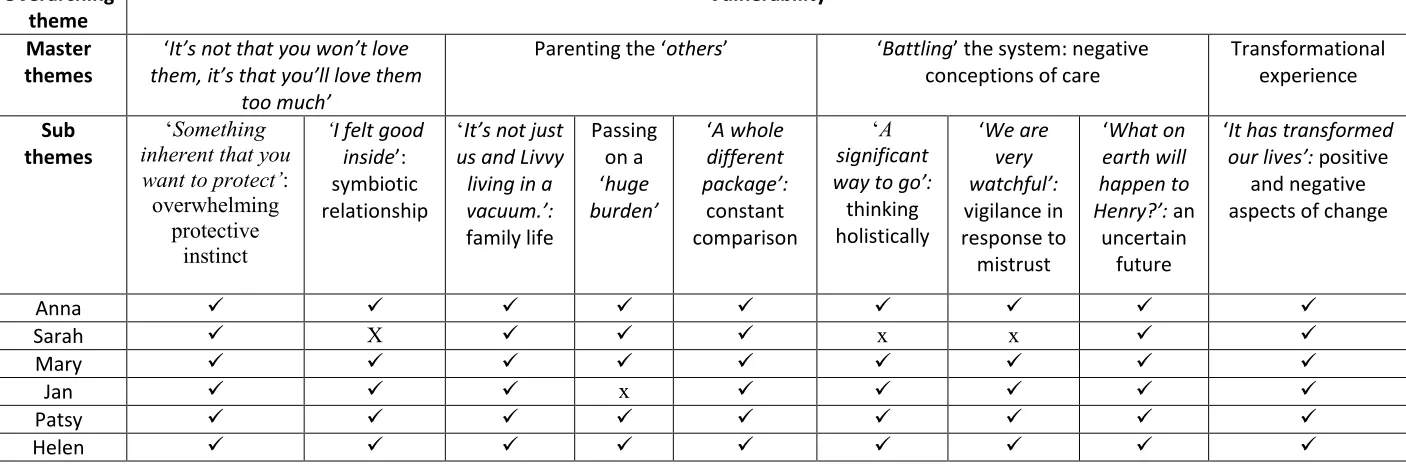
Analysis of the complete data set identified four inter-related
master themes capturing participants’ experiences (see Table 1).
The first theme encompasses issues relating to participants’
over-whelming need to protect their adult children and the way in which
the relationship was symbiotic such that participants’ affective state
reflected that of their daughter/son. The second theme
encompasses issues relating to parenting typically developing
children including balancing their needs against those of the child
with a disability, the way in which typically developing children’s
development serves as a constant reminder of the limitations
conferred by disability and consideration of the contribution they
will make to future care, particularly the tension between burden
and the need for someone who genuinely cares to be involved. The
third theme relates to conceptions of social care which are viewed
as largely obstructive and inadequate such that participants mistrust
care providers feeling that they fail to deliver holistic care. Mothers
respond to this lack of trust by maintaining a state of vigilance and
they are anxious about a future when they will no longer be able to
intervene. The fourth theme illustrates how all of the mothers felt
12
believed they had developed an enhanced propensity for
compassion and understanding. Further, ‘vulnerability’ was
established as an over-arching theme which permeated all others.
Young adults were perceived as vulnerable to abuse as well as
exclusion from many of the opportunities their typically developing
siblings had available to them. Intimate experience of vulnerability
affected participants’ world view with most feeling they had
developed greater empathy and compassion.
As a result of the inductive, participant- led approach adopted for
this study we garnered a large volume of data relating to various
aspects of the maternal experience as outlined above. One area of
particular concern relates to adult children’s vulnerability, an
ongoing need for support and the options available to families in
terms of care provision. Given the import of this phenomenon to
participants, in this paper we have elected to provide a contextual
and nuanced account of three mothers, Anna, Mary and Jan who
have each chosen different options for their adult child’s living
arrangements (reporting of the remaining data set is in
preparation). Anna’s son continues to live at home. Mary’s daughter
lives in a self-contained annexe of the family home and Jan’s
daughter lives in a residential care home. The three participants
whose experiences are not reported here have sons who also live in
residential provisions. We could equally have elected to include an
13
of Jan’s interview because she has the most experience of
residential provision.
This approach affords the opportunity to detail experience
illustrating its shared patterns of meaning at the same time as
retaining depth and an idiographic focus. To achieve this we report
three inter-related sub-themes from two of the master themes;
‘Something inherent that you want to protect’: overwhelming
protective instinct; ‘We are very watchful’: vigilance in response to
mistrust and ‘What on earth will happen to Henry?’ Facing an
uncertain future. Together they provide an illustration of how, in
different circumstances, mothers’ compulsion to protect their adult
children affects their experience of social care in light of the
on-going need for support. Young adults are perceived as vulnerable
and participants typically invoke a narrative of mistrust in relation to
care, either as a result of personal experience or the experience of
others as portrayed in the media with the result that they are
ambivalent about relinquishing control. Acknowledging that this
need will continue beyond their own lives throws participants’
mortality into sharp relief and they are increasingly anxious about
their offspring’s future. These factors combine to create a situation
which is not easily negotiated and uncertainty is a feature of
participants’ lives as they have no way of knowing how much longer
they will be able to maintain their current level of involvement.
14
The three sub-themes as they relate to the participants;
‘Something inherent that you want to protect’: overwhelming protective instinct
Societal conceptions of disability make adjusting to the birth of a
disabled child more difficult than necessary. Having a disabled child
‘is one of the most dreaded experiences a family can encounter’
(Gill, 1991, p.624) and society’s values and beliefs are mirrored in
the words and behaviours of friends, family and professionals’.
Given that wider society considers the birth of a disabled child a
tragedy, the revelation that mothers experience intense feelings of
love for their children may challenge popular conception. Mary
infers this when she says:
I think somebody did say something to me once it was just after
Megan was diagnosed and she actually had a 50 year old son with
Down’s syndrome, and she said ’When you have a child with a
disability or special needs, it’s not that you won’t love them, it’s that
you’ll love them too much.’ She said ‘It’s so hard.’ And she never
actually did manage to cut the strings really and then he was quite
bereft when she died. But it’s true …
Experience has taughtMary that this assertion is true.
Overwhelming maternal love compels her to continue to protect
Megan and she cites vulnerability as the factor which defines the
difference between her relationship with Megan and Megan’s
15
because of the vulnerability, yes, there is a stronger feeling of
protectiveness. I think the others have all the skills they need and if
Megan didn’t have a learning disability and just had a physical
disability I wouldn’t be as concerned at all. At all because I can
imagine how articulate she can be now sometimes and how much
she continue. There’s a great tenacity about her to keep telling you
something if you’re not listening.
Vulnerability is perceived as arising from Megan’s learning disability.
While her physical disability affects movement, her learning
disability limits cognitive function with the result that she doesn’t
have the ‘skills’ her sisters have; the skills which allow them to
function independently. Mary claims that that it is this aspect of
Megan’s disability which hinders her ability to protect herself and
represents the source of her own anxiety. Paradoxically Mary
acknowledges that Megan can be both articulate and tenacious
suggesting that she does in fact possess the skills necessary to alert
others to her needs. In light of Megan’s abilities Mary’s response is
not entirely rational and in attempting to articulate her reasoning
she is somewhat confused by the strength of her anxiety and the
influence it exerts on the way in which she parents Megan;
ultimately Megan’s disability induces a powerful and ineffable drive
to keep her safe.
Anna is aware that being over-protective of Henry is a characteristic
16
I think all our mums, I think if we’re criticised for anything it’s for
being a bit too protective and they’re all young men now. You know,
we’re all clucking ‘Ooh, have they got something to eat?’
The image her analogy conveys is of a mother hen staying close to
her chick, alert to its every need and always ready to intervene.
Anna recognises the irony of her actions given that her son is an
adult acknowledging that her approach is inappropriate; she is ‘too
protective’. However while able to recognise this she is not able to
attenuate her behaviour. It appears that there is something inherent
in the experience of having a disabled child that produces a
heightened awareness of that child’s physical and emotional state
and a concomitant need to respond.
All the women in this study have typically developing adult children.
They are thus able to recognise that the protective instinct they
describe is characteristic of the experience of having a child with a
disability. The psychological pain and anxiety experienced when a
mother fails in this quest is reflected in Jan’s account of a distressing
episode when, aged 18 years, Livvy transitioned from child to adult
services;
She’s stopped eating and drinking and a member of staff who was
on at the weekend had noticed when she was on the following
weekend, that Livvy was severely dehydrated and that she probably
hadn’t eaten or drunk for five days and she was taken into hospital
and put on a drip……. We realised that she’d had eighteen different
17
sixteen kids in the house (designed for eight) , total chaos. Now the
one thing that an autistic person needs is routine and stability,
consistency.
This incident, so vividly recounted, occurred more than eight years
ago and yet Jan still struggles to understand how a provision she and
her husband selected with great care failed their daughter from the
very start and with such catastrophic results. Jan’s perception is that
she entrusted the care of her vulnerable child to others and they let
her down. Not only did the staff fail to provide the ordered
environment imperative to the well-being of an individual with
autism, they failed in their duty to meet her most basic needs. Jan’s
anguish was compounded by the fact that once Livvy was discharged
from hospital she was told that bringing her home before the
college conceded that they were unable to meet her needs would
result in a complete withdrawal of social services funding.
Recognising that she would not cope without support, Jan had no
option but to concur:
That was the longest two weeks of my life. It was awful…
Returning Livvy to a provision described as being in ‘total chaos’ was
intensely painful as Jan felt powerless to protect her and was
terrified of what may be happening. There is a sense of time moving
forward at an intolerably slow pace while a mother waited for those
in positions of power to concede that they weren’t able to meet
18
‘We are very watchful’; vigilance in response mistrust
While the previous theme relates to the emotional tone of the
maternal experience this theme describes the concomitant
behavioural response. Lack of trust is a key characteristic of the
participant’s experience and mothers’ perception is that care
delivered by care workers is not of the same order as the loving care
they provide. Their response is to maintain a state of vigilance,
watching over and monitoring the actions of those employed in this
role.
Like the other mothers in this study Anna experiences a heightened
sense of anxiety because she believes that Henry’s autism makes
him vulnerable. His condition is such that he is able to go out into
the community unaccompanied and this serves to exacerbate
Anna’s concern;
I mean you read some horrendous stories that make me feel sick
about young people with learning disabilities being bullied , and then
the whole thing about residential care and horror stories, whether
it’s people with learning disabilities or older people in care homes I
think in this country we’re just not up to scratch with our carers...
Anna is alert to media reports of abuse and they contribute to her
lack of trust and anxiety. Thinking about vulnerable adults being
‘bullied’ induces a somatic response; she feels physically sick. The
world is perceived as a threatening place and the mother/son
19
knows Henry is in a safe environment and in keeping him in close
proximity, she protects them both.
The fact that prior to retirement she worked as a social worker
means that, like Mary, Anna has first-hand experience of care in
practice. She is disparaging of provision in England suggesting that
across the board carers simply don’t meet the requisite standard.
‘Horror stories’ pertaining to recipients of residential care elicit
overwhelming and painful feelings of fear and anxiety with the
result that she is not yet prepared to move Henry out of the family
home.
Given their close proximity Mary is very much aware of Megan’s
interactions with her carers and having envisaged her current
situation ‘through total rose-tinted glasses’, she is disappointed to
find that entrusting her daughter’s care to others continues to be
difficult. Mary’s ‘inherent’ need to protect means that safeguarding
her daughter is of utmost importance and she experiences difficulty
in finding staff of high enough calibre:
I think one of the biggest challenges is finding really good,
well-trained staff people who want to make a career and acknowledging
that you might only do this for two years and you may be studying,
but, people who are willing to keep their training up to date and that
it’s not just a job to fit in with the kids...
There is a contradiction in that while acknowledging that people
20
them ‘to make a career.’ Career suggests advancement, a profession
and although delivering personal care is an incredibly important
occupation it doesn’t receive sufficient recognition and this is
reflected in the status and salary it commands. Wanting employees
to think in this way demonstrates the importance Mary places on
the role. She is entrusting her daughter to their care and she needs
to feel that they care for Megan in just the same way she does. In
tacit acknowledgement that this is not the case she ‘still wants to
keep a certain amount of control to ensure she’s being looked after
properly.’
At 28 years old Livvy is the eldest of the young adults in this study
and Jan therefore has more experience of adult provision than the
other participants. As exemplified above, since entering adult
services Livvy has been subject to terrible neglect and withdrawn
from residential homes on two occasions. The family are currently
awaiting the findings of a police investigation into an incident which
occurred at her current home and the cumulative effect of these
events is that Jan is always ‘watchful.’ She uses the example of a
young woman in Livvy’s care home to illustrate what can happen
when there are no family members to monitor her well-being:
There is nobody watching out for that young woman and she can’t
talk. We have no idea whether anything has happened to her. All we
know is that from time to time her behaviour deteriorates and she
can’t explain why and there’s nobody visiting, nobody. So it’s totally
21
situation for anybody and of course this is what we’re terrified of.
Suppose Livvy had been in that situation and there was no family to
get her out of it. And the staff are worried about losing their jobs so
they don’t report it… This is what we’re worrying about. We’re
always concerned....
The critical importance of family supervision is evident. Given Jan’s
previous experience of negligent care, being ‘totally dependent on
the staff doing the right thing’ equates with being at risk of neglect.
She implies that carers are afraid to raise concerns relating to other
staff members when they are anxious about losing their jobs. This is
pertinent at a time when the economic climate is difficult and
unemployment high. For Jan the fact that employers and employees
have vested interests means that client care may be compromised.
In these circumstances the need for vigilance is paramount. Jan’s
lack of trust means that she exists in a pervasive state of fear that
Livvy may one day be in this situation; the distress this prospect
engenders is tangible.
‘What on earth will happen to Henry?’: facing an uncertain future
The fact that offspring will continue to need support throughout
their lives means that mothers are forced to confront their own
mortality, a future when they will no longer provide and oversee
care. This is a difficult prospect and there exists a tension between
recognition of the need to make provision and a deep-seated
22
While Mary feels compelled to remain involved in over-seeing
Megan’s care, as an employee within the social care sector she has
seen what can happen when a parent has not adequately prepared
their adult child to live independently:
I don’t want to ever get to the point, and I’ve seen it, professionally
myself, where, we have the 70 year old mother with the 50 year old
learning disability daughter and the 70 year old mother, sadly passes
away and the daughter is bereft and been cosseted all of her life
As she approaches fifty Mary is increasingly mindful of the passage
of time and a future when she is no longer able to protect Megan.
Experience has shown that it is imperative that she ‘let her go’. She
describes ‘the 50 year old learning disability daughter’ as ‘bereft.’
Invoking feelings of loneliness and abandonment, something she
wants to protect Megan from, Mary‘s inner turmoil is reflected in
her struggle to take the requisite step back knowing that in the long
term maintaining a high level of involvement will be detrimental.
She needs to let Megan ‘fly’ as her sisters have and yet remains
ambivalent about doing so.
Given Henry’s continuing need for support Anna recognises the
importance of addressing her concern about the quality of care
provision and making plans for the future:
you just assume you’re gonna live to be a ripe old age and we
don’t need to worry about that now. I think I’m more aware of those
23
thing. If anything should happen to us you know what on earth
would happen to Henry?’
As Anna approaches sixty and contemplates Henry’s future she is
forced to confront her own mortality. The powerful protective
instinct engendered by Henry’s vulnerability, existential awareness
and misgivings about the care system coalesce to create
deep-seated anxiety. Her lack of trust is reflected in the question ‘what on
earth would happen to Henry? There is a palpable sense of urgency
and yet Anna has not resolved the dilemma of where Henry will live
in the long-term. She knows that a decision must be made but the
prospect is distressing and she is not yet able to relinquish her son
to the care system.
Jan is more tentative in referring to a future when she is no longer
able to oversee Livvy’s care. She qualifies reference to a time when
she’s ‘not around’ by preceding the statement with ‘if’:
Well the future, that is difficult. I really don’t know, one of the things
that we’re glad about is through (support group) there’s a special
section called (name) and that’s about life-long advocacy with the
idea being that if we’re not around to keep a watch on things,
whether we’re ill or dead that there will be somebody who knows
her well who will be keeping an eye on things.
Jan refers to a charity which appoints advocates to support
individuals with disabilities, the idea being that advocates develops
24
Advocates visit on a regular basis developing knowledge and
understanding of those they represent. Knowing Livvy ‘well’ is
paramount but ultimately no one will know or care for Livvy in the
way her mother does. The maternal bond induces a profound love
and her vulnerability an overwhelming drive to protect. What Jan
ultimately craves is a proxy mother and recognising that this can
never be is almost too much to bear.
The importance of ‘keeping an eye’, maintaining a constant vigil,
reflects Jan’s mistrust. Given her previous experiences it is perhaps
not surprising that she feels one can never be complacent because
situations are subject to change:
… and you think something’s going brilliantly, and it might be
brilliant for three or four years and then you get a change of staff
and it all goes wrong and it can go wrong very quickly
Thus far Jan has been able to remove Livvy from potential harm
when situations have started to deteriorate. However she
recognises that the future is uncertain and is terrified of what may
happen in her absence. Awareness of her own mortality is
exceptionally painful; it means acknowledging that there will be a
time when she isn’t able to protect Livvy and this may explain why
Jan is tentative in referring to this eventuality.
Discussion
A strength of this study is that it addresses a significant gap in our
25
with a developmental disability; previous studies have typically
focused on the child. The findings illustrate the deep anxiety
experienced by mothers as they contemplate their offspring’s
continuing need for support and the fact that, in all probability, they
will not always be in a position to ensure these needs are
adequately met. Concern is exacerbated by both personal
experience of social care and widespread media coverage of abuse
perpetrated against vulnerable groups within society. To varying
degrees participants mistrust the system and those who work within
it. They maintain high levels of vigilance in an attempt to protect
vulnerable adult children.
That these mothers are reliant upon English social care may be
particularly pertinent as there has recently been a high-profile case
whereby vulnerable adults were subjected to significant abuse. The
value of this study is demonstrated by the fact that the Department
of Health emphasised that ‘listening to and involving people with
learning disabilities and their families’ is more important than ever
before (National response to Winterbourne View hospital, 2012).
The participants experienced their offspring as vulnerable, an
adjective defined as ‘exposed to being attacked or harmed’ (Oxford
English Dictionary). A corollary of this perception is that participants
experience an overwhelming drive to protect. Protecting adult
children from possible harm was paramount and as a result they
were highly attuned to children’s physical and psychological
26
prospect of their children being harmed in any way induced feelings
of intense anxiety. Maintaining a heightened state of awareness and
the psychological distress this engendered meant that mothers were
vulnerable too.
These findings could have been discussed in relation to attachment
theory (Bowlby, 1969) or parental control (Baumrind, 1967). While
these theories both focus on aspects of the parent/child interaction
their concern lies more with the resultant relationship and the
offspring’s behaviour in terms of the ability to form positive
relationships (attachment theory) and the ability to lead a successful
life (parental control). The data-driven nature of an IPA project
means that theoretical engagement is guided by the perspective of
the participants, in this case, the mothers. The participants in this
study identified the experience of parenting a young adult with a
disability as qualitatively distinct and analysis disclosed perceived
vulnerability as an important feature of that experience. As a result
we aim to demonstrate the usefulness of vulnerability as a concept
for starting to understand these findings theoretically as well as
providing a framework for thinking about ways in which the
difficulties experienced can be addressed.
Vulnerable Child Syndrome (VCS) develops in response to the
threatened loss of a child early in life resulting in ‘long-term
deleterious effects on both parents and children’ (Green and Solnit,
1963). In VCS, despite their objective health, parents perceive
27
They may also experience problems with separation due to an
inability to trust others with the care of their child. While not
pertaining to those with a disability, identification of this syndrome
has some explanatory power in that it demonstrates how
perceptions of vulnerability can engender protective behaviours and
issues with separation relating to trust. All three mothers expressed
a lack of trust in the ability of others to provide adequate care. Anna
made direct reference to ‘horror stories’ reported in the media
pertaining to care of the elderly and those with disabilities in
residential homes while Mary ‘wants to keep a certain amount of
control to ensure Megan’s being looked after properly’ and Jan is
‘very watchful’. As a result all were reluctant to relinquish control
and continue to be intimately involved. However VCS describes an
inappropriate response to an objectively healthy child. The young
adults in this study really are vulnerable by dint of their disabilities.
To varying degrees all will be reliant on others for support
throughout their lives with the result that their safety and
well-being is dependent upon the integrity of those delivering care. Given
widespread media coverage such as that relating to criminal abuse
perpetrated at Winterbourne View it is not surprising that mothers
experience anguish when contemplating their children’s future. For
participants whose children are already in residential care, vigilance
appears to be a rational response to possible threat.
When contemplating the possible abuse or neglect of adult
children’s needs mothers responded viscerally. Kittay (1999, p.34)
28
both parties identified as vulnerable, albeit in different ways. She
highlighted the fact that carers identify with the well-being of their
charges such that they empathise with their suffering. In light of the
high levels of anxiety participants expressed it appears that they too
are vulnerable. They experience intense psychological distress and
this is of particular concern given that their role as carer is on-going.
Tomkins and Eatough (2013, p.21) point to the fact that familial
care, unlike that delivered by professionals, has a long biographical
trajectory with the result that ‘the care experience meshes the past
with the present and the future.’ Having nurtured and protected
their children since birth, care has become an integral part of
participants’ lives, both past and present. As they project forwards
the prospect of no longer fulfilling this role makes the future a very
difficult prospect.
Mothers typically expressed a deep mistrust of those delivering care
suggesting that in failing to provide the nurturing care they both
want and expect vulnerable adults are not being valued as
individuals worthy of respect and this represented a huge source of
anxiety, particularly in relation to future provision. Having identified
vulnerability as an existential category, Sveinsdottir and Rehnsfeldt
(2005) proposed that respecting the patient’s dignity represents a
fundamental value in caring for another human being. It is evident
that mothers do not experience, or anticipate experiencing, care in
this way. Rather the data supports Galvin and Todres’ (2013, p.1)
assertion, supported by extensive survey data, that patients and
29
care is organised and practised.’ They propose that a service culture
predicated on target- setting and efficiency drives has somehow lost
its quintessential raison d'être; to deliver meaningful human care.
Galvin and Todres (2013) believe that the current patient/client
centred approach to care developed in response to the medical
model of illness and by extension, disability. They argue that in
attempting to redress this situation by empowering service users,
providers have failed to account for individuals’ vulnerabilities in
times of need. Further there is a continuing tendency to
overemphasise difficulties and attenuate agency. In focusing on
decontextualized goals and quantifying the measurement of quality
we run the risk of dehumanising practice (Hemingway, 2011). In
response to the failings of the current system Galvin and Todres’
(2013) developed a conceptual framework for the humanisation of
care which applies to the context of health and social care. Informed
by existential- phenomenological philosophy they described a
lifeworld-led approach to care. Lifeworld is a Husserlian concept
(1936/1970) denoting not an objective world ‘out there’, but rather
‘a humanly relational world full of meanings’ (Galvin and Todres,
2013, p.25). In this approach existential dimensions including
intersubjectivity, embodiment and mood, are employed to
understand an individual’s lifeworld and used to inform care
practises. Within this model they adopt an existential view of being
human with the fundamental dimensions of freedom and
30
(Todres, 2007). An example of how this might be applied in practice
is exemplified by Jan’s experience of Livvy’s current provision:
I don’t like some staff think that the easy way is for her to be
isolated. They don’t have to work on her, building up relationships
with the other residents. They each resident is independent and they
don’t mix. I don’t like that and it’s not in Livvy’s best interests to get
into those sorts of habits.
Implicit in this passage is the notion that Livvy needs structured
support and encouragement if she is to reap the benefits of
engaging with other people. In shifting the focus away from target
setting the framework provides the opportunity to place people at
the centre of care practice. It alerts providers to dimensions of
existence which give it meaning allowing them to tailor provision to
sensitively meet the needs of individuals in ways which recognise
both the possibilities and limitations of their condition. It may also
serve to alleviate mothers’ anxieties in relation to social care, both
now and going forward.
Limitations and future research
The study has a number of potential limitations. In the Reflexivity
section we referred to how the level of participant anxiety
challenged our preconceptions. Reviewers’ comments led us to
reflect on the way in which IPA’s inductive approach elicited
predominantly negative facets of the experience given that these
31
return to the data to ask focused questions with the aim of
exploring the contexts in which participants enjoy positive
experiences.
Criteria for inclusion stipulated that participants were the mothers
of young adults with a developmental disability. This describes
lifelong disabilities manifested before the age of 22 years and
attributable to physical and/or mental impairments. In this paper we
report on two participants whose young adults were diagnosed with
autism and one with cerebral palsy. Although these two conditions
have different characteristics both meet the criteria for a
developmental disability. Essentially we were interested in exploring
the experience of mothering a young adult whose need for support
transcends the typical pattern. Further all of the women were
white, lived in relatively large houses and appeared to experience a
comfortable standard of living. Their experiences may not relate to
those of women from different ethnicities and in different
socio-economic circumstances. Willig (2008) acknowledges that while
small qualitative studies are not able to make claims for
generalisation, in elucidating experience of a given phenomenon we
demonstrate that it is available within a society or culture. On this
definition we are able to claim that the findings represent one
experiential possibility. Research focusing on different participant
groups would further illuminate the phenomenon.
32
Arnett, J.J. (2007). Emerging Adulthood: What Is It and What Is It Good For? Child Development Perspectives 1, 68-73.
Baumrind, D. (1967). Child care practices anteceding three patterns of preschool behavior. Genetic Psychology Monographs, 75(1), 43-88.
Bowlby, J. (1969). Attachment and Loss: Vol.1Attachment. New York: Basic Books.
Burkhard, A. (2013). A Different Life: Caring for an Adolescent or Young Adult with severe Cerebral Palsy. Journal of Pediatric Nursing 28, 357-363.
Cambridge, P. (1999). The first hit: A case study of the
physical abuse of people with learning disabilities and challenging behaviours in a residential service. Disability and Society 14, 285-308.
Chapman, M. & Kenyon, P. (Programme director and producer). (2011). Panorama, Undercover Care: The Abuse Exposed. (Current affairs programme). BBC 1, London.
Freedman, R.L., Krauss, M.W. and Seltzer, M.M. (1997). Aging Parents Plans for Adult children with mental retardation. Mental Retardation,35.2, 114-123.
Galvin, K. and Todres, L. (2013). Caring and Well-being: A lifeworld approach. Routledge, Oxon.
Gill, C.J. (1991). Treating families coping with disability: doing no harm. Western Journal of Medicine 154, 624-625
Green, S.E. (2007). “We’re tired, not sad”: Benefits and burdens of mothering a child with a disability. Social Science & Medicine 64, 150-163
Green, M., & Solnit, A. J. (1964). Reactions to the threatened loss of a child: A vulnerable child syndrome. Pediatrics 34, 58–66.
Halling, S. (2008). Intimacy, Transcendence and Psychology. Palgrave Macmillan, Basingstoke.
33
Journal of Qualitative Studies on Health and Well-being 6.Published online 2011 December 9. 10.3402/qhw.v6i4.10364
Husserl, E. (1936/1970). The crises of European Sciences and Transcendental Phenomenology. An Introduction to
Phenomenological Philosophy (D. Carr. Trans.). Northwestern University Press, Evanston.
Jennings, J. (1987). Elderly parents as caregivers for their adult dependent children. Social Work 32, 430-433
Kittay, E. F. (1999). Love’s Labor: Essays on Women, Equality and Dependency. Routledge, New York.
Magill-Evans, J., Darrah, J., & Galambos, N.L. (2011) The Parenting Journey of Mothers of Young Adults with Multiple Impairments. Journal of Developmental and Physical Disabilities 23, 183-193
Mechanic, D. &. Tanner, J. (2007).Vulnerable People, Groups, and
Populations: Societal View. Health Affairs 26, no. 5, 1220–1230
Pudrovska, T. (2009). Parenthood, stress and mental health in late midlife and early old age. International Journal of Aging and Human Development, 68, 127-147.
Seltzer, M.M., Floyd, F., Song, J., Greenberg, J. and Hong, J.(2011). Midlife and Aging parents of Adults with Intellectual and
Developmental Disabilities: Impacts of Lifelong Parenting. American Association on Intellectual and Developmental Disabilities 116, 6, 479-499.
Smith, J.A. Flowers, P. & Larkin, M. (2009). Interpretative
Phenomenological Analysis: Theory, Method and Research. Sage, London.
Smith, L.E., Hong, J., Seltzer, M.M., Greenberg, J.S., Almeida, D.M. & Bishop, S.L. (2010) Daily Experiences Among Mothers of Adolescents and Adults with Autism Spectrum Disorder. Journal of Autism and Developmental Disabilities 40, 167-178.
Soanes, C., Hawker, S. & Elliott, J. (Eds.). (2005) Pocket Oxford English Dictionary (10th ed.). Oxford University Press, Oxford.
Sveinsdottir, H. & Rehnsfeldt, A. (2005). Vulnerability. Scandinavian Journal of Caring Sciences, 19, 85.
34
Todres, L. (2007). Embodied Enquiry: Phenomenological Touchstones for Research, Psychotherapy and Spirituality. Palgrave Macmillan, Basingstoke.
Website
Department of Health, United Kingdom Government
(2012).National response to Winterbourne View hospital: Final Report. Retrieved from
https://www.gov.uk/government/uploads/system/uploads/attachm
35 Overarching theme Vulnerability Master themes
‘It’s not that you won’t love them, it’s that you’ll love them
too much’
Parenting the ‘others’ ‘Battling’ the system: negative conceptions of care
Transformational experience
Sub themes
‘Something
inherent that you want to protect’: overwhelming
protective instinct
‘I felt good inside’: symbiotic relationship
‘It’s not just us and Livvy living in a vacuum.’: family life Passing on a ‘huge burden’ ‘A whole different package’: constant comparison ‘A significant way to go’: thinking holistically ‘We are very watchful’: vigilance in response to mistrust ‘What on earth will happen to Henry?’: an uncertain future
‘It has transformed our lives’: positive
and negative aspects of change
Anna
Sarah X x x
Mary
Jan x
Patsy
[image:36.842.72.775.83.315.2]Helen