1 | P a g e
Using soil microbial inoculations to enhance substrate performance on
1extensive green roofs
2Chloe J. Molineux 1, Alan C. Gange 2 and Darryl J. Newport 1 3
4
1 Sustainability Research Institute, University of East London, Docklands Campus, 4-6 5
University Way, London, E16 2RD 6
2 School of Biological Sciences, Royal Holloway University of London, Egham, Surrey, TW20 7
0EX 8
9 10
Abstract
11
Green roofs are increasing in popularity in the urban environment for their contribution to 12
green infrastructure; but their role for biodiversity is not often a design priority. Maximising 13
biodiversity will impact positively on ecosystem services and is therefore fundamental for 14
achieving the greatest benefits from green roofs. Extensive green roofs are lightweight 15
systems generally constructed with a specialised growing medium that tends to be biologically 16
limited and as such can be a harsh habitat for plants to thrive in. Thus, this investigation aimed 17
to enhance the soil functioning with inoculations of soil microbes to increase plant diversity, 18
improve vegetation health/performance and maximise access to soil nutrients. Manipulations 19
included the addition of mycorrhizal fungi and a microbial mixture (‘compost tea’) to green 20
roof rootzones, composed mainly of crushed brick or crushed concrete. The study revealed that 21
growing media type and depth play a vital role in the microbial ecology of green roofs, with 22
complex relationships between depth and type of substrate and the type of microbial inoculant 23
applied, with no clear pattern being observed. For bait plant measurements (heights, leaf 24
numbers, root/shoot biomass, leaf nutrients), a compost tea may have positive effects on plant 25
performance when grown in substrates of shallower depths (5.5 cm), even one year after 26
inoculums are applied. Results from the species richness surveys show that diversity was 27
significantly increased with the application of an AM fungal treatment and that overall, results 28
suggest that brick-based substrate blends are most effective for vegetation performance as 29
are deeper depths (although this varied with time). Microbial inoculations of green roof 30
habitats appeared to be sustainable; they need only be done once for benefits to still been 31
seen in subsequent years where treatments are added independently (not in combination). 32
They seem to be a novel and viable method of enhancing rooftop conditions. 33
34
Keywords: Microbial Communities; Resilience; Substrates; Nutrients; Species Richness; Sustainability.
35
1. Introduction
2 | P a g e
Extensive green roofs are those with a shallow rootzone – generally between 5 – 15
37
cm in depth, and often fall into three main types: Sedum systems, wildflower systems
38
and biodiverse roofs. From an ecological perspective, biodiverse roofs that mimic
39
brownfield habitat are of great interest and importance in our urban landscapes
40
(Schadek et al., 2009). With increasing construction in our cities it is vital to create
41
wildlife spaces to mitigate associated negative effects. Biodiverse green roofs
42
therefore offer great potential, if designed appropriately (Lundholm, 2015), to offer
43
regional biodiversity at roof level (Connop et al., 2016). The issue is that many green
44
roofs are constructed with a lack of knowledge about how to maximise biodiversity
45
(Kadas 2002). Sedum systems are selected by architects for their proven hardiness to
46
rooftop conditions (Monterusso et al., 2005) and the aesthetic value of instant
47
greening (Molineux et al., 2009). Biodiverse roofs are becoming more popular in cities
48
like London, however these are often extremely homogenous – with the same
49
substrate type and depth (Heim & Lundholm, 2014) over the roofs’ entirety. Substrate
50
type is particularly important (Molineux et al., 2009; Graceson et al., 2014b; Bates et
51
al., 2015; Molineux et al., 2015; Eksi & Rowe 2016), as it is the main green roof 52
component that will support the vegetation. Previous studies suggest that engineered
53
substrates may be biologically limited but that microbial inoculants could be used to
54
enhance the functioning below-ground (Molineux et al., 2014; Ondoño et al., 2014;
55
Young et al., 2015). Thus a physically engineered substrate, that has considered
56
biological functionality, will underpin the success of a specified planting scheme.
57
Soil microbial communities at ground level have been well studied in many
58
habitats. These microscopic organisms, including bacteria and fungi, are vital for
59
colonization of a substrate by plants (Lavelle et al., 2006). They offer favourable
60
conditions for plants to extract limited nutrients, either by breaking down and
61
recycling dead and decaying matter, or by providing access to nutrient pools that can
62
be unexploitable (Smith and Read, 2010). One group in particular, the arbuscular
63
mycorrhizal fungi (AMF), facilitate this via hyphal networks in plant root cells (Van der
64
Heijden et al., 1998) and in doing so also increase root hair surface area allowing
65
access to water films on soil particles in times of extreme drought stress (Allen, 2009).
66
AMF comprise of about 150 known fungal species and are said to be associated with
67
around 80% of all plant species root systems (Hodge, 2000).
3 | P a g e
The microbial ecology of green roof habitats is beginning to receive attention
69
McGuire et al., 2013, Rumble & Gange, 2013, John, 2014, Buffam et al., 2015, however
70
little of this research links the effects of microbial communities to plant growth on
71
green roofs (Young et al., 2015) or their effects on substrate nutrient levels. Green
72
roofs can be extreme environments for many plant species; thus microbial groups
73
such as AMF could potentially provide vegetation with a better chance of survival at
74
roof level (Molineux et al., 2014). This in turn would help maintain ecosystem services,
75
like building cooling, evapotranspiration and reduction in the urban heat island effect
76
(Oberndorfer et al., 2007; Lundholm et al., 2010); as well as increased storm water
77
retention (Connop et al., 2016), carbon sequestration (Parras-Alcántara et al., 2015)
78
and urban soil security (Anaya-Romero et al., 2015).
79
The aim of the research was to determine how substrate type and depth
80
effected plant species richness and plant ‘health’ determined by performance
81
measurements such as heights, leaf numbers, root and shoot biomass. It also explores
82
the additions of microbial inoculants to green roof substrates and the effect this had,
83
not only on the microbial communities themselves (as described in Molineux et al.,
84
2014), but also on the substrate nutrients and bait plant leaf nutrients. The main
85
research questions regarding the addition of microbial inoculations to various
86
substrate types and depths (described in methods section) were, did they (i) produce
87
larger plants (heights, leaf numbers, root and shoot biomass), (ii) increase root
88
colonisation by beneficial arbuscular mycorrhizal fungi, (iii) effect leaf nutrient levels,
89
(iv) increase species diversity and (v) increase available soil nutrients?
90 91 92
2. Methods
93
2.1 Field Site
94
To study the effects of substrate type and depth, an existing experimental set-up on
95
the gift shop at London Zoo (Regents Park, London) was utilised and microbial
96
inoculation treatments were applied. The experimental green roof is approximately
97
180 m2 and split into 2m × 2m plots which contain various substrates at five different 98
depths (further details in Kadas, 2007). Molineux et al. (2014) fully describes the
99
additions of the microbial treatments, but in short: two substrate types (brick-based
4 | P a g e
and concrete-based) at two of the depths (5.5cm and 8cm) were chosen for the
101
investigation, each replicated 3 times. Substrate properties data can be found in
102
Appendix I. The existing plots were further divided into quarters, which were then
103
used for the microbial manipulation experiments. The inoculations were applied three
104
times over the summer of 2007. The treatments were a commercial arbuscular
105
mycorrhizal fungal mix (hereafter referred to as ‘Fungi’), a live compost tea containing
106
bacteria and fungi (Tea), a combination of both treatments (Fungi + Tea), and finally
107
control plots where no inoculants were added (Control). Information on product
108
content is available at: http://www.symbio.co.uk/horticulture_datasheets.aspx.
109 110 111
2.2 Bait Plants
112
Before microbial manipulation could begin, bait plants – to be used as indicators for
113
any changes in plant growth due to the addition of microorganisms – were planted
114
into the experimental plots. The bait plant species chosen was Plantago lanceolata;
115
as a perennial it retains some leaves over winter and re-sprouts each spring from the
116
rootstock, making the recording of growth from one year to the next possible. It is
117
strongly mycorrhizal and is often used as a model plant in field studies (e.g. Walter et
118
al. 2016). By growing the P. lanceolata in pumice, in a controlled temperature room, 119
the bait plant roots remained mycorrhizal-free until added to the green roof plots.
120
Colonisation of the roots could then be analysed in the different treatments, by
121
removing one bait plant from each treatment plot annually. This also allowed for the
122
collection of dry shoot and root biomass data whilst leaving the established green roof
123
P. lanceolata population undisturbed by the experiment. Four bait plants of P. 124
lanceolata were planted into each of the designated experimental plots in May 2007, 125
after three months of growth in a control temperature room at Royal Holloway
126
University. This was to ensure that at least two plants would survive for removal after
127
treatments were applied. Plants were selected for similarity in size in order for height
128
comparisons to be made, and to reduce plant phenotypic variability.
129 130
2.2.1 Plant Heights & Leaf Numbers
5 | P a g e
Plant heights and leaf numbers for the bait plants of P. lanceolata were recorded in
132
November 2007, following treatments and November 2008, a year after treatments
133
were first applied. Means taken from three replicates were used to determine any
134
differences between the underlying substrate types (including depth) and the
135
microbial treatments.
136
All samples were taken in November, so that seasonal variation in microbial
137
biomass (Blume et al. 2002) was reduced as much as possible, many studies have also
138
shown microbial biomass is increased under cool and wet conditions, thus November
139
represented an ideal soil sampling time (Van Gestel et al. 1992; Arnold et al. 1999;
140
Papatheodorou et al. 2004). November also represented the end of the growing
141
season on our zoo green roof and therefore the plants were at their largest before the
142
frost began to restrict their growth.
143 144
2.2.2 Dry Biomass
145
In November 2007, the first batch of bait plants were removed from the green roof
146
plots. One plant was taken from each sub-plot and taken back to the laboratory where
147
they were washed, roots stored in 70 % ethanol and leaves transferred to large paper
148
envelopes. This was then repeated with the last batch of P. lanceolata bait plants,
149
which were removed from the London Zoo green roof plots in November 2008. Plant
150
leaves were placed into labelled envelopes and dried in an oven at 60 °C for 48-72 h.
151
Once dried, each sample was placed in a weighing boat and weighed to determine
152
total dry shoot biomass for each treatment plot. Means taken from three replicates
153
were used to observe differences between the underlying substrate types (including
154
depth) and the microbial treatments.
155 156
2.2.3 AMF root colonisation
157
The plant roots stored in 70 % ethanol, were washed in distilled water and put into
158
5% potassium hydroxide and then rinsed again with distilled water. They were
159
transferred to 1% HCl for 15mins, then placed in a simple ink stain comprising of Quink
160
ink, 1% HCl and water in a 0.2:1:50 ratio for 1hr. The samples were then cleaned by
161
soaking in Destain solution (glycerol:water:1%HCl in the ratio 70:24:1) for 24hrs
162
before temporary slides could be made for mycorrhizal analysis. This method was
6 | P a g e
modified from (Vierheilig et al., 2005). Mycorrhizal occurrence could be calculated by
164
slide scanning under the microscope at a magnification x200 as described by
165
McGonigle et al. (1990). Means taken from three replicates were used to determine
166
any differences between the underlying substrate types (including depth) and the
167
microbial treatments. Once AMF analysis completed, all the roots (including those on
168
temporary slides) were collected and subjected to the same drying technique used for
169
shoot biomass data collection (described in 2.2.2) in order to determine dry root
170
biomass.
171 172
2.2.4 Leaf Nutrient Analysis
173
Following the collection of dry shoot biomass data (as described in 2.2.2), the dried
174
bait plant leaves were ground into a fine powder using a pestle and mortar for leaf
175
nutrient analysis. Approximately 2 µg of leaf material was used for total carbon and
176
total nitrogen analysis using a Nitrogen and Carbon Soil Analyser (Flash EA1112 Series)
177
equipped with a Carbon, Hydrogen, Nitrogen and Sulphur configuration. The leaf
178
material was placed into individual tin containers and dropped by an autosampler into
179
the furnace, where total N and total C could be calculated for each plant collected.
180
Means were found for plants in each microbial treatment, with respect to underlying
181
substrate type and depth.
182
183 184
2.3 Species Diversity
185
The London Zoo gift shop green roof plots were monitored for plant species diversity
186
where both species type and individual numbers were recorded, using Blamey et al.
187
(2003). Surveys took place in July 2007, after microbial treatments were added and
188
May 2008, one year after treatments applied.
189 190 191
2.4 Substrate Analysis
192
Substrate/soil samples were also taken from each treatment plot on London Zoo gift
193
shop green roof to determine the quantity of available nitrates from nitrogen and
194
ammonia, potassium and phosphorus in the sub-plots. These nutrients are essential
7 | P a g e
for effective plant growth, so it was important to assess if the microbial treatments
196
had altered these properties of the substrate. Approximately 100 g of soil was
197
removed in November 2006 (before manipulations), November 2007 (after
198
manipulations) and November 2008 (one year following manipulations) and stored at
199
-20 °C until needed. A segmented flow analyser – Skalar Ltd, UK – comprised of SA1050
200
random access autosampler, chemistry unit SA4000, SA 853 SFA interface with a
201
digital photometer head and Flowaccess software was used to analyze all but
202
potassium nutrients. For all nutrients analysed each sample was replicated three times
203
to give a representative mean.
204 205
2.4.1 Nitrates
206
Substrate nitrogen was determined using a hydrazine reduction method (modified
207
from Henriksen & Selmer-Olsen, 1970) for nitrates and nitrites; and a Berthelot
208
method (modified from Rhine et al. 1998) for ammonia.
209
For nitrates and nitrites, 1 g substrate samples were added to 1M potassium
210
chloride in 100 ml conical flasks and placed on a shaker rack for 30 minutes. Three
211
samples of just the KCL reagent were used as control blanks. After this time each
212
sample was filtered through Whatman 25 mm GF/C paper directly into acid washed
213
tubes. These were then capped and stored at 5 °C in a fridge until needed. Reagents
214
for the Skalar SFA were also prepared ready for analysis. These included a buffer
215
solution containing potassium sodium tartrate, tri-sodium citrate and Briji 35, sodium
216
hydroxide, hydrazinium sulphate and a colour reagent containing sulphanilamide and
217
-naphthylethylenediamine dihydrochloride. Standards were also produced to give 1,
218
2, 3, 4 and 5 ppm of sodium nitrate solution. For analysis, each sample was transferred
219
to Skalar vials and placed into an autosampler. The determination of nitrate and nitrite
220
is based on the hydrazine reduction method; which forms a highly coloured azo dye
221
measured at 540 nm.
222
Ammonia was also extracted from substrate samples as above, however
223
different Skalar reagents were used for analysis. These included sodium salicylate,
224
sodium nitroprusside, sodium dichloroisocyanurate and the same buffer solution as
225
above. The standards were 0.4, 0.8, 1.2, 1.6 and 2 ppm of ammonium chloride solution.
226
For analysis, each sample was transferred to Skalar vials and placed into an
8 | P a g e
autosampler as with the nitrates. The procedure for the determination of ammonia is
228
based on the modified Berthelot reaction; after oxidation and oxidative coupling a
229
green coloured complex is formed and absorption measured photometrically at
230
660nm.
231 232
2.4.2 Phosphates
233
For phosphates, Olsen's Extractable Phosphorus in soil method was followed
234
(modified from Watanabe & Olsen 1965), whereby 2.5 g of soil was added to 50 ml
235
Olsen’s reagent in 100 ml conical flasks. The Olsen’s extractant is a 0.5 M sodium
236
bicarbonate solution with pH of 8.5. The samples were placed on a shaker rack for 30
237
minutes along with three blanks of just the Olsen’s reagent as control samples. After
238
this time each sample was filtered through Whatman 25 mm GF/C paper directly into
239
acid washed tubes. These were then capped and stored at 5 °C in a fridge until needed.
240
To determine phosphorous content, the following reagents were also prepared:
241
ammonium molybdate (1.2 % m/V), ascorbic acid solution and 1.5 M sulphuric acid
242
along with standards of 0, 1, 2, 4, 6 and 8 ppm potassium dihydrogen orthophosphate.
243
Before analysis, 2.5 ml samples were combined with 0.5 ml sulphuric acid, 10 ml
244
ammonium molybdate and 2.5 ml ascorbic acid solutions and allowed to stand for 30
245
minutes. The automated procedure is based on a reaction that produces an intensely
246
blue coloured complex, with absorbency read at 880 nm.
247 248
2.4.3 Potassium
249
Finally potassium was extracted from substrates based on the Ammonium Acetate (pH
250
7.0) method (modified from Simard, 1993); whereby 2.5 g of soil was added to 63 ml
251
of ammonium acetate (pH 7) solution. Three blanks to be used as controls containing
252
only the ammonium acetate were also produced. Samples were then placed onto a
253
shaker for 1h then filtered as described above. They were stored at 5 °C in a fridge
254
until needed. Potassium was analysed using a flame photometer with standards of 2,
255
4, 6, 8 and 10 ppm of the potassium stock solution.
256 257 258
2.5 Statistical Analysis
9 | P a g e
Plant performance measurements and leaf and soil nutrients analysis were examined
260
using a split-plot multiple analysis of variance (ANOVA) (Zar, 2005) to determine
261
differences between the factors: substrate type, substrate depth and microbial
262
treatment in the years 2007 and 2008. This analysis allowed for interactions between
263
treatments and underlying substrate types and depths to be explored. Data that were
264
not normally distributed were transformed with square roots or logarithms. Means
265
were separated with a Tukey's HSD post hoc test (Fowler et al., 1998). All analyses
266
were conducted using the statistical package UNISTAT®.
267 268 269
3. Results
270
3.1 Bait Plants
271
The following data obtained for bait plant performance have been displayed in
272
relation to statistically significant results. Where the microbial treatments did not
273
have an effect on a particular plant measurement, data has been graphed according
274
to underlying variables, such as substrate type and substrate depth irrespective of
275
treatment. Data are displayed in respect to 2007, after microbial treatments applied
276
and 2008, one year after treatments were first added.
277 278
3.1.1 Plant Heights
279
Figure 1a shows the effect of substrate type and depth (irrespective of treatment) on
280
plant heights over the study period. Plantago lanceolata bait plants on London Zoo
281
gift shop green roof were considerably taller in 2007 than they were in 2008 (F1,66 = 282
36.98, P <0.01). Substrate depth was also a significant factor affecting how tall plants
283
grew (F1,66 = 9.77, P <0.01), and there were interactions between the substrate type 284
and depth (F1,66 = 4.56, P <0.05). Plants in concrete-based substrate at 5.5cm depth 285
were similar in height over the two years whilst those in brick-based substrate at 8 cm
286
depth were considerably taller in 2007 and remained so in 2008 (F1,66 = 5.66, P <0.05). 287
These interactions mean that the choice of substrate composition for a green roof is
288
vital, as plant performance can change with varying depths.
289
Figure 1b shows that in 2007 the addition of AM fungi produced the largest
290
10 | P a g e
took place, all heights were reduced to similar levels with no significance found
292
between treatments. Furthermore, the AM fungi treatment and the compost tea
293
treatment were not additive as predicted, instead there was a significant interaction
294
between the two products used in combination (F1,66 = 3.82, P <0.05). This is shown 295
by fungi + tea bars being similar in size to all other treatments.
296 297
3.1.2 Leaf Numbers
298
As with the data for plant heights, there were decreased leaf numbers from P.
299
lanceolata bait plants in 2008 (F1,66 = 7.39, P <0.05) following one year without any 300
microbial treatments, Figure 1c & 1d. Figure 1c shows leaf numbers were affected by
301
substrate depth (F1,66 = 8.99, P <0.01), where plants in concrete-based substrate at 5.5 302
cm depths had almost twice as many leaves as those in 8 cm plots in 2008.
303
The addition of treatments (Figure 1d) AM fungi and compost tea, appeared
304
to increase leaf numbers compared to controls but this was not statistically significant.
305
Likewise there was no additive benefit when the two treatments were used in
306
combination, instead there was a significant interaction between AM fungi and
307
compost tea products (F1,66 = 6.68, P <0.01), suggesting antagonism between the 308
microbial species applied.
309 310
3.1.3 Root & Shoot Biomass
311
Dry shoot biomass (Figure 2a) and dry root biomass (Figure 2b) of P. lanceolata plants
312
were both lower in 2008 compared to 2007 (F1,66 = 5.71, P = 0.07 and F1,66 = 11.09, P 313
<0.05 respectively). Yet, the addition of the AM fungi treatment appeared to increased
314
root biomass slightly (F1,66= 3.32, P = 0.07) compared to other treatment plots and 315
control, regardless of year. Root biomass was also affected by underlying substrate
316
depth, where overall 8 cm plots allowed roots to become larger, thus increasing
317
biomass (F1,66 = 4.58, P <0.05). In 2007 (Figure 2c) the tea treated plots showed the 318
opposite trend, where substrates that were 5.5 cm deep, contained plants with a
319
larger total plant biomass compared to plots that were 8 cm deep. However by 2008
320
(Figure 2d), there was little difference in biomass between either substrate depths
321
where the tea treatment was applied.
11 | P a g e
3.1.4 AMF root colonisation
324
Figure 3 shows the levels of colonisation in relation to treatments applied in both years,
325
as well as the percentage of vesicles and arbuscules encountered. From 2007 to 2008
326
there was a considerable (F1,58 = 8.46, P <0.05) increase in arbuscular occurrence in 327
bait plant roots. In 2007, plants from tea treated plots contained approximately four
328
times more AM fungal root colonisation compared to plants from control plots, where
329
both arbuscules (F1,58 = 6.69, P <0.01) and vesicles (F1,58 = 11.88, P <0.001) were 330
significantly increased. The ratios of arbuscules and vesicles observed also shifted
331
from 2007 to 2008. In 2007 most plots contained more vesicles than arbuscules,
332
except for the tea treated plots, which contained even amounts of each. Yet in 2008
333
the opposite was true, ratios were more in favour of vesicles where treated with
334
compost tea; for all other treatments, there was an even divide between the vesicle
335
and arbuscular structures.
336
Furthermore, interactions occurred for arbuscules (F1,58 = 6.16, P <0.01) and 337
vesicles (F1,58 = 5.14, P <0.05) where compost tea and AM fungi treatments were 338
added together (irrespective of year), resulting in an antagonistic effect rather than
339
the additive one that would have been expected.
340 341
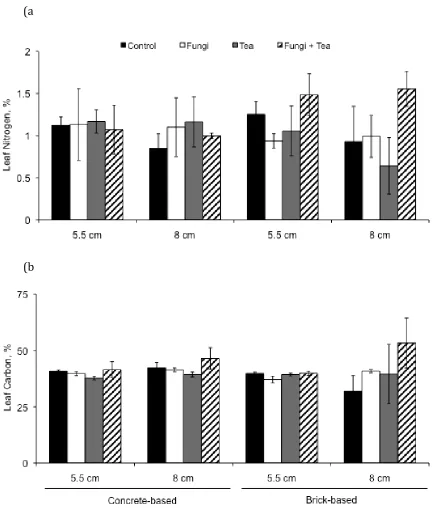
3.1.5 Leaf Nutrient Analysis
342
Figure 4 shows the nutrient content of bait plant shoots after microbial treatments
343
were applied to London Zoo green roof experimental plots in 2007. Data from 2008
344
have not been displayed as they were very similar to 2007 and year was not a
345
significant factor affecting either leaf nitrogen or leaf carbon.
346
Figure 4a shows the nitrogen percentage content of shoots. The combination
347
of the fungi and tea treatments increased nitrogen content in the brick-based
348
substrate (additive effect), but reduced nitrogen content in shoots from the
concrete-349
based substrate (antagonistic effect). Therefore there was a significant three-way
350
interaction (F1,63 = 6.16, P <0.01) between the substrate type and the fungi and tea 351
treatments; whilst individually the fungi treatment (F1,63 = 0.40, P = 0.52) and tea 352
treatment (F1,63 = 2.11, P = 0.15) were not significant factors effecting nitrogen in 353
leaves.
12 | P a g e
Figure 4b shows leaf carbon in bait plants taken from the London Zoo
355
experimental plots in 2007. There was a significant three-way interaction (F1,63 = 3.71, 356
P <0.05) between substrate depth and the fungal and tea inoculants; meaning that
357
where treatments were applied to deeper substrate plots (8 cm), plants contained
358
larger quantities of leaf carbon compared to plants grown in shallower plots (5.5 cm).
359 360 361
3.2 Species Diversity
362
The plant surveys conducted in the summer months of 2007 and 2008 indicated that
363
there was increased plant species diversity (F1,66 = 4.91, P <0.05) with the addition of 364
the AM fungi treatment (Figure 5a). Figure 5b shows differences between species
365
richness in the substrate types over the three years where treatments (sub-plots) have
366
been combined to give means for each experimental plot. Results have also shown
367
that the type and depth of substrate play an important role in determining how many
368
plant species are supported on a green roof. Brick-based substrates supported more
369
plant species than the concrete-based substrate (F1,66 = 4.91, P <0.05) whilst there was 370
also an interaction between the year and substrate depth (F1,66 = 12.66, P <0.001). In 371
2007, deeper substrates contained more plant species, whilst in 2008 the reverse was
372
true, with shallower substrates (depths of 5.5 cm) becoming more species rich.
373 374 375
3.3 Substrate Analysis
376
3.3.1 Nitrates
377
The nitrate and ammonium levels in substrate samples from London Zoo experimental
378
site were combined to give the total amount of nitrogen available in the soil for plant
379
acquisition (Table 1). There was a significant interaction between substrate type and
380
year (F1,51 = 4.51, P <0.05); where brick-based substrates contained larger quantities 381
of available nitrogen in 2007 compared to concrete-based substrates in the same year.
382
By 2008, there was little difference in available N levels between the two substrate
383
types. Interestingly however, there were no significant effects observed with the
384
addition of microbial treatments (Appendix II in supplementary material).
13 | P a g e
3.3.2 Phosphates
387
The substrate phosphorus levels (Table 1) were higher in 2007 than in 2008, F1,51 = 388
26.08, P <0.01, and this was particularly affected by underlying substrate type, F1,51 = 389
4.90, P <0.05. In 2007, brick-based substrates contained more phosphates than
390
concrete-based substrates, however by 2008, it was these substrate that held more
391
soil phosphorus. The compost tea inoculum increased quantities of available
392
phosphates in 2007, compared to 2008 (F1,51 = 5.07, P <0.05). There were also 393
increased levels found in brick-based substrates where this treatment was applied
394
(F1,51 = 4.45, P <0.05). Therefore there was a significant three-way interaction between 395
the year, substrate type and compost tea treatment (F1,51 = 4.68, P <0.05); implying 396
that in certain substrate types, the addition of compost tea may increase available
397
phosphates to plants in the year of application, but that this is not sustained unless
398
subsequent treatments are carried out.
399 400
3.3.3 Potassium
401
Finally substrate potassium levels (Table 1) were analysed from the green roof
402
experimental plots. Potassium content was significantly increased in 2008 compared
403
to 2007,,F1,51 = 54.47, P <0.01 and thus it seems that the addition of microbial 404
treatments had a negative effect on the substrate’s potassium. Furthermore,
brick-405
based substrates contained slightly larger quantities of potassium in 2008 compared
406
to 2007 – where both substrate types were similar in levels. The application of
407
compost tea increased potassium in 2008 at the deepest depth of brick-based
408
substrates but decreased this in the 8 cm concrete-based substrate plots. Despite
409
microbial treatments, in 2008, levels of potassium returned to similar levels as those
410
found in the baseline data (around 17-20 mg/kg soil).
411 412
4. Discussion
413
The use of bait plants on London Zoo green roof demonstrated the possible effects of
414
microbial inoculations on general plant performance over time. Plantago lanceolata
415
appeared well suited to the green roof environment, with all planted seedlings
416
surviving the course of the study. As a single species, it could not represent every plant
417
response in the green roof community, however it is considered a good model to
14 | P a g e
measure microbial effect in other field studies (Walter et al., 2016). Results showed
419
inconsistent patterns of microbial treatment benefit, varying with underlying
420
substrate type and depth. Generally, P. lanceolata plants increased in height from
421
plots where the AM fungi treatment was applied. As arbuscular mycorrhizal fungi have
422
been shown to significantly increase the survival, establishment and growth of plants
423
with colonised roots (Koske & Gemma, 1997; Bakker et al., 2013; Miransari, 2016) and
424
are said to be key elements in nutrient-unbalanced and xeric environments
(Roldan-425
Fajardo, 1994; Requena et al., 1996; Peña-Becerril et al., 2016); results suggest that
426
the fungal treatment effectively increased AMF root colonisation compared to
427
controls. Despite this, all plants were reduced in size by 2008. Substrates containing
428
75 % crushed brick at depths of 8 cm, produced plants that were considerably taller
429
than the 5.5 cm plots and any plot containing the concrete-based substrate. This was
430
probably because deeper plots retained more rainwater than shallower ones,
431
providing plants with increased access to water – essential for survival and growth
432
(Kramer & Boyer, 1995). Interestingly, plants grown in 75 % crushed concrete at 5.5
433
cm depths remained unchanged in height from 2007 to 2008, perhaps due to better
434
water storage capacity or less efficient drainage at shallower depths than the
brick-435
based substrate.
436
Leaf numbers on P. lanceolata plants showed similar patterns to heights,
437
where decreases were seen from 2007 to 2008. Average rainfall (from MetOffice data)
438
in 2006 was 101.2 mm, 86.9 mm in 2007 and 67.0 mm in 2008. This suggests that the
439
application of microbial treatments were successful in increasing plant size and leaf
440
numbers in 2007 but by 2008 - when numbers decreased for all plants - reduced water
441
availability may have been a reason for these changes. Appendix I (in supplementary
442
materials) also shows that mean maximum and minimum temperatures as well as
443
average sunlight hours decreased from 2007 to 2008. Thus weather conditions in 2008
444
were colder, drier and less sunny which would account for reduced growth rates
445
overall. The interesting findings were where significant interactions between
446
underlying substrate type and depth were observed and often this produced the
447
largest changes in leaf numbers. In 2008, concrete-based substrate contained bait
448
plants with twice as many leaves when grown at 5.5 cm depths compared to those in
449
8 cm plots. Furthermore, in 2007 P. lanceolata plants in 5.5 cm plots had up to six
15 | P a g e
more leaves when treated with the compost tea, compared to those in 8 cm
451
substrates.
452
Overall P. lanceolata biomass – root and shoot – was decreased in 2008
453
compared to 2007 (as generally seen with all P. lanceolata performance data). In 2007
454
the total biomass of plants grown in 5.5 cm deep substrates were significant larger
455
where the compost tea treatment was added and in 8 cm deep substrates where the
456
AM fungi treatment was applied. By 2008 however, there was little difference
457
between the total biomass in plants from either substrate depths or with microbial
458
innoculation. The reduction in 2008, as with bait plant heights and leaf numbers, was
459
therefore likely due to abiotic factors as discussed above. The soil nutrients could also
460
have been a contributing factor, which is also addressed further on.
461
Bait plant root colonisation by arbuscular mycorrhizal fungi increased
462
significantly from 2007 to 2008. After microbial inoculants were applied, experimental
463
plots treated with compost tea increased in mycorrhizal occurrence from 5 %
464
colonisation (in control plots) to approximately 25 % colonisation. However by 2008,
465
colonisation levels in the control plots had increased to over 20 % whilst the fungi and
466
tea treated areas were noticeably higher at over 30 % colonisation. Controls seem to
467
have naturally increased in the substrates at this time, perhaps due to natural
468
processes The structures of AM fungi found within plant roots are important in
469
determining how it is functioning within the substratum (Klironomos et al., 2004). In
470
2007, vesicles were observed more frequently than arbuscules in control plots and
471
fungi treated plots. Vesicles are storage structures whilst arbuscules are sites of
472
symbiotic nutrient exchange, and as such are thought to be more indicative of active
473
functioning (Klironomos et al., 2004). Therefore these results imply that the
474
mycorrhiza may have been stressed and not that active within the host bait plants
475
(Duckmanton & Widden, 1994; Titus & Leps, 2000; Wearn, 2006) until 2008, where
476
there was an increase in arbuscules.
477
Even though colonisation increases were recorded, the microbial treatments
478
often had small effects on plant performance measurements, with other parameters
479
such as underlying substrate type and depth being the most significant variables.
480
Therefore it appears that plants are not exploiting the usually beneficial root AMF.
481
Reasons for this could be because nutrients such as phosphorus (Koide, 1991), are so
16 | P a g e
limiting on a green roof, that the fungi are not helping plants gain any more than they
483
could without the symbionts. It has been said that optimal phosphorus levels, for AMF
484
to produce the greatest benefits to host plants is approximately 50 ppm (Swift et al.,
485
1979; Schubert & Hayman, 1986; Smith & Read, 1997) but the exceedingly low (< 5
486
ppm) plant phosphates from this study (see Table 1) suggest that green roof
487
substrates are extremely P limited. This probably means that, regardless of increased
488
AM fungi colonisation, mycorrhizae are ineffective in these environments. The use of
489
alternative aggregates in green roof growing media could provide more favourable
490
conditions for both plants and AM fungi. Molineux et al., (2009) found that clay pellet
491
substrates contained five times more phosphorus pentoxide – a common form of P in
492
many fertilizers (Bridger et al., 1953) – compared to red brick (contained in the
493
substrates on London Zoo green roof). This suggests that aggregates produced from
494
recycled waste materials, such as sewage sludge (Debosz et al., 2002), may provide a
495
source of potential phosphates that could be released in rainwater leachates.
496
An alternative explanation for these results may be that once the mycorrhiza
497
from the inoculation experiments have colonised plant roots, they could be having
498
deleterious effects on their hosts, as shown in more recent microbial studies by
499
Gadhave et al. (2016) and L. Jin et al. (2016). These studies highlight that AM Fungi
500
can cause growth depressions in plants (Johansen, 1993), particularly when growing
501
conditions are poor (i.e. in low nutrients, during drought periods). L. Jin et al. (2016)
502
propose that for AM fungal structures to grow, such as vesicles, the fungus needs to
503
obtain more photosynthetic products from the host plant, resulting in plant growth
504
depression. This would help explain why, in general, all bait plant performance
505
measurements in this investigation were reduced in 2008 compared to 2007 despite
506
the observed increase in AMF colonisation from 2007 to 2008. Furthermore, vesicles
507
were increased due to non-favourable conditions for the fungus, which would account
508
for the negative relationship between plant performance and AMF root colonisation.
509
Results from bait plant leaf nutrients have shown significant interactions
510
between the substrate type, depth and microbial treatments. For leaf nitrogen, there
511
were significantly higher levels found in plants from substrate composed of 75 % brick
512
compared to those that were 75 % concrete, where both the fungi and tea treatments
513
were added. Leaf carbon was also increased with the combination of AM fungi and
17 | P a g e
compost tea treatments, but only in the deepest substrate plots (8 cm). Increased root
515
biomass as well as higher nitrogen and carbon content of shoots, points to an
516
increased photosynthetic capacity by plants (Field & Mooney, 1986). This heightened
517
rate of photosynthesis implies that microbial treatments enhanced plant access to soil
518
nutrients, such as nitrogen and phosphorus – vital constituents of the photosynthetic
519
process (Blevins, 1999) – leading to improved plant fitness. Leaf nitrogen analysis
520
indicated that, in brick dominated media, the two microbial treatments were additive,
521
meaning that the fungi and tea treatments together resulted in higher concentrations
522
of leaf nitrogen than those from plots where just AM fungi or just compost tea was
523
applied. Conversely, in the concrete-based substrate, the two treatments were
524
competitive resulting in decreased concentrations of leaf nitrogen compared to plots
525
that were treated with just the AM fungi or just the compost tea. Possible reasons for
526
this could be substrate N and P content. As already seen, soil phosphates can vary
527
considerably with different aggregate types, and this is probably the same for soil
528
nitrogen. In the London Zoo plots, crushed brick dominated substrates may contain
529
higher N and P levels than the predominately crushed concrete ones. The applications
530
of the treatments together may have increased microbial mobilisation of phosphorus
531
and nitrogen for plant availability in the brick dominated substrates, because more
532
nutrients pools were present for symbiotic benefits to be exploited (Koide, 1991).
533
Previous microbial inoculation experiments by Requena et al., (1996) showed that leaf
534
nitrogen was increased with AMF root colonisation, and suggested this was due to an
535
increased exploration of soil nitrogen pools (Ames et al., 1984; Barea et al., 1991;
536
Azcon-Aguilar et al., 1993; Johansen et al., 1993). However, they also showed that
537
interactions between AMF and certain bacteria could lead to decreased shoot
538
nitrogen, indicating that limited P in soils could lead to antagonism between the
539
microbial groups due to resource competition. This may help explain the reduced leaf
540
nitrogen results from the concrete-based substrates.
541
The London Zoo green roof experimental site was originally seeded with a
542
wildflower mix but since then, natural colonisation of the plots has occurred with the
543
effect of increasing plant coverage and diversity (Kadas, 2007). Results from the
544
species richness surveys showed that in 2007, the 8 cm plots supported the most plant
545
species, correlating with previous research showing that deeper green roof substrates
18 | P a g e
are far more biodiverse than shallower ones (Brenneisen, 2006; Dunnett et al., 2008).
547
However, by 2008 the 5.5 cm plots became more species rich. In addition, the
brick-548
based substrate was also more effective at supporting increased diversity than the
549
concrete dominated media. The applications of compost tea did not affect plant
550
diversity in the green roof plots, however the use of the AM fungi treatment
551
significantly increased species numbers where added. Many studies have shown
552
similar positive effects on plant species diversity with the presence of AMF (Grime et
553
al., 1987; Gange et al., 1993; Klironomos et al., 2000); proposing that AM fungi provide 554
hyphal links between plants allowing a more even distribution of soil nutrients –
555
reducing competition by strong plant species that usually monopolise resources.
556
Soil nutrient analyses have shown that for both nitrogen and phosphates,
557
levels were higher in brick-based substrates in 2007, whereas potassium levels were
558
not increased in this substrate until 2008. For soil P, further increases were found with
559
the applications of compost tea. This supports the discussion above, where increased
560
substrate nitrogen and phosphates would account for increases in leaf nitrogen
561
content. Overall, the levels of total available nitrogen and phosphates were similar
562
below 5 ppm, and potassium was found at levels of around 20 ppm (Table 1). These
563
levels are extremely low compared to other habitats. Wearn, (2006) found levels of
564
nitrogen and potassium in field soil (grassland area on the Royal Holloway campus) to
565
be approximately 32 ppm and 80 ppm respectively and phosphates to be found on
566
average at 20 ppm. These were considered to be very low levels (Allen, 1989; Edwards
567
et al., 1999); in fact Swift et al., (1979) stated that phosphorus levels can reach above 568
150 ppm in grasslands/pastures. Phosphates are one of the most limiting nutrients to
569
plants in soils, especially in habitats like brownfield sites (Schadek et al., 2009), shingle
570
beaches (Scott, 1960; Lee et al., 1983) and xeric Mediterranean ecosystems
(Azcon-571
Aguilar et al., 1993; Requena et al., 1996). The extremely low levels found in the
572
London Zoo green roof plots would be a significant factor affecting floral growth
573
(Hinsinger, 2001).
574
Statistical analysis of data from Plantago lanceolata heights, leaf numbers and
575
AMF root colonisation identified significant interactions between the arbuscular
576
mycorrhizal fungi treatment and the compost tea treatment. When combined and
577
applied to the green roof plots, there was not always an additive effect as would be
19 | P a g e
expected, instead there was frequently competition between the two. Recent work
579
by Gadhave et al. (2016) has explored possible reasons for commercial inoculants
580
competing against each other when used in combination and there is evidence of
581
antagonism in other studies looking at the interactions between plant growth
582
promoting rhizobacteria (PGPR) and arbuscular mycorrhizal fungi (Bethlenfalvay &
583
Linderman, 1992); as well as specific interactions between AM fungi and other soil
584
microbes (Vosatka et al., 1992; Requena et al., 1996; Saison et al., 2006; Ondoño et
585
al., 2014). These authors suggest that competition arises due to soil nutrient 586
availability – especially the phosphorus content, supporting the nutrient analysis of
587
the London Zoo experimental plots previously discussed.
588 589 590
5. Conclusion
591
The results indicate that the addition of microbial treatments to London Zoo green
592
roof were variable in terms of having an effect on vegetation compared to controls.
593
The interactions between the AM fungi and compost tea applications and the different
594
substrate types and varying substrate depths produced significant changes in plant
595
heights, leaf numbers, species richness, and leaf/soil nutrient contents. Yet there were
596
inconsistent patterns with regards to the ‘best’ substrate type and the ‘most
597
appropriate’ substrate depth; generally speaking brick-based media at 8 cm depths
598
were more favourable but this did vary with time as well as microbial treatment.
599
However, what was clear from most results was that 2007 data were significantly
600
different from post-treatment data from 2008. This seemed to be due to a
601
combination of variables including the microbial inoculations, soil N and P and abiotic
602
factors such as the amount of rainfall (water), mean max. and min. temperatures and
603
sunlight hours. From previously published work, the treatments do seem to have
604
long-lasting effects on the microbial communities themselves, but more research is
605
needed to determine how much benefit they provide to the green roof plants over
606
time. This short-term study shows that enhancement of soil microbial functioning can
607
have positive impacts on some plant health/performance measurements on extensive
608
biodiverse roofs and, with the right substrate, also increase plant species diversity.
609
Green roofs need to be considered as habitats, albeit those with harsh conditions for
20 | P a g e
their flora and fauna; and should therefore be engineered, not only mechanically, but
611
biologically as well. The introduction of microbial communities through various
612
inoculations can help to improve green roof biodiversity and future research should
613
look at how this then boosts their role in urban green infrastructure; particularly as a
614
provision for ecosystem services and in respect to climate change mitigation.
615 616 617 618
6. Acknowledgements
619
We are grateful to the Natural Environment Research Council (NERC) for funding this
620
research and to the EU FP7 project Transitioning towards Urban Resilience and
621
Sustainability (TURAS) for post-analysis funding. Thanks also to Iñaki Valcarcel at RHUL
622
for his expertise in nutrients analysis and ZSL London Zoo, Regents Park, for facilitating
623
the green roof experiment.
624 625 626
7. References
627
Ames, R.N., C.P.P. Reid, and E.R. Ingham (1984). Rhizosphere bacterial population
628
responses to root colonization by a vesicular-arbuscular mycorrhizal fungus. New
629
Phytology, 96:555 – 563.
630 631
Allen, S. E. (1989). Chemical analysis of ecological analysis of ecological materials. In:
632
Allen, S.E. (Editor), Blackwell Scientific Publication.
633 634
Allen, M. F. (2009). Water relations in the mycorrhizosphere. In: Luttge, U.,
635
Beyschlag,W., Budel, B., Francis, D. (Eds.), Progress in Botany, vol. 70. Springer,
636
Berlin,Germany, 257–276.
637 638
Anaya-Romero, M., S. K. Abd-Elmabod, M. Muñoz-Rojas, G. Castellano, C. J. Ceacero,
639
S. Alvarez, M. Méndez, and D. De la Rosa (2015). Evaluating Soil Threats Under Climate
640
Change Scenarios in the Andalusia Region, Southern Spain. Land Degradation and
641
Development, 26 (5): 441-449. doi:10.1002/ldr.2363.
21 | P a g e 643
Azcón-Aguilar C., C. Alba, M. Montilla and J. M. Barea (1993). Isotopic (15N) evidence
644
of the use of less available N forms by VA mycorrhizas. Symbiosis, 15:39 – 48.
645 646
Bakker, P. A, R. L. Berendsen, R. F. Doornbos, P. C. Wintermans and C. M. Pieterse
647
(2013). The rhizosphere revisited: root microbiomics. Frontiers in Plant Science, 4:165.
648
doi:10.3389/fpls.2013.00165.
649 650
Barea, J. M., C. Azcón-Aguilar and R. Azcón, (1991). The role of vesicular-arbuscular
651
mycorrhizae in improving plant N acquisition from soil as assessed with 15N. In:
IAEA-652
SM 313/67 ed. Stable Isotopes in Plant Nutrition, Soil Fertility and Environmental
653
Studies, Vienna: International Atomic Energy Agency, 209 – 216.
654 655
Bates, A., J. Sadler, R. Greswell, and R. Mackay (2015). Effects of recycled aggregate
656
growth substrate on green roof vegetation development: a six year experiment.
657
Landscape and Urban Planning, 135: 22–31.
658 659
Bethlenfalvay, G. J and R. G. Linderman (1992). Mycorrhizae in sustainable agriculture.
660
Madison: ASA Special Publication.
661 662
Blamey, M., Fitter, S. R., & Fitter, A. (2003). Wild Flowers of Britain & Ireland. A. & C.
663
Black.
664 665
Blume, E., M. Bischoff, J. M. Reichert, T. Moorman, A. Konopka, and R. F. Turco (2002).
666
Surface and subsurface microbial biomass, community structure and metabolic
667
activity as a function of soil depth and season. Applied Soil Ecology, 20(3): 171-181.
668 669
Blevins, D. G. (1999). Why plants need phosphorous. Better crops, 83(2):29 – 30.
670 671
Buffam, A. P. D. I and M. E. Mitchell (2015) Nutrient cycling in green roof ecosystems.
672
In: Sutton R (ed) Green roof ecosystems, 1st edn. Springer International Publishing,
673
New York, pp. 107–137
22 | P a g e 675
Bridger, G. L., D. R. Boylan, and J. W. Markey (1953). Colorimetric determination of
676
phosphorus pentoxide in fertilizers using standard calibration plot. Analytical
677
Chemistry, 25(2): 336-338.
678 679
Brenneisen S (2006) Space for urban wildlife: designing green roofs as habitats in
680
Switzerland. Urban Habitats, 4:10
681 682
Connop, S., Vandergert, P., Eisenberg, B., Collier, M. J., Nash, C., Clough, J., & Newport,
683
D. (2016). Renaturing cities using a regionally-focused biodiversity-led multifunctional
684
benefits approach to urban green infrastructure. Environmental Science & Policy, 62,
685
99-111.
686 687
Debosz, Kasia, Søren O. Petersen, Liv K. Kure, and Per Ambus (2002). Evaluating effects
688
of sewage sludge and household compost on soil physical, chemical and
689
microbiological properties. Applied Soil Ecology, 19(3): 237-248.
690 691
Duckmanton, L. and P. Widden (1994). Effect of ozone on the development of
692
vesicular-arbuscular mycorrhizae in sugar maple saplings. Mycologia, 181-186.
693 694
Dunnett, N., Nagase, A., Booth, R., and Grime, P. (2008). Influence of vegetation
695
composition on runoff in two simulated green roof experiments. Urban Ecosystems
696
11:385-398.
697 698
Edwards, G. R, M. J Crawley and M. S. Heard (1999). Factors affecting molehill
699
distribution in grassland: implications for controlling the damage caused by molehills.
700
Journal of Applied Ecology, 36:434 – 442.
701 702
Eksi, M. & D. B. Rowe (2016). Green roof substrates: Effect of recycled crushed
703
porcelain and foamed glass on plant growth and water retention. Urban Forestry &
704
Urban Greening, 20 :81-88.
23 | P a g e
Field, C. and H. A. Mooney (1986). The photosynthesis-nitrogen relationship in wild
707
plants. In: Givnish, T. J. (ed). On the economy of plant form and function. Cambridge
708
University Press, Cambridge, 25 – 55.
709 710
Fowler, J., Cohen, L., & Jarvis, P. (1998) Practical Statistics for Field Biology, second
711
edition. John Wiley & Sons.
712 713
Gadhave, K. R., J. E. Hourston & A. C. Gange (2016). Developing Soil Microbial
714
Inoculants for Pest Management: Can One Have Too Much of a Good Thing? Journal
715
of chemical ecology, 42(4): 348-356.
716 717
Gange, A. C. (1993) Translocation of mycorrhizal fungi by earthworms during early
718
succession. Soil Biology and Biochemistry, 25, 1021 – 1026.
719 720
Graceson, A., J. Monaghan, N. Hall, and M. Hare (2014b). Plant growth responses to
721
different growing media for green roofs. Ecological Engineering, 69:196–200.
722 723
Grime, J. P., J. M. L. Mackey, S. H. Hillier and D. J. Read (1987). Floristic diversity in a
724
model system using experimental microcosms. Nature, 328:3.
725
Heim, A., and J. Lundholm (2014). The effects of substrate depth heterogeneity on
726
plant species coexistence on an extensive green roof. Ecological Engineering,
68:184-727
188.
728 729
Henriksen, A. A., and A. R. Selmer-Olsen (1970). Automatic methods for determining
730
nitrate and nitrite in water and soil extracts. Analyst, 95(1130): 514-518.
731 732
Hinsinger, P. (2001). Bioavailability of soil inorganic P in the rhizosphere as affected
733
by root-induced chemical changes: a review. Plant and Soil, 237:173 – 195.
734 735
Hodge, A. (2000) Microbial ecology of the arbuscular mycorrhiza. FEMS Microbiology
736
Ecology, 32, 91 – 96.
24 | P a g e
Johansen, A., I. Jakobsen and E. S. Jensen (1993). External hyphae of
vesicular-739
arbuscular mycorrhizal fungi associated with Trifolium subterraneum L. 3. Hyphal
740
transport of 32P and 15N. New Phytologist, 124:61 – 68.
741 742
John, J., J. Lundholm and G. Kernaghan (2014). Colonization of green roof plants by
743
mycorrhizal and root endophytic fungi. Ecological Engineering, 71:651-659.
744 745
Kadas, G. (2002). Study of invertebrates on green roofs: How roof design can
746
maximise biodiversity in an urban environment. Master of science thesis. University
747
College, London.
748 749
Kadas, G. (2007) Can Green Roofs provide a habitat for invertebrates in an urban
750
environment? Unpublished PhD thesis. Royal Holloway University of London.
751 752
Klironomos, J.N., McCune, J., Hart, M., Neville, J., (2000) The influence of arbuscular
753
mycorrhizae on the relationship between plant diversity and productivity. Ecology
754
Letters, 3:137–141
755 756
Klironomos, J. N., J. McCune and P. Moutoglis (2004). Species of arbuscular
757
mycorrhizal fungi affect mycorrhizal responses to simulated herbivory. Applied Soil
758
Ecology, 26(2):133-141.
759 760
Koide, R. T. (1991). Nutrient supply, nutrient demand and plant response to
761
mycorrhizal infection. New Phytologist, 117:365 – 386.
762 763
Koske, R. E., and J. N. Gemma, (1997) Mycorrhizae and succession in plantings of
764
beachgrass in sand dunes. American Journal of Botany, 84, 118 – 130.
765 766
Kramer, P. J. and J. S. Boyer (1995). Water Relations of Plants and Soils. Academic
767
Press, San Diego, USA.
768 769
Lavelle, P., Decaens, T., Aubert, M., Barot, S., Blouin, M., Bureau, F., Margerie, P.,
25 | P a g e
Mora, P. and J. P. Rossi, (2006) Soil invertebrates and ecosystem services. European
771
Journal of Soil Biology, 42, S3 – S15.
772 773
Lee, J. A., R. Harmer and R. Ignaciuk (1983). Nitrogen as a limiting factor in plant
774
communities. Nitrogen as an Ecological Factor (eds J. A. Lee, S. McNeil & I. H. Rorison),
775
Blackwell Scientific Publications, Oxford, 95 – 112.
776 777
Lundholm, J. T. (2015). Green roof plant species diversity improves ecosystem
778
multifunctionality. Journal of Applied Ecology, 52(3):726-734.
779 780
Lundholm, J., J. S. MacIvor, Z. MacDougall, M. Ranalli (2010). Plant species and
781
functional group combinations affect green roof ecosystem functions. PLoS ONE, 5
782
(3):e9677.
783 784
Jin, L., Q. Wang, Q. Wang, X., Wang, and A. C. Gange (2016). Mycorrhizal-induced
785
growth depression in plants. Symbiosis, 1-8.
786 787
McGonigle, T. P., M. H. Miller, D. G. Evans, G. L. Fairchild, and J. A. Swan (1990). A new
788
method which gives an objective measure of colonization of roots by vesicular—
789
arbuscular mycorrhizal fungi. New phytologist, 115(3): 495-501.
790 791
McGuire, K.L., S. G. Payne, M. I. Palmer, C. M. Gillikin, D. Keefe, S. J. Kim, S. M.
792
Gedallovich, J. Discenza, R. Rangamannar, J. A. Koshner, and A. L. Massmann (2013).
793
Digging the New York City skyline: soil fungal communities in green roofs and city parks.
794
PloS one, 8(3):58020.
795 796
Miransari, M. (2016). Stress and Mycorrhizal Plant. In: Recent Advances on
797
Mycorrhizal Fungi, 63-79. Springer International Publishing.
798 799
Molineux, C. J., Fentiman, C. H., & Gange, A. C. (2009) Characterising alternative
800
recycled waste materials for use as green roof growing media in the U.K. Ecological
801
Engineering, 35, 1507 – 1513.
26 | P a g e 803
Molineux, C. J., S. P. Connop, and A. C. Gange. (2014). Manipulating soil microbial
804
communities in extensive green roof substrates. Science of the Total Environment,
805
493:632-638.
806 807
Molineux, C. J., A. C. Gange, S. P. Connop and D. J. Newport (2015). Using recycled
808
aggregates in green roof substrates for plant diversity. Ecological Engineering,
82:596-809
604.
810 811
Monterusso, M. A, D. B. Rowe and C. L Rugh (2005). Establishment and persistence of
812
Sedum spp. and native taxa for green roof applications. HortScience 40: 391–396.
813 814
Oberndorfer, E., Lundholm, J., Bass, B., Coffman, R., Doshi, H., Dunnett, N., Gaffin, S.,
815
Köhler, M., Rowe, B., (2007) Green Roofs as urban ecosystems: ecological structures,
816
functions and services. Bioscience, 57, 823 – 833.
817 818
Ondoño, S., Bastida, F., and J. L. Moreno (2014). Microbiological and biochemical
819
properties of artificial substrates: A preliminary study of its application as Technosols
820
or as a basis in Green Roof Systems. Ecological Engineering, 70: 189-199.
821 822
Papatheodorou, E. M., M. D. Argyropoulou, S. J. Grayston, C. D. Campbell, R. D.
823
Bardgett, J. L. Mawdsley, C. D. Clegg, H. Ferris, R. C. Venette and K. M. Scow (2004).
824
Soil management to enhance bacterivore and fungivore nematode populations and
825
their nitrogen mineralisation function: The effects of large-and small-scale differences
826
in soil temperature and moisture on bacterial functional diversity and the community
827
of bacterivorous nematodes. Transport, 25(1).
828 829
Parras-Alcántara, L., B. Lozano-García, E. C. Brevik, and A. Cerdá (2015). Soil Organic
830
Carbon Stocks Assessment in Mediterranean Natural Areas: A Comparison of Entire
831
Soil Profiles and Soil Control Sections. Journal of Environmental Management, 155:
832
219-228. doi:10.1016/j.jenvman.2015.03.039.