2016 Joint International Conference on Artificial Intelligence and Computer Engineering (AICE 2016) and International Conference on Network and Communication Security (NCS 2016)
ISBN: 978-1-60595-362-5
The Sequential Assembling of EOOPN Component Net
Na ZHAO
2,a, Jian WANG
1,b*, Ying LIN
2, Qian YU
2, Zhen-Di YANG
2,
Xue SUN
2, Lei ZHANG
21College of Information Engineering and Automation, Kunming University of
Science and Technology, China
2School of Software, Key Laboratory in Software Engineering of Yunnan Province,
Yunnan University, Kunming, China
a[email protected], b[email protected]
*Corresponding author
Keywords: Sequential Assembling, Component Net, Base Net, EOOPN, Component Evolution.
Abstract. Base on the Extended Object-Oriented Petri Net, and the component evolution processes that has been proposed in our previous research, this paper studies the component assembling technique based on the EOOPN subnet combination. The definition of sequential assembling, a type of connector-based EOOPN-CN assembling approach, is given and subsequently its properties and proof is detailed. This paper’s work laid foundations for the further presentational and analytical aspects of component evolution.
Introduction
The description and evolution of components are one of the key technologies to fully exert the technical advantages of components, to realize software reuse and to build high-quality software product. To better support the component-based software development, many researchers have modeled components by using formalized method, and developed a variety of studies such as component evolution, component performances analysis, and so on.
Petri Nets has frequently been used in the process of software modeling due to its strict mathematical definition and visual graphical expression[1,2]. In order to more effectively carry out the formalized descriptions and analysis of components, the Petri Nets is extended to EOOPN [3-9], the object-oriented Petri-net that supports component evolution, based on the related definitions and principles of components while taking the features of object-oriented modeling methods into consideration.
The Extended Object-Oriented Petri Nets is the combination of Petri Nets and object-oriented technology. By compensating the modeling ability limitations of Petri Nets, such combination is capable of representing various resources and constraints within a highly complicated system in a simplified way. At the same time, the features of Petri Nets make it competent in revealing the simulated system's structural and dynamic behavioral information, especially in the analysis of system's performances and concurrency, so as to improve the efficiency of the system.
parallel assembling, selective assembling and repetitive assembling, by giving their definitions, and subsequently their properties.
Base Net of EOOPN[3-9]
Definition 1
The base net of EOOPN is a 7-tuple N =( P,T,F,S,AP,AT,AF), where:
(1) P is a finite set of places where oip (object identify place) is a special place which can be
defined as a 3-tuple oip =( id,p,ip ), where
id is the unique variable name of the class in EOOPN;
p is the interface place for sending and receiving messages of objects; ip is the variable name of the instance of a class;
(2) T is a finite set of transitions, P∪T ≠ andPT ; (3) F (P×T) ∪ (T×P) a set of directed arcs;
(4) S is a finite non-empty set, which is called as the colored set or type set;
(5) AP:P→L SP( ), AP is the color function of place. L SP( ) is linear function with non-negative
integer coefficients, L S( ) is the L SP( ) with coefficients are not all zero;
(6) AT:T→L ST( ), AT is a guard function of T, where L ST( ), meets the condition: tT,AT(t) fire
t ;
(7) AF :F→L SF( ),AF is the function of arc. Let fF,AF( f ) represents the combination of colors
passed through arc f ;
The Component Connector of EOOPN
Definition 2
The component connector of EOOPN is a 7-tuple LN =( P,T,F,S,AP,AT,AF), where:
(1) P is a finite set of places. P represented the inner state of connector LN while P.oip denotes the
input and output places are excluded from P;
(2) T is a finite set of transitions, P∪T ≠ andPT ; T represents the various operations in
connector LN where: tinand tout(tin,toutT ), respectively, stands for message receiving and sending
transitions .
(3) F (P×T) ∪ (T×P) is a finite set of arcs which describing the restraint relationship between
places and transitions in a LN;
(4) S is a finite non-empty set, used to define the data types transmitted by LN;
(5) AP:P→L SP( ) , AP is the color function of place. L SP( ) is a linear function with non-negative
integer coefficients and L SP( ) is the L S( ) that the coefficients are not all zero; p P, AP(p) represents the type and number of a color that p receives;
(6) AT:T→L ST( ), AT is a guard function of T, where L ST( ) meets the condition: tT,AT(t) fire t ;
(7) AF :F→L SF( ),AF is the function of arc. Let fF,AF( f ) represents the combination of colors
The Component Properties of EOOPN
Definition 3
In component net CN =( P,T,F,S,AP,AT,AF), for pP and tT,if(p,t)F,have AF(p,t)Lm
(AP(p)), or pP,tT; if (t,p)F, have AF(t,p) L m (AP(p)), then the place p and transition t in
component C is called typed-matched. Definition 4
For any interface of a component, denoted as C oipi. , and input and output transitions of connector
LN whereLN t. ,in LN t.outLN , if AF
C oip LN ti. , .in
Lm(A C oipP( .i )), AF
C oip LN ti. , .in
Lm(A C oipP( .i )), then.
i
C oip and LN is called type-matched.
Definition 5
In component net CN =( P,T,F,S,AP,AT,AF), component C is well-structured if the following
conditions are met: (1) |CN oip. | 1 ;
(2) for pP and tT, if(p,t)F or (t,p)F, then the place p and transitiont in component C is type-matched;
(3) for tT and pi t i( 1, 2. , )n
,have
1
( , ) ( )
n
F i T
i
A p t A t
.The Sequential Assembling of EOOPN Component Net
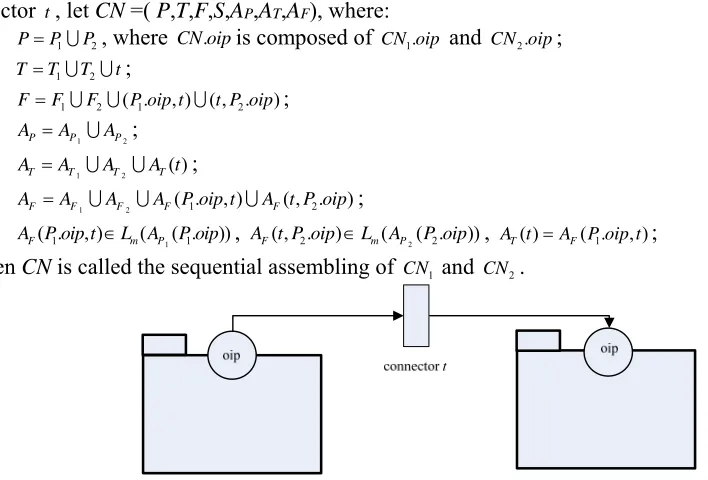
The idea that the assembling of multiple components is the extension of that between two components helps to narrow the discussion scope down to the assembling between only two components. There are four types of assembling approaches based on connectors: sequential assembling, parallel assembling, selective assembling and repetitive assembling. The sequential assembling will be discussed under the general frame of EOOPN in this paper.
Definition 6
1 1 1
1 (1 1 1 1 P T F)
CN P T, , , , , ,F S A A A , CN2(P T2, , , , , ,2 F2 S2 AP2 AT2 AF2) are two Component net, and
connector t, let CN =( P,T,F,S,AP,AT,AF), where:
1) PP1P2, where CN oip. is composed of CN oip1. and CN oip2. ;
2) TT1T2t;
3) FF1F2( .P oip t1 , ) ( , . t P oip2 );
4) AP AP1AP2;
5) AT AT1AT2A tT( );
6) AF AF1AF2A P oip tF( .1 , )A t P oipF( , .2 );
7) A P oip tF( .1 , )L Am( P1( .P oip1 )), A t P oipF( , .2 )Lm(AP2( .P oip2 )), A tT( )A P oip tF( .1 , );
[image:3.612.106.460.483.723.2]Then CN is called the sequential assembling of CN1 and CN2.
Theorem 1
Let CN1(P1, , , , , ,T1 F1 S1 AP1 AT1 AF1) and CN2(P2, , , , , ,T2 F2 S2 AP2 AT2 AF2) be two well-structured component nets and t be a connector. Then the sequential assembling component net CN =( P,T,F,S,AP,AT,AF) is also well-structured.
Proof
According to the well-structured properties of component net CN1, CN2, it’s given that
1 2
|CN oip. | |CN oip. | 1 . Since CN oip. is composed by CN oip1. and CN oip2. , thus component net CN also
have single entry and single exit property, meaning |CN oip. | 1 . So CN meets the well-structured
property (1).
SinceCN1(P1, , , , , ,T1 F1 S1 AP1 AT1 AF1), CN2(P2, , , ,T2 F2 S2 AP2,AT2,AF2) are two well-structured component net, according to well-structured component property (2), for p' P1P2 and t' T1T2,
if ( 'p,t')F1F2 or ( 't,p')F1F2, then place p and transitiont is type-matched. According to
sequential assembling definition, the properties of A P oip tF( .1 , )Lm(AP1( .P oip1 )) and
2
2 2
( , . ) ( ( . ))
F m P
A t P oip L A P oip ensured the fact that t and P oip1. ,P oip2. is type-matched. Therefore, for
p P and tT, if (t,p)F or (p,t)F , then the p and t in CN is type matched. This proves CN
satisfies property (2) of well-structured component.
Since CN1(P1, , , , , ,T1 F1 S1 AP1 AT1 AF1) and CN2(P2, , , ,T2 F2 S2 AP2,AT2,AF2) are two well-structured component net, According to property (3), for t' T1T2 and pi t i'( 1, 2. , )n
, one
will have
1
( , ) ( )
n
F i T
i
A p t A t
. According to sequential assembling definition, the properties of1
( ) ( . , )
T F
A t A P oip t ensured that, for tT and pi t i( 1, 2. , )n
, one will have
1
( , ) ( )
n
F i T
i
A p t A t
.This proves CN satisfies property (3) of well-structured component.
Summary
Based on the Extended Object-Oriented Petri Net, and the component evolution processes that has been proposed in our previous research, the sequential assembling technique of component net was discussed under the general framework of EOOPN in this paper. It is through component assembling that EOOPN is more capable of supporting component-based software evolution on a larger scale. The formal definition and detailed analysis on some other types of connector-based assembling approaches, like parallel assembling, selective assembling and repetitive assembling, to name a few, needs to be studied as the focus of next step.
Acknowledgement
References
[1]Stanislav Chachkov, Didier Buchs, From Formal Specifications to Ready-to-Use Software Components: The Concurrent Object Oriented Petri Net Approach. In Proceeding of ICACSD2001, 2001.
[2]Jang-Eui Hong, Doo-Hwan Bae, Software modeling and analysis using a hierarchical object-oriented Petri net. Information Sciences.130 (2000) 133-164.
[3]Na Zhao, The Description and Evolution of Components on the Basis of EOOPN[D]. PhD thesis, YunNan University, June 2011.
[4]Na Zhao, Fei Dai, Yong Yu, Tong Li. An Extended Process Model Supporting Software Evolution [C]. In Proceedings of 2008 International Symposium on Intelligent Information Technology Application (IITA 2008). IEEE computer society. December 2008, Shanghai, China, 1013~1016. [5]Na Zhao, Tong Li, Ling Ling Yang, Yong Yu, Fei Dai, Wei Zhang. The Resource Optimization of Software Evolution Processes [C]. In Proceedings of 2009 International Conference on Advanced Computer Control (ICACC 2009). January 2009, Singapore, 332~336.
[6]Na Zhao, Jian Wang, Wei Du, Yunchun Zhang, Zuo Jiang, Jinzhuo Liu, Ye Qian, Using Fuzzy Theories to Evaluate the Component Reusability in the Process of Software Evolution, In Proceedings of 2012 International Conference on Uncertainty Reasoning and Knowledge Engineering, August 2012, Jakarta, 212-215.
[7]Na Zhao, Jian Wang, Yong Yu, Fei Dai, Zhongwen Xie, Jianglong Qin, An Evaluation Algorithm of Component Retrieval Based on Fuzzy Theories, In Proceedings of 2012 International Conference on Uncertainty Reasoning and Knowledge Engineering, August 2012, Jakarta, 216-219.
[8]Na Zhao, Jian Wang, Tong Li, Yong Yu, Fei Dai and Zhongwen Xie. ESDDM: a Software Evolution Process Model based on Evolution Behavior Interface[C]. Communications in Computer and Information Science, Vol 135, pp. 562–567. 2011. Springer-Verlag Berlin Heidelberg.