The London School of Economics and Political Science
Negotiating Governance:
Kenyan contestation, cooperation, passivity toward the
Chinese.
Maddalena Procopio
Declaration
I certify that the thesis I have presented for examination for the MPhil/PhD degree of the London School of Economics and Political Science is solely my own work other than where I have clearly indicated that it is the work of others (in which case the extent of any work carried out jointly by me and any other person is clearly identified in it).
The copyright of this thesis rests with the author. Quotation from it is permitted, provided that full acknowledgement is made. This thesis may not be reproduced without my prior written consent.
I warrant that this authorisation does not, to the best of my belief, infringe the rights of any third party.
Abstract
The scholarship on Sino-African relations has been too pre-occupied with China’s behaviour and impact on Africa and paid little attention to the role played by African actors, contexts and processes of governance. This thesis addresses this deficiency through an examination of the interaction between Kenyan state and non-state actors in the relationship with China. In doing so, it focuses on how such interactive relation is mobilised and negotiated through Kenyan ‘agency’, and how it constitutes a means of building national capacity in domestic as well as foreign policy, paving the way for a less dependent and more sustainable developmental nation.
The thesis adopts a state-society approach which combines macro (national)-, meso (sectoral)- and micro-(issue-specific) level dynamics within a single country case study. Such complex and differentiated design helps to reach a nuanced understanding of actor agendas and mobilisation strategies within specific systems of governance. The cases are grouped into three main sectors, i.e. trade, healthcare and education, cutting across trade and aid type of engagements between a variety of Chinese and Kenyan actors.
Selected List of Acronyms
ACA – Anti-Counterfeits Agency
ACFTU - All-China Federation of Trade Unions ADB – African Development Bank
API - Active Pharmaceutical Ingredients CBA - Contract Bargaining Agreement CBD - Central Business District
CCCMHPIE - China Chamber of Commerce for Medicines and Health Products’ Imports and Exports
CCK - Communications Commission of Kenya CCP – Chinese Communist Party
CKRC - Constitution of Kenya Review Commission CMT - Chinese Medical Teams
CNOOC - China National Offshore Oil Company COFEK - Consumers Federation of Kenya
COMESA - Common Market for Eastern and Southern Africa COTU – Central Organisation of Trade Unions
CRBC - China Road and Bridge Corporation CSO – Civil Society Organisation
CSR – Corporate Social Responsibility
DFID – (UK) Department For International Development EAC - East Africa Community
FKE - Federation of Kenya Employers
FOCAC – Forum on China-Africa Cooperation
GFATM - Global Fund to Fight AIDS, Tuberculosis and Malaria HAC - Harmonization, Alignment and Coordination Group HRH - Human Resources for Health
ICC – International Criminal Court
IISS - International Institute for Strategic Studies ILO - International Labour Organisation
IP – Intellectual Property
IRT – International Relations Theory
ITUC-Africa - International Trade Unions Confederation-Africa JICA – Japan International Cooperation Agency
KAM – Kenya Association of Manufacturers KANU – Kenya African National Union KEBS - Kenya Bureau of Standards
KEMRI – Kenya Medical Research Institute KEMSA - Kenya Medical Supplies Agency
KESSP - Kenya Education Sector Support Programme KFRTU - Kenya Federation of Registered Trade Unions KHF - Kenya Healthcare Federation
KIPPRA – Kenya Institute for Public Policy Research and Analysis KNCCI - Kenya National Chamber of Commerce and Industry KU – Kenyatta University
MDG - Millennium Development Goals MOU – Memorandum of Understanding NARC – National Rainbow Coalition
NATHEPA - National Health Practitioners Association NCPD - National Council for Population and Development NPI - Natural Products Initiative
ODA - Overseas Development Assistance ODI – Overseas Development Institute
OECD-DAC - Organisation for Economic Co-operation and Development - Development Assistance Committee
PCK - People’s Commission of Kenya
PEPFAR - President’s Emergency Plan for AIDS Relief PRC – People’s Republic of China
SoE – State-owned Enterprise SSA – Sub-Saharan Africa SSC – South-South Cooperation SWAp - Sector Wide Approach TU – Trade Union
TUK – Technical University of Kenya
TVET - Technical and Vocational Education and Training
UNCTAD - United Nations Conference on Trade and Development UNDP - United Nations Development Programme
UON – University of Nairobi
USAID – United States Agency for International Development WB – World Bank
Acknowledgements
Navigating through this PhD has been an extra-ordinary journey. So unusual that, as I submit this thesis I am yet to fully understand all the immense personal and professional discoveries that I put myself through in the past four years and a half. Many people have contributed to the realisation of this project. Prof. Chris Alden, in his role as supervisor, supported me in good and bad times. He was the person who encouraged me to take on a PhD and his presence was, since then, a constant source of constructive criticism, a source of opportunities, a source of moral support. I have learnt a lot through him and with him. I feel privileged and grateful to have had him on my side.
I am grateful to Prof. Jude Howell and Dr. Daniel Large, my viva examiners, for having engaged with my thesis critically and constructively, and for having provided essential feedback for advancing my work. Special thanks go also to the colleagues I met in Nairobi. They welcomed me to the Institute for Development Studies at the University of Nairobi and provided me with a much-needed platform to exchange ideas with fellow PhD students and scholars. In particular, I want to thank Prof. Dorothy McCormick and Prof. Joseph Onjala. Engaging with them, experts as they are of Kenya, has proved to be a great intellectual exercise and a necessary step to confirm whether I was going in the right direction.
My immense gratitude goes to the dozens of people who will remain anonymous that I interviewed for this thesis during my fieldwork in Kenya. I felt privileged to have access to so many different points of view, personalities and venues. I have encountered brilliant policy-makers, societal leaders, private sector representatives, Kenyan, Chinese, and else. Most of the times I stood very small in the middle of a relationship that did not really foresee my presence, like the dash between Kenya and China in these relations under study, but I stood there and learnt more than anything I could have found on books.
My PhD studies and fieldwork in Kenya were generously supported by the LSE International Relations Department. Studentship awards, as well as numerous travel, conference and language grants were provided throughout the four years. Fieldwork was made possible thanks to the Dr Dominique Jacquin-Berdal grant for research on Africa and to the IR Department fieldwork grant. Trust in my research and financial support were key to finishing this PhD.
The emotional roller-coaster that this PhD has been would not have been crossed through without the support of friends and family. Lu was the first friend I made on the PhD programme and since that day back in 2011 we have not stopped sharing sweat, tears, doubts and small victories. She has been the most amazing companion one could have, and a lot of my ideas would not have taken proper shape if it weren’t for all the bouncing back and forth with her. Mumbi and Tanya welcomed me at home, in Nairobi, on the second day of siege of the Westgate shopping Mall, when I first set foot in a capital under terrorist attack. They made Nairobi my home for nine months and kept me sane all through the good and the bad of my Nairobian time, and life events around it.
Table of Contents
Abstract……….3
Selected acronyms………..4
Acknowledgements………6
Table of contents………..8
List of Tables………10
CHAPTER 1 Research Introduction and Design ... 11
1.1 Introduction ... 11
1.2 Literature Overview ... 13
1.2.1 Sino-African Relations Literature ... 15
1.3 Unpacking the Research questions ... 18
1.4 Methodology ... 24
1.4.1 The sectoral approach ... 24
1.4.2 Kenya ... 29
1.4.3 Design and Data Collection ... 32
1.4.4 Fieldwork ... 34
1.5 Chapters’ Outline ... 37
CHAPTER 2 ‘African’ Agency: the State, Society and the International ... 39
2.1 Introduction ... 39
2.2 Africa in IR ... 41
2.2.1 Domestically - State and Society ... 43
2.2.2 Internationally - Agency and dependence ... 46
2.2.3 The emergence of the South ... 50
2.3 Conceptualizing Agency ... 55
2.3.1 Actors ... 61
2.3.2 Layered interests ... 67
2.3.3 Systems of Governance – Negotiation Arenas ... 69
2.3.4 Modalities ... 70
2.4 Conclusions ... 73
CHAPTER 3 Kenya: domestic politics and the international dimension since 2002 ... 75
3.1 Introduction ... 75
3.2 Domestically: between the state and society ... 76
3.2.1 Background ... 76
3.3 International ... 88
3.3.1 Background ... 88
3.4 Kenya-China: actors, stakes and negotiations? ... 92
3.4.1 Diplomacy and ideology ... 95
3.4.2 Aid, trade, investment ... 101
3.4.3 The sectors of analysis ... 108
CHAPTER 4 Kenya-China trade practices: labour issues and ‘unfair’ competition ... 111
4.1 The context ... 111
4.1.1 China-Africa labour issues and ‘unfair’ competition ... 113
4.1.2 Kenya-China relations ... 114
4.2 Kenya’s responses ... 114
4.2.2 Counterfeits ... 127
4.2.3 Small traders ... 137
4.3 Sectoral dynamics ... 142
CHAPTER 5 Kenyan responses to healthcare cooperation and trade with China ... 146
5.1 The context ... 146
5.1.1 China-Africa healthcare cooperation ... 148
5.1.2 Kenya-China relations ... 153
5.2 Kenya’s responses ... 156
5.2.1 Trade in Health products and technologies ... 157
5.2.2 Infrastructure for healthcare ... 166
5.2.3 Traditional Medicine ... 173
5.3 Sectoral dynamics ... 182
CHAPTER 6 Engagement in the Education Sector ... 186
6.1 The context ... 186
6.1.1 China-Africa Educational Cooperation and Assistance ... 187
6.1.2 Kenya-China Educational Cooperation and Assistance ... 189
6.2 Kenyan Responses ... 193
6.2.1 Technical and Vocational Education and Training ... 194
6.2.2 Human resources for healthcare ... 202
6.2.3 Confucius Institutes ... 215
6.3 Sectoral dynamics ... 221
CHAPTER 7 Negotiating Governance: Contestation, Cooperation and Passivity ... 225
7.1 Overview ... 225
7.2 Actors ... 227
7.2.1 Repertoires ... 228
7.2.2 Resources ... 230
7.3 Layered interests ... 233
7.4 Arenas ... 235
7.4.1 Rooted governance and governance-in-the-making ... 236
7.5 Modalities ... 240
7.5.1 Initiator ... 241
7.5.2 Tables of negotiation ... 247
7.6 Conclusions ... 249
CHAPTER 8 Conclusions ... 251
8.1 Overview ... 251
8.2 Agency-as-ownership of the governance process. ... 253
8.3 Democracy or economic development? Blended governance instead. ... 255
8.4 Dependence for sustainability ... 258
8.5 Time for social change ... 259
Bibliography ... 262
Annex I – FOCAC commitments for health ... 297
Annex II – FOCAC commitments for education ... 300
List of Tables
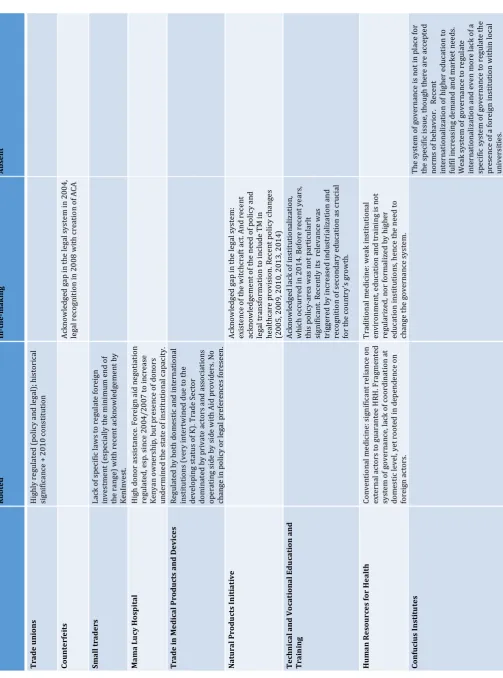
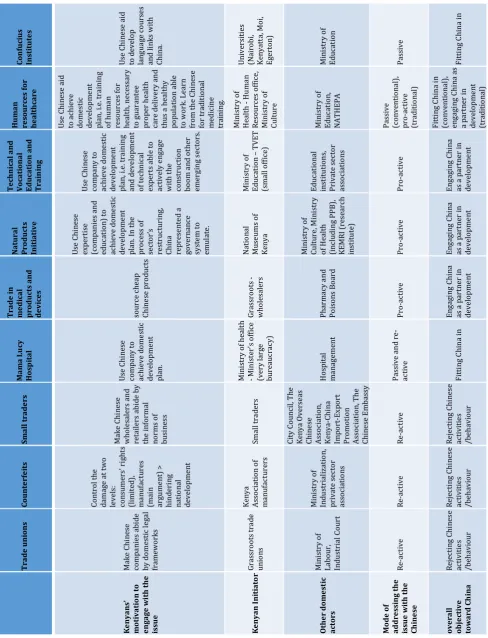
Table 1: Sectoral comparison of interests, actors and arenas/tables of negotiation – Trade ... 145
Table 2: Sectoral comparison of interests, actors, and arenas/tables of negotiation - Health ... 185
Table 3: Sectoral comparison of interests, actors, and arenas/tables of governance - Education ... 224
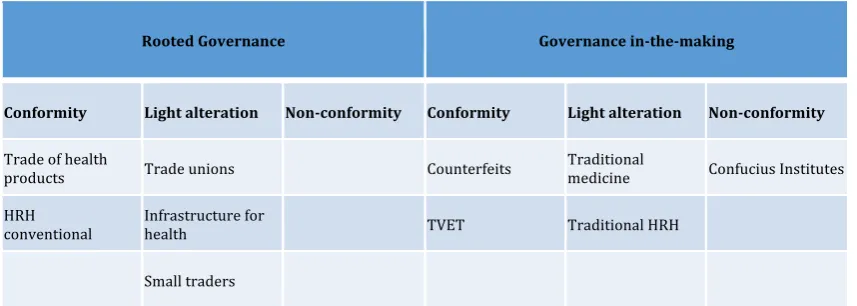
Table 4: Types of systems of governance ... 236
Table 5: Sub-sectoral systems of governance ... 238
Table 6: Initiator’s behaviour (by sub-sector) ... 246
CHAPTER 1
Research Introduction and Design
1.1
Introduction
China’s vastly increased involvement in Africa is one of the most significant developments in the region since the early 2000s. The scholarly focus on the topic has, more often than not, been on China’s foreign policy’s influence, impact, priorities, achievements and difficulties in Africa. Less attention has been paid to analysing the African side of the equation: beliefs, interests, resources and structures that determine the motivations and modalities of action in dealing with the opportunities and challenges that China is presenting.
This shortcoming does not come as a surprise if one looks at how Africa has been portrayed in the international relations literature: Africans’ leverage in negotiating with external forces has chronically been neglected, depicting the continent as
dependent and powerless. Similarly, Africa’s relations with China have been
understood as heavily asymmetrical due to China’s economic and political overall strengths, leading to assume that little negotiation willingness or ability was left to Africans. Even when Africans ‘were attributed’ decisional power, it has often been believed that if they could choose between Western1 normative approaches and
China’s no-strings-attached win-win promises, they would undoubtedly opt for the latter, based on ideological affinity and the possibility of quick returns. While these conditions contain elements of truth, it is about time that the African side of the equation is analysed not by studying the ‘consequences for Africa’ of China’s arrival, but the reasons and modalities of Africans’ action.
In a way, the thesis is an attempt to simply change the standing point for observing real world dynamics, to invert the logic to ask ‘What is the influence African contexts and people have on Sino-African relations?’ rather than continue asking only ‘What is the influence China has?’. The aim is thus that to explore whether Africans have the willingness and ability to safeguard their interests in the relational dynamics with external forces, what are their reasons and modalities,
1 For a good account of the conceptualization of the West in international relations, see J. O’Hagan, Conceptualizing the West
how the interactive relation between state and non-state actors is mobilised and negotiated, and how it constitutes a strength in building national capacity in domestic as well as foreign policy. The willingness and ability to safeguard their interests, i.e. ‘agency’, is articulated as the definition and determination of governance processes vis-à-vis the same processes being defined and determined by external actors. By studying these processes, the thesis aims at contributing to the existing literature on Africa in international relations, and more specifically Sino-African relations, through empirical findings.
To gather a full picture of these dynamics, this thesis transcends the disciplinary boundaries that often adopt single levels of analysis. While the literature on Sino-African relations has mostly understood the Sino-African engagements with China through a dichotomous lens, i.e. state or non-state action, in this thesis the author uses a combined state-society approach, believing that the governance of particular issues, domestically and with external actors, cannot be so easily circumscribed within such boundaries. As Mohan and Lampert suggest “Chinese relations with many African countries are maturing and moving beyond state-to-state deals, implicating many more actors. So, the need to move beyond statist, elite dialogues is not simply a theoretical exercise, but one made more pressing by this growing ‘embeddedness’ of mutual political and economic ties”2.
Moreover, the asymmetries identified between China and African countries, which presumably void the win-win discourse of its meaning, are often compared within a single sector without taking into consideration the wider context. To overcome this problem, this thesis combines reasoning about macro-, meso- and
micro-level dynamics, national, sectoral and issue-specific. It is argued that using
such three-layered approach and paying attention to the specific and broader contexts simultaneously, leverages the strengths and weaknesses that a country-system adopts vis-à-vis external forces. This is helpful for at least two reasons.
First, perpetuating the discussion about ‘Africa’ and China, often adopted in studies of multiple countries, may be producing inaccurate depictions of real world dynamics that are instead always, inevitably, context-dependent. While it is explained, in the next chapter, the inevitability of talking of ‘Africa’ as a collective presence, mainly because the literature, historically, refers to it as such, the aim of
the thesis is to select one single country and dig deep into its processes of decision-making.
Second, by looking at broader national contexts, in conjunction with the sector and issue-specific contexts, it may be possible to note that despite not winning in the same ‘discipline’ as China, African countries do gain from the relation. While some sectors suffer from increased relations with China, others may benefit. Kalu in his doctoral dissertation suggests that “Nigerians are willing to experience a continued trade deficit with China in order to achieve other important objectives”3.
This also relates to the need of breaking down national contexts and move beyond the widespread belief that African countries practice a single type of governance, according to which “states and public services operate in clientelist mode, the general model is neopatrimonial in nature and most practices fall into what is called
the informal realm”4. Doing so does not aim at suggesting that these types of
governance mechanisms are disappearing, but rather at establishing whether they are still largely representative of actual governance dynamics.
Finally, the thesis establishes that the processes of governance, negotiated across the state and non-state realms, are a crucial site for determining power distribution between Africans and external actors. The willingness and ability of domestic actors to safeguard their interests in the relations with external forces is the result of these processes of governance that are, in turn, shaped not by linear relations, but by a complex and non-static blend of beliefs, interests, resources negotiated within specific systems of governance.
1.2
Literature Overview
By locating this thesis in the field of International Relations, the main problem concerns, first and foremost, a necessary disambiguation about the fundamental
3 N.E. Kalu, ‘Understanding Africa’s China Policy: A Test of Dependency Theory and a Study of African Motivations in Increasing Engagement with China’, PhD thesis, University of Nebraska-Lincoln, 2012, p. 1.
units of the discipline. The literature on the African State5 and African Civil Society6
has mainly focused on the appropriateness of applying western concepts to non-western realities and how such concepts have been readapted/rejected by African states and peoples, in the face of both internal issues and external forces. In other words, it has been questioned whether the institutions of the state and civil society in Africa exist at all given that the original forms of associational space existent in Africa before the advent of colonisers were significantly different in structure to the western division of powers between the state and other societal actors.
As a consequence of these debates about the units of analysis, the role of African agents in international relations has often been underestimated. Cornelissen, Cheru and Shaw assert that “Africa is generally under-represented in the mainstream IR scholarship emanating from the North Atlantic world and is mostly left out of the theoretical debates that have animated this scholarship”7. This is grounded in a
widespread belief, in the real world and the scholarship on Africa, that Africa is marginal, irrelevant, powerless in the world’s global processes. The predominance of informal governance in Africa, consequential to the absence of a proper division between formal state apparatuses and social formations has led to believe that African states “might be rather different from the states that typically inhabit at least ‘traditional’ IR theory”8 (IRT) and because of this, they could hardly fit IRT9. This
normative understanding of political dynamics overlooked the historical trajectories and the complexities of empirical statehood without realising, as Williams claims, that “African states help to provide some of what we might call the
5 J.F. Bayart, The State in Africa. The Politics of the Belly, Longman, New York, 1993; J.F. Bayart, ‘Africa in the World: A History of Extraversion’, African Affairs, vol. 99, no. 395, 2000; C. Young, ‘The End of the Post-Colonial State in Africa? Reflections on Changing African Political Dynamics’, African Affairs, vol. 103, no. 410, 2004; L. J. Diamond, J. Linz & S. M. Lipset eds., Democracy in Developing Countries, Lynne Rienner, Boulder, 1988; D.S. Rothchild and N. Chazan, The Precarious Balance. State and Society in Africa, Westview Press, Boulder, 1988; A. Mbembe, On the Postcolony, University of California Press, Berkeley, 2001; M. Meredith, The State of Africa : A History of the Continent since Independence, Simon & Schuster, London, 2011.
6 D. Lewis, Civil Society in Non-Western Contexts: Reflections on the ‘usefulness’ of a Concept, Centre for Civil Society, London School of Economics and Political Science, London, 2001; P. Chabal and J.P. Daloz, Africa Works: Disorder as Political Instrument,
International African Institute in association with James Currey, Oxford, 1999; J.M. Makumbe, ‘Is there a Civil Society in Africa ?’, International Affairs, vol. 74, no. 2, April, 1998; S. Orvis, ‘Civil Society in Africa or African Civil Society?’, Journal of Asian and African Studies, vol. 36, no. 1, 2001; M. Bratton, Civil Society and Political Transition in Africa, Institute for Development Research Report Series, vol.11, no.6, Institute for Development Research, 1994; M. Edwards, ‘The Challenges of Civil Society in Africa’, lecture given at TrustAfrica [lecture notes online], 12 February 2009.
7 S. Cornelissen, F. Cheru and T.M. Shaw, ‘Introduction: Africa and International Relations in the 21st Century: Still Challenging Theory?’, in S. Cornelissen, F. Cheru and T.M. Shaw eds., Africa and International Relations in the 21st Century, Palgrave Macmillan, Houndsmill, 2012, p. 2.
8 D. Williams, ‘Agency, African States and IR Theory’, paper presented to the BISA Annual Conference, Manchester, 27-29 April 2011, p. 3.
9 W. Brown, 'Africa and International Relations: a comment on IR theory, anarchy and statehood', Review of International
‘limit cases’ but the broad issues that emerge are ones that can be applied to thinking about state agency in general”10.
To include the range of actors and political formations that constitute politics, it is necessary to break down assumptions about ‘difference’. Hence, the governance of domestic affairs in this thesis is defined as the power relations between the governing and the governed, devoid of normative attachments. It is not about ‘good’ governance, but rather about ‘real’ governance11. Aspects of ‘poor’ governance such
as corruption, ethnic allegiance, clientelism, are considered in this study as relevant as aspects of ‘good’ governance, such as accountability, participation, the rule of law. Real governance, as state by Olivier de Sardan, “is composed of multiple dimensions, some convergent and others contradictory; it is also the product of local, sectoral and individual microdynamics; and lastly, it faces on every front a pluralism of forms of action”12. Therefore, it is important to look at state-society relations in Africa not
“as a promised agenda for change”13 but as Mamdani suggests, in their “actual
formation” 14. This means that in defining state-society relations, the focus should
be on the broad range of collective activity and norms, be they democratic or not, that constitute actual society15.
1.2.1 Sino-African Relations Literature
Similar to the treatment of Africa in the broader field of IR, the literature on Sino-African relations has been less concerned with Africa than it has been with China. The debate on Sino-African relations has attracted scholarly attention since the Cold War period. Snow, Filesi and Duyvendak focused on the historical ties between China and the African continent16; others such as Yu, Larkin, Hevi and Hutchison
have instead focused on China’s foreign policy in Africa since the end of the Second World War to the late 1970s, with a view to the ideological underpinnings that still feature in nowadays relations17. However, it is only since the late 1990s that
10 Williams, op. cit., p. 3.
11 Olivier de Sardan, op. cit. 12 Olivier de Sardan, op. cit., p. 4.
13 M. Mamdani, Citizen and subject: contemporary Africa and the legacy of late colonialism, Princeton University Press, Princeton, 2006, p. 19.
14Ibid.
15 Orvis, op. cit., p.18.
16 See P. Snow, The Star Raft: China’s Encounter with Africa, Weidenfeld and Nicolson, London, 1988; T. Filesi, China and Africa
in the Middle Ages, trans. David L. Morison, Frank Cass, London, 1972; J. J. L. Duyvendak, China’s Discovery of Africa, Arthur Probsthain, London, 1949.
17 See G. Yu, ‘Peking Versus Taipei in the World Arena: Chinese Competition in Africa’, Asian Survey, vol. 3, no.9, 1963, pp. 439-453; G. Yu, ‘China’s Failure in Africa’, Asian Survey, vol. 6, no. 8, 1966, pp. 461-468; E.Hevi, The Chinese Communists and Africa, Praeger, New York, 1966; B. D. Larkin, China and Africa 1940-1970: The Foreign Policy of the People’s Republic of China
scholarly attention intensified, initially characterised by conventional views about the scope and role of the Chinese presence in Africa. Especially in the first years of engagement (ca 2000-2008), the debates broadly relied on journalistic accounts,
exacerbating a dichotomous understanding18: Western media tended to view the
development with scepticism and wariness19, while the Chinese perspective,
observed in official Chinese sources, was often characterised by unbounded optimism. In other words, the relations were polarised as either dangerously neo-colonial or optimistically beneficial for African countries.
As Alden suggests “we seem unable to escape our singular focus on competing discourses claiming colonial intent or benign purpose on the part of China in Africa”20. This inability seems to be due to an urge “to capture ongoing global
transformations and their manifestations” while they are in the process of taking shape. An inability that is also characterised by “our own biases and assumptions, including the ideology of difference that causes some Western scholars in particular to exoticize this relationship, or the ideology of sameness that causes some Chinese scholars to familiarize it”21.
Either way, the depiction of the role played by Africans within the relations was minimal, mostly characterised by Africans being acted on. This understanding was bound by, especially in the first decade of intensified Sino-African studies (2000-2010), a disproportionate propensity to understand China-Africa relations in realist terms, focusing on strong/weak power asymmetries revolving around the Chinese extraction of African natural resources. In effect, the narrow scholarly focus reflected the limited initial approach between China and African countries, characterised by state-to-state engagements and driven, first and foremost, by a Chinese appetite for natural resources, claimed to be satisfied unquestioningly by Africans. In this initial phase, despite the Chinese proclaimed win-win discourse, fierce criticism was raised against China’s involvement with states of all political orientations, including authoritarian ones, and concerns were voiced regarding the benefits the relations would bring to African societies, as opposed to African elites. In other words, the win-win symbolism seemed to be relevant, if at all, at
18 Also see China Aid Data to understand the role of the media as the first source of knowledge upon which many academic studies draw their data: China Aid Data, ‘Methodology’, China Aid Data [website], <http://china.aiddata.org/content/methodology>.
19 S. T. Freeman ed., China, Africa and the African Diaspora: Perspectives, AASBEA Publishers, Washington DC, 2009.
20 C. Alden, ‘In Search of Gravity’s Rainbow. Theoretical Approaches and China-Africa scholarship’, paper presented at the Making Sense of the China-Africa Relationship: Theoretical Approaches and the Politics of Knowledge conference, Yale University, 18-19 November 2013.
state level but not in relation to society. Based on a few studies of, mainly, authoritarian African countries, generalisations about elites’ behaviour across Africa assumed that these last would unquestioningly welcome China’s no-strings-attached approach, as opposed to more critical perceptions rising from society. African elites were often portrayed as passive watchers of Chinese abuses, i.e. disrespect for local rules and exploitation of local resources, even in cases where society’s uneasiness towards the Chinese was voiced.
With time, academic debates around the presumably exploitative attitude of the Chinese and assumed passivity of African elites started to be acknowledged. Alden, Large and Soares de Oliveria in 2008 asserted that Beijing was, more and more, finding itself “at odds with an emerging consensus on the necessity of good
governance within Africa itself”and that “the voices arguing for improvements in
accountability, transparency and democracy were not just civil society activists but some of the top leaders of the continent, like Nigeria’s former President Olusegum Obasanjo and South Africa’s Thabo Mbeki”22.
The seemingly consistent Chinese foreign policy discourse on win-win cooperation started being questioned by Africans as the practices of a diverse range of Chinese actors, not only state actors, further exacerbated the discussion, among societal groups as well as international organisations, concerning the exploitative nature of Chinese activities. At the same time, Chinese leaders begun to show signs of awareness concerning the importance of accounting for African internal
perceptions as well as Africangovernance dynamics for the success of their initiatives,
thus paying attention not only to formal institutions but also informal ones, not only to state organs but also to non-state entities, not only to the pragmatic aspects of the engagement but also to the image of China and its reception in African contexts.
Since the early 2010s, the literature has tried to make up for its biases, providing more attention to engagements beyond natural resources extraction and, if limitedly, to the role played by African people and contexts23 in Sino-African relations. This
diversification did not aim at diminishing the importance that natural resources play in Sino-African relations or the prominence of China. However, the actual engagements, increasingly more complex and diversified, were signalling the need to expand the focus and include units of analysis that had been, until then, neglected.
22 C. Alden, D. Large and R. Soares de Oliveira eds., China returns to Africa. A rising power and a continent embrace, Hurst Publishers, London, 2008. p. 21.
Studies on the African elaboration of the Chinese arrival started focusing on either
African elites’ responses to the Chinese or civil society’s behaviour. The content and modalities of the relations between the elites and societies, in light of the generally new engagement with China, was not problematized, but merely described as polar with the first having a positive attitude towards the Chinese, welcoming them without many conditions24, and the latter holding a negative and cynical view of
China’s presence.
1.3
Unpacking the Research questions
The analyses of China-Africa engagements in the international relations field are, more often than not, framed as analyses of Chinese foreign policy. As noted above, African actors and contexts involved in the relations with China are often overlooked or deemed passive, unable and irrelevant to the outcome of the interaction. The relations are often characterised as asymmetrical with the preponderance of power residing in the hands of Chinese actors and structures. An increasing body of literature has started paying attention to ‘African’ agency25 in the
recent years, suggesting that it should deserve more attention than it had so far received. This body is only limitedly addressing specific Sino-African relations while enquiring more generally about African agency in international relations26. As a
consequence, the subject still needs a systematic investigation to be grounded on empirical observations so to build a more substantial body of literature.
Aiming at contributing to filling this gap, this thesis studies African agency as the
indigenous/African ownership of governance processes within Sino-African
relations and asks: what are the degree, the motivations and modalities through which African ownership of governance processes is exerted in Sino-African relations?
The processes of governance are a crucial site for determining power distribution
24 Africa and Asia Departments at Georgetown University, Africa and China: Issues and Insights, Conference Report, Georgetown University, 7 November 2008.
25 W. Brown, ‘A question of agency: Africa in international politics’, Third World Quarterly, vol. 33, no. 10, 2012; W. Brown and S. Harman eds., African Agency and International Relations, Routledge, Abingdon, 2013; D. Neubert and C. Scherer eds.,
Agency and Changing World Views in Africa, Lit Verlag, Berlin, 2014; T. Shaw, ‘African Agency? Africa, South Africa and the BRICS’, International Politics, no. 52, 2015; L. Whitfield and A, Fraser, ‘Negotiating Aid: The Structural Conditions Shaping the Negotiating Strategies of African Governments’, International Negotiation, no, 15, 2010; P. Murray-Evans, ‘Regionalism and African agency: negotiating an Economic Partnership Agreement between the European Union and SADC-Minus’, Third World Quarterly, vol. 36, no. 10, 2015.
26 A recent exception is the edited volume: A. Gadzala ed., Africa and China: how Africans and their governments are shaping
between Africans and external actors. To delineate what agency-as-ownership means, it is first necessary to explain how governance is conceived.
Governance
According to Rosenau27, the concept of governance is more inclusive than
government as it embraces “governmental institutions and informal, non government mechanisms whereby needs and wants are fulfilled”. He asserts that governance is a system of rules accepted by the majority28. This broadening of the
focus to the concept of governance – instead of the narrower idea of government – is necessary to provide an accurate portray of actual Sino-African relations. In fact,
the willingness and ability to exert control in processes of negotiation with external
actors, depend on the existence of a range of actors, on their ideas, interests, and on the way power and resources are distributed and shared among them domestically, which can be accentuated in the relations with external actors.
To account for such diverse elements of governance, this thesis does not adopt a single theoretical paradigm. It rather asserts that to capture the complexity of governance processes unfolding across the domestic and international environments, a combination of theoretical approaches is required. In Chapter 2, the aspects that are deemed relevant, for this thesis, of the realist, institutionalist, constructivist and pluralist theoretical approaches will be presented. Though aware that uniting them will inevitably decrease their particular explanatory power, it is believed that together they can provide a more accurate depiction of actual
governance dynamics. By means of introduction, by pulling together relevant elements of each of these theoretical approaches, the thesis presents a conceptualization of governance that does not place the full explanatory power on individuals or structures, but rather on a complex intertwining of the two. This conceptualization:
- Identifies the diversity of actors in Sino-African relations. In doing so, the author recognises the importance of the State but understands it as acting through human agents, in a non-unitary fashion, subjected to social and market forces whose interests are negotiated through processes of
27 J. Rosenau, ‘Governance, Order and Change in World Politics’, in J.N. Rosenau & E.O. Czempiel eds., Governance without
competition and cooperation, based on the asymmetrical availability of resources.
- Recognises that agents identify their interests not only based on rational decisions but also based on social constructs, i.e. ideas and perceptions. - Assigns particular relevance to institutions, in particular in relation to their
dependence on historical paths.
- Recognises that governance is far from being merely state-determined, within
one country’s boundaries, but is rather increasingly the consequence of the inclusion in the decision-making of social and market forces, including multilateral organisations.
- Finally, all this is subjected to change over time. Even though path dependence finds significant space in this conceptualization, change is also an important element of Sino-African relations, determined by heuristic approaches to interaction, and of Africa’s relations with other external forces.
Resulting from this is an idea of governance that is dynamic, encompassing a wide range of actors who have asymmetrical access to resources and power and whose interests are negotiated across sub-national, national and international platforms. A governance that is constituted by a multitude of relationships that have historically determined the formal and informal norms, procedures, conventions of interaction; that is ideationally subjectively constructed, and that is subject to change. It is a multi-level type of governance according to which decision-making norms and institutions are forged at specific levels and negotiated then with tiers above and below29. These interactions occur as competing “economic and political forces seek
the most favourable conditions for insertion into a changing international order”30.
Ownership
Ownership of these complex governance processes in international relations is
contrasted with these processes being defined and dominated by external actors, hence the idea of agency-as-ownership. In other words, it means the safeguarding of African interests (vis-à-vis the interests of external actors) through the protection of the decision-making process. Africa remains a region whose formal and informal
29 N. Brenner, New State Spaces, Oxford University Press, Oxford, 2004.
30 B. Jessop, ‘The Crisis of the National Spatiotemporal Fix and the Ecological Dominance of Globalising Capitalism’,
structures, institutions and norms have been shaped, re-shaped, contested and challenged by external actors to an unprecedented degree. Considering China’s relatively new arrival in Africa and its proclaimed non-interference policy, it remains fundamental to understand how domestic capacities and international configurations of power interact.
As Whitfield and Fraser suggest in their study of aid negotiations between external actors as donors and African recipients, looking at African ‘ownership’ of governance processes in an international relations context means exploring “how a realm of decision-making can be protected from external influence, defending spaces in which African agents can struggle amongst themselves over the nature of appropriate political and economic processes”31. By ownership, they mean the
‘control’ over the content and modalities of governance, as opposed to these being decided upon by external actors, advancing the idea that “loss of control […] has had a malign effect”32. They continue by stating that, to one extreme, “the defense of
ownership is in effect a defense of the sovereign rights of African states”33.
It is assumed that if the domestic system of governance is safeguarded, then the
interests of African actors are also protected sincethe domestic system of governance,
which regulates how power and resources are shared among actors, serves as a point
of leverage over acts of narrow self-interest. It is, in other words, the product of
(continuous) negotiations over what is deemed legitimate and thus accepted by indigenous stakeholders34. This does not, however, imply that the system of
governance is, normatively speaking, a morally correct one or that procedures are bound by legality and formality. This thesis is about ‘real’ governance, not ‘good’ governance. As a consequence, the content and modalities of action to be safeguarded can be more or less morally justifiable, pertaining to the formal as well as informal worlds.
Moreover, safeguarding the system does not necessarily mean maintaining it. It can also mean revisiting it to make sure it is suitable to face emerging opportunities
31 Whitfield and Fraser, op. cit., p. 343. 32Ibid.
33Ibid.
and challenges. The focus on the system of governance is deemed extremely important in a study of relations with external actors as it is considered the synthesis of the structure-agency interplay within a country, one that is historically rooted in ideas, interests, relationships, and so forth, and thus an unavoidable aspect of the relations with external forces. As Long notes, “all forms of external intervention necessarily enter the existing life-worlds of the individuals and social groups affected, and in this way are mediated and transformed by these same actors and structures”35.
Negotiating governance
The act of negotiation is the struggle among groups about the most suitable pattern for governing a shared space, i.e. the arena. This struggle is what is most commonly referred to as politics, i.e. what Harold Lasswell defined ‘who gets what, when and how’36.
The first step of this approach to the negotiation of governance is the identification of interests (for a comprehensive discussion of interests see Chapter 2, section 2.3.2), the second step is the acknowledgement of whether existing systems are suitable to negotiate these interests to the benefit of involved African stakeholders, the third and last step is the enactment of strategies to either bring the negotiation inside the accepted system of governance or transform the latter to guarantee that the negotiation successfully safeguards interests. Three scenarios are presented.
In the first case, if the interests that emerge in the relations with China can be pursued through negotiations within an existing system of governance (‘rooted governance’), then ownership is expressed through the preservation of the procedural norms (conformity) that are entrenched in the existing system. In other words, China is required to abide by existing norms of conduct. This procedural success vis-à-vis the external actor may be, however, the result of numerous acts of negotiation/struggle among domestic stakeholders within the specific system of governance. This is because systems of governance are, first and foremost, sites of negotiation/struggle among domestic actors and only at a second stage they are sites of negotiation with external actors.
35 N. Long, ‘From paradigm lost to paradigm regained?’, in N. Long and A. Long eds., Battlefields of Knowledge: The interlocking
In the second case, if the interests that emerge in the relations with China cannot be pursued through existing systems of governance, then ownership is expressed through the identification of the shortcomings and transformation of the system (governance in-the-making). In other words, China’s presence has highlighted gaps in the system of governance to the point that this latter, through its entrenched processes, does not guarantee the safeguard of domestic interests. The transformation can be spurred by contestation or by rational-choice. The presence of China is not only perceived as negative, and thus something to re-act against, but can also be used as leverage to achieve emerging interests, thus spurring cooperation-seeking. It is worth to point out that ‘in-the-making’ refers to processes that can also take years to perfect the system of governance.
On top of these first two cases, it is also expected to find cases where political expediency is used to bypass existing systems of governance or where a specific system of governance does not exist. This is one of the main arguments in Sino-African relations, according to which political and economic asymmetries between the Chinese and African actors often lead the latter to bypass systems of governance to strike quicker deals with the Chinese, which presumably favour elites. Alternatively, African actors are believed not to have a strategy or structure to negotiate in their best interests.
One of the main aims of this thesis is to understand how frequent these three strategies are in processes of negotiation and how often they have an impact on the outcome. Hagmann and Péclard defined the first type of governance, i.e. rooted, as “dominated by longstanding conventions on how and by whom statehood is defined”37, the last type of governance, i.e. absent, is instead defined as “lack[ing]
predefined or commonly recognised procedural modalities for decision making”38,
and finally, in the middle, is governance in-the-making which is a combination of the two where a governance system either does not exist and is under construction, or does exist but was acknowledged as inappropriate, hence needing restructuring.
When external actors - themselves carriers of interests, norms, institutions and structures - enter/join African processes of governance, the domestically negotiated interests and modi operandi may be altered to the point that not only the processes
37 T. Hagmann and D. Péclard, ‘Negotiating Statehood: Dynamics of Power and Domination in Africa’, Development and Change, vol. 41, no. 4, 2010, p. 550.
do not unfold following the habitual route, but also the nature of broader systems of governance within which they take place is transformed. Studying the processes helps thus understand why, how and the extent to which systems of governance are preserved, transformed or circumvented. In this respect, it is worth remembering that the outcomes are studied as an end, in this thesis. They are indicative of the degree of safeguarding of interests achieved through negotiations conducted by African actors rather than as a means to achieve further objectives such as
“economic development, poverty reduction or democratic governance”39. Although
these further objectives are identified by stakeholders, and often form the basis of motivations to act, they are not assessed per se. This is because “the defense of a national realm protected to a large extent from external influence is a necessary but not sufficient pre-condition for such developments” 40.
1.4
Methodology
As outlined in previous sections, studies on China-Africa relations more often than not have focused on China’s influence, motivations, modalitiesin engaging with African realities, while lesser attention has been paid to the African side of the equation to understand the influence African practices and systems of governance may have on the outcome of the relations with China as an external actor. To study the African side of the equation, reveal the details of negotiations, and avoid ungrounded generalisations on China-Africa relations, the author decided to study a single country while selecting different sectors of engagement with China. In other words, she decided to move the “comparison from one sector to another while keeping the nation constant”41. This approach is expected to provide more space for
in-depth analysis of the influence that the domestic context has on the overall relations with China.
1.4.1 The sectoral approach
The choice of focusing on one single country allows for an in-depth study of the tensions between structures and agencies while presumably controlling the
39 Whitfield and Fraser, op. cit., p. 343. 40Ibid.
41 D. Levi-Faur, ‘A Question of Size? A Heuristics for Stepwise Comparative Research Design’ in B. Rihoux & H. Grimm eds.,
national context. The choice of focusing on more than one sector within a single country is to better understand the tension between national and sectoral/issue-specific interests. Looking beyond a unitary understanding of the national interest represents a contribution to the current scholarship on Sino-African relations. African agency in international relations is often framed as the ability of African
states to ‘hold up their national interests’42. This is problematic because agency does
not only mean state agency. While at the international level the role of the state is still predominant (more elaboration on this in the following chapter), when it comes to specific domestic policy areas, in Africa, as elsewhere, the state becomes one of many actors. Even more, within the state, bureaucracies compete, not always for a unified ‘national’ interest. While current accounts of African agency in relation to China revolve around state-to-state relations, which often assume the relationship is asymmetrical, if the engagement is approached from a sectoral perspective, this asymmetry may be less dramatic (the preponderance of power residing with local actors and their use of governance methods through formal/informal regulatory regimes).
As highlighted by Levi-Faur, the assumption behind this design is that “sectoral variations are important”43, i.e. difference within a country, and they can be as
important as national variations, i.e. differences between countries. This approach “emphasises the autonomous political characteristics of distinct policy sectors, hence the multiplicity of political patterns in any one country. Sectors are expected to be embodied in policy communities and policy networks organised domestically in a regulatory regime”44. The idea to develop a sectoral analysis is situated within
a body of literature that recognises that “actual modern states encompass dozens of institutionally distinct policy sectors with highly diverse organisational architectures”45, thus aggregating patterns of institutions and practices is not
helpful to explain the balance of power and interaction between state and society, and/or between domestic and international actors. By disaggregating the state and social structures in defined policy areas, not only vertical diversity is emphasised (not all state-society relations are the same) but also horizontal heterogeneity emerges (state bureaucracies differ, so as societal groups). This body of literature is,
42 A. Fraser, ‘Emerging Agents of Change: African and International Negotiations’, paper presented to the seminar Emerging Agents of Change? Africa in International Negotiations, Chatham House, London, 2 February 2011.
43 Levi-Faur, op. cit., p. 47. 44Ibid.
however, still in-the-making and studies adopting ‘one-country many-sectors’ approaches are still relatively few. Sellers reminds that “cross-national comparative studies have tended to focus on a single domain of policy within different countries […] As a result, the consistent consequences in policy sectors for state-society relations, and the relations between sectoral and national institutional differences for state-society relationships remain underexamined and undertheorized”46.
There are not comprehensive studies of this kind in the Sino-Africa scholarship. Taylor argues that “it is commonplace in the literature on external engagement with Africa to talk of “China” or “France,” and while heuristically this may make sense, it does have the potential effect of obfuscating what processes are unfolding and why. Ontologically, such labels are problematic and it is not plausible to speak of states as monolithic entities”47. Similarly, Alden recognises that “speaking about ‘China–
Africa’ at this stage in the relationship obscures as much as it illuminates”. He stresses the importance for future scholars to “pursue an agenda formed by the seeking of a heightened understanding of bilateral relations, a closer reading of cross-country sectoral studies, and deeper insights into communities. Digging deeper will expose this complexity, enrich our understanding of multi-variant ties and relationships, and ultimately move us away from the simple binaries that have characterised China–Africa studies to date”48. The adoption of a sectoral approach
thus contributes to the body of scholarship. It assumes that the ‘game’ consists of the recognition from both sides of the existence of overlapping and differentiated interests, which are at times clearly evident, at other times less. It is this push and pull bargaining exercise that leads to negotiating a “win-set”49 where both parties
gain. It is indeed necessary to acknowledge that the push and pull bargaining exercise takes place well beyond the national level. It is at the sectoral/issue-specific level that the process is re-negotiated, through consultation and implementation, by the local social environment that mediates interests and modalities of action50.
It is due to remind that ‘sectors’ are difficult to define fully within set boundaries. There is a range of actors and institutions at the national, sub-national and international level that influence sectoral processes and outcomes. The scope of
46 Ibid., p. 28.
47 I. Taylor, The International Relations of sub-Saharan Africa, Continuum, New York, 2010, p. 19. 48 C. Alden, ‘China and Africa: The Relationship Matures’, Strategic Analysis, vol. 36, no. 5, 2012, p. 706.
49 R.D. Putnam, ‘Diplomacy and domestic politics: the logic of two-level games’, International Organisation, vol. 42, no. 3, 1988, pp. 427-460.
sectors can also vary due to the fact that “boundaries are determined by variables as diverse as domestic policy priorities, international interest and influence, and local and national alliances”51.
Case Selection
It is important to specify what is meant by ‘case’ in this thesis. Is Kenya the case of this study? Alternatively, is it rather the sectors? Or the specific issues presented under each sector? In this stands the complexity of this project, which is not a typical single-country study where the comparative dimension often disappears.
The cases under study are the issues presented under each sector. Although one in-depth case-study per sector might have probably provided more analytical depth, it would not have fully served the purpose of this thesis, which is to provide a comparison of various governance behaviours within a single country. Levi-Faur attempts to explain how to merge the case-oriented approach with comparative designs, referring, in particular, to the problem of increasing the number of cases in a case-oriented approach. In King, Keohane and Verba’s Designing Social Inquiry52, a
number of techniques are presented concerning the way to increase the number of cases. This thesis adopts the one-country many-sectors design according to which the main subject under study remains governance processes vis-à-vis the Chinese and the comparison is carried out by studying motivations and modalities of adherence in
different cases, i.e. issue-areas. This is done bearing in mind Ragin’s definition of a
case, namely “a particular configuration of attributes”53. He continues: “the logic of
case study is fundamentally configurational. Different parts of the whole are understood in relation to one another and in terms of the total picture or package that they form. The central goal is usually to show how different ‘parts’ of a case interconnect […] What matters most is that the investigator makes sense of multiple aspects of the case in an encompassing manner, using his or her theory as a guide”54.
Hence, the usage of different issue-areas – instead of a single one – to provide a more articulate picture of the ‘whole’, i.e. the national context. It is argued that increasing the number of issue-areas under study provides a more nuanced understanding of how different parts interconnect.
51 J. Moncrieffe and C. Luttrell, An Analytical Framework for Understanding the Political Economy of Sectors and Policy Arenas, Overseas Development Institute, London, 2005, p. 13.
52 G. King, R.O. Keohane and S. Verba, Designing Social Inquiry: Scientific Inference in Qualitative Research, Princeton University Press, Princeton, 1994.
Levi-Faur reflects that the ‘encompassing manner’ means that “the purpose of the inquiry is not necessarily generalisation across cases”55. In fact, this study did
eventually end up presenting methodological dilemmas concerning the tension between plurality and the necessity to generalise beyond individual cases. By studying different sectors, and cases within each sector, the approach inevitably exposes itself to “important implications for the degree of control and the nature and scope of the generalisation that could be produced”56. Being the literature quite
scarce in this field, the discovery of these implications came, predominantly, through the author’s own efforts. The effort to show diversity was made particularly difficult by the lack of available or accurate accounts of Kenyan domestic debates and actions towards China-related activities. Therefore, this thesis is strongly grounded in empirical research according to which the selection of the issues under study mostly emerged from fieldwork findings and not from pre-determined decisions. This is mainly due, as better explained below, to the fact that the absence of relevant data did require a preliminary effort of scoping the subject on the ground before being able to formulate a strategy of research.
Grounded research is valuable to minimise selection biases, but also problematic as the cases are not necessarily selected following a specific methodological logic of most-similar/most-different. In other words, the content of the relationship as well as the outcome were not clear before having conducted a full investigation. The cases could thus not be chosen based on their similarities or differences as these were the very subjects of investigation in the first place. Consequently, the research had to be conducted to answer first what-type questions, i.e. basic facts defining a case, and only later to answer how and why questions. While methodologically, and logically, these steps can be divided, the difficulty of fieldwork research does not always allow for this neat separation, and it forces the researcher to investigate the potential relevance of a case while already addressing more ‘serious’ questions. More details about the selection of specific issue-areas and sectors can be found in Chapter 3 (section 3.4.3).
55 Levi-Faur, op. cit., p. 54.
1.4.2 Kenya
Kenya was selected as the country under study. The choice of the country occurred following three main types of rationale, the elaboration of which was based on the information available when the research started (in 2011): 1) the level of governance-sharing within the country; 2) the involvement in relations with China of different types of actors, i.e. state, non-state, private sector and so forth; 3) the lack of natural resources in the country. This study focuses on the period 2002 – 2014, representing “democratic Kenya”57 under President Mwai Kibaki and, since
March 2013, under President Uhuru Kenyatta. This period also coincides with the creation, in 2000, of the Forum on China-Africa Cooperation that institutionalised the engagement between China and African countries.
Governance-sharing
Given that the aim of the study is that to understand motivations and modalities of engagement with China leading to ownership of governance processes, and in order to move beyond a state-defined idea of agency toward external actors, it was deemed necessary selecting a country that provided spaces for non-state actors to enter the public debate. Since the study is based on a single country, it was believed ideal to select one where such non-state participation in public affairs is average, rather than particularly strong or weak. Kenya ranks near the middle of relevant indexes of good governance, of which the level of public participation is an indicator, making it a suitable case58.
Studying the domestic configuration of power and how different groups react to external forces is timely in the Sino-African literature, which has tended to dichotomize the approach to China: elites are favouring and benefiting from the Chinese presence, while the masses are resenting and suffering from it59. This focus
has led scholars to conclude that the behaviour of African actors towards China changes according to the role they occupy in society60. Elites are believed to
accommodate China’s interests, mainly as a consequence of the fact that China
57 H. Patroba, ‘China in Kenya: Addressing Counterfeit Goods and Construction Sector Imbalances’, China in Africa Project Occasional Paper n.110, South African Institute of International Affairs, March, 2012, p. 6.
58 According to the Ibrahim Index of Good Governance, 2010.
seemingly offers aid without preconditions, thus providing African leaders with a valid alternative to Western aid, which is instead tied to normative conceptions of development61. Alden and Hughes also suggest that African elites see their
interaction with the Chinese “as an opportunity to exert a new kind of international leverage over the industrialized countries”62. Common people, on the other hand,
were initially thought to be holding negative perceptions towards the Chinese, mainly due to poor human rights63 and labour standards on the workplace, job
competition, poor quality of products resulting in damage to consumers. However, Mohan and Lampert suggest that “just as many African governments have consciously turned to China as a potential partner in national development and regime legitimacy, African citizens have increasingly reached out to China as a source of useful resources for personal and business progression”64. Even more,
generalised conclusions concerning the elites and society’s responses to China may not hold true in cases of countries where the relations between state and society are more cooperative.
Participation in the relations with China
A further decisive step in the process of selection took place after a preliminary investigation on the countries involved in Sino-African meetings, especially meetings labelled as ‘peoples’. Participation in these meetings was a condition deemed important as a sign of wider (than the state) participation in Sino-African relations. The selection was based on a survey of meetings’ attendance65 which
showed that Kenyan actors’ participation was the most diversified and active (as organisers)66 together with South Africans. South Africa was excluded as a suitable
case for the study because it did not meet the first requirement, as it ranks very high in indexes of good governance67 in Africa. While it would have still been valuable to
study South African motivations and modalities of engagement with the Chinese, the
61 Tull, op.cit.
62 Alden and Hughes, op.cit. 63 Taylor, 2008, op.cit.
64 Mohan and Lampert, op. cit., p. 100.
65 The meetings considered were: China-Africa Civil Society Meeting, 2007, Shanghai; China-African Civil Society Dialogue, 2008, Nairobi; China-Africa Civil Society Forum on Peace and Development, June 2010, Beijing; China-Africa People’s Forum, August 2011, Nairobi; First China-Africa Think Tank Forum (CATTF 1), October 2011, Hangzhou; China-Africa People’s Forum, 2011, Nairobi; China-Africa Think Tank Forum (CATTF 2), 2012, Addis Ababa; China-Africa People’s Forum, 2012, Suzhou. 66 Meetings’ internal reports were consulted and the following countries appeared to be involved: Angola, Benin, Botswana, Cameroon, Chad, Congo-Brazzaville, DRC, Ethiopia, Ghana, Kenya, Morocco, Mozambique, Namibia, Nigeria, Senegal, Somalia, South Africa, Sudan, Tanzania, Uganda, Zambia, Zimbabwe.
case was expected to potentially provide less of a puzzle in the study of dynamics between governmental and societal agency or between agency and structures.
Fieldwork demonstrated, however, that relying on participation to the meetings as an indicator of engagement does not provide an accurate description of actual engagements. This was not only because actual engagements are broader in scope than those that are officialised through formal meetings, but also because there is a gap in how the Chinese and Kenyans understand the role and meaning of these meetings. All the meetings/forums/symposiums, from the most high-visibility, i.e. FOCAC, to those less so (such as peoples’ forums, trade unions symposiums, cultural forums and so forth), are strategically worked out by the Chinese for specific purposes that relate to Chinese national or sectoral agendas. Kenyan actors are
participants to these meetings, at times organisers, never initiators. Their
understanding of these events is more arbitrary than structurally defined and part of a continuum.
Absence of natural resources
Sino-African relations, especially in the first decade, were generally understood as revolving around interests in natural resources with little recognition of other sectors of involvement, including those heavily reliant on Chinese soft power objectives, such as the media and education. Studying a country like Kenya also serves the purpose of shifting the focus from a presumably skewed Chinese interest in engaging with African resource-rich countries – which are often associated with authoritarian regimes – to one where Chinese interests appear more diversified.
1.4.3 Design and Data Collection
Due to the relative lack of studies on Kenya-China relations based on in-depth empirical research, this study adopted a highly flexible design, which generally evolves during data collection68 and heavily relies on data collected during
fieldwork. It is a theoretically informed empirical research based on a qualitative design. The decision to use a qualitative design was consequential to the nature of the enquiry, namely an interest in understanding69 what lied behind the processes
of engagement between Africans and the Chinese, the ideas, meanings, motivations upon which the behaviour and decisions of actors depended. The author was not interested in mere outcomes, but rather in procedural dynamics. Hence the use of a qualitative approach appeared to be more fit70.
Robson suggests that the social constructivist and interpretivist approaches to research focus on how the social world is interpreted by those involved in it. As a consequence, “in principle there are as many realities as there are participants – as well as that of the researcher”71. To acquire these multiple perspectives, researchers
tend to use research methods such as interviews and participant