The London School of Economics and Political Science
Essays on Peer Effects in Social Groups
and Information Misperception
Manuel Staab
A thesis submitted to the Department of Economics of the London School of
Economics for the degree of Doctor of Philosophy
Declaration
I certify that the thesis I have presented for examination for the PhD degree of the
London School of Economics and Political Science is solely my own work other than
where I have clearly indicated that it is the work of others (in which case the extent of
any work carried out jointly by me and any other person is clearly identified in it).
The copyright of this thesis rests with the author. Quotation from it is permitted,
pro-vided that full acknowledgement is made. This thesis may not be reproduced without
the prior written consent of the author. I warrant that this authorization does not, to
the best of my belief, infringe the rights of any third party.
I declare that my thesis consists of approximately 51700 words.
Statement of Conjoint Work
Chapter 3, ‘The Benefits of Being Misinformed’, was jointly co-authored with Marcus
Roel. This statement is to confirm that I contributed a minimum of 50% of this work.
General decisions about the directions of research were made jointly between the
Acknowledgements
Only the support of a great many people made this intellectual and personal journey
possible.
I want to thank my supervisors whose continuous support was essential to this project.
Francesco Nava has supplied an immense amount of advice, support, and
construc-tive criticism that shaped this thesis and my entire time at LSE. And I benefited greatly
from challenging, insightful, and uniquely candid conversations with Balázs Szentes.
I am also grateful for the many helpful comments I received from the members of the
STICERD Theory Group; especially Andrew Ellis, Erik Eyster, Gilat Levy, Matthew Levy,
and Ronny Razin, who were always available for discussions. Furthermore, Christian
Ghiglino offered many valuable suggestions.
My friends and colleagues made this a much more inspiring, entertaining, and
cer-tainly less solitary journey. Michel Azulai, Hao Dong, Dana Kassem, William Matcham,
Davide Porcellacchia, Francesco Sannino, Arthur Seibold, Roberto Sormani, Heidi
Thy-sen, Guo Xu, and numerous others made contributions in many ways. And I want to
thank Marcus Roel who - on top of that - was also a great co-author. I furthermore
want to thank Judith Shapiro for inspiring a passion for economics during my
under-graduate days through her unwavering belief in the importance of economic research.
My family enabled me to pursue this journey and so I am very much indebted to them
and especially to my parents and grandparents, for making this possible.
Abstract
This thesis consists of three chapters. Chapter 1 develops a model that studies the
interaction of two forces in the formation of social groups: the preference for high
quality peers and the desire for status among one’s peers. I present a characterization
of fundamental properties of equilibrium group structures in a perfect information,
simultaneous move game when group membership is priced uniformly and cannot
directly depend on type. While equilibrium groups generally exhibit some form of
as-sortative matching between individual type and peer quality, the presence of status
concern reduces the potential degree of sorting and acts as a force for greater
homo-geneity across groups. Chapter 2 expands on this framework and analyses the effect of
status concern for the provision of groups under different market structures. I
partic-ularly focus on the implications for segregation and social exclusion. I find that status
concern reduces the potential for and benefit from segregation - both for a social
plan-ner and a monopolist - but the interaction of preference for rank and status can make
the exclusion of some agents a second-best outcome. Social exclusion might occur
even if the market is served by competitive firms.
Chapter 3 studies how two fundamental mistakes in information processing affect
the welfare ranking of information experiments. In the spirit of Blackwell (1951), the
binary ranking of informative action profiles is analysed under different classes of
perception distortions. By themselves, an agent’s tendency to misinterpret signals
and the degree to which the prior deviates from the truth reduce expected utility in
a model where payoff relevant actions also generate informative signals. However,
ex-periments can be affected to different degrees. Necessary and sufficient conditions
for when any binary ranking of action profiles can be reversed are provided. As a
con-sequence, different types of mistakes can interact in non-obvious ways such that an
agent might be better off suffering from both rather than just one. The chapter
con-cludes with a characterization when such positive interaction is possible and
Contents
1 The Structure of Social Groups under Status Concern 6
1.1 Introduction . . . 6
1.2 Related Literature . . . 8
1.3 The Model . . . 11
1.4 Structure of Social Groups . . . 15
1.4.1 Stable Equilibria . . . 19
1.4.2 Degree of Sorting . . . 22
1.5 Discussion . . . 23
1.6 Appendix . . . 25
1.6.1 A: Omitted Proofs . . . 25
1.6.2 B: Convergence . . . 36
2 The Provision of Social Groups under Status Concern 38 2.1 Introduction . . . 38
2.2 Related Literature . . . 40
2.3 Setting . . . 40
2.4 Status and Welfare . . . 43
2.4.1 Status and Segregation . . . 45
2.4.2 Status and Social Exclusion . . . 48
2.5 Privatization . . . 51
2.5.1 Monopoly . . . 52
2.5.2 Competition . . . 57
2.6 Numerical Example . . . 61
2.7 Conclusion . . . 64
2.8 Appendix . . . 66
2.8.1 A: Omitted Proofs . . . 66
3 The Benefits of Being Misinformed 81
3.1 Introduction . . . 81
3.2 Literature . . . 83
3.3 The Setting . . . 84
3.4 Unbiased Choice Problem . . . 86
3.4.1 Period 2 Cutoff-Strategy . . . 86
3.4.2 Choice in Period 1 . . . 88
3.5 Biased Perception . . . 89
3.5.1 Blackwell (1951) . . . 92
3.6 Biases and Their Implications . . . 93
3.6.1 Biased Prior . . . 95
3.6.2 Interaction of Biases . . . 95
3.6.3 Sophisticated vs Naive Agents . . . 103
3.7 Example: Investment with Information Acquisition . . . 104
3.8 Discussion . . . 106
3.9 Appendix . . . 107
3.9.1 A: Omitted Proofs . . . 107
3.9.2 B: Relationship To Blackwell . . . 114
3.9.3 C: Decision Problem Appendix . . . 116
Chapter 1
The Structure of Social Groups under
Status Concern
Because sometimes the only way you can feel good about yourself is by
mak-ing someone else look bad! And I’m tired of makmak-ing other people feel good
about themselves.- The Simpsons, ‘Dead Putting Society’ (7F08).
1.1 Introduction
When people interact in a social environment, whether it is at work or school, in clubs
or in their neighborhood, social spillovers tend to play an important role. At work,
co-operation with colleagues might be essential, at school and university, studying with
peers can promote understanding and enhance the learning experience. For any team
sport, other players are a pre-requisite. In many of these situations, we would like to
be surrounded by ‘strong’ peers as their ability influences the benefit we gain from the
interaction. At the same time, we might want to be someone with a relatively high
standing in the group. This presents a clear tension: the stronger the peers, the lower
one’s own standing.
Consider moving house and choosing a new neighborhood: when faced with the choice
between South Kensington, one of the most affluent boroughs in London, and
Cam-den, a borough with a more heterogeneous crowd, the decision is, among other
fac-tors, most likely influenced by the quality of public services, the valuation for these,
and the price of living in the two boroughs. But in addition, one might also be
wor-ried about one’s own relative status among the potential neighbors. A lower crime rate
does not necessarily compensate for the discomfort caused by being one of the lowest
earners.
in the formation of social groups very much in the spirit of Frank (1985). It addresses
the question what groups can be formed and how these differ from a setting where
the peer effects don’t have a status component. I explore observational differences
be-tween group structures with and without status concern.
In the model, a large number of agents observe a set of prices for group membership
and simultaneously decide which group to join. Agents are heterogeneous in their
type: a one-dimensional variable; for example, income. The agents’ payoff is
deter-mined by the composition of the group, the membership price, and their own type. In
particular, two statistics of the distribution of types within a group are payoff relevant:
thequality of the group - a function of the types of agents’ choosing the same group
- and thestatusof an individual - the rank in the distribution of types.1 It is assumed that there is a positive interaction between type and the characteristics of a group.
Agents with higher type value quality and rank more; just like high earners might care
more about the quality of schools as well as their own social status.
It is shown that status concern reduces the possibility of segregation. Status concern is
a force for homogeneity across groups as it limits the degree to which groups can differ
in their composition of types. For example, if two groups are priced equally, then they
have to be identical in their probability distribution over types, not just their
qual-ity. Additionally, there might be no prices that make a given group structure incentive
compatible even though such prices exist if agents only care about quality. Sorting
cannot be arbitrarily fine. If groups take the form of non-overlapping intervals, then
the number of such intervals in equilibrium is necessarily finite. If status concern is
relatively more important, less segregation can be achieved. In the extreme case where
agents have preferences only over their rank, no segregation is possible and all agents
joining a group pay the same price. In contrast, in the absence of status concern,
ar-bitrarily fine sorting is possible, at least if the quality function is suitably monotone in
types.
These findings can inform the literature on social groups: if status concern is relevant
in a given setting, empirical investigations might lead to different conclusions and
ul-timately different policies. If policies are misspecified, there can be significant
mis-allocations. More specifically, when agents care about their relative rank, we should
expect groups to be less segregated. If two groups are similar in quality, they should
also be similar in their distribution over types. In the empirical literature on Tiebout
sorting2- the sorting of agents into different communities based on their preferences for public goods - it is often noted that communities are much more similar across and
more diverse within than should be expected.3 This squares with the finding on seg-regation here. Status concern can, for a similar reason, have important implications
when identifying peer effects. If we try to measure the magnitude of
complemen-tarities by the degree of segregation across groups, we need to consider how
impor-tant status considerations are. An absence of positive sorting can indicate strong rank
preferences rather than the absence or irrelevance of complementarities. This can, of
course, lead to very different policy implications.
1.2 Related Literature
There are two themes in the literature this paper closely relates to: positional concerns
and the provision of (semi)-public goods.
The notion that agents have preferences over their relative status has received
consid-erable attention in various contexts. Veblen (1899)4expressed the idea of conspicuous consumption early on and Duesenberry (1949) stressed the importance of relative
in-come in consumption and savings decisions. Generally speaking, the conspicuous
consumption literature analyses the effects of preferences over consumption
differ-ences within a reference group on equilibrium outcomes. As a key contribution, the
model here looks at the effects from social interaction as well as social comparison.
For example, Hopkins and Kornienko (2004) study a setting where agents have
pref-erences over their rank in a distribution of a conspicuous consumption good. Becker,
Murphy and Werning (2005) characterize equilibrium income and consumption
dis-tributions when market participants can trade status. And Ghiglino and Goyal (2010)
analyse how the social structure in a pure exchange economy affect equilibrium prices
and allocations; finding that relatively less well-off agents can lose from social
integra-tion. Frank (1985) addresses the connection between status concern and sorting. And
Ray and Robson (2012)5focus particularly on status as the rank in a distribution of a one-dimensional characteristic. Rank enters utility in the same way as in this model.
Maccheroni, Marinacci and Rustichini (2012) provides a decision-theoretic
founda-2See Tiebout (1956)
3See, for example, Persky (1990) and Epple, Romer and Sieg (2001). Stephen Calabrese, Dennis Epple, Thomas Romer and Holger Sieg (2006) provides empirical evidence for the role of peer effects in this. 4See Veblen (2007) [1899]. The Theory of the Leisure Class. Oxford world’s classics. Oxford: Oxford
tion for such preferences. With a stronger focus on ordinal comparisons, the
litera-ture on contests and tournaments has examined status as a way to incentivize
perfor-mance. Moldovanu, Sela and Shi (2007), for example, looks at the optimal partition of
agents into status categories. As a key difference to this literature, in the model here
status arises automatically within a group and cannot be directly controlled by a third
party.6Nevertheless, the models do share the zero-sum nature of status allocations.
The importance of positional concerns is also validated in the empirical literature.7 Particular attention has been paid to the link between relative income and well-being.
Alesina, di Tella and MacCulloch (2004) provide evidence that there is a significant
re-lation between the relative income position and self-reported happiness in both the
US and Europe. Card et al. (2012) exploit informational differences to investigate the
role of income inequality on work satisfaction. They find that having a lower income
rank than close peers has a significant negative effect on satisfaction. A similar
conclu-sion is reached by Brown et al. (2008) where the importance of income rank is
high-lighted specifically. Positional concerns can also be a driver for migration decisions
as shown in Stark and Taylor (1991). The role of relative income within a
neighbour-hood has been investigated extensively in Luttmer (2005) using data from the
Ameri-can Household survey. He not only finds that relative changes have an effect of similar
magnitude on life satisfaction as absolute ones, but also that the effect is stronger for
people that socialize more with their neighbors. Furthermore, Ashraf, Bandiera and
S. Lee (2014) presents evidence from an educational setting that people are aware of
their relative standing and that the salience and payoff-relevance of rank influences
choices. Additionally, there is experimental evidence from Jemmott and Gonzalez
(1989) that status affects performance in group settings; students performed better in
groups where they have high status. Perhaps most closely related, Bottan and
Perez-Truglia (2017) investigate locational preferences among medical students in the
con-text of the National Resident Matching Program with particular focus on relative
in-come rank. They find that people care about the cost of living and relative inin-come
rank to a similar degree. They also demonstrate that there is significant heterogeneity
in the magnitude of positional concerns and that this is driven by differences in
valua-tion of some of the spillovers generated by the different locavalua-tions - in their case dating
prospects.
6In a similar way, Rayo (2013) looks at the optimal partition of agents into status categories. See Chapter 2 for a more detailed comparison.
There is a large body of literature on social spillovers and particularly the production
and sharing of ‘social goods’ that blur the line between purely public and private goods
- not unlike the quality of a group in the model proposed here. Buchanan (1965)
es-tablishes a foundation by augmenting a standard consumption model with clubs that
allow the sharing of a single consumption good. Those preferences can be either
di-rectly over the sharing good or simply the characteristics of other agents. In Levy and
Razin (2015), for instance, agents care directly about the average income of the people
in their group. Board (2009) explores in a setting closely related to the one here the
optimal group partitions offered by a monopoly supplier when these partitions also
determine the social good available in each group.8 The literature on clubs has paid particular attention to existence and stability of equilibria; primarily in the context of
cooperative game theory. It has been shown that when firms providing these clubs can
freely enter the market, there is a tension between heterogeneous preferences leading
to differentiation and increasing returns causing greater centralization.9 In a general equilibrium setting, Scotchmer (2005) studies the pricing of clubs with heterogenous
agents. If group memberships can discriminate between relevant characteristics and
thus effectively limit free movement of consumers, consumption externalities can be
internalized.
The literature on networks delivers many additional insights by focusing on the
spe-cific structure within a group. Ultimately, this can be traced back to models of
ef-ficient matching, for instance Becker (1973).10 Several papers have studied settings with social spillovers that vary across different types. In a non-specific networking
environment, which is closest to the model here, agents choose how much to
social-ize across their network, unable to discriminate between individuals. Durieu, Haller
and Solal (2011) analyse properties of Nash equilibria in such a model where agents
select between discrete networking intensities that apply to all their links. Also
tak-ing the network structure as given, Bramoullé and Kranton (2007) study the
provi-sion of public goods in a network when investments can be directed to specific links.
Bloch and Dutta (2009) endogenize both the link itself and the link quality. Cabrales,
Calvó-Armengol and Zenou (2011) study a setting where undirected investments in
links generate positive spillovers on private investment. Stable equilibria are
char-acterized by too high or too low investment relative to the Pareto efficient outcome.
8See Chapter 2 for a more detailed comparison.
9See Aumann and Dreze (1974) for the theoretical underpinnings and Demange and Henriet (1991) for a stability result when preferences can be ordered along a single dimension.
Baumann (2015) looks at a similar setting where benefits from (directed) investment
across links are symmetric but not separable and finds asymmetric equilibria in which
some agents form many low quality links while others establish few high quality
con-nections.
The empirical literature on these social spillovers is too rich to attempt even a cursory
overview here. Instead, I focus on one particular issue raised in Tiebout (1956): the
endogenous sorting of agents in communities when preferences are heterogenous.
Tiebout has spawned a large literature that studies the provision of public goods by
competing jurisdictions that can differentiate through the public goods they offer and
the taxes they charge. Theoretically, this should lead agents to cluster efficiently.1112 The empirical evidence, however, has been mixed. The Tiebout model in it’s simple
form predicts relatively homogeneous communities within i.e. fine sorting.13 How-ever, communities appear to be more heterogeneous within and accordingly more
similar across than predicted.14This has been discussed in Persky (1990) and more ex-tensively in Epple, Romer and Sieg (2001) and Calabrese et al. (2006); the latter
specif-ically shows that this disparity can be largely resolved when allowing for preferences
over the composition of the communities.15 The model here captures some of these aspects: depending on the group quality function, there can be an incentive to
sepa-rate finely but the preferences over rank can have an offsetting influence reducing the
benefit from sorting and limiting the degree of segregation.
1.3 The Model
A continuum of agents drawn from the Lebesgue unit intervalI choose from a
count-able set of groupsGas part of a complete information, simultaneous move game. An
agent is allowed to join at most one group. The action set isA=G∪{;} where {;}
rep-resents the choice of not joining any group. Group membership is excludable through
prices. For eachg ∈G, there is a chargepg ∈R+for joining that group. The vectorp
11For example, Conley and Wooders (2001) explore a settings where agents differ in tastes and genetic types. Genetic types affect the cost of acquiring a ‘crowding’ type that causes an externality. They characterize when taste-heterogeneous jurisdictions are optimal.
12Epple and Romano (2011) provides an overview of the Tiebout literature in the context of schooling choices.
13A prediction that has been questioned, for example in Pack and Pack (1977).
14See Ghiglino and Nocco (2017) for a theoretical analysis of the the interaction between conspicuous consumption and urban sorting.
contains all such membership prices.16 The price of not joining any group is normal-ized to 0. While these prices could be thought of more generally as costs associated
with participating in a group - membership in a country club not only requires the
payment of fees but also the right attire and the ability to travel there - they will, for
clarity, be interpreted more literally. For example, these could be the tuition fees at a
university or the membership fees of a social club.
Each agent has a one dimensional type or characteristic w ∈W whereW is the set
of characteristics in the population.W is simply taken to be the closed interval [w,w]
inR. L is a strictly positive probability measure onW and (W,Bw,L) is the corre-sponding probability space. It admits a continuous density f with the corresponding
CDF denotedF. The agent space is the atomless probability space (Ω,B,P) where
Ω=W ×I and the Borel σ-algebraB =Bw×BI.17 P is the probability measure
L×λwhereλis the Lebesgue measure on the unit interval.18
By joining a group, agents gain access to the peer effects generated by the agents
within the same group. In particular, I distinguish between two different types of
spillovers: there is a benefitφthat everybody values but potentially to a different
de-gree.φcould be interpreted as a preference over the composition of members or
sim-ply a public good that is ‘produced’ within the group with the output level depending
on the members’ characteristics.19 I call this thequality of the group. Formally,φis a function that maps fromBtoR+ and is continuous almost everywhere.20 This can, for instance, be a statistic of the distribution of agents choosing the same group like
the average type, the median type, or the lowest or highest type.21
Furthermore, agents have preferences over the rank in the distribution of types within
their group; another statistic of the distribution of agents. I call this thestatus of an
agent. Given the agents that chooseg, the rankrg(w)=Fg(w) of an agent with typew is the CDF of types ing evaluated atw. In other words, rank is a function fromW and
probability distributions overW to [0, 1].
16As a matter of convention, I takepto be in ascending order such thatp i≥pi−1 17B
Iis the Borelσ-algebra of the unit interval andBW accordingly the Borelσ-algebra ofW.
18This follow the modelling approach for infinitely many agents suggested in He, Sun and Sun (2017). 19For example, Kacperczyk (2013) demonstrates the importance of university peers in the decision to
become an entrepreneur - mainly through the transmission of information and a reduction in uncer-tainty.
20This is to restrictφto more intuitive cases although all of the analysis would go through without this assumption given appropriate adjustment of Definition 5.
I characterize the agents that make the same choice in A as thesocial group- a
fea-sible22measure onW.
Definition 1(Social groups). A social groupLg is a Lebesgue measure on W with the property that the combination of all such social groupsP
g∈ALg(B)≤L for any B ∈
BW. The vector containing all social groups is denotedLA
An agent of type w is in g (w ∈g) if some agents with traitw are part of the social
groupLg - i.e.wis in the support of that social group.
Preferences of agents are represented as follows:
U¡w,g,LA ¢
=u¡w,φg,rg(w)¢−pg (1.1)
Beyond additive-separability of prices, I make the following assumptions on
prefer-ences and quality:
Assumption 1(General). u(w,φr)is continuous and at least twice differentiable. It is strictly increasing in w , φ and r , and ∂w∂2∂φu(w,φ,r)> 0, ∂w∂2∂ru(w,φ,r) >0 and
∂2
∂φ∂ru(w,φ,r)≥0. For every subset Wi ⊆W , φis bounded for every social groupLg with its support contained in Wi.
Assumption 2(Single-crossing). If u( ˆw,φ0,r0)≥u( ˆw,φ,r)for some r0,r∈[0, 1],φ0≥φ, andwˆ∈W , then this inequality holds for all w>w .ˆ 23
Assumption 3(Stand-alone payoff ). The stand-alone payoff for any social groupLg= 0as well as the payoff from the isolation choice;denoted u is such that u≤u(w,φ, 0)
for all w∈W whereφis the lower bound ofφgiven W .
The general assumptions capture the notion that agents not only value quality and
rank but that this valuation is increasing in their own type. A mere scaling ofW does
not diminish the effect of either component. People with higher wealth living in a
richer neighbourhood might exhibit stronger positional concerns. They might also
have a higher valuation for school quality and other public goods exclusive to their
22Feasibility requires that for all measuresL
g withg∈Aand all setsB∈BW, we havePALg(B)≤
L(B).
neighbourhood. 24 25 Bayer, Ferreira and McMillan (2007), for example, provide ev-idence that more highly educated households value the education characteristics of
their neighbours more. And Barrow (2002) finds evidence that the valuation for school
quality is positively related with income and education. The fact that these
prefer-ences tend to be observable through location choice implies that they are not
(en-tirely) obscured by status concerns. This motivates Assumption 2. It essentially states
that if an agent of typew prefers higher quality over a given rank trade-off, then this
must also be the case for agents with a higher type. Otherwise status concern might
outweigh other preferences and impede positive sorting simply by assumption. To
il-lustrate the assumption in terms of the university choice example, suppose a student
prefers university A over university B where A offers a higher educational quality but
the student’s relative ability is less at A. Then, under Assumption 2, a student with
higher ability would also prefer university A if she faced the same quality/rank
trade-off.
Assumption 3 states that agents that choose not to participate, do not interact in this
social environment. Someone who chooses not to study does not benefit from any
spillovers in higher education institutions. Finally, joining any group is generally
ben-eficial - at least at 0 cost.26
We can now introduce the equilibrium notion. With the next chapter in mind, I
re-fer to the (sub-)game in which the agents observe the prices of groups and then join a
group as theagents’ game. In Chapter 2, this will be extended by an additional stage.
The focus lies on pure-strategy Nash equilibria. An equilibrium is an assignment of
agents to groups such that, given the social groups generated by the assignment, no
agents (measure 0 set) can be made strictly better-off by an individual deviation.
Definition 2(Equilibrium). Apure Nash Equilibriumin the agents’ game is aB-measurable function y from the agent space to A that either assigns each agent a group g∈G or no
group (;), with the property that for all agents i∈Ωwith type w(i):
U¡w(i),y(i),LA ¢
≥U(w(i),a,LA) ∀a∈A
24This is similar to models where rank enters multiplicatively as in Hopkins and Kornienko (2004). 25This can be seen to an analogy to the ‘networks as resources’ view in the sociological literature.
Con-nections with peers can be interpreted as a resource - for example due to the information peers hold. See, for example, Campbell, Marsden and Hurlbert (1986) for evidence that people with higher so-cioeconomic status are better connected and have thus better access to network resources. Sobel (2002) offers a critical (economic) perspective of this literature on social capital.
whereLAis the vector of social group generated by the assignment function y.27
Given an assignment, only some social groups might have a non-zero measure of
agents and, mainly to avoid the negation, I call these non-empty groups theactive
social groups. An active price pg is the membership price of an active social group. The smallest convex set containing the support of an active social groupLg is de-noted [wg,wg].28The highest type in any groupg is thuswg, and the lowestwg.
In several instances the outcomes under preferences with status concern are
con-trasted against preferences where agents care only about quality or only about status.
The utility functions below are used for these comparisons.
The utility function for agents without status concern is defined as:
Uq(w,g,LA)=u(w,φg,r)−pg
for some constantr ∈[0, 1]. And similarly, the utility for agents with only status
con-cern is defined as:
Ur(w,g,LA)=u(w,φ,rg(w))−pg
for some constantφ∈R+.
I refer to preferences characterized byU as preferences with status concern,
prefer-ences captured byUq as preferences without status concern, and those described by Ur as preferences over status only.
1.4 Structure of Social Groups
We start by analysing some fundamental properties of equilibrium social groups.
De-spite the potential multiplicity in equilibria typical for coordination games, the
struc-ture of equilibrium social groups can be characterized in terms of the relation between
price, quality, and the ‘extreme’ types in each group. This is then contrasted to a
set-ting with no status concern. While status concern adds some potential freedom in how
distributions can overlap, it generally imposes stronger restrictions on how exactly the
distributions over types can differ. This section thus explores properties that have to
be fulfilled given any price vector, independent of how these prices arise. I then restrict
attention to equilibria that are ‘stable’ in the sense that they don’t rely on indifference
of a continuum of agents. I exploit those results in the subsequent chapter to
charac-27We treat L
; as a ’special’ social group in which agents do not interact and thus by assumption
U(w,;,LA)=u
28Clearly, for any social groupw
terize equilibria in a sequential game where first some provider - like a social planner
or monopolist - sets these prices and then agents make their group choice.
Proposition 1. In any equilibrium, two active social groups have equal prices pg =phif and only if they are identical in their probability distribution over W , meaning Fg=Fh.
Proof: All omitted proofs are in the Appendix (1.6).
Let us first consider the extreme case where all prices are equal: Proposition 1 implies
the probability distribution overW generated by an active social group must be
iden-tical to all other active social groups. There can be very little variation across groups.
The relevant statistics - quality and status - need to be identical. Such homogeneous
price vectors can arise from legal or practical restrictions. For example, in countries
where tuition fees are set on a national level, this model would predict that the
distri-bution of student ability should look very similar across universities if students care
about their rank in the distribution at their university (abstracting from other factors
like regional variation and locational preferences). Furthermore, this can have
impli-cations for sorting at work. If an employer lets agents freely decide on their team or
choose their shift, and if employees need to be equally paid, for instance due to union
rules, then we should expect the distribution of abilities within each team to reflect
the overall distribution of abilities. This might give an indication why even when an
employer has a strict incentive to create such representative teams, it might not be
necessary to actively allocate workers across teams. 29 Without status concern, only the quality would have to be the same across active groups.
As the proposition states, this logic generalizes to any two groups that are equally
priced. If they are both active groups, meaning they are chosen by agents in
equi-librium, then status concern puts a strong requirement on the homogeneity across
groups. Equal prices imply equal quality. But if two groups are equally priced and
equal in quality, agents choose the group in which they achieve the higher rank.
There-fore, the rankr(w) that members with typewcan attain needs to be the same across
these groups. This, in turn, implies that the probability distributions overW need to
be the same. The only remaining differences between groups can be in size i.e. the
measure of agents in each group. Whether or not such differences can exist in
equilib-rium depends on the quality functionφ. Ifφis invariant to the size of the group and
only depends on the probability distribution over types, it displaysno returns to scale
and equivalently, ifφchanges if the measure overW is scaled, it displaysreturns to
scale.
Definition 3. Any two social groupsLg,Lhare identical up to size ifLg(B)=κLh(B) for someκ>0and all B∈BW. They are identical ifκ=1.
Corollary 1.1. If in equilibrium there are two active social groupsLg,Lhwith pg=ph, then they must be such that:
a) ifφhas no returns to scale thenLg andLhare identical up to size. b) ifφhas returns to scale thenLg andLhare identical.
If any two active groups are priced equally, then ifφdepends on the size of the social
group, these groups must be measure-0 identical. Ifφonly depends on the
probabil-ity distribution of types but not the size of the social group, then any such two social
groups must be identical up-to a positive scaling parameter.
Moving to a more general price vector, we can ask how group quality, cut-off types, and
prices are related. The following definition establishes a particular link between
qual-ity and extreme types. If it is fulfilled, any strict ordering in qualqual-ity implies a related
weak ordering in extreme types and vice versa. In its strict version, any strict ordering
in quality implies a related strict ordering in type and vice versa. For instance, if social
groups are strictly monotonic in the highest type, then ifwh>wg for two active social groups, we can also conclude thatφh>φg.
Definition 4(Monotonicity). Social groups are (weakly) monotonic in quality (i) at the top if for any two active groups g,h∈G:
φh>φg ⇒wh≥wg
(ii) at the bottom if for any two active groups g,h∈G:
φh>φg ⇒wh≥wg
Social groups are (weakly) monotonic in type
(i) at the top if for any two active groups g,h∈G:
wh>wg ⇒φh≥φg
(ii) at the bottom if for any two active groups g,h∈G:
wh>wg ⇒φh≥φg
Figure 1.1: A group structure ruled out by Proposition 2
As the following Proposition establishes, we can indeed equivalently order social groups
by their highest type and their quality. Furthermore, if we can strictly rank two groups
by the lowest type in each group, saywh>wg, then the ordering in terms of quality is the same, i.e. φh>φg. And finally, if we can strictly rank two groups by their quality,
sayφh>φg, then this means the lowest type inhhas to be at least weakly greater than
the lowest type ing.
Proposition 2. In any equilibrium, social groups are strictly monotonic in type at the top and bottom, strictly monotonic in quality at the top and weakly monotonic in
qual-ity at the bottom.
In equilibrium, social groups are such that we can observe some degree of assortative
matching between quality and type - at least at the top and bottom end of groups. The
potential trade-off between rank and quality allows for a greater variety strictly inside
of the support of groups. For instance, just because an agent of typew0 chooses a
group with qualityφ0does not imply that all typesw >w0choose a group of quality φ≥φ0. But if an agent of type w0 is member in a group with quality φ0 where she obtains rank 1, then all agents with higher type must be in a group with strictly higher
quality. Intuitively, if the most able student at University A is better than the most able
at University B, then University A must also have the higher educational quality.
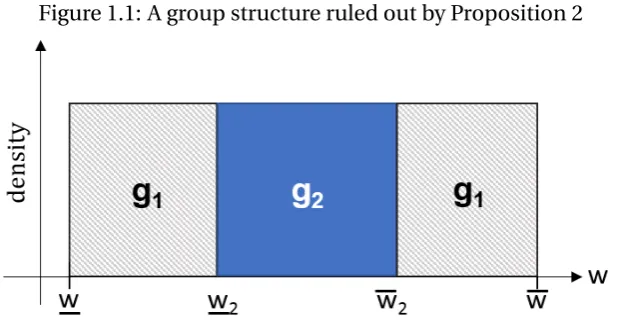
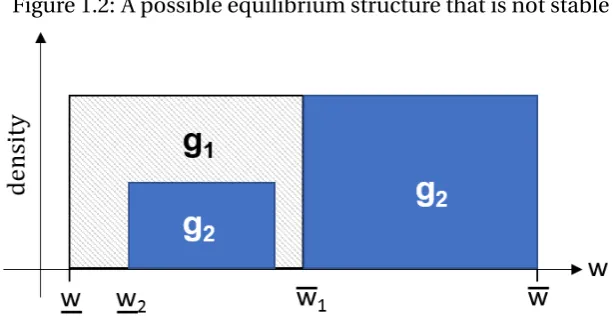
Figure 1.1 shows a structure ruled out by Proposition 2. There are two social groups
and strict monotonicity in type at the bottom implies thatφ2>φ1. But then strict
monotonicity in quality at the top requiresw2>w1which is not the case. Figure 1.2,
on the other hand, shows a possible equilibrium structure withφ2>φ1.
The monotonicity in quality has implications for the prices of groups in equilibrium.
mone-Figure 1.2: A possible equilibrium structure that is not stable
tary transfer to avoid low ranked agents in lower quality groups to join. A group with
higher quality needs to have a higher price. To stay within the previous example,
tu-ition fees at University A need to be higher. In Figure 1.2, the price ofg2needs to be
strictly greater than that ofg1.
Corollary 2.1. In equilibrium, for any two active social groupsLh,Lg: φh>φg⇔ph>pg
Similar to the result that equal prices must imply equal characteristics of groups, we
find that if two groups are equal in their highest type then they must be identical in
their payoff-relevant characteristics:
Corollary 2.2. For any two active social groupsLg,Lhin equilibrium,
(i) ifφhas no returns to scale, wh=wg if any only if the social groups are identical up to size.
(ii) ifφhas returns to scale, wh=wg if any only if the social groups are identical.
1.4.1 Stable Equilibria
Attention is now restricted to equilibria that exhibit a certain stability. If groups differ
in quality, then any intersection of their supports on a set of positive measure requires
the agents in this set to be exactly indifferent between higher rank versus higher
qual-ity. But indifference for a continuum of agents entails a degree of instabilqual-ity. Suppose,
for example, a number of students over a range of abilities is indifferent between two
schools. Now if the distribution of one of these schools is slightly perturbed, either
because the distribution changes or because the perception of it is altered, then the
status of almost all students in that school is affected. Indifference breaks necessarily
for almost everybody with an ability in the overlap; even if this perturbation is
[image:20.595.142.449.84.248.2]around somew, then the rank of almost all agents above that is increased while that
of those below is reduced. Independent of the effect on quality, indifference can’t hold
for (almost) anyone.30
Definition 5(²-Perturbation). A measureL²g is an²-perturbation of a social groupLg ifL²g ≤L and the related qualityφg² and rank rg²differ fromφg and rg by at most².
Clearly, for²large enough, any active social group is the²-perturbation of another. But
for small², it allows us to describe the set of (potential) groups that are similar in status
and quality. Given the continuity ofφ, such a perturbation always exists. Stability
here is the notion that if one equilibrium group was to be replaced by a very similar
group (even if this group is not actually feasible), then the set of agents for which the
membership in this perturbed group is suboptimal should also be small. Negligible
differences in groups (or the perception of these groups) should have negligible effects
on outcomes. The following refinement captures this:
Definition 6(Stable equilibrium). An equilibrium is stable if for any²-perturbation of any active social groupLg, as²→0, the measure of agents with w∈W such that
U¡w,g,L0A¢≥U¡w,a,L0A¢ ∀a∈A (1.2)
whereL0Ais the perturbed vector of social groups, approachesLg.
Take any equilibrium group structure. This equilibrium is stable if after the status or
quality in any group is perturbed by an arbitrarily small amount, the set of agents for
which the group assignment is not optimal is also arbitrarily small. As the following
Lemma concludes, this rules out any overlap in between the supports of groups:
Lemma 1. In any stable equilibrium, the intersection of the supports of all active social groups has measure 0.
As the following result states, stability significantly narrows down the type of social
groups that can form in equilibrium. At the same time, it does not pose an issue with
existence. Stability simply rules out any overlaps in the support; whether complete
overlaps, as in the case of social groups with equal cost that are identical up to size,
or partial overlaps. The supports of all active social groups (that are not the isolation
choice) form an interval partition of [w,w] wherew≥w.
Proposition 3. In a stable equilibrium, the group structure can be represented by an interval partition of[w1,w] with w1≥w . The support of any active social group is convex.
The convexity result highlights that in a stable equilibrium, there can be no ‘gaps’ in
the support of any social group. Any such gap is driven by the rank/quality trade-off.
Since the two groups can’t be identical in quality, a gap in the support means that the
agents with types in that gap achieve higher utility in a lower quality group.31 But this can only arise if there are also intersections in the support. These are ruled out by
sta-bility. A group structure as in Figure 1.2 cannot be a stable equilibrium.
Stability allows for a stricter monotonicity result. Since there can be no overlaps, a
higher group quality implies a higher lowest type and vice versa. Given the interval
structure, we can further conclude that for any two active groups withφh>φg, we
needwh≥wg; the lowest type in the higher quality group needs to be weakly greater than the highest type in the lower quality group.
Corollary 3.1. In a stable equilibrium, social groups are strictly monotonic in type and quality.
Without the stability refinement, we were able to conclude that if two groups have
equal quality, they must be equally priced and have equal support. With stability we
find that there can be no two active groups of equal quality at all. It is therefore without
loss to think of agents paying the same price as being members of the same group.
Corollary 3.2. In a stable equilibrium, there can be no two active social groups equal in price or quality.
With the combination of status concern and stability, we are able to eliminate some
multiplicity. Any groups equal in quality need to be equal in their distribution over
W. With stability, every type needs to be assigned just one group. Accordingly, there
can be only one group of a particular quality. Following those results, not only can we
represent an equilibrium group structure as an interval partitionI ={w1, ...,w},32but
every interval corresponds to a distinct group. In the following sections, stable
equi-librium social groups will be characterized by the partition ofW they induce. When
convenient, I highlight theequilibrium group structureor equilibrium partition that a
set of prices induces, rather than the social groups themselves.
Definition 7(Equilibrium group structure). I ={w1, ...,w}is called an equilibrium
group structure if there exists an assignment y :W → A such that for every interval
[wi,wi+1]with wi,wi+1∈I, there is a unique gi∈G with y(w)=gifor all w∈(wi,wi+1]
31In the opposite case, where the quality of the group covering the gap is higher, the single-crossing assumption would imply that all higher types achieve higher utility in that group. This could not be an equilibrium independent of stability.
and y(w)= ;for all w∈[w,w1)and there exists a p such that this is an equilibrium in
the agents’ game.
1.4.2 Degree of Sorting
We now explore how status concern affects the equilibrium sorting or ‘segregation’.33 It is shown that with status concern, there is a bound on the number of active social
groups in a stable equilibrium. If status concern is parametrized, it can be shown
that a stronger preference for status reduces the number of active groups that can be
maintained in equilibrium and, in the extreme case where only status matters, there
can only be a ‘representative’ social group.
Without status concern, given a suitable price vector, any interval partition can be
maintained in equilibrium; at least if the group quality is increasing in types.34 The preference of agents over status in their social group puts a limit to this:
Proposition 4. There is an upper bound k≥1on the number of active social groups in any stable equilibrium.
The economic intuition is that for a very fine group structure, the quality difference
between any two adjacent groups is very small. But because of the interval structure,
there is a cut-off type that achieves rank 1 in one group and rank 0 in the other. If
groups are too close in quality, incentive compatibility for such social groups cannot
hold for any vector of prices. In an equilibrium, the quality difference between two
adjacent social groups needs to be sufficiently large if agents have status concern. If
University A is almost identical to University B but any student in A could achieve a
strictly higher rank in B, then this is not an equilibrium outcome independent of the
tuition fees.
We can further show that this is ‘monotone’ in status-concern: as status becomes
more important, the maximum number of active social groups in a stable
equilib-rium decreases. To capture this comparative static, I write preferences asuα(w,φ,r)≡
u(w,φ,r)+αv(w,r) for some 0≤α< ∞and a continuous and differentiable function
v with ∂∂rv(w,r)>0, ∂r∂∂2wv(w,r)>0.35 Ordering preferences by this parameterα, we can conclude that asαincreases, less segregation can be maintained.
33I refer to a population being (unambiguously) more segregated if the equilibrium group structure is finer. This is, of course, only a partial order.
34If the group qualityφis monotone in type in the sense that if almost all types in a group are higher then the quality of that group is (weakly) higher, then any (convex) interval partition can be maintained as a group structure in equilibrium. See Definition 9 for a formal definition of monotonicity.
Corollary 4.1. The least upper-bound on the number of active social groups in any sta-ble equilibrium is weakly decreasing inα.
But the fact that a stronger status concern allows for less segregation does not hinge
on the stability refinement. Without stability, groups can ‘overlap’ and we cannot
de-scribe segregation in terms of the coarseness of the partition ofW. However, in a sense
groups need to be more similar. It is shown in the Appendix (1.6.2) that for any
increas-ing sequence ofα’s approaching infinity, in any corresponding sequence of probability
distributions of active social groups, the difference between these distributions has to
converge uniformly to 0. Furthermore, asαincreases, these distributions have to be
arbitrarily close to the population distribution - at least over their support. If status
concern becomes very important, than agents can still be excluded from participating
in social groups but differences in active social groups have to disappear.
Taking this yet one step further, if agents have preferences over status only, previously
defined asUr, then no segregation can be achieved at all. If there are multiple groups, then they must be identical in their payoff relevant characteristicspandr. In a stable
equilibrium, there can only be one active social group whose probability distribution
is equal to the population distribution over the support of the group.36
Corollary 4.2. If agents have preferences over status only, then in any equilibrium all active social groups must be identical up to size and have equal prices. In a stable
equi-librium, there can be at most one active social group.
1.5 Discussion
This Chapter establishes that status concern limits the degree of segregation across
social groups that can be sustained in equilibrium when the composition of groups
determines the payoff. Status concern is a force for homogeneity across groups. When
people care only about the ‘quality’ of a group, then arbitrarily fine separation is
feasi-ble and, at least for quality functions that are increasing in the type of members, any
interval partition of the type space can be sustained as an equilibrium outcome. If
agents care about the rank they occupy in a group, this is no longer possible. If groups
take the form of interval partitions, there is a finite upper bound on the number of
non-identical social groups that can be sustained in equilibrium. In the pure status
case where agents care only about their rank, there can be only one type of group.
36In fact, ifu
While complementarity in types and quality allows for sorting, status concern
consti-tutes a countervailing force.
If status concern is important, empirical models might need to take this into account.
For instance, Kendall (2003) tries to derive conclusion about whether or not spillovers
in ability in professional basketball exhibit complementarities - stronger players
ben-efitting more from stronger team members - by analyzing the concentration of strong
players in teams. It is found that teams are more similar in quality than would be
ex-pected if complementarities were strong. If, however, players care about their rank
within the team, there might be little concentration despite the presence of
comple-mentarities. Status concern might constrain firms in how they can allocate employees
across teams. In Mas and Moretti (2009) it is found that due to the nature of spillovers
in ability of cashiers, it is efficient to create representative teams for each shift.
Never-theless, the firm does not actively assign workers to shifts. If these workers care about
their relative ability within their team, then workers have a tendency to sort efficiently
without an explicit allocation. More generally, if prices are forced to be equal across
groups (e.g. laws setting tuition fees, union rules equalizing pay, etc.) then we can
expect these groups to be similar in their distribution of agents’ types - if agents care
1.6 Appendix
1.6.1 A: Omitted Proofs
Proof of Proposition 1:
First, the following Lemma is proved:
Lemma 2. If there are n equal active prices, in any equilibrium the corresponding n active groups must be identical inφand their probability distribution over W .
Proof. Take any probability distribution overG×W. Suppose there arenactive groups
with equal prices. LetGn⊆Gbe the set of these groups with equal prices. Let further-moreGn⊆Gn such that for anyg ∈Gn, the corresponding social groupLg is such thatφg =max{φj:j ∈Gn}.
Let [wn,wn]=Wn⊆W be the smallest interval containing the supports of all groups inGn. We first observe that an agent with characteristic w sufficiently close to wn must be member of a group withg ∈Gn. Suppose not and she’s member of a groupk withφk<φg. Given equal prices, this can only be optimal ifrk(w)>rg(w).
But it follows from continuity ofuthat there exists an²>0 such that for anyw>w˜≡
w−²we haverk(w)−rg(w)<δwhereδis such that:
u( ˜w,φg,rk( ˜w)−δ)=u( ˜w,φk,rk( ˜w))
For anyw >w, there is a strict incentive to join a group in˜ Gn. It follows that agents sufficiently close townmust be in a group with the highest quality.
Similarly, agents sufficiently close townmust be in a groupg ∈Gn. We can conclude this by noting that for any other groupkwithk∉Gnandrk(w)>rg(w) for allg ∈G
n
there exists some²>0 such that for all w <w˜ =wn+²we haverg(w)−rk(w)<δ whereδis such that:
u( ˜w,φg,rk( ˜w)−δ)=u( ˜w,φk,rk( ˜w))
For an agent with a sufficiently low type, if prices are equal, there is a strict incentive
to join the highest quality group since the agent’s rank is close to 0 in any group and
∂
∂φu(w,φ,r) is strictly positive for anyr.
Furthermore, by the same argument, any agent in a groupk∈{Gn\Gn} with typew such thatrk(w) is sufficiently close to 0 has a strict incentive to join a group inG
∂
∂φu(w,φ,r)>0. Since every group with positive mass must have such members, all
such groups need to be inGn.
To conclude, we can observe that when prices and quality are equal across a set of
groups, then for anyw∈W, we needrg(w)=rh(w) for anyg,h∈G n
. All active groups
need to be identical in terms of quality and rank for any type. But since the rank of an
agent with typew is equal to the CDF evaluated atw, the CDF over types needs to be
equal across groups.
Using this Lemma, we can prove the Proposition:
Proof. Sufficiency:
If two active social groupsLg,Lh have the same probability distribution, then nec-essarilywg =wh. For indifference, we need:
u(wh,φh, 0)−ph=u(wg,φg, 0)−pg
WLOG supposeph >pg. Then for indifferenceφh >φg. But since the probability distributions are equal, we also know thatwh=wg >wg. Complementarity inw,r andφimply that
u(wh,φh, 1)−ph>u(wg,φg, 1)−pg
which contradictswg =wh.
Necessity:
If for two active social groupspg =ph, then applying the argument from Lemma 2 to Wn=[wh,wh]∪[wg,wg] andGn={g,h}, we can conclude thatφh=φgwhich implies that for allw∈g,hwe needrg(w)=rh(w) which means the probability distributions overW must be identical.
Proof of Corollary 1.1:
Proof. a) Suppose not and for some subsetB⊂W we haveLg(B)6=κLh(B). Then it follows from the Radon-Nikodym theorem that the probability distribution over types
within each group is such that for somew ∈g, Fg(w)6=Fh(w). But it follows from Proposition 1 that this cannot be the case in equilibrium sinceph=pg.
b) As the probability distributions have to be the same across both groups, suppose
all agents ing have a strict incentive to joinhsince they obtain the samer but higher φat the same price. In equilibrium,φh=φg and thereforeLg=Lh.
Proof of Proposition 2:
Proof. Take any two active social groupsLg,Lhwith withg,h∈G. By definition, the smallest convex set containing their support are [wh,wh] and [wg,wg].
Case 1 - bottom:
Suppose monotonicity in quality at the bottom fails such thatφh>φg butwh<wg. Then any agent with typewsufficiently close towhin groupgcan instead join grouph and obtain a strictly higher rank and benefit from higher quality. This switch is strictly
beneficial unlessph−pg is sufficiently large. But due to the complementarity inφand w, we know that ifwg >whthen
u(wg,φh, 0)−u(wg,φg, 0)>u(wh,φh, 0)−u(wh,φg, 0)
Therefore, ifph−pg ≥u(wg,φh,rh(wg))−u(wg,φg, 0) then
u(wh,φh, 0)−ph<u(wh,φg, 0)−pg
Membership inhfor agents close to and includingwhcannot be optimal.
Case 1 - top:
Suppose strict monotonicity in quality at the top fails such thatφh>φg butwg ≥wh.
Using the previous result, we know that
u(wh,φh, 0)−ph≥u(wh,φg,rg(wh))−pg
withrg(wh)≥0. It follows that
u(wh,φh, 0)−ph≥u(wh,φg, 0)−pg
From complementarity inφandw, it must be the case that for allw>wh:
u(w,φh, 0)−ph>u(w,φg, 0)−pg
andr, it follows that:
u(w,φh, 1)−ph>u(w,φg, 1)−pg
and therefore for anyrg(w)≤1
u(w,φh, 1)−ph>u(w,φg,rg(w))−pg
Agents with typew such thatw≥whmust strictly prefer membership in grouph. By continuity, this is also true for agents with types below but sufficiently close towh. A contradiction towg≥wh.
Case 2 - bottom:
Suppose strict monotonicity in type at the bottom fails such thatwh>wg butφg ≥φh. It must be that
u(wh,φh, 0)−ph≥u(wh,φg,r(wh))−pg (1.3)
Sinceφg ≥φh, this can only hold ifph<pg. But we know that:
u(wg,φg, 0)−pg≥u(wg,φh, 0)−ph
From complementarity we conclude that this must also hold for agents withw>wg and furthermore:
u(wg,φg,r)−pg>u(wg,φh, 0)−ph
for allr∈(0, 1]. Sincerg(wh)>0, group membership inhcannot be optimal for agents close to and includingwh. A contradiction.
Case 2 - top:
Suppose strict monotonicity in type at the top fails such thatwh>wg butφg ≥φh. From monotonicity in quality at the bottom, we know thatwg≥wh. It follows
u(wg,φg, 0)−pg ≥u(wg,φh,rh(wg))−ph
This implies for anyr∈(0, 1] andw≥wg:
u(w,φg,r)−pg>u(w,φh,r)−ph
It follows that
u(wh,φg, 1)−pg>u(wh,φh, 1)−ph
Proof of Corollary 2.1:
Proof. For any two active social groups withφh>φg, monotonicity in quality at the
bottom implies thatwh≥wg. In equilibrium:
u(wg,φg, 0)−pg≥u(wg,φh, 0)−ph
But since for any w ∈W, φ, and r ∈[0, 1] we have ∂φ∂ u(w,φ,r)> 0, we need that
ph>pg.
For the other direction, supposeph>pg. Take the typewh∈hwithrh(wh)=0. Nec-essarily, the rank obtained in the other group isrg(wh)≥0. Suppose nowφg ≥φh. Monotonicity in quality at the bottom implieswg ≥wh. In equilibrium we need:
u(wh,φh, 0)−ph≥u(wh,φg, 0)−pg
But ifφg >φh, it cannot be thatph>pg as again ∂φ∂ u(wh,φh, 0)≥0. And ifφg =φh, it follows immediately that we cannot haveph>pg as the above inequality would be violated.
Proof of Corollary 2.2:
Proof. Case (i) - sufficiency:It follows from strict monotonicity in quality at the top thatφg =φh. Given strict
monotonicity in type at the bottom, we can then conclude thatwg =wh. This im-plies thatph=pg. It follows from Proposition 1 that the probability distributions need to be the same.
Case (i) - necessity:
If the CDF’s are identical, then sinceφ has no returns to scale,φ must be identical.
Strict monotonicity in type at the top then implies thatwh=wg.
Case (ii) - sufficiency:
The argument is the same as in Case (i) with the addition that equal quality requires
the measures to be identical for every measurable subset of W.
Case (ii) - necessity:
If the social groups are identical, thenφis identical and then strict monotonicity in
type at the top implieswh=wg.
Proof of Lemma 1:
[w10,w2] withw10 >w1. Because of the continuity of φalmost everywhere, for every
²there exists such a perturbation (noting that rank is necessarily continuous). If for every²there exists such aL²g with qualityφ0g such that²> |φ²g−φg| >0, then no mat-ter the², all agents in [w10,w2] either strictly prefer membership in social groupL²g or
Lh. The equilibrium is not stable.
If this does not exist, then we can conclude from continuity that at least for some such ²-perturbations, φ²
g−φg =0. But then there exist ²-perturbations that increase (or decrease) the status of all agents inL²g with type [w01,w2]. Again, all agents in that
interval either strictly preferL²g orLhfor all such perturbations. The equilibrium is not stable.
Proof of Proposition 3:
Proof. We first prove theinterval result:
Suppose the support of social groups does not represent an interval partition of a
sub-set ofW. Then there must be at least two social groups Lg,Lh and a compact set S⊂W such that for every subsetSi⊆S,Lg(Si)>0 andLh(Si)>0. This requires that (alomst) all agents inSare indifferent between the two groups.
If not and there is a typewstrictly insideSthat is not indifferent and, for instance,
u(w,φh,rh(w))−ph>u(w,φg,rg(w))−pg
then for a small enough²>0,
u(w+²,φh,rh(w+²))−ph>u(w+²,φg,rg(w+²))−pg
This means types immediately abovew must also strictly preferh. This implies that
rg(w)=rg(w0) for allw0>w. Single-crossing then implies that allw0strictly preferh tog. The support cannot intersect overS.
But if all types inSare strictly indifferent, then they have measureL(S)>0 which is
ruled out by Lemma 1.
Finally, we observe that no set of agents [w1,w2] strictly inside ofW can be priced
out of every group unless all agents with typew<w1are also not participating in any
group. If there is any typew≤w1in groupg, thenU(w,g,LA)>u. But from
single-crossing we can infer that this is also true for allw0>w1.
Suppose the support of an active social group is not convex. Then there is an interval
W1=[wl,wh]⊂W such thatLg([wl,wh])=0 for some groupgand there are intervals Wl=[wg,wl0] andWh=[wh0,wg] withLg positive for any measurable subset of these two intervals andwl0≤wl<wh≤wh0.
Note that by the previous argument there must be at least one groupf ∈GwithLf(W1)>
0.
The membership pricespf andpg must be such that for some ˆw<wh:
u( ˆw,φf,rf( ˆw))−pf ≥u( ˆw,φg,rg( ˆw))−pg
Ifφf ≥φg, then for all w ∈( ˆw,wh], the following must be true noting thatrg(w) is constant for allw∈W1whilerf(w) is increasing:
u(w,φf,rf(w))−pf >u(w,φg,rg( ˆw))−pg
It follows from the single-crossing condition that it cannot be the case that for any
w∗≥wh:
u(w∗,φf,rf(w∗))−pf ≤u(w∗,φg,rg( ˆw))−pg
Suppose instead thatφf <φg: We know that
u(wg,φg, 0)−pg ≥u(wg,φf,rf(wg))−pf
and sinceu is strictly increasing inr and w, and as rf must be constant in Wl ac-cording to the interval partition statement, we can conclude that for anyw