2017 2nd International Conference on Artificial Intelligence and Engineering Applications (AIEA 2017)
ISBN: 978-1-60595-485-1
A Method to Allocate Machine Tools Based on
Design Structure Matrix
HUI HUANG and FAN ZHANG
ABSTRACT
In order to solve the issue of enterprises on reasonably allocating machine tools quickly before a part is manufactured, this paper presented a machine tool scheduling method based on design structure matrix (DSM). A scheduling model for correlation matrix between part manufacturing processes and machine tools was constructed. The matrix traversal algorithm was utilized to allocate machine tools automatically and reasonably based on the process information of a part to be manufactured. The evaluation indexes and standards of optimal machine tool scheduling plan were put forward and the TOPSIS method was used to solve the problem of choosing the optimal machine tool scheduling plan. The feasibility of the method was verified through an application case using the developed prototype system. Compared with other two methods, namely the manual allocation method of machine tool and the scheduling method based on genetic algorithm, our method has an advantage of spending less time.
KEYWORDS
Machine tool scheduling; design structure matrix (DSM); scheduling model; allocation scheme.
FOREWORD
Production scheduling is an important business activity of a modern agricultural machinery manufacturing enterprise. It refers to the reasonable allocation of production resources (such tools, machine tools, fixtures, production personnel, etc.) during the total product life cycle to complete the processing of a part. Agricultural machinery manufacturing enterprise, by way of this reasonable resource allocation, achieves expected economic goals (for example, low manufacturing cost, short processing time and low energy consumption).
Reasonable production scheduling can improve the manufacturing efficiency of an agricultural machinery manufacturing enterprise, reduce the idle and waste of processing resources, and improve its productivity and competitiveness. Unreasonable production scheduling may disturb or interfere an enterprise’s overall production planning and progress, extend the product processing time, thus cannot guarantee
_________________________________________
products’ delivery. How to realize the rapid and reasonable allocation of processing resources has become an important indicator of measuring an agricultural machinery manufacturer’s response ability to market.
Reasonable allocation of machine tools is an important step in production scheduling. Different machine tools have large difference in energy consumption when processing. With the emergence of energy-saving production and green manufacturing, agricultural machinery manufacturing enterprises raised higher requirements for the allocation of machine tools. Reasonable and rapid allocation of machine tools has become a research hotspot in the field of agricultural machinery manufacturing and management.
Current scheduling methods are mainly divided into two types: (1) Manual allocation of machine tools; (2) artificial-intelligence based methods. Manual allocation and analysis is time-consuming and inefficient, so only applicable to the scheduling of machine tools for small producers. Current artificial-intelligence based methods mainly include Genetic Algorithm (GA)[1], Ant Colony Algorithm (ACA)[2, 3], Simulated Annealing Algorithm (SAA)[4], etc. Both domestic and foreign scholars have used artificial-intelligence methods (such as GA, ACA, SAA, etc.) to solve scheduling problem. LIU Qiong, et al.[5] put forward an improved genetic algorithm to solve the scheduling problem of flexible workshop. WANG Xiaoyuan, et al.[6] proposed the process of same-time-stop scheduling constraint processing technology based on genetic algorithm, which solved the problem of the same-time-stop and control of processing time with multiple processes. The limitation of genetic algorithm to solve scheduling problem is: the accuracy of optimal solution depends heavily on the number of iterations and the size of population and the larger the population size is, the closer to the optimal solution we will be. The larger the population size is, the more the computing resources will be consumed because the demand for computing resources will be increased sharply. PAN, el at.[7] adopted ant colony optimization algorithm to solve the problem of processing resource scheduling in assembly line. Although ant colony algorithm to solve workshop scheduling optimization problem can get a feasible solution accurately, the accumulation of pheromone requires more search time at the beginning of the algorithm, Therefore, it takes a longer time to obtain optimal solution or approximate optimal solution by using ant colony optimization algorithm. LI Jun, et al.[8] used the improved simulated annealing algorithm to solve the problem of scheduling optimization with flexible workshop. The advantage of simulated annealing algorithm is: strong local search capability. The disadvantage of simulated annealing algorithm is: it often takes a longer time for the search process to stabilize due to lack of anticipation of the entire search space.
In view of above-said methods’ shortcomings, this paper proposed a method for the allocation of machine tools based on Design Structure Matrix (DSM).
OVERVIEW OF MACHINE TOOL SCHEDULING
the least energy consumption while guaranteeing that part processing is completed. The mathematical set is described as follows:
<Mcon> :: = Msta| Mspe |Rpm < P > :: = P1| P2|∙∙∙| Pm
<M> :: = M1| M2|∙∙∙| Mm Mi = fi (Pi),1 i m
Ti=fti (Pi, Mi),1 i m
<T>:: =T1| T2|∙∙∙| Tm
1 m total i i T T
Ci=fci (Pi, Mi),1 i m
<C>:: =C1| C2|∙∙∙| Cm
1 m total i i C C
Ei = fei (Pi, Mi),1 i m
<E >:: = E1| E2|∙∙∙| Em
1 m total i i E E
[Min T] total|Ctotal|Etotal
< P >Mcon <M>
In which, Mcon represents the set of constraint conditions for machine tool selection; Msta stands for machine tool status constraints; Mspe indicates machine tool specification constraints; Rpm is the interconnection constraints between processes and machine tools; P denotes the set of all processes for a part to be processed; Pm means the mth process and m is the total number of processes; M indicates the set of all machine tools selected for the part to be processed; Mm is the machine tool selected for mth process; fi represents the mapping function from Pi to Mi; Ti is the time spent for process Pi completed by machine tool Mi; fti is the mapping function from (Pi, Mi) to Ti; T, the set of processing times to complete all processes; Ttotal, total time to complete all machining processes; Ci, the production cost if process Pi is completed by machine tool Mi; fci, the mapping function from (Pi, Mi) to Ci; C, the set of production costs to complete all processes; Ctotal, the total production cost to complete all processes; Ei represents the energy consumption for process Pi to be completed by machine tool Mi; fei represents the mapping function from (Pi, Mi) to Ei; E represents the set of energy consumptions for all processes to be completed by machine tools; Etotal, the total energy consumption for all processes to be completed; the final formula is expressed as the allocation scheme P corresponding to M to achieve the Min (Ttotal or Ctotal or Etotal) when machine tools are allocated under the constraints Mcon according to the process set.
METHOD OF MACHINE TOOL ALLOCATION
The issues to be solved by this paper are as follows.
Object of study: Machine tools in the workshop of the agricultural machinery manufacturing enterprise
Given conditions: Status of all machine tools in the workshop; operation procedures of the parts to be processed (including their processing procedure information, the requirements of their specific dimensions, etc.); associative mapping relationship between process name and machine tool
Objective of study: Developing a method to allocate machine tool automatically (machine tools are allocated automatically and reasonably according to parts’ processing procedures) to ensure part processing is completed smoothly and achieve the shortest processing time, or the minimum energy consumption, or the lowest cost, or the best comprehensive result.
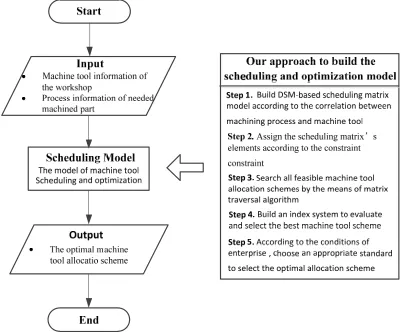
Figure 1. Flowchart of machine tool allocation based on DSM associative scheduling matrix.
The core of this allocation method is to build machine tool’s scheduling optimization model. Detailed modeling method is presented as below.
Build a scheduling model
According to the correlation between machining process and machine tool, an associative scheduling matrix is built between process and machine tool. Without loss of generality, we suppose there are m processes (P1, P2, ..., Pm) in total for the part to be processed and there are n machine tools (M1, M2, ..., Mn) in the workshop. We now map the selection relation between each process and machine tool as a matrix, where matrix’s row corresponds to the machine tool and its column corresponds to the process, so an m n -order matrix is formed which is also called DSM-based
Matrix assignment strategy
From Section 3.1, we can know that the valuation of the scheduling matrix reflected the state of a process’s selection of machine tool. The matrix element’s valuation strategy embodies process selection corresponding to the condition of the machine tool. We may use a mathematical set to describeaij’s valuation strategy, i.e.
the condition of aij=1 as follows:
<Mconij> :: = Mstaj| Mspej | Rpmij Val (Mstaj){0,1}
Val (Rpmij){0,1}
If Val(Mstaj)=1 Proi Scope(Mspej) Val(Rpmij)=1 then aij=1
P1
P2
P3
…
Pm
M1 M2 M3 M4 … Mn
n machine tools in a workshop
a
12a
13a
14 …a
1n…
… … … … …
a
21a
31a
m1a
22a
23a
24 …a
2na
32a
33a
34 …a
3na
m2a
m3a
m4 …a
mn [image:6.612.189.405.246.431.2]a
11Figure 2. Model of associative scheduling matrix based on DSM.
TABLE 1. RELATIONSHIP BETWEEN PROCESS NAME AND MACHINE TOOL TYPE. Process name Machine tool type
Drilling Drilling machine Turning excircle Lathe
…… ……
Boring Boring machine
[image:6.612.89.505.474.535.2]of the machine tool is shown in Table 1. The last row means that machine tool satisfies three conditions at the same time (1. State of the machine tool is selectable, 2. Part size is within the machine tool’s specifications; 3. Process name and machine tool type match each other). Scheduling matrix element’s value (aij) is 1, which means that the ith process can be completed by the jth machine tool.
Machine tool allocation schemes
When assigning machining jobs, there may exist such a situation that a process can be performed by several machine tools respectively. So when allocating machine tools based on process, multiple possible schemes may arise. It is the main target of this section how to find the feasible machine tool allocation scheme from the associative scheduling matrix quickly.
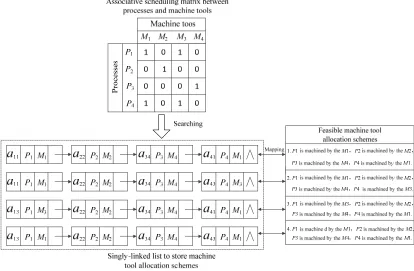
After assigning the associative scheduling matrix, choose an element with a value of 1 from each row of the matrix in sequence to form a feasible allocation scheme. Figure 3 shows us a 4 4 -order associative scheduling matrix which is assigned. An element is taken in sequence from each row of the associative scheduling matrix shown in Figure 3 and stored in a singly-linked list, so we will have four singly-linked lists and the corresponding machine tool allocation schemes will be four. The matrix traversal algorithm is used for automatic search of feasible machine tool allocation schemes.
Evaluation index of allocation plans’ advantages and disadvantages
Figure 3. Linked storage of allocation schemes.
Processing time
Processing time refers to the sum of the processing times for a part to be processed in all processes by each machine tool. The formula to calculate processing time is as follows:
1
m total i
i
T T
(1)
In above equation, Ttotal means sum of the processing times spent on all processes (m) for a part to be processed on corresponding machine tool. Ti refers to the processing time that is spent on process Pi with its chosen machine tool.
Processing cost
Processing cost refers to the sum of the processing costs for a part to be processed in all processes by corresponding machine tool. The formula to calculate processing cost is as follows:
1
m
total i
i
C C
(2)
Energy consumption
Energy consumption refers to the sum of the energies for a part to be processed in all processes by corresponding machine tool (here mainly means the electrical energy which is consumed by machine tools). The formula to calculate energy consumption is as follows:
1
m total i
i
E E
(3)In above equation, Etotal means sum of the energies consumed on all processes (m) for a part to be processed on corresponding machine tool. Ei Refers to the energies that is consumed on process Pi with its chosen machine tool.
Optimal selection of allocation schemes
If an enterprise wants to select the best allocation plan according to their business operation requirements to guide the actual production, a criterion or standard is needed for evaluation. This paper proposes four rules for optimal selection of machine tools by abiding to the characteristics of manufacturing enterprises.
Rule 1: For a manufacturing enterprise with relatively short delivery time, the optimal selection should be the allocation plan with the least processing time.
Rule 2: For a manufacturing enterprise highly focusing on cost control, the optimal selection should be the allocation scheme with the lowest processing cost.
Rule 3: For a manufacturing enterprise with energy shortage, the optimal selection should be the allocation plan with the lowest energy consumption.
Rule 4: For a manufacturing enterprise which has to meet delivery requirement, but also consider both cost control and energy consumption, it may select a scheme with the optimal comprehensive combination of processing time, processing cost and energy consumption.
Rule 1 is easy to implement, where you may use formula (1) directly to calculate each allocation scheme’s processing time and sort the results, finally, the machine tool allocation scheme with the minimum value is recommended as the optimally selected scheme. The implementation of Rule 2 or Rule 3 is similar to that of Rule 1, except that formula (1) is replaced by formula (2) or (3). As to Rule 4, it is difficult to implement because the measurement unit of processing time is in minutes, that of processing cost is in Yuan and that of energy consumption is in Joule, belonging to different dimensions. According to Rule 4’s different factors (processing time, processing cost and energy consumption), multiple attribute decision making method (TOPSIS)[11-16] is used to solve the problem of selecting the optimal machine tool allocation scheme.
APPLICATION VALIDATION AND METHOD EVALUATION
Application verification
system was developed using Microsoft Visual Studio 2008 as a development platform, C++ language and Microsoft SQL Server 2005 databases. The allocation system has two core functional modules: (1) Search a feasible machine tool allocation plan; (2) Choose the optimal machine tool allocation scheme to guide the actual production of the workshop. These two modules adopted the feasible machine tool allocation (search) and optimization method based on the design structure matrix proposed in this paper.
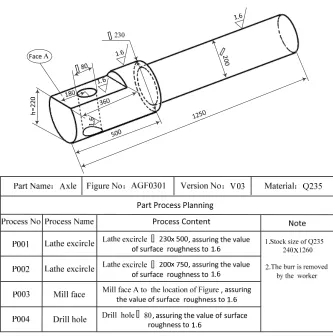
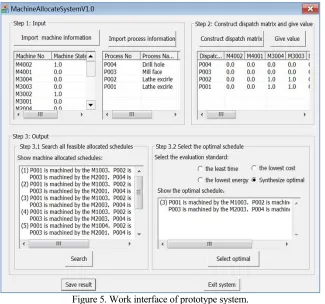
[image:10.612.133.466.379.715.2]Application verification of the prototype system’s allocation function was carried out at an agricultural machinery manufacturing enterprise located in Zhanjiang, Guangdong Province. The object to be verified is a shaft as shown in Figure 4. The system’s work interface is shown in Figure 5. In the module of imported machine tool information, ‘1’ means that the machine tool is in normal state, i.e., in idle state, so can be selected. ‘0’ indicates that the machine tool is in maintenance, or damaged, or being used by other machining task and so cannot be chosen. After importing the enterprise’s machine tool information and process information of the part to be machined, feasible allocation plans of the machine tool are found (searched) automatically by the system to select an optimal comprehensive machine tool allocation rule, obtaining an optimal machine allocation scheme (#3), so as to guide the actual production. This scheme is consistent with the allocation scheme obtained by manual allocation of machine tool, which verifies the correctness and feasibility of this method.
Figure 5. Work interface of prototype system.
TABLE 2. TIMES SPENT BY THREE METHODS ON MACHINE TOOL ALLOCATION. Method Allocation time Method of this paper 18 milliseconds Manual allocation of machine tool
GA-based allocation 26 milliseconds 480 seconds
Notes: Times listed in both method of this paper and GA-based allocation are algorithm time
Method evaluation
In order to evaluate the merits of the method proposed in this paper objectively, the method here and the other two methods (manual allocation of machine tools and genetic-algorithm based method) are used under the same conditions for contrast experiment. The time spent in allocating machine tools is used as the index and the method with the least allocation time is considered as the best.
Table 2 lists the times spent by the three methods which are applied in Section 4.1 when optimal comprehensive marks are used as the evaluation standard. According to Table 2, the method proposed by this paper is better than the other two methods under the same condition if times spent on machine tool allocation are used as evaluation index.
CONCLUSION
be processed and enterprise’s machine tools, the method built a scheduling and allocation matrix by presetting matrix elements’ assignment strategy and allocation plans’ optimal selection index and criterion. The method is verified by application case to be correct and feasible. If times spent on machine tool allocation are used as evaluation index, this method is better than the other two (manual allocation of machine tools and the method based on genetic algorithm). The achievements of this paper (machine tool allocation based on design structure matrix) can be applied to the machine allocation system of an agricultural machinery manufacturing enterprise to shorten the time an enterprise spends on machine tool allocation during the preparation phase, thus improving enterprise’s productivity.
ACKNOWLEDGEMENTS
The authors acknowledge the Special Foundation for Guangdong Non-profit Research and Ability Building of China (No. 2016A020210005),Central Public-interest Scientific Institution Basal Research Fund for Chinese Academy of Tropical Agricultural Sciences of China (No. 1630122017019) .
REFERENCES
1. Moradi M.H., Abedini M., A Combination of Genetic Algorithm and Particle Swarm Optimization for Optimal DG Location and Sizing in Distribution Systems. International Journal of Electrical Power & Energy Systems, 2012, 34(1), pp. 66-74.
2. Reed M., Yiannakou A., Evering R., An Ant Colony Algorithm for the Multi-compartment Vehicle Routing Problem. Applied Soft Computing, 2014, 15, pp. 169-176.
3. Kefayat M., Ara A.L., Niaki S.A.N., A Hybrid of Ant Colony Optimization and Artificial Bee Colony Algorithm for Probabilistic Optimal Placement and Sizing of Distributed Energy Resources. Energy Conversion and Management, 2015, 92, pp. 149-161.
4. Jose T.J., Idelfonso I.M., Alberto G.R., et al., A Dual Representation Simulated Annealing Algorithm for the Bandwidth Minimization Problem on Graphs. Information Sciences, 2015, 303, pp. 33-49.
5. Liu Qiong, Zhang Chaoyong, Rao Yunqing, et al., Flexible Job-shop Scheduling Problem With Improved Genetic Algorithm. Industrial Engineering and Management, 2009, 14(2), pp. 59-66.(In Chinese)
6. Wang Xiaoyuan, Wang Aimin, Fan Ruicheng, et al., Maching and Same-time-Stop Scheduling Constraint Processing Technology Based on Genetic Algorithm. Computer Integrated Manufacturing Systems, 2014, 20(11), pp. 2788-2797. (In Chinese)
7. Pan Q.K., Tasgetiren M.F., Suganthan P.N., et al., A Discrete Artificial Bee Colony Algorithm for the Lot-streaming Flow Shop Scheduling Problem. Information sciences, 2011, 181(12), pp. 2455-2468.
8. Li Jun, Liu Zhixiong, Zhang Yu, et al., Modified Simulated Annealing Algorithm for Flexible Job-shop Scheduling Problem. Journal of Wuhan University of Science and Technology, 2015, 38(2), pp. 111-116. (In Chinese)
9. Clarkson P.J., Simons C., Eckert C., Predicting Change Propagation in Complex Design. Journal of Mechanical Design, 2004, 126(5), pp. 788-797.
10. Tang Dunbing, Xu Ronghua, Tang Jicheng, et al., Analysis of Engineering Change Impacts Based on Design Structure Matrix. Journal of Mechanical Engineering, 2010, 46(1), pp. 154-161. (In Chinese)
12. Chen Xiaohong, Li Xihua, Multi-attribute Group Decision-Making Method Based on Intuitive Trapezoid Fuzzy TOPSIS. Journal of Control and Decision, 2013, 28(9), pp. 1377-1381.(In Chinese)
13. Chen C.C., Lee Y.T., Tsai C.M., Professional Baseball Team Starting Pitcher Selection Using AHP and TOPSIS Methods. International Journal of Performance Analysis in Sport, 2014, 14(2), pp. 545-563.
14. Cevik Onar S., Oztaysi B., Kahraman C., Strategic Decision Selection Using Hesitant Fuzzy TOPSIS and Interval Type-2 Fuzzy AHP: A Case Study. International Journal of Computational Intelligence Systems, 2014, 7(5), pp. 1002-1021.
15. Büyüközkan G., Güleryüz S., Multi Criteria Group Decision Making Approach for Smart Phone Selection Using Intuitionistic Fuzzy TOPSIS. International Journal of Computational Intelligence Systems, 2016, 9(4), pp. 709-725.