© 2017, IRJET | Impact Factor value: 5.181 | ISO 9001:2008 Certified Journal | Page 2952
Soil Stabilization using Scrap Rubber Tyre
Sanjeev Singh
1, Umesh Dhiman
2, Rubel Sharma
31
M.tech student, Dept. of Civil Engineering, GGGI College of Engg. & Technology, AMBALA, Haryana, India
2,3Assistant Professor, Dept. of Civil Engg. GGGI College of Engg. & Technology, AMBALA, Haryana, India
---***---Abstract
-
Disposal is a big problem links with
extremely growing up country like India. The waste
rubber tyres is safer disposal has become a biggest
challenging job. This thesis work represents the how to
safe dispose of the rubber tyres waste to save the
environmental and atmosphere of the earth. The
dissertation represents how to convert the rubber waste
to useful material for construction work in geotechnical
engineering and their properties. As we know that India
is a growing country and population is increase day by
day so this factors need to development and construction
of building , roads, etc. because they can easily survive. In
India the soil have found in different types. Some were
the soil have good bearing capacity and poor also. So we
have need to improves this poor bearing capacity of soil
to provide the strength hardness, Durability of the
structure The rubber tyre have some good physical and
chemical properties to improve the soil strength ,
bearing capacity , and effect less costly. Rubber tyres are
widely used for stabilization of soil in engineering work.
The commonly in general application being in
construction of highway , roads and airfield pavements.
Where the basic objective is stability of soil and to also
decrease the maintenance and construction cost
effectively by making aggravate use of locally available
materials. Stabilization is a basic fundamentally
changing the chemical properties of soft soil by adding
stabilizers or binders either in dry or wet situation to
developed the stiffness and strength of the originally
weak soil.
Key words:-
Clay. Soil, Sand, Waste rubber tyre crumbs,
UCS unconfined compression test, standard proctor
test.
1.INTRODUCTION
Finding effective ways in which to lose scrap tyres continues to be a haul throughout the planet. In an exceedingly growing country like Republic of India, disposal problems beside a seamless increase in tyre production have resulted in increase in tyre stockpiles which will harbor environmental issues, vector borne diseases and fireplace
hazards. In an attempt to cut back the change of integrity problem, alternatives, like waste reduction, resource recovering, land filling, and usage are being reviewed to cut back the continuing accumulation of scrap tyres. Sadly, every of those alternatives contains technical, economic and environmental limitations that inhibit the choice of an overall resolution. It's for this reason that continuing analysis is being conducted to determine use for scrap tyres within the market that effectively reduces that this limitations encountered by existing alternatives.
Waste tyre
stockpiles have reached menacing volumes in
severalindustrial countries, making an acute ought to establish engineering alternatives for the useful apply of discarded tyres. The producing method for tyre combines raw materials into a special kind that yields distinctive properties like flexibility, strength, resilience and high resistance. If tyres are reused as construction material, the distinctive properties of tyres will once more be exploited in an exceedingly useful manner. The advantages of mistreatment scrap tyres are significantly increased if they'll be accustomed replace virgin construction materials made of non-renewable resources. To boot, scrap tyres are show to own vital action capability for organic liquids and vapors. Recent analysis indicates that chopped tyres don't show any change of being a dangerous waste or of getting adverse effects on well water quality. Albeit classified as waste, tyre shreds have distinctive properties for several geotechnical and Geo-Environmental application. Properties of waste tyres are of serious worth for the planning of main road mound. The mixture of tyre shreds with soil for mound construction might not solely give different means that of reusing tyres to handle economic and environmental considerations, however conjointly facilitate solve geotechnical issues related to low soil shear strength. If
waste tyres are reused
as a Construction material instead of
disposed or burned,their distinctive properties will once more be useful in an exceedingly property materials stream
. Waste tyres may well
be effectively used as substitute to geo-
synthetics made of non- renewable resources.© 2017, IRJET | Impact Factor value: 5.181 | ISO 9001:2008 Certified Journal | Page 2953
2. EXPERIMENTAL INVESTIGATION
A series of unconfined compressive strength tests were conducted determine shear strength characteristics of untreated clay and clay stabilized with tire scrap to evaluate the effect of tire scrap on shear strength of the soil. These characteristics have been illustrated by establishing the relationships between resulting axial stress and applied axial strain in strain controlled tests. Unconfined compressive strength determined as peak strength value and respective failure strain have been calculated from the observations taken during the tests.
2.1 Soil used
The soil is classified as medium compressible clay, CI, as per IS: 1498 (1970). The grain size distribution and the physical properties of soil are reported in Table 3.1
2.2 Tyre-Scrap
Tire scrap have been divided into two categories on the basis of size for their inclusion in various percentages to the parent soil.The specific gravity of crumb tire scrap varies from 0.9 to 1.10, values as obtained from manufacturer.
[image:2.595.300.565.121.349.2]Scrap tyre different properties given as below.
Table -1:
classification of waste tyre according toparticlesize.
Material
Size
Cuts <300mm
Shred 50-300mm
Scrap 10-50mm
Granulate 1-10mm
Powder <1mm
Fine Powder <0.5mm
Buffinq’s 0-40mm
Reclaim Depend on input
Devulcanisate Depend on powder
Pyroliticchar <10mm
Arbon products <0.5mm
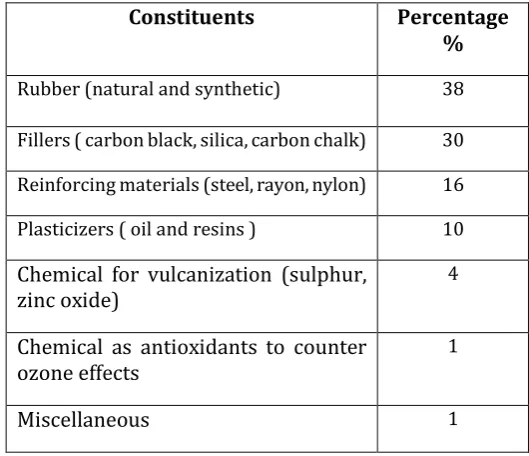
Table -2:
Chemical composition of waste tyres.Constituents
Percentage
%
Rubber (natural and synthetic) 38
Fillers ( carbon black, silica, carbon chalk) 30
Reinforcing materials (steel, rayon, nylon) 16
Plasticizers ( oil and resins ) 10
Chemical for vulcanization (sulphur,
zinc oxide)
4
Chemical as antioxidants to counter
ozone effects
1
Miscellaneous
1Table-3:
index properties of materials
PHYSICAL
PROPERTIES MATERIAL
PAREN
TCLAY RUBBER TYRE SCRAP
GRAIN SIZE DISTRIBUTI ON DATA
GRAVEL
(%) 0 SYMBOL SIZE DETAIL
SAND
(%) 4
CALT= SILT (%) 96
SPECIFIC GRAVITY 2.59 R-425 µ
Passing from 600 µ sieve & retained on 425 µ seive
LIQUID LIMIT 41
PLASTIC LIMIT 25
PLASTICITY INDEX 16
R-150 µ
Passing from 425 µ sieve & retained on 150µ seive IS CLASSIFICATION CI
OMC(%) 24
[image:2.595.31.574.395.784.2]© 2017, IRJET | Impact Factor value: 5.181 | ISO 9001:2008 Certified Journal | Page 2954
3. Sample Preparation
3.1 Composition of specimens
Specimens of parent soil and treated with 4.5, 9, 13.5 and 18% by weight of rubber tire scrap of various sizes were prepared at maximum dry density and optimum moisture content as per IS: 2770 (Par 7) (1974).
3.2 Mixing
Oven dry soil was dry mixed with various percentages of additives. Sufficient quantity of distilled water was then added to bring the moisture content to the desired level. The mixture was then manually mixed thoroughly with a spatula. All the specimens were kept in polythene bags for maturing for three days.
4. CASTING AND TESTING
A total of 10 specimens mix of parent clay and clay
stabilized with 4.5, 9, 13.5 and 18% of rubber tyre scrap of various sizes.
Table-4 Compaction characteristic of clay stabilized with tyre scrap
SAMPLE DESCRIPTI ON
COMPA CTION PROPE RTIES
PERCENTAGE OF
STABILIZER(TYRE SCRAP)
0% 4.5
% 9% 13.5% 18%
PARENT CLAY+TYR E SCRAP (R-425 µ)
OMC
(%) 24 23.4 22.9 21.7 20.5
MDD (g/cc)
1.60 1.57
6 1.563 1.496 1.466
PARENT CLAY+TYR E SCRAP (R-150 µ)
OMC (%)
24 23.1 22.7 21.2 20.7
MDD (g/cc)
1.60 1.58
5 1.540 1.490 1.475
4.1 COMPARISON CURVE
Standard proctor test
Standard Increase in proportion of scrap rubber tyre addition with soil decreases the maximum dry density of the prepared soil. Soil is treated with increasing proportions of scrap rubber tyre.it effect the optimum moisture content of soil.
Chart -1: comparison of mdd values of clay stabilized with various percentages of tyre scrap
Chart-2: Comparison of OMC values of clay stabilized with various Percentages of tyre scrap
UNCONFINED COMPRESSION TEST
© 2017, IRJET | Impact Factor value: 5.181 | ISO 9001:2008 Certified Journal | Page 2955
Table-5:
unconfined compressive strength ofstabilizedclay
SAMPL E DESCRI PTION
STRENGT H PROPERT IES
PERCENTAGE OF STABILIZER (TYRE SCRAP)
0% 4.5
% 9% 13.5% 18%
PAREN T CLAY+ TYRE SCRAP (R-425 µ)
UNCONFI NED COMPRES SIVE STRENGT H (kg/cm2)
1 1.20 1.45 1.67 1.75
FAILURE STRAIN
0.0
82 0.025 0.034 0.047 0.054
PAREN T CLAY+ TYRE SCRAP (R-150 µ)
UNCONFI NED COMPRES SIVE STRENGT H (kg/cm2)
1 1.17 1.28 1.39 1.55
FAILURE STRAIN
0.0
82 0.031 0.038 0.047 0.052
Chart-3:
comparison of ucs values of clay stabilizedwithvarious percentages of tire scrap
3. CONCLUSIONS
Largely, there is an increase in the value of unconfined compressive strength due to increase in percentage of tyre scrap of various sizes indicting strength improvement of soil. By and large, for rubber tyre scrap treated soil, the value of UCS is greater in comparison to that of parent soil. For soil treated with 18% of tyre-scrap (R-425 μ – tyre-scrap passing 600μ and retained on 425μ IS sieve), highest UCS value of 1.75kg/ cm2 has been observed.There is no significant variation in the values of strain at failure, but normally there is a decrease in the values due to increase in percentage of tyre scrap of various size. The decrease may be attributed to granular nature of tyre scrap.
ACKNOWLEDGEMENT
The present thesis work is a living testimony to the numerous contributions of a galaxy of distinguished personalities whom I had the good fortune of associating with. I deem it an honor and duty to acknowledge the help and cooperation I received from these luminaries. First of all I express profound sense of obligation to the “Omnipresent” for showering immense blessings on me, which culminated into the success of this great endeavor. Firstly, I wish to express my heartfelt, deep sense of unbound gratitude and indebtedness to director Dr. Raj Kumar,Galaxy Global Group Of Institutions, Ambala for having given me opportunity to do research in Soil stabilization using Scrap Rubber Tyre’ Further, I am thankful to Mr. Umesh Dhiman (Assistant professor , Civil Department , Galaxy Global Group Of Institutions ) for his timely recommendations , suggestions, support and for providing necessary departmental facilities , services and peaceful ambience for research work. I wish to express my deep gratitude to my family members. They were main source of inspiration, motivation and encouragement throughout my life. My special thanks to all the people who have directly or indirectly helped me during this research work. I thank all the souls who helped me in this herculean task. Finally, I bow my head to the ALMIGHTY for all the blessings he has showered on me .
(Sanjeev Singh) Roll No-73150109
REFERENCES
1. ASTM: STP 126 (1952, “Symposium on Consolidation Testing of Soils” 54thAnnual Meeting, American Society for Testing and Materials.
2. IS: 1498 (1970), “Indian Standard Methods of Test for Soils: Classification and Identification of Soil for General Engineering Purposes”, Bureau of IndianStandards.
Content-© 2017, IRJET | Impact Factor value: 5.181 | ISO 9001:2008 Certified Journal | Page 2956 Dry Density Relation using Light Compaction”,
Bureau of Indian Standards.
4. IS: 2720 (Part 15) (1986), “Indian Standard Methods of Test for Soils: Determination of Consolidation Properties”, Bureau of Indian Standards.
5. ASTM.STP 892(1986) Indian Stabndard Method of tests for soils: Determie of Consolidation Properties Beureau of Indian Standard.
6. IS: 2720 (Part 10) (1991), “ Indian Standard Methods of Test for Soils: Determination of Unconfined Compressive Strength”, Bureau of Indian Standards
.
7. Singh, Alam and Chowdhary, G.R. (1994), “Soil Engineering in Theory and Practice”, GeotechnicalTesting and Instrumentation Vol. 23, CBS Publishers and Distributors, Delhi.
8. Edil, Tuncer B. and Bosscher, Peter J, (1994), “ Engineering properties of tyre scrap and soil mixtures”,Geotechnical Testing Journal (GTJ), Vol.17, Issue 4, pp 453- 464
9. Ranjan, Gopal and Rao, A.S.R. (2000), “Basic and Applied Soil Mechanics”,New Age International (P) Ltd, New Delhi.
10. Lee, Kin-Man (2003), “Lightly cemented Scrap tyre scrap as LGM for construction of earth structures”, MaSTEC2003-Materials Division of the Hong Kong Institution of engineers,pp1/17-17/17
11. Zomberg, Jorge G., cabral, Alexaudre R. and Viratjandr, Chardphoom (2004),“Bhavaviour of tyre shred- sand mixture”, Canadian Geotechnical Journal, 41,Pp227-241.
12. Cetin, Hasan, Fener, Mustafa and Gunaytin, Osman(2006), “ Geotechnical properties of tyre-cohesive clayey soil mixtures as a fill material”, Engineering Geology, 88, pp 110-120
13. Robani, A. Rqfidahbinti and Chan, B. Chee-Ming (2008), Unconfined Compressive strength of clay stabilized with cement-rubber scrap”, Seminar, UniversityTun Hussein Onn Malaysia (UTHM).
14. Oikonomou, N. and Mavridou, S. (2008), “ The use of waste type rubber in civil engineering work”, ebooks.narotma.ac.id
15. Ho, Mee-Hoan, and Chan, Chee-Ming (2010), “The potential of using rubberscrap as a soft clay stabilizer enhancing agent”, Modern Applied Science, Vol.4, Issue10, pp 122-131