© 2017, IRJET | Impact Factor value: 5.181 | ISO 9001:2008 Certified Journal
| Page 844
DISTANCE BASED CLUSTER FORMATION FOR ENHANCING THE
NETWORK LIFE TIME IN MANETS
Haftom Gebrehiwet Kidanu
1, Prof. Pallam Setty
21
PG Scholar, Dept. of Computer Science & Systems Engineering Andhra University, Visakhapatnam, India
2
---***---Abstract -
Clustering is one of the important methods forextending the network lifetime in Mobile AD Hoc Networks. It involves grouping of nodes into clusters and electing cluster heads for all the clusters. Cluster heads collect the data from their member nodes and forward the collected data to the cluster gateway or cluster head of other cluster. A main challenge in MANET is to select appropriate cluster heads. MANET is self-created and self-organized by a collection of mobile nodes various mobile ad hoc network consists of devices with various characteristics in terms of transmission power, energy, and capacity. The proposed clustering algorithm is first randomly select the clusters heads at a run time then the nodes which are near to cluster head based on their distance are members of that cluster head. The performance analysis of the distance based clustering approach is carried out using NS-2 and MATLAB and analyzed by using the consumed energy, residual energy, and distance graph from each cluster head up to the end of simulation. The simulation shows that the relationship between node distances is directly proportional with the energy consumption in MANET.
Key Words: MANET, Clustering, Cluster head, Energy,
Distance
1. INTRODUCTION
Mobile Ad-Hoc Network (MANET) is basically a peer to peer network, which consist of moveable or mobile nodes interconnected by wireless links. MANET is a self-configuring infrastructure less network of mobile devices connected by wireless. These networks can be set up easily anywhere and at any time. Each device in a MANET is free to move independently in any direction. It may frequently link with other devices. Under a cluster structure, mobile nodes may be assigned a different status or function, such as cluster head, cluster gateway or a cluster member. In MANETs the nodes communicate over reliable wireless links within the transmission range of each other. In large MANETs, if two hosts are not within the communication range of each other they communicate if other hosts lying in between are willing to forward packets for them. Therefore every node participates in multi-hop routing to reach all nodes in the network. Flooding is a cause of routing in MANETs which leads to degradation of the efficient use of bandwidth and depletes battery-power of nodes. Hence, many clustering schemes have been proposed where the
nodes in a network are divided into clusters. Hierarchical routing is adopted, where a standard proactive or reactive protocol can be used within the cluster but other protocols are used for inter-cluster routing. In the dominating set based clustering schemes routing is done based on a set of dominating nodes (DS). These schemes are quite expensive and not very scalable when the number of nodes in the MANET are large and are moving at high speeds. Topologies in MANET are random, multi-hop and dynamic. Moreover, there is scarcity of link bandwidth and transmission power of mobile nodes. Therefore, MANET faces major challenges concerning routing, scalability and management functions [1] [2].
The basic principle behind ad hoc networking is multi-hop, in which messages are sent from the source to the destination through the nodes. The communication between two ends of nodes is carried out through the number of intermediate nodes whose function is to relay the information from one point to another. In the last few years in multi hop ad hoc networks in which relaying nodes in general mobile, communication needs are primarily between nodes within the same network. It is peer to peer network without any centralized server. MANETs represent complex distributed system. The wireless Cluster structure mobile nodes can freely and dynamically self-organize in ad-hoc network topologies [3].
MANET is basically an organization less network of transportable devices having wireless communication capabilities that can join together at any time and at any place dynamically. In this type of network mobile hosts, sometimes, simultaneously acting as a router, are connected to one another by wireless links and they can easily move randomly hence network topology dynamically change so this makes an autonomous system of mobile nodes having no base station. In MANET each node has limited transmission range so packets are forwarded from any initiating node to any end point node in a network with the help of multiple hopes.
2. RELATED WORKS
Bhawnesh Kumar, Vinit Kumar Sharma [4]in this paper, a distance based Cluster head selection algorithm is proposed for improving the sensor network life time. This protocol achieves a good performance in terms of lifetime by
© 2017, IRJET | Impact Factor value: 5.181 | ISO 9001:2008 Certified Journal
| Page 845
balancing the energy load among all the nodes. Thisclustering technique help to prolong the life of wireless sensor network, especially in hostile environment where battery replacement of individual sensor nodes is not possible after their deployment in the given target area. Therefore, the proposed technique to distribute the role of the cluster head (CH) among the wireless sensor nodes in the same cluster is vital to increase the lifetime of the network. This algorithm uses a distance based method for providing the cluster head selection. Clustering techniques also provide good load balancing, and in-network data aggregation.
Priyanka Chatterjee and Nikhil Agarwal [2]in this thesis, they present a clustering scheme that minimizes message overhead and congestion for cluster formation and maintenance. The algorithm is devised to be independent of the MANET Routing algorithm. Depending upon the context, the clustering algorithm may be implemented in the routing or in higher layers. The dynamic formation of clusters helps reduce data packet overhead, node complexity and power consumption, the simulation has been performed in ns-2. The simulation shows that the number of clusters formed is in proportion with the number of nodes in MANET.
A.Mercy Rani, J.Sivaranjani [5] this paper proposed position and distance based clustering approach for offering better connectivity among the network. The proposed clustering algorithm first form the clusters based on the position of the nodes then it will select the Cluster head based on the distance of the nodes. The performance analysis of the proposed position and distance based clustering approach is carried out using NS-2. The performance is analyzed by using the metrics packet delivery ratio, dropped packets and end-to-end delay.
3. CLUSTERING
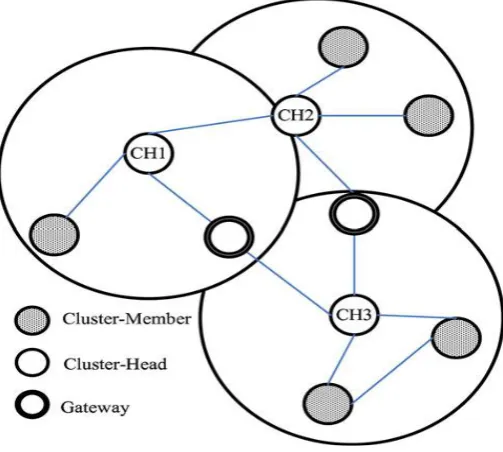
Clustering is one of the important methods for prolonging the network lifetime in Mobile AD Hoc Networks. Clustering scheme is used here where cluster head node will play the role of transmitting packet from one cluster to the other. It involves grouping of nodes into clusters and electing cluster heads for all the clusters. Cluster heads collect the data from particular cluster’s nodes and forward the aggregated data to main node. Division of network into different virtual groups, based on certain rules in order to differentiate the nodes allocated to other sub network. In simple words we can say that clustering in MANET is done by virtual partitioning of nodes into sub-networks according to geographical area [1]. Clustering provides a method to build and maintain hierarchical addresses in ad hoc networks. Clustering refers to a technique in which MANET is divided into different virtual group; generally nodes which are geographically adjacent are allocated into the same cluster driven by set of protocols based on behaviors and characteristics of the node. This enables the network to
become manageable. Various clustering techniques allow fast connection and also better routing and topology management of MANET [2].
Fig -1: Cluster structure
4. PROPOSED WORK
In MANET after creating the cluster head we have to decide the cluster .Here we propose an algorithm for selecting cluster head randomly based on the position of the nodes and creating cluster based on distance.
4.1 Proposed Algorithm
The following are the steps for each & every cluster. Select Cluster-head (n, C)
Begin:
Step 1. Number of clusters, C, must be specified
Step 2. Pick the 1st, 10th and 19th nodes as cluster-heads randomly based on their position;
Step 3. Let we have a set C cluster-heads;
C= {C1, C2…Cm}
Step 4. Calculate the distance of all node from all clusters heads using Euclidean distance
for i=1 to n do
for j=1 to m do
dij= distance from i to Cj
[image:2.595.310.562.146.372.2]© 2017, IRJET | Impact Factor value: 5.181 | ISO 9001:2008 Certified Journal
| Page 846
endforStep 5. Distance comparison of each node from each cluster-head
if dij from Cj(i) is smaller than dij from Cj..m(i)
Step 6. Assign the node i is under its closest Cluster-head of Cj(i) based on distance values.
Step 7. Calculate the consumption energy of each nodes equation (1)
Step 8. Calculate the remaining energy of each node equation (2)
Step 9. Making residual energy initial energy of each node’s next simulation time.
Step 10. Steps 2 to 9 are repeated until the simulation time ends.
End
Fig -2: Cluster formation process
5. SIMULATION RESULTS
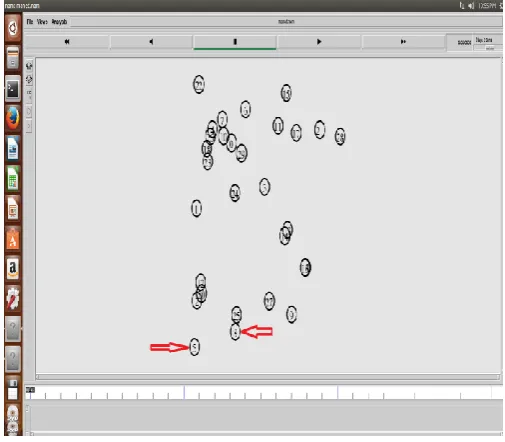
Randoly deployed nodes from NS-2
Fig -3.1 (a): location of nodes at first simulatiom
[image:3.595.307.560.160.381.2] [image:3.595.43.564.379.649.2]© 2017, IRJET | Impact Factor value: 5.181 | ISO 9001:2008 Certified Journal
| Page 847
Fig -3.3: Simulation .nam LayoutTable -1: Simulation Parameters
Parameters Values
Number of nodes 30 Simulation Time 3
Area 500*500 m
Max Speed 100
Bandwidth 10Mbps
Traffic Source FTP
Mobility model used Random way point Routing protocol AODV
Initial Energy 0.01 J
Chart -4 and chart -5 shows energy consumption and residual energy graphs respectively consumption between cluster heads and non-cluster heads
To calculate the energy consumption with using the following formula [6]:
ETx(k,d)=Eelec * k + Eamp * k * dn (1)
Note that, in this thesis work, we let n=2, k=bit(8), Eelec=50nJ/bit, and Eamp=100pJ/bit/m2
After nodes communicating has been finish there will be an energy which is smaller than the initial energy which is residual energy. To calculate the energy residual with using the following formula:
To calculate the energy residual with using the following formula:
Residual energy(i)= E(i) - ETtx(i) (2)
Note E(i)=initial energy and ETtx(i)=consumed energy
0 5 10 15 20 25 30
0 20 40 60 80 100 120
Distance from CH1
Nodes
D
is
ta
n
c
e
(
m
)-
-->
S1 S2 S3
Chart -1: CH1 distance bar graph (CH1=cluster head 1, S1=simulation 1, S2=simulation 2, S3=simulation 3)
From chart -1 we have seen that the distance of all the 30 nodes from the cluster head 1(the node which is found in the 1st coordinates) in every running time. The distance of the cluster head from itself is 0. Always the distance of cluster head 1 at all rounds is 0 that is why it’s receiving energy is 0.
0 5 10 15 20 25 30
0 20 40 60 80 100 120
Distance from CH2
Nodes
D
is
ta
n
c
e
(
m
)-
-->
S1 S2 S3
© 2017, IRJET | Impact Factor value: 5.181 | ISO 9001:2008 Certified Journal
| Page 848
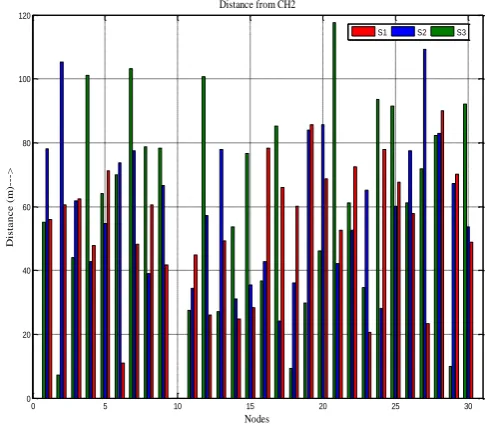
From chart -2 we have seen that the distance of all the 30nodes from the cluster head 2(the node which is found in the 10th coordinates) in every running time. The distance of the cluster head from itself is 0. Always the distance of cluster head 2 at all rounds is 0 that is why it’s receiving energy is 0.
0 5 10 15 20 25 30
0 20 40 60 80 100 120
Distance from CH3
Nodes D is ta n c e ( m )- -->
S1 S2 S3
Chart -3: CH3 distance bar graph (CH3=cluster head 3, S1=simulation 1, S2=simulation 2, S3=simulation 3)
From chart -3 we have seen that the distance of all the 30 nodes from the cluster head 3(the node which is found in the 19th coordinates) in every running time. The distance of the cluster head from itself is 0. Always the distance of cluster head 3 at all rounds is 0 that is why it’s receiving energy is 0.
Consumed energy of each nodes
5 10 15 20 25 30
0 1 2 3 4 5 6 7 8x 10
-6 Energy Consumption
Nodes E n e rg y ( Jo u l) --->
S1 S2 S3
Chart -4: Consumed energy (S1=simulation 1, S2=simulation 2, S3=simulation 3)
From chart -4 we have seen that the total consumed energy of all the 30 nodes in every simulation time. The cluster heads are the 1st, 10th and 19th nodes that is why they consume less power than the others because the distance to their own is 0. Energy consumption is directly proportional to the distance in-between the nodes.
Residual energy of each nodes
5 10 15 20 25 30
9.988 9.99 9.992 9.994 9.996 9.998
10x 10
-3 Residual Energy
Nodes E n e rg y ( J o u l) --->
S1 S2 S3
Chart -5: Residual energy (S1=simulation 1, S2=simulation 2, S3=simulation 3)
From chart - 5 we have seen that the total residual energy of all the 30 nodes in every simulation time. The cluster heads are always at the 1st, 10th and 19th node positions being they are cluster heads they have more residual energy than the member nodes. The residual energy of the first simulation is the initial energy of the second simulation and go the like up to the end of the simulation time for each its node.
6. CONCLUSIONS
© 2017, IRJET | Impact Factor value: 5.181 | ISO 9001:2008 Certified Journal
| Page 849
REFERENCES
[1] Dr.M.Bala Murugan , Kavi Priya.C “Energy Based Cluster Head Selection Algorithm in MANET ”, Kavi Priya.C et al | IJCSET(www.ijcset.net) August 2015.
[2] Priyanka Chatterjee and Nikhil Agarwal “Energy Aware, Scalable, K-Hop Based Cluster Formation In MANET”.
[3] Ms. Deepika M. Tech Student,Department of Computer Science & Engineering MDU University Rohtak (Haryana) “Cluster Based Routing Protocol in MANETs”,Vol. 5, No.2, April 2016 (ISSN 2278 –5973).
[4] Bhawnesh Kumar , Vinit Kumar Sharma “Distance based Cluster Head Selection Algorithm for Wireless Sensor Network” International Journal of Computer Applications (0975 –8887) Volume 57–No.9, November 2012.
[5] A.Mercy Rani, J.Sivaranjani “An Efficient Position and Distance Based Clustering Approach in Mobile Ad Hoc Network” IOSR Journal of Electronics and Communication Engineering (IOSR-JECE) e-ISSN: 2278-2834,p-ISSN: 2278-8735.Volume 12, Issue 4, Ver. III (Jul.-Aug. 2017).