© 2018, IRJET | Impact Factor value: 6.171 | ISO 9001:2008 Certified Journal | Page 1129
Optimization of GTAW Process Parameters on Aluminum Alloy 6063 on
Taguchi Method.
Mr. S.Sethuraman
1, Mr. D.Balaji
2, Dr. V.Sivaramakrishnan
3, Mr. M.Sudhahar
41PG Scholar, Sri RaraRaajan College of Engineering and Technology, Karaikudi. 2&4 Assistant Professor, P.R. Engineering College, Vallam, Thanjavur 3 Professor, E.G.S.Pillay Engineering College, Thethi, Nagapattinam
---***---Abstract - This paper aims to optimize process parameters for gas tungsten arc welding (GTAW) of Aluminium alloy AA6063 using Argon as inert gas. The Taguchi method is used to obtain the Optimization parameters of Tungsten Inert Gas welding on 6063 Aluminum Alloy. Taguchi method is by ANOVA and Regression analysis is used to determine the effect of the individual parameters and a appropriate combination was found out. We have used Non destructive testing to find out weld defects for different levels of input parameters. The optimal parameters of TIG welding process is resolute and the experimental results demonstrate the proposed approach.
Key Words: Aluminum, Taguchi, Analysis of Variance, AA6063, Optimization, Design of experiment, Regression, Hardness, Impact Strength, ANOVA.
1. INTRODUCTION
Welding is a perpetual joining process used to join diverse materials like metals, composites or plastics, together at their reaching surfaces by utilization of warmth or potentially weight. Weld capacity of a material relies upon various components like the metallurgical changes that happen amid welding, changes in hardness in weld zone because of quick hardening, degree of oxidation because of response of materials with environmental oxygen and inclination of split arrangement in the joint position.
1.1 TIG welding Aluminum Failure
Usually welding failure occurs due to
1. On TIG welding Transformers, forgetting to put high frequency to continuous when TIG welding of aluminum. This will result in the machine stuttering at low amperage because the alternating current will lose some of its half cycles when the direction of the current changes. 2. Wrong size terminal
3. Wrong size filler rod
4. An excess of argon on the light . 5. Insufficient anode stand out 6. Utilizing unadulterated tungsten …
1.2 Process parameters of TIG welding
The parameters that affect the quality and outcome of the TIG welding process are given below.
a) Welding Current
Higher current in TIG welding can lead to splatter and work piece become damage. Again lower current setting in TIG welding lead to sticking of the filler wire. preset current mode will vary the voltage to maintain a constant arc current.
b) Welding Voltage
Welding Voltage can be fixed or adjustable depending on the TIG welding equipment. A high initial voltage allows for easy arc initiation and a greater range of working tip distance.
c) Inert Gases
The choice of shielding gas is depends on the working metals and effects on the welding cost. Argon or Helium may be used successfully for TIG welding applications
d) Welding speed:
Welding speed is an important parameter for TIG welding. If the welding speed is increased, power or heat input per unit length of weld is decreases.
1.3 Scope of Work
© 2018, IRJET | Impact Factor value: 6.171 | ISO 9001:2008 Certified Journal | Page 1130
each parameters and hardness is analyzed, And optimized parameter is determined through Taguchi method.
Aluminium welding
Aluminium can be joined in many ways - a critical requirement in fabrication as whole products are usually formed from a number of parts. Joining methods consist of demountable systems for example bolting as well as more permanent methods including welding, especially where continuity of joining is required.
2. EXPERIMENTAL WORK
2.1 Tig Welding Machine Specification
TIG Welding Machine:
Amps : 20 -300-AT/TIG TIG : 16 Amps /415v Cooling : Air cooling Frequency : 50Hz
It has a good surface finish; high corrosion resistance is readily suited to welding and can be easily anodized. Most commonly available as T6 temper, in the T4 condition it has good formability.
2.2 Chemical Properties
Table-1: Chemical composition of aluminium alloy 6063
Element Percentage
Si 0.2 to 0.6
Fe 0.0 to 0.35
Cu 0.0 to 0.1
Mn 0.0 to 0.1
Mg 0.45 to 0.9
Zn 0.0 to 0.1
Ti 0.0 to 0.1
Cr 0.1
Al Balance
2.3 Physical Properties
Table 2: Physical Properties of aluminium alloy 6063
Density 2700 kg/m3
Melting Point 600°C
Modulus of Elasticity 69.5 GPa
Electrical Resistivity 0.035x10⁻⁶ Ω.m
Thermal Conductivity 200 W/m.K Thermal Expansion 23.5 x 10⁻⁶ /K
2.4 Taguchi Approach
The Taguchi method uses a special design of orthogonal arrays to study the entire parameter space with a small number of experiments only. The experimental results are then altered into a signal– to – noise (S/N) ratio for measuring the quality characteristics deviating from the desired values Usually, there are three categories of quality characteristics in the analysis of the S/N ratio, i.e., the–lower–better, the–higher–better, and the–nominal–better. The optimal level of the process parameters is the level with the greatest S/N ratio
The formulae for signal to noise ratio are designed so that an experimenter can always select the largest factor level setting to optimize the quality characteristic of an experiment. Therefore a method of calculating the Signal-To-Noise ratio we had gone for quality characteristic. They are
1. Smaller-The-Better,
2. Larger-The-Better, 3. Nominal is Best.
3 DESIGN OF EXPERIMENT
Table-3 Process parameters and their levels
Levels Process Parameters
Peak Current Base Voltage GAS PR Kg/Cm2
1 130 20 4
2 150 25 5
3 170 30 6
3.1 Input Parameter
Table-4 Input Parameter
Peak Current Base Current Gas Pressure
130 20 4
130 25 5
130 30 6
150 20 5
150 25 6
150 30 4
170 20 6
170 25 4
© 2018, IRJET | Impact Factor value: 6.171 | ISO 9001:2008 Certified Journal | Page 1131
3.2 Rockwell Hardness Test
Rockwell Hardness systems use a direct readout machine determining the hardness number based upon the depth of penetration of either a diamond point or a steel ball. Deep penetration indicated a material having a low Rockwell Hardness number.
Using the “B” Scale;
a. Use a Diamond indenter
b. Major load: 100 Kg, Minor load: 10 Kg
Table-5 Hardness values
Peak current Base Current Gas pressure HRB VALUE
130 20 4 84
130 25 5 106
130 30 6 99
150 20 5 96
150 25 6 95
150 30 4 103
170 20 6 113
170 25 4 102
170 30 5 96
[image:3.612.335.562.143.213.2]Hardness And S/N Ratios Values For The Experiments
Table-6 Hardness (Analysis of Result)
TRIAL
NO. DESIGNATION PEAK BASE GP HARD SNRA1
1 A1B1C1 130 20 4 84 -38.4856
2 A1B2C2 130 25 5 106 -40.5061
3 A1B3C3 130 30 6 99 -39.9127
4 A2B1C2 150 20 5 96 -39.6454
5 A2B2C3 150 25 6 95 -39.5545
6 A2B3C1 150 30 4 103 -40.2567
7 A3B1C3 170 20 6 113 -41.0616
8 A3B2C1 170 25 4 102 -40.1720
9 A3B3C2 170 30 5 96 -39.6454
Hardness Response For Each Level Of The Process Parameter
Table-7 Response Table for Signal to Noise Ratios
Smaller is better
Level PEAK BASE GP
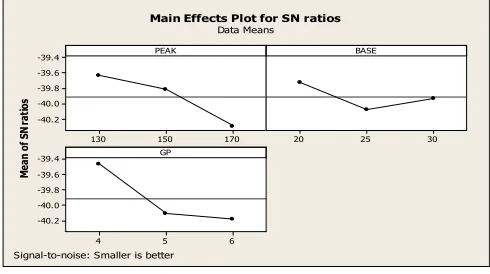
1 -39.63 -39.73 -39.46
2 -39.82 -40.08 -40.11
3 -40.29 -39.94 -40.18
Delta 0.66 0.35 0.71 Rank 2 3 1
Table-8 Response Table for Means
Level PEAK BASE GP
1 96.33 97.67 94.33 2 98.00 101.00 101.33 3 103.67 99.33 102.33 Delta 7.33 3.33 8.00 Rank 2 3 1
[image:3.612.29.295.263.384.2]General Linear Model: Hard Versus Peak, Base, Gp
Table-9 Analysis of Variance
Source DF Seq SS Adj SS Adj MS F P CONTRIBN %
PEAK 2 88.7 88.7 44.3 0.31 0.765 17
BASE 2 16.7 36.8 18.4 0.13 0.887 3
GP 2 134.1 134.1 67.1 0.46 0.683 25
Error 2 288.5 288.5 144.3 54
Total 8 528
S = 12.0111 R-Sq = 45.35% R-Sq(adj) = 0.00%
170 150 130
-39.4 -39.6 -39.8 -40.0 -40.2
30 25 20
6 5 4 -39.4 -39.6 -39.8 -40.0 -40.2
PEAK
M
ea
n
of
S
N
ra
tio
s
BASE
GP
Main Effects Plot for SN ratios Data Means
[image:3.612.327.572.387.524.2]Signal-to-noise: Smaller is better
Fig 1.Main Effects Plot for Means
170 150 130 105.0 102.5 100.0 97.5 95.0
30 25 20
6 5 4 105.0 102.5 100.0 97.5 95.0
PEAK
M
ea
n
of
M
ea
ns
BASE
GP
Main Effects Plot for Means Data Means
[image:3.612.25.307.438.582.2]© 2018, IRJET | Impact Factor value: 6.171 | ISO 9001:2008 Certified Journal | Page 1132
Taguchi Analysis: HARD versus PEAK, BASE, GP
Response Table for Signal to Noise Ratios Smaller is better
Level PEAK BASE GP 1 -39.63 -39.73 -39.46 2 -39.82 -40.08 -40.11 3 -40.29 -39.94 -40.18 Delta 0.66 0.35 0.71 Rank 2 3 1
Response Table for Means
Level PEAK BASE GP 1 96.33 97.67 94.33 2 98.00 101.00 101.33 3 103.67 99.33 102.33 Delta 7.33 3.33 8.00 Rank 2 3 1
Main Effects Plot for Means
Factor Type Levels Values PEAK fixed 3 130, 150, 170 BASE fixed 3 20, 25, 30 GP fixed 3 4, 5, 6
Analysis of Variance for HARD, using Adjusted SS for Tests
Source DF Seq SS Adj SS Adj MS F P PEAK 2 88.7 88.7 44.3 0.31 0.765 BASE 2 16.7 36.8 18.4 0.13 0.887 GP 2 134.1 134.1 67.1 0.46 0.683 Error 2 288.5 288.5 144.3
Total 8 528.0
S = 12.0111 R-Sq = 45.35% R-Sq(adj) = 0.00%
3.3 Impact Test
Impact testing is an ASTM method of determining impact strength. A notched specimen is generally used to find out the impact strength.
The dimensions of a standard specimen for ASTM D256 are 4 x 12.7 x 3.2 mm (2.5" x 0.5" x 1/8"). Almost common specimen thickness is 3.2 mm (0.125"), but width can be varying between 3.0 and 12.7 mm (0.118" and 0.500").
3.4 Charpy Impact Strength
Energy Range = 0 – 300 J Least Count (1 Division) = 2J
Specimen size = 10 X 10 X 55 mm
Notch = V NOTCH
Notch Depth = 2mm
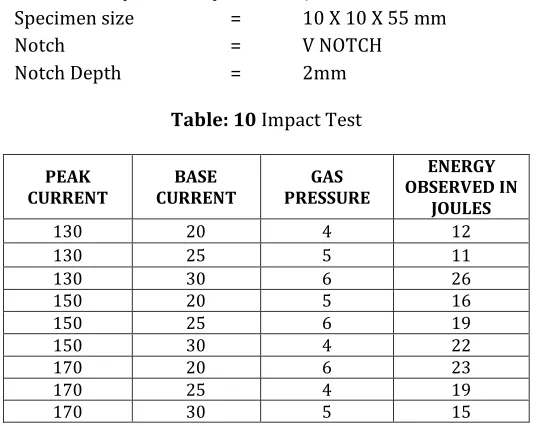
Table: 10 Impact Test
PEAK
CURRENT CURRENT BASE PRESSURE GAS
ENERGY OBSERVED IN
JOULES
130 20 4 12
130 25 5 11
130 30 6 26
150 20 5 16
150 25 6 19
150 30 4 22
170 20 6 23
170 25 4 19
170 30 5 15
Impact Srength (Analysis Of Result)
Hardness And S/N Ratios Values For The Experiments
Table 11 Hardness And S/N Ratios Values For The
Experiments
T.NO DESIGNATION PEAK BASE GP SRENGTH IMPACT SNRA1
1 A1B1C1 130 20 4 12 21.5836
2 A1B2C2 130 25 5 11 20.8279
3 A1B3C3 130 30 6 26 28.2995
4 A2B1C2 150 20 5 16 24.0824
5 A2B2C3 150 25 6 19 25.5751
6 A2B3C1 150 30 4 22 26.8485
7 A3B1C3 170 20 6 23 27.2346
8 A3B2C1 170 25 5 19 25.5751
9 A3B3C2 170 30 4 15 23.5218
[image:4.612.317.585.130.343.2]Impact Response For Each Level Of The Process Parameter
Table 12 Response Table for Signal to Noise Ratios
Larger is better
Level PEAK BASE GP
1 23.57 24.30 23.98
2 25.50 23.99 23.50
3 25.44 26.22 27.04
Delta 1.93 2.23 3.54
© 2018, IRJET | Impact Factor value: 6.171 | ISO 9001:2008 Certified Journal | Page 1133
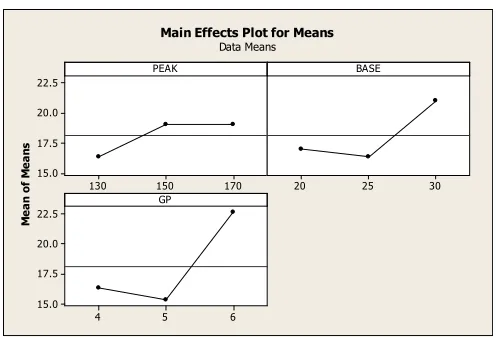
Table 13 Response Table for Means
Level PEAK BASE GP
1 16.33 17.00 16.33
2 19.00 16.33 15.33
3 19.00 21.00 22.67
Delta 2.67 4.67 7.33
[image:5.612.43.286.318.480.2]Rank 3 2 1
Table -14 Analysis of Variance
Source DF Seq SS Adj SS Adj MS F P Contribution %
PEAK 2 14.22 14.22 7.11 0.30 0.768 7
BASE 2 38.22 48.76 24.38 1.04 0.491 19
GP 2 105.42 105.42 52.71 2.24 0.308 52
Error 2 47.02 47.02 23.51 22
Total 8 204.89 100
S = 4.84883 R-Sq = 77.05% R-Sq(adj) = 8.20%
170 150
130 27 26 25 24 23
30 25
20
6 5
4 27 26 25 24 23
PEAK
M
e
a
n
o
f
S
N
r
a
ti
o
s
BASE
GP
Main Effects Plot for SN ratios Data Means
[image:5.612.38.286.512.681.2]Signal-to-noise: Larger is better
Fig 3.Main Effects Plot for SN Ratio
170 150
130 22.5
20.0
17.5
15.0
30 25 20
6 5
4 22.5
20.0
17.5
15.0
PEAK
M
e
a
n
o
f
M
e
a
n
s
BASE
GP
Main Effects Plot for Means Data Means
Fig 4.Main Effects Plot for Means
Taguchi Analysis: IS versus PEAK, BASE, GP
Response Table for Signal to Noise Ratios Larger is better
Level PEAK BASE GP 1 23.57 24.30 23.98 2 25.50 23.99 23.50 3 25.44 26.22 27.04 Delta 1.93 2.23 3.54 Rank 3 2 1
Response Table for Means Level PEAK BASE GP 1 16.33 17.00 16.33 2 19.00 16.33 15.33 3 19.00 21.00 22.67 Delta 2.67 4.67 7.33 Rank 3 2 1
Main Effects Plot for Means
Factor Type Levels Values PEAK fixed 3 130, 150, 170 BASE fixed 3 20, 25, 30 GP fixed 3 4, 5, 6
Analysis of Variance for IS, using Adjusted SS for Tests Source DF Seq SS Adj SS Adj MS F P
PEAK 2 14.22 14.22 7.11 0.30 0.768 BASE 2 38.22 48.76 24.38 1.04 0.491 GP 2 105.42 105.42 52.71 2.24 0.308 Error 2 47.02 47.02 23.51
Total 8 204.89
S = 4.84883 R-Sq = 77.05% R-Sq(adj) = 8.20%
3.5 Depth Of Penetration
© 2018, IRJET | Impact Factor value: 6.171 | ISO 9001:2008 Certified Journal | Page 1134
Table 15 Various Sizes of Bead Width, Depth of
Penetration and Heat Affected Zone-Ss41-Gtaw
SL.NO Area Mean Min Max Angle Length
1 0.501 186.877 77.409 229.551 -0.902 13.805
0.256 204.062 50 233 90 7.065
2 0.541 191.515 95.224 234.844 -0.418 14.891
0.277 176.003 47.424 221.143 89.182 7.609
3 0.371 190.565 75.723 224.085 -1.219 10.219
0.293 198.578 68.333 229.288 88.452 8.046
4 0.533 212.502 95.467 239.822 179.151 14.675
0.328 185.885 49.534 230 87.93 9.027
5 0.49 202.053 79.366 253.027 -1.386 13.481
0.273 207.75 72.333 244.367 88.34 7.503
6 0.501 183.031 59.648 231.333 179.549 13.804
0.28 200.401 67 239.667 90 7.717
7 0.588 183.822 59.333 235.949 0.385 16.195
0.368 162.634 20.333 218.011 91.232 10.11
8 0.399 205.419 66.337 240.158 0.567 10.978
0.328 171.004 42.044 228.819 92.07 9.027
9 0.517 200.97 63.667 239.921 -179.125 14.24
0.331 167.119 31.333 233 90 9.13
4 NON-DESTRUCTIVE TESTING
Non-destructive Testing is aimed for extracting information on the physical, chemical, mechanical or metallurgical state of materials or structures. This information is obtained through a process of interaction between the information generating device and the object under test. The information can be generated using X-rays, gamma rays, neutrons, ultrasonic methods, magnetic and electromagnetic methods, or any other established physical phenomenon. The process of interaction does not damage the test object or impair its intended utility value. The process is influenced by the physical, chemical and mechanical.
4.1 Non –Destructive Testing Techniques
NDT Methods varies from the simple to the complicate. Visual inspection is the simple one. Surface imperfections invisible to they may be revealed by penetrate or magnetic methods. If serious surface defects are found, there is often little point in proceeding further to the more complicated examination of the interior by other methods like ultrasonic or radiography.
The principal NDT methods are Visual or optical inspection, Dye penetrant testing, Magnetic article testing, Radiography testing and Ultrasonic testing.
In this Experimental work we have been used Liquid penetrant test and Ultrasonic used for find out the good weldment correspondent result also are attached.
4.2 Ultrasonic Testing
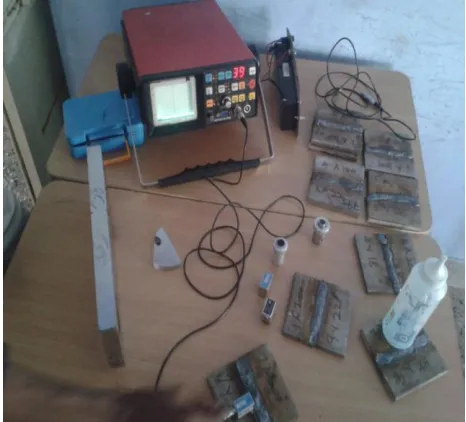
Fig 5 experimental setup of ultrasonic testing
Ultrasonic inspection is a NDT method in which beams of high frequency waves are introduced into materials for the detection of subsurface flaws in the material. The sound waves travel through the material with some attendant loss of energy and are reflected at interfaces (cracks or flaws). The reflected beam is visible and then analyzed to find the presence and location of flaws or discontinuities.
Ultrasonic testing is used to find out the size and location of the defects. The most common ultrasonic testing is pulse echo, in which sound is introduced into a test object and reflections are returned to a receiver from internal imperfections or from the parts geometrical surfaces.
ULTRASONIC RESULT
MACHINE SPECIFICATION UT INSTRUMENT: PX20
Transducer angle : 70o 4 MHZ, Technique : pulse Echo,
Material : D3
[image:6.612.333.566.153.364.2]© 2018, IRJET | Impact Factor value: 6.171 | ISO 9001:2008 Certified Journal | Page 1135
Table 16 Ultrasonic report
S.NO CURRENT PEAK CURRENT BASE PRESSURE INDICATIONS GAS
1. 130 20 4 ICP &Por
2. 130 25 5 ICP
3. 130 30 6 Cr
4. 150 20 5 ICP &Por
5. 150 25 6 CR
6. 150 30 4 EP
7 170 20 6 Sl
8 170 25 4 NI
9 170 30 5 Cr
5 CONCLUSION &RESULT
TIG welding can be used successfully to join AL6063 .The processed joints exhibited better mechanical and metallurgical characteristics. The joints exhibited 90-95% of parent material’s Hardness value. The specimen failures were associated depending upon the improper changes of heat value. It creates so many metallurgical defects and it is identified by using NDT testing. In our experiment we found out the input parameter value 170 PC/25 BC &Gas pressure 5 Kg/cm2 is the best value and it does not create any major changes and failures in the testing process.
Finally I concluded the suitable input parameter for Al6063 material of 10 mm thickness in GTAW welding process. According to the Taguchi design optimized parameter for maximum tensile strength
OPTIMAL CONTROL FACTOR
1. Impact strength- A3(Peak current -170AMPS)B2(Base current -25 AMPS )C1(Gas pr-4Kg/cm2) According to the Taguchi design optimized parameter for minimum Hardness
2. Hardness- - A2(Peak current -150AMPS)B3(Base current -30 )C1(Gas pr-4Kg/cm2)
REFERENCE
[1]K. M Eazhil, Optimization of Tungsten Inert Gas Welding On 6063 Aluminum Alloy on Taguchi Method. Volume 1, Issue III, August 2014.
[2]Dr. Brajesh Varshney, Optimization of Tungsten Inert Gas Welding Process Parameters ofAI6063/15%Sicp Metal Matrix Composites. International Journal of Engineering Research & Technology (IJERT) ISSN:2278-0181, Vol.311, November-2014.
[3]Mr.Nilesh Landge, A Review paper on Comparative Investigation of V and U Groove Butt Weld Joint For Strength Analysis using Tig Welding.International Journal of Engineering Sciences& Research Technology. ISSNl:2277-9655, (12OR), Publication Impact Factor:3.785, (ISRA), Impact Factor:2.114.
[4]Pankaj.C, Review on Welding Parameter Effects on TIG Welding of Aluminium Alloy. International Journal of engineering Research and General Science Volume3, Issue3, May-June,2015.
[5]Parthiv.T, Experimental Investigation of Process Parameters on Weld Bead Geometry for Aluminium Using GTAW. International Journal of Science and Research
(IJSR), ISSN (online):2319-7064, Impact Factor
(2012):3.368.
[6]Ravinder, Parametric Optimization of TIG Welding on Stainless Steel (200) & Mild Steel by using Taguchi Method, International Journal of Enhanced Research in Science Technology& Engineering. Vol.4 Issue 6, June-2015, PP:(434-494).
[7]J.P Bergmann, Effects of diode laser superposition on pulsed laser welding of aluminum, Department of Production Technology, Ilmenau University of Technology, Neuhaus 1, D-98693.
[8]Ahmet Durgutlu, Experimental Investigation of the effect of hydrogen in argon as a Shielding gas on TIG welding of austenitic Stainless Steel. Gazi University, Technical Education Faculty, Ankara, Turkey, Received 6 February 2003, accepted 30 July 2003.