© 2017, IRJET | Impact Factor value: 5.181 | ISO 9001:2008 Certified Journal
| Page 948
Power Management in Wireless
Sensor Network
Priya
Student Dept of CSE , South Point College , Sonipat – 131305 , Haryana
---****---Abstract:
Wireless sensor network has evolved the energy efficient utilization.WSN has limited budget for energy so this paper mainly focus on harvesting of energy and energy saving. Cooperation nodes selected must be choosen such that they have long time usuable batteries as batteries are not easily rechargeable and available which is not reliable. The selection of such nodes is for error estimation and power conservation. In this paper main focus is on the algorithm , approaches and techniques to increase the efficiency of the batteries.Keywords
:- Wireless Sensor Network (WSN), Power Conserving; Maximum Power Point Tracking (MPPT) ; Power Control ; Power Management ; EnergyHarvesting; Sleep/Awake.
1.Introduction
Wireless Sensor Network are rapidly growing area for research and development. WSN consists of many sensor nodes. These tiny sensor nodes , which consist of data processing and communicating components which leverage the idea of Sensor Network based on collaborative effort of a large number of nodes[1].WSN has wide range of applications such as health ministry , security , humidity and pressure. In WSN enegy is dissipated during the transmission of packets which make the system unreliable. Communication is the main energy guzzler and nodes dissipate more energy. Conventionally , disposal batteries can be used for power supply in WSN , where researchers have made efforts to save finite battery on power control by routing algorithm and topology optimization[2].
In WSN rechargeable batteries not used and non rechargeable batteries are very costly so we employ energy saving techniques. These techniques divided into two categories – Power Control and Power Management.In
Power control energy is optimize by transmission range of nodes. In Power management , energy is harvested by design of batteries. To utilize both power control and power management we use Simultaneous power control and management algorithm ( SPCM)[19].SPCM is divided into two parts – Centralized [5] which is determined by analytical and distributed [5] determined by average.SPCM based on energy model and sector shaped topology and load balancing which helps in cost , insulation and maintains of nodes and batteries.
This paper consist of different sections – Section 2 consist of Approaches of power management in WSN. Section 3 consist of techniques that define transmission of power at nodes.Section 4 consist of algorithm that determines efficiency of battery and nodes. Section 5 consist of conclusion with simple overview. Section 6 consist of references.
2.APPROACHES FOR POWER MANAGEMENT
:
In this section we describe the different methods of power saving for hardware components in WSN. In this section describe the use of solar energy for power management and batteries can be extend to rechargeable.
(A)Problem to consider –
To harvest the power in batteries and nodes we use solar energy. Many students have conducted research work on the usage of solar energy , while still remain some aspects which need to optimize . A solar energy has low charge capacitor and low storage and optimum cost[7].Some aspects are –
© 2017, IRJET | Impact Factor value: 5.181 | ISO 9001:2008 Certified Journal
| Page 949
(b). Using rechargeable batteries which result in highperformance and avoiding charge duty of batteries.
(c). Reduces the complexity of the system.
(B).Battery Selection –
In market Different type of batteries is available like lead acid, nickel-cadmium , nickel- hydrogen , lithium-ion respectively. Lithium-Polymer is the best system usage battery which provide low capacity of load and reliable to the system.
Batter y Name
Voltag
e/v Number of cycles
Self dischar ge Rates/ %M-1
Me mor y effec t
Environ mental
Lead-
acid 2.0 250 ~300 5 ~ 15 No Poisonous Lithiu
m- cadmi um
1.2 300 ~
700 15 ~ 30 Yes Poisonous
Nickel -hydro gen
1.4 400 ~
1000 25 ~ 35 Little Harmful
Lithiu
m - ion 3.7 500 ~ 1000 5 ~ 10 No harmful Lithiu
m - polym er
3.7 500 ~
1000 2 ~ 5 No Non - poisono us
For more details see power management eg [9]. energy
3. Techniques of power management in WSN –
In this section we describe the techniques of energy preservation in WSN. These are classified in two categories –
(3.1) Power Control :- The design of efficient power control algorithm for WSN is crucial to reduce energy consumption to a level suitable for many applications.Power control algorithm adjust the transmission range without affecting the properties of network. As transmission power is responsible for the 70% energy consumption for off the self sensor
nodes.Power control algorithm guarantees the connectivity as well as equally Quality of Service(QoS) concentrating on the efficiency of WSN , while optimizing the necessary transmission of data communication to each node[10]. Transmission Power Control(TPC) which is basically used in Radio Signal Strength Indicator (RSSI) provides many metrics such as – Power Management for throughput enhancement in Wireless Ad-hoc network , Energy efficient algorithm for power control in WSN , Battery awareness.TPC approach provide better link quality and distance , chip error rate , better signal and conserve energy at dynamic transmission.TCP is employed for low power control under different schemeto remove unreliable links[11] , adaptive transmission control[11] . This is based on Minimum Spanning Tree (MST) which provide the shortest path for the nodes and provide successful delivery of data.
(3.2)Power Management:- Power management algorithm is based on turning off those radios and nodes which are inactive. this is used for management of rechargeable batteries. Power management is basically design for the lifetime of batteries. Differtent techniques of power management are –
(3.2.1).Power-Gating – This technique is used to save energy for both active and sleep mode of the device.In this introduce an electronic switch between chip and power supply line.Power gate is implemented by PMOS or NMOS for cutting the ground or power line.
(3.2.2).Avoiding Voltage Regulators – Energy efficiengy os these regulators is impressive and reaches value higher than 95%. Inclusion of such regulator make the design of WSN more energy efficient.
© 2017, IRJET | Impact Factor value: 5.181 | ISO 9001:2008 Certified Journal
| Page 950
4). SPCPM Algorithm For Power Management
:-
SPCPM is based on simultaneously sleep / active node. By simultaneously adapting both parameters , the nodes can maximize the number of transmitted packetswhile respecting the limited and time- varying amount of available energy[13]. This is based on following parameters –
(4.1). Network Topology
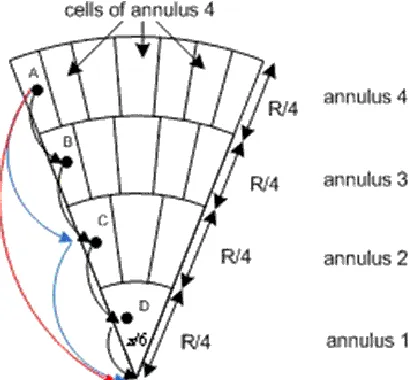
[image:3.612.39.246.358.548.2]In WSN, data flows toward the base station and the network area assumed as a sector-shaped area and the whole area is divided into some cells with the same area. The model of the network area is represented by ψ(α,R,N,K) using a sector with the angle of α and radius R which is divided into N cells and K annuluses. Fig 1. shows Sector shaped network, ψ(π/6,R,16,4) which contains 4 annuluses and 16 cells with the angle of π/6.
Fig 1. Sector Shaped Network
(4.2).Energy Model
For the energy model, we adopt the first-order radio model[11][17]. The energies consumed in the transmit state (Etx(d)) and receive state (Erx(d)) for a linear
communication as a function of the distance (d) are,
E(Consumed) = E(Transmit) + E(Receive)
But during transmitting and receiving state the energy is lost so a ( Path loss factor) is added.
E(consumed) = E(Transmit) + E(Receive) +a
In this algorithm we assume,
E(consumed) = E(Transmit) = E(Receive)
(4.3). Defining Algorithm
SPCPM is for minimizing the energy consumption of the sector-shaped WSN. We assume that the set of traffic demands denoted by f(si) where si is the ith sensor source
node . t(si) denotes the set of the edges used for transmitting data from the source si to the SINK node.
Our main focus is on the network nodes to provide traffic demand and minimize the energy consumption. The averge energy of node is computed by –
E(u)=Σ(u,v)∈t(si)LiLMAX.(Ee+Er×d(u,v)2)+Σ(v [4]
Where u transmit to v and v transmit to u.
SPCPM algorithm has two parts –
(4.3.1).Centralized SPCPM –
This algorithm is based on a combined cost function and decides about the state of nodes and the transmission range of the active nodes simultaneously. The input of the network ψ(α,R,N,k), and its output is the subnet graph G’(V’,E’) where V’ is the set of active nodes and E’ is the transmitting link. In this algorithm one node is master/ head and other nodes are slaves. The master node sends the nodes to other sink nodes with intermediate nodes.
Inter hop distance for nodes is
Hop(i) = log2i + 1 [5]
The number for the next hop is calculated from:
© 2017, IRJET | Impact Factor value: 5.181 | ISO 9001:2008 Certified Journal
| Page 951
This algorithm is based on MST , transmission control [11]and Minimum power configuration[4].
(4.3.2). Distributed SPCPM -
The distributed algorithm is based on destination-sequenced distance-vector (DSDV) method which implement the Bellman-Ford shortest path algorithm . There is no master and slave nodes. The nodes advertise its distance to sink nodes by broadcasting updating message.By receiving the message each node sets its neighbour with minimum cost as its parent node.The routing cost of the nodes is calculated by number of annuluses to the sink node. Each node operate in either sleep/active mode. For sleep mode management we use a scheduled-based algorithm like sensor medium access control (SMAC).The routing table is formed foe each node where table is broadcasted periodically to other nodes. In this GPS is used to localized the nodes.
2).Table , DIFFERENCE BETWEEN CENTRALIZED AND DISTRIBUTED
Parameter Centralized
SPCPM Distributed SPCPM
Definition One node
master and one node slave
All nodes broadcast message to other nodes.
Cost/Algorithm Cost is
calculate by MST
Cost is calculate by Bellman-Ford algorithm
Decision Central
node made decision
Decision made by SMAC
Distance of Hop Distance of
hop – Hop(i)= log2i +1
Distance of hop
calculate by number of annuluses of sink node.
GPS No GPS used GPS is used
to localized the nodes.
Maintain Minimize
energy Least cost of nodes.
5). CONCLUSION
This paper presents the review of power management in Wireless sensor network. This presents review of techniques, approaches and algorithm of WSN. Approaches of WSN present a detail of hardware component of WSN like battery selection and system of WSN. Approaches of WSN consider the low estimation error and minimizing the energy conservation. This paper presents the techniques of WSN, power control which determine the quality and quantity of nodes and link factor of transmission ranges, Power management present the route path and their transmission range of nodes and provide a new aspect of non-rechargeable batteries. For achieve efficiency of power in batteries it define SPCPM algorithm it define the shortest path for nodes and compute least cost and consider all factors delivery rate , packet loss etc. SPCPM categorized in two parts centralized SPCPM and distributed SPCPM which is based on Minimum power configuration (MPC).
REFERENCES
[1] I.F. Akyildiz, W. Su*, Y. Sankarasubramaniam, E. Cayirci, “Wireless Sensor Networks: A Survey” I.F. Akyildiz et al. / Computer Networks 38 , pp. 393–422, 2002.
[2] Ahonen T, Virrankoski R, Elmusrati M., “Greenhouse monitoring with wireless sensor
network” , IEEE/ASME. Int. Conf. on MESA, (IEEE/ASME, Beijing),
pp. 403-408, 2008.
[3] Silva , Liu, and Mehta Maddham, “Power-Management Techniques for Wireless Sensor Networks and Similar Low-Power Communication Devices Based on Non- rechargeable Batteries”, Journal of Computer Networks and Communications, Vol. 2012 , Article ID 757291, 10 pages.
[4] Guoliang Xing, Chenyang Luying Zhang And Qingfeng Huangrobert Pless,” Minimum Power Configuration for Wirelesss Communication in Sensor Networks”,ACM Transactions on Sensor Networks, Vol. 3, No. 2, Article 11, Publication date: June 2007.
© 2017, IRJET | Impact Factor value: 5.181 | ISO 9001:2008 Certified Journal
| Page 952
[6] Rajendra S. Navale, SKNCOE, Pune VaishaliS.Deshmukh, “An EfficientLoad Balancing Algorithm for Energy Utilization in Wireless Sensor Network”, International Journal of Computer Applications (0975 – 8887) Volume 82 – No.8, PP. 26-31,November 2013
[7] Yin Li and Ronghua Shi ,”An intelligent solar energy-harvesting system for wireless sensor networks”, EURASIP Journal on Wireless Communications and Networking 2015, doi:10.1186/s13638-015-0414-2
[8] Taneja J, Jeong J, Culler D. Design,” modeling, and capacity planning for micro-solar power sensor networks. Proc.”, 7th. IEEE. Int. Conf. IPSN, (IEEE Computer Society, St. Louis, Missouri, 2008), pp. 407-418,2008
[9] Giuseppe Anastasi*, Marco Conti#, Francesco*, Andrea Passarella#Mario Di”Energy Conservation in Wireless Sensor Networks: a Survey”,ARTICLE in AD HOC NETWORKS, MAY 2009.
[10] Omar Said, “Performance evaluation of WSN management system for QoS guarantee”,EURASIP Journal on Wireless Communications and Networking 2015,2015:220 doi:10.1186/s13638-015-0449-4
[11] Khemapech, A. Miller and I. Duncan,”A Survey of Transmission Power Control in Wireless Sensor Networks”,International Journal of Computer Applications ,ISBN: 1-9025-6016-7 © 2007
[12] Vana Jeliˇci´c,”Power Management in Wireless Sensor Networks with High-Consuming Sensors”,JELICˇ IC´, Qualifying Doctoral Examination, April 2011.
[13] Sandra Sendra, Jaime Lloret, Miguel García and José F. Toledo, “Power saving and energy optimization techniquesfor Wireless Sensor Networks”,Journal Of Communications, Vol. 6, No. 6,pp. 439-459, September 2011
[14] M Nickray, A Afzali-kusha, R Jantti, MEA, “An Energy Efficient Algorithm for dense sector based Wireless Sensor Networks”, EURASIP Journal on Wireless Communications and Networking 2015, 2015:151 doi:10.1186/s13638-015-0376-4
[15] Xun Li, Geoff V Merrett and Neil M White,“ Energy-efficient data acquisition for accurate signal estimation in wireless sensor networks”,EURASIP Journal on Wireless Communications and Networking 2013, 2013:230 doi:10.1186/1687-1499-2013-230
[16] Mohsen Nickray, Ali Afzali-Kusha and Riku Jäntti, “Simultaneous power control and power management algorithm with sector-shaped topology for wireless sensor networks”,EURASIP Journal on Wireless Communications and Networking 2015, 2015:118 ,doi:10.1186/s13638-015-0355-9.
[17] Nadeem Javaid, Muhammad Babar Rasheed, Muhammad Imran, Mohsen Guizani, Zahoor Ali Khan, Turki Ali Alghamdi and Manzoor Ilahi, “An energy-efficient distributed clustering algorithm for heterogeneous WSNs”,EURASIP Journal on Wireless Communications and Networking 2015, 2015:151 doi:10.1186/s13638-015-0376-4
[18] Sarika Khatarkar and Rachna Kambale, “Wireless Sensor Network: SMAC and TMAC protocols”, Indian Journal of Computer and Science Engineering (IJCSE), Vol. No. 4, pp. - 304-310, Aug-Sept- 2013.