© 2018, IRJET | Impact Factor value: 6.171 | ISO 9001:2008 Certified Journal | Page 559
EFFECT OF NANO TITANIUM DIOXIDE AND M-SAND IN SELF CURING
CONCRETE
L.SRIKANTHAN
1, J. BHUVANESH
2, M. DEEPA
3, E.RATHNA
41
Assistant professor, Department of civil Engineering, ARM College of Engineering and technology,
sattamangalam, Maraimalai nagar, Tamilnadu-603209
2,3,4
B.E Final year student, ARM College of Engineering and technology, sattamangalam, Maraimalai nagar,
Tamilnadu-603209
---***---ABSTRACT -
The development of self curing concrete hasbrought about the essential need in place of water scarcity and also the application of nanotechnology in concrete has added a new dimension to the efforts to improve its properties. Nano materials, by virtue of their very small particle size can affect the concrete properties by altering the micro structure. In this project, an attempt is made to use the anatase based nano titanium dioxide (Tio2) of size 15 nanometer (nm) was used to improve the compressive strength. Nano Tio2 is replaced with cement in the proportions of 0.5% and 1% by weight of cement. M sand is completely used instead of river sand. The Mix design adopted is M25 grade. Self curing agent used is poly-ethylene glycol (PEG) with a molecular weight of 600 (PEG 600). This PEG 600 is added in proportions of 0.5%, 1%, 1.5%, 2% and 2.5% by weight of cement. For all the specimens (Self curing concrete and Conventional concrete) only compression strength is tested after 28 days of curing. Then the result is compared with Self curing concrete specimens and Conventional concrete specimens. The experimental result shows that self curing concrete cube specimens made with replacement of 1% of nano titanium dioxide, 1% PEG 600 (by weight of cement) and M-Sand gives highest compressive strength (38.75 N/mm2) after 28 days of self curing when compared to conventional concrete cube specimens and any other types of self curing concrete cubes specimens and also all self curing concrete cube specimens gives high compressive strength when compared to conventional concrete cube specimens.
Key Words: Nano Titanium dioxide, Polyethylene glycol,
M-sand, compressive strength
1.
INTRODUCTION
1.1.Self curing concrete:
Proper curing of structures is important to meet the performance and durability requirements. Self curing
concrete is a type of concrete which is cured by itself without
any use of external curing methods.
Self curing or internal curing is a technique that can be used to provide additional moisture in concrete for more effective hydration of cement. This self curing concrete is used in water scarcity area, where the demand of water is high and application of water curing is not possible for some reasons of economy. Since, in internal curing there is a chance of
atmospheric effect and also hydration process is not completely eliminated and this may affect the concrete strength and other parameters. Hence, to make internal curing a successful process, water soluble polymers is used along with concrete. This usage of water soluble polymers imparts strength in self curing concrete but with some dosage.
1.2 NANO TITANIUM DIOXIDE:
Nano materials (Nano Titanium Dioxide) are very small sized materials with particle size in nanometers (nm). These materials are very effective in changing the properties of concrete at the ultrafine level by the virtue of their very small size. The small size of the particles also means a greater surface area. Only a small percentage of cement can be replaced to achieve the desired results. These nano materials improve the strength and permeability of concrete by filling up the minute voids and pores in the microstructure. The use of nano titanium dioxide (TiO2) in
concrete mix in previous studies has shown results of increase in the compressive and tensile strength of concrete. Nano titanium dioxide mixed with cement can generate nano-crystals of C-S-H (Calcium silicate hydrate) gel after hydration. This C-S-H does not have a definite structure and it is so called as gel. This C-S-H is the main product of hydration of Portland cement and it is primarily responsible for the strength in cement based materials. These nano-crystals accommodate in the micro pores of the cement concrete, hence improving the permeability and strength of concrete. The properties of Nano titanium dioxide used in this project are shown in table 1.
Table 1: Properties of Nano Titanium dioxide
Specific gravity 3.7
Particulars Anatase based pH content 7.4
Colour White Particle size (nanometer) 15
Oil absorption % 15 to 30% Moisture content 0.50% max Density (Kg/m3) 3.76
© 2018, IRJET | Impact Factor value: 6.171 | ISO 9001:2008 Certified Journal | Page 560 1.2 POLY ETHYLENE GLYCOL:
In this project, Poly-ethylene glycol with a molecular weight of 600 (PEG 600) was used as a self curing agent. Poly-Ethylene Glycol 600 is a condensation polymer of ethylene oxide and water with the general chemical formula HO (C2H4O)nH. One common feature of PEG appears to be the
[image:2.595.44.277.257.358.2]water soluble nature and hence this PEG 600 is directly added to the water. This PEG 600 is always added to the water and stirred for some time with glass rod without any air bubbles and then only added to the concrete.
Table 2: Details of PEG 600 used in this project
Average Molecular weight 570 to 630
Weight per ml at 20°C 1.126 to 1.128 grams
Viscosity at 100°C 9.9 to 11.2 Centistokes
Freezing point ~ 20°C
Hydroxyl number 178 to 197
Water 0.5% max
2. EXPERIMENTAL STUDY
2.1. Materials Used:
a)Ordinary Portland cement (OPC):
In this project, Ordinary Portland Cement of 53 grade conforming to IS 12269-1987 was used with a specific gravity of 3.15.
b)Fine Aggregate (F.A):
In this project, natural sand (resulting from natural disintegration of rocks) is used as fine aggregate confirming to IS 383-1970. In this project, natural sand is used only for making of conventional concrete cube only and this conventional concrete cube is cured by external curing methods.
c)Manufactured Sand (M-sand):
M-Sand stands for Manufactured Sand. M-sand is crushed aggregates produced from hard granite stone which is cubically shaped with grounded edges, washed and graded is also identified as a good alternative fine aggregate to river sand. In this project, M-sand is replaced completely by natural sand for making of self curing concrete cubes.
Fig -1: M-Sand
d) Coarse Aggregate (C.A)
Crushed stones obtained from local quarries were used as coarse aggregate. Crushed angular coarse aggregates of 20mm nominal sizes are used as per IS 383-1970.
e) Nano Titanium dioxide (Tio2):
As described previously, anatase based Nano titanium dioxide of size 15 nanometer was used to improve the compressive strength of self curing concrete cubes. This Nano Tio2 is replaced with cement in the proportions of
0.5% and 1% by weight of cement only for making of self curing concrete cubes.
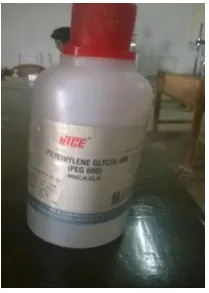
f) Polyethylene Glycol (PEG 600):
As described previously, PEG 600 was used as a self curing agent for making of self curing concrete cubes. This PEG 600 was added in proportions of 0.5%, 1%, 1.5%, 2% and 2.5% by weight of cement.
Fig -2: PEG
e) Water:
Portable water free from salts was used for casting and curing of concrete with pH value of 6 to 7.
2.2 Material Testing results:
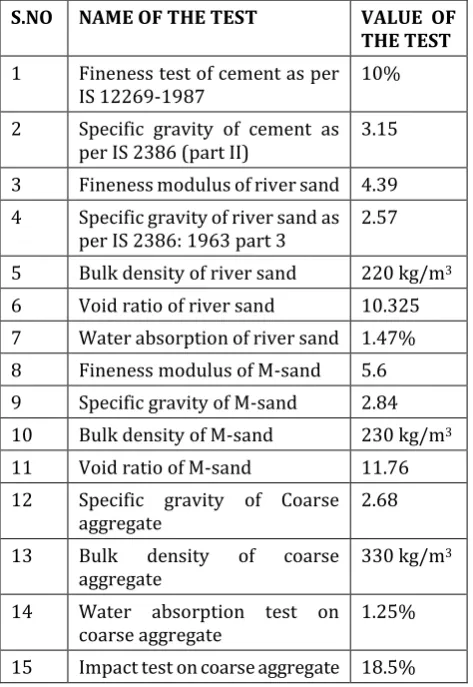
[image:2.595.382.487.479.626.2]© 2018, IRJET | Impact Factor value: 6.171 | ISO 9001:2008 Certified Journal | Page 561 laboratory and the material testing results for each of the
basic materials was shown in table 3.
Table 3: Material testing results
S.NO NAME OF THE TEST VALUE OF
THE TEST 1 Fineness test of cement as per
IS 12269-1987 10%
2 Specific gravity of cement as per IS 2386 (part II) 3.15 3 Fineness modulus of river sand 4.39 4 Specific gravity of river sand as
per IS 2386: 1963 part 3 2.57 5 Bulk density of river sand 220 kg/m3
6 Void ratio of river sand 10.325 7 Water absorption of river sand 1.47% 8 Fineness modulus of M-sand 5.6 9 Specific gravity of M-sand 2.84 10 Bulk density of M-sand 230 kg/m3
11 Void ratio of M-sand 11.76 12 Specific gravity of Coarse
aggregate 2.68
13 Bulk density of coarse
aggregate 330 kg/m
3
14 Water absorption test on
coarse aggregate 1.25% 15 Impact test on coarse aggregate 18.5%
2.3 Mix Design:
In this project, mix design adopted was M25. The concrete proportions arrived by using M25 grade concrete as per IS 10262:2009 was 1:1.48:1.97 (Cement: Fine aggregate: Coarse aggregate)
2.4 Fresh Concrete Test:
In this project, slump cone test is carried out for different cement ratio and the values of slump for each water-cement ratio were tabulated as shown in table 4.
Volume of slump cone = 0.005495m3
Density = Mass / Volume 2400 kg / m3 = Mass / Volume
Mass = (2400 kg / m3) × (volume)
Mass = 2400 × 0.005495 Mass = 13.188 kg Adopt wastage = 5% of mass
Final mass including wastage = 15 kg of concrete Sum of concrete = (Cement + F.A + C.A)
Sum of concrete = (1+ 1.48+1.97) = 4.45 kg
[image:3.595.299.567.140.431.2]Mass of cement = (1 / 4.45) × 15 = 3.370 kg Mass of F.A = (1.48 / 4.45) × 15 = 4.98 kg Mass of C.A = (1.97 / 4.45) × 15 = 6.640 kg
Table 4 – Values of slump for different water cement ratio
S.NO
Water-cement ratio Amount of water in mL Slump height in mm
1 0.40 1348 20
2 0.50 1686 60
3 0.60 2022 150
Fig -3: Slump Cone Test
2.4 Casting, curing and batching of concrete cube specimens:
Concrete cube of size 150mm×150mm×150mm was used for testing of M25 grade concrete at 28 days for both conventional concrete and self curing concrete. All the specimens were kept at room temperature after demoulding of concrete cubes. The details of all the concrete cube specimens were shown in table 5 to table 15.
Fig -4: Casting of specimen Fig -5: Concrete cube specimen
Table 5 – Details of Conventional concrete cube (C1)
Cement (kg) F.A (kg) C.A (kg) Water (mL)
[image:3.595.45.282.149.493.2] [image:3.595.308.560.557.675.2]© 2018, IRJET | Impact Factor value: 6.171 | ISO 9001:2008 Certified Journal | Page 562 Table 6 – Details of Self curing concrete cube (SC1)
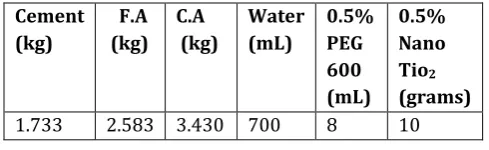
Cement (kg) F.A (kg) C.A (kg) Water (mL) 0.5% PEG 600 (mL) 0.5% Nano Tio2 (grams) 1.733 2.583 3.430 700 8 10
Table 7 – Details of Self curing concrete cube (SC2)
Cement
(kg) F.A (kg) C.A (kg)
Water (mL) 1% PEG
[image:4.595.34.279.119.194.2]600 (mL) 0.5% Nano Tio2 (grams) 1.733 2.583 3.430 700 17 10
Table 8 – Details of Self curing concrete cube (SC3)
Cement
(kg) F.A (kg) C.A (kg)
Water (mL) 1.5% PEG
600 (mL) 0.5% Nano Tio2 (grams) 1.733 2.583 3.430 700 25 10
Table 9 – Details of Self curing concrete cube (SC4) Cement
(kg) F.A (kg) C.A (kg)
Water (mL) 2% PEG
600 (mL) 0.5% Nano Tio2 (grams) 1.733 2.583 3.430 700 34 10
Table 10 – Details of Self curing concrete cube (SC5)
Cement
(kg) F.A (kg) C.A (kg)
Water (mL) 2.5% PEG
600 (mL) 0.5% Nano Tio2 (grams) 1.733 2.583 3.430 700 43 10
Table 11 – Details of Self curing concrete cube (SC6)
Cement
(kg) F.A (kg) C.A (kg)
Water (mL) 0.5% PEG
600 (mL) 1% Nano Tio2 (grams) 1.723 2.583 3.430 700 8 20
Table 12 – Details of Self curing concrete cube (SC7)
Cement
(kg) F.A (kg) C.A (kg)
Water (mL) 1% PEG
600 (mL) 1% Nano Tio2 (grams) 1.723 2.583 3.430 700 17 20
Table 13 – Details of Self curing concrete cube (SC8)
Cement
(kg) F.A (kg) C.A (kg)
Water (mL) 1.5% PEG
600 (mL) 1% Nano Tio2 (grams) 1.723 2.583 3.430 700 25 20
Table 14 – Details of Self curing concrete cube (SC9)
Cement
(kg) F.A (kg) C.A (kg)
Water (mL) 2% PEG
600 (mL) 1% Nano Tio2 (grams) 1.723 2.583 3.430 700 34 20
Table 15 – Details of Self curing concrete cube (SC10)
Cement
(kg) F.A (kg) C.A (kg)
Water (mL) 2.5% PEG
600 (mL) 1% Nano Tio2 (grams) 1.723 2.583 3.430 700 43 20
2.5. Compressive Strength of concrete:
One of the most important properties of the hardened concrete is its strength which represents the ability if concrete to resists forces. Of the various strengths of concrete, the determination of compressive strength has receives a large amount of attention, because the concrete is primarily meant to withstand compressive strength or in other words, concrete is strong in compression and weak in tension. Hence the value of tension for concrete is neglected. The compressive strength of concrete is defined as the load which causes the failure of specimen, per unit area of cross section under given rate of loading. The compressive strength of concrete is expressed as N/mm2. The
compressive strength at 28 days of curing (any type of curing methods) is taken as a criterion for specifying the quality of concrete. This is termed as grade of concrete. IS 456-2000 stipulates the use of 150mm cubes.
Compression strength = (Load at failure (or) Load at final crack) /(Area of compression face) in (N/mm2).
[image:4.595.308.562.307.370.2] [image:4.595.324.540.643.754.2]© 2018, IRJET | Impact Factor value: 6.171 | ISO 9001:2008 Certified Journal | Page 563
3. RESULTS AND DISCUSSIONS
The results of mechanical strength properties such as compressive strength corresponding to Nano TiO2 dosage,
PEG 600 dosage of the different concrete cube specimens has been thoroughly studied and comparison of Nano TiO2, PEG
[image:5.595.315.558.59.240.2]600 and M-Sand influenced concrete cube specimens (self curing concrete cube specimens) with conventional concrete specimens were made and compared. Since the main focus of this project is to utilize effect of the Nano titanium dioxide, PEG 600 and M-sand to attain maximum strength, the results obtained from the compression strength test are briefly discussed in this chapter. The values of compressive strength for both conventional and self curing concrete cubes were shown in table 16.
Table 16 – Compressive strength results at 28 days for M-25 grade concrete
Cube
Name Load at Final Crack (KN) Area of cube (mm2) Compressive strength (N/mm2)
C1 750 150×150 33.33
SC1 834 150×150 37.06
SC2 842 150×150 37.42
SC3 808 150×150 35.91
SC4 796 150×150 35.37
SC5 785 150×150 34.88
SC6 860 150×150 38.22
SC7 872 150×150 38.75
SC8 866 150×150 38.48
SC9 854 150×150 37.95
SC10 846 150×150 37.60
Chart -1: Compression strength values for conventional Concrete cube (C1) VS Self curing concrete cubes (SC1,
SC2, SC3, SC4 & SC5)
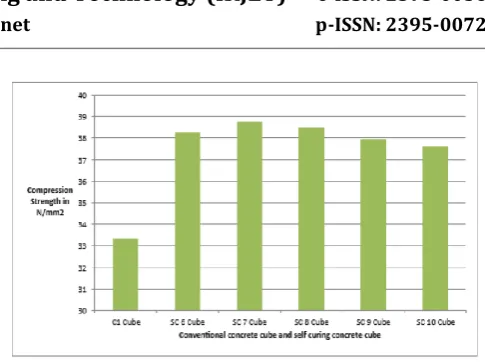
Chart - 2: Compression strength values for conventional Concrete cube (C1) VS Self curing concrete cubes (SC6,
SC7,SC8, SC9, SC10)
Chart 3 - Compression strength values for all Self curing Concrete cubes
Chart 4 – Compression strength values for all concrete Cube specimens
4. CONCLUSIONS:
© 2018, IRJET | Impact Factor value: 6.171 | ISO 9001:2008 Certified Journal | Page 564 gives highest compressive strength (SC 7 Cube – 38.75
N/mm2) after 28 days of self curing when compared to
conventional concrete cube specimens (C1 cube) and any other types of self curing concrete cubes specimens.
ii) Self curing concrete cube specimens made with replacement of 1% of nano titanium di-oxide (by weight of cement) along with addition of different proportions of PEG 600 (0.5%, 1%, 1.5%, 2% and 2.5% by weight of cement – SC 6 Cube, SC 7 Cube, SC 8 Cube, SC 9 Cube and SC 10 Cube) gives higher compressive strength when compared to conventional concrete cube specimens.
iii) Self curing concrete cube specimens made with replacement of 1% of nano titanium dioxide (by weight of cement) along with addition of different proportions of PEG 600 (0.5%, 1%, 1.5%, 2% and 2.5% by weight of cement – SC 6 Cube, SC 7 Cube, SC 8 Cube, SC 9 Cube, SC 10 Cube) gives higher compressive strength when compared to other self curing concrete specimens (SC 1 Cube, SC 2 Cube, SC 3 Cube, SC 4 Cube and SC 5 cube).
iv) All Self curing concrete cube specimens gives high compressive strength when compared to conventional concrete cube specimens.
v) Self curing concrete cube specimens made with replacement of 0.5% of nano titanium dioxide (by weight of cement) along with addition of 1% PEG 600 (by weight of cement – SC 2 Cube – 37.42 N/mm2) gives higher
compressive strength when compared to other self curing concrete specimens (SC 1 Cube, SC 3 Cube, SC 4 Cube, SC 5 Cube) and conventional concrete cube specimen (C1).
vi) Finally, use of both nano particles (nano titanium dioxide) and PEG 600 imparts greater compressive strength in self curing concrete
REFERENCES
[1] L.Srikanthan, S. Felix Franklin, A.P. Iyappan, J.Bhuvaneswari, A. Preethika “Replacement of cement by using Nano titanium dioxide in concrete, volume 5, issue 7, 2017, International journal for scientific research and development, page 499 to 503
[2] Shikha Tyagi “An Experimental Investigation of Self Curing Concrete Incorporated with Polyethylene Glycol as a Self Curing Agent”, volume 2, issue 6, 2015, International Research journal of Engineering and technology, page 129 to 132
[3] V. Mohammed Shafeeque, P.B Sanofar, K.P Praveen, Jithin Raj, V.P. Nikhil, P.M. Gopikrishna, “Strength comparison of self-curing concrete and Normal curing concrete” volume 3, issue 3, 2016, International journal of civil engineering (SSRG – IJCE), Page 56 to 61
[4] M. Poovizhiselvi, D. Karthik “Experimental Investigation of Self Curing Concrete”, volume 4, issue 1, 2017, International Research journal of Engineering and technology, page 298 to 301
[5] M.V. Jagannadha Kumar, M. Srikanth, K. Jagannadha Rao. “Strength Characteristics of Self-Curing Concrete”, volume 1, issue 1, 2012, International journal of research in engineering and technology, page 51 to 57
[6] M.K. Ankith. “Self Curing Concrete with Light Weight Aggregate”, volume 3, issue 7, 2015, International journal of scientific engineering and research, page 107 to 111
[7] K. Bala Subramanian, A. Siva, S. Swaminathan, M. Arul. G. Ajin “Development of High Strength Self Curing Concrete Using Super Absorbing Polymer”, volume 9, issue 12, 2015, International journal of civil and environmental engineering
[8] Hoff. G.C., “Internal Curing of Concrete Using Lightweight Aggregates”, American Concrete Institute, Volume 234, March 2006, P621-640.
[9] S. Aiswarya. “An Experimental Investigation On Concrete By using Nano Metakaolin” Research Journal of Recent Sciences, volume 2 (ISC-2012), 17-24 (2014)
[10] IS 10262: 2009 "Concrete Mix Proportioning"
[11] IS 456: 2000 "Plain and Reinforced Concrete"
[12] IS 2386 Part I 1963 "Methods of Test for Aggregate for Concrete"
[13] IS:383-1970: Specification for coarse and fine aggregates From natural sources for concrete, Bureau of Indian Standards, New Delhi,1993.