ISSN: 1992-8645 www.jatit.org E-ISSN: 1817-3195
A SIMULATION BASED DECISION-MAKING SUPPORT
APPROACH FOR MACHINE-BUILDING PLANTS
INVESTMENT PROJECTS ESTIMATION OF EFFICIENCY
MIKHAIL V. ZENKOVICH, YURY G. DREVS
National Research Nuclear University “MEPhI” (Moscow Engineering Physics Institute) Kashirskoe highway 31, 115409, Moscow, Russian Federation
ABSTRACT
Methods and software enabling the estimation of efficiency and the comparisons of alternative designs of machine-building plants are discussed. Problem of efficiency estimation for investment projects of machine-building plants is formulated in the terms of decision theory. Presented approach is based on the reduction of multicriterion problem of estimation of investment project to one-criterion problem. This paper describes: the structure of set of outcomes of admissible alternatives, set of vectorial estimations of outcomes, mapping of set of outcomes of acceptable alternatives to set of vectorial estimations of outcomes and structure of decision maker’s preferences. Decision rule which allows carrying out required operation over the set of admissible alternatives is formulated. Application of simulation for estimation of technological and structural decisions, which was made during the plant design, is the central feature of presented approach. Designed simulation model refers to discrete-event class. Object-oriented approach was applied for designing of the model and programming language C++ for its implementation. Application of detailed simulation model of production line allows carrying out an accurate estimation of technological and structural characteristics of involved projects. Presented methodology of estimation of investment projects of machine-building plants is tried-and-true method which applies on the phase of designing and engineering of machine-building plant. The presented approach is discussed on the example of foundry plant with moulding line.
Keywords:Simulation, Investment Projects Estimation Of Efficiency, Decision-Making Support,
Machine-Building Plant, Production Line.
1. INTRODUCTION
Machine building is a large branch of industry; it includes different types of production systems. Each type of production system is based on its own technological process. Despite the fact that all production systems have a lot of common features they are also have much differences because of different technological processes they are based on. On account of the facts mentioned above it is very hard to present a universal methodology which allows carrying out an accurate estimation of technological and structural characteristics of investment projects for all categories of machine-building plants. In this situation it is reasonable to consider particular classes of production systems separately. As the example of such production system let us take foundry plant with moulding line. The technological process on which this production system is based on is – green sand moulding. Green sand moulding currently is the most widely used of all casting manufacturing
methods. Moulding line is the main synchronizing element of the complex technological system of casting production in green moulds. Values of throughput and economical characteristics of foundry plant are depending of moulding line’s work.
ISSN: 1992-8645 www.jatit.org E-ISSN: 1817-3195
of the project are analyzed, some corrections implemented and the procedure of estimation for this project is repeated.
Problem of efficiency estimation for investment projects of machine-building plants is formulated in the terms of decision theory. Presented approach is based on the reduction of multicriterion problem of estimation of investment project to one-criterion problem. This paper describes: the structure of set of outcomes of admissible alternatives, set of vectorial estimations of outcomes, mapping of set of outcomes of acceptable alternatives to set of vectorial estimations of outcomes and structure of decision maker’s preferences. Decision rule which allows carrying out required operation over the set of admissible alternatives is formulated. Application of simulation for estimation of technological and structural decisions, which was made during the plant design, is the central feature of presented approach. Designed simulation model refers to discrete-event class. Object-oriented approach was applied for designing of the model and programming language C++ for its implementation. Application of detailed simulation model of production line allows carrying out an accurate estimation of technological and structural characteristics of involved projects.
In general investment project P could be described by the following model [1]:
P = {ICj, CFk, p, r},
where: ICj – investments in the year j, j = 1,
2,…, q, q ≤ p; CFk – cash flow in the year k, k = 1,
2, …, p; p – project’s length (period of time for the implementation of the project); r – discount rate.
For the efficiency estimation of such projects usually the following criterions are used [1], [2]: Net Present Value (NPV), Profitability Index (PI), Internal Rate of Return (IRR), Payback Period (PP), Discounted Payback Period (DPP), Accounting Rate of Return (ARR) and Modified Internal Rate of Return (MIRR).
1. Criterion NPV is based on comparison of overall value of investments (ICj) with overall
value of discounted cash flows (CFk). Because
cash flows are distributed in time, they are discounted by the means of discount rate r. The value of r is determined by the decision-maker. The following rule is existed for project’s efficiency estimation with application of criterion
NPV. If the value of criterion NPV > 0, then the project must be accepted for implementation. If the value of criterion NPV < 0, then the project
must be rejected. If the value of criterion NPV = 0, it means that the project is nor profitable nor unprofitable.
2. Criterion PI is a ratio of overall value of discounted cash flows to the overall value of investments. The following rule is existed for project’s efficiency estimation with application of criterion PI. If the value of criterion PI > 1, then the project must be accepted for implementation. If the value of criterion PI < 1, then the project must be rejected. If the value of criterion PI = 1, it means that the project is nor profitable nor unprofitable.
3. Under criterion IRR we understand the value of discount rate r, when criterion NPV = 0, i.e. IRR
= r, when NPV = f (r) = 0. IRR is reflecting expected profitability of project. If the value of criterion IRR > CC, then the project must be accepted for implementation. If the value of criterion IRR < CC, then the project must be rejected. If the value of criterion IRR = CC, it means that the project is nor profitable nor unprofitable. Parameter CC is reflecting capital’s costs.
4. If calculated value of criterion PP (or criterion DPP) is less than certain maximum payback period, then the project must be accepted for implementation. Otherwise the project must be rejected. In case of calculation of criterion DPP
discounted values of cash flows are used. In case of calculation of criterion PP values of cash flows are not discounted.
5. Criterion ARR is a ratio of average yearly income to average value of investments. Usually calculated value of criterion ARR is compared with the minimal admissible value (which is chosen be the decision-maker). If this minimal admissible value is less than calculated value of criterion ARR, then the project must be accepted for implementation. Otherwise the project must be rejected.
6. Criterion MIRR is modification of criterion
IRR. It allows taking into account reinvestments.
MIRR is reflecting expected profitability of project. If the value of criterion MIRR > CC, then the project must be accepted for implementation. If the value of criterion MIRR < CC, then the project must be rejected. If the value of criterion
MIRR = CC, it means that the project is nor profitable nor unprofitable. Parameter CC is reflecting capital’s costs.
ISSN: 1992-8645 www.jatit.org E-ISSN: 1817-3195
criterions. It is evident that it is very hard (often impossible) to find the project which would be the best by all criterions. In practice the following method is used very often. All criterions are combined in the one complex criterion. Nowadays several methods of complex criterion constriction exist. In spite of the fact that all of them have some drawbacks there are in the wide use for the reduction of multicriterion problems of estimation of investment project to one-criterion problems.
2. DECISION-MAKING PROBLEM
DEFINITION
Decision-making problem can be formulated conceptually in a following way: there is a set of decision variants (alternatives), every alternative realization leads to some event (outcome) each outcome is characterized by a set of vectorial estimations. It is needed after studying all decision-maker’s preference to design a model of alternative choice better in some specific sense.
Decision-making problem can be described formally by the following tuple [3]:
<A, , E, F, Ps, D, Т>,
where A – a set of admissible alternatives, Ω – a set of outcomes of admissible alternatives, E – a set of vectorial estimations of outcomes, F – mapping of a set Ω to a set E, F : → E; Ps – structure of decision-maker’s preferences.
It is necessary to find some decision rules or algorithm D to provide needed action T on a set of alternatives A: to select a set of non-dominating alternatives, to find the most preferable alternative, to produce linear ordering of admissible alternatives and etc.
Needed action T: on a set of alternatives A
characterizes the type of decision-making problem (choice, ordering and etc). Environment and a system of preferences are granted with elements Ω, E, F, Ps, D. Single result (deterministic or
random) which is characterized with vector estimation corresponds to each alternative. The system of preferences is described by some total combination of sets (criterions, alternatives, results, for example) with preferences relations and is some empirical system with relations. Structural representation of decision-maker’s preferences as a system with relations will be named decision-maker’s preferences structure. This structure defines the procedure of estimations comparison e(ω) and the decision rule or algorithm – the principle of elements choice from set A on the basis of comparison results in conformity with required action T.
In the considered problem elements of the tuple above are [5]–[8]:
1. The set of admissible alternatives outcomes Ω.
Outcome ω∈Ω, corresponding to alternative
A
a∈ is characterized with the vector of following type [4]–[8]:
(
ec ec+ con+ec con+ec+ tec+con+ec tec+con+ec+ pro+tec+con+ec)
=ω ω ω ω ω ω ω ω
ω 1,K, , 1,K, , 1,K, , 1,K,
,
where ω1,K,ωec – components which are describing economic parameters of project (costs for castings, raw materials, energy and etc); ec – is a number of components describing economic parameters of project; ωec+1,K,ωcon+ec – components which are describing structural parameters of project (a number of continuous-handling systems for cooling, devices for transporting of moulds and etc); con – is a number of components describing structural parameters of project; ωcon+ec+1,K,ωtec+con+ec – components
which are describing technological parameters of project (number of moulding sand components, recommended values of technological characteristics for all issued casting types and etc);
ec con tec pro ec
con
tec+ + + ω + + +
ω 1,K, – are components describing parameters which characterize line throughput (a number of definite type good castings produced on moulding line during a year; capacity factors for equipment in production sites of a line and etc); pro – is a number of components describing line throughput.
2. Mapping F: Ω→E is following vector function [5]–[8]:
( )
ω(
NPV( ) ( )
ω PIω IRR( ) ( )
ω PPω DPP( )
ω ARR( )
ω MIRR( )
ω)
F = , , , , , ,
where NPV(ω) – is a function of the criterion Net Present Value, PI(ω) – is a function of the criterion Profitability Index, IRR(ω) – is a function of the criterion Internal Rate of Return, PP(ω) – is a function of the criterion Payback Period,
DPP(ω) – is a function of the criterion Discounted Payback Period, ARR(ω) – is a function of the criterion Accounting Rate of Return and MIRR(ω) – is a function of the criterion Modified Internal Rate of Return.
3. A set of vectorial estimations of outcomes E.
Set elements are vectors e(ω)∈E, which components values correspond to criterions values (NPV, PI, IRR, PP, DPP, ARR and MIRR), calculated for the corresponding outcomes [5]–[8].
4. Needed action T over a set of admissible alternatives A. It is necessary to find the most preferable alternative a*∈A [5]–[8].
ISSN: 1992-8645 www.jatit.org E-ISSN: 1817-3195
find such alternative a*∈A, for which corresponding outcome ω*∈Ω, ensures the maximum meaning of efficiency function:
( )
∑
( )
=⋅
=
7 1)
(
i i ii
UN
F
U
ω
ρ
ω
,where U(ω) – is project (alternative) efficiency
A
a∈ corresponding to the outcome ω∈Ω;
ρ1, …, ρ7 – are weight coefficients reflecting the
relative impotence of corresponding criterions values. They are assigned processing from individual decision-maker’s preferences reflecting his preferences structure Ps,
{ }
: 0, 1, ,7, 1 .7 1 = = ≥ = =
∑
= i i i ii
ρ
ρ
iρ
ρ
ρ
KCriterion function NPV(ω), PI(ω), IRR(ω),
ARR(ω) and MIRR(ω) are maximized and PP(ω) and DPP(ω) are minimized. To maximize the value of selected efficiency function U(ω) it is necessary to have all criterion functions maximized. That is why it is necessary to change the purpose direction (replacement «min» to «max») for criterions PP(ω) and DPP(ω). For this we use the following transformations:
( )
ω PP( )
ωF4 =− and F5
( )
ω =−DPP( )
ω .Now it is necessary to conduct the procedure of criterions normalization and ranking because we propose using multicriteria choice of economically rational investment project of foundry plant, but criterions chosen for its evaluation have different dimensions. The given procedure means taking criterions to none-dimensional view with the help of certain transformation. That transformation has to satisfy the following qualities: 1) to have the mutual beginning of counting out and single change values order for the whole set of admissible alternatives; 2) to be monotonous (that is to say this transformation has to keep preference relation for whole set of admissible alternatives).
( )
ω), =1, ,7,ω∈Ω(F i K
UNi i – are monotonous functions transporting every criterion function
( )
ω,i=1,K,7,ω∈ΩFi to normalized (non-dimensional) view, F1
( )
ω =NPV( )
ω; F2( )
ω =PI( )
ω;( )
( )
;3ω IRRω
F = F4
( )
ω =−PP( )
ω; F5( )
ω =−DPP( )
ω;( )
( )
;6ω ARRω
F = F7
( )
ω =MIRR( )
ω.For criterion normalization let us use the procedure of full normalization:
( )
( )
=
∈
Ω
−
−
=
ω
ω
ω
)
,
1
,
,
7
,
(
max minmin
K
i
F
F
F
F
F
UN
i i i i i i ,where Fimin and Fimax – the least and the greatest
(correspondingly) criterion function value Fi(ω) at
the set of admissible alternatives results Ω. This normalization reflects initial criterion values to a segment [0, 1]. The best value of normalized criterion equals 1, the worst one equals 0.
6. The relation of preference.
Let us consider that the alternative a1 is more preferable than alternative
a
2 (a1fa2) if forcorresponding outcomes ω1 andω2∈Ω the following inequality is true:
U
( )
ω
1>
U
( )
ω
2 . In case U( )
ω1 =U( )
ω2 we consider alternativea
1and
a
2 are equal or equivalent (a
1~
a
2).3. CRITERIONS COMPUTATION AND
VARIANT GENERATION
There are two most widespread approaches to the computation of mentioned above criterions (NPV, PI, IRR, PP, DPP, ARR and MIRR) of investment projects evaluation [1], [2], [9]–[11]: deterministic and stochastic (related upon statistical tests method). When using the deterministic approach the values of all cash flow parameters sets on the bases of experts’ estimations. When we use stochastic approach we can divide these parameters into two groups: 1) meanings of those arranged by decision-maker personally and 2) random values for which decision-maker sets only intervals of change, random distribution types and parameters reflecting (according to decision-maker’s opinion) certain regularity of given parameter value change. Thus in general view correlation for NPV criterion computation will be as follows (it is possible to produce correlation for computation other criterions in the same way):
NPV = f(χ1,…,χi,…,χl,ξ1,…,ξj,…, ξs),
where χi – are stochastic parameters
(components of cash flow; they are random values); l – is a number of stochastic parameters; ξj
– are deterministic parameters (components of cash flow which after analysis were defined as independent values or weakly depending on environment and so will be considered as deterministic values); s – is a number of deterministic parameters. Then with the help of special software statistical modeling is provided and on this basis the valuations of criterions sought values are obtained.
ISSN: 1992-8645 www.jatit.org E-ISSN: 1817-3195
by decision-maker on a subjunctive basis. One of the ways out of this situation is using simulation model for throughput parameters values estimations of moulding line project under consideration [4]–[8]. When using this approach decision-maker sets the values of economic parameters on the basis of experts’ estimations. Values of structural parameters are set in accordance with technological regulations, cards and expert’s evaluations. Values of structural and technological parameters influence throughput parameters values. Simulation model of moulding line allows estimating throughput parameters values of considering moulding line project changing technological and structural parameters.
Quantity of good castings producing in a year is the main parameter among all moulding line throughput parameters. With market requirements and price this parameter influences very much on income value of production realization in a year. In its turn realization production income for the year, summary production costs for the year and profit tax pay in a year are the main parameters which are taking in account when computation yearly cash flow (CFk) is taking place. Annual
yearly cash flows depending on investment project under realization are taken in account when criterions NPV, PI, IRR, PP, DPP, ARR and MIRR
are calculated.
We shell name casting as a good one if all values of its technological characteristics are in the certain limits [4]–[8]. Let’s name the technological characteristics of casting: 1) time from semimould production till mould assembly; 2) time from mould assembly till its casting; 3) metal temperature when mould was cast; 4) duration of casting cooling in a mould; 5) duration of casting cooling after its shaking-out; 6) content of bentonite and 7) content of a special technological addition in moulding sand which this mould was produced from. Structural features of specific moulding line, equipment stoppage in the moulding line, staff qualification and some other factors influence values of those parameters. We shall consider a casting bad even if only one of its characteristics will be out of permissible meanings.
4. GENERAL PRINCIPLES OF
SIMULATION MODEL DESIGN
The theory of aggregative system [12] has been chosen for formal description of moulding line. In this approach state of each unit is described by a vector which components are time functions. Time
dependence can be continuous (casting temperature, for example) and discrete (positions in continuous-handling system, for example).
Let us consider moulding line as an aggregative system consisting of four aggregative subsystems. They are corresponding to production sites of moulding line (casting and cooling, shaking-out and cooling after this, moulding sand preparation and moulding). In its turn each aggregative subsystem consists of limited number of aggregates describing equipment included in the production sites of given subsystem. Each aggregate in any aggregative system can be classified from one of the following groups [4]: 1) transporting device: device for transporting semimoulds, moulds and castings; 2) continuous-handling system: system for semimoulds, casting, cooling and castings cooling after shaking-out; 3) device for making object: moulding machine and device for assembly of moulds; 4) mixer/bunker for moulding sand: mixer and bunker for moulding sand; 5) casting machine with flooding scoop; 6) device for object disassembling: shaking-out device and device for flask disassembling; 7) belt feed conveyor. Algorithm for presentation of aggregates belonging to each groups is being made on the base of general aggregate model which describes common features for all aggregates in this group features.
Simulation model of moulding line is built on the basis of four autonomous models of production sites [13]. Models of all moulding line production sites consist of two modules: structural module and algorithms of its elements interactions. Common modules of moulding lines models are modeling monitor and user’s interface. Discrete-events method was used for model design. The mechanism of time advancement with a constant step was used as a principle of time changing. Object-oriented approach was used for design and language C++ was used for model implementation.
ISSN: 1992-8645 www.jatit.org E-ISSN: 1817-3195
interaction algorithm was based on conditionally-events principle. Such approach to the implementation of control mechanism permits to easily modify the function system algorithm and to model any non-permanent situation. New elements could be integrated into structural part of the model without changing of already existed function algorithm [4], [13].
5. EXAMPLE OF PROJECTS
ESTIMATION
Let’s take a good look at the implementation of discussed methodology on the following example. Two alternative projects of foundry plants on the basis of moulding lines are estimated. Let’s mark them – Project 1 and Project 2. So in this case А – set of admissible alternatives consists of two elements a1 and a2. Range of produced castings for
both two projects is the same. The main differences of these two projects are specifications of casting and cooling site of moulding line design, the amount of initial investments and costs of castings manufacture. The amount of initial investments and costs of castings manufacture for Project 1 are higher (in compare to Project 2). Estimation of these projects conducted by described above methodology gave the following results:
Project 1 Project 2
NPV 4,22 mil. USD 3,018 mil. USD
PI 2,34 1,97
IRR 25,1% 23,5%
PP 2 years 2,2 years
DPP 2,5 years 2,8 years
ARR 55,3 % 52,8 %
MIRR 23,1 % 21,7 %
U(ω) 0,83 -0,16
It is evident from the presented data that variant
1
a
is more preferable than variant a2 (a1fa2),because for corresponding to them outcomes
Ω ∈ 2 1andω
ω the following inequality is true:
( )
ω1 U( )
ω2U > .
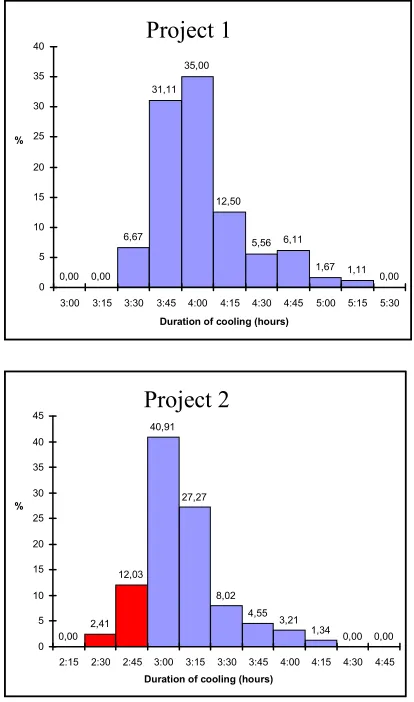
Values of all criterions and value of efficiency function in case of Project 1 implementation are more preferable than values of the same criterions and efficiency function in case of Project 2 implementation. Values deterioration of all criterions and efficiency function in case of Project 2 implementation were analyzed. It was reveled that this significant deterioration was conditioned by specifications of casting and cooling site of moulding line design. On the projected moulding
line it is supposed to produce castings for which permissible meaning of technological characteristic “duration of casting cooling in a mould” is above 3 hours. On the Figures 1 are presented histograms of durations of casting cooling in a mould distributions for Project 1 and Project 2 respectively.
In case of the implementation of Project 1 duration of casting cooling in a mould for all moulds would be above 3 hours. In case of the implementation of Project 2 duration of casting cooling in a mould for 14.44% of moulds would be less than 3 hours. Because technological characteristic “duration of casting cooling in a mould” for this castings is out of permissible meanings we consider this castings as wasted. Decreasing of produced good casting amount leads to values deteriorations of all criterions and efficiency function in case of Project 2 implementation.
[image:6.612.317.524.337.688.2]
Figure 1: Durations Of Casting Cooling In A Mould Distribution.
From this example you can see that adopted on
Project 2
0,00 2,41
12,03 40,91
27,27
8,02 4,55
3,21 1,34
0,00 0,00 0
5 10 15 20 25 30 35 40 45
2:15 2:30 2:45 3:00 3:15 3:30 3:45 4:00 4:15 4:30 4:45
Duration of cooling (hours) %
Project 1
0,00 0,00 6,67
31,11 35,00
12,50 5,56 6,11
1,67 1,11 0,00 0
5 10 15 20 25 30 35 40
3:00 3:15 3:30 3:45 4:00 4:15 4:30 4:45 5:00 5:15 5:30
ISSN: 1992-8645 www.jatit.org E-ISSN: 1817-3195
the earlier stages of project implementation construction concept could lead to production of considerable amount of wasted castings, which in turn leads to values deteriorations of all criterions and efficiency function. In spite of the fact that on the first account it was supposed that this construction concept could allow shortening expanses significantly, without any negative effect. Discussed above traditional methods of investment projects estimation (deterministic and stochastic) aren’t permit to take into account structural and technological parameters of project. Because production efficiency significantly depends from values of these parameters it is better to use different approaches for estimation of such kind of projects. Presented in this paper approach is based on the application of simulation model of moulding line for the estimation of structural and technological parameters of the considered project. Application of this approach improves decision-making efficiency, especially on the earlier stages of project implementation.
6. CONCLUSION
Presented evaluation method for investment projects of foundry plants on the base of mould-ing lines proved its efficiency on designmould-ing and engineering stages of project’s implementation. Problem of estimation of efficiency of investment projects of foundry plants on the basis of moulding lines is formulated in the terms of decision theory. As it was mentioned above in-vestment project estimation of efficiency could not be solved as only one criterion problem. For the complex analysis of all characteristics of the project it is recommended to use several criterions. It is evident that it is very hard (often impossible) to find the project which would be the best by all criterions. Presented approach is based on the reduction of multicriterion problem of es-timation of investment project to one-criterion problem. All criterions were combined in the one complex criterion. This paper describes: the structure of set of outcomes of admissible alterna-tives, set of vectorial estimations of outcomes, mapping of set of outcomes of acceptable alter-natives to set of vectorial estimations of outcomes and structure of decision maker’s prefer-ences. Decision rule which allows to carry out required operation over the set of admissible al-ternatives is formulated. Application of simulation for estimation of technological and struc-tural decisions, which was made during the plant design, is the central feature
of presented ap-proach. Model of moulding line refers to discrete-event class. Object-oriented approach was applied for designing of the model and programming language C++ for its implementation. Application of detailed simulation model of moulding line allows carrying out an accurate es-timation of technological and structural characteristics of involved projects. Presented methodol-ogy of estimation of investment projects of foundry plants on the basis of moulding lines is tried-and-true method which applies on the phase of designing and engineering of foundry plant.
We have successful results of considered method application and never the less we have some plans for its improvement. Now the thorough revision of moulding line simulation model is made in accordance with agent modeling principles [14]. Agent technologies are connected with the concept of intellectual agent as some intellectual robot (active element) purposely in-teracting with other such elements and environment under taking conditions. There are a lot of successful examples of implementation of agent-based simulation models of different produc-tion systems [14], [15]. It is very impotent for us because moulding line is also a production system.
REFERENCES
[1] V.V. Kovalev. Introduction to financial management. Moscow: Finance and statistics, 2004.
[2] R.A. Brealey, S.C. Myers. Principles of Corporate Finance. 7th edition. The McGraw−Hill Companies, 2003.
[3] A.N. Borisov, A.V. Alekseev, G.V. Merkureva, N.N. Sliadz, V.I. Glushkov. Processing of fuzzy data in the decision-making support systems. Moscow: Radio and communications, 1989. [4] M.V. Zenkovich, Y.G. Drevs. Decision-making
support of moulding lines design // Automatization in industry. 2010. №11. [5] M.V. Zenkovich, Y.G. Drevs. Supported
decision making in estimation of investment projects of foundry plants // Applied informatics. 2012. №5(41).
ISSN: 1992-8645 www.jatit.org E-ISSN: 1817-3195
[7] M.V. Zenkovich. Estimation of investment projects of foundry plants with application of simulation models // System analysis and information technologies: 15-th International conference SAIT 2013, Kyiv, Ukraine, May 27–31, 2013. Proceedings. – ESC “IASA” NTUU “KPI”, 2013.
[8] M.V. Zenkovich, Y.G. Drevs. A simulation based decision-making support approach for foundry plants investment projects estimation of efficiency // Recent advances in mathematical methods in applied sciences. Proceedings of The 2014 International Conference on Mathematical Models and Methods in Applied Sciences (MMMAS 2014).: Saint Petersburg State Polytechnic University, Saint Petersburg, Russia, September 23-25, 2014.
[9] Jay April, Marco Better, Fred Glover, James Kelly. New advances and applications for marrying simulation and optimization // Proceedings of the 2004 Winter Simulation Conference, 2004, Washington, D.C., USA. [10]Gerald W. Evans, Suraj M. Alexander. Using
multi-criteria modeling and simulation to achieve lean goals // Proceedings of the 2007 Winter Simulation Conference, 2007, Washington, D.C., USA.
[11]Bernard J. Kornfeld, Sami Kara. Project portfolio selection in continuous improvement // International Journal of Operations & Production Management. 2011. Volume 31 issue 10.
[12]N.P. Buslenko. Simulation and modeling of complex systems. Moscow: Nauka. 1978. [13]Y.G. Drevs., M.V. Zenkovich, A.S. Lubchenko.
Simulation of moulding lines // Automatization in industry. 2008. №7.
[14]Barbosa J., Leitao, P. Simulation of multi-agent manufacturing systems using Agent-Based Modelling platforms // 2011 9th IEEE International Conference on Industrial Informatics (INDIN) pp. 477 – 482.