S T U D Y P R O T O C O L
Open Access
Open versus laparoscopic left lateral hepatic
sectionectomy within an enhanced recovery
ERAS
W
programme (ORANGE II
–
Trial): study
protocol for a randomised controlled trial
Ronald M van Dam
1,8*, Edgar M Wong-Lun-Hing
1, Gerard JP van Breukelen
3, Jan HMB Stoot
4,
Joost R van der Vorst
5, Marc HA Bemelmans
1, Steven WM Olde Damink
1,2,6, Kristoffer Lassen
7and
Cornelis HC Dejong
1,2ORANGE II Study Group
Abstract
Background:The use of lLaparoscopic liver resection in terms of time to functional recovery, length of hospital stay (LOS), long-term abdominal wall hernias, costs and quality of life (QOL) has never been studied in a randomised controlled trial. Therefore, this is the subject of the international multicentre randomised controlled ORANGE II trial.
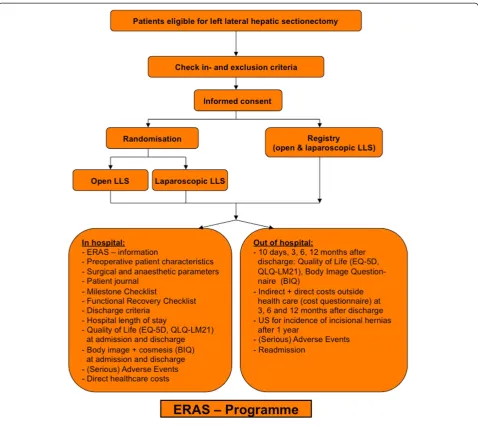
Methods:Patients eligible for left lateral sectionectomy (LLS) of the liver will be recruited and randomised at the outpatient clinic. All randomised patients will undergo surgery in the setting of an ERAS programme. The experimental design produces two randomised arms (open and laparoscopic LLS) and a prospective registry. The prospective registry will be based on patients that cannot be randomised because of the explicit treatment preference of the patient or surgeon, or because of ineligibility (not meeting the in- and exclusion criteria) for randomisation in this trial. Therefore, all non-randomised patients undergoing LLS will be approached to participate in the prospective registry, thereby allowing acquisition of an uninterrupted prospective series of patients. The primary endpoint of the ORANGE II trial is time to functional recovery. Secondary endpoints are postoperative LOS, percentage readmission, (liver-specific) morbidity, QOL, body image and cosmetic result, hospital and societal costs over 1 year, and long-term incidence of incisional hernias. It will be assumed that in patients undergoing
laparoscopic LLS, length of hospital stay can be reduced by two days. A sample size of 55 patients in each randomisation arm has been calculated to detect a 2-day reduction in LOS (90% power andα= 0.05 (two-tailed)). The ORANGE II trial is a multicenter randomised controlled trial that will provide evidence on the merits of laparoscopic surgery in patients undergoing LLS within an enhanced recovery ERAS programme.
Trial registration:ClinicalTrials.gov NCT00874224.
Keywords:Laparoscopy, Open liver resection, Hepatectomy, ERAS, Left lateral sectionectomy, RCT
* Correspondence:[email protected]
1
Department of Surgery, Maastricht University Medical Centre, Maastricht, The Netherlands
8Clinical and Surgical Sciences, Department of Surgery, Maastricht University
Medical Centre, PO Box 5800, 6202, AZ Maastricht, The Netherlands Full list of author information is available at the end of the article
Background
Liver resection for colorectal metastasis is the only poten-tially curative therapy, and has become the standard of care in appropriately staged patients, offering 5-year sur-vival rates of approximately 35-40% [1]. For symptomatic benign lesions and those of uncertain nature or large size, liver resection is also a widely accepted treatment. Within the framework of optimising postoperative recovery and/ or producing a shorter length of stay (LOS) in hospital, laparoscopic surgery and enhanced recovery programmes have recently been introduced for liver surgery.
Laparoscopic liver resection was first described in 1995 [2]. Over the past decade the method has gained wide ac-ceptance for various liver resection procedures [3-9]. Mul-tiple retrospective case series and reviews comparing open with laparoscopic liver resection indicate that laparoscopic liver resection can be used safely for both malignant and benign liver lesions [10-15]. Recent publications from ex-pert centers show that a substantial part of the total vol-ume of major and minor liver resections is performed laparoscopically, and results are good [16,17]. Laparo-scopic liver resection is associated with shorter LOS, less postoperative pain, earlier recovery, and better quality of life (QOL) [9,13,18,19]. Comparing patients undergoing an open left lateral sectionectomy (LLS) of the liver with those undergoing laparoscopic LLS, both Vigano et al. and Carswellet al. [20,21] found no significant difference in operating time between the two groups. In addition, the median length of postoperative LOS was significantly less (6 vs. 9 days, P < 0.01) after laparoscopic resection [3]. Furthermore, no evidence of a compromised oncolo-gic clearance in laparoscopic liver resection has been found [3,13]. However, recovery and LOS are not only dependent on the type of surgery or procedure, and other variables should also be taken into account.
The Enhanced Recovery After Surgery (ERAS)
programme has been introduced to improve postoperative care. This multimodal programme, derived from Kehlet’s pioneer work in the 1990s for multimodal surgical care, involves optimisation of several aspects of the periopera-tive management of patients undergoing major abdominal surgery. In patients undergoing segmental colectomy, the ERAS programme enabled earlier recovery and conse-quently shorter LOS [22-25]. Furthermore, a reduction of post-operative morbidity in patients undergoing intestinal resection was reported [26-29]. These results stimulated liver surgeons of the ERASWgroup (Maastricht, Edinburgh and Tromsö) to adapt the ERAS programme to patients undergoing open liver resection. Van Damet al. [30] found a significantly reduced LOS after open liver resection when patients were managed within a multimodal ERAS programme. Besides a reduction in median total LOS from 8 to 6 days (25%), the data also suggested that a further re-duction in stay could be possible as there was a delay
between the recovery and actual discharge of the patients [30]. Moreover, Stootet al. found retrospectively that there was a further reduction in LOS from 7 days to 5 days when patients were operated laparoscopically and managed within an ERAS programme [31]. In that study there was also a delay between recovery and actual discharge of the patients. Previously, Maessen et al. reported a median delay to discharge of 2 days after patients had functionally recovered after colonic surgery managed within an ERAS programme [32]. This delay is often linked to patient age, hospital logistics, and absence of social and/or homecare support.
In most reported trials aiming at earlier recovery or a re-duction in LOS, type of surgery and/or perioperative man-agement were not standardised. In addition, the added value of laparoscopic LLS compared with open left lateral sectionectomy within an ERAS programme in terms of time to functional recovery, LOS in hospital, costs, and QOL has never been studied in a randomised controlled trial (RCT). However, randomisation of patients undergo-ing open or laparoscopic liver resection is hazardous. It is to be expected that experienced centres will be reluctant to randomise patients because of the absence of clinical and patient equipoise for laparoscopic resection. To capit-alise on both centers with and without preference for lap-aroscopic liver surgery, and to thereby acquire an uninterrupted prospective series of patients, an alternative trial design with two randomisation arms (open versus lap-aroscopic surgery) and a prospective registry has been con-structed for the ORANGE II trial. The combination of an RCT and a prospective registry will improve overall power and strengthen the external validity and generalisability of study results [33-35].
Methods
Ethics approval
The study has been approved by the Medical Ethical Review Board of the Maastricht University Medical Center, Maastricht, The Netherlands trial number NL 25591.068.08 / MEC 08-2-110. Ethics consent will also be obtained from the national or regional ethics boards in each participating country. Patients willing to participate in this trial will receive both verbal and written informa-tion at the time of recruitment in the outpatient clinic. In accordance with the local medical ethics committee all participating sites will provide an independent surgeon or physician if needed. An independent surgeon (M. Poeze) has been appointed for the Maastricht University Medical Center to answer questions. Confidentiality is guaranteed by assigning the participators an encoded trial number. This indicates that only the physician with the decoding
future analysis of these data. Withdrawal from the trial at any time or for any reason will not hold any form of conse-quences for the patient, and data from these patients will be deleted.
Study design
The ORANGE II trial is a prospective superiority study with an experimental design, using two double-blinded randomised controlled arms and a prospective registry to determine whether laparoscopic surgery is to be pre-ferred over open surgery in patients undergoing a LLS and participating in an enhanced recovery programme. In the participating randomising centers, patients, nurses and the ward physician (but not the operating surgeon) will be blinded for the type of intervention up to and in-cluding postoperative day (POD) 3. They will record the functional recovery criteria twice daily. Only the investi-gator and operating surgeons will know the actual pro-cedure. The blinded ward physician(s) will decide on whether a patient will be discharged or not.
However, randomisation of patients undergoing open or laparoscopic liver resection is hazardous as previously explained. Moreover, another potential source of bias exists when randomising patients with a strong treat-ment preference. When patients cannot be blinded to their treatment allocation (POD 3) they may be resentful and demoralised if they do not receive their preferred treatment, and consequently they may have poor compli-ance. By contrast, patients receiving their preferred treat-ment may have above-average compliance.
Thus to capitalise on centres both with and without preference for laparoscopic liver surgery, and thereby to acquire an uninterrupted prospective series of patients, all non-randomised patients undergoing a LLS will be approached to participate in the prospective registry. Registration of these patients is imperative to guarantee a consecutive series of patients and also because the ab-sence of such a series may restrict generalisation of the results, as randomised participants may not in fact be representative [36]. The combination of an RCT and a prospective registry will improve overall power and strengthen the external validity and generalisability of study results [33-35]. This non-randomised registry group will be analysed for centre and centre by treat-ment interaction as an observational study. Medical cen-tres that wish to participate in this trial, but with liver surgeons early in the laparoscopic learning curve, will be accompanied during the procedure by an experienced proctoring laparoscopic HPB-surgeon.
Primary & secondary endpoints
The primary endpoint of the ORANGE II trial is time to functional recovery. A patient is fully functionally recov-ered when all of the following five criteria are satisfied:
1) adequate pain control with oral analgesia; 2) restor-ation of mobility to an independent level; 3) absence of intravenous fluid administration; 4) ability to eat solid foods; and normal or decreasing serum bilirubin level and international normalised ratio.
It is medically justified to discharge patients when the criteria for full functional recovery are met and if the patient is willing to go home. Secondary endpoints in-clude postoperative LOS in hospital, percentage of read-missions, total morbidity (both general and procedure related), composite endpoint of liver-surgery-specific morbidity, QOL, body image and cosmesis, reasons for delay of discharge after functional recovery, hospital and societal costs over 1 year, and long-term incidence of in-cisional hernias.
Morbidity
The preoperative morbidity status of patients will be measured using the American Society of Anesthesiolo-gists (ASA) scale. The Portsmouth modification of the Physiological and Operative Severity Score for the Enu-meration of Mortality and Morbidity (P-POSSUM) will be used to evaluate the risk of perioperative morbidity and mortality. Post-operative morbidity is rationally predictable, with hemorrhagic complications occurring predominantly during surgery or in the early postopera-tive phase, and biliary complications, intra-abdominal abscess, or liver failure in the later postoperative phase. Wound infection and sepsis will be additional complica-tions that require monitoring. Morbidity will be
classi-fied and analysed according to the validated
classification for postoperative morbidity as described by Dindoet al[37].
Liver resection-specific composite endpoint
In this trial, we will also use a well-defined liver surgery-specific composite endpoint, as suggested by van den Broeket al. [38]. This endpoint is a parameter composed of a combination of procedure-specific complications, which is considered as a single, dichotomous outcome: operative mortality, intra-abdominal haemorrhage, asci-tes, bile leakage, intra-abdominal abscess, and post-resec-tional liver failure. These components, which are all specific to liver surgery and have substantial clinical rele-vance, reflect complications rated as Dindo grade 3–5. A composite score of 1 (failure) will reflect the occurrence of at least one of the above liver-specific complications, and a score of 0 (success) will be assigned if none of these occur.
Quality of life
translated EQ-5D for international centers will be used. The EQ-5D is a standardised instrument for use as a measure of health outcome, which consists of the five dimensions of mobility, self-care, usual activities, pain/ discomfort, and anxiety/depression, with three levels each and a rating on the EQ visual analogue scale (VAS; 0–100). [39-41] Furthermore, the European Or-ganisation for Research and Treatment (EORTC) 30-item post-cancer QOL questionnaire (QLQ-C30; with the liver metastases (LM21) module will be used for liver-specific treatment measurements [42]. Assessment of the patients’ QOL will be performed at the time of consent, discharge and 10 days, 3, 6 and 12 months after discharge.
Body image and cosmesis
To evaluate differences in postoperative body image and cosmesis, the Body Image Questionnaire (BIQ) will be used [43,44], which consists of eight questions about body image and cosmesis. The body image assessment will be performed preoperatively at time of consent. Both the body image and cosmesis assessment will take place at discharge, and at 10 days, 3 months, 6 months and 12 months after discharge.
Hospital and societal costs
The economic evaluation will include a cost-utility ana-lysis from a Dutch societal perspective. The incremental costs per quality adjusted life year (QALY) gained will be based on utility scores from the EQ-5D [39-41]. All hospital expenses (direct and indirect) related to both interventions will be monitored. In addition, a cost questionnaire offered at the regular follow-up consult-ation (3, 6 and 12 months) will help assess the societal and individual costs outside health care relating to patients’ absence, impaired mobility, work, or normal daily activities. Unit prices will be based either on prices from the participating hospital financial depart-ments or will be extrapolated using Dutch guidelines for cost calculation [45].
Incidence of incisional hernias
Incisional hernia after open surgery is a well-known complication of surgery, with an incidence of up to 20% after a 10-year period [46]. In patients undergoing a sig-moid resection, Anderson et al. found that laparoscopic resection led to a significantly lower incidence of inci-sional hernia compared with open surgery [47]. Further-more, in two retrospectively analysed series of patients who received a partial hepatectomy, different types of incisions were compared. D’Angelicaet al. reported that the common incisions used for partial hepatectomy were the Mercedes incision and extended right subcostal (ERSC) incision, and that the ERSC incision provides
adequate, safe access and is associated with fewer long-term wound complications (9.8% vs 4.8%, P<0.001) [48]. More recently, Togo et al. reported frequencies of incisional hernia after median, J-shaped, right transverse incision with a vertical extension at the midline from the subumbilical region to the xiphoid process (RTVE), and reversed T incisions to be 6.3%, 4.7%, 5.4%, and 21.7%, respectively. A diagnosis of ‘no hernia’ required a mini-mum follow-up of 12 months [49].
To assess the incidence of incisional hernias in patients undergoing laparoscopic and open LLS, they will be con-tacted at a mean time of 1 year after resection to undergo ultrasonography to assess the incidence of incisional hernia.
Study population
Every patient requiring an LLS will be identified and informed at the outpatient clinic about open and laparo-scopic liver resection. Only patients meeting the inclusion and exclusion criteria will be approached for randomisa-tion. After reading the ORANGE II trial patient informa-tion and being allowed 1 week for considerainforma-tion, patients will be asked for their informed consent. All patients ineli-gible for randomisation will be approached for participa-tion in the prospective registry. If patients express an explicit preference, they will be allocated to the prospect-ive registry and interviewed to ascertain the reasons for their preferences. Personal written informed consent will be obtained for all groups. Randomisation will be carried out through the ORANGE II trial website using web-based randomisation software (TENALEAW; www.tenalea. com) (see Figure 1 for trial flow-chart).
Patients will be approached for randomised inclusion if they meet each of the following inclusion criteria: require LLS; willingness to participate in the study; able to understand the nature of the study and what will be required of them; are men or non-pregnant, non-lactat-ing women between the ages of 18 and 80 years of age; have a body mass index of between 18 and 35; and have ASA grading of I to III.
The exclusion criteria are: liver resection other than LLS; underlying liver disease; unwillingness to participate; in-ability to give written informed consent; and ASA grading of IV to V.
ERAS-programme
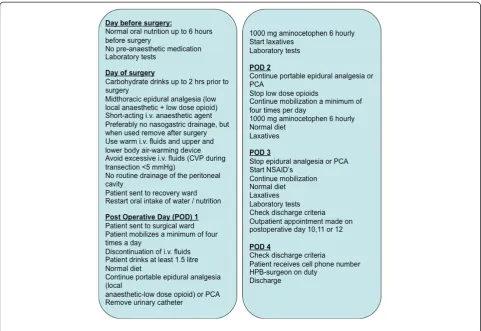
All patients will participate in the ERAS liver programme, with a standardised peri-operative management. For daily guidelines of the pre- and postoperative care of patients undergoing liver resection (Figure 2).
Functional recovery criteria
the hospital. The discharge process starts at the pre-admis-sion counseling sespre-admis-sion, during which any special needs of the patients will be determined (for example, homecare or social support, transport. Before admittance, any problem that could delay discharge will be identified and addressed. Patients will only be discharged when they have met the functional recovery criteria and are willing to go home. Reasons to delay discharge after functional recovery will be monitored and documented. Functional recovery cri-teria and LOS in hospital will be independently monitored and analysed.
Adequate pain control with oral analgesics
Postoperative pain will be systematically registered twice daily using the validated verbally administered 11-point
numeric rating scale (NRS-11, 0 to 10) [50-53]. Members of a specialised pain team will ask patients to rate the intensity of their current pain on a scale of 0 (no pain) to 10 (worst possible pain), with pain rated as‘mild’(1 to 3)‘moderate’ (4 to 6) or ‘severe’) 7 to 10 [54]. The NRS-11 seems to be better accepted by most patients and to be at least as sensi-tive and valid as the more traditional VAS ratings [53].
Tolerance of solid food
[image:5.595.59.538.87.522.2]ranging from 0 (no nausea) to 10 (worst possible nau-sea), and where necessary, be countered prophylactically by antiemetic treatment.
Mobility
To assess the difference between the preoperative and postoperative mobility level, the ERAS Mobility Scale (EMS) has been developed from the Groningen Activity Restriction Scale [55]. The EMS assesses 10 basic actions to compare the level of mobility before and after surgical intervention. When the patient is able to perform 8 of the 10 items, they are independently mobile. Patients will be assessed whether they are able or not to independently perform these basic actions fully. Daily the assessment will be repeated and compared with the preoperative baseline score until mobility at an independent or pre-operative level is achieved.
Statistical analysis
Sample size
Because laparoscopic liver surgery focuses on accelerated recovery, time to functional recovery is used as the
[image:6.595.57.539.88.419.2]for the loss of degrees of freedom incurred in the data analysis, which takes centre and treatment × centre effects into account, a total sample size of 110 (n = 2 × 55) will be required.
For all secondary outcome measures, the power will be 75% after correction for multiple testing with two-tailed α= 0.01, assuming the same effect size (d= 0.73) as for the primary outcome. An interim analysis of the primary outcome, using Snapinn’s method, will be performed after inclusion of 50% of the sample to avoid unnecessary inclusion of too many patients in this ORANGE II trial [56].
Descriptive statistics
The primary outcome parameter of time to functional re-covery and the secondary parameter of LOS in hospital will be given in days, with a median and range. Morbidity will be classified according to the classification described by Dindoet al. and defined as a dichotomous composite endpoint, while readmission will be given as a percentage. Scores for quality of life, body image and cosmesis will be given as mean and standard deviation per time point per treatment arm. Hospital costs will be given as median and range. Long-term incidence of incisional hernia will be reported and analysed.
Univariate analysis
The primary outcome measure of time to functional re-covery will be measured in days, and will be analysed with fixed-effect regression that will take centre and treatment × centre interaction into account as fixed effects. If the actual number of centers and the sample size per centre allow random effects analysis, this will also be performed and this analysis will have the same power as the planned fixed effects analysis if the design effect does not exceed 1.2. With a sample size of 10 patients per centre, the design effect is 1.2 if the intra-class correlation (ICC) is 0.02, where the ICC is based on treatment × centre interaction [57].
All secondary outcomes as measured at discharge will be analysed by fixed-effect regression using linear regression for quantitative outcomes and logistic regression for binary outcomes, and including the baseline measure as a covari-ate to improve power and precision. In addition to P -values, confidence intervals for all effects will be reported. Morbidity will be classified as described by Dindo et al., but will be presented as raw data only because the required sample size for intervention effects on morbidity is much larger than the calculated sample size for this trial [58].
Economic evaluation
The economic evaluation will include a cost-utility ana-lysis from a societal perspective. The time horizon of this evaluation will be the same as the duration of the trial,
that is, 12 months. All costs (direct and indirect) related to both interventions will be calculated. The final cost calculation of unit costs will be based on a combined bottom-up and top-down approach. In accordance with Dutch guidelines for cost calculation, indirect healthcare costs will not be taken into account. In addition, re-source use will be measured by use of primary data that is registered in our case record forms (CRFs) by use sim-ple checklists. Furthermore, a questionnaire will be used to survey the direct non-healthcare costs related to trav-elling, impaired mobility and domiciliary care (for nor-mal daily activities). The incremental, indirect non-healthcare costs per QALY gained will be based on the utility scores from the EQ-5D [39-41]. For all direct healthcare costs, the unit prices will be based either on prices from the hospital financial department or the Dutch guidelines for cost calculation [45].
Registry
The prospective registry of patients who cannot be rando-mised because of ineligibility or because of explicit treat-ment preference on the part of the patient or surgeon will be analyzed as an observational study. In addition, data from the registry will be analyzed for interaction between treatment, centre, and study type (randomised or not). On condition that there is no interaction between treatment, centre, and study type, and that the observational study does not suffer from severe confounding (because adjust-ing for that strongly reduces the power of the observa-tional study), pooling of both studies should give more power than separate analyses of either study. Possible con-founders will be registered in the CRFs. The inclusion of the prospective registry in the trial design will create an uninterrupted case series, which will increase external val-idity and generalisability.
Data collection
Data concerning patient characteristics, functional recov-ery, surgical and anaesthesiologic parameters, morbidity, LOS, QOL, patient compliance, and costs will be pro-spectively collected using both paper CRFs and an open source clinical trial software platform (OpenClinicaW; Ikaza Research, Cambridge, MA, USA) that uses e-CRFs for electronic data capture and clinical data manage-ment, which are validated and stored in compliance with good clinical practice guidelines. The e-CRFs will be stored in a secured database (Oracle Cor., Redwood Shores, CA, USA), and as stated previously, all patient data will be encoded to ensure privacy.
Monitoring
a medical specialist. In a concerted effort a DSMB char-ter will be developed, and all three members will sign a non-competing interest form. The DSMB will be respon-sible for safeguarding the interests of trial participants, assessing the safety and efficacy of the interventions dur-ing the trial, and monitordur-ing the overall conduct of the clinical trial.
Intention to treat
Analysis of all patients will be performed according to the intention-to-treat principle: patients will be analysed as randomised or as planned in the non-randomised pro-spective registry, and all patients will be included in the data analysis with proper methods for handling missing data.
Discussion
Several authors have indicated that laparoscopic liver section has many benefits over conventional open liver re-section. However, this has never been proven in an RCT, and what the primary endpoint should be for an RCT comparing open and laparoscopic liver resection is a sub-ject to debate. Using either liver surgery-related mortality or liver surgery-specific morbidity as an endpoint is not feasible, because patient accrual would take many years and be a logistically major global effort [58]. LOS in hos-pital, time to recovery, long-term incisional hernias, body image, and costs are potential candidates because improve-ments in these are some of the possible benefits. Laparo-scopic liver resection is appealing for many surgeons and patients, but the learning curve for the surgeon is thought to be long and costly for hospital budgets. However, oper-ating times in laparoscopic LLS tend to be shorter, and may compensate for expenses in technology and consum-ables [31,59]. Moreover, the existing trials in liver surgery have not evaluated time to recovery or LOS in hospital after laparoscopic liver resection within an enhanced re-covery programme. The more rapid rere-covery reported after enhanced recovery programmes may be further accel-erated as a consequence of small incisions in laparoscopic surgery. In addition, learning curves for laparoscopic left lateral resection or anterior segments seem to be reason-ably short for liver surgeons with advanced laparoscopic experience [60]. The question remains whether an RCT is necessary to prove that laparoscopy should be accepted as the preferred method to perform liver resection. In the Louisville consensus meeting on laparoscopic liver surgery, it was stated that laparoscopic LLS should be standard practice in experienced hands [61]. However, this may have been a subjective vision of a subset of opinion leaders, because long experience with both open and laparoscopic liver surgery was the main characteristic of those attending the meeting. Undoubtedly, the dissemination phase of lap-aroscopic liver surgery has started, and it is to be expected
that many surgeons will adopt this technique in the future. A multinational multicentre prospective registry, a well-organised multicentre RCT, training programmes, and quality control measures are of great importance during this adoption period [33].
It is well recognised that a well-conducted double-blind RCT provides the highest level of evidence to prove the possible benefits of laparoscopic liver resection. However, performing an RCT in surgery is not without difficulties, and alternative trial designs may be necessary [33,34,62]. First, the intervention needs to be tested in a standardised environment, and the properties of the intervention should remain unchanged during the trial period. This seems im-possible for an intervention such as laparoscopic liver sur-gery in a multicentre RCT. Experience varies between participating centres, and will vary over time. Moreover, local standards for perioperative care are different. Both LLS and the ERASWenhanced recovery protocol provide the standardisation needed. The learning curve of a LLS is short in centres with experience in liver surgery and advanced laparoscopy. The use of proctor surgeons in cen-tres with limited experience in laparoscopic liver surgery the operative techniques can be reasonably standardised, and this should eliminate learning curve influences on out-come parameters. Quality of the surgery can be assured by digital video recording.
Second, the intervention should be double-blinded. Al-though double blinding in a surgical trial is difficult, using a fixed abdominal dressing for 3 days after surgery is feasible, and should prevent both ward caregivers and patients from knowing the type of intervention.
Third, it is reasonable to query whether this is now the right time to perform an RCT and whether the results of the trial will be valid for the more general surgical commu-nity. A recent review of the results of laparoscopic liver re-section in 2,804 patients showed that laparoscopic liver resection in expert centres is feasible and safe for both minor and major liver resections [36]. The percentages of liver resections performed laparoscopically now range from 25% to 65% in high-volume expert centres such as University Hospital Southampton NHS (Southampton, UK), Henri Mondor (Paris, France), UPMC (Pittsburgh, USA), UZ Leuven (Leuven, Belgium) and Rikshospitalet (Oslo, Norway) [36,63]. Although it is to be expected that many centres worldwide will adopt laparoscopic liver re-section as a more or less standard procedure in the near future, there are still many patients and surgeons that pre-fer the open procedure long beyond the learning curve. In parallel with the development of laparoscopic liver surgery,
equipoise and a prospective registry to cover both sur-geons who believe that based on their laparoscopic experi-ence randomisation is not ethically justified and patients with a strong treatment preference will provide external validity. This trial design capitalises on rather than ignores the differences between patients, will provide more robust outcome data, and should lead to continuous performance monitoring after the trial [35,62].
The key question clearly is as to whether this RCT is really necessary. The benefits of laparoscopic liver resec-tion are not beyond reasonable doubt, and although data are becoming increasingly available, recent publications do not provide sound data on time to recovery. World-wide, median LOS in hospital for open and laparoscopic resections varies from 4 to 8 days [17,30,64-66]. Reasons for delay in discharge and discharge location are often absent, and a clear definition of recovery has not been used to date in any of the publications. Departing from the standpoint that an RCT should be conducted, the question is which sample size should be used? In our opinion, a reduction of only 1 day in time to recovery or LOS in hospital after laparoscopic resection would be a disappointingly low gain. To prove such a reduction, 320 patients would be needed (α = 0.05 and power of 90%), making the trial unlikely to be accomplished. Based on available reports, a 2-day reduction should be possible [17,31,66], and reduces the sample size to 110 patients undergoing LLS. This number is reasonably moderate, and it is to be expected that patient accrual will be accomplished within 1–2 years.
It should be realised that many centres have intro-duced laparoscopic liver surgery programmes in the ab-sence of a central reporting or certifying agency. In our opinion, laparoscopic LLS should function as a model for further dissemination of laparoscopic techniques in hepatic surgery. The left lateral segment of the liver has been a natural first step for a laparoscopic resection given the peripheral anatomical location (thin liver seg-ment, minimal requirement for biliary dissection, and ease of controlling the left portal pedicles and left hep-atic vein), and has been proven to be safe and feasible with reproducible results [20,36]. The implementation of the laparoscopic LLS may not only serve as a guide to develop and master programmes for major laparoscopic hepatic resections, but may also be used as an introduc-tion for centres new to laparoscopic approaches in liver surgery. To adopt laparoscopic liver resection safely, cer-tification for centres, surgeons, and units should be avail-able through the International Hepatobiliary (HPB) Association, and national and international HPB associa-tions should become involved in the goal of establishing training standards and credentials to ensure a high and consistent outcome. The ORANGE II trial in which techniques are standardised and a training and proctor
programme is available, combined with the hybrid design of randomisation and registry may help to provide a framework for controlled and safe implementation of laparoscopic liver resection across participating centres.
Conclusions
The international multicentre randomised controlled OR-ANGE II trial is based on the observations of more rapid recovery and discharge after laparoscopic liver resection, and more rapid recovery and discharge after open liver re-section within an enhanced recovery programme. This is the first RCT to provide evidence on the merits of laparo-scopic surgery in patients undergoing a LLS within an enhanced recovery programme.
Trial status
Currently there are nine actively participating centres, con-sisting of the Maastricht University Medical Center (MUMC), Academic Medical Center (AMC), University Medical Center Utrecht (UMCU), Erasmus Medical Cen-ter (Erasmus MC), University Medical CenCen-ter Groningen (UMCG), Maxima Medical Center (MMC), Medical Spectrum Twente (MST) in The Netherlands. In addition, the University Hospital Aachen (UK Aachen) and San Raf-faele Hospital Milan (HSR Milan) are two participating centres in Germany and Italy. Additional centres will be invited to participate.
Abbreviations
ORANGE: Optimised recovery with accelerated nutrition and GI enhancement; ERAS: Enhanced recovery after surgery; LLS: Left lateral sectionectomy; LOS: Hospital length of stay; POD: Post operative day; CRF: Case record form; ASA: American society of anaesthesiology; P-POSSUM: Portsmouth physiologic and operative severity score for the enUmeration of mortality and morbidity; EORTC: European organization for research and treatment of cancer.
Competing interests
Both positive and negative results will be published. There are no financial interests in this trial and none of the parties concerned has right of veto.
Acknowledgements
The ORANGE II trial is partly funded by the Profiling Fund of the Maastricht University Medical Center, Maastricht, The Netherlands number PF 298. In addition, CovidienWsupports this trial with an unrestricted grand. Collaborators of the ORANGE II Study Group: O.R.C. Busch, P.J. Tanis, L.T. Hoekstra (Academic Center Amsterdam), R. van Hillegersberg, I.Q. Molenaar (UMC Utrecht), C. Verhoef, T. Terkivatan, J. de Jonge (Erasmus MC), G.D. Slooter, R.M.H. Roumen (Maxima MC), J.M. Klaase, E.B. van Duyn (Medical Spectrum Twente), K. Boscha (Jeroen Bosch Hospital), R. J. Porte, M.T de Boer, J.W. Haveman (UMC Groningen), J.H.W. de Wilt, O.R. Buyne (UMC Nijmegen), P. van Duijvendijk (Gelre Hospitals), U. Neumann, M. Schmeding (UH Aachen), G. Ferla, L.A. Aldrighetti, F. Ferla (HSR Milan), J.N. Primrose, M. Abu Hilal, N.W. Pearce (University Hospital Southampton), I. Dagher (Antoine Béclère Hospital), A. Laurent (Henri Mondor Hospital), B. Topal (UZ Leuven), R.I. Troisi (UZ Gent), B. Edwin (Oslo University Hospital). DSMB members: M.A. Boermeester, I.H.M. Borel Rinkes, A.W. Ambergen.
Author details
1
Department of Surgery, Maastricht University Medical Centre, Maastricht, The Netherlands.2Nutrim School for Nutrition, Toxicology and Metabolism,
Maastricht University Medical Centre, Maastricht, The Netherlands.
Centre, Maastricht, The Netherlands.4Department of Surgery, Orbis Medical
Centre, Sittard, The Netherlands.5Department of Surgery, Leiden University Medical Centre, Leiden, The Netherlands.6Department of Surgery, Royal Free
Hospital, London, United Kingdom.7Department of Surgery, University of Northern Norway Hospital, Tromsö, Norway.8Clinical and Surgical Sciences,
Department of Surgery, Maastricht University Medical Centre, PO Box 5800, 6202, AZ Maastricht, The Netherlands.
Author’s contributions
RMvD, EMW-L-H and JRvdV drafted the manuscript. RMvD, EMW-L-H, JRvdV, JHMBS, MHAB, SWMOD, KL, and CHCD participated in the design of the study and revised the manuscript. GJPvB performed the sample size calculations, advised in trial design, leads interim analysis and revised the manuscript. All authors read and approved the final manuscript.
Received: 22 September 2011 Accepted: 6 May 2012 Published: 6 May 2012
References
1. Ruers T, Bleichrodt RP:Treatment of liver metastases, an update on the possibilities and results.Eur J Cancer2002,38(7):1023–1033.
2. Cuesta MA, Meijer S, Paul MA, de Brauw LM:Limited laparoscopic liver resection of benign tumors guided by laparoscopic ultrasonography: report of two cases.Surg Laparosc Endosc1995,5(5):396–401. 3. Carswell KA, Sagias FG, Murgatroyd B, Rela M, Heaton L, Patel AG,et al:
Laparoscopic versus open left lateral segmentectomy.BMC Surg2009,9 (14):9.
4. Vigano L, Tayar C, Laurent A, Cherqui D:Laparoscopic liver resection: a systematic review.J Hepatobiliary Pancreat Surg2009,16(4):410–421. 5. Cherqui D:Laparoscopic liver resection.Br J Surg2003,90(6):644–646. 6. Dagher I, Di Giuro G, Dubrez J, Lainas P, Smadja C, Franco D:Laparoscopic
versus open right hepatectomy: a comparative study.Am J Surg2009, 198(2):173–177.
7. Dagher I, O'Rourke N, Geller DA, Cherqui D, Belli G, Gamblin TC, Lainas P, Laurent A, Nguyen KT, Marvin MR:M, Ravindra K, Fielding G, Franco D, Buell JF: Laparoscopic major hepatectomy: an evolution in standard of care.Ann Surg2009,250(5):856–860.
8. Abu Hilal M, Di Fabio F, Teng MJ, Lykoudis P, Primrose JN, Pearce NW: Single-centre comparative study of laparoscopic versus open right hepatectomy.J Gastrointest Surg2011,15(5):818–823.
9. Abu Hilal M, McPhail MJ, Zeidan B, Zeidan S, Hallam MJ, Armstrong T, Primrose JN, Pearce NW:Laparoscopic versus open left lateral hepatic sectionectomy: a comparative study.Eur J Surg Oncol2008,34:1285–1288. 10. Abu Hilal M, Pearce NW:Laparoscopic left lateral liver sectionectomy: a
safe, efficient, reproducible technique.Dig Surg2008,25:305–308. 11. Dagher I, Lainas P, Carloni A, Caillard C, Champault A, Smadja C, Franco D:
Laparoscopic liver resection for hepatocellular carcinoma.Surg Endosc
2008,22(2):372–378.
12. Dagher I, Proske JM, Carloni A, Richa H, Tranchart H, Franco D: Laparoscopic liver resection: results for 70 patients.Surg Endosc2007, 21(4):619–624.
13. Lee KF, Cheung YS, Chong CN, Tsang YY, Ng WW, Ling E, Wong J, Lai PB: Laparoscopic versus open hepatectomy for liver tumours: a case control study.Hong Kong Med J2007,13(6):442–448.
14. O'Rourke N, Shaw I, Nathanson L, Martin I, Fielding G:Laparoscopic resection of hepatic colorectal metastases.HPB (Oxford)2004,6(4):230– 235.
15. Troisi R, Montalti R, Smeets P, Van Huysse J, Van Vlierberghe H, Colle I, De Gendt S, de Hemptinne B:The value of laparoscopic liver surgery for solid benign hepatic tumors.Surg Endosc2008,22(1):38–44.
16. Nguyen KT, Gamblin TC, Geller DA:World review of laparoscopic liver resection-2,804 patients.Ann Surg2009,250(5):831–841.
17. Bryant R, Laurent A, Tayar C, Cherqui D:Laparoscopic liver resection-understanding its role in current practice: the Henri Mondor Hospital experience.Ann Surg2009,250(1):103–111.
18. Laurence JM, Lam VW, Langcake ME, Hollands MJ, Crawford MD, Pleass HC: Laparoscopic hepatectomy, a systematic review.ANZ J Surg2007,77 (11):948–953.
19. Alkari B, Owera A, Ammori BJ:Laparoscopic liver resection: preliminary results from a UK centre.Surg Endosc2008,22(10):2201–2207.
20. Carswell KA, Sagias FG, Murgatroyd B, Rela M, Heaton N, Patel AG: Laparoscopic versus open left lateral segmentectomy.BMC Surg2009, 9:14.
21. Vigano L, Tayar C, Laurent A, Cherqui D:Laparoscopic liver resection: a systematic review.J Hepatobiliary Pancreat Surg2009,16:410–21. 22. Fearon KC, Ljungqvist O, Von Meyenfeldt M, Revhaug A, Dejong CH, Lassen
K, Nygren J, Hausel J, Soop M, Andersen J:Kehlet H: Enhanced recovery after surgery: a consensus review of clinical care for patients undergoing colonic resection.Clin Nutr2005,24(3):466–477.
23. Kehlet H, Wilmore DW:Multimodal strategies to improve surgical outcome.Am J Surg2002,183(6):630–641.
24. Wilmore DW, Kehlet H:Management of patients in fast track surgery.BMJ (Clinical research ed2001,322:473–476.
25. Lassen K, Soop M, Nygren J, Cox PB, Hendry PO, Spies C, von Meyenfeldt MF, Fearon KC, Revhaug A, Norderval S, Ljungqvist O, Lobo DN:Dejong CH: Consensus review of optimal perioperative care in colorectal surgery: enhanced recovery after surgery (ERAS) group recommendations.Arch Surg2009,144(10):961–969.
26. Basse L, Madsen JL, Kehlet H:Normal gastrointestinal transit after colonic resection using epidural analgesia, enforced oral nutrition and laxative.
Br J Surg2001,88(11):1498–1500.
27. Basse L, Raskov HH:Hjort Jakobsen D, Sonne E, Billesbolle P, Hendel HW, Rosenberg J, Kehlet H: Accelerated postoperative recovery programme after colonic resection improves physical performance, pulmonary function and body composition.Br J Surg2002,89(4):446–453. 28. Delaney CP, Zutshi M, Senagore AJ, Remzi FH, Hammel J, Fazio VW:
Prospective, randomized, controlled trial between a pathway of controlled rehabilitation with early ambulation and diet and traditional postoperative care after laparotomy and intestinal resection.Dis Colon Rectum2003,46(7):851–859.
29. Zutshi M, Delaney CP, Senagore AJ, Mekhail N, Lewis B, Connor JT, Fazio VW: Randomized controlled trial comparing the controlled rehabilitation with early ambulation and diet pathway versus the controlled rehabilitation with early ambulation and diet with preemptive epidural anesthesia/ analgesia after laparotomy and intestinal resection.Am J Surg2005,189 (3):268–272.
30. van Dam RM, Hendry PO, Coolsen MM, Bemelmans MH, Lassen K, Revhaug A, Fearon KC, Garden OJ, Dejong CH:Initial experience with a multimodal enhanced recovery programme in patients undergoing liver resection.Br J Surg2008,95(8):969–975.
31. Stoot JH, van Dam RM, Busch OR, van Hillegersberg R, De Boer M:Olde Damink SW, Bemelmans MH, Dejong CH: The effect of a multimodal fast-track programme on outcomes in laparoscopic liver surgery: a multicentre pilot study.HPB (Oxford)2009,11(2):140–144.
32. Maessen J, Dejong CH, Hausel J, Nygren J, Lassen K, Andersen J, Kessels AG, Revhaug A, Kehlet H, Ljungqvist O, Fearon KC:von Meyenfeldt MF: A protocol is not enough to implement an enhanced recovery programme for colorectal resection.Br J Surg2007,94(2):224–231.
33. McCulloch P:Developing appropriate methodology for the study of surgical techniques.J R Soc Med2009,102(2):51–55.
34. Gore SM:The consumer principle of randomisation.Lancet1994,343 (8888):58.
35. Brewin CR, Bradley C:Patient preferences and randomised clinical trials.
BMJ1989,299(6694):313–315.
36. Nguyen KT, Gamblin TC, Geller DA:World review of laparoscopic liver resection-2,804 patients.Ann Surg2009,250:831–841.
37. Dindo D, Demartines N, Clavien PA:Classification of surgical complications: a new proposal with evaluation in a cohort of 6336 patients and results of a survey.Ann Surg2004,240(2):205–213. 38. van den Broek MA, van Dam RM, van Breukelen GJ, Bemelmans MH,
Oussoultzoglou E, Pessaux P, Dejong CH, Freemantle N:Olde Damink SW: Development of a composite endpoint for randomized controlled trials in liver surgery.Br J Surg2011,98(8):1138–1145.
39. Lamers LM, McDonnell J, Stalmeier PF, Krabbe PF, Busschbach JJ:The Dutch tariff: results and arguments for an effective design for national EQ-5D valuation studies.Health Econ2006,15(10):1121–1132.
40. Lamers LM, Stalmeier PF, McDonnell J, Krabbe PF, van Busschbach JJ: Measuring the quality of life in economic evaluations: the Dutch EQ-5D tariff.Ned Tijdschr Geneeskd2005,149(28):1574–1578.
42. Blazeby JM, Fayers P, Conroy T, Sezer O, Ramage J, Rees M:Validation of the european organization for research and treatment of cancer QLQ-LMC21 questionnaire for assessment of patient-reported outcomes during treatment of colorectal liver metastases.Br J Surg2009,96(3):291– 298.
43. Polle SW, Dunker MS, Slors JF, Sprangers MA, Cuesta MA, Gouma DJ, Bemelman WA:Body image, cosmesis, quality of life, and functional outcome of hand-assisted laparoscopic versus open restorative proctocolectomy: long-term results of a randomized trial.Surg Endosc
2007,21(8):1301–1307.
44. Dunker MS, Stiggelbout AM, van Hogezand RA, Ringers J, Griffioen G, Bemelman WA:Cosmesis and body image after laparoscopic-assisted and open ileocolic resection for Crohn's disease.Surg Endosc1998,12 (11):1334–1340.
45. Oostenbrink JB, Koopmanschap MA, Rutten FF:Standardisation of costs: the Dutch manual for costing in economic evaluations.
Pharmacoeconomics2002,20(7):443–454.
46. Hoër J, Lawong G, Klinge U, Schumpelick V:Einflussfaktoren der narbenhernienenstehung retrospektive untersuchung an 2.983 laparotomierten patienten über einen zeitraum vno 10 jahren.Chirurg
2002,73:474–480.
47. Andersen LP, Klein M, Gogenur I, Rosenberg J:Incisional hernia after open versus laparoscopic sigmoid resection.Surg Endosc2008,22(9):2026–2029. 48. D'Angelica M, Maddineni S, Fong Y, Martin RC, Cohen MS, Ben-Porat L,
Gonen M, DeMatteo RP, Blumgart LH, Jarnagin WR:Optimal abdominal incision for partial hepatectomy: increased late complications with Mercedes-type incisions compared to extended right subcostal incisions.
World J Surg2006,30(3):410–418.
49. Togo S, Nagano Y, Masumoto C, Takakura H, Matsuo K, Takeda K, Tanaka K, Endo I, Shimada H:Outcome of and risk factors for incisional hernia after partial hepatectomy.J Gastrointest Surg2008,12(6):1115–1120.
50. Paice JA, Cohen FL:Validity of a verbally administered numeric rating scale to measure cancer pain intensity.Cancer Nurs1997,20(2):88–93. 51. McGuire DB:Comprehensive and multidimensional assessment and
measurement of pain.J Pain Symptom Manage1992,7(5):312–319. 52. Dorrepaal KL, Aaronson NK, van Dam FS:Pain experience and pain
management among hospitalized cancer patients.A clinical study. Cancer
1989,63(3):593–598.
53. Jensen MP:The validity and reliability of pain measures in adults with cancer.J Pain2003,4(1):2–21.
54. Krebs EE, Carey TS, Weinberger M:Accuracy of the pain numeric rating scale as a screening test in primary care.J Gen Intern Med2007,22 (10):1453–1458.
55. Suurmeijer TP, Doeglas DM, Moum T, Briancon S, Krol B, Sanderman R, Guillemin F, Bjelle A, van den Heuvel WJ:The Groningen Activity Restriction Scale for measuring disability: its utility in international comparisons.Am J Public Health1994,84(8):1270–1273.
56. Snapinn SM:Monitoring clinical trials with a conditional probability stopping rule.Stat Med1992,11(5):659–672.
57. van Breukelen GJ, Candel MJ, Berger MP:Relative efficiency of unequal versus equal cluster sizes in cluster randomized and multicentre trials.
Stat Med2007,26(13):2589–2603.
58. van den Broek MA, van Dam RM, Malago M, Dejong CH, van Breukelen GJ, Damink SW:Feasibility of randomized controlled trials in liver surgery using surgery-related mortality or morbidity as endpoint.Br J Surg2009, 96(9):1005–1014.
59. Koffron AJ, Auffenberg G, Kung R, Abecassis M:Evaluation of 300 minimally invasive liver resections at a single institution: less is more.Ann Surg
2007,246:385–392. discussion 392–384.
60. Vigano L, Laurent A, Tayar C, Tomatis M, Ponti A, Cherqui D:The learning curve in laparoscopic liver resection: improved feasibility and reproducibility.Ann Surg2009,250(5):772–782.
61. Buell JF, Cherqui D, Geller DA, O'Rourke N, Iannitti D, Dagher I, Koffron AJ, Thomas M, Gayet B, Han HS, Wakabayashi G, Belli G, Kaneko H, Ker CG, Scatton O, Laurent A, Abdalla EK, Chaudhury P, Dutson E, Gamblin C, D'Angelica M, Nagorney D, Testa G, Labow D, Manas D, Poon RT, Nelson H, Martin R, Clary B, Pinson WC, Martinie J, Vauthey JN, Goldstein R, Roayaie S, Barlet D, Espat J, Abecassis M, Rees M, Fong Y, McMasters KM, Broelsch C, Busuttil R, Belghiti J, Strasberg S:Chari RS; World Consensus Conference on Laparoscopic Surgery: The international position on laparoscopic liver surgery: The Louisville Statement, 2008.Ann Surg2009,250(5):6.
62. McCulloch P, Taylor I, Sasako M, Lovett B, Griffin D:Randomised trials in surgery: problems and possible solutions.BMJ2002,324(7351):1448–1451. 63. Kazaryan AM, Pavlik Marangos I, Rosseland AR, Rosok BI, Mala T, Villanger O,
Mathisen O, Giercksky KE, Edwin B:Laparoscopic liver resection for malignant and benign lesions: ten-year Norwegian single-center experience.Arch Surg145:34–40.
64. Topal B, Fieuws S, Aerts R, Vandeweyer H, Penninckx F:Laparoscopic versus open liver resection of hepatic neoplasms: comparative analysis of short-term results.Surg Endosc2008,22(10):2208–2213.
65. Pessaux P, Regimbeau JM, Dondero F, Plasse M, Mantz J, Belghiti J: Randomized clinical trial evaluating the need for routine nasogastric decompression after elective hepatic resection.Br J Surg2007,94(3): 297–303.
66. Ito K, Ito H, Are C, Allen PJ, Fong Y, DeMatteo RP, Jarnagin WR, D'Angelica MI:Laparoscopic versus open liver resection: a matched-pair case control study.J Gastrointest Surg2009,13(12):2276–2283.
doi:10.1186/1745-6215-13-54
Cite this article as:van Damet al.:Open versus laparoscopic left lateral hepatic sectionectomy within an enhanced recovery ERASWprogramme (ORANGE II–Trial): study protocol for a randomised controlled trial. Trials201213:54.
Submit your next manuscript to BioMed Central and take full advantage of:
• Convenient online submission
• Thorough peer review
• No space constraints or color figure charges
• Immediate publication on acceptance
• Inclusion in PubMed, CAS, Scopus and Google Scholar
• Research which is freely available for redistribution