AN IMPROVISED APPROACH TO GENERATE
SIGNIFICANT ASSOCIATION RULES FROM CUSTOMER
TRANSACTION DATABASE- EMPIRICAL ANALYSIS
1ARCHANA SINGH, 2AJAY RANA, 3JAYANTHI RANJAN
1Asso Prof., 1ASET AUUP, Noida, INDIA
2 Prof., ASET AUUP, Noida, INDIA
3 Prof., IMT Ghaziabad, UP, INDIA
E-mail: [email protected] , [email protected], [email protected]
ABSTRACT
There are techniques available in order to remove redundant and irrelevant association rules from transactional database. This paper emphasizes on identifying the significant rules from pool of rules generated using an improvised approach of the algorithm. A score model is proposed to find essential rules out of many rules. An attempt is made to find significant rules by using a proposed algorithm RuleGenerator which is based on an approach of adjacency lattice and depth first search to generate association rules. The proposed algorithm is less complex as compared to the existing one and generates rules in less number of edges. The empirical research analysis is done on the customer transaction database using Maruti Suzuki cars, it results in the vital customer choices and rules. The application in automobile sector, cars results in rules which help the Organization in identifying the segment of cars preferred by the certain category of customers. The study also focuses on the implication in detail, the usage of significant rules in various decision making activities.
Keywords:Association Rules; Data Mining Algorithm; Significant Rule Value; Adjacency Lattice Structure; Decision Making
1. INTRODUCTION
IT Leaders have their own rules to make them renowned distinguish entrepreneur. There always has been the importance of rules and following of rules. The definition of rules for any business makes it significantly different from others. In the current competitive environment the focus is on the customer who is an intelligent entity. The functionalities of CRM combined with the data mining obtain useful, considerable and concrete rules. IF-THEN rules empower the decision making activity. IF-THEN rules were described by Kim for CRM systems, campaigning and marketing activities [1]. Kim configures the data warehouse on the basis of set of campaign rules generated. Since, with the existing of large databases and large number of frequent item sets in them many association rules are generated. So, it is important to prune the rule and to select the best fit or an important rule from the rule lot. The existing work discussed the interestingness of association rule measure, importance of association rules out of many rules generated[2] .Selected important rules can further be ranked according to the measure, which
extension of our previous work [11]. In the current paper the experimentation of algorithm is done for real time data of customers using cars for an automobile industry and the implementation of algorithm is done in Oracle SQL developer. This paper contributes in generating essential association rules for an automobile industry using a proposed algorithm and a score model. A score model is proposed which will generate the rules using significant rule template as input. As a result, significant rules are generated which can be further used for various decision making activities like, campaign/marketing induction programs, in turn facilitating better product or service promotion by targeting the right customer. This paper attempts to find significant, non redundant and relevant rules for decision making process in automobile sector. In our earlier published research work [11] the results were found using a new proposed algorithm with the datasets of 30 transactions. The result were evaluated and compared with the existing algorithm proposed by [4]. In our previous work detailed analysis on the differences between the association rules generated by the new proposed algorithm and existing algorithm has been shown with their complexities. Our proposed algorithm has less complexity and is capable of finding all essential rules in comparison with the algorithms [7] [12-14] used in previous authors’ work.
In this paper using the descriptive research, Data is collected in two phases: secondary data is composed from the dealer and primary data from various questionnaires prepared after the discussion with scholars and experts and customers’ social website responses.
1.1 Related Work Done
Researchers proposed an efficient association rule mining algorithm[10], FP-growth algorithm[23], its usage, advantage of tree based approach[14-15]. It explained how hash based techniques helps in finding frequent patterns and pruning reduces the response time, its pros and cons. The interestingness measure of association rules [16]. The commendable work in Data Mining techniques in customer relationship management [17-20] .In the work she proposed holistic framework on CRM, analytical CRM from the view of data mining. Data mining in marketing and brings about knowledge in them [21]. The generalized association rules are described with the help of pruning technique [22].An online algorithm which does not depend on the transactional data size and finds association rules from large data set reducing time[4].
The paper is organized as follows: In section2: the approach of the selecting significant rules is given and in section3 the steps of algorithm RuleGenerator. The
section 4 is about the empirical research, analysis and the implications of the study and section 5 wraps up with a conclusion and future scope of work.
2. APPROACH
The approach aims to identify the importance of significant rules and how significant rules value can be computed. A proposed algorithm RuleGenerator is used to generate significant rules by applying a significant rule template as an input to it.
2.1 Importance Of Significant Rule Generation From A Score Model
It has been realized that effective and efficient decision making activity requires vital rules to develop strategies. As, on the daily basis, we come across many real time situations where frequently asked and less frequently asked questions are involved and these queries helps the top management to take up the right decisions. Since different people have different opinions therefore, for the best rule deduction “Domain experts are required”. Deduction of rule should contain all important attributes that are sufficient to define all valuable concerns in the data. All the attributes in the rule signifies / extracts all important rule which is required. Since, rule generation is objective not subjective. Rules with higher measures are considered to be more significant.
The scoring model shown in figure 1 takes rule template as input and generates all the relevant and significant rules. Data is collected from various operational data sources like customer feedback details; purchase details, customer personal details, etc. In this model it has an ETL tool which cleans data.
In data discretization step all missing values are removed, data binning and other technique is applied to make data consistent and increases the degree of correctness. After data preprocessing, data warehouse contains relevant customer’s casesets which are further clustered or divided into groups contains similar kind of information by Domain Data Engine (based on Data mining clustering technique). This model has another component as Manager which takes out Core factor attributes from multiple factor attributes contains in each cluster formed. On these factor dimensions significant rule template is applied to generate rules with minimum threshold support value. Applying the mathematical formula to compute Significant Rule Value, essential and relevant rules with high measure can be used for decision making process.
2.1.1 Data Mining Technique for Significant Rule Generation: Proposed Association Rule mining algorithm
A transaction database contains daily transacted items. In a transactional database, to attain vital rules from core dimension reduction of dimensions are required. Selecting significant number of relevant attributes, bringing out information from unexplored data can be achieved by data mining techniques. Data mining explores hidden patterns by using its various algorithms for classification, clustering and association rule mining. Association rule mining is a concept which is also called pattern mining or generating even the hidden rule from the database. Association rule mining can be defined as the process of nontrivial extraction of implicit, previously unknown and potentially useful information. In a transactional database where it contains a number of attributes called item sets.
Association rule mining algorithms solves the problem in two steps, first by finding large item sets second by generating rules from these item sets. The rule has two sides, left side is antecedent (factor condition) and right side is consequent (decision factor). It has been learnt that if a rule is generated frequently among different rule sets infers that the rule frequently generated is significant. To filter the significant rule among the various rules generated association rule mining technique has important measure that is called support. Support is the measure which contains significant transactions in a specific rule [3]. Association rule
can be defined as :
Factor condition (f)(antecedent) → decision factor(D)(consequent), where f and D are mutually exclusive item sets in the transaction database T. Support(s) can be defined as the percentage of occurrence of antecedent and consequent together in a transaction. The confidence(c) is that the ratio percentage of transactions containing E also contain D.A typical practical problem with support and confidence measure one come across when with the same value or different values of support and confidence many association rules are generated. Many algorithms [28] have already been designed to crack this problem. In our earlier work the algorithm has been proposed to generate association rules from the large transactional database, where the graph generated in our algorithm has less edge in comparison with lattice structure used by the algorithm proposed by [4]. In the proposed algorithm it generates all the significant and essential rules without repetition and missing [11]. The graph which is generated by the algorithm is the directed graph with weights associated with the edges. The number
of edges produced is less as compared to the previous one. In this paper, the algorithm is implemented in Oracle SQL developer and applied for the real time dataset collection to find a business solution for an automobile sector.
The proposed (RuleGenerator) algorithm is based on two conditions.
1. A product of the confidence of the path between the starting node and the visited mode must be greater than minimum confidence.
2. To reduce simple redundancy: We generate set of all children of the visited node and then this set of child nodes is compared with the nodes that have already been used by the same starting node for rule generation. If any one of the child nodes is found there from this visited node no rule can be generated. As, this rule will be redundant.
2.1.2 Significant Rule Value
There are many rules generated, but all are not important. Selection of an essential rule is the root finding problem. The best rule should contain all the required attributes for the inference of the rule or for diagnosing the problem or for better decision making. This Significant Rule Value can be defined as a rule which contains all the necessary factors enforcing the customer to buy the product. The parameters which attract the customer to retain and to become more loyal and satisfied are termed as factor condition like customer preferences. The decision factor example product is the deciding attribute based on factory conditions. The association rule mining technique can be
applied on the transactional datasets to generate essential rules. Significant Rule Value (SRV) can be explained as it is the frequently generated rule in comparison with the less frequent generated rule across the same rule sets.
SRV = Number of times rule occurs in all the generated RuleDomain / Number of customer case sets (N). RuleDomain is the pool of rules generated.
SRVi = f ( rulegeny)/N ,
Where, N=number of Case sets; rulegeni RuleDomaink
where i=1….n,y = 1…k ……… equation 1
Significant Rule Template such as,
<factor condition1, factor condition2, factor condn >
<Decision factori> ……equation
| f ∪ D |
2
This equation 2 is applied to generate multiple rules for multiple cases. SRV (Significant rule value) further can be calculated as the frequency of the rule generated. It also depicts the measure of importance of individual rule generated. The rules generated from different attributes would infer different results. So, it is important to evaluate rules generated from the pool.
a) Rules with 100% value
b) Selecting rules having more and important factor conditions are given weight age than the rule with less or fewer factor conditions.
c) Removal of redundant rule from the Rulesets.
Since there could be more rules generated if all core and non-core attributes are considered for rule generation.
d) Selected rules are ranked.
3. PROPOSED ALGORITHM
Figure 2 ; Proposed Algorithm
4. EMPIRICAL ANALYSIS
There is a cut throat competition in an automobile sector, a manufacturer needs to know the factors/features of its product prefer by customers. For different product segments, there are different parameters to examine and evaluate. However, there are some generalized features that a manufacturer must keep in mind while automobile the product as mileage, performance, looks, space, engine, etc... Few features like fuel, space economy and value for money are more sought after by the buyers. The customer data using Maruti Suzuki [29-30] cars are collected from various sources like email, social websites, personal interactions and dealer. Maruti Suzuki is an Indian automobile company which has around 40% of customer using its product all over
the India [31]. The brand has various cars in various segments. The data contributing the demographic details of customers as well as buying preferences like mileage, space economy, performance etc.
Car dataSet: This Car data set contains 12 factor attributes and 931 customer casesets. Association rule mining RuleGenerator algorithm first finds the frequent Item sets which are the core factor condition attributes with the help of minimum threshold support and confidence values. Using equation 1(described earlier) significant rule template is applied on core attributes to generate significant rules. These rules are generated by using the proposed algorithm RuleGenerator and its implementation is done in Oracle SQL Developer. Table 1, shows number of frequent CoreFactorSets Steps of Proposed algorithm RuleGenerator
Step 1: Creation of Adjacency Lattice Structure
Step 2: Calculate the values of Edges between node A and node B, EdgeWeight = support (B) /support (A)
Step 3: Create an Adjacency Matrix by storing the values of edges in the matrix. Only those values will be stored whose values are greater than minimum confidence.
Step 4: Rules are generated by applying depth first search (DFS) in the directed graph, and generate all possible rules satisfying conditions (mentioned above) from the visiting node to the starting node.
<Applying Rule Template> Step 5: Calculate the
product = EdgeWeight (starting node) * EdgeWeight (visiting node)
Step 6: IF product >= minimum _confidence THEN Generate all the children of the visited node. Compare with the nodes that have already used by the starting node for rule generation IF duplicate Node THEN
Discard the Rule //redundant rule ENDIF
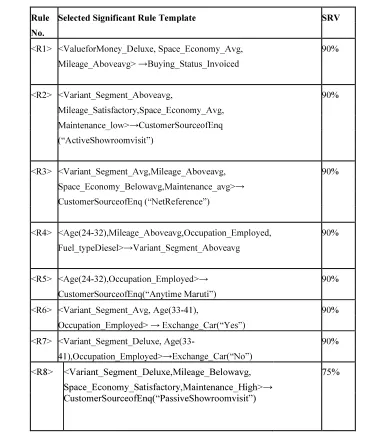
and Table 2, describes frequent CoreFactorSets . In Table 3 it lists significant rule templates. Applying 9
support = 10% andConfidence = 90% to frequent
CoreFactorSetsand the rules generated are Ranked
according totheir Significant rule value as shown in the table 4.
Table1, Table2, Table 3, Table4 here
5. THEORETICAL AND MANAGERIAL IMPLICATIONS OF THE STUDY
Around 20,237 rules are generated with all the coreFactorSets but, it has been observed that significant rule is generated with 9 CoreFactorSets and rules with 90% confidence contain decision Mileage, buying status, Variant_Segment Exchange_Car status and buying choice. These
factors can be used as input decision makers for further effective and efficient planning. Many rules from the above table can be used for various decision making activities.
a) Campaign / Marketing Induction Programs
Generation of Campaign Rules takes input data from Customer demographic data, Customer buying data, Campaign data, Customer feedback data (review post about the product and service).
For the launch of new/Existing Vehicle of Maruti Suzuki in
India, Campaign Rules (CR) is as follows:
A Rule based Datawarehouse(RBD) can be developed by analyzing the rules like,
If the customer source of enquiry is “Event_Organised” then Customers attending the event their name, age, occupation and Variant_Segment(product) would be the key attributes of the database and “Feedback/response_Form” from the customers defines the target data for the success of the event Organized as a
Campaign action.
d) Developing and updating the CRM system of the Organization
Customer Relationship Management (CRM) systems [24][26][27], are the backbone for making marketing strategies profitable by bringing novelty in campaign induction programs. CRM which deals with customer data includes campaign management and analysis [21], customer
lifecycle, Maximization of customer acquisition, retention, customer review/ feedback management system, sales coverage optimization, pricing optimization, product development.
For the customer activity analysis this huge amount of data can be stored in the data warehouse which is a repository of the large bulk of data in terabytes. The rule based CRM system takes input from IF-THEN rules applied in marketing. CRM system CR1: IF (sales of Variant_Segment) = Aboveavg AND Maintenance=”Avg” AND Mileage=”High”
THEN Target:Customer_Age = {24-32} OR Occupation = “Employed” AND CustomerSourceofEnq=”Telecalling/InboundCalls”
CR2 : IF (sale of Variant_Segment) = ”Luxury” AND Maintenance =”High” AND
Mileage=”Satisfactory” THEN Target:Customer_Age = {33-41} OR Occupation = “Employed” AND CustomerSourceofEnq = “Event_Organized
”
RBD2 : IF Variant_Segment = AboveAvg THEN
{ “ValueforMoney”,
“Mileage”,”Performance”“Maintenance”, Space_Economy”, “Customer_Name”, “Customer_Age”,“Customer_BuyingStatus” IS_ACTIVE/PASSIVE/INVOICED “ Number_ofVariantSales” QTY }
RBD1: IF Customer_SourceofEnq =“Event_Organised” THEN {Customer_Name”,“Variant_Segment”“Customer_age”, “Occupation”,”FeedBack/Response_Form”
helps immensely in contributing to the design and implementation of campaign rules of marketing. Specific rules generation requires the knowledge of specific domains. The Progressive updating CRM system is very important for effective and efficient decision making. The rules are generated <R4><R5><R6><R7><R10><R13><R14> would help the CRM system to help in retaining their existing and loyal customers, to have a better conversion rate from passive to active customers. The customer feedback or review system would help for better services to customers.
6. CONCLUSION
The approach used in this paper is to find all hidden and relevant rules based on association rule mining techniques for a real time customer transaction database. So, to get the feasible, significant and beneficial rules from a large set of rules generated is an important task to accomplish. In this paper, an improvised approach based algorithm is applied to generate association rules. The algorithm RuleGenerator which is implemented in Oracle SQL Developer and rules are generated with the help of an example of a car dataset of 931 casesets of customer buying details, customer choice details and so on. This work can be further elaborated in detail developing Rule Based CRM for production department, and configuration of data warehouse for a complete dataset of an organization. The work can be explored using multilevel association rule mining using different dataset
REFRENCES:
[1] Y.M Kim, and S. Hawamdeh, Leveraging customer knowledge: Association Rules Using comparative study of e-CRM functionality of commerce websites, International Journal of Electronic CRM, Vol. 1, No. 4, and pp.327– 340. (2008)
[2] Jiye Li and Nick Cercone, Introducing A Rule Importance Measure: A Data Mining Review(2010)
[3] Rakesh Agarwal ,Imielinski,T., Swami. A, Database Mining: A performance Perspective. IEEE Transaction Knowledge and Data Engineering, vol 5,6, pp 914-925.(1993) [4] Charu C. Aggarwal, Yu. S. Philip, A New
Approach to Online Generation of Association Rules. IEEE Transactions on knowledge and data Engineering, JULY/AUGUST 2001, VOL. 13, NO. 4 (2001)
[5] Rakesh Agarwal , Imielinski,T., Swami. A, Mining associations between sets of items in large databases. Proc. Of ACM SIGMOD Int. Conference on Management of Data, Washington D.C. pp 207-216.(1993)
[6] Rakesh Agarwal, Srikant, R, Fast Algorithms for mining association rules in large databases. Proc of 20th Int. Conference on Very Large databases, Santiago de Chile pp 487-489. (1994)
[7] Cavique, Luís, A Scalable Algorithm for the Market Basket Analysis, Journal of Retailing & Consumer Services London Elsevier, ISSN 0969-6989, ZDB-ID 12043850. - Vol. 14.2007, 6, p. 400-407Elsevier. (2007)
[8] Eui-Hong (Sam) Han, George Karypis .Scalable Parallel Data Mining for Association Rules. IEEE Transactions on Knowledge and Data Engineering,12(3) (2003)
[9] M.J. Zaki, Mining Non-Redundant Association Rules Data Mining and Knowledge Discovery, 9,223-248. Kluwer Academic Publishers. The Netherlands.(2004)
[10] C. Wang, Tjortjis, C., PRICES, An Efficient Algorithm for Mining Association Rules, Lecture Notes in Computer Science, Volume 3177, Pages 352 – 358 (2004)
[11]Archana Singh , Megha Chaudhary, Ajay Rana , Gauarv Dubey , Online Mining of data to Generate Association Rule Mining in Large Databases. IEEE-International Conference on Recent Trends in Information Systems. Page(s): 126 – 131.(2011)
[12]Imran Ali, Ziauddin, Abdur Rashid, Faza lMasud Khan, Improving Pruning Techniques. Proceedings of the IEEE International conference on Data Mining (ICDM’02), Japan pp 227-234.(2002)
[13]J.S Park, M.S Chen and Yu P.S, An effective Hash Based Algorithm for Mining Association Rules, ACM SIGMOD Int'l Conf. Management of Data, pp. 175-186, May.(1995)
[14]Jiawei Han, JianPei, Mining Frequent Patterns by Pattern-Growth: Methodology and Implications, ACM SIGKDD December, Volume 2, Issue 2-Page 31 (2000)
Rules IEEE Intelligent Systems. September/ October 47-55.(2000)
[17]Jayanthi Ranjan , Vishal Bhatnagar , A holistic Frame work for mobile CRM from Data Mining perspective. Information management and computer security, Emerald Publishers, Vol.17, Issue.02, pp:151-165. (2009)
[18]Archana Singh, Ajay Rana, Jayanthi Ranjan, Reviewing Data mining and its techniques in customer relationship management , accepterd and under publishing IJDATS, Inderscience, 4(7) (2014).
[19]Archana Singh , Jyoti Agarwal, Ajay Rana, Performance Measure of Similis and FPGrowth Algorithm. International Journal of Computer Applications (0975 – 8887) Volume 62– No.6.(2013)
[20]Ngai, E.W.T., Viu, L. and Chau D.C.K,. Application of data mining techniques in customer relationship management: a literature review and classification, Expert Systems with Applications, Elsevier, March,Vol. 36, No. 2, Part 2, pp.2592–2602.(2009)
[21]M. J. Shaw, C. Subramaniam , G. W. Tan and M. E. Welge, Knowledge management and data mining for marketing, Decision Support Systems, v.31 n.1, pages 127-137.(2001)
[22]Chris,Jyun- Cheng,David, Data Mining Techniques for Customer Relationship Management Technology in Society 24 483-502,Elsevier.(2002)
[23]Zhang G.F. ,Jin G.D, Research on Customer Segmentation theories and their application Strategies, Journal of College of Mechanical Science and Engineering, pp.101-104.(2006) [24]Wu, X., Zhang, C., Zhang, S. Efficient Mining
of both Positive and Negative Association Rules, ACM Transactions on Information Systems, Vol. 22, No. 3, July, Pages 381–405 (2004).
[25]http://en.wikipedia.org/wiki/Maruti_Suzuki [26]http://www.vipulmotors.com/home.asp [27]http://en.wikipedia.org/wiki/Automotive_indust
Figure 1: Score Model
Table1: Showing Number Of Frequent Corefactorsets
S. No.
Frequent
CoreFactorSets
1 {ValueforMoney, Mileage, Space_Economy, Maintenance,
Buying_Status}
2 {Variant_Segment, Mileage, Maintenance, CustomerSourceofEnq }
3
{Variant_Segment, Occupation, Exchange}
4 {Variant_Segment, Fuel_type, Occupation, Age}
5 {Variant_Segment, Age, Occupation, CustomerSourceofEnq } 6 {Variant_Segment, CustomerSourceofEnq, Age, Exchange} 7 {Variant_Segment, CustomerSourceofEnq, Buying_Status}
8
{Variant_Segment, Age, Comfort}
9 {Variant_Segment, Maintenance, Comfort, Occupation}
Pro RuleGenerator
Customer Feedback
E
T
L
Deciding Committe e
Domain
Data
Engine
Core Factor
Attributes
Manager
Pool of Rules Significant Rule
Template
(
y)
i
f
r u l e g e n
S R V
N
=
Table 2: Description of frequent CoreFactorSets
CoreFactorSet Desciption Values
s
ValueforMoney This variable describes whether Low (1), Medium the product gives is worth (2), High(3)
buying.
Mileage How much distance covered Belowavg(1),
per litre Avg(2), Aboveavg(3)
Maintenance Is the Maintenance factor is Low(1)/
very high or low in terms of High(2)/Veryhigh(3
(time and money both)
Space Is the car spacious Belowavg(1),
Economy Avg(2),
Aboveavg(3)
Buying_Status Has the customer bought the [Values
car ? =Passive/Active/Inv
oiced](Passive
=>Customer not interested(1), Active = Customer takes test drive and following(2), Invoiced=> Car is purchased(3)) Variant_Segme Maruti provides cars in various Avg(1),Aboveavg(2), nt segments like luxury, deluxe Deluxe(3),
Luxury(3)
Customer How a customer has ActiveShowroomvisi Source of approached the showroom t (1)/Reference
Enquiry (2)/EventOrganized(
3)/
PassiveShowroomvi sit (4)
/NetReference (5) / Anytime Maruti(6) Age Grouped the age of peoples’ (24-32) (1), (33-41)
data (2), (42-50) (3)
Exchange_Car Whether the customer wants to Yes (1), No (2) purchase the new car in
exchange of existing Maruti Car
Fuel_Type Type of fuel used in the Car Petrol(1), Diesel(2), CNG(3)
[image:9.595.108.482.138.651.2]Table 3: Significant Rule Templates
ST1 <ValueforMoney, Space_Economy, Mileage > → Buying_Status
ST2 <Variant_Segment,Mileage,Space_Economy,Maintenance> →CustomerSourceofEnq
ST3 <Age,Mileage, Fuel_type, Occupation> →Variant_Segment ST4 <Age, Occupation > →Buying_choice
ST5 <Variant_Segment, Age, Occupation> → Exchange_Car
Applying 9 Frequent CoreFactor Sets with support = 10% andConfidence = 90% and also rules are Ranked
according totheir Significant rule value as shown in the table 4.
Table 4: Showing Selected Significant Rules Template Applied
Rule Selected Significant Rule Template SRV
No.
<R1> <ValueforMoney_Deluxe, Space_Economy_Avg, 90%
Mileage_Aboveavg> →Buying_Status_Invoiced
<R2> <Variant_Segment_Aboveavg, 90%
Mileage_Satisfactory,Space_Economy_Avg,
Maintenance_low>→CustomerSourceofEnq
(“ActiveShowroomvisit”)
<R3> <Variant_Segment_Avg,Mileage_Aboveavg, 90%
Space_Economy_Belowavg,Maintenance_avg>→
CustomerSourceofEnq (“NetReference”)
<R4> <Age(24-32),Mileage_Aboveavg,Occupation_Employed, 90%
Fuel_typeDiesel>→Variant_Segment_Aboveavg
<R5> <Age(24-32),Occupation_Employed>→ 90%
CustomerSourceofEnq(“Anytime Maruti”)
<R6> <Variant_Segment_Avg, Age(33-41), 90%
Occupation_Employed> → Exchange_Car(“Yes”)
<R7> <Variant_Segment_Deluxe, Age(33- 90%
41),Occupation_Employed>→Exchange_Car(“No”)
<R8> <Variant_Segment_Deluxe,Mileage_Belowavg, 75% Space_Economy_Satisfactory,Maintenance_High>→
[image:10.595.105.489.312.757.2]<R9> <Variant_Segment_Luxury,Mileage_Low, 75% Space_Economy_High,Manitenance_Veryhigh>
→CustomerSourceofEnq (“EventOrganized”)
<R10> <Age(33- 75%
41),Mileage_Satisfactory,Occupation_Employed> →Variant_Segment_Deluxe
<R11> <Age(42- 75%
50),Occupation_SelfEmployed>→CustomerSourceofE nq (“Campaign/Events”)
<R12> <ValueforMoney_Aboveavg,Maintenance_High> 60% →Buying_Status_Active
<R13> <Age(42-50),Mileage_Avg, Occupation_SelfEmployed, 50% Comfort_Aboveavg> →Variant_Segment_Luxury
<R14> <Age(33- 50%
41),Occupation_Employed>→CustomerSourceofEnq (“Reference”)